

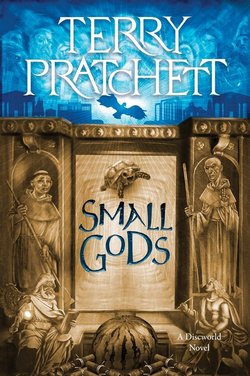
 Small Gods
DETAILS:
Series: Discworld, #13
Publisher: Harper Perennial
Publication Date: July 8, 2025
Format: Paperback
Length: 354 pg.
Read Date: October 3, 2026


What’s Small Gods About?
Like many Fantasy worlds, Discworld, has a plethora of deities, each with their own rites, ethos, and whatnot. One of these deities, Om, takes on physical form and finds himself in the form of a tortoise and with few abilities. It turns out that in a nation with a powerful church there’s only one actual believer in Om left—an acolyte serving in the garden. Brutha becomes the Chosen One, the next prophet.
Om has a mission for Brutha to fulfill (getting him back to a place of power so he can shed the tortoise)—all Brutha has to do is stop a religious war, avoid an inquisition, stop the head of the church from corrupting him, and a few insignificant tasks like that.
Why did I pick this up? Why did I keep reading?
This was the October pick for our Fantasy Book Club, so I took a detour from my Discworld reading plan.
I kept at it because it was what you want in Pratchett—some hilarious bits, some good satire, some fun characters, and had some very thought-provoking passages.
Diminutive Deities
Om and Brutha reminded me of Tchaikovsky’s Nihilostes and Yasnic and Marmell’s Olgun and Widdershins, and at least one other series that I can’t quite remember. A deity clinging to existence and their last believer. Now, centuries of Western philosophy and Christian Theology have plenty of objections to this kind of notion (although there are centuries of Western philosophy that are find with it, too). But hey, in Discworld, it works.
Whatever the problems of theology, it’s enough for Pratchett to explore the nature of faith, the nature of religion, Ecclesiology, and the overlap between the three in the Venn diagram. The satire of it all works for me—anything where humans have come in with their humanness is ripe for satire. I’m not sure I can swallow much of the positive arguments he makes (or suggests), but they’re fun to think about.
So, what did I think about Small Gods?
This was fine. I’m less than content with the story as a whole—it seemed a little underbaked, and was primarily a vehicle for Pratchett to sound off on philosophy and religion. It served its purpose well
I enjoyed Om, I enjoyed Brutha (who reminded me a bit too much of Carrot frequently). Just about everything having to do with the Library they visit was fantastic. The last couple of pages were great, I should add.
I laughed a lot, and chuckled a little bit more. I enjoyed thinking about the ideas—even the ones I think are full of nonsense. I didn’t walk away with strong opinions about the book either way, though. And I kind of regret that, I’d rather something I could really tear into or rave about—this was just there.
Maybe when/if I read it again, I’ll have a stronger take.
This post contains an affiliate link. If you purchase from it, I will get a small commission at no additional cost to you. As always, the opinions expressed are my own.
Read Irresponsibly, but please Comment Responsibly