

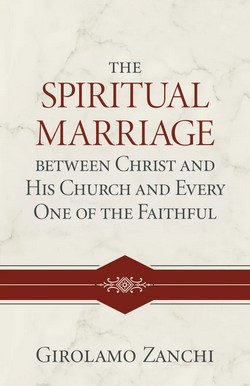
 The Spiritual Marriage between Christ and His Church and Every One of the Faithful
by Girolamo Zanchi, translated by Patrick J. O’Banion
DETAILS:
Publisher: Reformation Heritage Books
Publication Date: November 27, 2021
Format: eBook
Length: 150 pg.
Read Date: October 25, 2026


What’s Spiritual Marriage About?
This is an excurses from Zanchi’s commentary on the book of Ephesians, the only part published during his life (the Translator’s introduction suggests there’s no known reason why this was the part he published). In it, Zanchi sets out to explain the benefits of salvation in Christ through the idea of spiritual marriage.
Whatever is conveyed in various passages of Holy Scripture concerning the church’s origin and her spiritual marriage with the Son of God, the apostle deduces, explains, and confirms from the first creation of humankind, as from a fountain of the mysteries of Christ, when, in the epistle to the Ephesians, chapter 5, he says, “Husbands, love your wives even as Christ loved the church” [v. 25], and so forth.
He does this, primarily, by looking at what Genesis 2 teaches about human marriage (he uses the term “carnal,” without any negative connotations, merely to distinguish from “spiritual”) and then applies that to the marriage between Christ and his Church. And then makes a few applications to human marriage from that, too. But his overwhelming concern is not human marriage—seeming to hold that Western culture has the essence of that down (while noting some areas it could be improved), but that Christians are missing out on the idea of the Spiritual Marriage.
He also uses this to address some problematic Protestant ideas (and one or two Roman Catholic notions)—primarily those of Gnesio-Lutherans (unnamed in the text itself, but the Introduction will prepare the reader to see it).
Zanchi’s Method
First off, this is written in a series of theses—not all of which are that thoroughly worked out. But they’re given enough that you don’t need him to turn every 2-5 sentence paragraph into several paragraphs (although there are more than enough theses that do get a multi-paragraph explanation).
Secondly, Zanchi is incredibly Aristotelian in his approach—both in language and the way he breaks down each topic.
The book covers the topic like this:
Chapter One: The Creation of Eve and Her Marriage to Adam
Chapter Two: The Doctrine of Carnal Marriage
Chapter Three: The Doctrine of Spiritual Marriage
Chapter Four: The Final Causes of the Spiritual Union
Chapter Five: The Duties of the Husband and of the Wife
The final chapter being a mix of applications for the believer in relation to the Church as well as to their own spouse.
So, what did I think about Spiritual Marriage?
I expected this to be a thornier work than it is, expecting to spend a couple of weeks on it, rather than one long afternoon. The use of thesis rather than intricate arguments help with that. But also, Zanchi isn’t going for intricate—he has his points to make and he does so. This doesn’t mean he avoids subtlety, or small ideas—he just deals with them in a direct manner.
The Translator’s Introduction says that Zanchi wasn’t an original thinker—you get no new ideas here. Several that I’ve read before (even without the patristic sources he looks to)—and that’s nice. I’m not saying some original thought would’ve been out of place, but just encapsulating a lot of thought into an easily digestible book is just as valuable sometimes.
I really appreciated the way he made his argument and explained things—some of the language about spousal relations and duties may be off-putting to contemporary readers, but in the historical context of the work—and the Christ-like nature of husbands that he assumes/calls for, it shouldn’t.
This isn’t a work that will shake anyone’s understanding of anything—but I do think his use of the Spiritual Marriage between Christ and His Church will be helpful to understand the nature of salvation and the benefits from it. At least it should serve to refresh one’s understanding and see it in a fresh light.
It’s a helpful work, and a good introduction to a Reformer I’ve seen referenced plenty but had never read before.
This post contains an affiliate link. If you purchase from it, I will get a small commission at no additional cost to you. As always, the opinions expressed are my own.

Read Irresponsibly, but please Comment Responsibly