


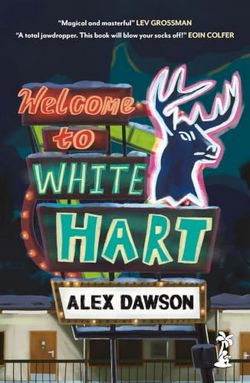
 Welcome to White Hart
by Alex Dawson
DETAILS:
Publisher: Little Island Books
Publication Date: December 1, 2026
Format: eARC
Length: 144 pg.
Read Date: November 24, 2026


What’s Welcome to White Hart About?
In the days leading up to New Year’s Day, the barrier between worlds weakens—thins, really. Through one of these thin spots in an atypical Alabama wood, a white hart slips through. And right into the sights of some hunters who aren’t that concerned with hunting regulations.
It escapes and finds its way into the horse barn where Mags spends Christmas Eve with her family’s horses—having been told by her Mamo that on that night, the animals may talk to her. Mags doesn’t believe in that kind of thing anymore, having grown out of it. But that doesn’t stop her from trying.
When the hart appears, Mags knows this is no regular deer (blood that’s gold in color is a major clue), and does what she can to patch it up. She enlists Macon (“Make”), the ranch help. He’s got a way with animals that she aspires to.
The two of them do what they can to protect the hart from the hunters for the next week until (they hope) it can slip back through the thin spot and get home. This would be much easier if the hunters (led by a man who calls himself Tasty Murder) weren’t staying at the family inn. But what’s life without a little challenge?
Why did I pick this up? Why did I keep reading?
I got the sign-up link to this Book Tour the week (possibly the day) I posted Fantasy with Friends: Do You Enjoy Magical Realism?, and it contained the phrase “Magical Realism.” It was on my mind, so I hopped on it—I’m not even sure I read the blurb, honestly. If I did, I forgot what I read almost instantly.
I kept going because the first chapter wove a spell around me, the setting, the protagonist…I wanted to see more of it and to spend a little time in the Mags’ world. And then the chapter’s last line sealed the deal. I needed to keep going.
What are some of the dominant themes of this book?
I think the most prominent theme is belief—Mags believed in something until she “grew out of it,” but even then it smoldered, ready to be reignited. Macon believes in Mags and her grandmother—maybe simplistically, but that’s not a bad thing. And Mags’ grandmother, Mamo…well, she believed for various reasons—and that drove her life. (I won’t get into other characters). But the ability of those three to rely on and expect certain things from the world carries them—much in the same way I think it carries everyone, it’s just that their belief is in things a bit more flashy (technically glowing) than most people.
There’s obviously a lot about people’s relation to animals here, too. There’s no message to the book in this regard, but there’s a perspective to chew on. Humans relating to humans gets wrapped up in that, too—but not in the same degree.
So, what did I think about Welcome to White Hart?
Before I get into some specifics, I don’t want to ignore this simple thing: it’s just a pleasure to read. I got sucked in (as I said above) right away, and then it’s just an entertaining read. Generally, when I’m reading something for a Book Tour, or an ARC, or that kind of thing, there’s part of my brain thinking about what I’m going to say about the book, or just analyzing it in a way that’s different than just reading for pleasure. I don’t know when I stopped doing that with Welcome to White Hart, but it was pretty early on. In the end, I didn’t read this for the Tour—I read it for me.
It’s being marketed as a YA novel apparently. I guess it is, but could just be labeled as good for all ages (or at least Middle Grade on up).
One of the things I loved is the way that Mags and Macon mixed wonder with practicality—what they have before them is literally the thing of fantasy fiction. And yet…they have to deal with things like bandages and feeding. The everyday ins and outs of animal husbandry. It’s that kind of mix that makes me respond the way I do to Magical Realism/other books approaching it. It’s very much the “Real World” in a way that Urban Fantasy just can’t land on—but with a little sprinkle of something else.
Most of the characters are wonderfully conceived and executed. But then there’s Tasty—our primary antagonist. He is drawn in bold lines without a hint of subtlety. While reading and since, I’ve been bouncing between thinking of him as a cartoonish exaggeration that clashes with the skill in the rest of the writing, and yet knowing that I could probably go to a particular local café and find 6 men that would match him in those exaggerations (and then I’d have to stick around for breakfast, because they’re great).
I should say something about the Hart at the middle of all of this—but doing that feels like I’m encroaching on Dawson’s territory, and I wouldn’t want to read anything about it beforehand. The way Dawson describes it is just…chef’s kiss.
Besides, this is really Mags’ story, heart and soul (no pun intended). She’s a little Elliott Taylor (E.T.), a little Fern Arable (Charlotte’s Web), a little Lucy Pevensie, and a little Opal Buloni (Because of Winn-Dixie)—and a good amount of that special Southern ability to be polite in a way that isn’t. My biggest complaint about the book is that it’s too brief and we don’t get to hang out with Mags more (the story is the perfect length, I should stress—it’s just not enough time with her).
It is easy for all of us—even those with deep convictions to the contrary—to forget that there’s more to this world than what we see before us. Alex Dawson, Mags, and Mamo remind us to expect more, to look for more, to think about more than that—and to respond in wonder.
This post contains an affiliate link. If you purchase from it, I will get a small commission at no additional cost to you. As always, the opinions expressed are my own.

Read Irresponsibly, but please Comment Responsibly