Author: HCNewton Page 207 of 610

Catch-Up Quick Takes: A Few Remaining August Titles

The point of these quick takes posts is to catch up on my “To Write About” stack—emphasizing pithiness, not thoroughness. Except for the two books that I want to do full posts on, this wraps up August. I’m in danger of catching up. (insert the obligatory “Narrator: He will not” joke here)


The Alchemist and an AmarettoThe Alchemist and an Amaretto

by Annette Marie, Cris Dukehart (Narrator)

DETAILS:
Series: The Guild Codex: Spellbound Series, #5
Publisher: Tantor Audio
Publication Date: January 27, 2020
Format: Unabridged Audiobook
Length:  6 hrs., 55 min.
Read Date: August 24-25, 2022
Support Independent Bookstores - Visit IndieBound.org

(the official blurb)
This series is the trunk that the others branch out from, it’s the anchor for the whole thing—and I’m just about at an end with it. It feels like Marie’s discovered a template and is just following it.

That said…I’m not leaving this because I want to see how the others unfold, I really like Tori, I want to see how things turn out with her brother, and the books are entertaining enough, while still being exasperating (to illustrate, Cobra Kai Season 5 is just on the other side of that line). But man…I’m tired of the non-romance romantic story and I’m fed up with the Ezra storyline (that I think is what the whole series is going to be ultimately about, so I’d better get used to it).

Putting my gripes aside—the alchemy stuff here is great, and I really liked the way all of it developed. This approach to werewolves is great and I’d really like to see more (but am pretty sure we won’t because of the whole template thing…but maybe in the Warped series?)

Also, I’m really hoping that at one point the protagonists from these series will figure out they should be allies and friends for one final, climactic battle before living a life of relative peace and routine.
3 Stars

Her Last BreathHer Last Breath

by Linda Castillo, Kathleen McInerney (Narrator)

DETAILS:
Series: Kate Burkholder, #5
Publisher: Macmillan Audio
Publication Date: June 17, 2013
Format: Unabridged Audiobook
Length: 9 hr., 46 min.
Read Date: August 25-26, 2022
Support Independent Bookstores - Visit IndieBound.org

(the official blurb)
I truly had a hard time with this one because so much of the book is about this police chief that we’re supposed to be rooting for going around and manipulating a case, lying to other law enforcement officers, and pressuring her siblings into lying to cover up what will be a clear case of self-defense so that she can keep her job.

The other storyline about the hit and run that turns out to be vehicular homicide? That was pretty good—a touch predictable, sure. But only because Castillo did everything but name the killer McMurderer, because this one needed to be about Kate figuring it out and the reader seeing what that put her through.

If we can put the self-defense cover-up story behind us now, I can keep going. Otherwise, this series becomes Dexter with a really low body count, and I’m just not going with that.

3 Stars

The HeronThe Heron

by Don Winslow, Ed Harris (Narrator)

DETAILS:
Publisher: Audible OriginalsT
Publication Date: July 28, 2022
Format: Unabridged Audiobook
Length: 1 hr., 6 min.
Read Date: August 12, 2022

(the official blurb)
This is only an hour long, so it’s really difficult to talk about. But that’s a shame because I want to go paragraph by paragraph and talk about it—a live-blog running commentary seems to be the best way to talk about it, but who has the time for that?

I’m going to start with Ed Harris rocking this one—the dude is perfect and I want nothing else out of life than a new Winslow story every month or so read by Harris. That’s hyperbole to make a point, but it feels like one of the most honest sentences I’ve uttered recently.

This is short fiction at its best—a great premise, some good twists, a great conclusion, and a perfect ending. It just made me happy. I was about to say that there’s a great villain, but I’m not sure which character I’d attribute that to. There are a good number of great criminal characters running around committing crimes against each other—it’s just a matter of who comes out on top and how they do so. Grab some popcorn and enjoy.

Also, as I look back at what I noted when I listened—only 4 stars? I remember it better than that. Maybe it was the length? I’m going to trust my initial reaction, but as I write this, 4 seems like I’m underselling it.
4 Stars

This post contains affiliate links. If you purchase from any of them, I will get a small commission at no additional cost to you. As always, the opinions expressed are my own.

The Friday 56 for 9/23/22: Hell and Back by Craig Johnson

The Friday 56This is a weekly bloghop hosted by Freda’s Voice.

RULES:
The Friday 56 Grab a book, any book.
The Friday 56 Turn to Page 56 or 56% on your ereader. If you have to improvise, that is okay.
The Friday 56 Find a snippet, short and sweet.
The Friday 56 Post it.

from Page 56 of:
Hell and Back

Hell and Back by Craig Johnson

We slowly drove through town. I could see the lights were still on in the library, and I felt a twinge of guilt about not having been able to lock it up. “I made a pass at your librarian.”

“He kept his eyes on the road. “You what?”

“Well, not the librarian exactly, but the one from the café that re-shelves books, Martha?”

He nodded. “Who else have you had contact with since “you’ve been in town?”

“What, you think I’m contagious?”

“I’m just curious as to what a fellow does after finding himself lying out there in the road during a blizzard.”

The Ballad of Bonaduke—Episode 1: The Register by R. T. Slaywood: A Sufficiently Intriguing Introduction

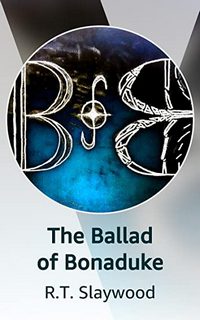
The Ballad of BonadukeThe Ballad of Bonaduke—
Episode 1: The Register

by R.T. Slaywood

DETAILS:
Series: The Ballad of Bonaduke, #1
Format: Kindle Vella Story
Read Date: September 22, 2022

I’m not sure how I got here and, honestly, I stopped caring.

I mean, I know, but I don’t remember.

Ah, who am I kidding? I know exactly how I got here, I can never forget the screams from that night.

The Story So Far…

Okay, this is Episode 1, so there’s nothing to put here now. This is the introduction to the series. The author states

This episode is the baseline, the norm for Michael Bonaduke; a broken man, and protagonist of this story. Everything from here on is abnormal, and will help you understand how Bonaduke came to be.

Which sounds pretty ominous, no?

What’s The Register About?

An inebriated man shops at a liquor store for another bottle to help him get through the night. Exactly what’s driven him to this, we don’t know, but he’s looking for an escape—not a good time.

He’s a little short on cash, though, and begins a “grift” to get the money he needs from the cashier. This, I think, is where the paranormal aspect kicks in—but we’ll have to see next time.

So, what did I think about The Register?

It’s not bad—it definitely gives you plenty to be interested in and leaves you wanting to know more.

I’m pretty curious about Bonaduke, which is the point. But beyond that? It’s too soon to say.


3 Stars

Dead Man’s Hand by James J. Butcher: Welcome to the World of The Unorthodox

Dead Man's Hand Dead Man’s Hand

by James J. Butcher

DETAILS:
Series: The Unorthodox Chronicles, #1
Publisher: Ace
Publication Date: October 10, 2022
Format: eARC
Length: 384 pg.
Read Date: September 16-20, 2022
Support Independent Bookstores - Visit IndieBound.org

The World of This Novel

This is a Fantasy world where the Muggles (here, they’re called “Usuals”) know about Magic and the Supernatural populace (called “the Unorthodox”). They’re largely not that comfortable with them, it doesn’t seem—and maybe look down upon them. We don’t get a lot of Usual/Unorthodox interaction, so it’s difficult to get a good read.

The Unorthodox are policed by a division of the Department of Unorthodox Affairs called Auditors. They’re witches with the power to enforce the laws governing the Unorthodox. And there are rules governing how the Unorthodox interact with Usuals. We don’t get to see a lot of them here—but you know they exist.

It occurs to me now that we really don’t get that much insight or information about all the situation the protagonists find themselves in (more below). Dead Man’s Hand cares about the story and will let the rest take care of itself. It took me until now (and this is the last section of the post I’m writing) to realize just how little we know because I didn’t care. My mindset apparently was the same as the novel’s: just tell me the story. I got the impression that there were rules and bureaucracy and some sort of history, but my focus was on this case.

That’s kind of cool, really—until it comes time to think about and write about the book.

So What Exactly is Dead Man’s Hand About?

One of our two protagonists is Grimshaw Griswald Grimsby. Grimsby grew up wanting to be an Auditor and tried to work on the requisite skills as much as he could to prepare himself. He’s not the most powerful witch, but he can do a lot with what he has (roughly the equivalent of “street smarts” vs. “book smarts”). He’s flunked out of the Auditor Training Program at the very end and has to go find a job in the Usual world.

He ends up as a performer/custodian at a Chuck E. Cheese-style restaurant, where the animated figures are powered by his magic. It’s humiliating, embarrassing, and eats at his soul. Grimsby went through some big trauma in his childhood; was on the verge of his dreams coming true before that ended; and now he’s scraping by demeaning himself and his abilities. It’s hard to find a character with supernatural abilities downtrodden or pitiful, but…Grimsby is. To put it concisely, he’s a schlub and he’s fully aware of that.

The other protagonist is a Usual who worked with the Auditors, Leslie Mayflower, better known as The Huntsman. He’s responsible for enough death and destruction amongst the Unorthodox that many don’t believe he actually exists—he’s an Urban Legend to keep people in line. In reality, he’s a guy who’s seen too much, done too much, and when personal tragedy hits, he’s done. He retires to drink himself into oblivion to avoid the memories and his own tragedy.

The Auditor who flunked Grimsby is considered one of the most powerful and dangerous witches in the world. Mansgraf is respected and feared—mostly feared. And when the novel opens—she’s been killed in a fairly brutal fashion (the only way she’s going to be able to be taken out). Mayflower spent his career (at least the bulk of it) as her partner—and he’s brought in to look at the scene to see if he can pick up any clues. He comes up with one—and doesn’t share it with the Department—and it points right to Grimsby as his prime suspect.

The Huntsman is back in the saddle for one last ride—to get vengeance, and his target is a man currently wearing a pink tutu with taco wings and an avocado wand. The Taco Fairy at Mighty Magic Donald’s Food Kingdom.

It’s almost patently obvious to Mayflower that Grimsby can’t have killed Mansgraf, but that’s where the evidence points. The Auditors won’t be far behind, and they’ll be less inclined to listen to Grimsby. So Mayflower has to stay one step ahead of them while protecting the witch and using him to help the investigation. The result is a buddy cop kind of story—without that much comedy or much in the way of buddy-ness. The duo drag themselves and fight their way through a variety of hazardous situations facing a variety of supernatural obstacles (some are solid takes on well-established ideas—some are new and surprising twists to them).

Broken Heroes

Mayflower is your typical brooding, laconic, action hero. He’s grizzled, he’s serious, and he really only cares about wrapping this up so he can get back to destroying his liver. But he’s fair, he’s got a strong moral core, and on some level, he feels sorry for Grimsby and wants to help him out. We know just enough of his backstory to understand what kind of man he is and the scars he carries.

We get more information about Grimsby and the hardships he’s endured. His cowardice, his lack of confidence, and his lack of career prospects make him a relatable kind of character, and you want to root for this underdog. Although you (and Grimsby) know that he’s going to need a lot of help from Mayflower to survive, much less succeed here. His problems are both played for laughs and treated with respect—frequently in the same paragraph. He has a genuine reason for being scared by things, but it can result in some laughs/grins. I keep thinking about Arthur from The Tick.

There’s a stoic, stay standing while the waves crash against you, feel to Mayflower’s outlook and the way he treats Grimsby. Yes, life is hard, but keep moving because that’s what you have to do. Whatever problems there are with that worldview, the immediate circumstances the duo finds themselves in, it works. if they survive it, maybe more nuanced approaches and help can be found. But that’s a problem for another day.

Comparing This to that Other Butcher

I really don’t want to spend a lot of time comparing this Butcher to his father, but 1. everyone I talk to about this asks about it and 2. the publisher’s description mentions him, basically inviting the comparisons. I’d prefer to consider him on his own—but here we are.

Honestly, I don’t see a lot of similarities—beyond seeing the influence that Jim Butcher has on many UF series (see Anton Strout, Kevin Hearne, Mike Carey, Benedict Jacka, etc., etc.). Sure, there are similar attitudes portrayed, similar character types and voices, and even a couple of situations that feel like I could easily name some parallels to in The Dresden Files. But again, every time I could point to something and say, “That’s his Dad,” I could point it and say, “That’s Peter Hartog” or “That’s Jacqueline Carey.” So maybe it’s just James J. Butcher.

His writing style is different, the characters aren’t just retreads of Harry or his friends, and the particulars of the plot don’t seem to fit something for Harry.

If you’re looking for someone who writes things in the same general vein as Jim Butcher, you can look to James J. Butcher. But if you’re looking for Butcher 2.0? There are other options that would be better.

So, what did I think about Dead Man’s Hand?

This is a solid introduction to a series. I want more of the worldbuilding, I want to see how Usuals/The Unorthodox interact when they’re not at a lousy restaurant, etc. But I’m more than content to wait for it—like I said, I didn’t really realize what we didn’t get until now.

I would say I’m not a huge fan of the epilogue—the events of it should prove interesting, even if I might want for a different storyline to be pursued—but I don’t like the way it functioned in the novel. Personally, I’d have been happier if it had been a prologue to book 2 or 3, and let the book end without it. I don’t think it was needed, and I think the book ending with Chapter 47 would give a stronger impression.

Aside from that, I really have no complaints about the book—I was solidly entertained and invested from Chapter 1 onward. I don’t know that I can say that I was blown away by anything—but there are some things I’m not talking about here because of space/don’t want to give something away, that I will be talking about for months (and have already started doing so). I’m not going to be announcing to the world that the next Jim Butcher/Seanan McGuire is here. But I will say that this new writer is really good and absolutely worth reading. You’re going to be entertained. Seriously, pick this up just for the kid’s birthday party scenes, and then stick around for the excitement.

In the last twelve months, we had to say goodbye to Jane Yellowrock this year and Alex Verus the year before, I’m glad we got to say hello to The Unorthodox Chronicles now. I think this series could be as long and as satisfying as those if it’s given the chance to grow naturally and doesn’t get overshadowed by Butcher’s DNA.

Disclaimer: I received this eARC from Berkley Publishing Group via NetGalley in exchange for this post—thanks to both for this.


4 Stars

This post contains an affiliate link. If you purchase from it, I will get a small commission at no additional cost to you. As always, the opinions expressed are my own.

The Days of Tao by Wesley Chu: A Fast and Fun Post-Script to the Trilogy

The Days of TaoThe Days of Tao

by Wesley Chu

DETAILS:
Series: Tao Trilogy, #3.5
Publisher: Hunter & River, Inc
Publication Date: April 30, 2016
Format: Kindle Edition
Length: 104 pg.
Read Date: September 10, 2022

You can do this, Cameron. You have intelligence, competence, and experience on your side.

“You’re right. I can handle this job on my own. I got this,” he huffed as he tried to make himself believe those words.

I was referring to me.

What’s The Days of Tao About?

Cameron Poe is about to graduate from college—he would’ve graduated already if he hadn’t picked up a D in Art History, of all things. To make up for that before he can start training to be a full-fledged Prophus operative, he’s taking a summer class in Greece with a couple of his friends. It’s a relaxing time in a fascinating part of the world with an interesting group of students—and a chance for one last college romance before he has to focus.

But then a Prophus agent needs immediate extraction because he has vital information to share, his life is in danger, and the Genjix are about to take their aggression to the next level throughout the world. And Cameron’s the closest thing that the Prophus have to an operative in the country.

Cameron can’t abandon his friends, though—and they won’t abandon their classmates—so he ends up dragging along most of the group on his rescue mission (why make things easy for himself?)

What did I think about The Days of Tao?

I bought this shortly after its publication, and have no idea why I didn’t read it until now (and don’t get me started on The Fall of Io). If it accomplished nothing else, it got me thinking about the series and remembering how much fun it was.

I don’t remember what I thought of them while reading them (and I’m not going to look), but I remember the Tao novels being a little longer than they needed to—that’s not a criticism, but I think they could have been tightened up a bit. Not this—the advantage of the novella—there’s not an ounce of fat to this, not one wasted word. That’s not to say that it’s all plot or anything— Beyond the action and the extraction, there are some good character moments, some necessary development of Cameron, and a couple of laughs—but this novella never slows or drags for a moment. Once the agent says he needs extraction (and, even before that), we’re off to the races and you’d better be buckled up.

Looking at this book’s place in the series, it serves to put the action and the characters (including Io) in place for The Rise of Io. Was this a necessary bridge between the Tao and Io books? Not really no. That’s one thing about these Subterranean Press books—they’re a nice bonus to completists, but people who don’t want to/are too slow to shell out the money for the nice hardcovers (and don’t want to go ebook or audiobook) don’t miss anything they need. But man, it was a nice way to spend an hour or so with some old friends. I really enjoyed this and would commend it (even at this late date) to fans of Tao and the Tan family.


3.5 Stars

WWW Wednesday, September 21, 2022

I knew I’d been distracted lately, but I just saw how many comments I haven’t approved/replied to over the last couple of weeks. I guess I’ve been really distracted, I’d better work on that tonight (assuming I get the chance). In the meantime, it’s time for WWW Wednesday!
This meme was formerly hosted by MizB at A Daily Rhythm and revived on Taking on a World of Words—and shown to me by Aurore-Anne-Chehoke at Diary-of-a-black-city-girl.

The Three Ws are:

What are you currently reading?
What did you recently finish reading?
What do you think you’ll read next?

Easy enough, right?

What are you currently reading?

I just started Hell and Back by Craig Johnson—it looks like Walt’s off on another supernatural adventure. I’m about to finish listening to the return of DC Smith in  The Truth by Peter Grainger, Gildart Jackson (Narrator) on audiobook.

Hell and BackBlank SpaceThe Truth

What did you recently finish reading?

I just finished James J. Butcher’s Dead Man’s Hand—which was as good as I’d hoped—and Big Red Tequila by Rick Riordan, Tom Stechschulte (Narrator) on audio—it was nice to remember what pre-Percy Jackson Riordan was like.

Dead Man's HandBlank SpaceBig Red Tequila

What do you think you’ll read next?

My next book should be the SF/Mystery hybrid, Station Eternity by Mur Lafferty, and my next audiobook should be the essay collection Movies (And Other Things) by Shea Serrano, Mario Toscano (Narrator).

Station EternityBlank SpaceMovies (And Other Things)

While I work on catching up on comments, feel free to drop your Ws.

Pub Day Post: Wealth Management by Edward Zuckerman: Not Your Garden-Variety Thriller

Wealth ManagementWealth Management

by Edward Zuckerman

DETAILS:
Publisher: Arcade Crimewise
Publication Date: September 20, 2022
Format: eARC
Length: 288 pg.
Read Date: September 14-16, 2022
Support Independent Bookstores - Visit IndieBound.org

What’s Wealth Management About?

Not that long ago, Catherine, Rafe, and Majid had attended Harvard Business School together—they were competitors, friends, and (at least briefly) more than friends. After graduation, they’d each gone their separate ways, but life has brought them all back together in Geneva, Switzerland.

Catherine is working for a large and important bank, Majid and his partner run a fairly new hedge fund management firm, and Rafe…well, there’s what he tells people and what’s really going on with him. The personal entanglements have started/resumed before we see the reunion of the trio, and they become more entangled after the book begins. As do the professional dealings—and here’s where it gets messy.

It turns out that one of Catherine’s more significant clients seems to be involved in some money laundering (and is dragging her along with him)—and possibly some worse crimes. Majid’s firm is in serious cash problems, that might have been saved by one client—but he and his partner are concerned about this client and how he knows just the right stocks to sell short. And Rafe just might be able to save both of them from these, shall we say, complications.

There’s at least one murder, a terrorist act or two, some CIA agents, a persistent (and possibly honest) Nigerian police detective, and other assorted criminal and conspiracies afoot as well—and once Majid and Catherine become aware of them (and/or stop lying to themselves about how complicit they may be), it looks like Rafe’s help isn’t only attractive—but their sole lifeline.

Can Rafe help his friends/lover/frenemies? Can they uncover—and maybe stop—a terrorist plot?

The Financial Side

Like I said last week when talking about Nineteenth Century Monetary Crime—I’m not particularly interested in, or seemingly that capable—of rolling up my sleeves to get into the nitty-gritty of the World of Finance. I get the broad concepts—and can even appreciate the broad outlines of a discussion of short-selling (and things along those lines).

I was a little apprehensive about that idea before I started the book. Would this get into the weeds with that kind of thing? I remember learning too much about nuclear submarines or the inner-workings of an aircraft carrier deck’s operations back in the 80s and 90s when all I wanted was some action. Would the infodumps/background information slow things down too much?

Yeah, I was also a little worried about not being able to follow the focus of the action—no one likes their novels making them feel dumb. Or even if I could understand it, would it really be interesting enough to hold my attention?

Thankfully, it didn’t get too far into the weeds. I could understand the financial actions—and it wasn’t dull at all. Actually, I think this is the kind of thing that’d be good to see more of. Just how do terrorist groups—or even criminal organizations (outside of theft or selling drugs/guns/whatever)—fund themselves? It’s not like you can reuse explosive materials or bullets, and they don’t grow on trees—the money has to come from somewhere, and it sure isn’t from bake sales. The idea that certain targets/plots are motivated as a way to generate income for a terrorist group is a great way to cost a guy some sleep (and hope that “the good guys” are able to stop them).

And if cryptocurrencies reared their head at all, it was so briefly* that it didn’t leave a lasting impression—right now, you have to be grateful for that.

* Also, a quick word search didn’t turn up the term.

I’m Not Entirely Sold On This…

There’s a Love Triangle here among our protagonists—it’s not a significant part of the story, but it’s not insignificant either. Well, “Love” might only apply for 1-1.5 of the sides, but “Friends-With-Benefits Triangle” doesn’t have a great ring to it, and “Sex Triangle” seems to suggest all sorts of things that Zuckerman didn’t have in mind.

If this is a product of a “you have to have sex in a thriller to sell” kind of a thing, I guess it fulfilled its cynical function—and didn’t put off prudes like me.

If it’s to round out these characters and make them more than young professional types out to make all the money they can—or to ground them in reality and/or make them more interesting? I guess it succeeded (maybe not in the interesting part, but its possible).

If it’s to add layers of additional and conflicting motivations to the characters—giving them reasons to trust, distrust, and be unwilling to work with each other? It’s not bad—but I think it could’ve been played up a bit more—or at least more thoroughly. We get some of this, but I think it could’ve been explored a bit better.

It’s likely all three of these things—and probably more—and as such, it largely succeeds. But my gut tells me that it could’ve been done a bit better without turning the book into something all about the Triangle.

So, what did I think about Wealth Management?

Okay, I called this a Financial Thriller (as does the publisher)—but never fear, there’s the requisite gunplay, hand-to-hand violence (and threat thereof)—and actual terrorist activity. The thrills aren’t all in deft trades and market chicanery. The money material is the focus and does provide most of the thrills—and it’s what distinguishes this book from the rest of the market. In the end, we get a tight and intricate novel full of intrigue.

At one point, I counted a dozen competing/conflicting motives/goals/actions at work among the named characters—plus a handful of people we don’t meet. Zuckerman keeps the action jumping from character to character quickly, advancing each plot line a little at a time so they can come together in a nicely dramatic fashion.

Some of the characters aren’t that developed—but there’s enough to hang on to. With most of them, it’s easy to see that in another 50-100 pages or so, you could see them being described as such. But with a cast as big as this one in under 300 pages? You’re going to get some that are undercooked, there’s just no way to do that. Like with most thrillers—if it comes down to a choice between plot vs. character, plot wins—especially when it’s paced the way this is. It’s not a bug, it’s a feature (not my favorite feature, but it is one).

My initial reaction when I was emailed about this book was, “‘MBAs,” ‘Banking’, and ‘Thriller’ are not terms I’d expect to be together”—and they’re still not. But when done right—done the way that Zuckerman did it in these pages—I’m glad to say that I was wrong.

This is a very effective thriller, a little something different in the diet—and generally a good time. Yes, I think that another hundred pages could’ve been added to better develop characters, the whatever-triangle, and to flesh out a few other aspects of the book—but I think that might have sacrificed pace and tension, and you don’t want a ponderous thriller. So, I think Zuckerman made the right choices there. A quick glance at IMDB shows you, that he knows his way around a tight plot—also any author who is able to induce a moment of acrophobia deserves kudos.* I’m glad to recommend Wealth Management and encourage you to check it out.

* Sure, in real life or on film (or via a Go Pro video), I’m on a hair trigger for that kind of thing, but to do it without visual stimuli is a trick.

Disclaimer: I received this eARC from the author via Wiley Saichek and Saichek Publicity in exchange for this post—while I appreciate that, the opinions expressed are wholly mine.


3.5 Stars

This post contains an affiliate link. If you purchase from it, I will get a small commission at no additional cost to you. As always, the opinions expressed are my own.

PUB DAY REPOST: Confronting Jesus by Rebecca McLaughlin: Introducing Jesus Without Any Baggage

Confronting JesusConfronting Jesus:
9 Encounters with
the Hero of the Gospels

by Rebecca McLaughlin

DETAILS:
Publisher: Crossway
Publication Date: September 20, 2022
Format: eARC
Length: 208 pg.
Read Date: August 21-28, 2022
Support Independent Bookstores - Visit IndieBound.org

What’s Confronting Jesus About?

Most people have a lot of preconceptions about Jesus, a lot of people have read and/or heard things about Him and the Scriptures that tell about him. But not as many have actually read those Scriptures, particularly the Gospels.

Rebecca McLaughlin tries to clear away some of the cultural debris that has piled up between non-Christians and the Gospels and the subject of the Gospels. For example, as she points out, given Christianity’s impact in shaping Western Civilization, it’s difficult to think of Jesus as non-Western.

The goal of the book is to help the reader (particularly those with little-to-know-exposure to Christianity) begin to see the Gospels for what they really are, not the readers’ preconceptions of them. And the Jesus revealed in the Gospels as the Gospels want to portray him, not what the reader may already think.

It’s a high and lofty goal—possibly too lofty for 200 pages. But this isn’t intended as a definitive work, more like an invitation for the reader to do their own work.

A Menagerie of References

A lot of writers (and preachers, truth be told) will introduce a subject or thought by grounding their introduction in some sort of shared knowledge. Sometimes it’ll be an experience (first day of school), a person everyone knows (George Washington), a current event, or some sort of cultural reference (literature, music, film/TV, etc.). McLaughlin almost always goes for the latter. And, for the overwhelming majority of the time, it’s a very contemporary reference.

She starts off by invoking the musical Hamilton, and does so in-depth—it wasn’t long at all before I made a note, “can we be done with Hamilton now?” The answer was no—she came back to Miranda’s hit time and time again. Thankfully my worries about this being a book about Jesus, the gospels, and a hip-hop musical about a Founding Father quickly evaporated and she moved on to other cultural touchpoints—Harry Potter, Doctor Who, The Princess Bride, Gladiator, The Picture of Dorian Gray, The Lord of the Rings, Jane Austen, A Tale of Two Cities, and more. It’s an interesting mix of pop-culture and more high-brow references.

I’m spending more time on this than I initially intended, but I kept bumping on this tendency of hers, and I ended up spending as much time thinking about it as I did her arguments. Now, I don’t think most readers will do that—but most readers aren’t considering the delivery of the content as they are the content. So I don’t think most readers will be distracted by this as I am.

Still, the volume of pop culture references strikes me as a dangerous strategy (as comfortable and relatable as it might be). It can trivialize the subject matter. It can possibly cause offense (how many people really want to relate to J.K. Rowling right now? A different crowd than those who didn’t want anything to do with her in the 90s, to be sure).

Lastly, it reduces the shelf-life of the book tremendously. Wilde, Dickens, and Austen are references that will stand (and have stood) the test of time—but will The Hunger Games and Ted Lasso? Maybe. But Maybe not. McLaughlin’s arguments and insights may be worth reading in ten years, but will the book as a whole? Or will what makes it most approachable today make it stale and off-putting within a presidential election cycle or two.

(that took a lot more time to express and explain my concerns than I thought it would—this is not a significant detriment to the effectiveness of the book, but it is one)

The Tone

McLaughlin has an approachable, almost breezy style. I started this book while taking a break from a more scholarly book, and the early chapters had some overlap with the other book I was reading. And I suffered a little mental whiplash. I got over it the more of the book that I read (especially as it diverted into different territory from the other), but it almost seemed too shallow. A lot of readers might think that, too. If you persevere, however you’ll see that’s not that case.

McLaughlin comes across as open, honest, and earnest—the kind of person you’d enjoy chatting with—and her grounding things in events with her life or a movie you’ve both seen (or that she’s told you enough about that you want to see it), makes the material something you connect with.

So, what did I think about Confronting Jesus?

I enjoyed the book. I was charmed by McLaughlin’s style and found her arguments compelling—not convincing. But, as I said, I’m not sure she was trying to convince her readers—I think she was set on moving them to do more research, more reading, and to deal with more convincing ideas and arguments. This was an introduction to Jesus, hopefully lowering perceived barriers to him—and a challenge to deal honestly with Him and His claims rather than preconceptions and reputations about Him (and His followers).

That said, I’m predisposed to agree with her. We’re on the same team, and don’t have the same barriers that the non-Christian will have. So I can’t ultimately say how well the book works. Do I think that several of my friends would benefit from it? Sure. But that’s just a guess/hope. The ultimate sign of the quality and effectiveness of this book is going to come from the non-Christian reader.

Also, this book does make me curious about McLaughlin’s other work—and I anticipate grabbing at least one of her earlier books soon.

Disclaimer: I received this eARC from Crossway via NetGalley in exchange for this post—thanks to both for this opportunity.


3 Stars

This post contains an affiliate link. If you purchase from it, I will get a small commission at no additional cost to you. As always, the opinions expressed are my own.

Spelling the Month in Books: September

Spelling the Month in Books: September
So this month’s entry kicks off the “-ber” months (most of them are “-ember’s, too), and coming up with enough books that start with “E” is going to be tricky. It was fun revisiting some of these books, at least for these brief paragraphs. Like I have for the previous 8 months, I’m tempted to stop everything and re-read at least half of this list today.

S Striaght Man

Straight Man

Richard Russo’s novel traces the week of the chairman of an English Department at a Pennsylvania university. It’s hard to imagine how much damage a man can do to his own life in so short of time. It’s one of those “serious” novels for literary readers that is (intentionally) funny—and still manages to tell a good story, with a lot of heart—and a little academic satire, too. And any book with a duck like that on the cover has to be worth a read, right?

E Eragon

Eragon

Say what you will about Christopher Paolini’s debut, the story of his writing and getting it published is pretty cool. I remember enjoying it for what it is—a fun MG story about a 15-year-old who finds a dragon egg, which launches a bunch of adventures that reminded me a bit too much about Star Wars. (which didn’t make it less fun, just made it a different kind of fun).

P The Phantom Tollbooth

The Phantom Tollbooth

Norton Juster’s children’s classic is one of those books that I can read and enjoy today. The story of a dull boy who receives a magic tollbooth and travels to a strange world where he has to use his mind and imagination. I loved (and still do) the wordplay, the puns, and the very strange companions that Milo picks up along the way. Jules Feiffer’s illustrations are the perfect companion to the story, and when I listened to an audiobook version of it, not having them took a little away from the experience.

T True Grit

True Grit

This has to be the best-known work by Charles Portis—and it deserves its renown. Mattie Ross is such a great character. Her interactions with Rooster Cogburn while they hunt for her father’s killer was unexpectedly entertaining. I really wouldn’t have imagined this to have been so entertaining before I dove in—but I had a blast with this feisty protagonist.

E Envy the Night

Envy the Night

This was the first stand-alone thriller from Michael Koryta, and I remember not being sure what I’d think about it. My memory for the details is hazy (it’s been 14 years), but I remember being gripped. It was a new tone and a new kind of character for him, but everything else—the writing, the storytelling, and the suspense of the novel were just what the reader had become accustomed to.

M Mirrorshades

Mirrorshades

Bruce Stirling’s inaugural collection of cyberpunk stories is one of the very few short story collections that I’ve read multiple times. It defined a movement, brought it to the masses, and is just so much fun.

B Brighton Beach Memoirs

Brighton Beach Memoirs

I don’t know how many times I watched the movie version of this, but the script for the play is just so much better. The story of Eugene and his family struggling to get by, worriedly watching what’s going on in Europe in 1937, and preparing to take in their relatives who are clearly going to need a new place to live. Genuine laughs, a lot of heart, and a solid coming-of-age story.

E Everything Changes

Everything Changes

This was the first Jonathan Tropper book that I read. Having read them all (most more than once), it’s not my favorite, but as it was my first, I do have a soft spot for it. With his wedding coming up, Zack deals with the death of his best friend (2 years prior), Zack’s less-than-Plantoic feelings for his friend’s widow, and his father returning to his life after decades. As less than positive I might have sounded, it did bring me back for more—I can’t get enough of Tropper’s voice.

R The Ranger

The Ranger

It’d take about 30 seconds of not-very-intense research around here to see that I’m an Ace Atkins fan—and the series that kicks off with The Ranger is a big part of that. In this novel, Army Ranger Quinn Colson comes home from Afghanistan to discover that his uncle, the county sheriff, either committed suicide or was killed. Colson looks into the death and learns a lot more than he expected. Colson’s story (and the story of that county) is still going strong after 11 books.

The Story Retold by G. K. Beale and Benjamin L. Gladd: Everything You Want in a NT Introduction and More

The Story RetoldThe Story Retold:
A Biblical-Theological Introduction
to the New Testament

by G. K. Beale, Benjamin L. Gladd

DETAILS:
Publisher: IVP Academic
Publication Date: February 24, 2020
Format: Hardcover
Length: 490 pg.
Read Date: January 2-August 14, 2022
Support Independent Bookstores - Visit IndieBound.org

What’s The Story Retold About?

From the Publisher’s Website:

New Testament introductions fall into two categories: those that emphasize the history behind the text through discussions of authorship, dating, and audience, and those that explore the content of the text itself. Few introductions weave the Old Testament into their discussions, and fewer still rely on the grand narrative of the Old Testament.

But the New Testament was not written within a vacuum. Rather, it stands in continuity with the Old Testament. Israel’s story is the church’s story.

In The Story Retold, G. K. Beale and Benjamin L. Gladd explore each New Testament book in light of the broad history of redemption, emphasizing the biblical-theological themes of each New Testament book. Their distinctive approach encourages readers to read the New Testament in light of the Old, not as a new story but as a story retold.

As an NT Introduction

After three chapters of introductory material: “The Story Line of the Bible,” “The Use of the Old Testament in the New,” and “Introduction to the Gospels” (all pretty self-explanatory), we get a chapter on each book of the New Testament (with some chapters combining multiple books—e.g., The Pastoral Epistles).

Like most NT Introductions (as the description above says), Beale and Gladd discuss authorship, dating, and so on, with a good outline and overview of the book. Some of the ways they phrase things, or organize the material are helpful and unique—but on the whole, they’re helpful and pretty much what you get in every NT Introduction out there.

This isn’t a good or a bad thing, it’s simply saying that on the basics this is a pretty good Introduction.

The Little Something Extra in Each Chapter

The thing that separates this from similar works is the way that the authors tie the particular Biblical book into the overall storyline of the Bible. By focusing on the Biblical Theological/Redemptive Historical themes of the books—specifically grounding them in one or more Old Testament books about the same themes, it helps the reader to deal with, wrestle with, and (frequently) review the use of the OT by the NT in order to further cement and to expand the reader’s understanding of how the Bible as a whole tells the same story about Jesus Christ and His people.

Some of these sections blew me away—all deepened my understanding of the various books. Not just the NT, but seeing how the OT is used by the apostles helps understand those books/passages.

Format

This was produced as a textbook and it’s nice to read one of these again—I haven’t since my undergrad days. It’s a heavy tome, with thick, glossy paper and a lot of pictures. Sure, it’s a bit difficult to curl up with to read—but you can’t help but feel that it’s going to last for years as you read it.

Also, it’s heavy enough to use as a self-defense device.

The format does make this a pretty spendy book (although cheaper than most textbooks I bought in my undergrad days). But it’s worth the purchase price (as I said, it feels like it’s going to last for years).

So, what did I think about The Story Retold?

This isn’t an overly technical read—I think it could be used by older high school students. But sure, it’s aimed at college/early grad-school students, so go to it with the right expectations.

I really don’t know what to say about it at this point—I spent months reading this thing, it feels as if I should have several more pages of things to say. Basically, if the description sounds good to you, it’s going to deliver exactly what it promised.

It’s not what most people think of as devotional material—but it worked for me as such. This is definitely one of the better and more useful books I read this year. It’s also going to serve well as a reference book. Whether you dip in and out or read cover-to-cover, The Story Retold is worth its weight.


5 Stars

This post contains an affiliate link. If you purchase from it, I will get a small commission at no additional cost to you. As always, the opinions expressed are my own.

Page 207 of 610

Powered by WordPress & Theme by Anders Norén