Author: HCNewton Page 385 of 632

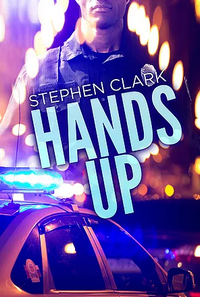
Hands Up by Stephen Clark: The Aftermath of a Police Shooting Seen from Multiple Angles

Hands Up

Hands Up

by Stephen Clark

Kindle Edition, 292 pg.
Wido Publishing, 2019

Read: November 5, 2019

“If you want to survive as a cop on these streets, then you need to check your conscience at the door. Sometimes there’s casualties. But if we don’t do whatever it takes to get the bad guy, then we could end up like your dad”

About a month ago, I posted about N. Lombardi, Jr.’s Justice Gone, and as I started to write this post, I noticed I was about to write something very similar here. But why re-invent the wheel? I’m just going to repeat the first few sentences (don’t worry, I get original after that).

I’ve mentioned before here that after I decide to read a book I forget what its about (if I even know) to keep myself coming from being disappointed by preconceived notions. It worked this time, I really had no idea what it was about when I opened it on my Kindle last week.

Which made the opening pages, featuring the killing of an innocent and unarmed black teen by the police, as shocking as they could’ve been. But they also led me to believe I was in for a grim, adult version of The Hate U Give.

That I’ve used that idea twice in a month says a few things to me, including: 1. Angie Thomas has clearly taken up residence in a corner of my mind (welcome, Angie, sorry for the clutter); 2. the fact that I keep running into novels about the police killing innocents says something about our cultural moment (and it’s not positive); and 3. thankfully, all three of these authors run with the concept in very different directions.

Lombardi quickly becomes about other killings (prompted by the police’s unjust actions and the officers not facing any consequences), Thomas focuses on what happens to the witness of the shooting (but includes what happens to the family of the victim and the city in the aftermath), Clark focuses on the aftermath of the killing on the victim’s family and the officer who pulled the trigger ending Tyrell Wakefield’s life.

Let’s start with that officer, Ryan Quinn, shall we? We meet him in the opening pages, working to reassure himself that he’s not a murderer as he prepares to give a statement about the shooting. He’s been a part of the Philadelphia Police Department for 8 months at this time. His partner, Sgt. Greg Byrnes knew Ryan’s father when he was an officer, too. And after Ryan’s dad was killed on the job, Byrnes has acted as a surrogate father. It’s because of Byrnes that Ryan was in a position where he had to make that fatal choice, and it’s Byrnes that guides him through the aftermath (for good or ill, I’ll let the reader decide).

Clark makes the very uncomfortable choice (for the reader, and I can only imagine for the author) of making Ryan the only first-person narrator of this book. Early on, I resented having to be in his head through all of this—especially as I learned just how sketchy the circumstances around the shooting (and what Byrnes did afterward) were. I didn’t want to be that close to this man’s thoughts at this time, I didn’t want to find him sympathetic, I didn’t want to pull for him at all through this process. Which is exactly the reaction I think that Clark wants. It’s uncomfortable by design.

The shooting affects Ryan, his family and his fiancé. He starts having panic attacks, getting professional help, and taking steps to become a different person on the one hand, while trying to keep his job, avoid prosecution, and rescue his career on the other hand. Too many authors would make him a complete villain or a misunderstood hero. Clark does neither. Or maybe he does both. Either way, Ryan is depicted in a very believable way.

One complaint with Ryan: throughout the book, Ryan thinks of his mother by her first name. I found that distracting at best. I can’t help but wonder if Clark changed him from third-person to first late in the process and forgot to change that to “Mom” (or an equivalent) in the editing process.

As far as Byrnes? Ugh. Clark clearly wants the reader to not trust him, not like him, and wish that Ryan would get away from his influence. He succeeded in all of that with me. He’s not a cartoonish racist cop or anything, he’s just a horrible person.

Now, on to Tyrell’s family. We first meet his sister Jade minutes before she discovers what had happened to him. She then has to break the news to her mother. Their grief and anger feels real, it feels raw, and you can’t help but share their desire for justice and their pain.

Jade’s our second protagonist and from the moment we meet her up until the very end of the book, she’s the one you really identify with, pull for, and agree with almost every step of the way. If Clark had put her in another novel, I’d really enjoy spending time with her as a character instead of watching her in the tumultuous days of anger and grief.

She’s a bartender, and one day Ryan comes into her bar for a few drinks. She recognizes him, he has no idea about Tyrell’s family. Things get interesting from there.

The third protagonist in the book is Tyrell’s estranged father who comes back to Philadelphia after a decade or so away when he gets the news.

Kelly saw his son for the first time in ten years, lying still in a casket, he could feel his heart breaking. He knew he could never get back all the time he lost with him. But if only he could have five minutes. Five minutes to catch up on his life. Five minutes to pass on his wisdom. Five minutes to tell him how much he loved him. Kelly just sat in the pew, staring at his son’s body in silence.

Now, Kelly’s a major complication that this family didn’t need at this time. Initially, I was very sympathetic toward him and wasn’t sure that Jade (and the others, but primarily Jade) were giving him a fair shake. Jade’s openly hostile toward her father—even when others warm to him. It didn’t take me long, though, to get on Jade’s side and start to wonder about Kelly (and Clark did a nice, subtle job with his character).

Each protagonist’s storyline takes on turns that you might not expect going into the book—Kelly and Ryan do a lot in a short amount of time and their characters change and develop. Everything that happens—even though much of it has nothing directly to do with the shooting happens in the shadow of Tyrell’s killing. It colors every conversation, every event, every reaction. In time Jade, Ryan, Kelly and the others will be able to move past this and do other things with their lives. But none of that happens now.

There’s some stuff with Kelly and Jade at the end that made me think about rating this lower, but in the end, Clark pulled it off (and more than once I wondered if he could). Kelly makes some choices that I initially thought unnecessarily complicated a pretty full plot, and I’m still not sure that Jade would have done what she did (and I’m less sure I should accept her explanation of it). But the more space I give those events, and the more I mull about Clark’s resolution, the better I feel about them. But I’m primarily giving this rating for what happens in the first 80 or so percent of the book.

Also, some of my reactions (still) to what happened in this book are so visceral that I’ve got to give Clark the credit for that. This is a much more even work than his first novel (which I liked, but had reservations about), but shares his talent for taking people who should be antagonistic toward each other, untrusting, and disinclined to to build any sort of relationship with each other—and helping them see the common humanity in each other and moving on past their differences. I’m a sucker for that kind of thing, as long as it’s not done in a cheesy, “A Very Special Episode of…” kind of way. Which, I want to stress is why I like Clark’s approach.

It’s not a perfect book, but it’s a good one—with some powerful moments that are dealt with skillfully. I encourage you to check out Clark’s work and join me in waiting to see what he’ll do next.

4 Stars

LetsReadIndie Reading Challenge2019 Cloak & Dagger Challenge

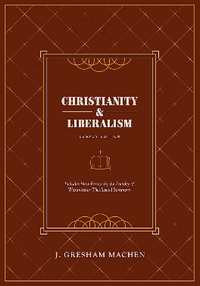
Christianity and Liberalism: Legacy Edition by J. Gresham Machen: A Timeless Classic is Given a New Edition with Some Nice Bonuses

Christianity and Liberalism

Christianity and Liberalism: Legacy Edition

by J. Gresham Machen

Paperback, 266 pg.
Westminster Seminary Press, 2019

Read: October 20-27, 2019


Man…this is hard. Back in 1995, I heard a reference on a radio show to this book, and the hosts talked about how even though it was written over 50 years ago, it felt like it was written for the Church today. I figured I’d give it a whirl (not sure if I read it in 1995 or ’96, it was one of the two). I still remember being blown away by it, and wondering why I never heard anyone talk about it. I’ve since found myself in circles where people are familiar with it—but still not enough talk about it.

I can’t tell you how many times I’ve read this book. I know I’ve talked before about the author here, but not as much as I should/could have. Anyone who’s read what I’ve written about my son’s kidney transplant will have noticed that he was named after Machen. It’s because he’s a great writer, but it’s Who and what he writes about that makes me such a fan. Sure, he’s a fallen man, and has feet of clay (at the best of times), but he’s one we should all heed.

So clearly, there’s no illusion of a hint of objectivity to be found here.

Machen’s essential argument is this: Liberal Christianity is a different religion. It’s not the faith once handed down, it’s not that which was defined in the Ecumenical Creeds, it’s not that communicated by the Church Fathers, nor the Reformers, nor anyone else with a legitimate claim to Christian. It’s rank unbelief that isn’t honest enough to call it that. He’s clear—he wouldn’t waste as much time talking about them and their teaching if they’d just be honest about their goals, ends and beliefs. But as long as they persist in claiming they belong in the Church, he can’t do anything but oppose them.

Having set forth his thesis, he goes on to demonstrate it looking at the teachings of both Christianity and Liberalism as they are seen in the central areas of God and Man, The Bible, Christ, Salvation, and The Church. He doesn’t just lay out the problems of Liberalism, it’s not just a critique—he presents a positive case that the Bible teaches Christianity. While his criticisms still hold in Liberal Christianity (and can easily be applied to much of “Evangelicalism” today), it’s in his positive presentations where the text comes alive. The closing paragraphs of his chapter on The Church felt like they were written just for me (this time through the book anyway, other passages had that impact previously). For any part of a book to have that kind of impact after reading it (at least) a dozen times? That’s something special.

Machen has a tendency in his writing to lay things out in a pattern. My opponents say this thing over here, most of their critics say something over there, and all act like those are the two positions; but I propose to you a third way to look at the idea. But he doesn’t do that once in these pages. It’s very cut and dry—there are these men (theological liberals) teaching something they call Christianity, but it’s not it. On the other hand, there are actual Christians—yeah, there are important differences (and Machen has no problem identifying and discussing them), but on these issues we’re united. Unbelief vs. belief, period.

Each time I’ve read it, it feels fresh. Not like I’ve read it for the first time, but there’s something about his style that just jumps off the page. Yes, despite being 96 years old, it might as well have been published for the first time in 2019 (although the theological schools might have to get a new name). Clear, thoughtful, persuasive, it’s everything you should want (and get) in a book of this nature.

So aside from putting it out in a new, attractive cover, what’s the Legacy Edition have to offer? Seventeen brief essays about Machen, this book and how they live on in the work of Westminster Theological Seminary (which was founded by Machen and others as a result of the controversies addressed in this book which made it impossible to remain at Princeton Theological Seminary). This edition was produced both in the ninetieth year of the seminary and the first year that the book entered the public domain. So these essays commemorate both the book and the institution. My only complaint about them is the way that some shoehorned both the school and the book into the same essay, it just felt awkward. Most of the time that wasn’t a problem, but when it was . . . bleh. Other than that, these essays are helpful and good reading (some more than others, but none are bad). As I said, these essays are brief—I’ve written longer blog posts than some of them, so don’t let the number of them intimidate you. Also, it’s very possible to read the book and ignore them if that’s your thing.

This book has had such an impact on me and continues to do so, it’s really unfair to try to assign it stars. Five isn’t enough. The new essays are a nice little bonus, but it’s not like they improve on the classic, but they might help the reader appreciate what they read a little more. Get this edition, the older edition from P&R, or find an old, used copy. Just get it and read.


5 Stars5 Stars

2019 Cloud of Witnesses Reading Challenge

Saturday Miscellany—11/9/19

Odds ‘n ends over the week about books and reading that caught my eye. You’ve probably seen some/most/all of them, but just in case:

    This Week’s New Releases I’m Excited About and/or You’ll Probably See Here Soon:

  • Maxine Unleashes Doomsday by Nick Kolakowski—Post-apocalytic heist novel (well, more mid-apocalyptic), is just a blast. I tried to titlesummarize my thoughts about it yesterday.
  • The Ocean at the End of the Lane (Illustrated Edition) by Neil Gaiman, illustrated by Elise Hurst—I got this a few days ago, it’s just gorgeous. I don’t need another copy of this fantastic book. But I don’t care. This trailer gives you a feel for the illustrations.
  • The Ninja Daughter by Tori Eldridge—”An action-packed thriller about a Chinese-Norwegian modern-day ninja with family issues who fights the Los Angeles Ukrainian mob, sex traffickers, and her own family to save two desperate women and an innocent child.” How do you say no to that?
  • The Last Dance by Martin L. Shoemaker—An investigation into space mutiny. Looks like a winner.
  • Made Things by Adrian Tchaikovsky—I’ve been wanting to try Tchaikovsky for a while now, this might be the one that gets me.

Lastly, I’d like to say hi and extend a warm welcome to Tom Gamache, proofreadingebooks (the name is making me nervous about my content), Yvonne and Fragilistic for following the blog this week. Don’t be a stranger, and use that comment box, would you?

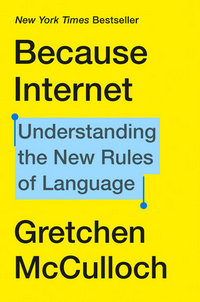
Because Internet by Gretchen McCulloch: Emojis, Tweets and Memes May Not be the End of Language…

Because Internet

Because Internet: Understanding the New Rules of Language

by Gretchen McCulloch

Hardcover, 274 pg.
Riverhead Books, 2019

Read: October 18-21, 2019

I’m a linguist, and I live on the internet. When I see the boundless creativity of internet language flowing past me online, I can’t help but want to understand how it works. Why did emoji become so popular so quickly? What’s the deal with how people of different ages punctuate their emails and text messages so differently? Why does the language in memes often look so wonderfully strange?

That encapsulates the book right there, McCulloch looks into each of these questions—along with some related and foundational questions—about how communication online has and is changing the way we write at each other.

If I was going to do this the right way, I’d need a dozen pages (at least), and I just don’t have the patience to write something that long (and, let’s be honest—who’d read it?). So let me be brief: this is an entertaining and informative book. She discusses the advantage of studying informal writing over edited and published works (and how the Internet Age makes that so much easier), “typographical tone of voice,” emojis and other emotional indicators, memes (and the like), and offers a new metaphor for considering language.

The tone is light and informal, but this isn’t a breezy read. It’s not that difficult, however. But there are times that I will confess that my eyes glazed over when she does some of the nitty-gritty explanations about how this works (and how it’s researched). But that doesn’t happen as often as I might think it would. What she does with the nitty-gritty, how she applies it? Love it. But when she’s “showing her work” (as we used to say in math class), I have a hard time tracking—that’s on me, I want to stress. McCulloch goes out of her way to make even that kind of thing interesting and approachable.

The way she frames the discussion for each chapter is fascinating. Then the conclusions she makes, or application of all that work, is simply insightful and even more fascinating. It’s just the stuff in the middle that didn’t need to be as long. But that’s very likely just me. McCulloch is a bit more open to changes and innovations than a guy who likes the idea of language standards (like me) can truly be comfortable with—but she almost wins me over.

This is probably the most entertaining book about language that I can remember reading (and, yeah, I used to dabble). It feels as alive as the language she’s considering. This is one for the language lover in your life.


3.5 Stars
2019 Library Love Challenge

Yet More Quick Questions with . . . Nick Kolakowski

Man…this is the third time I’ve got to pick Nick Kolakowski’s brain (the first and the second, for you completists). I can’t believe he keeps coming back for more — but when I get great answers like these, I’ve gotta keep asking, you know? Do read the others if you’re wanting to learn more about him in general — I stuck to Maxine Unleashes Doomsday (I posted about it earlier today, in case you missed that) this time.

Hope you enjoy!

Did you set out to write Science Fiction or is that something that came about as you started the project?
I’ve always wanted to write a dystopian novel, but all my early attempts were ignoble failures; they were Diet Cormac McCarthy, pastiches of “The Road” that were just retreads of what everyone else was trying to do. It’s only when I mashed the concept onto a noir framework that it started to work for me—a heist novel was the grounding that I needed, even if the target of that heist, in this post-apocalyptic context, is really, really weird.
What were some of the new challenges (and/or freedoms) compared to your earlier works given this setting/genre?
I’ve never written a book that covers the whole scope of someone’s life. Any novel comes with its share of continuity challenges; even if the timeframe is really short (i.e., a few hours or days), you need to keep all of your pieces and characters aligned and consistent. But keeping the details of a character’s life aligned across decades can prove much more difficult—did this happen to her left or right arm when she was a teenager, etc.

In terms of freedoms, though, you can create an incredible character arc if you have that kind of super-expansive timeframe to play with. There’s a real poignancy to tracing someone’s life from their teenagehood to the very end, especially if the country is radically changing around them at the same time.

What came first—the story or Maxine? Is that your typical approach, or does it vary from project to project?
Maxine came first: I had a vision of a badass woman, bitter and chain-smoking but refusing to give up no matter what life threw at her. From there, I wanted a story that put her in worse and worse circumstances. What happens to someone who loses everything? What’s left?

In terms of actual writing, this book started in the middle. Then I wrote Maxine’s childhood and teenage-dom. Then I stalled for about a year because I couldn’t think of where to take her from there; it was only when I came up with the broader framework—of academics discussing her life and her impact on society—that I figured out where to take everything.

In this book, Preacher reminded me a lot of Main Bad Guy’s Walker—but a very different take on the character type. Is 2019 your Year of the Aging Badass, or is that just a coincidence?  I’m having a hard time not asking a spoiler-laden question about him, so let me take the easy way out – what would a prospective reader want to know about Maxine’s very disfunctional paternal figure?
That was a coincidence, but now that you mention it… yeah, Preacher and Walker are brothers of a type! I didn’t mean it that way; Preacher made his first appearance in my head circa 2014, while Walker emerged around 2017-18, when I was writing “Main Bad Guy.”

Not to spoil too much, but Preacher isn’t the badass that Maxine thinks. He’s ultra-tough, and he deserves his fearsome reputation in the ruined part of the world where Maxine and her family lives. But his weaknesses—and frankly, his lies—eventually force Maxine to step up. The thing about badasses like Preacher and Walker, they can serve as crutches for your main character; at some point, you need to neuter them or take them away if your protagonist is truly going to move on and grow.

Are you far enough into your next book to talk about it – are you sticking with SF, going back to Crime Fiction, or trying your hand at something like Wizards?
Haha! Noir-ish wizards would be pretty cool, although I’m sure someone has already covered that arena already. Up next is actually the sequel to “Boise Longpig Hunting Club,” so it’s back to crime fiction (and Idaho!). The as-yet-untitled sequel is actually giving me a bit of trouble, because I’m trying to ratchet up the tension as tightly as possible on Jake and Frankie, my two main characters (and siblings). They survived some insane crap in the first book, so I have to figure out a way to make things even crazier.
Thanks for your time—and thanks for introducing me to Maxine
Thank you! I love her. I hope readers will, too.

Maxine Unleashes Doomsday by Nick Kolakowski: Kolakowski Gets His Crime Fiction Chocolate in this SF Peanut Butter

This is one of those books that I’m uber-excited about, yet I don’t think I do a good enough job at explaining why I am. It’s just good.
—

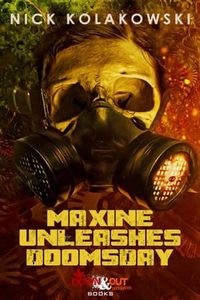
 Maxine Unleashes Doomsday

Maxine Unleashes Doomsday

by Nick Kolakowski

eARC, 274 pg.
Down & Out Books, 2019

Read: October 29-31, 2019

“You know the trick to surviving? The one thing you got to do?”

“What’s that?” Maxine asked.

“You got to treat every day like an adventure. Like it’s fun, or a challenge, even when everything’s crappy. Especially when it’s crappy. Because otherwise, it’s all going to crush you.”

“I feel like I spent my whole life being crushed.”

“Well, that’s your fault. A normal job, trying to live a normal life, it’s just inviting people to stomp you. And they do.”

“Yeah.”

“But at least in my line of work, sometimes you get to stomp back…”

In case the author’s name looks familiar to you, yeah, you’ve seen me use it a few times this year—3 novellas, 1 short fiction collection, and now this novel, Maxine Unleashes Doomsday. It occurs to me now, that he was the first author I read this year, and he did a pretty good job setting the tone for 2019’s reading. This book is his first step out of Crime Fiction and into Science Fiction—dystopian SF, to be precise (that really should be obvious to anyone familiar with him, I don’t think he’s got a utopian novel in him).

That said, there’s enough of a Crime Fiction flavor to this SF novel, that fans of either genre will have enough of their drug of choice to be satisfied.

This is set in the near-future, at various points along the fall of the US/Western Civilization. While there are plenty of other characters to keep an eye on, our focus throughout is on Maxine. After a rocky start to life with a drug-addicted mother, and an unsuccessful academic career (although she tried for a little bit), she tries to follow her uncle’s example and become a criminal. She has some success in that, but a large failure resulted in life-threatening injuries to a friend and the loss of one of her arms. Following that, she tries to live a non-criminal life, she gets a job, settles down with a guy and has a kid. But her heart’s not in it, and she ends up dabbling in thievery. At some point, she abandons that life and sets her eyes on a criminal career.

Maxine is one of my favorite characters this year—she’s flawed (not as flawed as she thinks), she’s a fighter (not as good as she thinks), self-destructive, optimistic, and driven. She takes a lot of (metaphorical and literal) punches, and while she may not get up right away after them, she doesn’t stop moving forward. Ever. I love reading characters like that.

Her uncle, who goes by Preacher, is one of the most significant criminals in the New York area—and has some cops dedicated to taking him down, and any number of civilians supporting him. Off and on throughout her childhood, Preacher tried to get Maxine’s mother to leave her addictions behind to provide for and care for her kids. Between his power and influence on the one hand, and being just about the only adult to look out for her and her brother, it’s no wonder that Maxine will want to be part of his life. Readers of Kolakowski’s Main Bad Guy will enjoy playing a compare/contrast game with Preacher and Walker.

There are a number of other characters that greatly influence Maxine’s life and desires, but none so much as her uncle. And to get into them would just push this post beyond the length I want (and would end up spoiling stuff to really talk about).

By and large, this is the story of Maxine’s journey from a struggling public school student to being a wanted criminal (and beyond). But that’s not everything that’s going on. For the first chapter, you get the impression you’ll be reading a book about rival groups fighting for supplies in mid-apocalyptic New York. But then you’ll realize that’s not it at all, it’s a story about how Maxine became the tenacious gun-fighter and would-be criminal mastermind that she is. Eventually you discover that yeah, both of those are true, but Kolakowski’s really writing a different story—and boy howdy, you feel pretty clever when you suss it out, and it’s such a brilliant way of telling this story that you don’t mind being wrong about what the book is trying to accomplish. But even then, you won’t really understand everything until the last line of the book (I’m not sure I actually pumped my fist when I read it, but I probably thought about it pretty hard).

Yes, it’s a pretty violent book (this too, should really be obvious to anyone familiar with Kolakowsi), but most of the truly horrible stuff happens “off-screen,” making it a lot easier to take. The prose moves quickly and assuredly, the writing is sone with a strong sense of style and savoir faire. Frankly, it’s too lively and enjoyable to keep the most readers who aren’t into gunfights, etc. from being turned off by the violence.

It’s a well-realized dystopia, one that’s easier to imagine happening than say, Panem. Kolakowski does a wonderful job of littering this book with little details that tell you so much about the world his characters live in and entertain the reader. Hitting both of those notes regularly is a difficult task. For example:

“Someday I want to go to California,” Michelle told Maxine. “Did you know it used to be a state?”

and

This far north, the concept of local government grew teeth and claws. If you stuck to the highway, you would cross into territory controlled largely by the New York Giants, which had expanded beyond its origin as one of the nation’s most consistently mediocre sports teams to control a big swath of towns northeast of Buffalo.

One of the conceits of the book is that the material is a result of an academic study about Maxine. It’s one of the best moves that Kolakowski makes in this book (and it’s full of great moves). Don’t skim over these notes, you’ll be rewarded for your attention.

Oh, I should warn you: This book might put you off popcorn for a while. I’m just saying…

Rob Hart wrote one of the endorsements for this: “Take one of Richard Stark’s Parker novels and throw it in the blender with DVDs of Mad Max and The Warriors. Guess what? You just broke your blender. Find solace in this book, which is what you should have done in the first place.” I repeat that for a couple of reasons—1. I love the last two sentences. 2. He’s right, and says everything in 4 sentences that I tried to above. You should listen to one of us. Kolakowski has outdone himself with this one, it was a pleasure from end to end. You really need to read it.

Disclaimer: I was provided a copy of this novel by the author in exchange for this post and my honest opinion. My opinions are my own, and weren’t influenced by this.


4 1/2 Stars
LetsReadIndie Reading Challenge

Look Both Ways by Jason Reynolds: A School Bus Falls from the Sky but More Interesting/Important Things are Going On

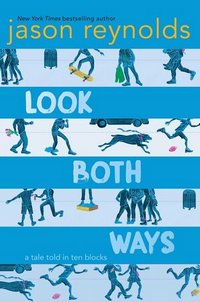
Look Both Ways

Look Both Ways: A Tale Told in Ten Blocks

by Jason Reynolds

Hardcover, 188 pg.
Atheneum/Caitlyn Dlouhy Books, 2019

Read: October 31, 2019

A school bus is many things.

A school bus is a substitute for a limousine. More class. A school bus is a classroom with a substitute teacher. A school bus is the students’ version of a teachers’ lounge. A school bus is the principal’s desk. A school bus is the nurse’s cot. A school bus is an office with all the phones ringing. A school bus is a command center. A school bus is a pillow fort that rolls. A school bus is a tank reshaped—hot dogs and baloney are the same meat. A school bus is a science lab—hot dogs and baloney are the same meat. A school bus is a safe zone. A school bus is a war zone. A school bus is a concert hall. A school bus is a food court. A school bus is a court of law, all judges, all jury.

This is a novel—sort of. It’s a short story collection—sort of. It’s a hybrid of the two like Winesburg, Ohio was. I can’t tell you how often I thought about Sherwood Anderson’s book while I read this.

A lot happens right after school lets out for the day—particularly on the way home. The last gasp of socialization for many before the reality of home, chores, family, homework, game systems, etc. take over. Jason Reynolds gives us the stories of ten individuals/friend-groups on the way between school and home (some take interesting detours, too). There’s drama, comedy, romance, tension, action, and . . . some things that defy explanation.

There’s no overarching theme or plot, just these ten stories, so it’s hard to encapsulate this much. I can’t even say some characters stand out more than others because they all do.

This is one of those YA books that I wish didn’t have that tag, because too many non-young adults are going to ignore this because of that label. Yes, the book is written for the YA crowd, but non-YA readers will appreciate this just as much (if they let themselves read it).

No two stories/chapters are the same in tone, voice, or character. Some are pretty straightforward, some get a bit more unconventional in structure. But through it all, they’re well-written stories. While none of the chapters will affect the way things go in others, there are layers of interconnectedness (leading to some chapters giving some nuance or new understanding to things you’ve already read).

While I enjoyed some of the chapters more than others, there wasn’t a dud in the bunch—and it’s not often I say that about short story collections. All of them tapped into something that you can probably relate to today—if you can’t, you certainly could have when you were a young adolescent. It’s a truly impressive collection.

I don’t know what else to say at this point, so I’ll stop—bring this one home, get your teens to read it, too. It’s funny, it’s poignant, it’s touching, it’s inspiring—and it’s a fun read during it all.


3.5 Stars

2019 Library Love Challenge

WWW Wednesday, 6-November-2019

Welcome to WWW Wednesday!

This meme was formerly hosted by MizB at A Daily Rhythm and revived on Taking on a World of Words — and shown to me by Aurore-Anne-Chehoke at Diary-of-a-black-city-girl.

The Three Ws are:

What are you currently reading?
What did you recently finish reading?
What do you think you’ll read next?

Easy enough, right?

What are you currently reading?

I’m working through the audiobook of The Right Stuff by Cornelia Funke and Lynn Redgrave (Narrator) and I’m reading Stephen Clark’s Hands Up.

What did you recently finish reading?

I just finished The Night Fire by Michael Connelly and Monday I finished Dragon Bones by Patricia Briggs and Joe Manganiello (Narrator) on audio.

What do you think you’ll read next?

My next book will be Fallen by Benedict Jacka (5 weeks after its release…what is wrong with me?), my next audiobook will be Undeath and Taxes by Drew Hayes and Kirby Heyborne (Narrator)

Hit me with your Three W’s in the comments! (no, really, do it!)

Catch-Up Quick Takes: My Plain Jane; The Rest of Us Just Live Here; The Ables

Here’s another batch of overdue takes on some good audiobooks. I don’t have the time for full-posts, so read the official blurbs if you need more information. Last time I tried one of these, I didn’t do such a good job on the “Quick” part, so I’m being more strict with myself this go-around. To that end: the narrators of these do a very capable job with their texts, but I don’t have a lot to say about their performance (I’d be happy to listen to other books by them, I should add).
—

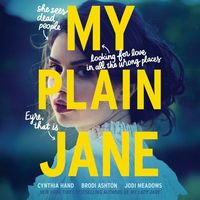
My Plain JaneMy Plain Jane

by Cynthia Hand, Brodi Ashton, Jodi Meadows,
Fiona Hardingham (Narrator)
Series: The Lady Janies, #2
Unabridged Audiobook, 10 hrs., 7 min.
HarperAudio, 2018
Read: September 24-28, 2019
(the official blurb)
I was really looking forward to this sequel to My Lady Jane, especially because it would involve a supernatural Jane Eyre retelling with a strong comedic sensibility. It wasn’t what I’d hoped it would be, but it was still a lot of fun.

The best part of it was having Charlotte Brontë as a character in the story—as Jane’s best (living) friend. I enjoyed Charlotte’s character enough that I’d willingly read a sequel about her.

And yes, I said, “living” there—Helen, the poor girl from Lowood Institution whose death was so hard for Jane is still around in ghost form. The death was still hard on Jane, but having Helen around as a ghost ended up becoming a different kind of obstacle for her to overcome.

I’d have expected a better link between the Janes—at least a stronger link in the supernatural aspects of the stories—than what we got.

Still, it was a fun listen and I’m definitely coming back for the next installment about Calamity Jane.
3 Stars

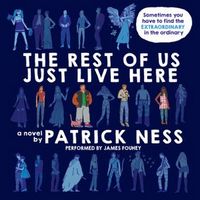
The Rest of Us Just Live HereThe Rest of Us Just Live Here

by Patrick Ness, James Fouhey (Narrator)
Unabridged Audiobook, 6 hrs., 23 mins
Read: October 7, 2019
(the official blurb)
I loved the idea of exploring the lives of the “regular kids” in a high school characterized by heroes, legends, slayers, etc. Basically, the kids at Sunnyvale High who know that Buffy is saving their skin on a semi-regular basis who aren’t Xander, Willow, Cordelia, etc. While Buffy is fighting vampires and the rest, these kids have family drama, fall in love, get rejected, worry about the future (assuming they don’t get eaten by the Monster of the Week) and all the rest. She may be the hero in general, but they’re the heroes of their own lives.

So Patrick Ness tells the story of one group of these students on the verge of graduation (while the world is being saved from a threat too complicated to talk about).

Great, great concept. The execution was . . . okay. I enjoyed it, but it didn’t leave me dancing in the aisle or anything. This is only my second Ness, but it didn’t feel like this was really his wheelhouse—maybe I’m wrong, maybe A Monster Calls is that thing that’s out of the norm for him.
3 Stars

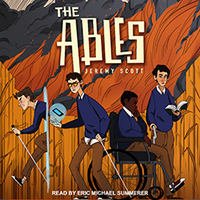
The AbelsThe Abels

by Jeremy Scott, Eric Michael Summerer (Narrator)
Series: The Ables, #1
Unabridged Audiobook, 14 hrs., 5 mins
Tantor Audio, 2019
Read: October 18-21, 2019
(the official blurb)
The concept behind this was fantastic—seriously. An upper-MG/younger-YA novel about a Special Education class in a Super Hero High School? Genius. You’ve got the kid with telekinesis who was born blind, the teleporter who lost his vision in an accident, a wheelchair-bound telepath (okay, that’s been done before), a kid with Down Syndrome who has the genetic markers for superpowers, but no one’s sure what they are, and so on. These students come together and learn how to work together and become the heroes they dream of being.

This was a blast—think early-Percy Jackson kind of quality. Some solid emotional moments, real character growth, great action. There was one gut-punch of a surprise that I still can’t believe that Scott had the nerve to make—and two big reveals that sealed the deal for me (one that I saw coming for miles, but he executed well enough that I don’t care; and one that I should’ve seen coming, but didn’t).

This one will be enjoyed by readers of all ages, I expect. Recommended.

3.5 Stars

2019 Library Love Challenge

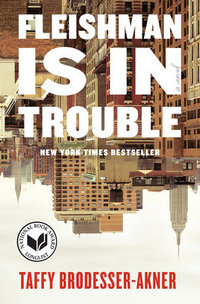
Fleishman is in Trouble by Taffy Brodesser-Akner: This novel is as Troubled as the Eponym

Fleishman is in Trouble

Fleishman is in Trouble

by Taffy Brodesser-Akner

Hardcover, 373 pg.
Random House, 2019

Read: October 22-23, 2019

Hr, which was what his preferred dating app was called, was now his first-thing-in-the-morning check. It had replaced Facebook, since when he looked at Facebook, he became despondent and overwhelmed by the number of people he hadn’t yet told about his divorce. But Facebook was also a landscape of roads not taken and moments of bliss, real or staged, that he couldn’t bear. The marriages that seemed plain and the posts that seemed incidental and not pointed, because they telegraphed not an aggressively great status in life but a just-fine one, those were the ones that left him clutching his heart. Toby hadn’t dreamed of great and transcendent things for his marriage. He had parents. He wasn’t an idiot. He just wanted regular, silly things in life, like stability and emotional support and a low-grade contentedness. Why couldn’t he just have regular, silly things? His former intern Sari posted a picture of herself bowling at a school fundraiser with her husband. She’d apparently gotten three Strikes. “What a night,” she’d written. Toby had stared at it with the overwhelming desire to write “Enjoy this for now” or “All desire is death.” It was best to stay off Facebook.

Back with my In Medias Res post about this book, I pretty much covered everything I want to say about this book. I was hoping that the last half would pick up (and I almost decided it did). But, really, it just kept doing what it had been and ended up killing almost all my interest in the book.

The official blurb says:

Toby Fleishman thought he knew what to expect when he and his wife of almost fifteen years separated: weekends and every other holiday with the kids, some residual bitterness, the occasional moment of tension in their co-parenting negotiations. He could not have predicted that one day, in the middle of his summer of sexual emancipation, Rachel would just drop their two children off at his place and simply not return. He had been working so hard to find equilibrium in his single life. The winds of his optimism, long dormant, had finally begun to pick up. Now this.

As Toby tries to figure out where Rachel went, all while juggling his patients at the hospital, his never-ending parental duties, and his new app-assisted sexual popularity, his tidy narrative of the spurned husband with the too-ambitious wife is his sole consolation. But if Toby ever wants to truly understand what happened to Rachel and what happened to his marriage, he is going to have to consider that he might not have seen things all that clearly in the first place.

A searing, utterly unvarnished debut, Fleishman Is in Trouble is an insightful, unsettling, often hilarious exploration of a culture trying to navigate the fault lines of an institution that has proven to be worthy of our great wariness and our great hope.

I’d summarize it as: two messed-up people in a very troubled marriage (that had been troubled for a while), going through a divorce and bringing out the worst in each other and themselves. Hurting careers, friendships, their children and each other along the way. By the time we meet them, they’re like many going through a bitter divorce, and are (at least then) terrible, horrible, no good, very bad people doing terrible, horrible, no good, very bad things to each other (while exonerating themselves of all but a few faults). And this is supposed to be comedic.

All of which could have been addressed years ago if they’d just talked to each other and worked together, rather than keeping score, justifying themselves, assuming the worst of each other and holding grudges. But that’s neither here nor there.

There were some saving graces:

  • Brodesser-Akner’s writing, there are some great passages, great insights, and sentences worthy of praise, study, and quotation. As I said previously, the prose is delightful, there are turns of phrase that I’ve stopped to re-read. Brodesser-Akner has a sharp wit and an equally sharp eye for observation/social commentary. If/When she publishes a second novel, the technical aspects of b>Fleishman is in Trouble were strong enough that I’ll be back.
  • When Toby (a hepatologist) is at work and caring for patients and/or instructing his interns, he’s a great character. Inspirational even. I’d read a book about him at work dealing with the bureaucracy of a hospital, insurance companies, young doctors and suffering patients and probably do little beside sing its praises. This, it should be stressed, is not that book.
  • Toby’s friend Libby. I don’t approve of (not that she asked)/appreciate a lot of her choices and attitudes. But she feels real, she’s genuine, she’s relatable (even—especially—when she’s treating her husband like garbage for no good reason), she deals with her problems (and her friends) in a way that most readers can see themselves in. She actually has a greater role in the novel than you think she will in the first half (or more), but the book would really benefit for more of her.
  • I have neither the time, inclination, or interest in listing my problems with this novel—just see my summary of the novel as a whole, and we’ll call it good.

    Based on some of what I’ve read about this novel, and my own observations, you could get away with calling this a Feminist John Updike. Which is a pretty good summation of why I wouldn’t recommend it, actually. It’s also reductionistic, so you probably shouldn’t say it. However, if a Feminist Updike sounds like something you’d really enjoy (not just are mildly curious about)—you might find yourself enjoying this.


    2 1/2 Stars

    2019 Library Love Challenge

Page 385 of 632

Powered by WordPress & Theme by Anders Norén