Author: HCNewton Page 399 of 633

Classically Cool—Let’s Talk Classics!

Last week, Witty and Sarcastic Bookclub posted Classically Cool- Let’s Talk Classics!, and it got me a-thinkin’, what Classics would I mention as faves?

Dickens doesn’t do anything for me, ditto for the overwhelming amount of Shakespeare I’ve read, Hawthorne makes me angry, I don’t get Melville’s appeal (but I also kind of do…I just don’t want to put in the effort)…but by and large “The Classics” (aka the Canon) are Classics for a reason (not because some nameless, faceless group of (now-)Dead, White Males exercised hegemonic powers to impose their tastes, either).

Still, there are some favorites:

Starting with The Oresteia (for chronology’s sake), this is the only existing example we have of a Greek dramatic trilogy. This series showing the fall-out of the Trojan War for Agamemnon and his family/kingdom and is pretty impressive.

Call me silly, but Beowulf has always really worked for me. I don’t know how to rank the various translations, I’ve read a handful and don’t think I ever knew a single translator’s name. I’ve meant to try the Haney translation since it came out, but haven’t gotten to it yet—the same goes for Tolkein’s. From about the same time (a little later, I believe, but I’m not going to check because if I start researching this post, it’ll never get finished) is The Dream of the Rood, a handly evangelistic tool (one of the better written ones) in Old English.

Moving ahead a couple of centuries (I’ll pick up the pace, don’t worry, the post won’t be that long) and we get Gawain and the Green Knight, which is fun, exciting and teaches a great lesson. Similarly, we have that poet’s Pearl, Patience, and Purity. I don’t remember much about the latter two, beyond that I liked them, but the Pearl—a tale of a father mourning a dead child and being comforted/challenged in a dream to devotion—is one of the more moving works I can remember ever reading.

I want to throw in Tom Jones (technically, The History of Tom Jones, a Foundling) by Henry Fielding here, but I’ve never actually completed it. Which says more about my patience and how distracted I can get than the book—which is an impressive work. I’ve gotta get around to actually finishing it at some point.

I can’t remember the titles for most of the Robert Burns poems I’ve read—”A Red, Red Rose” and “To a Mouse, on Turning Her Up in Her Nest With the Plough, November, 1785” (one of the best titles in history) are the exceptions—but most of them were pretty good. And I’m not a poetry guy.

Skipping a few centuries and we get to Alexandre Dumas’ The Three Musketeers. If all you know is the story from movies, you’re in for a treat when you actually read this thing. I’ve read it a few times, and each time, I’m caught off-guard at how fast-moving it really is, how entertaining and exciting it can be. It’s not a classic by any stretch of the imagination, but I feel compelled at this point to mention that the book about Dumas’ father, The Black Count: Glory, Revolution, Betrayal, and the Real Count of Monte Cristo by Tom Reiss is a must-read for any fan of Dumas.

I don’t remember how Ivanhoe by Sir Walter Scott ended up on my bookshelf (I think whatever relative took me to the bookstore said I could get something silly and trashy (in their view) if I got a Classic, too). But a few years later, I finally got around to reading it at about the same time that another kid in my class (we were High School sophomores) was reading it—both of us talked about how it was pretty good, but too much work. Until we got to a point somewhere in the middle (he got there a day before I did, I think) and something clicked—maybe we’d read enough of it that we could really get what was going on, maybe Scott got into a different gear, I’m not sure—and it became just about the most satisfying thing I’d read up to that point in my life.

Jane Eyre by Charlotte Brontë is one of my favorite books, probably belonging in the Top 3. Go ahead and roll your eyes at the idea of me saying that about a romance novel, that just means you’ve misread the book. This tale about integrity, about staying true to what one holds dear, what one believes and to what is right despite everything and everyone around you is exciting, inspiring, fantastically-written, and so-memorable. And, yeah, there’s a nice love story to go along with that 🙂

Speaking of love stories, we now get to my favorite, Edmond Rostand’s Cyrano de Bergerac. I steadfastly refuse to learn anything about the actual figure, because I don’t want anything to ruin this for me. When I first read the play in junior high, I considered the best parts the lead-up to the duel in Act I, and Christian’s trying to pick a fight with Cyrano the next day. Now I know the best parts are Christian’s realization in Act IV and Cyrano’s reaction to it and then, of course, Cyrano’s death (I’m fighting the impulse to go read that now instead of finishing this post). And don’t get me started about how this play’s balcony scene leaves any other romantic balcony scene in the dust.

I can’t pass up an opportunity to praise, The Adventures of Huckleberry Finn, Mark Twain’s tour de force. Satire, social commentary, general goofiness and some real heart. This book has it all.

I’m not sure that Ambrose Bierce’s The Devil’s Dictdionary is technically a “Classic.” But I’m counting it as one. It’s hilarious, it’s incisive, it’s a great time for those who like to subtly (and not-so-subtly) play with words. Yeah, it’s cynical—but it’s idealistic, too (as the best cynics are). If you haven’t sampled it yet, what’s wrong with you?

I feel strange dubbing anything from the Twentieth Century as a Classic, so I won’t talk much about The Old Man and the Sea, The Great Gatsby, Winesburg, Ohio or Our Town (the best way short of having a dog die to make me cry is get me to read/watch Act III). But I do feel safe mentioning To Kill a Mockingbird by Harper Lee, the ground-breaking, thought-shaping, moving, inspiring, and (frequently) just plain fun look at a childhood in the south.

When I started this, I figured I’d get 4-5 paragraphs out of the idea. I guess I overshot a little. Anyway, that’s what came to mind when I read W&S’ post—maybe other works would come to mind if I did this another time, but for now, those are my favorite Classics. What about you?

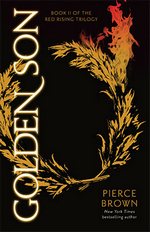
Reposting Just ‘Cuz: Golden Son by Pierce Brown

Here we are with the second of today’s Pierce Brown reposts. Even if Golden Son isn’t really volume 2 of a trilogy anymore, everything else I said about it still stands. There are few writers who can jerk me around like Brown can—he plays with emotions and expectations like Yo-Yo Ma on a cello. And I wish he’d lighten up on his readers, but I don’t expect that he will anytime soon (and I really don’t want him to, it just feels like it).
—

Golden SonGolden Son

by Pierce Brown
Series: Red Rising, #2

Hardcover, 442 pg.
Del Ray, 2015
Read: February 3 – 4, 2015

I glimpse Gray police standing over arrested Brown vandals who covered an apartment complex with the image of a hanging girl. My wife. Ten stories tall, hair burning, rendered in digital paint. My chest constricts as we pass, cracking the walls I’ve built around her memory. I’ve seen her hanged a thousand times now as her martyrdom spreads across the worlds, city by city. Yet each time, it strikes me like a physical blow, nerve endings shivering in my chest, heart beating fast, neck tight just under the jaw. How cruel a life, that the sight of my dead wife means hope.

As you start this book you’re thinking, this is going to be Red Rising continued — Darrow’s got a good steam and he’s going to continue to rise and learn. And then, you finish the first chapter and see how horribly wrong you were.

The important thing to remember while reading Golden Son: this is the 2nd volume in a trilogy. What does that mean about the book as a whole, especially the ending? Think: The Empire Strikes Back, Kinslayer, Catching Fire, The Deaths of Tao, The Two Towers, and so on. It’s going to get dark, it’s going to be messy, things are going to look bad for Darrow and his group.

Time and time again, Brown suckered me with this book. I got comfortable, got in a groove with the narrative, figured he’s about to zig and he’d zag. 30-50 pages later, we’d do the same thing again . . . and again. Up to, and including the final zig when I was sure he was about to zag. The number of times that a narrative gut punch was delivered as Brown was pulling the rug out from underneath you was enough to make you feel like you were one of Darrow’s crew on a bad day.

I read this at what turned out to be a busy time for me, so I couldn’t get to blogging about it then — I don’t remember many of the details (pretty sure the good ones are spoilery anyway), so I can’t get too specific about things. But I do remember the experience of reading it. This was just a brutal read — and each time Brown sent me reeling, I wanted more.

This was the second book in 2015 that I gave 5 Stars to. Since then I’ve read better books — some of which I’ve rated lower — but the way this book grabbed me, the way it made me feel while reading it? It earned the 5 Star then and still deserves it now.

I can’t wait for the conclusion, Morning Star this coming February.

—–

5 Stars

Reposting Just ‘Cuz: Red Rising by Pierce Brown

Time got away from me this past weekend—and not just because I wrote one post that turned about about 3x as long as I’d figured (which is fine, I had a lot of fun with my family, just didn’t write as much as I wanted to). That’s just a nice way of saying that I couldn’t shut up (you’ll see in a couple of hours). But I wanted to get something else up today, and since I’m knee-deep in Brown’s Dark Age at the moment, I figured I’d repost what I wrote about the first two books in the series. Glancing over it, I agree with everything I said, but kept shaking my head like Leslie talking to Ann: “You are a beautiful, naïve, sophisticated newborn baby.” This was one of my Top Reads of 2014 and the series is one of my most beloved. I urge you to jump on this runaway train if you haven’t yet.
—

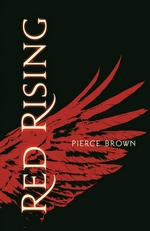
Red Rising (Red Rising Trilogy, #1)Red Rising

by Pierce Brown
Series: Red Rising, #1

Hardcover, 382 pg.
Del Rey, 2014
Read: Feb 26 – Mar 6, 2014

I’m having a hard time deciding what to say about this one. To really talk about it would require me spoiling every plot point that I loved (most of which I didn’t see coming). So I won’t. I’ll just say that I really, really dug this book.

I don’t want to just compare this to The Hunger Games, as much as reviews/blurbs/etc. make a guy want to. There are some surface-level similarities, yeah. And you could make the case (as I did when just starting the book) that Brown’s Mars was just the place for people who thought Collins’ Panem was a bit easy. In fact several parts of this feel like The Hunger Games dialed up to 11. The working/living conditions for Darrow and his family are more severe, what Darrow has done to him to prepare him for what’s to come makes what Cinna et al. do to Katniss look like child dress-up, Darrow plays a deadly game on a larger scale than Katniss, and so on. But Darrow’s motivation is different than Katniss’ — she’s trying to survive, he’s trying to do far more (and much of the time, survival’s pretty low on his list) — the stakes he’s playing for are greater, and he will go to lengths that Ms. Everdeen doesn’t have to.

There are a few moments when things seem too slow, or meandering, or even redundant — but each time, I was wrong, and Brown made it all pay off. Visceral was the word that kept coming back to me as I read the book. I had almost visceral reactions to some of the horrors depicted, I could feel the grime and muck (literal and metaphorical) that Darrow crawled around in.

This shows every indication of leading to something epic in the next volume, leaving Mars behind and moving to other planets and/or the space between. As well as seeing if Darrow can retain his self and purpose — and how far will he be willing to go to carry it out.

There is a classic SF reference in Part IV that made me giggle with delight (in the middle of a pretty grim part of a fairly grim book, so I appreciated the placement). I won’t spoil it, but Pierce Brown has bought a lot of loyalty from me with two simple words.

Go grab this one.

—–

5 Stars

Not Home Yet by Ian K. Smith: This *is* My Father’s World

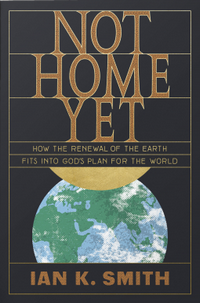
Not Home YetNot Home Yet: How the Renewal of the Earth Fits into God’s Plan for the World

by Ian K. Smith

eARC, 176 pg.
Crossway, 2019
Read: August 4, 2019

In the beginning, we’re told, God created the heavens and the earth. As Rod Rosenbladt used to say (maybe still does, it’s been a while since I heard him), “God likes matter, He made it.” The Scriptures are replete with post-Fall references to God visiting Earth, coming to Earth and dwelling with His people. This is what the Incarnation and the bodily resurrection are about. Yes, the risen Christ ascends to Heaven—but He’s coming back to renew the planet. That’s what it’s all about. The goal of humanity is not going to Heaven after we die, but to live with Him in our resurrection bodies on a renewed Earth. That’s what this book is about, in a nutshell—how Creation isn’t to be abandoned, discarded and therefore it doesn’t matter what we do. Instead, we’re caretakers of this place waiting to be renewed when our pilgrimage is complete.

Smith begins his case with Genesis 1-2 and what this tells us about God’s attitude toward His creation. Then he moves on to the Fall and God’s work through his redeemed people to renew the Earth, through the Flood and the covenant made with Earth, to the eventual establishment of Israel and his dwelling with His people in the Tabernacle and Temple—all of which points to the ultimate tabernacling with humanity in the person of Jesus Christ. Then Smith moves into a discussion of Christ’s resurrection and what it means for His people and this world as explained by the Apostles—what it means for this world and how we should view the world.

Now, I shared the general, overall thesis of the book before I read this—but I hadn’t given it much thought, and didn’t see it in the kind of detail that Smith brought out. I found most of this book fascinating and relish the opportunity to give it a slower, more careful read in the future. I found the explanations and arguments carefully framed and well-reasoned. There’s a chapter or two that I highlighted the majority of, and every chapter has a good amount of highlighting, the way he put certain points was very helpful. I could’ve used a little more depth (not possible in a book of this length, and the goal was probably something involving length to draw in—or not scare off—readers).

There are some problems with the book if you ask me. I can’t buy, at all, his arguments about Genesis 6:1-4 (that “sons of God”=angels*), but as it’s not pivotal to his overall argument, it’s not a big deal for me (it just gave me a little pause).

* I know it’s not unique to Smith, but it’s rare enough that I run into it that it stuck out to me. And, no, I won’t waste anyone’s time debating that here, it’s not that type of book. Read Bavinck for one of the quickest arguments against it, or check out Christ the Center, Episode 373.

My major reservation about this book is the lack of application—I’d have preferred a chapter or two (or four?) of “given this, how then should we live?” Smith hints at, even points toward, what the believer should do in light of this thinking. But to me, it seemed as if he was reticent to show how these ideas should affect the way that readers should put these ideas into action, how they should impact what they do from day to day—or how to think about their actions and society (ecclesiastical, political, geographic—take your pick). Yes, a good deal is self-evident, but I’d appreciate having it spelled out (if for no other reason than it’d be good to put some meat on these bones).

The book is a bit brief, and (again) I’d like to see some of what he said expanded upon, but what’s there is really good, thought-provoking, faithful to the text of Scripture and consistent. It was a rewarding read, and I think it’ll be an even more rewarding re-read. It’s an accessible book and one that I’d encourage people to pick up and discuss.

Disclaimer: I received this eARC from Crossway via NetGalley in exchange for this post—I am grateful that both groups gave me the opportunity.

—–

3 Stars

Saturday Miscellany—8/10/19

Odds ‘n ends over the week about books and reading that caught my eye. You’ve probably seen some/most/all of them, but just in case:

  • Comeback story: A new chapter for indie bookstores—”While their numbers aren’t what they once were, independent bookstores are reclaiming their place in society. Behind their surprise resurgence is renewed emphasis on fostering community.” Yeah, I’ve posted a variation on this story before, and I’ll keep posting them as long as they are written.
  • A #thread about #preorders.—A great thread about the business side of publishing.
  • The Radical Transformation of the Textbook—Textbooks aren’t really the kind of thing I tend to talk about here (although, I can think of a few that I could have, if this existed in the 90’s), but this is pretty fascinating.
  • Last Stand in Lychford—Paul Cornell announces (well, echoes Tor’s announcement) that next year’s Lychford novella will be the end. Which is a shame, but I never expected the series to, well, be a series. We got three or four more of what I expected, and I’m looking forward to seeing how he wraps things up (and what happens right before that, actually).
  • Megan Abbott on the Difference Between Hardboiled and Noir: In Conversation with the Author of Give Me Your Hand—I haven’t read a lot of Abbott, but I liked what I have—but this discussion about the distinction between hardboiled and noir is fantastic. I’m going to refer to it a lot (I should probably track down her dissertation).
  • Why Hacking is the Future of Crime Fiction—sure, it’s a bit self-serving, “hey, my novel is the future!”, but it’s a great point. And his book seems promising. But so often (on screen and in print) hacking in fiction is so . . . hacky?
  • Cartoonist Randall Munroe Will Be Your Answer Man—Not sure this book is for me, but I’ll probably try it, Munroe rarely disappoints.
  • Summer Flings – 5 Fantasy Standalones—cute idea for a list, at least two good books on the list (have heard good things about at least one other).
  • Classically Cool- Let’s Talk Classics!—I dig this post from the Witty and Sarcastic Bookclub (incidentally, I don’t see that much sarcasm there — wazzup with that, pal?). I’ve been trying to find the time to write a similar post myself, but in the meantime go read hers.
  • Are books still relevant today?—Obviously, the answer is a resounding, “YES!”, but you should still read the post.
  • The Ultimate Summer Playlist to Inspire Your Summer Booklist—I’ve never heard (to my knowledge) any of the songs on this list, and probably wouldn’t like most of them. But, I thought this was a cool idea, so am passing it along. What songs/books would you add?

    This Week’s New Releases I’m Excited About and/or You’ll Probably See Here Soon:

  • A Dangerous Man by Robert Crais—possibly Crais’ best since Suspect, loved this novel about Joe Pike running errands and stumbling onto a kidnapping. I’ll talk more about this early next week.

Lastly, I’d like to say hi and extend a warm welcome to Vee Aozoraa, happytonic, Elizabeth Ruggiero and adiswings for following the blog this week.

A Few Quick Questions With…Maggie Lynch

Earlier, I gave some brief thoughts about Maggie Lynch’s Gravity, a fun Space Opera/SF adventure, and now I get to ask the author a few questions. I start off talking about The Obsidian Rim series as a whole before we narrow in on Gravity and Lynch herself. There are some great answers here, and I’m blown away that she’d spend so much time on them. Hope you enjoy!

How did The Obsidian Rim project come about? Who picked who was taking part?
When I was planning my 2019 and 2020 writing schedule I decided I wanted to write more SF, but with a romantic subplot. My fiction writing career started with SF and I published short stories in magazines and anthologies back in the 1980’s and 1990’s. It was always my first love in writing. But I’ve been writing romance novels for the past decade and love the genre, and have a following. So, I wanted a way to combine the two genres with a leaning toward real science fiction.

I looked at what was labeled Science Fiction Romance and really didn’t care for the trend of shifters and mating rituals, alien lovers or world saviors, and very hot males where sex often came before relationship building. I wanted a series that was really based in a well-conceived science fiction world—preferably space opera for some fun and adventure. But I had no following in that genre. I did some research of the market and found, what I believe, was a missing niche. That is SF for smart women who liked the science but also wanted the relationships. That fit what I love to write. Character-driven stories, based in science but with definite romantic relationships that make a difference in the story. But I knew I couldn’t do it alone and get a following quick enough to make it work.

So I approached my friend, Jessa Slade writing as Elsa Jade, who’s story telling ability I love. Even when she’s writing shifters, paranormal, or alien lovers she is still writing smart fiction. She creates strong women characters who are as much in control of the situation as the men in the romances. She has been part of a number of multiple author group projects, and enjoyed the experience. So I asked if she would be interested in us co-coordinating this one. Fortunately, she agreed.

We both created the basis of the Obsidian Rim world. What you read on the Obsidian Rim website regarding the World background is what Jessa and I came up with. I’m the more sciency of the two of us, so things like metric measurements, wormhole time dilation etc. is from my research. The concept of Quantum Energy Drives and Bombs is Jessa’s idea and how that actually plays out in the science is both of us. The details of things like language, weaponry, etc. were contributed by individual authors as they built their own stories and is attributed.

Once we had the background, rules of the world, and contract details we began recruiting writers we knew personally who we believed could write these kinds of stories (based on what they’ve written in the past) and who we knew to be reliable. Because we have an aggressive release schedule with a new book every two weeks, we needed people who could get their books finished and through an editor on time. As we began recruiting in February, several of the people we approached were unable to join us because their annual release schedule was already full. But we are happy with the writers we have and if everything goes well this year, will open up to additional writers in 2020.

Just judging by Gravity, there was a lot of worldbuilding involved in The Obsidian Rim—how much of that was group effort, how much was you?
As I indicated above, the basis of the Obsidian Rim world was created by Elsa Jade and me. However, each author has the ability to go beyond those basics and create whatever he/she needs to make her story work. The only rules are: there are no aliens in this world; and because of the magnetic barrier at the rim no one can go beyond the galaxy rim. Everything else about the individual planets, planetoids, asteroids or space stations are up to each author as are the characters, creatures, and other developments. We do talk to each other in a closed Facebook Group just to keep everyone informed. And we do try to intersect with each other’s books in some way in order to keep readers interested in reading beyond one particular author they may already know.

So, in Gravity, the concept of cryoborns is mine and their special gift for navigation is a central piece of my trilogy in the Obsidian Rim world. The characters, their background stories, and the type of travel and planets visited are all mine. The book begins on Ydro-Down which is a mining planet that Elsa Jade created for her trilogy in the world. She gave me the outline of what was there in her mind and the basic corporate structure, and we agreed on an intersection with one particular character who would be the hero in her first book. I took it from there. When I finished the section that took place on Ydro-Down, I sent it to her for review in case I took too many liberties with her world or portrayed the intersection character inaccurately. We were both writing our drafts at the same time, so we were both figuring things out as we wrote. Fortunately, there were only a couple of easy changes to make it mesh.

Tell me a little about the participants in the project and their corners of the universe.
As I haven’t read all the books that have been published I don’t know a lot of details. I only know the blurbs that we have on the website for each book, and what the authors have shared as they try to use and pickup tidbits from each other. What I can say is that, each author has built their own worlds within the Galaxy and has committed to intersecting with at least one other author’s book. What I can tell you is that we have planets with toxic plants; a variety of criminal elements from pirates to royalty; some cool companion robots like dogs; and in one case cats with special powers to get humans to do what they need. Actually, that describes my own cats right now. ☺

We have recently put up a revised map of approximately where the different worlds are in the galaxy that have been a part of a book so far. As people share what living environments they’ve created, we try to place them in the Rim in our best guess as to how it works with the rest of the bookso and the intersection of stories. It is definitely NOT exact or even close, as the further out you go along the spiral arms the less we know right now which means less to extrapolate for the future. Also, distances even within one sector of the galaxy are still tens of thousands of light years apart.

I would love to share a little bit about each author in the 2019 round of novels.

I’ve already talked quite a bit about Elsa Jade., my co-conspirator in this undertaking. In addition to writing great stories, she is also a developmental editor and has won two Rita awards for her editing on author’s books. Jessa Slade/Elsa Jade now has 50 books published, with the more majority in SFF Romance and continues to write amazing character-driven stories that keep readers coming back. Her Obsidian Rim trilogy features the primary mining planetoid for qubition—the ore that powers ships to get through wormholes and also powered Q-bombs that destroyed most of the galaxy.

Jane Killick lives in the U.K. She works for the BBC as her day job and her love of SF started with movies and UK series television. Her most popular book, Stasis Leaked Complete, is based on interviews with the cast and crew of the successful space comedy, Red Dwarf.  Another popular nonfiction work is her five book series going behind the scenes of Babylon 5. Her most recent SFF fiction series is The Perceivers, A YA telepathy thriller series of four books. Her Obsidian Rim trilogy features freelancersplying their trades throughout the Rim.  It’s a great backdrop for exploring both the good and corrupt parts of commerce in the future.

Shree Aier is our only freshman writer. Her Obsidian Rim book, Coexistence, is her first published novel. I like Shree because she is even nerdier than me. Until recently, Shree has been pursing academic interests in science. She has two undergraduate degrees in business, psychology and biochemistry, and a Masters in materials science & engineering. She’s worked on research projects in psychology, biochemistry as well as cancer therapeutics using nanotechnology. Her trilogy features the Earth Conservatory, a place where original stocks of plants, seeds, and animals that came on generational ships are stored and monitored—not always with the best interest of humanity.

Shona Husk is a well-published writer, with 45 books published across several romance genres. The majority feature fantasy and science fiction worlds. She lives in western Australia and brings a definite knowledge of writing with multiple author series. Her Obsidian Rim trilogy, Dead Suns, features a royal family with a criminal element and mercenaries that sometimes work with them and at other times against them. Lots of page-turning adventure and great character-building within the Rim world. Her stories feature insights into social hierarchy, politics, and power and their impact on a personal level.

Jody Wallace is our humorous author, both in person and in her writing. Like any good comedian, she finds humor in the strangest situations. This is proven by her choice of planet for her trilogy—Trash Planet. Yes, it is literally a planet devoted to collecting and recycling all the trash from the Rim. With over 30 books published she has a great track record for delivering humor with good stories. Other writers may know her in her alter ego as the Grammar Wench, and/or the “cat lady” who has run a “meankitty” blog since 1999. Like Jessa Slade, Jody is also a freelance editor.

Sela Carsen is the author I’ve personally known the longest. We first met in an author critique group about 15 years ago. We were both starting on our novel writing journey in romance at that time and created a group of seven authors. Sela is particularly skilled at writing shorter works—short stories and novellas. Something I admire, as to me a short story is at least 8K words. The majority of her titles are in fantasy, a large number in the Nocturne Falls world created by Kristin Painter. Sela loves legends and fairy tales, so you are likely to see some of that seeping into her SF books as well. She agreed to tackle this slightly longer form for the Obsidian Rim novels and we are glad she’s joined us.

CJ Cade is another writer with a large backlist. With over 35 novels to date. Her SF Romances are written as CJ Cade, whereas her contemporaries and paranormals are written as Cathryn Cade. Right now the two pen names are running neck and neck for number of titles. Cathryn is also an author with a history of working in multiple author series, so she brings that experience of collaboration to the table. Her Obsidian Rim trilogy features a world where the plants are actually toxic to most humans, but some have adapted. An interesting dilemma indeed.

Let’s focus on Gravity now—what came first—characters or the story?
All of my SF works, whether novel length or short stories, begin with an idea. Then I try to find a character that can embody that idea and personalize it. Also, I’m one of those writers who tends to explore the same themes in every book—no matter the genre—that is how we make decisions and through that process learn to be our best selves (or not in the case of villains).

For me, I began this trilogy with the idea of how the Rim was populated or how humans were able to go tens of thousands of light years away from earth. I knew there needed to be generational ships and that likely meant most of the colonists would be in cryosleep. But what happens to people in cryo during the Oblivion War when large quantum waves wash over them? Something had to change, and that is where the special navigational abilities arise.

For me characters, and particularly with a romantic element, need to have opposing needs. I had a good idea of Kash. Though he starts the book enslaved, he has a memory of a past that was peaceful and loving before being put in cryo and that shapes his view of what is possible. That is juxtaposed by Lehanna who was raised a criminal, a pirate, and has no basis for believing anything good about the world unless she gets it or take sit herself. But these two are thrown together with these different world views and need to work it out. How do humans do that? And what pulls one to the other, even when the worldview is so opposite? I find that ultimately interesting and the basis for problem solving all the scrapes they get in. Both of their skills are needed and both of their worldviews are needed, because neither one has the entire truth.

Keeping spoiler-free, can you talk about Adira and Layla—both seemed inspired to me, don’t get me wrong, I enjoyed all the characters, but there’s something about these two and the role they played that really got to me.
I’m so happy you liked them. It’s funny, to me, how secondary characters take on a life of their own. I am what I fondly call a “plantser.” That means my native way of writing is as a “pantser” starting and writing into the mist (or the dark) and solving problems as they come along. However, the more books I’ve done and the faster I’ve learned to write, I’ve learned that plotting at least a little makes it easier to get to the end by deadline. ☺

But characters are the best part of “pantsing” for me, because they come from my heart and they are there to create questions or other views in the protagonist(s) life. It is not at all unusual that these secondary characters eventually get a story of their own.

Adira was created out of a need to steal something from the evil slave overlord on Ydro-Down. Because he was truly evil, I had to develop a character who somehow survived him no matter what trauma she felt, and yet kept her humanity because she also remembers (like Kash) a time in her life when things were beautiful and peaceful. Adira also serves as a good mirror to Lehana—who also comes from trauma but has shut down her ability to feel or sublimated it with anger and aggression.

Layla is actually a personification of my cat, Layla. ☺ She was so named because the name, from the Arabic, means “dark beauty” or one born at night. My cat, Layla, is primarily black with streaks of golden brown around the face. She is very calm, but also astute and can lay in wait for an attack for hours if needed. Layla in my book therefore is also dark skinned, calm, but very astute. I made her unusually tall to emphasize that juxtaposition between largeness and peace. Also, compared to Adira who is small, like Lehanna, it seems like another subtle way to show how diversity still brings commonality.

I don’t know yet, how Adira and Layla are going to feature in the next two books or if they will eventually get stories—or series—of their own. For now, in many ways, they are the centering force for extremes that occur with my protagonists.

Can you talk a little about what’s next for your storyline?
Magnetism is the next book in the Cryoborn Gifts trilogy. It will be released in early September. It is going through first round edits now and I hope to have actual ARCs available for reviewers in mid-August. It will take our protagonists to another level in their relationship and we get to know the children in this next book. The crux of the entire trilogy is how much is one willing to change in order to save themselves, their family, or an entire universe?

I think for many people, that is an ongoing question in our lives. How much should I, can I, do to help make things better. From stories of jews being protected in WWII at the risk of the protectors lives, to those who dedicate their life to causes that are beyond challenging and take you away from everything you know—those who fight for climate justice, homelessness, science, the arts—whatever the cause it can become all consuming and is that good?

These heroic stories are always ones that interest me. What kind of people make those choices and what price do they pay? At the end, I and the reader are left to answer the question if the price was worth it. Life is not black and white, and I like exploring the complexity of those questions.

Will Lehanna and Kash choose to change so much that they can never go back to “normal” again? Or will only one choose? Or will they find a way out of total commitment? All answers are possible and all choices are ones that help.

Tell us about your road to publication—was your plan/dream always to become a novelist and your education/other jobs were just to get you to this point, or was this a later-in-life desire?
I was a creative child growing up. I wrote poetry, music, and stories from the moment I could conceive them. In high school I was playing a violin in the orchestra, writing my own kind of folk music, a regular member in drama club and doing theater. And occasionally wrote stories or scripts. However, I also grew up as the oldest of nine children and not a lot of money for things beyond food.

I didn’t plan to go to college because I couldn’t afford to go. However, my father guilted me into using my savings from working as a waitress for three years to go to one year of college instead of moving out. He was a smart man and I loved the challenge of learning. I never considered pursuing a creative path because I was paying for it all myself and I knew it would never pay me enough to live on my own. My career and eventually academia was a great way to satisfy my love of life-long learning and get paid for it.

My need for creative outlet was satisfied by writing short stories on the side—occasionally getting them published in magazines and anthologies. I have about 60 out of more than 100 I wrote that were published. I participated in community theater until into my early 40’s and occasionally got a small part in a B movie being filmed near where I lived. One week of filming at base SAG rates was more income than I got paid in a month of working as a therapist at a university. But those films only came around once every couple of years.

Somewhere around age 45 I realized that the best way for me to pursue a creative life was to be a novelist. I’d had nonfiction work published in books, along with a variety of articles—from academic to every day articles in local magazines or tourist features. Being ever the planner, I decided if I started my novel career by the time I was 50, and could write three books a year while working full time. I would have built up 30 books by my retirement and have a following.

It didn’t work exactly how I planned, but that’s another story. I retired early, at 56, and began writing full time then. I’m up to about 20 books but picking up steam. I don’t know that I’ll ever achieve the income I had in academia or consulting. But I make enough to keep food on the table and a roof over our head and I love what I do.

What’s the one (or two) book/movie/show in the last 5 years that made you say, “I wish I’d written that.”?
I’m going to stretch your timeline a bit, because the truth is I haven’t had much time to watch movies or read books beyond what is required for my writing. So, my list is limited. I can say that in the last decade the movie that affected me the most was Avatar. In some ways it mirrored the fantasy series I was writing at the time—The Forest People—in that it explored a group of beings that revered the natural ways of nature in both a spiritual and a practical way. There is a lot I disliked about that movie—particularly how the ending was done—but I liked the themes.

In terms of a book, in 2008, a good friend told me about Suzette Haden Elgin’s trilogy. She is a linguist who created an entire language, Laadan, specifically for women in her fictional series. She wrote a series of books about a future time when the 19th amendment was repealed. Women had been stripped of their civil rights. Yet, it is the women who have the skills to communicate with alien races. And those skills create the language Laadan which gives them power and

Though the trilogy was published 1984-1987 I’d never heard of it. It was the first time I’d read a book that might be described as feminist. She played with form and function and made them a part of the story. I personally liked the story as a whole, and liked that the women never gave up communicating with each other and with trying new ways to communicate with aliens. It was a “smart” book for smart readers and I appreciated that. It opened my mind to new levels of writing I hadn’t considered.

Thanks for your time—and thanks for Gravity, I enjoyed it, and hope you have plenty of success with it.
Thank you, for taking the time to read my book! I love learning what people see or don’t see in a finished book. Certainly, as the writer, I put things in that speak to me and the themes I am exploring and hope that some of those speak to the reader. However, I’m always excited to hear what other things become important to the readers.

Ultimately, once a book is in a reader’s hands, the story becomes their story and they may see things I never thought/knew were there. That is the beauty of creation and sharing it with others. If I kept it to myself, I’d never learn more about how we as humans can make connections that are common even within such diversity of thought and experience.

Gravity by Maggie Lynch: A Promising Start to a Space Opera Saga

I’d like to take a beat to apologize to Maggie Lynch, I’d intended to get this posted a couple of weeks ago, but other priorities/commitments/energy levels kept intervening.

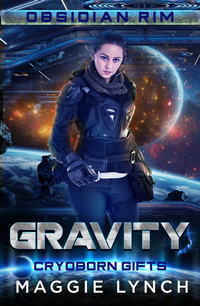
GravityGravity

by Maggie Lynch
Series: The Obsidian Rim, #1Kindle Edition, 235 pg.
Windtree Press, 2019

Read: July 9 – 11, 2019

Lehana is a smuggler known throughout the Outer Rim as one who’ll take just about any job if the price is right. That’s actually about all that anyone knows about her, really. Thanks to a small computer problem, Lehana crashes onto a mining planet, seriously impeding their production for a couple of days. To appease the owners of the mines, as well as to get a little assistance, she agrees to one of those jobs she has turned down before.

Because of a bad experience she had with the man who runs the mine, Lehana decides to take one of his slaves with her as she leaves. What she doesn’t know is that she helped other slaves—a man and his two cryogenically frozen children—leave the planet. She’d have been well within her rights to turn them over, but that didn’t sit right with her. She’s no supporter of slavery, but she’s not a revolutionary either and would prefer to just do her own thing without getting embroiled in anything. Still, she can’t hand over kids.

Taking that many slaves is enough to get her current clients to send people after her, and the rest of the book revolves around the questions: can she successfully deliver her cargo and make a profit off of it, before those coming to collect the brand new price on her head show up to collect? Can she—does she want to—save the lives of the stowaways? Will she work again after this stunt?

I really appreciated the way that Lynch set up these characters and introduced us to this world. It feels familiar to people who’ve read a smattering of Space Operas before, but it’s not a clone of any that I know of. A mix of the routine and the new makes for an easy entry into the world for the reader. This applies for the way the characters were introduced to each other and became a team, as well as the world they exist in.

Lehana’s a solid character to build a series on, and the other characters that were prominent were pretty strong, too. I don’t feel comfortable getting into the characters as much as usual, I think you should get to know them in the novel rather than me getting into a discussion too deep, I’m just afraid I’d spoil too much. On the whole, I liked the characters—there were a couple of people on Lehana’s crew that were sidelined most of the time, but the others really clicked well for me. I’d have preferred more time with just about all of them over the stuff that I’ll talk about in the next paragraph. Now, the characters that I found the most interesting (at least one of them) were not the characters that Lynch found the most use for. I grant you that I may be more curious about them than I am others because Lynch didn’t focus on them as much, so there are more questions about them.

My biggest gripe would have to be about the way that Lehana and Kash interacted with the ship to help the navigation—it just didn’t make sense. I mean, I got it—both the way it was described and the way that Lynch used it to spur some character development in Lehana. But it’s not something I could really buy/accept. I don’t think this is a reflection on Lynch’s writing, it’s the concept behind it. It’s hard to talk about briefly and without ruining the story for anyone, but I just didn’t like it. This wouldn’t be a big deal, except for the prominence it took in the storytelling. It’s not a deal-breaker, but I found it annoying and boring at the same time. On a related note, I think the amount and detail of sexual references could’ve been toned down, but I skew prudish, I know.

I had a good time reading this—it was fast, it was fun, set in an intriguing world with well-constructed and entertaining characters. I think I’m curious enough about what’s going on to come back for more—and maybe to check out some other works in this universe, just to see how they’re different/similar. If you’re in the mood for a nice space opera, this could just be the thing for you.

Disclaimer: I received a copy of this novel from the author in exchange for this post, but I read it because I wanted to and the opinions expressed are my own and not influenced by her.

—–

3 Stars

LetsReadIndie Reading Challenge

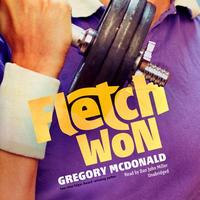
Fletch Won (Audiobook) by Gregory McDonald, Dan John Miller: A Real Mixed Bag

Fletch Won (Audiobook)Fletch Won

by Gregory McDonald, Dan John Miller (Narrator)

Series: Fletch, #8 (#1 Chronologically)
Unabridged Audiobook, 6 hrs., 30 min.
Blackstone Audio, 2018

Read: June 20 – 26, 2019

This is chronologically the first Fletch novel, he’s a rookie reporter, who’s been bounced around from headline writer, to obituaries, to wedding announcements, and is finally sent to the Society pages—with a warning. Fit in, and don’t make any trouble or he’ll be unemployed. His first assignment is to meet with an attorney, Donald Habeck, in the publisher’s office to discuss a major donation he’ll be making to a local museum and do a puff piece about it. Fletch objects, wanting to do real news—the kind of stuff he’ll later be known for. His editor (Frank Jaffe, a name known to those who’ve read Fletch and Fletch and the Widow Bradley) refuses, insisting that this is his assignment—and maybe later he’ll get a chance to do something else.

There’s a catch—Habeck is murdered in the newspaper’s parking lot on his way to this meeting. Fletch jumps on the opportunity to report on this, but the senior crime reporter shoos him off (and Jaffe). Fletch tries to exercise squatter’s rights, but no one is having any of it. Naturally, this means that Fletch will ignore this and will investigate the murder on his own—and typically is a few steps ahead of both the police and the senior crime writer.

In the meantime, he has to do his actual job (at least until he has something he can print). There’s another story they want Fletch to work on, there’s a local “escort service” parading itself as a fitness establishment—Jaffe insists that Fletch do an expose about them. To stay employed, Fletch agrees—but threatens the most detailed and explicit expense report ever. This isn’t a story that appeals to Fletch—I don’t think he cares too much if this service is just close to prostitution, or if it’s the actual thing—and he has better things to do with his time. Also, he’s about to get married, the last thing his fiancé is going to want is him hanging around a brothel all day.

The opening chapter is a hoot. As are several of the encounters Fletch has with the members of Donald Habeck’s family (particularly his wife)—and Alston Chambers never fails to be amusing. The escort service story is fun, and ends up being the kind of thing that Fletch can write about—but its main purpose is to give Mcdonald an opportunity to opine on our cultural obsession with beauty, health, and so on, while causing problems for Fletch’s personal life. There’s not a lot of meat to this story, but there’s a lot of fun. On the other hand, the murder investigation is great and vintage Fletch. It’s the best part of the book (as a mystery novel, I guess it should be, right?)

All in all, a decent Fletch novel—full of interesting characters, a nice twist, Fletch bucking all sorts of authority (police, veteran reporters, Frank Jaffee), and more than a few amusing situations. It works as an origin story, how did he become the sort of reporter we know, etc. As I mentioned earlier, we even see young Alston Chambers — just starting as an associate in a powerful law firm. But—and this is a big but— this places Fletch at the newspaper we know he ends his newspaper career with as a rookie, as a man about to be married (for the first time). We know there’s not a lot of time between the end of his first marriage and Fletch, but there’s some. Enough for a second marriage and the Window Bradley events, but not much more. What there isn’t time for is the past referred to in Confess, Fletch, Fletch’s Fortune and even hinted at in The Man Who — and the first two of those depend on Fletch’s history to work. Unless we’re to believe that his wives let him leave the state, work in a variety of other papers, developing a Fletchian reputation, move back to the same paper he started his career in (with the same senior editor), and then hit him up for alimony and still be carrying a torch for him. It stretches credulity a bit too much for me to stomach. The next book, Fletch, Too, doesn’t help things.

Does that ruin Fletch Won for me? Not totally, but that alone keeps it out of my personal top-tier Fletch novels and rank it slightly above The Widow Bradley (only for the chuckles it gives me). Clearly, McDonald isn’t as picky about this sort of thing as many of his readers are, but man, that rankles. Still, it’s fun, it features entertaining characters— some odd poetry—and enough Fletchisms to keep you happy. It’s a good time, and if you ignore what it suggests about the rest of the series, you should have a good time.

—–

3.5 Stars
2019 Cloak & Dagger Challenge

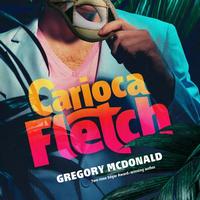
Carioca Fletch (Audiobook) by Gregory McDonald, Dan John Miller: A Bad Fletch Book — whodathunkit

Carioca FletchCarioca Fletch

by Gregory McDonald, Dan John Miller (Narrator)
Series: Fletch, #7 (#5 Chronologically)
Unabridged Audiobook, 6 hrs., 3 min.
Blackstone Audio, 2018
Read: May 21 – 25, 2019

Just in case people were thinking I’d drunk too heavily in the Fletch/Gregory Mcdonald Kool-Aid bowl, this should alleviate any concern. I just don’t like this book.

Following the events of Fletch, our now-jobless journalist is enjoying life in Brazil, he’s got a girlfriend, is making some investments and friends and is about to enjoy Carnaval. Quite by accident, he runs into the newly-widowed Joan Allen Stanwyk, and things get a little awkward for a bit. But before he can follow up with her, an elderly Brazilian woman claims that he’s the reincarnation of her murdered husband, come back to identify his murderer.

This distracts Fletch greatly and between that, and a new group of acquaintances who seem to be rich young men who devote all their time to wine and women, Fletch can’t deal with Joan. He first has to spend some time trying to deal with the problems of their debauchery, this supernatural claim and learning about the Brazilian culture in general.

This might, might, be an okay book if it was about any other American hiding in Brazil, learning about the culture and people. But it’s not a Fletch book. He doesn’t solve the mystery by being clever or interviewing anyone. It’s not a particularly funny book, either. It’s mostly Fletch bouncing from situation to situation with little control or agency for a couple of hundred pages, and then solving a decades-old mystery by a cheap stunt.

What redeems this book is the Joan Allen Stanwyk material that bookends it. Those are the only chapters that really feel like Fletch (and, they’re grounded in the rest of the series). Also, Fletch’s background in, interest in, and history of investing in art is shown here in embryo—as well as the other things he does to pay for his villa, GCN stock, racehorses, and so on. So that’s good, but we didn’t need to see it, the character was good enough without that.

Naturally, Dan John Miller had nothing to do with any of my problems, he does a great job as usual.

This was just a misfire for Mcdonald (not the only one in the series), and is easily forgotten—and should be.

—–

2 1/2 Stars
2019 Cloak & Dagger Challenge

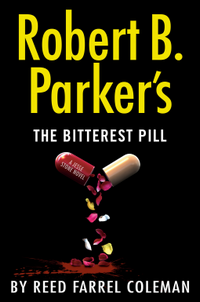
The Bitterest Pill by Reed Farrel Coleman: Paradise, MA comes face to face with the Opioid Epidemic

The Bitterest PillRobert B. Parker’s The Bitterest Pill

by Reed Farrel Coleman
Series: Jesse Stone, #18
eARC, 368 pg.
G.P. Putnam’s Sons, 2019

Read: July 31 – August 3, 2019

Well, it’s pretty clear that Don Winslow has left his mark on Reed Farrel Coleman—there’s a quotation from Winslow on the so-called War on Drugs as the epigraph to this novel. Jesse cites it and alludes to it later in the novel. It’s a good line—catchy and insightful (and, not that it matters, I agree 100% with it)—don’t misunderstand me, but I’m used to Robert B. Parker characters citing Shakespeare, (Edmund) Spenser, Shelley, and songs from the late 60s/70s. I don’t think I’ve ever seen one quote someone contemporary. The latest focus of most of our country in that War is the Opioid Crisis, in The Bitterest Pill, that epidemic shows up in Paradise, Massachusettes—partially fulfilling Vinnie Morris’ prediction to Jesse that Boston crime was on its way to Paradise.

A student at Paradise High—the daughter of a city councilman—dies of an overdose and the city is rocked. It can’t be the first drug-related death in its history, but this was a different kind of thing. She’s not an obvious user, cheerleader, from a well-to-do family, and so on. Not the kind of person that Paradise is ready to believe would be an addict or that would die of an O.D.

What’s obvious to Jesse and his team is that if they don’t shut down the supply chain that fed this girl her drugs, she won’t be the only death, she’ll just be the first. This sets Jesse on a Hunt through Paradise High School and Boston’s underbelly. There’s a moment that made me think of Connelly’s Two Kinds of Truth (which just means that Connelly and Coleman have both done their research into the ways prescription drug rings work, not that Coleman’s copying anything)—but there’s a difference. Bosch is trying to deal with a situation, he’s involved in busting a ring as a means to an end. Jesse? He’s trying to protect his town it’s personal—and the ways that this particular ring is trying to invade Paradise are more diverse than what Bosch dealt with.

Skip this next paragraph if you’re worried about Colorblind spoilers.
I avoided talking about the new character Cole last time out, because, how could I? I’m on the fence with him, honestly. I don’t see where he was necessary—Jesse has Suit to father (although, at this stage, Luther doesn’t need much), he’s got the weight of the city on his shoulders, what’s added to the character by this relation? On the other hand, scenes with him are done so well, and Jesse’s different with him. I really enjoy him—he’s not the Paradise equivalent of Paul Giacomin, thankfully (nothing against Paul, we just don’t need another one), he’s a different kind of character (as Jesse was compared to Spenser and Sunny).

Speaking of Suitcase, I think I’ve loved everything Coleman’s done with him (every major thing, anyway, there might have been a scene or two that I forgot about), other than not using him as often as he could. But there’s a scene with Suit and Cole in this book that is so well done that it’s one of those passages I could read from time to time just to smile at. He’s come a long way. Molly seemed a little under-used, but she was good whenever she showed up and did get to shine a bit. I think Coleman overplayed the difficulty of Molly doing her job because of the way this case impacted Paradise’s children a bit (really not much), and, as always, he’s too dependent on bringing up the incident with Crow in relation to Molly. But on the whole, Suit, Molly and the rest of Paradise PD came off pretty well.

For awhile under Coleman and Ace Atkins, Vinnie Morris seemed more dangerous, more of a wild card—less “tamed.” But both the way that Atkins has used him the last time or two and here he seems to be tacking back to a friendly criminal who’s too willing to help out the non-criminal element. Frankly, I prefer the less-tame version, but as someone who’s enjoyed Vinnie since he worked for Joe Broz ages ago, I don’t care, I just like seeing him on the page.

After the very effective use of the mayor recently, I was surprised at her absence in this novel—not that there was room for anything like that.

There’s really one more supporting character that we should talk about—Alcohol. Jesse’s greatest foe (although, you could argue he’s the enemy and alcohol is the tool he uses to attack himself, but…eh, let’s make this easy and say alcohol). He may be clean and sober, but he’s still an addict, and his drug of choice is still a near-constant presence in his life. I love, respect and admire the way that Jesse (and Coleman) have dealt with this subject, particularly since Jesse stopped drinking. It’s so much more believable (and healthy) than Jesse’s attempts to manage his drinking before. I liked the approach in Colorblind, and continuing it in The Bitterest Pill made it stronger.

So, we’ve got Jesse battling personal demons (but with a clearer head), adjusting to a new personal reality, and dealing with a potentially crushing crime wave that’s leaving a trail of destruction through the youth of Paradise. Throw in the instability of a new romantic relationship? Jesse’s in a pretty healthy place, but given the pressures (and a couple I didn’t list)—it’s gotta be weighing on him, and Coleman does a pretty good job of balancing the health and precarious nature of Jesse’s state of mind.

As Coleman’s writing, it seemed frequently that he was trying too hard to make this something the level of Colorblind or Debt to Pay, and didn’t quite make it. Maybe because he was trying so hard? The topic he’s dealing with is important, so it’s understandable he’s taking big swings to hit this out of the park. But there are a few sentences that no one but Reed Farrel Coleman could have written. They were gorgeous and practically sang. I don’t want to sound like one of those anti-genre literary snobs, but Coleman comes close to transcending the genre and its easy to see the impact his poetry frequently has on his prose.

At the same time, he’s an effective mystery writer—there are red herrings all over the place for readers to get distracted with. As far as the main conduit for drugs into the school goes, I had a candidate I was sure of and a back-up, and another one, too. I couldn’t have been more wrong and had dismissed the actual perpetrator without much thought at all. While ratcheting up the tension, keeping me locked into the story, he pulls the wool over my eyes and manages a few lines that are practically lyrical. There are few in the genre who can match that.

The ending of this novel came as a little bit of a gut punch. Granted, there was a sense in which the last couple of pages couldn’t have gone any other way—I’ll leave the specifics out of it, but the last few paragraphs were hard to read. But they were so, so good. They might be the most effective few paragraphs in the book. I don’t think it’s much of a spoiler to say that just when you think the story’s done, it’s not.

Rumor has it that this is Coleman’s last Jesse Stone book—I hope it’s not true, but it’d make sense as he’s switching publishers. As I said when his first entry in this series came out, his was the best Jesse Stone since Parker’s early days with the series. Yes, he didn’t do things the way Parker would have (especially later), but what he did was honest and genuine to the spirit of the characters and series that Parker left. Stone has a complexity that Spenser lost in the mid-80s, and Coleman recaptured that. The Bitterest Pill might not have been Coleman’s Stone at his best, but I think that’s largely because he was trying too hard to say something about the societal impact of the drugs (whereas in Colorblind it seemed effortless). And, while it wasn’t as good as it wanted to be, it was very, very good, and will go down as one of the higher points of the series.

The Bitterest Pill would be a good place to meet Jesse Stone and the rest of the Paradise Police Department, and it’s a great way for long-time fans/readers to touch base with them. I strongly recommend this.

Disclaimer: I received this eARC from Putnam Books via NetGalley in exchange for this post—I thank both groups for this.

—–

4 Stars

2019 Cloak & Dagger Challenge

Page 399 of 633

Powered by WordPress & Theme by Anders Norén