Author: HCNewton Page 430 of 633

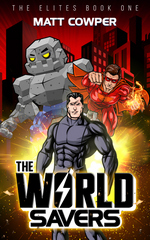
The World Savers by Matt Cowper: A Bang-Up Start to a new Super-Hero Series

The World SaversThe World Savers

by Matt Cowper
Series: The Elites, #1

Kindle Edition, 257 pg.
2018
Read: December 11 – 12, 2018

There are going to be a lot of comparisons in this to Marvel/DC characters. This isn’t saying Cowper’s being derivative — nor is he ripping any character off. These are well-known and established types — he’s not doing anything that Ben Edlund didn’t do in The Tick, or Bendis in Powers, or Kirkman in Invincible — etc. I’m just going to say something like “Slab is a Thing-like character” so I don’t have to write three sentences to describe the Thing.

Beverly Gillespie (an Amanda Waller-esque character), the Secretary for Superhuman Affairs, is re-assembling the legendary team, The Elites. Enough time has gone by since they disbanded (for very good reasons) that the government wants to start them up again — under new leadership. Nightstriker — a very Batman/CW’s Arrow -type of guy. He’s driven, he’s obsessive, he’s seemingly incorruptible, and doesn’t play well with others and is pretty paranoid. Which is what attracts Waller — she wants someone who’ll go out of his way to keep the team’s integrity.

It takes some doing, but Nightstriker relents and selects a few people to join the new group — none of them are the crème de la crème, Nightstriker considers them misfits, actually. But misfits that he thinks can work well together and be a strong Gestalt-y greater than the sum of its parts entity. No sooner have they assembled, than their home base, Z City, is under attack. I’ll leave this vague, but essentially these opponents are Occupy Wall Street with a cult-like flavor, following a would-be world conqueror, with everyone within the group possessing some sort of metahuman abilities. So The Elites have to stop this group from destroying the city (or at least the financial and governmental structures), while learning to function as a team.

The book is told through the points of view of Nightstriker and a member of his Elites, Blaze. Nightstriker’s a strong take on the type — you know him pretty well almost instantly.You get his motivation, his way of doing things and can understand his paranoia about reforming this team. He sees himself as not just Team Leader, but Mentor/Coach to his team — but he has a lot to learn about being a Team Player as well as a Leader.

Blaze is a high schooler struggling with Biology tests while he goes around fighting crime in a Human Torch-ish way (with shades of Firestorm, too). He’s eager, he’s naive, he’s a little reckless, he has a sense of fun that’s outweighed by a sense of responsibility. He’s so wet behind the ears that it threatens to put out his fire. But he’s smart (probably smarter than he realizes) and has nothing but potential. Nightstriker sees all of that (and probably more), and sees similar qualities in the other recruits. I really enjoyed his chapters — the Nightstriker point of view is what the DC movies are (at their best), Blaze’s are Marvel movies. The two together make a powerful combination.

Metal Girl doesn’t have point-of-view chapters, but we learn a lot about her — her origin story, what makes her tick, etc. She’s sort of a Vision/Red Tornado/Metamorpho cocktail. That description can only work once you’ve read the book — it’ll click when you do. I really dug her as a character and can’t wait to see what Cowper has in store for her development.

There are two members of The Elites that are under-served — which isn’t too much of a complaint, there’s a lot of plates spinning in these pages and to try to fit in more of these two probably would be counter-productive. First is Buckshot — think the Green Arrow or Hawkeye, but with guns (it’s been too long since I’ve read anything with him in it, but maybe that makes him Arsenal-like) with a Western-motif about him and a talk-radio conservative world-view — I like him, but think Cowper overplayed some of his characteristics (just a little bit). The other one is Slab — he’s a Thing-type character, who really isn’t that much like Ben Grimm — although they’re similar. There’s something about this guy — as much as I enjoyed the rest of the cast, it wouldn’t surprise me at all if Slab becomes the heart and soul of the team — and maybe the guy who really comes through at the very end to land the coup de grâce in the finale. Maybe it’s just me, but I like Slab enough that if you told me that Cowper was releasing a novella starring him today, you’d be reading my review about it tomorrow.

There’s plenty of solid super-hero action with a much larger cast of characters than you expect going in — much larger than I’ve told you about, too. The best thing about the opponents of The Elites (I hesitate to call them villains — although it’s appropriate for at least some of them) is that there’s some merit to their cause, enough that at least some of the super-heroes fighting them have to consider their actions. The world seems awfully black-and-white at the beginning, but by the end there’s a lot of gray.

This takes place in the same world as Cowper’s Johnny Wagner, Godlike PI books, but it feels rather different. And it should — one’s a PI novel with super-hero overtones, the other’s a straight-forward super-hero book. I enjoyed the first of those books (and really should’ve read the second by now), but Double Lives took awhile to win me over. The World Savers had me by the end of the first chapter. Don’t ask me what the difference was, I couldn’t tell you. But it’s there.

Great action, great characters (with room to develop and signs that they will), a world teeming with possibilities, this is a strong intro to a series that could turn out to be great (it could also turn out to be simply really good — I’d be okay with that, too). This is a planned trilogy, and I’d pony up the cash for the next two installments right now if I could, I’m eager to see where Cowper takes these characters next (I have a small wish list, but I expect he has better plans).

Disclaimer: I received a copy of this book from the author in exchange for my post and my honest opinions.
Saturday Miscellany – 12/22/18

Odds ‘n ends over the week about books and reading that caught my eye. You’ve probably seen some/most/all of them, but just in case:

    This Week’s only had One New Release that Caught my eye:

  • The Disasters by M. K. England — “The Breakfast Club meets Guardians of the Galaxy” ’nuff said.

Lastly, I’d like to say hi and extend a warm welcome to Russell Deasley for following the blog this week.

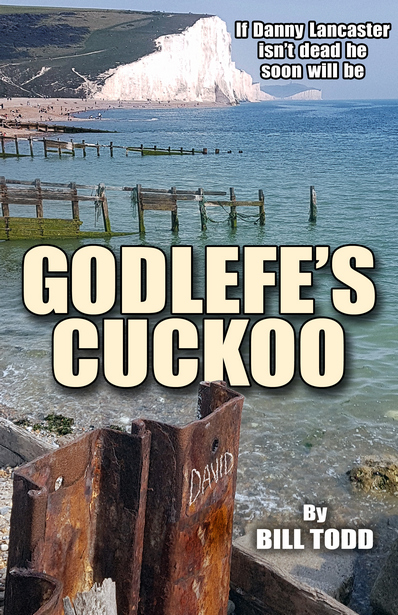
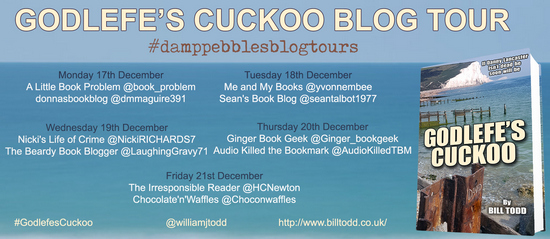
Godlefe’s Cuckoo by Bill Todd: A Deadly Game of Hide-and-Go-Seek

Godlefe’s CuckooGodlefe’s Cuckoo

by Bill Todd
Series: Danny Lancaster, #6

Kindle Edition, 270 pg.
DLE-Fiction, 2018

Read: December 19 – 20, 2018

He lit another cigarette. Popped the ringpull on another can of Stella.

This was pointless.

He could sit here forever debating the pros and cons like some poncy intellectual while all the time he knew what he would do.

Fuck it, those bastards had to be sorted out.

Anyway, you had to die of something.

So Danny Lancaster is a former soldier, injured in the line of duty — leaving him with one prosthetic (see also, Cormoron Strike). He didn’t seem to know what to do with himself after leaving the army and ended up a small-time criminal who did a little time in prison. Then he started working as a P. I. (I’m not sure if he could have officially done that given his record, but I don’t know). He seems to have skirted the edge of legality through this career — helping the police frequently, but a known associate of noted criminals (see also, Rebus and Big Ger). The picture I get is of a less intellectual, more violent, and less alcoholic Matt Scudder.

Given that this is Book 6 in a series, Danny Lancaster is a pretty established character and the novel doesn’t spend a lot of time exploring the character, mostly it’s just using him. Which makes sense, especially given the plot — but that means I have to rely a bit more than I normally would on extrapolating from what we’re given and comparing him to better known characters.

When the book opens, he’s been missing — presumed dead by many — for months. There are some hoping he’s still alive, who wish the police (or someone) would find him. There are some who are convinced (hoping?) he’s dead, and are fully prepared to leave him this way. And then there’s one person who is convinced he’s alive — and will continue to be convinced until he sees a body — and he’s determined to find Danny.

The problem is that this man is a Russian mobster, with a lot of money, a lot of power — and no patience or much time to live. Shortly before the “accident,” Danny had disrupted this Russian’s smuggling enterprise and he wants revenge. His associates in England pursue a particular strategy to bring Danny out of wherever he’s hiding — they start killing people associated with him, and will continue to do so until it works. They do this in such a way that it takes the police a long time to realize that’s what’s going on (and no one believes the first one to come to this conclusion).

Once Lancaster realizes what’s happening, he takes definitive steps to bring this to an end. Now that the prey has been flushed from cover, it becomes a matter of hunter vs. the hunted (I’m not sure which is which, really). The action scenes are great, and it’s easy to see why Danny Lancaster (the series or the character) have made it through five books already.

Most of the characters, like Lancaster, are clearly previously drawn and established. There are plenty of them, too. Again, if I knew them, I could appreciate their appearance and use. Those characters that are used for the first time I have a strong handle on and appreciate for.

I’m convinced that I’d have enjoyed this more than I did if it wasn’t my first Danny Lancaster book. That said, you can absolutely read this as an entry point to the series — it won’t work as a stand-alone, you’re going to want to read a possible seventh, and at the very least to go back and read the previous five. I just don’t see anyone reading this and thinking, “yeah, I’m done now.” I didn’t fully appreciate everything that happened here, but I could tell that long-time readers would and that there was something about these characters that could inspire loyalty and excitement.

I liked it, I think I should’ve and could’ve liked it more, if I’d only done my homework. Give it a shot — or better yet, read some of the earlier books and you’ll like this all the more.

—–

3 Stars

My thanks to damppebbles blog tours for the invitation to participate in this tour and the materials they provided (including the book).

BOOK SPOTLIGHT: Godlefe’s Cuckoo by Bill Todd

Today I welcome the Book Tour for the thrilling Godlefe’s Cuckoo by Bill Todd. Along with this spotlight post, I’ll be giving my take on the novel here in a bit.

Book Details:

Book Title: Godlefe’s Cuckoo by Bill Todd
Publisher: DLE-Fiction
Release date: March 10, 2018
Format: Paperback/ebook
Length: 270 pages

Book Blurb:

Danny Lancaster has been missing since the fishing boat exploded. Police are closing their inquiry but Wanda Lovejoy continues her campaign to find the truth. An evil man kept alive by machines nurses a corrosive hate. As drugs and disease pull his dying mind apart he throws his crime empire into a scorched earth quest to find one man. If Danny Lancaster isn’t dead he soon will be.

About Bill Todd:

Ruth SuttonI’m a journalist and travel writer who has visited more than 40 countries from the white wastes of Arctic Finland to the ancient deserts of Namibia. Love a good wilderness. I received the Ed Lacy travel award in 2007.

I’ve written six crime thrillers featuring soldier-turned-investigator Danny Lancaster and was startled and delighted to be voted one of the 100 best crime authors in the WH Smith readers’ poll in 2015. I’ve also written three short factual military histories. I live to write although keyboard time has been cut lately with the arrival of grandson Theo.

Bill Todd’s Social Media:

Twitter ~ Facebook ~ Website ~ Instagram ~ Amazon Author Page

Purchase Links for Godlefe’s Cuckoo:

Amazon UK ~ Amazon US


My thanks to damppebbles blog tours for the invitation to participate in this tour and the materials they provided.

The Everlasting Story of Nory by Nicholson Baker: A Look at Life through the Eyes of a 9-year-old Girl

The Everlasting Story of NoryThe Everlasting Story of Nory

by Nicholson Baker

Hardcover, 226 pg.
Random House, 1998

Read: December 17 – 18, 2018

Sometimes the problem with telling someone about a book was that the description you could make of it could just as easily be a description of a boring book. There’s no proof that you can give the person that it’s a really good book, unless they read it. But how are you going to convince them that they should read it unless they have a glint of what’s so great about it by reading a little of it?

When I read these musings of a little nine-year-old girl, all I could think was, “Welcome to my world, kid.” Seriously, what book blogger hasn’t had that thought at least once a week? If this hadn’t been set in the mid-90’s, Baker might have been tempted to have his protagonist take to blogspot to talk about her favorite books (which I absolutely would have read).

Nory, her parents and her two-year old brother have moved to England from Palo Alto, CA, where she attended a Chinese Montessori School. She’s now attending a Roman Catholic school with grades and a structured curriculum. Which isn’t an easy transition for her (as you’d expect). As she’s an “Americayan” with a strange accent and difficulty understanding British phrases, she’s on the outside of her school’s social structure.

This is rough for her, but I think it’d be rougher for other kids. Nory has an incredibly vivid imagination and tells herself stories (some of which she writes down, some she enacts with dolls and toys, some of which she just says to anyone who might be around). They are intricate, inventive, and as entertaining as the parts of the book that are about Nory (arguably more so). When times are tough, when she’s bored, when she needs to entertain her brother, when she has trouble sleeping — these stories are there for her. The reader gets to go along for the ride with her — which is a nice bonus.

When she’s not making up stories (or opining on the construction of them), she’s struggling through school and through the mine field that is making friends, and searching for a best friend. There’s a girl who frequently seems to like Nory, but would appreciate it if Nory would change a few things. There’s another girl who is bullied, teased, and generally disparaged by the rest of her class. Nory very unsuccessfully tries to defend her, but mostly just tries to be friendly to her.

And that’s the bulk of the book — there’s some “slice of life” stuff with her family, some parts where Nory remembers Palo Alto and the Chinese Montessori school — that kind of thing. But mostly it’s the tale of a few months of a 9 year-old looking for a friend, trying to stay out of trouble in a school she doesn’t understand and playing with her dolls.

Nory is a girl of opinions — some of them very strong. She has very definite ideas about storytelling, and what’s necessary to a successful story or book. Ironically, this book fails Nory’s own tests due to its lack of plot, and relatively small stakes. That’s probably an intended irony, and Baker’s really saying that people like me that want plots like Nory insists on have child-like tastes. I don’t know that to be the case, but I’d be willing to put money on it.

It’s told in third-person, but the narration is very stream of consciousness, very nine-year-old stream of consciousness — bouncing all over the place with a short attention span, and nine-year old misunderstandings of life around her. It’s delightful to read, and only a little annoying when you pause to reflect on what’s happening (or better, what’s not happening). In the moment, it’s just fun to surround yourself with Nory’s thoughts.

I won’t say this is a must-read, but if you give it a shot, I can’t help but think you’ll be rewarded. It’s perfectly safe for anyone Nory’s age or older to read, but I can’t imagine many people Nory’s age will appreciate it (but I could be wrong). It’s better appreciated by those of us who can remember some of what it’s like to be her age. I liked it, am glad I tried it and I expect you will be, too.

—–

3 Stars

Blackwater by GJ Moffat: A Brutal and Gripping American Crime Story

BlackwaterBlackwater

by GJ Moffat

Kindle Edition, 292 pg.
Fahrenheit Press, 2017

Read: December 14 – 15, 2018

           Early went to [redacted]’s body and hunkered down in front of [redacted]. His skin was flaccid and his jaw and face swollen and misshapen from the effects of his injuries. His shirt was entirely soaked in blood.

Early shook his head, thinking: this is what men do.

Take Walt Longmire (Deputy Longmire, before Lucian Connally’s retirement) throw him into Jesse Stone’s Paradise, and then tell a story imbued with the spirit of Fargo (movie or show), your results will be pretty close to GJ Moffat’s stunning Blackwater.

It’s a tale of violence, bloodshed, power, inevitability and death — what men do.

Deputy Sheriff Early Simms of Blackwater County is the son of the previous sheriff and probably the only member of the Department really fit for the job. A tragic accident in High School changed the direction of his life, and as a result he’s in the same dying New England area he grew up in. He’s made peace with this, and even seems to be happy — he’d be happier if his boss (and colleagues) cared a bit more about the job and his father wasn’t battling Alzheimer’s, sure. But this is his life.

And then everything changes in a couple of days — his old high school flame (and love of his life) returns to town, there’s an investigation into a corrupt public official, an investigation into an assault/attempted murder at a nearby jail, and a couple of brothers on a killing spree have come to the region. There’s also some drug running, spousal abuse, a pretty nasty bar fight. I don’t want to say that Early Simms is the only one investigating the crimes, in trying to preserve the peace — there are three (that we know of) other members of the Sheriff’s Department, some other local law enforcement officers and some FBI agents running around. But Early’s the only individual who’s in each of the stories — he’s the region of intersection in the Venn diagram of Blackwater (and frequently the most capable person around).

One of the criminals we meet in these pages (not saying which one) is clearly not an evil man. There’s some sort of undiagnosed (by the author or by any professional this criminal has ever encountered) mental health issue affecting him. Which does not lessen the evil he does and the trauma he inflicts on others. Part of me wants to know more about the whys, hows, wherefores, and whatnot about this disorder and is a little frustrated that Moffat doesn’t give us any of it. The other part of me is so glad that he didn’t succumb to temptation to get into tall that, instead merely showing his readers what was going on with this man, leaving it to us to do the work. There’s someone else who probably has some sort of Traumatic brain injury symptoms — not quite the same, but some of the same results.

We also see crime perpetrated by someone motivated by power, money and meanness. Also, there are some criminals who just don’t seem to have options, means or inclination to do anything but break the law. It’s up to Early to face down these people, no matter where on the spectrum they seem to be found, to prevent them from inflicting too much harm on the community.

How successful he is at that, well . . .

Moffat can write. That’s all there is to it. It took almost no time at all to recognize that. You get a strong sense of every character in just a few lines and his world is as fully realized as you could hope for. He presents the evil Early sees and fights against in this book fairly realistically, in a way that is as capricious and destructive as anything you see on the news.

So many times — almost every chance he gets — Moffat will do precisely what you don’t expect. What people just don’t do in this kind of book. He’ll put the characters in a situation you’ve seen dozens of times before, and just when you think “X will happen right after I turn the page,” B happens before you can turn the page. I realize there’s a danger in saying that — you’ll be looking for that kind of thing. But I expect that the same thing’ll happen to you as it did to me every time he pulled the rug out from under me — you’ll get sucked in by his writing and the characters (and possibly still be reeling from the last shock) and you won’t even think to expect that he’ll do it again.

I finished the book I was reading before this earlier than I expected to, and didn’t have the next on my list with me, so I took the opportunity to pay a visit to what I call my Kindle’s “Fahrenheit Ward” — where I stick all the Fahrenheit Press books that I buy without time to read — and I grabbed this. I’m so glad my timing worked out that way — this is exactly what I needed. I got sucked in by this immediately, and it was practically impossible to put down. Before I got to the novel’s final confrontation(s), I jotted in my notes, “Man, I hope this isn’t the first of a series — I don’t know if the community can survive another book.”

But if Fahrenheit published a sequel today? I’d shell out cash before the end day. I strongly expect you’ll feel the same way once you recover from Blackwater.

—–

4 Stars

GUEST POST – The Open Road Awaits: Your Guide to Literary Road Trips

I’m very happy to have this guest post today — and not just because I need some time to finish a couple of things you won’t see for a few weeks. I love a nicely designed (and informative) infographic and this one hit the sweet spot for me. When I was asked if I’d be interested in posting this, I jumped on it. Give this a read and check this out. Then maybe plan a trip?
—
Literary Road Trips Across AmericaScott Fitzgerald, Jack Kerouac and Tom Wolfe…

These are a handful of renowned authors responsible for writing some of the most iconic books we know and love. The sources for their inspiration came from their life experiences, including some at the heart of American culture—road trips. From adventures lasting ten to over one hundred hours, these famous works of literature account for the national parks, cities and cultural events each author explored.

For example, On the Road, by Jack Kerouac, follows the story of Sal Paradise and his friends. The crew of young, broke hippies in love with life travel from New York to San Francisco. Through his young characters’ adventures, Kerouac’s work captures the spirit of freedom and the American dream. The narrative draws from Kerouac’s personal experiences traveling across the country.

The experiences of many authors are brought to life through the words crafted in their stories, making it incredibly difficult to put these books down. And each year, thousands of Americans, inspired by wanderlust and words, set out on their own adventures. The freedom of a cross-country road trip, whether on your own or with a group of close friends, never fails to enchant. There’s something intensely clarifying about hitting the open road. You’re suddenly able to disconnect from the routines of everyday life. You become what’s happening in that moment. You are living outside time.

Inspired by the need for adventure and the words of iconic authors, CarRentals created a guide to literary road trips across America. Instead of simply living them through the pages of your favorite novel, you can set off on routes that follow the narrative arc of six iconic books. Create new stories of your own by exploring the paths of these famous American authors. The road awaits!

The United Smiths of America by Jon Voss: I read it so you don’t have to.

The United Smiths of AmericaThe United Smiths of America

by Jon Voss

ePub, 371 pg.
2018
Read: December 12 – 14, 2018

This is going to be rough, but I promised to write this, so here goes . . .

Ten citizens of the U. S. wake up in a shipping container. They’re wearing something akin to prison jumpsuits, and a collar. They have no idea where they are, they have no idea how they got there, or who anyone with them is. They are told that they have 10 hours to defeat 9 other teams, made up of people from 9 other regions (some single-nation, others geographic groups) to win $1 billion. There are a couple of vehicles provided for them, and a lot of weapons (that they have to figure out how to use). Oh, and those collars are equipped with C-4 in order to assure they’ll comply.

Hunger Games meets the Amazing Race (or something). The Americans are all named Smith — a sign that they’re random nobodies — and each team is full of equivalents — Garcias, Suzukis, Ivanovs, etc. (these are not necessarily the names, I refuse to open the book again to check and see). Each chapter covers ten minutes or so of the ten hours they have to fight or die.

I did not enjoy a single moment of this experience. When I wasn’t bored, I was offended. When I wasn’t offended, I was discouraged by the writing. I walked away from each session disappointed and dreading returning to it. I’m not saying it ruined my life for a couple of days, but it sure made things unpleasant.

The “humor” (I think there were bits that were supposed to be humorous) was juvenile, puerile, and not funny. To say that the characters from various nations were walking stereotypes would be generous, more than one were also racist — oh, and someone (a fairly educated character) described (presumably white) Australians as a “race.” Which was news to me. One, I stress one of the Smiths came close to being more than two-dimensional and worth reading about — no other characters (no matter their nationality) came close. The story as a whole makes 80’s action films like Iron Eagle look subtle and nuanced. The author uses italics and all-caps to show emotion in dialogue, which should have been the first sign that I need to bail on the book.

The sex scene gives new meaning to gratuitous. I mean . . . ugh.

The fight scenes — and there were many, just not as many as you might expect — were decent, though.

I pushed on to the end because 1. I’d told the publicist I’d read this piece of garbage; 2. I was curious about the point of it all (and yes, you have to get near the end to find it); and 3. I wanted to see if there was anything redeeming to be found in the book. The results were, not surprisingly, disheartening. 1. I can’t imagine that group will want to work with me again; 2. The point is . . . maddening, convoluted, and uninspired; and 3. Nope.

Don’t. Just don’t. If any of you have a time machine and would like to use it to stop me, leave a note in the comments and I’ll give you a time, date and address.

Disclaimer: I received a copy of this novel in exchange for this post from a publicist who will probably not appreciate this post at all. Sorry about that.

—–

1 Star

✔ Read a book that takes place in one day.

Saturday Miscellany – 12/15/18

It’s still technically Saturday. Especially in my time zone…. Nothing wrong, just one of those days. So, here’s a few odds ‘n ends over the week about books and reading that caught my eye. You’ve probably seen some/most/all of them, but just in case:

    I actually didn’t see any new releases this week that made me sit up and take notice. I probably missed some good ones.

Lastly, I’d like to say hi and extend a warm welcome to Jenniely, Pinklotus76 and Word Hunter for following the blog this week.

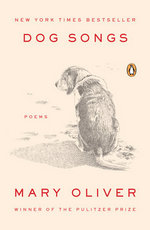
Dog Songs by Mary Oliver, John Burgoyne: A combination of one of my favorite topics and least favorite form

Dog SongsDog Songs

by Mary Oliver, John Burgoyne (Illustrator)

Paperback, 121 pg.
Penguin Press, 2013
Read: December 6 – 11, 2018

Be prepared. A dog is adorable and noble.
A dog is a true and noble friend. A dog
is also a hedonist.

I don’t know if I’ve posted about poetry here before. Probably not. Despite many attempts (when I was younger) — including a few classes, I’m just not a poetry guy. I can appreciate the occasional poem — and there are a few poets I can really get into, but on the whole? Not my thing.

But part of the 2018 While You Were Reading Challenge, was to read a collection of poetry — and I came close to grabbing an Ogden Nash book off my shelves, but my wife had been given a collection a year or so ago of poems about dogs. And it’s been at least a month since I posted something about dogs, so it’s about time.

So yeah, there are 35 poems about dogs — most of them (all of them?) seem to be based on Oliver’s own dogs — a couple of dogs get a handful of poems about them. Those, obviously, you get a pretty good idea about. Otherwise, it’s just one-shots about some great-sounding dogs.

Oliver does a great job conveying a strong impression about a dog in just a few lines — or even a few words. “He was a mixture of gravity and waggity” is one of the best lines I’ve read in 2018. I do think she goes over the top in terms of the wisdom or deep knowledge, etc. of dogs. But when she focuses on behavior, or personalities of specific animals, I find her pretty entertaining — and even moving.

I’m not saying that I’m going out to grab every Oliver collection in print or anything, but I liked most of these poems — several of them I liked a lot.

There’s also one essay in this slim volume. Skip it. Oliver is a poet, not an essayist.

Does this book need Burgoyne’s illustrations? Nope. But they’re nice to look at, so I’m not complaining. I’d be more than happy to hang some of these around the house.

—–

3 Stars

✔ Read a collection of poetry.

Page 430 of 633

Powered by WordPress & Theme by Anders Norén