Author: HCNewton Page 437 of 624

Ways to Die in Glasgow by Jay Stringer: Three distinct and entertaining voices take you on a tour of Glasgow’s underbelly

Ways to Die in GlasgowWays to Die in Glasgow

by Jay Stringer
Series: Sam Ireland Mysteries, #1

Kindle Edition, 289
Thomas & Mercer, 2015
Read: July 21 – 22, 2018

Inside the front door of the building, I checked the directory, looking to see which floor the firm was on, only to find that they used all of it. The recession hadn’t reached this far up the street. The reception area was decorated in muted shades of black and tan. Anything that didn’t share that colour scheme was made of glass. A woman who was far too young and far too skinny greeted me. She took my name and waved me into a large waiting area.

She didn’t whisper that she was a child slave or beg for help.

She didn’t ask if I could sneak her a cheeseburger.

So we are just dropped into the action here, no background, no setup, no idea who this guy narrating things is — the very definition of in media res, and, come to think of it — we are also dropped into the very definition of coitus interruptus. In this particular case the interruptus takes the form of a couple of guys trying to kill our narrator. Somehow, Mackie (the narrator) escapes — though injured — and seeks shelter at his Uncle’s place — which turns out to have been recently tossed by persons unknown (the people that came after Mackie?), and his Uncle Rab is nowhere to be found. Mackie gets patched up by his therapist and the two head out to search for Rab.

Once that’s underway, we jump back a couple of hours in time to meet our second narrator, Sam Ireland. Sam’s a newish Private Investigator who made a little splash in the news recently and is working enough to keep going, but not enough to pay rent on the office. So the office is now her apartment. It’s her father’s firm, but he’s in a retirement home and Sam’s trying to keep it alive — with a little help from her brother. Sam’s got an appointment with a potential new client, who insists on very strange meeting times (e.g., 11:23) — it’s the law office described in the quotation above. They’d read about her in the papers and wanted to hire her for some things, but first they want a test run — they’d like her to deliver some legal papers to a local celebrity author. As Sam says “…a Glasgow celebrity. . . is one way of saying dangerous.” He’s writing true crime memoirs now, and there’s a problem with his latest book so they need to serve him with papers — but can’t find him, can Sam? For the price they’re willing to pay, yes, yes she can. The celebrity’s name? Rab Anderson.You begin to see the fun here.

It turns out that our third narrator, DI Lambert, also has a vested interest in finding Rab. But there’s the tiny little thing called a job that is interfering. There’s a suspicious death that he really wants to write off as a suicide, but the guys from the Lab won’t let him. He also has connections to our other narrators. He’s a friend of Sam’s and will occasionally bend a rule or two to help her with some information. He’d also arrested Mackie some years back on a pretty serious charge.

The novel is told bouncing back and forth through each of these narrators (sometimes the same scene is retold from a different perspective) — there’s a little bit of shifting back and forth through time to keep everyone at about the same point, but it’s easy to follow. Each of these narrators has a great and distinctive voice — you really don’t need the chapters to tell you who is “speaking” you get it within a sentence (not that I mind the help). I could easily read an entire novel from one of their perspectives — Lambert’s wouldn’t be as entertaining as either Mackie’s or Sam’s, but it’d still hold up. Bringing these three voices — from radically different backgrounds, education, age, experience, vocation — but all representing Glasgow. Mackie’s a great, great character — he’s the first we get to know in this book, and in many ways, he’s the heart. But Sam’s the star — she’s stubborn, reckless, clever, and resourceful. That doesn’t quite make up for the fact that she’s a small woman with little ability to defend herself — but she frequently has her large brother along to offset that.

One of my favorite parts of John Wick was how we’re dropped into this extensive underground world with relationships, rules, alliances and whatnot — as the film goes on we grow to understand them. Something very similar is at work in this novel — we don’t have a point of entry character, really (Sam’s close), we have nothing really to get us oriented in this reality other than what happens when the characters interact and what we learn from that. This is a rich world full of many colorful, dangerous people. It’s not long before we move beyond the hunt for Rab and dive deep into the murky waters surrounding him, Mackie and Lambert — and hope that at least someone is able to survive before Sam gets drug under as well.

That metaphor may have gotten away from me. But oh well . . .

This is a violent book — make no mistake. It’s a visceral blood bath at times — and its disturbing. But honestly? The hard scene to get through had no blood, no guns, knives or anything. It was a chapter where a father thinks about the trouble his daughter is in and what he can do to help her — it’s a couple of pages long, helps build the tension, it deepens the mystery, and just breaks your heart. Give me a dozen bloody corpses any day over that.

If there’s one thing I’ve learned from Kate McCall and Sam Ireland, it’s that daughters should not take over their father’s PI business unless they’re ready to learn a lot about their father that they didn’t want to know. It’s possible that’s true for daughters taking over any business of their father’s — I’m not sure, I should probably read more about them, but I don’t recall a lot of novels being written about daughter’s taking over for their father’s CPA firm or pizza parlor or dry cleaning business. There’s a pretty big difference between these two ladies (there are plenty of similarities, now that I think about it, too). Kate is surrounded by oddballs, eccentrics, and actors up for anything who are generally good-natured and willing to help her. Sam is surrounded by people she can’t trust, people she shouldn’t trust, a brother who has to be harassed into helping her out, a maverick cop, and a whole lot of shady characters — all of whom (except the brother and probably the cop) would be just as likely to drop her in a grave as they would be to lend her a helping hand.*

I thoroughly enjoyed this book and am definitely coming back for more from Stringer. It’s twisty, it’s violent, it’s got a lot of heart, it’ll put a smile on your face and get you to come back for more. Check out this unique look into Glasgow.

* This isn’t to knock McCall & Co. — I actually rather enjoyed the book, and plan on reading the rest of the series soon. It was just a parallel I thought of when reading this.

—–

4 Stars

Saturday Miscellany – 8/4/18

Odds ‘n ends over the week about books and reading that caught my eye. You’ve probably seen some/most/all of them, but just in case:

    I didn’t see any new releases this week that really appealed to me — as is generally the case for a fifth week of the month. More time to catch up.

Lastly, I’d like to say hi and extend a warm welcome to http120111324 (which is one of the stranger monikers I’ve come across online, which isn’t a bad thing), Clarissa, and Jenn for following the blog this week.

The Blue Kingfisher by Erica Wright: Kat Stone — and her wonderful wigs — are back for more danger

The Blue KingfisherThe Blue Kingfisher

by Erica Wright
Series: Kathleen Stone, #3
eARC, 320 pg.
Polis Books, 2018
Read: August 1, 2018

So, Kat Stone, private investigator, is trying something new — she’s being herself. No disguise, no wig, no fake name (well, most of the time). There’s no need, the person she was hiding from has found her. He hasn’t done anything about it — but there’s no need to go to extra effort. But she’s not used to just being Kat Stone anymore — and that’s going to take a little work.

One morning, Kat finds a body — a body in horrible shape in the shadow of the George Washington Bridge. While waiting for the police, she recognizes the body — the maintenance man from her apartment building, Tambo Campion. The police are quick to dismiss the death as a suicide, but Kat’s unconvinced. Why would someone trying to kill themselves miss the water so completely?

This, of course, isn’t enough. So she ignores paying customers for a bit to launch her own investigation, trying to find more evidence. She doesn’t necessarily have to find the murderer, she just needs more evidence to get anyone in the NYPD to take her seriously enough to investigate his death. She plunges into Tambo’s life — partially driven by guilt that she didn’t pay him enough attention in life. It turns out that Tambo is a kingfisher, someone who finds jobs for people who aren’t in the country legally or who are wanting to stay off-the-radar, for a fee. This alone provides several avenues of investigation. But there are others, too, don’t get me wrong. All of these take her into all sorts of corners of NYC society — and gives her an excuse to dabble in different identities.

The NYPD requirement of “more evidence” is a trigger of sorts for her. It reminds her of the constant refrain from her superiors during her undercover days at the NYPD. They always wanted more evidence — even when she becomes concerned for her own safety, they say she hasn’t done enough, she needs more evidence to bring down Salvatore Magrelli. Between the Magrelli knowing where she is now, and this requirement, Kat spends a lot of time ruminating on the times she felt most threatened by Magrelli — and the things she didn’t provide enough evidence on. While she has several other things going on in her life, these are the thoughts that dominate her attention.

As interesting as the murder case is, obviously, it’s the Magrelli (past and present) stories that provide the major emotional hook for this novel. Even while she’s meeting with success at Kat Stone, even when she finds evidence of a crime — multiple crimes, actually. She can’t get out of the shadow of her past or the threat of the present.

I failed to get around to reading the first book in this series, after reading The Granite Moth, which really bugs me, so I can’t really comment between the ties between it and this book, but I’m reasonably certain there are some. Characters from The Granite Moth show up here and events from it are discussed as well, which is always nice, too many PI novels ignore what happened before. I don’t know (but I can’t imagine) that too many people from The Blue Kingfisher will show up down the road, but I’ll be happy to see any of them that do. But several events from this book will show up soon.

I remembered liking Kat Stone – I didn’t remember how much or why I did, and I’m very glad I got to rediscover her. Kat is clever, very clever when she’s not distracted. She’s resourceful. She may not have the skills of Lori Anderson or even Charlie Fox when it comes to weapons or hand-to-hand, but she’s got a mental toughness that’s hard to beat. And I really hope to see how she moves forward — because there’s just no way that what comes next is going to look too much like what’s come before, and I’m very curious about that. The New York she travels in isn’t the one I’m used to seeing (it’s not so different that I don’t recognize it) in Crime Fiction, and the way she sees the world is a fresh perspective.

The writing in this one — and this is not a knock on The Granite Moth — feels more disciplined, the plot more controlled. I took it as a sign of growth, that whatever Wright intended to accomplish in this book was clear to her and she executed things to that end. I’m almost more curious about what she’ll do next than what Kat will do next. Almost.

This isn’t a criticism, this is more of a wonderment: There is a lot of time spent on Kat’s affection for New York City. Do people spend a lot of time doing that, really? Thinking about how much they love/appreciate the town they live in (assuming they do)? Her leaving town was brought up once — indirectly — but it wasn’t like anyone was really suggesting that to her — and even after she made it clear that it wouldn’t happen, there it is again, her love for NYC. I could see it fitting in if people were actively trying to get her to move, or if she’d just returned after some time away (on a job, in self-appointed exile, etc.) — but given her situation, it felt forced. Now, I liked the way she expressed it, and I can understand her affection (theoretically, anyway, I’ve never been there). It just seemed out-of-place and/or unnecessary.

This is a good, satisfying PI novel with a protagonist that you will definitely enjoy. Like its predecessor, it’s a decent jumping on point for a new reader, and a welcome return to the world for someone who’s met Kat before. I’m eagerly awaiting the next book in this series already.

Disclaimer: I received this eARC from Polis Books via NetGalley in exchange for this post — thanks to both for this.

—–

3.5 Stars

Reposting Just ‘Cuz: Skyfarer by Joseph Brassey

Last night I found myself reading when I “should have been” writing — which meant that by the time I finished, there wasn’t time enough to really get anything ready for today. Well, today, I find myself almost at the half-way point in the sequel to this outstanding book, the possibly more-outstanding (outstandinger?) Dragon Road. But I can’t talk about it yet, which is what I really want to do. So instead, let me once again post this little nugget.

SkyfarerSkyfarer

by Joseph Brassey
Series: Drifting Lands, #1
eARC, 352 pg.
Angry Robot Books, 2017
Read: August 11 – 14, 2017

I’ve read a few interesting mergers of SF and Fantasy this year — some that were just that, interesting, some that were good — a couple that were more than good. Thankfully, Brassey’s Skyfarer was in that latter camp. Even in those early chapters where I was still trying to figure out the world, remember which name lined up with what character, and get a handle on the plot, I had a sense that this was going to be one of those books I talked about very positively — and very often. That sense just only got stronger as the book went on.

I feel like could go on for pages about this book — but won’t let myself (so I can avoid the wrath of Angry Robot and you can actually get something out of reading it yourself — which you have to go do as soon as it comes out).

So you’ve got this group called the Eternal Order — a group committed to death, destruction, power, and plunder. When it comes to numbers, they can’t stand up to the civilizations around them, at least when they ally themselves against the Order. But when they (rarely, it seems) can come in with a quick strike against one people they can wreak much havoc. Which is exactly what they do here — they come in and demand that the rulers of Port Providence hand over the Axiom Diamond, or they will wipe them out — and it’s clear that Lord Azrael, the commander, isn’t being hyperbolic. The royal family responds with armed resistance, which has some measure of success, but is primarily fighting losing battles.

Into the midst of this looming genocide comes a wayward spacecraft, the Elysium. The Elysium is a small carrier with more weapons than one should expect (we’re initially told this, anyway). The crew has just welcomed an apprentice mage, fresh from the academy, to complete her studies with her mentor/professor. Aimee de Laurent has been pushing herself for years to excel, to be the best — if there’s a sacrifice to be made for her studies, she’s made it. All leading up to this day, where her professor, Harkon Bright has taken her as an apprentice on his exploration ship to complete her education. She joins a crew that’s been together for years and is eager to find her place within them.

When the Elysium arrives in the middle of this, it doesn’t take anything approaching calculus for them to figure out what this particular crew is going to do. There’s The Eternal Order on one side, civilians and the remnants of the military on the other. There’s a ravaged civilization on one side and the ravagers on the other. There’s a group trying to prevent The Eternal Order from getting something they want and there’s, well, The Eternal Order. So our band of adventurers tell the remnants of the royal family that they’ll hunt down the Axiom and protect it.

This isn’t exactly a revolutionary idea for a story — but man, it doesn’t matter. There’s a reason everyone and their brother has tried this — it’s a good story. Especially when it’s told well. And, I’m here to tell you that Joseph Brassey tells it really well. Not just because of his hybridization of SF and Fantasy, but because he can take a story that everyone’s taken a shot at and make it seem fresh, he can deliver the excitement, he can deliver the emotion. There is some horrible stuff depicted — either in the present or in flashbacks; there’s some pretty tragic stuff; and yet this is a fun read — the pacing, the tone, everything makes this feel like the adventure films and books that I grew up on. You want to read it — not just to find out what’s going to happen next, but because it’s written in such a way that you just want to be reading the book, like a having a glass of iced tea on a summer’s day.

The characters could uniformly use a little more fleshing out — which isn’t a weakness in the writing. Brassey pretty much points at the places where the reader will more details (especially when it comes to Aimee and Harkon), making us want more than he’s giving us. What we’re given, though, is enough to make you root for or against them, hope that they survive (or are subjected to painful and humiliating defeat), or simply enjoy the camaraderie. The good news is, that there’s more to learn about everyone — about their past and their present — and how those shape their future.

You’ve got magic — various schools of magic, too, each with its own understanding of what magic is and how it can be used; you’ve got swords and lasers (and similar kinds of weapons); you’ve got space ships running of magic (not just hyperspace drives that act like magic); objects and persons of prophecy; beings and intelligences that aren’t explicable — tell me why you wouldn’t want to read this? Especially when you throw in epic sword fights, magic duels, and spacecraft action all written by someone who writes like a seasoned pro. Sign me up for the sequel!

Disclaimer: I received this eARC from Angry Robot Books via NetGalley in exchange for this post — thanks to both for this.

—–

4 1/2 Stars

July 2018 Report: What I Read/Listened to/Wrote About

I’ve had a little time on my hands lately, so I’ve gotten a few more books read than usual — but fewer audiobooks. The downside to a reading burst is that it’s difficult to keep up with the posts about what you read. Oh well . . . worse problems to have.

So, here’s what happened here in July.

Books/Novels/Novellas Read/Listened to:

Doctor Who: Christmas Invasion Needle Song My Lady Jane
3.5 Stars 5 Stars 4 Stars
Planet Funny The Affectionate Theology of Richard Sibbes Besieged (Audiobook)
3.5 Stars 3 Stars 3 Stars
Marked An Obvious Fact (Audiobook) The Day That A Ran Away
4 Stars 3 Stars 4 Stars
The Death Pictures Heaven on Earth Small Favor (Audiobook)
3.5 Stars 3 Stars 4 1/2 Stars
Nightwolf Arsenal Colorblind
4 Stars 3.5 Stars 4 1/2 Stars
Lessons From Lucy The Long Way to a Small, Angry Planet True Fiction
5 Stars 4 Stars 4 Stars
Ophelia Immune Ways to Die in Glasgow The Puppet Show
3 Stars 3.5 Stars 4 Stars
Doctor Who: Twice Upon a Time Between the Shade and the Shadow A Mint Condition Corpse
3.5 Stars 2 Stars 5 Stars
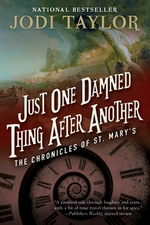
The Passenger Boise Longpig Hunting Club  Just One Damned Thing After Another
3.5 Stars 3.5 Stars
(maybe more..)
4 Stars
Picket Town Eleanor Oliphant Is Completely Fine      
3 Stars I’m not sure yet      

Still Reading:

The Holy Spirit Dear Mr. Pop Star Scoundrels Among Us
The Life and Theology of Paul            

Reviews Posted:

Book Challenge Progress:

Angel's Guilty Pleasures My Lady Jane (Audiobook) by Cynthia Hand, Brodi Ashton, Jodi Meadows, Katherine Kellgren
Planet Funny by Ken Jennings
Besieged (Audiobook) by Kevin Hearne, Luke Daniels
An Obvious Fact (Audiobook) by Craig Johnson, George Guidall

Planet Funny by Ken Jennings
Doctor Who: Christmas Invasion by Jenny T. Colgan
Arsenal by Jeffery H. Haskelll
The Long Way to a Small, Angry Planet by Becky Chambers
Ophelia Immune by Beth Mattson
Ways to Die in Glasgow by Jay Stringer (link to come)
The Puppet Show by M. W. Craven (link to come)
Between the Shade and the Shadow by Coleman Alexander
Boise Longpig Hunting Club by Nick Kolakowski (link to come)
Just One Damned Thing After Another by Jodi Taylor (link to come)
Picket Town by Chris von Halle (link to come)
Eleanor Oliphant Is Completely Fine by Gail Honeyman (link to come)
Nightwolf by Willie Davis

Arsenal by Jeffery H. Haskell
Ophelia Immune by Beth Mattson
Between the Shade and the Shadow by Coleman Alexander
Boise Longpig Hunting Club by Nick Kolakowski (link to come)
Picket Town by Chris von Halle (link to come)
Nightwolf by Willie Davis
Needle Song by Russell Day
A Mint Condition Corpse by Duncan MacMaster (link to come)

Another month with nothing for this one…not feeling good about it.

How was your month?

Picket Town by Chris von Halle: An Age-Appropriately Creepy SF for the MG reader in your life

Picket TownPicket Town

by Chris von Halle

PDF, 178 pg.
Clean Reads, 2018
Read: July 31, 2018

Amanda is bored. Every day is the same — her life isn’t bad, she actually likes it. But she wants more. She’s not sure exactly what it is that she wants — but it’ll be found outside the city limits of New Pines (she calls it Picket Town). She and her friend Sam spend their days after school playing a computer RPG, eating with their families, playing the game some more and repeating the whole thing the next day.

Then something starts happening — some of the kids in town come down with some sort of bacterial infection that requires them to be hospitalized while a cure is worked on. Amanda starts to wonder if everyone is going to be okay — no matter how often she’s assured that the grown-ups have everything under control. She wants to strike out, she wants to learn something — and on the way home from school, they pass the same sign forbidding them to enter the forest that they walk by every day. But this day, this particular day she decides she’s had enough — and then she convinces Sam to come with her. They climb over the fence and explore the forest. This is the most thrilling thing they’ve ever done. Right up until the point that they find a what appears to be a flying saucer (well, a saucer that’s landed). Pretty much everything they’ve ever known ends right there. What follows is exciting, dramatic, and unexpected (well, at least for the target audience — Middle Grade — adult readers will have a pretty good chance of seeing what’s around the corner, most of the time).

I wasn’t so sure that I was going to enjoy this at the beginning, I’m not sure why, it just didn’t seem like it clicked. But it honestly didn’t take long before it reminded me of the better SF I read in grade school, and I was in it for the long haul. Although, honestly, I’m not sure any of the books I read when I was that age would’ve gone where von Halle took this. That’s a compliment, by the way, it may not look like one.

I’m not crazy about the conclusion, I have to say, as much as I liked almost everything that came before. There’s a good twist to it — and I really liked it. But the ending itself? I don’t know — it relied too much on a big info-dump, and then the reveal for Amanda and Sam could’ve been executed a little better. But I think those are quibbles, and I really don’t imagine that there’s a Fourth Grader out there that’ll say the same thing.

This isn’t a MG novel that transcends the label and that’ll appeal to adults — in other words, not everyone is J.K. Rowling. I’ll give you a moment to digest that revelation. This is a MG novel that knows its audience and that will deliver what it wants. Were I in that audience, I’d be re-reading this a few times. I’m not, so I’ll tell people to give it to someone who’ll appreciate it more.

Disclaimer: I received a copy of this book from the author in exchange for my honest opinion, given above.

—–

3 Stars

✔ Read a book with a child narrator.

Pub Day Repost: Nightwolf by Willie Davis: A beautifully written book about some horrible people

NightwolfNightwolf

by Willie Davis
Kindle Edition, 286 pg.
7.13 Books, 2018
Read: July 12 – 16, 2018

The police thought they collared Nightwolf. The newspapers kept cagey about it, saying the cops book a person of interest in a “prolonged vandalism case.” Prolonged vandalism–like the tagger had writers block and agonized for weeks, and then returned to the scene of the crime to erase a comma.

In the first three paragraphs, our narrator, Milo Byers sets the stage and the tone for what is to follow — a killer introductory section that is irreverent (at best, cynical, jaded, and — simultaneously — honestly optimistic.

We are then thrown into a giant mess surrounding the culture of runaways and poor teens in Lexington, KY. Dropouts, petty criminals, not-so-petty criminals with aspirations of greater crimes, drug dealers, addicts, users, the mentally ill, the ignored, the abused, and their friends create an interesting cultural web for Milo and his associates to move in. At this time, I’m not sure Milo actually has any friends (at least not to his knowledge), but he is constantly surrounded by people.

Milo’s not technically a runaway — he goes home to his mother frequently, but his mother’s dealing with dementia and other problems, so Milo’s practically orphaned. He had (has?) an older brother who left home a few years before, and no one’s heard from him since. Theoretically, that’s why Milo spends time with some of the criminal class — they knew his brother, and he’s sure that he’ll get a clue if he just hangs around enough.

Also running around the city is Nightwolf. He’s a graffiti artist who dabbles in vigilantism (and not wholly successfully) — a folk hero of sorts. For reasons I’ll let Milo explain, he’s got a theory that Nightwolf is his brother. Now he just needs to meet him to unmask him, hopefully finding his brother — and everything will make sense for him. Despite the book’s title, Nightwolf is a relatively minor character — but his presence (or lack thereof) hovers over just about everything we see Milo do.

Now, all this time — I don’t like Milo. He’s not got a lot going for him as a character, he’s a weasel, he lies to himself and everyone else in his life constantly (and frequently without reason) — it’s not that he’s a criminal, there’s at least something defining the character then. I just didn’t care about him, or about what happened to him. Honestly, he’s the best of the bunch — among this cast of characters he’s the most sympathetic, the most reliable, and the most tolerable. Frankly, I spent a lot of time wondering just what the point of this book was — I didn’t dislike the book, just everyone in it and just about everything they did.

(Small spoiler) Now, at 60% there’s a pretty big time jump. I was totally unprepared for that — and enjoyed someone saying, “Time moves too fast” two chapters later. I was initially annoyed because in many ways this jump ended things before I was ready for them to be ended. But it didn’t take me too long to figure out that pretty much everything before was setting the stage for Part Two. Yes, you could argue that sixty percent of a novel is too long to spend on the introduction — and typically you’d be right. But Davis makes it work. The characters have matured enough, have enough distance from the acts of the first part, and have seen what’s happened since then to those involved, etc. The last forty percent of the novel worked for me in ways that the first didn’t, but it wouldn’t have been able to without the foundation laid.

Whenever I’d brush up against “Southern” fiction in my lit classes in college — those stories/novels became my favorite in the course, and I’ve often intended on taking a year or so to do some sort of deep dive into that tradition — but I haven’t gotten around to it. I should see if there’s an iTunesU (or equivalent) covering that. Anyway, I’ve gotten distracted here. My point is that I can see a direct line from Faulkner and Flannery O’Connor to Willie Davis — particularly the latter. She’d be disappointed in Davis’ attitude toward religion, I think, but she’d note a kindred spirit, I think. That should give you a spirit of the flavor of the novel — agnostic, 21st century O’Connor-ish.

Better yet? Davis has the talent to pull that off. Even when I didn’t like the characters (and I mean “actively disliked” not “didn’t appreciate yet”) and wasn’t sure I wanted to know more about what was happening to them — I could not stop reading the writing. When I didn’t mind the characters and felt a certain apathy toward the plot, I couldn’t stop reading the writing. When I sorta kinda maybe liked one or two of the characters and was curious where things were going — I could not stop reading Davis’ writing. I think you get what I’m saying here. Davis’ writing is worth the hassle. I’m not going to try to explain it really — I don’t think I could. Just go with me on this. At the 9% mark, my notes read “horribly ugly world — beautiful prose.”

The book is funny (not really because of events, it’s largely in the narration), sad, thoughtful, mournful, provocative, visceral, offensive and strange (in the most positive sense of the word). It’s not one for a quick casual read, but will reward the effort. For most of the book — and maybe even now (I’m unconvinced) — I didn’t care what happened, ultimately, I just wanted to see what Davis would do with ideas and language (not that I wasn’t ultimately pulling for a few things to happen plot-wise). I’m not wholly satisfied with the novel — not that I can fully articulate why (beyond really not liking anyone or what they were doing for most of the book) but I have a nagging suspicion that the problems are within me, not the text. I will be keeping an eye out for Davis in the future, and suggest you do the same — but read Nightwolf first.

Disclaimer: I received a copy of this novel from the author in exchange for my honest opinion and this post.

—–

4 Stars

Ophelia Immune by Beth Mattson: The feminist Zombie Book you didn’t know you were missing

Ophelia ImmuneOphelia Immune

by Beth Mattson
Kindle Edition, 304 pg.
2018
Read: July 21 – 22, 2018

We come into this world sometime into the Zombie Apocalypse — or at least Outbreak, it’s tough to say. Most of our information is given to us second or third-hand through the narration of a young girl. Actually, it’s probably more like 52nd or 53rd-hand. North America (who knows what the rest of the world is like) is filled with people traveling from camp to camp trying to make it just another day. Some families drive from camp to camp, others have to risk walking.

These camps, by the way, have fences around them — including overhead. Because at night — the Zombies come. And if you aren’t in a camp, you’d better hope you’re at least in a car, because you’ve got nothing else to stop them than whatever weapon you might have.

Ophelia lost an older sister to the infection, and then her parents had a couple more kids (for people who never leave their car, this is quite the interesting proposition) that she has to look after. At some point, her family is able to get pretty far north (Canada somewhere), where at least in the cold winter, the infected can’t move. They have a house, they start to make a life for themselves — and then disaster strikes.

The title of the book is Ophelia Immune and there’s really only one way to find out if she’s immune, so this isn’t really a spoiler — she gets bitten. But she doesn’t become a mindless people-eating machine. She gets the strength, she gets the ability to carry on while wounded (details are in the book), but she keeps her brain, her personality. Sadly, anyone who looks at her won’t see that unless they get to talk to her.She runs from her family, finds her way to a city and tries to survive. Along the way, she encounters people selling young women — girls — to join polygamous families “for their protection.” She finds corrupt Rangers, who are to protect people from the infected. And much worse. She also finds some scientists, who are happy to experiment on her blood — actual infected blood is hard to find, blood of an immune person? Priceless.

I told Mattson that I didn’t like Zombie stories — by and large it’s the truth, too. And I didn’t like most of this book, because it was a really good Zombie story. It had all the elements and was downright creepy and disturbing. At a certain point, the tenor and focus of the book became something more — it was still creepy and disturbing with mindless ex-humans wandering around eating humans, don’t mistake me — but it shifted. I liked a lot of that.

Next to M. R. Carey’s Melanie, Ophelia is the most interesting Zombie I’ve ever encountered (well, maybe Gwen Dylan . . . ). She’s naive, she’s innocent — which is just strange to say — and idealistic. If you give her half a chance, she’ll win you over. It’s hard to judge the other characters — because Ophelia’s perspective is pretty strange, and you only see them from hers. But there are some good people, and some horrible humans in this world. So many horrible ones that you start rooting for the infection, really. But the rest of them, like Ophelia, give you hope.

Mattson’s writing itself is clear, strong and effective. I’d prefer if she buried the ideology under a couple more inches of narrative, plot and character – but that could just be me. I would definitely check out her next offering.

I’m the wrong person to ask really if you should read this book. If you like Zombie stories, yeah, give this one a shot — I doubt you’ve read anything like it. If you don’t? Ehhhh, think about it anyway, you probably haven’t read anything like it before.

Disclaimer: I received a copy of this book from the author in exchange for my honest opinion — and I warned her ahead of time that this was an uphill battle.

—–

3 Stars

The Long Way to a Small, Angry Planet by Becky Chambers: A charming, earnest and frequently delightful space opera that pretty much matches the hype.

The Long Way to a Small, Angry PlanetThe Long Way to a Small, Angry Planet

by Becky Chambers
Series: Wayfarers, #1

Paperback, 443 pg.
Harper Voyager, 2018
Read: July 18 – 20, 2018

We are all made from chromosomes and DNA, which themselves are made from a select handful of key elements. We all require a steady intake of water and oxygen to survive (though in varying quantities). We all need food. We all buckle under atmospheres too thick or gravitational fields too strong. We all die in freezing cold or burning heat. We all die, full stop.

Ohhhh boy. One of yesterday’s posts was easy — I state the premise, say the book lived up to the premise, and there ya go. A finished post. Today? I’m not sure I could succinctly lay out the premise in 6 paragraphs, much less say anything else about the book. It’s deep, it’s sprawling, it’s fun and full of heart. What isn’t it? Easy to talk about briefly.

So I’m going to cut some corners, and not give it the depth of discussion that I’d like to.

So you know how The Hitchhiker’s Guide to the Galaxy starts off with the Vogon Constructor Fleet constructing a hyperspace bypass right through our Solar System? Well, if the Vogons were the megacorp doing that, the crew of the Wayfarer is your mom & pop-level company doing the same kind of work. But there are no Vogons, and it’s not a hyperspace bypass they’re constructing, but the metaphor works — the Wayfarer is building/cutting/creating ways for spaceships to make it from point A to point B faster — I’ll leave the detailed explanation to Sissix or Kizzy to explain when you read it (I think it was Kizzy, but I could be wrong — my copy is in another state, so it’s hard for me to check things like that).

The Wayfarer is made up of a mix of species — including human (some of which were raised on a planet, others not), the others? Well, they’d fit right in with the customers in the Mos Eisley Cantina (with names like Sissix or Kizzy) — too difficult to explain, but they’re all radically different from pretty much anything you’ve seen or read before. Chambers’ imagination when it comes to their physiology, culture, mannerisms, beliefs is just astounding. Really it’s fantastic. And the crew is a family — when a new crew member joins, they’re greeted with “welcome home.” And that’s just what they mean.

This new crew member is Rosemary Harper, our entry point into this world, too. She’s never been off-planet before, doesn’t understand the science behind the work they do, really only has textbook knowledge of most of the species they run into. As she learns, so does the reader. Phew. Essentially, the plot is this: the captain of Wayfarer gets a chance to make history and make more money than he’s used to — he jumps at it, but his crew has to take a freakishly long trip to get to the (for lack of a better term) construction site (see the title). This long trip is filled with dangers, encounters with family members no one has seen in ages and old friends. And pirates. Even when they get to the construction site, the challenges are just beginning and everyone on board is going to be put through the wringer just to survive.

In the midst of all this is laughter, love, joy, pain, sorrow, and learning. Rosemary becomes part of the family — by the actions of the crew bringing her in, and through her own reciprocal actions. Now, many parts of this book seem slow — but never laboriously slow — it’s the way that Chambers has to construct it so that we get the emotional bonds between the characters — and between the characters and the reader — firmly established, so that when the trials come, we’re invested. I was surprised how much I cared about the outcomes of certain characters at the end — it’s all because Chambers did just a good job building the relationships, nice and slow. The book frequently feels light — and is called that a lot by readers — but don’t mistake light for breezy.

I want to stress, it’s not laboriously slow, it’s not boring. It’s careful, it’s well-thought out. It’s your favorite chili made in the slow cooker all day, rather than dumping the ingredients in a pot an hour or so before dinner. It occasionally bugged me while reading, but by that time, I was invested and had a certain degree of trust for Chambers — and by the time I got to the end, I understood what she was doing in the slow periods and reverse my opinion of them.

I frequently felt preached at while reading this book. There were agendas all around and these characters did what they could to advance them. Most of the speechifying and preaching worked in the Wayfarer Universe, but not in ours. When I read it, I had no problem with it — but the more I think about it, the less I agree and the more annoyed I get. The opening quotation was one of the themes pushed, another had to do with family and/or brothers — but the best lines about those involve spoilers or need the context to be really effective, so go read them yourselves. I don’t want to get into a debate with the various characters in the book, so I’ll bypass the problems I have with just the note that I have them. But in the moment and in the context of the novel, the writing behind the characters’ points/values, the emotions behind them are moving, compelling and convincing — and that’s what you want, right?

It is super, super-easy to see why this won buckets of awards — and probably deserved most (if not all) of those awards. This is one of the better space operas I’ve read in the last few . . . ever, really. It’s easy to see why it got the hype and acclaim it did, and while I might not be as over-the-moon as many readers are with it, I understand their love. I heartily enjoyed it, and can see myself returning to this universe again soon.

As far as the star rating goes? I’ve vacillated between 3-5 a lot over the last week or so (including while writing this post), usually leaning high — so take this one with a grain of salt, it’s how I feel at the moment. (that’s all it ever is, really, but I’m usually more consistent)

—–

4 Stars

True Fiction by Lee Goldberg: A Writer on the Run

True FictionTrue Fiction

by Lee Goldberg
Series: Ian Ludlow Thrillers, #1

Kindle Edition, 248 pg.
Thomas & Mercer, 2018
Read: July 20 – 21, 2018

“Sorry I’m late,” Ian said. “I’ve been on the run all morning.”

It was a line worthy of Clint Straker and Ian knew it. He couldn’t stop being a writer, always thinking of the next line in one of his thrillers. But he was living a thriller now and it was no thrill at all.

This is one of those books that’s super easy to write about — if you like the premise of the book, you’ll like the book. It’s just that simple. The tricky part is finding someone who wouldn’t like this premise.

Ian Ludlow, television writer turned thriller novelist, can’t believe his eyes — a terrorist attack in Hawaii went exactly the way that he designed and he’s pretty sure that someone is trying to kill him. Ludlow was part of a group of writers (movie, TV, novelists) that came up with some scenarios for the CIA that terrorists might use, so the CIA could design counter-measures. This is a thing that actually happened (maybe still does) following 9/11, because writers have much better imaginations than government employees do. One of those scenarios is playing out in real life and Ludlow doesn’t know what to do. Clearly someone out there doesn’t want Ludlow spreading the word that he’s the source for this attack.

Before he realizes what’s happening, Ludlow is running for his life and has dragged Margo along with him. Margo’s a dog-sitter, house-sitter, aspiring musician, and occasionally drives authors visiting Seattle to their signings. That’s how this poor girl gets sucked into Ludlow’s mess — she saves his life (and then he returns the favor), dooming her to having to run with him.

Add in some over-the-top villains (I hope, see below), and Goldberg’s signature wit and solid writing, and you’ve got yourself a winner.

This is a fast fun ride featuring about the most unlikely of all thriller protagonists. Ian Ludlow isn’t really in any kind of shape; he has no skills with hand-to-hand combat, cars, or weapons — his people skills are suspect, really; all he has going for him is a pretty agile mind. Margo’s a little better off, but not much. They quickly run to the home of one of Ian’s friends who lives off of the grid and is paranoid enough he’ll believe their story. Which may not really be the strongest of qualifications, but they can’t afford to be choosy. The three of them will have to figure out a way to survive — and possibly stop whoever it was behind the attack.

Does anyone else remember Condorman? The Disney film about a comic book writer/artist who accidentally (very accidentally) becomes a super-spy? I was 7 or 8 when it came out and loved it. Anyway, I had a flash-back to that when Ludlow stumbles his way into taking out one of the many assassins that come after him — one of the many times I had an honest audible response to this book (not a book I recommend reading in an ICU ward, for what it’s worth, people tend not to like noises there).

Now, I called the villains over-the-top. I’m not really sure they are — they seem over the top, but there’s a little part of me wonders how hard it really would be for someone to pull off something like this. John Rogers, of Leverage, frequently talked about how some of their over-the-top bad guys were watered down versions of the real thing (because no one would believe the real thing). Take my word for it, I don’t have time to track him down saying it. Let’s put it this way — they’re perfect for this book, and like just about every thriller villain ever, it’s best that they stay inside the book.

While he’s telling a very fun story, Goldberg takes a little bit of time to satirize thrillers, thriller writings, and thriller heroes — I loved every bit of that. It helps that Goldberg writes and reads the same books he’s satirizing, so you know he does it with love and honesty. Some of the excerpts from Ludlow’s books are just awful, it must’ve been hard to write (but so much fun). Ditto for the TV shows that Ian’s friend Ronnie starred in, I really hope that those are things that Goldberg made up for this book (and fear they aren’t).

This feels like Goldberg and Evanovich’s Fox & O’Hare books, or maybe The Man with the Iron-On Badge (which features a protagonist only slightly more likely than Ian) — not his more serious work like King City. The story moves quickly, deftly and will leave you smiling — I can’t imagine Goldberg writing a disappointing book at this point, I just don’t think he can. Pick this up, you will be entertained.

—–

4 Stars

Page 437 of 624

Powered by WordPress & Theme by Anders Norén