Author: HCNewton Page 440 of 624

The Question of the Dead Mistress by E. J. Copperman, Jeff Cohen: Samuel Answers a Question a G-g-g-g-host

The Question of the Dead MistressThe Question of the Dead Mistress

by E. J. Copperman, Jeff Cohen
Series: Asperger’s Mysteries, #5

eARC, 288 pg.
Midnight Ink, 2018

Read: June 26 – 27, 2018

“Is my husband having an affair with a dead woman?”

That doesn’t seem to be the kind of question that Samuel and Ms. Washburn would tackle as Questions Answered. They typically take on things that require esoteric research, problem solving, and occasionally something that takes some investigation that looks a lot like the kind of thing a P.I. would do. Paranormal investigation is not in their wheelhouse. Samuel is almost reflexively dismissive of the idea — but his associate, Ms. Washburn makes him listen to the prospective client’s story. And then he tries to reflexively dismiss the question, but she won’t let him. While Samuel is convinced there’s nothing supernatural afoot — in fact, the notion is impossible — Ms. Washburn had an experience she can’t explain as a teenager, and refuses to rule it out.

So Samuel let’s her try to come up with an answer to the question and goes back to whatever he was doing before. Before she can get very far into her research, the husband is murdered. Suddenly, the question doesn’t matter as much as the replacement question, “Who killed my husband?” Given Ms. Washburn’s involvement, Samuel gets interested in things again — and the two get involved in a very twisty and complicated mystery. As far as twisty-turny-keep you guessing-mysteries go, this is the best that the duo has encountered and will easily satisfy the most puzzle-obsessed of readers.

What makes this even better — is that given the supernatural/supernatural-adjacent nature of the instigating question, the two are approaching things in very different ways and decide to operate largely separately. Samuel interviews people with assistance of other to drive him places or via the Internet, while Ms. Washburn goes on her own, trying to use Samuel’s methods. This change in modus operandi is refreshing for the characters and the readers, and will lead both Samuel and Ms. Washburn to re-evaluate the way they do business in the future.

The danger level in this one is great — and there are direct threats made against Ms. Washburn and Samuel’s mother and father. Which just makes Samuel more determined to come up with definitive answers quickly. The possible supernatural elements stay with the story throughout and it’s only near the end that all the characters come to the same conclusions about it. This novel features a great puzzle and the solution is very satisfactory — and one I didn’t see coming (but in retrospect makes complete sense).

So much for the mystery — there’s also plenty going on in Samuel’s personal life. On the whole I thought they dealt with it well, but…

I appreciated Samuel pointing out that Asperger’s is no longer a diagnosis, but he still claims it s a shorthand way to describe the way he acts/thinks to others. Which is just a great — and realistic — way to handle the change in status for the label. Let me follow that observation with this one — what frustrated me about this one — and I will admit I was very frustrated at times — is how little Samuel’s mother seemed to understand him. Ms. Washburn, too, but she hasn’t known Samuel as long — or as well as his mother. Dealing with the father who abandoned his family decades ago suddenly reappearing and trying to merge back into his life, would be difficult, complicated and messy. For someone like Samuel? Well, I’m guessing it’d be just as difficult and complicated — but he’d tell you exactly what’s going on with him. And Samuel does so — repeatedly. His father doesn’t believe him; Ms. Washburn seems to try to believe him, but doesn’t; neither does his mother. His mother has been with him every day of his life, devoting more of her life and energy to her son than most parents do — how does she not know him well enough to not double-guess his emotions? If Samuel says he feels “X,” then that’s probably exactly what he feels — unless you force him to look at things another way. Over and over again, his mother shows less awareness of Samuel’s reactions to things than almost anyone. It just didn’t ring true. Samuel’s Asperger’s isn’t new to her (or Samuel) — she shouldn’t act like this.

I should add — the authors know a whole lot more about all of this than I do, and their depictions of this are probably spot-on, I guess they just didn’t convince me about those depictions like they usually do. Also, in the overall-scheme of things, this was a relatively minor quibble and didn’t detract a lot from the pleasure I had in the book — it just took a lot of space to describe.

The trick to Samuel is to give him a little personal growth, a little greater awareness, a little understanding of himself and the emotional needs of others. Yet, only a little bit. I do think this is depicted faster (possibly unrealistically so) in the books — because outside of Nero Wolfe, Sherlock Holmes, or other Golden Age/Golden Age-like characters who don’t grow and evolve by design, we expect some sort of noticeable personal growth in our series characters (particularly the central characters) from book to book. Samuel shouldn’t give us much in that way — his evolution/growth/whatever you want to call it is going to happen on a glacial pace. And over the last three books (I really need to double back and read the first two in the series), he’s taken significant steps forward — so much so it’s like Ms. Washburn has slipped into forgetting that he’s not neurotypical a few times here. That makes sense, because their relationship (in every sense) is pretty new. Thankfully, she catches herself and deliberately attempts to accept that — and generally does – and recognizes when he’s trying. Because we readers get a direct pipeline to Samuel’s thoughts, we might have an easier time with it than she does, but she does a decent job (and his mother usually does, too). It’s a heckuva trick to pull off narratively, and Copperman/Cohen nails it, time and time again.

Another clever mystery, well-told with one of Crime Fiction’s most original and convincingly written characters (not a detective, just someone who can easily be mistaken for one) — this series is a consistently pleasant and rewarding read. The Question of the Dead Mistress is a great jumping-on point, and a welcome-return read for those who’ve spent time with the crew from Questions Answered before.

Disclaimer: I received this eARC from Midnight Ink via NetGalley in exchange for this post — thanks to both for this. My opinions are my own, however.

—–

3.5 Stars

Happy July 4th!


Nothing to post today, in celebration of Independence Day in these United (at least officially) States of America. Enjoy some time with your family and friends, take in a parade, enjoy the weather, have some good food and drink, or catch up on your reading (or maybe all of the above).

And, since we’re all about reading here — take a moment and read the document published 242 years ago today.

To people outside this country, happy Wednesday?

Dead in the Water by Simon Bower: A Vacation Goes Very Awry Giving Some Characters their Just Desserts

Dead in the WaterDead in the Water

by Simon Bower

Kindle Edition, 403 pg.
Middle Farm Press, 2018

Read: June 27 – 30, 2018


I’ll be upfront with you — at the core here, there’s one decent person in this book (at least among the core eight characters), and we don’t spend that much time them. The best you can say about some of the others is that one is an almost-competent professional, a couple of others are a short course of self-improvement away from being decent people — and the rest are just horrible people. I’m not talking serial killers, stalkers, or dog abusers — not vile, evil people; just the kind of people we all would like to pretend don’t really exist. The book blurb describes some of them as “A human rights’ lawyer, an IT geek, a businessman, a waitress, a phone guy and a physiotherapist.” You could also describe them (I’ve shuffled the order to protect the identities of the guilty) as “A creep, a gold-digger, a busy-body, a drunken philanderer, an unscrupulous businessman who ignores international law, and a more successful gold-digger.”

These six people find themselves on a vacation together, all carrying their own histories and circumstances and concerns — on the whole, enjoying themselves — until some sort of calamity occurs bringing them into contact with France’s least-capable police officer, desperate to make his mark on law enforcement. Meanwhile, that one decent person is off living their life, unaware that they’re on the verge of being plunged into all the drama ensuing off the coast of France and in the mountains near Switzerland.

As I’m reading this, I get the impression I’m being awfully judgemental when it comes to these characters — and maybe I am. But that’s only in retrospect (and occasionally while reading, but that was a passing thing). While reading it, they were just “Charlie,” “Ana,” “Scott,” “Mia,” etc. Sure, you’d cringe while Scott makes another poor choice, or something, but you’re not sitting there looking down your nose at them the whole novel.

Beyond the experience of enjoying a story well told there are different things that will attract a reader to a novel. For me, usually, it’s character; frequently it’s voice or style. But sometimes — like, Dead in the Water it’ll be something else — the way the novel is put together. This story is told in a very careful, complex way — weaving multiple Point of View characters (frequently narrating the same events) and time-jumps together to tell this story. I’d accuse Bower of cheating once (and I’d be right, too) having a character show up i the middle of a sequence without any warning/indication that the character was even on the right continent. Still, it made utter sense that X would be with Y in the middle of Y’s plan, so it still worked — and the suddenness of Y’s appearance in the middle of the action was a well-timed and well-executed surprise, that guaranteed the success of story telling.

This doesn’t mean that there’s not a strong voice (or several, in this case), or that the characters were wanting — they weren’t. We have 8 well-drawn characters here, but man, you can tell this was a well-planned and (I’m guessing here) carefully finessed and re-written book to get these dominoes set up just “so.” There is a good deal of setting up — you spend the first 27% or so of the novel waiting for the crime part of this Crime Fiction to get going. Until that point, this could be a General Fiction kind of read. But then the dominoes start to fall, and initially you think that you’ve got a nice little puzzle before you (made more difficult by everyone lying about something), but then a few more fall and you realize that the novel you’re about halfway through is not at all what you thought it was.

The core of the crime part of this novel comes from a few characters trying to cut corners here and there — and then more than corners — to get ahead. Not because they feel life owes it to them, but the opportunities present themselves and these people are too weak/too opportunistic to let them slip by. There are no criminal masterminds at work here (or investigative geniuses on the other side, I should stress), just everyday folk — people you likely work, live and shop with — that decide to take the easy way.

This almost-Everyman nature of the criminals/would-be criminals in this nature leads me to my last point. I do think this novel could’ve been more effective — but not much more. The entire time, it’s never more than a couple of inches away from being a wonderful dark comedy. If Bower had just leaned into the humor just a little bit further, every twist and turn would’ve worked a little better and the novel as a whole would have been better for it. It almost succeeds as one now, it wouldn’t take much. But that’s not the direction Bower went, so we’re left with a pretty good straight crime novel.

This is a wonderfully constructed novel full of characters that are all-too believable in circumstances it’d be easy to see yourself in (assuming you had a pretty wealthy uncle and/or college friend who invited you along) in some fantastic locations throughout the world. This is a fun read that will keep you thinking through all the different things that could be happening next. Give this one a shot folks, I think you’ll be entertained.

—–

3.5 Stars

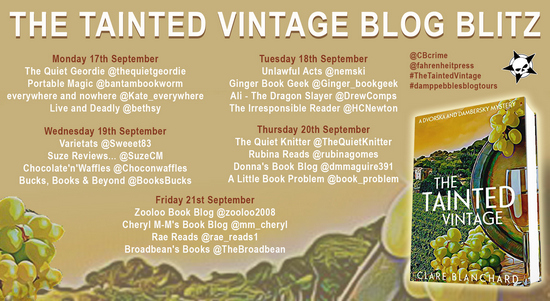
BOOK SPOTLIGHT: Dead In The Water by Simon Bower and something better than a Giveaway

Today we welcome the Book Tour for Dead in the Water by Simon Bower. Along with this spotlight post, I’ll be giving my take on the novel here in a bit. Scroll on down for a special Giveaway — guarantee you’ll win!

Book Details:

Book Title: Dead in the Water by Simon Bower
Publisher: Middle Farm Press
Release date: May 8, 2018
Format: Paperback/ebook
Length: 402 pages

Book Blurb:

Was it murder, suicide or an accident? Who will be next to die?

Six international friends all appear to be successful, albeit to different levels. A human rights’ lawyer, an IT geek, a businessman, a waitress, a phone guy and a physiotherapist. None of them are known to the police.

One of them must know what happened that fateful night on the catamaran.

Agent Georges Fournier is assigned the case in the French resort town near Antibes. He’s short on time, with a growing health problem and a District Attorney who just wants the case closed as accidental. But he’s not letting go.

Chrissie is a single mother and respected flight attendant in New York. When she finds out who her father is, she’s ecstatic and wants to meet him.

But within a week she’d wish she’d never known.

About Simon Bower:

Simon BowerSimon Bower is a British and Canadian author born in Berkshire in 1973. Since 1998, he’s adopted a global lifestyle, setting up home at times in Europe, Africa and North America. In 2016 Simon turned to writing full time, which led to his first published work, Dead in the Water, being released in paperback and eBook by Middle Farm Press in 2018. Simon currently lives in France, near the Swiss border, where his young family, mountains, acrylic paint and sharpened skis keep him in regular mischief.


Ian’s Social Media:
Twitter: https://twitter.com/SimonBowerBooks

Facebook: https://www.facebook.com/simon.bower.books/

Amazon Author Page: https://www.amazon.co.uk/Simon-Bower/e/B07CVX87L6/ref=dp_byline_cont_ebooks_1

Goodreads Author Page: https://www.goodreads.com/author/show/18017224.Simon_Bower


Purchase Links:
Amazon.co.uk: https://www.amazon.co.uk/Dead-Water-Simon-Bower-ebook/dp/B07CVQH56L/ref=la_B07CVX87L6_1_1?s=books&ie=UTF8&qid=1529592666&sr=1-1

Amazon.com: https://www.amazon.com/Dead-Water-Simon-Bower-ebook/dp/B07CVQH56L/ref=mt_kindle?_encoding=UTF8&me=&qid=1529592739

Waterstones: https://www.waterstones.com/book/dead-in-the-water/simon-bower/9780992889692

Who Needs a Giveaway, Anyway?


Just go get the thing for free! (through July 6, anyway)


My thanks to damppebbles blog tours for the invitation to participate in this tour and the materials they provided.

June 2018 Report

I read a decent chunk of things — and rated most of them pretty well. I don’t think I had anything under a 3 — which is the first in a few months (this year, maybe?). The only regret I have is that while the spirit was willing, the flesh was weak and tired, and the writing about what I read just didn’t get done. I’d also planned a few posts that weren’t just reflections on a particular reading experience that didn’t get finished enough to see the light of day. Maybe July will be more productive. Regardless, I’m calling June a winner.

So, here’s what happened here in June.

Books/Novels/Novellas Read/Listened to:

The Incredible Ordinary Hero or The Brave Bystander: Burns Rubicon Rescued
3 Stars 4 Stars 3.5 Stars
Any Other Name (Audiobook) Refugees Brief Cases
4 Stars 3 Stars 5 Stars
Cry Fox Jesus and His Enemies Kill the Farm Boy
3.5 Stars 3 Stars 4 Stars
White Night (Audiobook) Go Home, Afton Assassination
5 Stars 3.5 Stars 4 Stars
This Thing of Darkness Superheroes Can’t Save You Dry Bones (Audiobook)
4 Stars 3 Stars 4 Stars
The Highwayman (Audiobook) The Last Cleric The Wrong Side Of Goodbye
3.5 Stars 4 Stars 4 Stars
The Eyre Affair (Audiobook) Shattered Blades Volume 1: The Glory of Christ
3 Stars 4 Stars 5 Stars
Marching to Zion The Naming of the Dead The Question of the Dead Mistress
3 Stars 4 Stars 3.5 Stars
All the Nations of the Sky Harry Potter and the Chamber of Secrets (Audiobook) Dead in the Water

Still Reading:

Planet Funny Besieged (Audiobook)      

Reviews Posted:

Book Challenge Progress:

Angel's Guilty Pleasures Any Other Name (Audiobook) by Craig Johnson, George Guidall
Dry Bones (Audiobook) by Craig Johnson, George Guidall
The Highwayman (Audiobook) by Craig Johnson, George Guidall
The Eyre Affair (Audiobook) by Jasper Fforde, Susan Duerden
The Naming of the Dead by Ian Rankin
Harry Potter and the Chamber of Secrets (Audiobook) by J. K. Rowling, Jim Dale

The Incredible Ordinary Hero or The Brave Bystander: Burn s by Aida Rascanu, Beatrice Magrini (Illustrator)
Jesus and His Enemies by Paul F. Yeulett
Superheroes Can’t Save You: Epic Examples of Historic Heresies by Todd Miles
Dead in the Water by Simon Bower

The Incredible Ordinary Hero or The Brave Bystander: Burns by Aida Rascanu, Beatrice Magrini (Illustrator)

Another month with nothing for this one…not feeling good about it.

How was your month?

Born to the Blade 1.11: All the Nations of the Sky by Michael Underwood: Season 1 Wraps Up in a Strong and Sufficient Manner — but will leave the audience wanting more

My post about 1.10 was supposed to run 6/22, but I apparently only saved it as “Draft,” so it went up late on 6/28 (so glad I pushed off sleep last week to get it done), and then my thoughts about episode 1.11 were delayed a couple of days by not being able to push off sleep, but assuming I clicked the right buttons you still will get to read them when they’re fairly fresh. In a day or two I’ll have some thoughts on Season 1 of Born to the Blade as a whole — which will include some interaction with comments Bookstooge left a couple of weeks ago. Anyway, on to All the Nations of the Sky, the season finale.

All the Nations of the SkyAll the Nations of the Sky

by Michael R. Underwood
Series: Born to the Blade, #1.11

Kindle Edition.
Serial Box, 2018
Read: June 28, 2018
I’m going to try to keep my thoughts to this episode, but I won’t promise that I’ll succeed.

Somewhere between episodes 10 and 11 Michiko made a pretty big decision. Okay, she made a huge decision — and we only get to see the result, not the thought process — this is annoying, but I can live with it, if I have to (and, by the by, we know she found something in the paperwork that her predecessor left of interest to the current goings-on, but we’re not told what, this also is annoying). Part of the story-telling style that Born to the Blade is employing leaves us open to this kind of thing, so it’s to be expected — I’m just not crazy about it. Still, while I’m excited for what this means for Michiko, her nation, and the narrative opportunities for Season 2, I do regret what it means for some of the character interaction I’ve been enjoying all along. That’s all I’ll say about that now.

Also, I couldn’t help but feel that some of the progress made between Kris and Adechike last week has been walked back a bit — some of which I understand, most of which I want explained before I can get on board wholly. But I don’t see that happening. Still, I liked (both as a fan and as someone who’s trying to look at the series through an armchair-critical eye) what both Adechike and Kris did throughout this episode.

We got a long-awaited duel in this episode (like last episode), it didn’t end the way my fan-boy impulses wanted it to, but did end the way it needed to. It’s the kind of thing I think I expected the series to be built on — and if a certain little war hadn’t happened, probably would have.

Every jot and tittle about Ojo in this episode was perfect, and I wouldn’t change a thing. I can’t say any more, but this was spot-on.

I’m not sure what else to say at this point without venturing into spoiler territory, so I guess I’ll wrap it up.

Now, it’s easy — very easy — to forget about one nation of the seven — Tsukisen, and their warder, Hii no Taro. Yes, it’s explained a few times — but anytime Tsukisen is mentioned, it only seems to underline how often they aren’t. This can be improved — Underwood had a great opportunity here to fix that, and he passed. Which is okay, he’s not the only one who had the opportunity, and I can only assume that this means that there’s a plan behind it. I do hope that’s rectified quickly in Season 2. And this point probably belongs more to the season-long wrap up post I’m trying to do, but I wanted to get it down before I forgot.

This has been dubbed as “Season 1” since the beginning, so we knew everything wasn’t going to wrap up nicely. In fact, there’s a lot that’s left hanging. But we got enough resolution to leave readers satisfied with where things left off. I do hope that Serial Box gives this team another shot to tell their story because I’m very curious about a few things and characters. But for now, we’re left with an optimistic, but not a rose-colored glasses, ending — true to the vision of the initial episodes, but with a darker undercurrent than one might have guessed from the first couple of installments. I’m not wholly sold on everything that happened this season, but I’ve come to accept and appreciate 96% of it — and I will probably come around on the rest eventually.

A good story, a good cap to the season and a good launching point for a potential Season 2. I’m just going to stop before I say “good” again — pick up season 1 now, if you haven’t yet.

—–

4 Stars

Saturday Miscellany – 6/30/18

Ugh. Three posts behind for the week (stupid body requiring sleep); my scheduling was defeated by apparently hitting “draft” instead of “schedule” twice in the last week (took me 7 days to notice one of them); just got a shipment notification for a book I preordered so many months ago I forgot to expect it Tuesday — which means I have to reorganize my entire week; basically, life as a book blogger is hard, yo.

Anyway, enough about my travails and woes. Here are the odds ‘n ends over the week about books and reading that caught my eye. You’ve probably seen some/most/all of them, but just in case:

    A Book-ish Related Podcast Episode you might want to give a listen:

  • I meant to mention last week: Episode 147: Michael Koryta of the Speaking of Mysteries Podcast.

    This Week’s New Releases I’m Excited About and/or You’ll Probably See Here Soon:

  • My Plain Jane by Cynthia Hand, Brodi Ashton, Jodi Meadows — you know me, I’m a sucker for takes on Jane Eyre — even when they come in a YA Romance with a supernatural accent.

Lastly, I’d like to say hi and extend a warm welcome to cagedunn and Aspen Kendrick for following the blog this week.

Born to the Blade 1.10: Shattered Blades by Marie Brennan: An exciting penultimate episode that’s sure to please

ACK! I apparently never took this off of draft mode! I thought this ran last Friday! Whoops!!

Shattered BladesShattered Blades

by Marie Brennan
Series: Born to the Blade, #1.10

Kindle Edition, 58 pg.
Serial Box, 2018
Read: June 21, 2018

           The Warders’ Circle was supposed to prevent this kind of thing. It gave the nations a way to settle their disputes without warfare, with the limited and ritualized violence of a duel. But that only worked if people believed in it. It was a game, and everyone had agreed to play by its rules.

Until they didn’t.

Sure, there were still warders on Twaa-Fei. Juniors thrust into the role of seniors, unwilling and unprepared and, worst of all, unsupported. Their nations had abandoned them to play out what remained of this farce, while behind that disintegrating cover of civility they prepared for and carried out war.

Nations on the brink of war (well, just on the wrong side of the brink), almost everyone’s favorite diplomat the target of assassins (favorite of readers and almost every other diplomat), relationships torn apart — the home of the Warders, Twaa-Fei itself, is being ripped apart by violence. The stakes really couldn’t be much higher.

But this episode isn’t about the stakes for the nations (not that those are uninvolved — it’s just not the focus): it’s about Michiko making some important choices and acting on them, in ways that will leave her life (and potentially the lives of the people she represents) changed forever; it’s about Takeshi finding what’s been missing (I hope); it’s about Kris and Adechike getting all their priorities straight; and about a few other things that I can’t talk about.

In the midst of all this character growth, character development and conflict — we get two knockout duels. Not the civilized, controlled, formal duels of Kris’ trials, either — we’re talking two people who unleash everything they have — magic and swordcraft alike — at each other. Brennan absolutely sold this part.

This episode was everything I wanted — great character moments, better action sequences — and every character (finally) not worrying so much about playing politics, but about doing the right thing (even if it’s the wrong thing for someone else). My notes have me writing twice “this is the high point of the series (so far),” and there’s at least one other candidate for that moment in these pages. I’m hoping that the season finale continues the uptick we’ve been on for the last couple of weeks.

—–

4 Stars

The Wrong Side Of Goodbye by Michael Connelly: Bosch takes on a new role, and gives the same solidly entertaining result.

The Wrong Side Of GoodbyeThe Wrong Side Of Goodbye

by Michael Connelly
Series: Harry Bosch, #19

Paperback, 386 pg.
Grand Central Publishing, 2017
Read: June 20, 2018
Not shockingly at all, retirement doesn’t sit well for Harry Bosch. As we saw in The Crossing, neither does working for defense attorneys. So what’s a guy like Harry Bosch — with that strong sense of mission driving him for decades — to do with himself when the LAPD forces him to retire?

Naturally, he’s going to get a PI license and do what he can with. But there’s going to be a dearth of clients that want him to investigate the kind of crimes he’s driven to investigate. Thankfully, the San Fernando Police Department is suffering a horrible budget crises and can utilize him as a reserve police officer looking at cold cases (this is an actual thing that happens, and was suggested by a member of the SFPD to Connelly as something for Bosch). This is work for free, true, but anyone who thinks that Bosch is driven by money in any real sense hasn’t talked to him for five minutes.

Bosch is hired by an elderly billionaire (at least), to hunt down a potential heir to his empire — his family “forced” him to abandon a lower-class woman after he impregnated her in the 50’s, and now looking at his mortality rushing to meet him, he wants to pass things on to his heir. He doesn’t have much to give Harry to start from — a name, an employer, and a time frame. That’s it. He needs Harry to keep this to himself — and has him sign a very tight non-disclosure agreement — because he doesn’t trust anyone in the company he’s the head of. He’s right not to trust anyone, as Harry quickly learns, but that’s a whole ‘nother story.

This case grabs Harry’s attention, particularly when he becomes convinced that he’s tracked down the heir — who served in Vietnam at the same time Harry did. In fact, Harry’s reasonably sure that they were briefly on the same ship at the same time. In addition to this being very interesting, watching Harry backtrack this man’s family — this focus on Vietnam gets Harry to reflect some on his time there, and even discuss a bit with Maddie. I think this is the most that Harry has talked about Vietnam since The Black Echo (feel free to correct me in the comments), and I appreciate reminding us where the character comes from.

As interesting as that is — both through the procedure Harry enacts, what’s revealed about the case and himself, plus the surprising amount of peril that beings to follow him — the other case that Harry’s looking into is more up his alley.

In the course of his duties as a reserve officer, he’s been looking through cases that haven’t been closed — the one he’s focused on now isn’t a murder (as you’d expect), but is a serial rapist. Between the way the cases were reported, the staffing problems SFPD has, some jurisdictional issues, and (most importantly) language barriers, it wasn’t until Harry started reading all the case files he could get his hands on that patterns started to emerge and a coherent picture of one criminal’s work became clear. The SFPD detective that Harry’s working with, Bella Lourdes, seems like a solid detective — probably not as obsessive as Harry, but a dedicated detective. She’s able to handle the interview side of things better than Harry, actually (see the language barrier, among other things). As things heat up with the other case, Harry can’t get away and Lourdes ends up carrying the water on vital aspects of this by herself. It’s one of the healthier partnerships Harry’s had, really. But don’t worry — at the end of the day, this is a Harry Bosch novel. Not a Harry and Bella. Harry’ll put all the pieces together — but not early enough to keep things from getting pretty harrowing for all involved.

MIckey Haller shows up briefly early on, and I thought “oh, that was a nice cameo.” But at some point, he becomes a strong supporting character — as important to the private client storyline as Lourdes was to the serial rapist. I appreciated the smooth way that Connelly merged Haller into this novel. But that’s not all — Harry spent a moment thinking about Jerry Edgar (is that the influence of the Amazon series, or just Harry getting retrospective?) and there was a completely unnecessary — but nice — little appearance by Det. Lucia Soto. Unnecessary to the plot, but it shows something about Harry, I think, that wouldn’t have described him a few books ago.

The mysteries themselves are a shade on the easy side for this series — but the fun in this comes from watching Bosch chip away, step by step, through the process. Sure, he cuts a corner or five, makes several lucky guesses — but we’re not looking for verisimilitude here, right?

That said, there were several moments in the latter third or so that I assumed I had everything worked out — and I was right as much as I was wrong. Connelly didn’t cheat, but he zagged a lot when I was sure he was going to zig. At this stage of the game, for Connelly to be able to fool me that often, that says plenty about his skill.*

A good ride for old fans — a decent (not excellent, but acceptable) place for a new reader to jump on — The Wrong Side of Goodbye capably demonstrates why Michael Connelly in general, and Harry Bosch in particular, has been at the top of the American Crime Fiction scene — and likely will stay there for quite some time.

*Sure, it could say something about me, and what kind of reader I am, but let’s give credit ot Connelly’s craft and not my gullibility, shall we?

—–

4 Stars

No . . . just . . . No (or Initial Thoughts on Netflix’s announced adaptation of Atkin’s Wonderland)

According to Variety and Deadline stories today, another actor has been tapped to take on the role of Robert B. Parker’s Spenser: Mark Whalberg. He’ll be starring in Peter Berg’s movie for Netflix, an adaptation of Wonderland — the second novel Ace Atkins wrote about the Boston sleuth — as the potential first in a series.

I’m not Whalberg’s biggest fan, but given the right material, he’s good and he can pull of the physicality needed (and then some, but, whatever). And I have more trust in Peter Berg than most directors (Battleship notwithstanding). And the source material is great.

BUT. . .

From Deadline‘s story:

The movie will differ from the novel, in that it begins with Spenser emerging from a prison stretch, stripped of his private investigator license. Here, he gets pulled back into the underbelly of the Boston crime world when he uncovers the truth about a sensational murder and the twisted conspiracy behind it.

Stripped of his PI license after a prison stretch???? I know that adaptations have to make changes to the character, that’s the whole point of adapting. But this is striking at the core of the character. Spenser a felon? That’s a deal breaker. That makes almost all the changes in The Dresden Files series seem acceptable. It’s like making Edward a werewolf and Jacob a vampire. Or using an animated tiger in Life of Pi à la Bedknobs and Broomsticks. I’m having trouble here, okay? You can get the gist of what I’m saying.

So, I’m happy for the Parker Estate, Ace Atkins and anyone else who made some money off this. I’m happier yet for anyone who discovers Parker/Atkins/Spenser because of this.

But…nope. Just flat-out no. Count me out.*

*(which everyone knows is a giant lie, I’m totally going to watch this because I’m weak, I’m a sucker, and a Spenser-addict)

Page 440 of 624

Powered by WordPress & Theme by Anders Norén