Category: A-B Page 12 of 23

Authors A-B

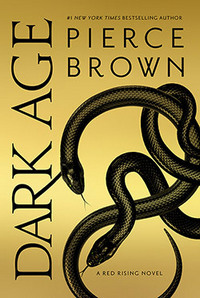
Dark Age by Pierce Brown: The blood-dimmed tide is loosed… / The best lack all conviction, while the worst / Are full of passionate intensity.

Dark AgeDark Age

by Pierce Brown
Series: Red Rising, #5

Hardcover, 800 pg.
Del Rey Books, 2019

Read: August 9 – 16, 2019

From a distance, death seems the end of a story. But when you are near, when you can smell the burning skin, see the entrails, you see death for what it is. A traumatic cauterization of a life thread. No purpose. No conclusion. Just snip.

I knew war was dreadful, but I did not expect to fear it.

How can anyone not, when death is just a blind giant with scissors?

This will not end well

Lysander au Lune has a few thoughts along those lines pages after falling in an Iron Rain on Mercury, but this was one of the more striking examples. For a “bad guy,” he’s awfully easy to identify with. He’s trying to establish an alliance between the remnants of the Society and the Outer Planets to crush the Rising once and for all, and so has to curry favor with Atalantia by joining in the counter-attack on Mercury. This attack does not go well for anyone—both armies and the civilian population on Mercury took on incalculable losses, provoking a lot of thoughts like this on both sides, I’d imagine. And that’s just how this novel starts

It’s been almost a week since I finished Dark Age and I haven’t been able to stop thinking about it—plot, characters, and ramifications of the events of the novel—and I don’t think I will anytime soon. I’ve joked (online and IRL) that I’ve used “brutal” in every post I’ve written about this series (at least once) and I was going to have to get a new thesaurus to help me come up with alternatives before I wrote this—not just so I’d add a little variety to the posts, but primarily because it just doesn’t seem to be descriptive enough about what happens here.

Iron Gold shows us what can go wrong as a society throws off the shackles of tyranny, but is still learning how to act with a replacement for that system. And it wasn’t pretty. Dark Age is all about what happened right after Iron Gold how does Darrow follow-up his dramatic act on Mercury? How do the remnants of the Society react to that? Can Virginia maintain control of the government (and should she?), and what’s going on with the kidnapped children and the kidnappers?

None of the answers to those questions are easy, and it’s hard to like any of the answers you might find. But man, what a book. Brown surprised me time after time after time and I have no idea what to expect for the next volume. You find yourself hoping that Character X will survive whatever dire situation they’re in, but you almost hope they fall now, because whatever is coming up next for them is going to be worse, much worse.

For a change, this isn’t primarily Darrow’s story. But even as I say that I want to object. The opening chapters are full of him, but after the first 100 pages or so (I’m estimating because I had to take it back to the Library already), other characters—primarily on the Moon and Mars—get the majority of the space. At the same time, there’s not one page—not one paragraph, really— that isn’t in the shadow of Darrow. His acts, his movement, his intentions, his affects on various individuals and/or society at large. Even if the Red Rising is put down and the demokracy is defeated, it will be generations before Darrow’s impact is forgotten. So, yes, he’s sidelined for most of this novel, but ultimately, it’s still all about Darrow.

I can’t take the time to talk about everything that I want to, but if anyone’s going to defeat Darrow/the Rising, I wouldn’t mind if it was Lysander. Sadly, Lysander wouldn’t be alone, and his allies aren’t as honorable or noble (actual nobility, not hereditary titles) as he is—so I hope he goes down in flames.

Yes, I didn’t think Iron Gold was necessary—or as good as the initial trilogy (while I did enjoy it)—but as it paved the way for Dark Age (and whatever comes next) I’m not complaining. This was probably the best thing since Red Rising (in many ways, probably superior), and I’m once again invested in this series.

Brown’s writing has never been better—this is his biggest book to date in terms of size and scope. Yes, it’s an investment of time, but not one that’s impossible to surmount (and is totally worth it). It’s a longer book, with more characters, more perspectives and more potential to surprise the reader (both in this book and what comes next). It’s like he took Yeat’s “The Second Coming” and said, I wonder what verse 1 would look like in the Red Rising Universe?

I can’t do justice to this book, I just can’t. There’s not an ongoing SF series that I can recommend as highly as this, and whatever flaws there might be are dwarfed by the strengths to the extent that I can’t even enumerate them. If your interest post-Morning Star has waned, I encourage you to give this a shot. If you’ve never tried this series, do not jump on board here. Go back to Red Rising, and after you’ve endured (and loved) the emotional battering that follows, you’ll see what I’m talking about.

“What does Mars mean to you, Nakamura?” I ask.

The Terran hesitates. “Hope. And you, my liege?”

“War.”

Virginia says a lot in that last syllable (even ignoring the pun). It sounds ominous there, and I think it tells us everything we need to know about the rest of this series.

—–

5 Stars
2019 Library Love Challenge

Reposting Just ‘Cuz: Golden Son by Pierce Brown

Here we are with the second of today’s Pierce Brown reposts. Even if Golden Son isn’t really volume 2 of a trilogy anymore, everything else I said about it still stands. There are few writers who can jerk me around like Brown can—he plays with emotions and expectations like Yo-Yo Ma on a cello. And I wish he’d lighten up on his readers, but I don’t expect that he will anytime soon (and I really don’t want him to, it just feels like it).

Golden SonGolden Son

by Pierce Brown
Series: Red Rising, #2

Hardcover, 442 pg.
Del Ray, 2015
Read: February 3 – 4, 2015

I glimpse Gray police standing over arrested Brown vandals who covered an apartment complex with the image of a hanging girl. My wife. Ten stories tall, hair burning, rendered in digital paint. My chest constricts as we pass, cracking the walls I’ve built around her memory. I’ve seen her hanged a thousand times now as her martyrdom spreads across the worlds, city by city. Yet each time, it strikes me like a physical blow, nerve endings shivering in my chest, heart beating fast, neck tight just under the jaw. How cruel a life, that the sight of my dead wife means hope.

As you start this book you’re thinking, this is going to be Red Rising continued — Darrow’s got a good steam and he’s going to continue to rise and learn. And then, you finish the first chapter and see how horribly wrong you were.

The important thing to remember while reading Golden Son: this is the 2nd volume in a trilogy. What does that mean about the book as a whole, especially the ending? Think: The Empire Strikes Back, Kinslayer, Catching Fire, The Deaths of Tao, The Two Towers, and so on. It’s going to get dark, it’s going to be messy, things are going to look bad for Darrow and his group.

Time and time again, Brown suckered me with this book. I got comfortable, got in a groove with the narrative, figured he’s about to zig and he’d zag. 30-50 pages later, we’d do the same thing again . . . and again. Up to, and including the final zig when I was sure he was about to zag. The number of times that a narrative gut punch was delivered as Brown was pulling the rug out from underneath you was enough to make you feel like you were one of Darrow’s crew on a bad day.

I read this at what turned out to be a busy time for me, so I couldn’t get to blogging about it then — I don’t remember many of the details (pretty sure the good ones are spoilery anyway), so I can’t get too specific about things. But I do remember the experience of reading it. This was just a brutal read — and each time Brown sent me reeling, I wanted more.

This was the second book in 2015 that I gave 5 Stars to. Since then I’ve read better books — some of which I’ve rated lower — but the way this book grabbed me, the way it made me feel while reading it? It earned the 5 Star then and still deserves it now.

I can’t wait for the conclusion, Morning Star this coming February.

—–

5 Stars

Reposting Just ‘Cuz: Red Rising by Pierce Brown

Time got away from me this past weekend—and not just because I wrote one post that turned about about 3x as long as I’d figured (which is fine, I had a lot of fun with my family, just didn’t write as much as I wanted to). That’s just a nice way of saying that I couldn’t shut up (you’ll see in a couple of hours). But I wanted to get something else up today, and since I’m knee-deep in Brown’s Dark Age at the moment, I figured I’d repost what I wrote about the first two books in the series. Glancing over it, I agree with everything I said, but kept shaking my head like Leslie talking to Ann: “You are a beautiful, naïve, sophisticated newborn baby.” This was one of my Top Reads of 2014 and the series is one of my most beloved. I urge you to jump on this runaway train if you haven’t yet.

Red Rising (Red Rising Trilogy, #1)Red Rising

by Pierce Brown
Series: Red Rising, #1

Hardcover, 382 pg.
Del Rey, 2014
Read: Feb 26 – Mar 6, 2014

I’m having a hard time deciding what to say about this one. To really talk about it would require me spoiling every plot point that I loved (most of which I didn’t see coming). So I won’t. I’ll just say that I really, really dug this book.

I don’t want to just compare this to The Hunger Games, as much as reviews/blurbs/etc. make a guy want to. There are some surface-level similarities, yeah. And you could make the case (as I did when just starting the book) that Brown’s Mars was just the place for people who thought Collins’ Panem was a bit easy. In fact several parts of this feel like The Hunger Games dialed up to 11. The working/living conditions for Darrow and his family are more severe, what Darrow has done to him to prepare him for what’s to come makes what Cinna et al. do to Katniss look like child dress-up, Darrow plays a deadly game on a larger scale than Katniss, and so on. But Darrow’s motivation is different than Katniss’ — she’s trying to survive, he’s trying to do far more (and much of the time, survival’s pretty low on his list) — the stakes he’s playing for are greater, and he will go to lengths that Ms. Everdeen doesn’t have to.

There are a few moments when things seem too slow, or meandering, or even redundant — but each time, I was wrong, and Brown made it all pay off. Visceral was the word that kept coming back to me as I read the book. I had almost visceral reactions to some of the horrors depicted, I could feel the grime and muck (literal and metaphorical) that Darrow crawled around in.

This shows every indication of leading to something epic in the next volume, leaving Mars behind and moving to other planets and/or the space between. As well as seeing if Darrow can retain his self and purpose — and how far will he be willing to go to carry it out.

There is a classic SF reference in Part IV that made me giggle with delight (in the middle of a pretty grim part of a fairly grim book, so I appreciated the placement). I won’t spoil it, but Pierce Brown has bought a lot of loyalty from me with two simple words.

Go grab this one.

—–

5 Stars

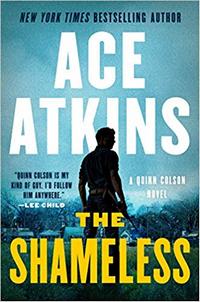
The Shameless by Ace Atkins: Tibbehah County’s Dark Past, Present and Future Combine for Atkins’ Strongest Novel Yet

The ShamelessThe Shameless

by Ace Atkins
Series: Quinn Colson, #9
Hardcover, 446 pg.
G.P. Putnam’s Sons, 2019

Read: July 23 – 24, 2019

This just feels like too much of a novel to do an adequate job with. It’s been a week and a half (at the time of writing), and I’m still thinking about this book and everything Atkins did in it. I’m honestly not up to the task of doing it right. But I’ll give it a shot, with the up-front caveat that I’m missing a lot. You just need to read this.

Twenty years ago, when Quinn was in High School, a student a couple of years older than him went missing in the woods while hunting—and everyone came out in droves to look for him. For weeks the town, the media, and the Sheriff’s Department (under Quinn’s uncle) devoted every waking hour to finding him. They eventually found his body near his rifle and ruled it a suicide. But no one was satisfied with that finding. Now, two New York journalists have arrived to re-open the case, look at things from a new perspective, and hopefully come up with enough material (and, better, a satisfying conclusion) for the next season of their podcast about missing people.

Quinn’s new wife, Maggie, had been the boy’s girlfriend and initially helps the podcasters out a lot. The boy’s family isn’t united about this new search for answers, but most people are willing to help (while being suspicious of the two). A lot of old secrets, old prejudices, and unanswered questions and qualms are brought forth from the recesses of the collective memory of the community. A tragedy that had shaken the county decades previously is doing the same thing again.

These two are in town for months, stirring up trouble, stirring up gossip, stirring up emotions (sometimes intentionally, sometimes not), and generally being a distraction for Quinn. He’d frankly love to devote energy, time and attention to solving a cold case, but there’s a bigger, more dangerous, and frankly, very contemporary threat—Senator Jimmy Vardaman. Vardaman’s been on the fringes (and frequently closer) to the problems around Tibbehah County for quite some time, but now he’s running in the gubernatorial primary and is doing much better than expected. If he wins this, he’s a shoo-in for the actual election. Tapping into a false sense of nostalgia for the Mississippi that never was, a healthy dose of racism, and empty platitudes—and a healthy dose of Syndicate cash—Vardaman’s doing better than anyone expected.

There are a number of crimes that Quinn strongly believes are tied to Vardaman, but he can’t find enough proof. Every time he comes close, something prevents it from happening—he has a few opportunities here to bring Vardaman down before primary and devotes all his energy toward them. One of the strongest themes running through this novel is the intersection of crime and politics, and how that affects both enterprises. Too often (in fiction and reality), politics boils down to the influence of and lust for money and power—which is pretty much what crime (particularly the more organized forms of it) is. Vardaman’s not the only example this series or this novel has of it, but he’s the current exemplar in Atkins’ world.

Meanwhile, Fannie Hathcock is still running the show when it comes to illicit materials and licit (but not fully-clothed) women in Tibbehah County. Recent events have left things shaky for her, and Vardaman’s ascent (and those he owes favors to) will make things shakier. We don’t see much of what that means in this book, but I think we will soon. I don’t think Fannie is a woman to be taken lightly—the power structures on both sides of the law may be less-than-welcoming to a woman—and I don’t expect her to go quietly (if she goes at all).

My biggest complaint is about Boom Kimbrough. Yes, Quinn’s best friend and staunchest ally (no offense to Maggie or Lillie), is a presence throughout—but is absent from the major story, and his subplot doesn’t get that much space. Boom’s primarily recovering from—to some extent—the events of The Sinners, and that’s about all we see from him. He and Caddy spend a lot of time together, but if he has more than one conversation with Quinn, I’d be surprised. I should’ve taken notes on that front (but who’d have thought I’d have to?). I assume we’ll see more of him in future books—I just don’t want to wait.

Using the podcast—and the stir it creates—to revisit many of the characters’ storylines, see how they got to where they are now (possibly to look at them in a different light)—is a brilliant move and Atkins uses it very effectively. There are moments recalled because of this podcast that I’d forgotten about or hadn’t seen in relation to the greater story arcs. Also, it’s a great way to help the reader see that other parts of the county may not see Quinn’s actions the same way the reader has. By using the podcast, Atkins is able to create drama with this as well as avoiding several dull information dumps.

Something that I don’t particularly enjoy—but respect and appreciate—is the way things ended. I’ve seen several people call it a cliff-hanger of an ending. I don’t really see it that way, but I can see where they’re coming from. Now, I’m not going to get into the details for obvious reasons (for one, I’m not a monster), but I can say that it was a very noir ending. Which fits, this is a dark series—fun, sometimes funny—but a real Southern noir. This is Colson at the noirest, particularly the last chapter. It was a perfect ending to a great book—so don’t take my not particularly enjoying as a complaint. I’d prefer an ending where justice triumphs, evil is vanquished, and Quinn rides off into the sunset. That ain’t the world we live in, that’s not the world of Tibbehah County, and this novel is better at showing us than the others have been (not that things like a tornado wiping out huge parts of the county are exactly rainbows and unicorns, either).

Can this be read as a jumping-on point? I actually think it can—it easily serves as a “Where We Are Now/Where We Have Been” novel. But just know that you’re going to want to go back and read the others to understand everything talked about (much of which is alluded to, rather than explained—the way you’d talk to an old friend about something that happened four years ago). Obviously, the best thing to do is get The Ranger and work your way up to this point, but this would be the best jumping-on point since The Ranger.

The Shameless is the longest novel in the series, easily the most ambitious, and very possibly the best (I can’t think of a better one, but I’d have to re-read them. Which isn’t a bad idea, actually.). It feels like a change in the series—which is hard to describe without spoiling, but if Chapter One was Quinn’s struggles against Stagg, Chapter Two would be everything up to this book until Stagg went to prison, and then Chapter Three is whatever comes after The Shameless. Something tells me this small-town sheriff is missing the days when his biggest problem was Stagg.

I really can’t recommend this enough—Quinn Colson and Ace Atkins are some of the best in the genre today and The Shameless is the best proof of that.

—–

5 Stars

2019 Library Love Challenge2019 Cloak & Dagger Challenge

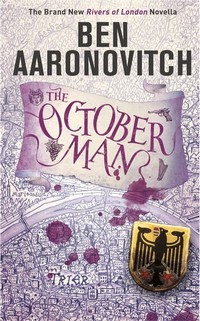
The October Man by Ben Aaronovitch: Meeting Peter Grant’s German Counterpart

The October ManThe October Man

by Ben Aaronovitch
Series: The Rivers of London, #7.5

Hardcover, 208 pg.
Subterranean Press , 2019
Read: June 19 – 21, 2019

So about the time that the one German Magic Practitioner hears that Nightengale has taken on an apprentice in Peter Grant, she decides that it’s time for Germany to do the same — keeping the playing field level, and all — she finds that apprentice in a second generation police officer, Tobias Winter. We meet Tobias a few years into things when he’s called away from leave time to investigate something that may be supernaturally related.

He recognizes vestigia right away — although I think the manner of death would be a pretty big tip off, no matter what. A mysterious fungal rot that covers him in precisely the way that fungus doesn’t cover people. I can’t do justice to how creepy it sounds when Tobias narrates it for us — you’ll have to read it.

Tobias is teamed up with Vanessa Sommer, a local police officer who knows the area, knows a bit about the particular fungus, and is super-curious about magic. Naturally, there’s an encounter with a River or two, and an interesting take on regional history — because this is a Rivers of London novel, what else are you going to get?

It’s a quick read with great story and the kind of people that Aaronovich fills his books with — these just happen to speak German and look at things in a different way from Peter and those he usually runs with — Tobias isn’t as funny as Peter, but he’s amusing to read and handles things in ways that Peter doesn’t. Still, at the end of the day, Peter’d be happy getting the same result (and probably would be jealous how little property damage that Tobias inflicts before wrapping up the investigation).

We’ve been given glimpses of what Nightengale and his fellows got involved in during WWII, but here we get more details — from the German point of view. It’s always been clear that happened wasn’t pretty — but I didn’t realize just how devastating it was until now. It’s also interesting to see just how significant it was for Nightengale to make Peter an apprentice. He essentially kicked off an international magical arms race (of sorts). Don’t get me wrong, the main point of this book is to be introduced to new characters, to see how magic is dealt with somewhere that isn’t London — but man, what we learn about things in London is fascinating.

I don’t know how this qualifies as a novella — even a “long novella,” as I’ve seen it marketed. I have several novels within reach of me right now that are smaller than this. It’s a semantic thing, but book nerds are supposed to be into words — so I don’t get it. Two hundred eight pages does not mean novella to me. If someone can explain it (or point to where Aaronovitch or Subterrerean Press explained it already), I’d appreciate it. Just to scratch that intellectual itch.

Aside from what to call this book, I enjoyed it. Tobias is an good character, he’s no Peter Grant, but he’s not supposed to be (in either Aaronovitch’s mind or the German practitioners’). I’d like he and Peter or he and the Nightengale to brush up against each other — or to have extended contact (like FBI Agent Reynolds and the Folly have had). If Aaronovitch decides on writing another novella/novel/adventure with him, I’d jump on it. But I’m not going to be waiting expectantly — if he doesn’t want to write another (or sales don’t justify it), I can be satisfied with just this much that we’ve been given here.

This’d be a great jumping on point for someone who wants to get a feel for the Rivers of London and Aaronovitch’s style. It’s also a great way for devoted fans of that series to dabble in something new, get a fresh perspective and realize that Peter Grant’s world is smaller than he realizes — while enjoying a creative and fun story.

—–

3 Stars

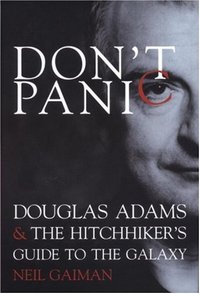
Don’t Panic by Neil Gaiman, David K. Dickson and MJ Simpson: An Indispensable Guide to Douglas Adams and his Work

I’d intended to get this up and ready for Towel Day last week — but, obviously, I failed. Schemes once again, Gang aft a-gley. It’s pretty fitting, really that this is late.

Don't PanicDon’t Panic: Douglas Adams & The Hitchhiker’s Guide to the Galaxy (Third Edition)

by Neil Gaiman; Additional Material by David K. Dickson & MJ Simpson
Series: The Hitchhiker’s Guide to the Galaxy Trilogy (related)

Hardcover, 207 pg.
Titan Books, 2003
Read: May 22 – 23, 2019

          
The idea in question bubbled into Douglas Adams’s mind quite spontaneously, in a field in Innsbruck. He later denied any personal memory of it having happened. But it’s the story he told, and, if there can be such a thing, it’s the beginning. If you have to take a flag reading THE STORY STARTS HERE and stick it into the story, then there is no other place to put it.

It was 1971, and the eighteen year-old Douglas Adams was hitch-hiking his way across Europe with a copy of The Hitchhiker’s Guide to Europethat he had stolen (he hadn’t bothered ‘borrowing’ a copy of Europe on $5 a Day, he didn’t have that kind of money).

He was drunk. He was poverty-stricken. He was too poor to afford a room at a youth hostel (the entire story is told at length in his introduction to The Hitchhiker’s Guide to the Galaxy: A Trilogy in Four Parts in England, and The Hitchhiker’s Trilogy in the US) and he wound up, at the end of a harrowing day, flat on his back in a field in Innsbruck, staring up at the stars. “Somebody,” he thought, “somebody really ought to write a Hitchhiker’s Guide to the Galaxy.”

He forgot about the idea shortly thereafter.

Five years later, while he was struggling to think of a legitimate reason for an alien to visit Earth, the phrase returned to him. The rest is history, and will be told in this book.

I distinctly remember purchasing the first edition of Don’t Panic from BookPeople of Moscow in the fall of 1991 — I remember being blown away by the idea that someone would write a book about Douglas Adams’ work. I had no idea who this Neil Gaiman fellow was, but I enjoyed his writing and loved the book he wrote — and read it several times. It was a long time (over 2 decades) before I thought of him as anything but “that guy who wrote the Hitchhiker’s book.” The Hitchhiker’s Trilogy had been a favorite of mine for years by that point, and getting to look behind the scenes of it was like catnip.

This is the third edition, and as is noted by Gaiman in the Forward, it “has been updated and expanded twice.” The completist in me would like to find a second edition to read the original 3 chapters added by David K. Dickson in 1993, but the important change was in 2002, when “MJ Simpson wrote chapters 27-30, and overhauled the entire text.” If you ask me, Gaiman’s name should be in the smaller print and Simpson’s should be the tall letters on the cover — but no publisher is that stupid, if you get the chance to claim that Neil Gaiman wrote a book, you run with it. Overhauled is a kind way of putting it — there’s little of the original book that I recognize (I’m going by memory only, not a side by side comparison). This is not a complaint, because Simpson’s version of the book is just as good as the original, it’s just not the original.

This is a little more than the story of The Hitchhiker’s Trilogy, but it’s certainly not a biography of Adams — maybe you could call it a professional biography. Or a biography of Adams the creator, which only touches upon the rest of his life as needed. Yes there are brief looks at his childhood, schooling, etc. But it primarily focuses on his writing, acting, producing and whatnot as the things that led to that revolutionary BBC Radio series and what happened afterward. Maybe you could think of it as the story of a man’s lifelong battle to meet a deadline and the lengths those around him would go to help him not miss it too much.

Once we get to the Radio series, it follows the The Hitchhiker’s Trilogy through each incarnation and expansion — talking about the problems getting it produced (in whatever medium we’re talking about — books, TV show, movie, stage show) and the content. Then the book discusses other Adams projects — Dirk Gently books, The Last Chance to See, his computer work, and other things like that.

It’s told with a lot of cheek, humor, and snark — some of the best footnotes and appendices ever. It’s not the work of a slavish fanboy (or team of them) — there are critical moments talking about problems with some of the books (some of the critiques are valid, others might be valid, but I demur). But it’s never not told with affection for the man or his work.

Don’t Panic is a must for die-hard fans — and can be read for a lot of pleasure by casual fans of the author or his work. I can almost promise that whatever your level of devotion to or appreciation of Adams/his work, it’ll increase after reading this. Any edition of this book should do — but this third edition is an achievement all to itself. Imagine someone being able to say, “I improved on Gaiman’s final draft.”

I loved it, I will return to this to read as well as to consult for future things I write about Adams, and recommend it without hesitation.

—–

5 Stars

Humor Reading Challenge 2019

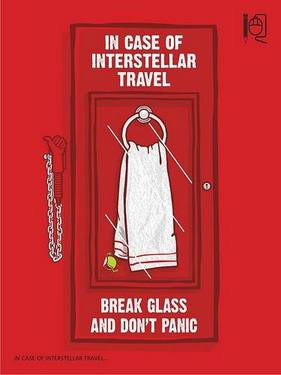
Towel Day ’19: Do You Know Where Your Towel Is?

(actually updated and slightly revised this 5/25/19!)

           The Hitchhiker’s Guide to the Galaxy has a few things to say on the subject of towels.

A towel, it says, is about the most massively useful thing an interstellar hitchhiker can have. Partly it has great practical value. You can wrap it around you for warmth as you bound across the cold moons of Jaglan Beta; you can lie on it on the brilliant marble-sanded beaches of Santraginus V, inhaling the heady sea vapors; you can sleep under it beneath the stars which shine so redly on the desert world of Kakrafoon; use it to sail a miniraft down the slow heavy River Moth; wet it for use in hand-to-hand-combat; wrap it round your head to ward off noxious fumes or avoid the gaze of the Ravenous Bugblatter Beast of Traal (such a mind-bogglingly stupid animal, it assumes that if you can’t see it, it can’t see you); you can wave your towel in emergencies as a distress signal, and of course dry yourself off with it if it still seems to be clean enough.

More importantly, a towel has immense psychological value. For some reason, if a strag (strag: non-hitch hiker) discovers that a hitch hiker has his towel with him, he will automatically assume that he is also in possession of a toothbrush, face flannel, soap, tin of biscuits, flask, compass, map, ball of string, gnat spray, wet weather gear, space suit etc., etc. Furthermore, the strag will then happily lend the hitch hiker any of these or a dozen other items that the hitch hiker might accidentally have “lost”. What the strag will think is that any man who can hitch the length and breadth of the galaxy, rough it, slum it, struggle against terrible odds, win through, and still knows where his towel is is clearly a man to be reckoned with.

Hence a phrase that has passed into hitchhiking slang, as in “Hey, you sass that hoopy Ford Prefect? There’s a frood who really knows where his towel is.” (Sass: know, be aware of, meet, have sex with; hoopy: really together guy; frood: really amazingly together guy.)

One of my long-delayed goals is to write up a good all-purpose Tribute to Douglas Adams post, and another Towel Day has come without me doing so. Belgium.

Next year . . . or later. (he says for at least the 4th straight year, a work ethic I like to believe Adams would recognize)

Last year, I did a re-read of all of Adams’ (completed) fiction. For reasons beyond my ken (or recollection), I didn’t get around to blogging about the Dirk Gently books, but I did do the Hitchhiker’s Trilogy:


Adams is one of those handful of authors that I can’t imagine I’d be the same without having encountered/read/re-read/re-re-re-re-read, and so I do my best to pay a little tribute to him each year, even if it’s just carrying around a towel. Although, I do have the planet logo from the series tattooed on my forearm — so I do carry around a tribute to him constantly. I’ve only been able to get one of my sons into Adams, he’s the taller, thinner one in the picture from a couple of years ago below.

TowelDay.org is the best collection of resources on the day, recently posted this pretty cool video, shot on the ISS by astronaut Samantha Cristoforetti.

Even better — Here’s an appearance by Douglas Adams himself from the old Letterman show — so glad someone preserved this:

Love the anecdote (Also, I want this tie.)

Storm Cursed by Patricia Briggs: Goblin Royalty, Coyote, the Strangest Zombies you’ve Run Across Combine and an excess of “Next”s

Storm CursedStorm Cursed

by Patricia Briggs
Series: Mercy Thompson, #11

Hardcover, 355 pg.
Ace, 2019
Read: May 8 -10, 2019

Adam grinned at me, “That which doesn’t destroy us . . .”

“Leaves us scratching our heads and saying, ‘What’s next?'” I said.

There’s always plenty of things that can answer that “What’s next?” question in the land of Mercy Thompson — but Storm Cursed seems to have extra nexts in it. Briggs is such an excellent series writer — there’s always a great mix of classic favorites (Zee, Uncle Mike, Mary Jo and Ben) and the new (Goblin King, the events of Silence Fallen, the baddies of this book) — like a favorite band touring in support of their new album that no one’s heard yet, she sprinkles in enough of the familiar with the new that you can enjoy the songs you can sing along with and appreciate the new for what they bring to the table.

We start off with the typical mini-adventure featuring Mary Jo, Ben and Mercy — with a little bit of Larry mixed in. There’s a goblin on the run from law enforcement after causing some mayhem in California who thought the Tri-Cities would be a safe place to lay low. Boy, was he wrong. This goblin accomplishes a lot of other things, though. He brings Mercy and the pack into a new part of the area and the law enforcement there, for starters.

This sets things up perfectly for Mercy and Mary Jo to come to the aid of said law enforcement when it comes to a very strange supernatural outbreak. Miniature zombie goats. ’nuff said.

Zombie goats — no matter their size (as important as it is to Mercy and Stefan) don’t just show up one day. They’re the product of witchcraft, and with Elizaveta still in Europe following Silence Fallen the Ti-Cities is ripe for new witches to move in and usurp her. I’m not going to tell you if they’re successful or not, but they sure make things interesting for the defenders of the area like Mercy and Adam. This also gives Sherwood Post, the mysterious wolf sent by the Marrock to be a part of this pack after something happened that he can’t talk about/remember involving witches. He apparently picked up a thing or two, and gets the chance to demonstrate that.

I’ve liked Sherwood since he showed up the first time, and now I’m super-intrigued by him.

There’s a big, summit-like meeting between representatives of the U.S. and the Fae leadership in the making — and the Pack has a lot to do with making sure it happens without a hitch. Naturally, for reasons that are unclear (at first), the new witches in town are working to disrupt it for their own ends. Because there’s not enough going on without that — an excess of nexts, really.

Speaking of excess — Coyote is lurking in the background of many of these events and he’s determined to keep Mercy in the middle of things, for his own reasons. If he’d just been up front with her, I think she’d have been on-board without hesitation (and certainly seems glad to have helped once she figures out his play). Instead, he manipulates her into doing what he wants — which is bad for the character, good for the reader, because he’s so much fun to read, especially when it comes at Mercy’s expense.

No matter what happens in a Mercy Thompson book — they’re filled with fun, and it’s easy to fool yourself into only remembering the fun parts and pushing the darkness and trauma aside in your memory until the next book comes along and reminds you just how messed up things can get for Mercy and the rest. This book is no exception — but in may ways the evil they confront this time is a special kind of Evil that requires at least one capital when you talk about it. What happens throughout this book, what’s uncovered here — especially the last few chapters — is probably the most inherently disturbing that Briggs has given us yet. I wondered at more than one point, if even Atticus O’Sullivan could hate witches as much as Mercy does (for good reason!). I decided the two would probably end up in a tie, but that Mercy has more recent evidence for her prejudice.

There’s something that happens in the climactic battle scene that I want to talk about more than I want to talk about anything else in this book — because in the long run it’s going to be bigger and more important than anything else that happens or I’ll eat my hat. It’s so small, so quick that it’d be easy to miss — 2 sentences on one page, then twelve pages later 2 more sentences. And Briggs has at least one novel’s worth of plot seeded right there. I love when I see an author do something like that and make it look effortless. And I think I’m underselling it. But I’ll have to leave it there — maybe in book 12 (or 15) when it happens, I’ll remember to say, “Remember that thing I didn’t talk about in Storm Cursed? This is it.”

Overall, this is another very solid entry in an incredibly reliable series, and I’m already excited to see what happens in book 12. Still, I get the feeling that Briggs is holding back a lot lately — here more than usual. Maybe it’s to keep the tone light, maybe it’s to keep the page count in check. Maybe it’s just me. But it seems to me that the last few books could’ve easily been deeper, darker, and more exciting, if Briggs would just allow that to happen — like she’s pulling her punches. As much as I love these characters, this world and Briggs’ writing, I just can’t get as excited about them as I want to. This is a great read — please don’t misunderstand me — but it could be better, it feels like it’d be easy for her to make it better. So I’ve got to stick with 4 stars — which feels like I’m pulling my punches, too.

—–

4 Stars

You Die Next by Stephanie Marland: The latest Starke & Bell thriller is a tale of obsession that may leave the reader feeling a little obsessed, too.

If you have not read Stephanie Marland’s My Little Eye, you shouldn’t read this post, because I don’t know how much I might let slip, and while you probably can enjoy this book without having read it — you won’t appreciate it the way you should. Also, you should reconsider your life choices from the last year or so, because My Little Eye was one of the best things that was published in 2018.

You Die NextYou Die Next

by Stephanie Marland
Series: Starke & Bell, #2

Kindle Edition, 336 pg.
Hachette Book Group, 2019
Read: April 18 – 22, 2019

The tunnel would be pitch-black without the safety lights, but even with them Dom, Parekh and Timber have to tread carefully, using their torch beams to scan the rails for signs of blood. Back on platform five, the CSIs are working their magic. Once Dom’s established the route taken by Thomas Lee, they’ll start work on the tunnel as well. They need to move fast, find leads as to what the hell happened here. This has to be one of the most bizarre crime scenes that Dom’s attended.

Given the crime scenes we know Dom’s seen? That’s saying something.

I’ll admit, I wasn’t sure how Marland was going to proceed with Starke and Bell. Sure, teaming up the amateur and the Police Detective once is believable, but how do you do it again without it coming across as contrived? It’s not as if DI Bell can call her up, “Say, Clementine…I’ve got this real puzzler of a case that’s got me stumped, you think you and your pals can take a crack at it?” without violating so many rules and regulations that he wouldn’t have a job long enough to arrest anyone. Marland makes the smart choice — she put them in each other’s rearview mirrors.

Starke’s off on her next research project, lamenting the notoriety that she earned (and enjoyed) after the events of My Little Eye, dealing with university politics, deadlines, and continuing to research her father’s death with the True Crime online group. She’s currently studying thrill-seekers and voyeurs, the genesis of their obsession and what feeds it. A fan of her work (for lack of a better term), keeps trying to get her to look into Urban Explorers. She finally gives in, just to get him off her case about it (she hopes), and watches a video he insists she watch. While doing so she sees two things — first, that he’s probably right, they’d make good subjects for her research; and second, she’s pretty sure she sees a murder. Which settles things — Clementine Stark dives into the world of Urban Explorers in general and those on the video in particular.

Bell’s working various cases, trying to decide what to do with his DS post-My Little Eye, and worried about the internal investigation about that case that went so wrong before the last book that still wreaks havoc on almost every relationship in his life. He’s called out to the scene of a car striking and killing a pedestrian — not really his kind of case, if not for the fact that the pedestrian probably would’ve been killed by the stab wounds all over him if the car hadn’t sped his death along. Meanwhile, as I said, the look into Operation Atlantis continues and the strain on his relationship with his sister is such that it’s at the breaking point, and Bell’s ex is pushing him for information on the investigation into the operation. Bell’s close to putting things together, and when he does, this ugly situation is probably only going to look worse for everyone.

It’s on the back-of-the-book blurb, so I feel I can say this without giving away too much — Bell’s pedestrian is one of the Urban Explorers that Starke’s looking into. So again, they’re working the same case, but don’t know it — and are approaching it from very different angles. But Starke also observes some of the people involved in that Operation Atlantis raid that went so horribly wrong, clearly plotting and planning about what to do about Bell — how to exploit him at the very least. Whatever went wrong between them, Starke’s not going to let anything happen to Bell if she can help it. So, again, the two are working the same case from different angles. There’s another thing they will have in common, too — but I’m not going to get into it beyond saying it exists. But let’s just say there are really three mysteries being investigated in this book, and both Starke and Bell have a stake in all three, but aren’t really working together on any of them.

That sounds confusing, maybe like a little narrative overkill, too. But it’s not, Marland weaves these six storylines together perfectly — actually, there are more than six, but they can be boiled down to six without losing much, if I tried to diagram it exactly, I’d end up with something looking like one of those cork-boards covered in newspaper clippings, note cards and photos tied together with strings between connections that were so popular on TV a few years ago. (and that Starke has in her apartment, come to think of it). I lost my point there — Marland artfully weaves/juggles the various stories into a cohesive whole in a way that doesn’t overwhelm the reader and keeps the reader engaged with all the various mysteries, plot advances, character moments, etc. It’s a real feat that she pulls off with aplomb.

I’m going to be haunted by the conclusion for a while. It reminds me of something I read in December 2017, and frankly, haven’t shaken yet (I’ll not mention the title, because doing so might tell you more about the conclusion than I want to). It’s the only way this book really could end — and I’m not complaining about it at all — but it’s going to linger longer than most do in the back of my mind.

I want to talk about some of the supporting characters — and Bell’s DS and DC, in particular, really deserve more attention than I’m paying them. But I’m going to skip that this time. I just don’t have enough time to do them justice. While Starke and Bell are fascinating, complex characters that any reader will enjoy digging into, the same is true for the people around them. They’re pretty well fleshed out, and you can easily imagine that Marland has plans for their future use. Any of the secondary or tertiary characters in this series could become very important in future events and should probably be paid attention to by readers (which is easy, because even the one who might as well be named Lecherous Scumbag is a character you can enjoy reading).

I’ve managed to only use the word “obsession” once so far — which is surprising. Not only is it the focus of Starke’s research, obsession can be used in some way to talk about every story, every idea, every character in You Die Next.. The person hunting down Urban Explorers is clearly obsessed with whatever their motivation is. Bell’s obsession over whatever investigation he’s pursuing has damaged romantic relationships, his relationship with his sister, and even his career. Starke’s obsessions with her work, Bell, her father’s death, this possible murder she saw, and . . . well, really — what isn’t she obsessed with? This book is permeated with notions of, examples of, and the repercussions of obsession.

In both concept and execution, Marland tried to accomplish a lot in My Little Eye and succeeded. You Died Next strikes me as more ambitious than its predecessor, making it harder to pull off — the bar was set pretty high and she moved it up. I’m not sure Marland was as successful with this novel as she was with My Little Eye, but I can’t point at any part of this book and say “this could be better here.” I think my hesitancy about this book comes from so much of the conclusion of this novel pointing to the third installment. My Little Eye told a story, with the potential for more. You Die Next told a story, but kept the resolution to much of it dangling. If we didn’t get You Die Next, for whatever reason, My Little Eye could stand on its own. Without Starke & Bell #3, You Die Next is the novel equivalent of “Shave and a Haircut”/Tum-ti-ti-tum-tum without the “Two Bits”/Tum-tum.

And by not as successful, I think I’m saying this is more of a 4.25-4.35 than a clear 4.5.

I may not be the biggest fan of every choice that Marland made for these two in this book, but they were honest choices entirely consistent with the characters — and will lead to a whole lot of exciting narrative possibilities in Starke & Bell #3 (and beyond, if there is a beyond). Either of these characters could anchor a pretty decent series on their own, together they make a special kind of magic. Their continued interaction may not do them a lot of good, but it will prove destructive to more than one criminal in London — and a whole lot of fun for readers. You Die Next brings the two characters together in a way that highlights their strengths (and weaknesses), pitting them against a cold and clever killer and a criminal conspiracy (or two) more widespread and powerful than they yet realize. I haven’t read a whole lot this year that I’d call a must, but this is. Stop wasting your time on my stuff and get this in front of your eyes.

—–

4 1/2 Stars

LetsReadIndie Reading Challenge 2019 Cloak & Dagger Challenge

My Favorite Crime/Mystery/Detective/Thriller Fiction of 2018

Once I settled on dividing this chunk of my reading out for its own list, I knew instantly half of the books that’d make it before I looked at just what I’d read in 2018. After going through that list, I had 15 more candidates for the other 5 spots. Whittling those down was hard, but I’m pretty comfortable with this list. That doesn’t mean the other 90 or so books I read in this family of genres were bad — most were great (I can think of maybe 5 I could’ve missed). But these are the crème de la crème.

Man, I wanted to write the crème de la crime there. But I’m better than that.

Not all of these were published in 2018 — but my first exposure to them was. As always, I don’t count re-reads, or almost no one could stand up to Stout, early Parker, etc. and my year-end lists would get old fast.

Now that I’m done with this, I can focus on 2019.

(in alphabetical order by author)

The Puppet ShowThe Puppet Show

by M. W. Craven

My original post
A book with some of the darkest moments I came across last year — and some of the brightest, too. The mystery was great, the character moments (not just between the protagonists) were better — great rounded, human, characters. Even after I saw where Craven was going with things, I refused to believe it — and only gave up when I had no other choice. Two (at least) fantastic reveals in this book, very compelling writing and fantastic characters. What more do you want? Washington Poe and Tilly Bradshaw are two of my favorite new characters and I can’t wait to see where they go next.

5 Stars

Needle SongNeedle Song

by Russell Day

My original post
I could pretty much copy and paste that above paragraph for this one. It never gets as dark as The Puppet Show, but the depravity displayed is bad enough to unsettle any reader. What makes this story compelling isn’t really the crime, it’s the way the crime impacts the people near it — those who lost a family member (I don’t want to say loved one) and those who are close to the suspects. Yakky and Doc Slidesmith are characters I hope to see again soon, and I want to bask in Day’s prose even more.

5 Stars

She Rides ShotgunShe Rides Shotgun

by Jordan Harper

My original post
The story of a little girl being surrounded by death and destruction, with both looming and threatening her all the time, and her discovering how to be brave. The story of a man trying to be a good father — or just a father. The story of survival. A story of revenge. A story about all kinds of violence. Wonderfully told.

4 Stars

WreckedWrecked

by Joe Ide

My original post
Not as entertaining as IQ, but it works as a novel in ways the previous two didn’t. I don’t know if I could put my finger on it, but it’s there. Wrecked is a clear step in evolution for Isaiah, Dodson, and probably Ide. It definitely demonstrates that the three are here to stay as long as Ide wants, and that these characters aren’t satisfied with being inner-city Sherlock/Watson, but they’re going places beyond that. Some good laughs, some good scares, some real “I can’t believe Ide ‘let’ them do that to Isaiah” moments — a great read.

5 Stars

A Mint Condition CorpseA Mint Condition Corpse

by Duncan MacMaster

My original post
I put off reading this for reasons I really don’t understand and haven’t forgiven myself for yet. But the important thing is that I read it — it took me a chapter or two to really get into it, but once I did, I was in hook, like and sinker. In my original post I said this is “a joy to read; full of characters you’ll want to spend days with, that you’ll want to have over for Thanksgiving dinner just to lighten things up and distract you from Aunt Martha’s overcooked yams and dry turkey; a completely fun time that’s very likely most I’ve enjoyed a book in 2018. It is escapist. It is silly. It is clever.” I also said, “Probably the 5-Star-est 5-Stars I’ve given this year.” There are a couple of books that could compete for that line, but I’m not sure they’d win.

5 Stars

My Little EyeMy Little Eye

by Stephanie Marland

My original post
Fantastic, fantastic premise. Great hook. Another great pair of protagonists (although most of their work is independent of each other). A True Crime blogger and a DI racing to uncover a serial killer, while battling dark secrets, dark pasts, and outside pressures that threaten to derail them at every turn. Marland surprised me more often and in more ways than just about any author this year. I was floored by some of them, too. A great puzzle, a great mish-mash of amateur detective and police procedural.

4 1/2 Stars

Her Last MoveHer Last Move

by John Marrs

My original post
I didn’t realize what I was getting myself into when I said yes to this Book Tour request. I’m not sure I could have — no offense to Mr. Marrs, but I don’t think I’d heard of him before. He’s definitely on my radar now. This was brutal, devastating, shocking, and just about every other adjective reviewers (professional and otherwise) overuse when describing a thriller. Marrs did so many things I didn’t think he would do. He didn’t do a lot that I thought he would (and seemed to mock the idea that he’d so some of what I wanted him to do). I spent a lot of time while reading this book not liking him very much, but so grateful I was getting to read the book. I’m still upset by some of it, but in awe of the experience.

5 Stars

Stoned LoveStoned Love

by Ian Patrick

My original post
Sam Batford, undercover cop, is back in a sequel that shows real growth from a very impressive debut. Batford is in incredibly murky ethical and legal waters — and that’s not counting what his undercover op is. Any misstep could ruin his career, end his life, land him in prison — or all three. Actually, those options hold true even if he doesn’t make any missteps. There are so many balls in the air with this one that it’d be easy to lose track of one or more. But Patrick doesn’t seem to struggle with that at all — and he writes in such a way that a reader doesn’t either. That’s a gift not to be overlooked. I liked the overall story more than it’s predecessor and think that Patrick’s writing was better here. This is a series — and a character — that you really need to get to know.

4 1/2 Stars (I remember liking it more than that…I’m sure I had a reason at the time)

Exit MusicExit Music

by Ian Rankin

My original post
I’ve spent enough time with John Rebus over the last couple of years that I knew one of the books had to end p here, I just wasn’t sure which one. Exit Music ended up on the Top 10 not so much for the main mysteries (although they put the book in contention), but for all rest of the things that the novel was about — Rebus’ moving on (not knowing how to or to where), Siobhan moving on (and not sure she wants to), and the dozen or so little things surrounding the two of them and their work. Even Big Ger was kind of moving on here — and that’s just strange to read about. Exit Music would’ve been a great way to say farewell to John Rebus, I’m just glad it wasn’t that.

5 Stars

Trouble is a Friend of MineTrouble is a Friend of Mine

by Stephanie Tromly, Kathleen McInerney (Narrator)

My original post
If not for Kirby Baxter (above), I could say this was the most fun I had with a Mystery novel this year (not to take anything away from the sequels on that front). This is just the right mix of high school hijinks, teen drama, quirky characters and writing with panache. Zoe and Digby are a great combo of smarts, recklessness and responsibility as they work their way through puzzles surrounding missing kids, drug dealing doctors, and some strange cult-like group. You can feel the chemistry between them — like Remington Steele and Laura Holt, David Addison and Maddy Hays, Cumberbatch’s Sherlock and Freeman’s Watson. Throw in their friends and frenemies and you’ve got a recipe for fun and suspense. I listened to this on audiobook (and bought the paperback for my daughter before I got to the end, I should add) and McInerney’s narration was perfect — she captured the spirit of the book and made the characters come alive.

4 Stars

Page 12 of 23

Powered by WordPress & Theme by Anders Norén