Category: A-B Page 16 of 23

Authors A-B

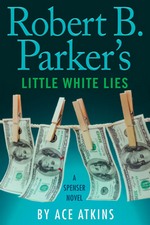
Pub Day Repost: Robert B. Parker’s Little White Lies by Ace Atkins

Really, all I want to say about this book is: “Yes! Atkins did it again — it’s just so good, folks. Long-time fans’ll love it, new readers will likely see the appeal of the series. A lot of fun with a great ending!” But that seems a little surface-y and is just bad writing. But really, that’s everything I’ve got to say.

Little White LiesRobert B. Parker’s Little White Lies

by Ace Atkins
Series: Spenser, #45eARC, 320 pg.
G.P. Putnam’s Sons, 2017
Read: March 16 – 17, 2017

Pearl and I were off to Central Square . Her long brown ears blew in the wind as we drove along Memorial Drive against the Charles. Rowers rowed, joggers jogged, and bench sitters sat. It was midSeptember and air had turned crisp. The leaves had already started to turn red and gold, shining in Technicolor upon the still water.

I debated about what quotation I’d open with — I went with this Parker-esque (and Atkins-esque) description. Little White Lies is one of the better of Atkins run on this series, because (like here) he did something that feels like something Parker would’ve written, but not quite what he’d have said (the more I think about it, the less I think that Parker’d have said “bench sitters sat”).

Actually, that’s true of the other quotation I almost used, too:

I nodded , adding water to the new coffeemaker sitting atop my file cabinet. I’d recently upgraded from Mr. Coffee to one of those machines that used pre-measured plastic cups. I placed my mug under the filter, clamped down the lid, and returned to my desk. Demonic hissing sounds echoed in my office. Where have you gone, Joe DiMaggio?

This is Atkins sixth Spenser novel, and you’d think he’s got enough of a track record that I could stop comparing him to Parker. Well, you’d be wrong — I can’t stop. This, like most of Atkins’ work on this series, is so reminiscent of early Parker novels that it makes some of the latter Parkers look more like they were written by a hired gun. Still, I’m going to try to keep it to a minimum because it doesn’t seem fair to keep doing.

Susan has sent one of her clients to Spenser for some help that she can’t provide. Connie Kelly had been dating someone she met online, invested in one of his real estate deals — and he vanished, taking the money with him. Could Spenser track him down and get her cash back? Sure, he says. It doesn’t take long for the investigation to show that he owes plenty of people money — a couple of months rent here, hundreds of thousands of dollar there.

Here’s the fun part: M. Brooks Welles, the deadbeat in question, is a silver-haired, silver-tongued mainstay on cable news. He’s former CIA, and an expert on military and national security issues — one of those that producers call on regularly when they need a talking head. Why’s a guy like that flaking out on real estate deals? Spenser knows something fishier than expected is going on — which takes him into a world of mercenaries, gun deals, and the ATF.

Then someone tries to kill him. A couple of times. And the book stops feeling like a semi-light adventure, poking fun at the blowhards on cable TV and the state of American Journalism, and how we shouldn’t trust as many people who have cameras pointed at them as we do. Things take on a different tone, bodies start piling up, and a darkness slips in to the book. This also brings in Belson and his new boss — who’s still not a fan of Spenser. About the same time, Connie starts to waver in her conviction that she wants her money back and Welles punished. Spenser, naturally, doesn’t care and plows ahead. Hawk is able to connect Spenser with some mercenaries that travel in the same circles as Welles and the chase is on. Eventually, the action moves from Boston and its environs to Georgia. Which means that Teddy Sapp is going to make an appearance.

All the characters were great — I would’ve liked some more time with some of Welles’ co-conspirators in Boston, I think it’d have helped round out our picture of his crimes. But it’s a minor complaint. We also got plenty of interaction with his Georgia-based colleagues. Even the characters that show up for a page or two as witnesses to the crimes were interesting — it’s the little things like those that add so much. It was nice to see Teddy Sapp again, too. He was the best part of Hugger Mugger (faint praise, I realize). The Hawk material was very good — maybe Atkins’ best use of the character yet.

I fully expect that people are going to spend a lot of time talking about the ending — it didn’t feel like a Parker ending. That said, it felt like an ending that pre-A Catskill Eagle Parker might have tried. It was satisfying, don’t misunderstand, it’s just not the kind of ending that Parker employed. Honestly, there were two other perfectly acceptable places to end the book — and if not for the progress bar at the bottom of my screen, I might have believed that thee ending was earlier and equally strong.

Now, because Atkins and the Parker estate aren’t stupid, there are certain characters that you just know are safe, no matter what shenanigans that they’ve let Atkins and Coleman get away with when it comes to killing off long-term supporting characters. But there was a definite feeling of peril when it comes to [name redacted] and [name redacted]. Sure I knew they’d live to be read about another day, but I wondered how healthy they’d be in the meantime.

This is sharply written, as usual. Atkins knows what he’s doing (in this series or anything else) — a great mix of character moments and plot. Spenser’s voice is strong — as are the voices of the other regulars. It was just a pleasure to read through and through. Let me leave you with one more snippet that is could’ve come from an early-80’s Spenser just as easily today’s, a voice like this is enough reason to read the book — the rest is just gravy (and there’s plenty of gravy):

I returned with sore legs back to my seat on the steps. I spent the next fifteen minutes watching women of all ages, sizes, and colors walk past me. I liked the way most women walked. I liked the way they dressed. And talked and smelled. I was pretty damn sure I was a fan of women in general. Did this make me a sexist or a feminist? Or somewhere in between.

Disclaimer: I received this eARC from Putnam Books via NetGalley in exchange for this post — thanks to both for this.
N.B.: As this was an ARC, any quotations above may be changed in the published work — I will endeavor to verify them as soon as possible.

—–

4 1/2 Stars

A Rare Book of Cunning Device (Audiobook) by Ben Aaronovitch, Kobna Holdbrook-Smith

A Rare Book Of Cunning DeviceA Rare Book Of Cunning Device

by Ben Aaronovitch, Kobna Holdbrook-Smith (Narrator)
Series: The Rivers of London, #5.6
Unabridged Audiobook, 29 min.
Audible Studios, 2017

Read: April 28, 2017


This is an audio-only release (for now anyway) about Peter (and Toby) go looking for a poltergeist in the stacks of the basements of The British Library. Harold Postmartin was hanging out at the Folly when Peter got the case, and wouldn’t let him shrug it off for awhile, so he got to do a little field-work, too.

It was fun to see Postmartin in action and learn a bit more about him. Peter and Toby were their usual entertaining selves. The Librarian (who’s name I can’t remember, sorry), was fun — the tie-in with Peter’s family was, nice too. The Library (in both fact-based and clearly UF ways) was an interesting place, and I can easily see the need for Peter to return there on another case.

Holdbrook-Smith is just fun to listen to, if I heard another couple of books in this series, I’d probably hear him in my head for any future Peter Grant/Rivers of London books. Top-notch stuff there.

I gripe too much about short stories being to short, so I’ll try not to here. This was a complete story, but it very easily could’ve gone on — in fact when the file ended, I pretty much thought that my headphones ran out of juice. It was good enough to satisfy, but not so good that I can’t grumble about it being short. This was fun, and though I’m not sure how giving a story away works to earn money for a library charity, I’ll trust that it does some how and hope that it meets with plenty of success.

—–

3 Stars

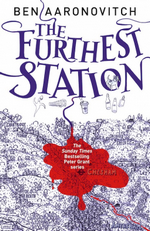
The Furthest Station by Ben Aaronovitch

The Furthest StationThe Furthest Station

by Ben Aaronovitch
Series: The Rivers of London, #5.7

eARC, 144 pg.
Subterranean Press, 2017

Read: April 24, 2017

He asked if we were really ghost hunting, and I said we were.

“What, like officially?”

“Officially secret,” I said because discretion is supposed to be, if not our middle name, at least a nickname we occasionally answer to when we remember.

This novella hit the spot — a short, but fully developed, adventure with our friends from the Rivers of London series — full of action, a bit of snark, and seeing Peter in his element (and far out of it, too). Would I have preferred a full novel? Sure — but if I can’t have one, this is more than adequate.

Peter Grant, apprentice wizard and Police Constable, is investigating several reports of a ghost terrorizing people on the Underground during the morning commute. Naturally, even when interviewed immediately following a sighting the witness would only be able to remember details for a few moments before they forgot and/or rationalized them away. Which makes it pretty difficult to ask follow-up questions. As Peter continues to investigate, he ends up finding a very non-supernatural crime that he needs to deal with, even if he goes about it in a pretty supernatural way. While there’s little in this series that I don’t like, but Peter doing regular policework is one of my favorite parts.

Along for the ride (and looking for trouble) is his cousin, Abigail Jumara, acting as a summer intern for the Folly. Honestly, I barely remembered her when she shows up here — but I eventually remembered her, and I was glad to see her back. I’m not necessarily sure that I need to see her all the time, but seeing more of her would definitely be pleasant.

In addition to the subplot about Abigail’s future, there’s a subplot revolving around another personification of a river — not one of Mama Thames’, either. I enjoyed it, and thought it fit in nicely with the rest of the novella, while giving us the requisite dose of a body of water.

There’s not a lot to sink your teeth into here — but the novella length doesn’t leave you wanting more (like a short story would). It’s good to see the Folly involved in smaller cases. Not just the serial killing, major magical threat, etc. kind of thing — but the “smaller” stuff, too.

For any fan of the Folly/Peter Grant/Rivers of London series, this is one to get. It’d even make a pretty good introduction to the series for someone who hasn’t yet discovered this fun UF series.

Disclaimer: I received this eARC from Subterranean Press via NetGalley in exchange for this post — thanks to both, I needed something like this.
N.B.: As this was an ARC, any quotations above may be changed in the published work — I will endeavor to verify them as soon as possible.

—–

4 Stars

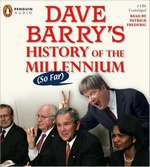
Dave Barry’s History of the Millennium (So Far) (Audiobook) by Dave Barry, Patrick Frederic

Dave Barry's History of the Millennium (So Far)Dave Barry’s History of the Millennium (So Far)

by Dave Barry, Patrick Frederic
Unabridged Audiobook, 4 hrs., 29 mins.
Penguin Audio, 2007

Read: April 10, 2017


Back in high school, I worked at a public library (shock, right?), and I kept shelving this book — Dave Barry Slept Here, and eventually succumbed and took it home — several times. I fell in love with Barry’s humor, and read him a lot over the next decade — every book, as many columns as I could find, etc., etc. But I eventually stopped, for no good reason that I can think of (it’s probably not Harry Anderson‘s fault) — and have really only read his novels since then.

Still, when I saw this audiobook on the library’s site, it was an automatic click — without even reading the description. This is essentially a reprinting of his “Year in Review” columns for the first few years of this millennium and a review of the previous 1,000 years of human history.

It was hilarious. Just that simple. There’s nothing more to say, really.

In the beginning Frederic played it straight — which surprised me a bit, but I liked the effect. A serious reading of Barry’s goofiness worked remarkably well. Later on, Frederic seemed to loosen up — he even did a couple of decent impressions. I really enjoyed his work on this.

Yeah, the humor’s a bit dated, but funny is funny. This is a great look back at the early part of the 21st Century (and before). I laughed a lot, remembered a few things, and generally had a good time with this.

—–

3.5 Stars

Deep Down Dead by Steph Broadribb

Deep Down DeadDeep Down Dead

by Steph Broadribb
Series: Lori Anderson, #1

eARC, 350 pg.
Orenda Books, 2017

Read: April 4 – 5, 2017


Crime Fiction blogger turned novelist, Steph Broadribb’s debut novel, Deep Down Dead is the story of a bail enforcement agent (bounty hunter) making a pickup that will change her life in a fairly dramatic way. Lori Anderson couldn’t be in worse financial straits — her daughter’s medical bills from Leukemia (currently in remission) treatment are so far past due that future treatment is in jeopardy, and they’re about to get evicted from their home. So when the bondsman she works for offers her the largest amount she’s ever been offered for a job, she has to jump at it.

It’s supposed to be a simple midnight run, go pick up the fugitive from another agent not licensed in Florida (or he’d drop off the fugitive himself) and deliver him to the police herself. Almost immediately, problems start (none that deter Lori from the cash reward waiting) — her sitter has plans, so she has to take her daughter, Dakota, with her. Secondly, the fugitive in question is her former mentor, JT — the one who taught her everything she knows, who’s inexplicably got a criminal record now. Then when she arrives at the pickup, the agent she expects isn’t there — instead three very aggressive ruffians (best word I can think of) are there and decide to rough her up a little.

Things really go downhill from there — before Lori knows it, she’s got bigger problems than getting her money. She has to deal with a criminal enterprise running from one of the state’s largest amusement parks; a mob with a long-standing grudge; corrupt law enforcement officials; and being a suspect in violent crimes. This is intertwined with the story of Lori and JT’s past association, how he saved her life and set her on the path that she’s on now.

By the time I got to a whopping 12% my notes started using the word “brutal.” This was like if Pierce Brown took a crack at writing Stephanie Plum. Most of the time the violence (gun play or hand-to-hand) was brtual, but not overwhelming — just heightened enough to fit a crime novel.

You like Laurie almost instantly, Dakota will charm you and grab your heart, and you’ll even appreciate JT (maybe more . . . ) and his crusade — at the very least, you’ll get the connection between he and Laurie. The villains are evil, no two ways about it — but not in the mustache-twirling way, just in the kind of evil that we like to pretend doesn’t exist in this world.

It’s not just in her characterization, but it’s in her plotting, pacing and interweaving the stories of present and past that Broadribb displays more skill than your typical debut novelist. This lived up to every expectation I had from the interviews, reviews, etc. that I’ve heard and read, which was a relief. I sorta feel like I’ve been giving too many 4 Stars lately, like I’ve been overly generous, so I tried to rate this lower. But I just can’t — this is a 4 Star book, easy — and with a little more experience under her belt, Broadribb (and Anderson) will be knocking out 5 Star reads regularly. I can’t wait to see what’s next.

Disclaimer: I received this eARC from Trafalgar Square Publishing via NetGalley in exchange for this post — thanks to both for this entertaining and almost traumatic experience.

—–

4 Stars

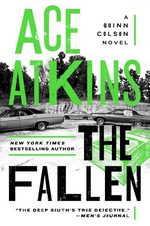
Robert B. Parker’s Little White Lies by Ace Atkins

Really, all I want to say about this book is: “Yes! Atkins did it again — it’s just so good, folks. Long-time fans’ll love it, new readers will likely see the appeal of the series. A lot of fun with a great ending!” But that seems a little surface-y and is just bad writing. But really, that’s everything I’ve got to say.

Little White LiesRobert B. Parker’s Little White Lies

by Ace Atkins
Series: Spenser, #45

eARC, 320 pg.
G.P. Putnam’s Sons, 2017

Read: March 16 – 17, 2017

Pearl and I were off to Central Square . Her long brown ears blew in the wind as we drove along Memorial Drive against the Charles. Rowers rowed, joggers jogged, and bench sitters sat. It was midSeptember and air had turned crisp. The leaves had already started to turn red and gold, shining in Technicolor upon the still water.

I debated about what quotation I’d open with — I went with this Parker-esque (and Atkins-esque) description. Little White Lies is one of the better of Atkins run on this series, because (like here) he did something that feels like something Parker would’ve written, but not quite what he’d have said (the more I think about it, the less I think that Parker’d have said “bench sitters sat”).

Actually, that’s true of the other quotation I almost used, too:

I nodded , adding water to the new coffeemaker sitting atop my file cabinet. I’d recently upgraded from Mr. Coffee to one of those machines that used pre-measured plastic cups. I placed my mug under the filter, clamped down the lid, and returned to my desk. Demonic hissing sounds echoed in my office. Where have you gone, Joe DiMaggio?

This is Atkins sixth Spenser novel, and you’d think he’s got enough of a track record that I could stop comparing him to Parker. Well, you’d be wrong — I can’t stop. This, like most of Atkins’ work on this series, is so reminiscent of early Parker novels that it makes some of the latter Parkers look more like they were written by a hired gun. Still, I’m going to try to keep it to a minimum because it doesn’t seem fair to keep doing.

Susan has sent one of her clients to Spenser for some help that she can’t provide. Connie Kelly had been dating someone she met online, invested in one of his real estate deals — and he vanished, taking the money with him. Could Spenser track him down and get her cash back? Sure, he says. It doesn’t take long for the investigation to show that he owes plenty of people money — a couple of months rent here, hundreds of thousands of dollar there.

Here’s the fun part: M. Brooks Welles, the deadbeat in question, is a silver-haired, silver-tongued mainstay on cable news. He’s former CIA, and an expert on military and national security issues — one of those that producers call on regularly when they need a talking head. Why’s a guy like that flaking out on real estate deals? Spenser knows something fishier than expected is going on — which takes him into a world of mercenaries, gun deals, and the ATF.

Then someone tries to kill him. A couple of times. And the book stops feeling like a semi-light adventure, poking fun at the blowhards on cable TV and the state of American Journalism, and how we shouldn’t trust as many people who have cameras pointed at them as we do. Things take on a different tone, bodies start piling up, and a darkness slips in to the book. This also brings in Belson and his new boss — who’s still not a fan of Spenser. About the same time, Connie starts to waver in her conviction that she wants her money back and Welles punished. Spenser, naturally, doesn’t care and plows ahead. Hawk is able to connect Spenser with some mercenaries that travel in the same circles as Welles and the chase is on. Eventually, the action moves from Boston and its environs to Georgia. Which means that Teddy Sapp is going to make an appearance.

All the characters were great — I would’ve liked some more time with some of Welles’ co-conspirators in Boston, I think it’d have helped round out our picture of his crimes. But it’s a minor complaint. We also got plenty of interaction with his Georgia-based colleagues. Even the characters that show up for a page or two as witnesses to the crimes were interesting — it’s the little things like those that add so much. It was nice to see Teddy Sapp again, too. He was the best part of Hugger Mugger (faint praise, I realize). The Hawk material was very good — maybe Atkins’ best use of the character yet.

I fully expect that people are going to spend a lot of time talking about the ending — it didn’t feel like a Parker ending. That said, it felt like an ending that pre-A Catskill Eagle Parker might have tried. It was satisfying, don’t misunderstand, it’s just not the kind of ending that Parker employed. Honestly, there were two other perfectly acceptable places to end the book — and if not for the progress bar at the bottom of my screen, I might have believed that thee ending was earlier and equally strong.

Now, because Atkins and the Parker estate aren’t stupid, there are certain characters that you just know are safe, no matter what shenanigans that they’ve let Atkins and Coleman get away with when it comes to killing off long-term supporting characters. But there was a definite feeling of peril when it comes to [name redacted] and [name redacted]. Sure I knew they’d live to be read about another day, but I wondered how healthy they’d be in the meantime.

This is sharply written, as usual. Atkins knows what he’s doing (in this series or anything else) — a great mix of character moments and plot. Spenser’s voice is strong — as are the voices of the other regulars. It was just a pleasure to read through and through. Let me leave you with one more snippet that is could’ve come from an early-80’s Spenser just as easily today’s, a voice like this is enough reason to read the book — the rest is just gravy (and there’s plenty of gravy):

I returned with sore legs back to my seat on the steps. I spent the next fifteen minutes watching women of all ages, sizes, and colors walk past me. I liked the way most women walked. I liked the way they dressed. And talked and smelled. I was pretty damn sure I was a fan of women in general. Did this make me a sexist or a feminist? Or somewhere in between.

Disclaimer: I received this eARC from Putnam Books via NetGalley in exchange for this post — thanks to both for this.
N.B.: As this was an ARC, any quotations above may be changed in the published work — I will endeavor to verify them as soon as possible.

—–

4 1/2 Stars

Silence Fallen by Patricia Briggs

Silence FallenSilence Fallen

by Patricia Briggs
Series: Mercy Thompson, #10

Hardcover, 364 pg.
Ace Books, 2017

Read: March 10 – 13, 2017


It was pretty clear from the pages of Fire Touched that Mercy’s little The Doctor to the Sycorax speech was a big deal. But I don’t think any of us really had a clue just how far-reaching the potential ramifications were until it’s spelled out for us by a few different characters here. Well, okay, that’s probably not true — a lot of people who read these books probably thought about it, but I didn’t — and I think that Mercy and her acquaintances do a better job of spelling things out than I could, so I’ll let them. But many in the supernatural communities aren’t happy that she did it and are looking for ways to insulate themselves from it, as well has looking for ways to take advantage of it for their benefit.

One such person is Bonarata — one of the oldest, and most feared vampires in the world — he has ties to the Tri-Cities vampires, as well. He’s the one who’s responsible for Marisila, Stefan and Wulfe leaving Europe and ending up in the Tri-Cities. He’s also a legend in Werewolf circles — many years ago, he killed an Alpha and turned his mate into a blood-slave. After the death of Chastel, Bonarata is the closest thing the non-Fae have to a Super-Villain (pretty sure any of the Grey Lords that wanted to could wipe the floor with him).

So shortly after Fire Touched, Bonarata arranges for Mercy to be kidnapped. Now, while Briggs’ vampires aren’t the political wheels-within-wheels schemers that Faith Hunter’s are, they’re still crafty and wily — so all his reasons for doing so aren’t immediately discernible (and probably not totally discernible by the end of the book — but we get closer).

Mercy is Mercy, however, and it doesn’t take too long before she escapes from Bonarata and finds herself running throughout Europe to escape from his henchmen. She finds herself in Prague (this detail feels like a spoiler, but it’s on the dust jacket, so . . . ) where her best bet for an ally is one of the few Alphas in the wold with a grudge against Bran Cornick. In addition to this she finds herself in the middle of a couple of vampire nests competing for control of Prague, and there’s a whole bunch of ghosts (and other things that go bump in the night) that are taking advantage of the presence of someone who can see them.

Meanwhile, Adam, Marisila, Stefan, Honey and a couple of others are on the way to Bonarata’s home to negotiate for Mercy’s release. Whoops. These chapters are told in Mercy’s voice from Adam’s point-of-view, as if she’s relating what he told her happened, which is a nice touch. It also suggests that she survives this mess — not-at-all-a-spoiler: the first person narrator lives. It’s here that we learn a lot more about Honey, Marisila and Stefan — we also learn about Adam’s Doctor Who fandom. It’s nice seeing things from Adam’s POV for a change.

Mostly the book consists of Adam and Mercy doing all they can to survive long enough to see each other again — which is sweet. We’ve seen them work together plenty of times in this series — we’ve also seen them apart for brief periods — this is the longest (that I can recall) that they’ve been separated, and the furthest apart they’ve been. They’re both independent by nature (however that nature is shaped into something else for the needs of the Pack), so they can adapt to this, but their primary goal is to get back together. Which I’m sure made many, many fans cheer and melt.

Will someone drawn in by the cover art, or wanting to see what the fuss over this Briggs-person enjoy the book? Yeah, I think so — but not as much as the established fan. This book works as well as it does because of the world, not just the story. We’ve been in Mercy’s world for 10 books now — for most of us you can add the short stories and Charles & Anna novels, too. We know it what it means for Honey to make that trip. We know what it means for people to exploit Mercy (or try to) to get to Bran or Adam. We know the pain that the loss of pack-link or mate-bond creates. This would be a lousy book 4, but with the cumulative weight of this series, Silence Fallen us a strong book 10.

It was a fun book — exciting, amusing, and fascinating to see how packs and nests work outside of the US. Most of all it was a good story, taking several competent and powerful characters out of their usual setting and circumstances, and throwing them into a milieu they’re not familiar with to watch them sink or swim. Excellent read for fans of the series — which isn’t a surprise to any, but just something I think I have to say.

Now begins the wait for #11.

—–

4 Stars

Mercy Thompson Audiobooks 1-3: Moon Called, Blood Bound, Iron Kissed by Patricia Briggs, Lorelei King

Rather than try to talk about these individually, I thought I’d save time and tackle them in one post. Let’s hope it works…

Moon CalledMoon Called

by Patricia Briggs, Lorelei King (Narrator)
Series: Mercy Thompson, #1
Unabridged Audiobook, 9 hrs., 14 min.
Penguin Audio, 2009
Read: December 23 – 38, 2016

Blood BoundBlood Bound

by Patricia Briggs, Lorelei King (Narrator)
Series: Mercy Thompson, #2
Unabridged Audiobook, 10 hrs., 2 min.
Penguin Audio, 2009
Read: December 28 – 30, 2016

Iron KissedIron Kissed

by Patricia Briggs, Lorelei King (Narrator)
Series: Mercy Thompson, #3
Unabridged Audiobook, 9 hrs., 11 min.
Penguin Audio, 2009
Read: December 30, 2016 – January 4, 2017


I’ve only posted about a couple of the books in this series, since I read most of the series before starting this blog, it feels strange not to have old posts to go back and steal from. How do I do this concisely, now? I mean this should be one of the longest posts I’ve written, if I was going to do it right.

But I’m not going to do it right, I’m going to do it quick. Simply: Mercy Thompson is a skinwalker of sorts, who was raised by a pack of werewolves (a pack led by the Alpha of North America, it should be noted), who has an English degree and works as a VW mechanic. When we meet her in Moon Called, she’s living near the Alpha of the Tri-Cities of Oregon, is friends with a vampire, knows a couple of the Fae who live on the (Fae) reservation nearby. Almost no one knows about her ability to shift into a coyote (other than these supernatural folks), and she has no intention of changing that. However, she finds herself in the middle of a few goings-on in the supernatural community and becomes a prominent player in the area.

In Moon Called Mercy discovers a group experimenting on werewolves — even creating some for the sole purpose of being guinea pigs. In Blood Bound, Mercy is called upon by the local vampires to pay a debt by helping them track and destroy a rogue über-vampire/serial killer. Then in Iron Kissed Mercy begins helping local Fae investigate a series of murders on the reservation, using her special abilities — in the end, she has to dance around Fae politics while trying to prove that a dear friend wasn’t behind the killings. Throughout this, she has a love life, some friends, helps the local pack with some internal issues, and finds herself in mortal danger frequently. All while maintaining her shop, sense of humor, and independence.

I love these characters — all of them, I can’t think of a single one of them I wouldn’t want to spend more time with. Mercy has an attitude, perspective and humor that I enjoy, and good taste in friends/acquaintances, too. Briggs’ approach to werewolves, vampires, etc. is fantastic and I frequently judge other UF writers by how they match up to Briggs’ approach.

There is a richness to Briggs’ writing and to the world she’s created that’s truly impressive. It takes me less than a chapter to feel absolutely at home in the books (this happened when I first tried Moon Called and has happened with every successive volume — not just in my going through them again on audio). What blew me away going through these books is how much of this series (and the spin-off series, Alpha and Omega) is established in Moon Called — she’s what, 14 books or so in and 98% of those books can be traced to this first one. Whether that’s because she’s good at going back and picking up details to flesh out or because she plotted things out so well, it really doesn’t matter — the material was there and she’s using it well. The world she established is so well-formed that she can keep playing in it without having to invent new things, change the rules she established, or anything else. I can’t think of another UF universe that was so well-built from book one.

King gives a really strong performance here — her characters are spot-on, the narrative stays engaging. Really, a bang up job, with one big flaw: she can’t pronounce local geographic names. Granted, most people who don’t live in Washington/Idaho/Montana(ish) aren’t going to notice, but man, it’s hard to listen to. If I have to hear her butcher “Coeur d’Alene” one more time . . . On the other hand, there’s this scene in Iron Kissed between Adam (local Alpha) and Ben (British werewolf who joined the pack because he had to leave England under suspicious circumstances) where Ben has to explain to Adam the psychological trauma Mercy’s suffered and how she’s reacting. When I first read the book, I was in shock a. because of the traumatic scene (really well written) and b. Ben’s more than capable and empathetic understanding/explanation. This time through, King’s performance just stunned me — it was so good. She nailed the whole thing and almost had me in tears in my cubicle.

I loved the books, I think the audiobooks are among the best I’ve heard — the only reason that I haven’t gone further in this series of audiobooks is that the library system here doesn’t have #4 (they do have the rest of the series, oddly enough), and I haven’t justified the expense for myself yet. For old fans of the books, or people looking for something new to listen to — these are well worth your time. Great material presented in a pretty compelling way.

—–

4 Stars

Rivers of London: Night Witch by Ben Aaronovitch, Andrew Cartmel, Lee Sullivan

Rivers of London: Night WitchRivers of London: Night Witch

by Ben Aaronovitch, Andrew Cartmel, Lee Sullivan (Artist)
Series: Rivers of London Comics, #2

Trade Paperback, 128 pg.
Titan Comics, 2016
Read: January 21, 2017


I enjoyed the first collection of Rivers of London comics, Body Work, but it felt like something was missing — I’m not sure what. Night Witch, on the other hand, built on that good foundation and topped it. This one felt whole, complete — there wasn’t anything lacking here.

Some Russian bigwig’s child has been taken — his wife is certain it’s by someone/something supernatural. They try to take care of it on their own, recruiting Varvara Sidorovna — well, trying to. She tells them to get the police involved, specifying they request Nightingale’s involvement. It’s not that easy to sell official police involvement on this couple. The way they go about doing so isn’t really that typical, either.

Still, Peter and Nightingale get into things and start turning up all sorts of interesting magical things — including The Faceless Man and Lesley. Speaking of which — comics-Lesley? Perfectly creepy.

The story feels a little scattered, but when it’s all told, you can reflect on things and get all the pieces to fit into place nicely — moreso than you can when reading from front-to-back. But it’s easy to forgive that because the story is so strong — and the little character beats are great.

The art is good — it’s great to see the magic –as well as the characters — in these stories brought to life.

Bev’s way of dealing with a home invasion crew of Russian mobsters made me laugh out loud — I don’t know if Aaronovitch could’ve pulled it off in a novel, or if that’s something he only could’ve accomplished with the help of an art team. Either way, I’m glad I got to read it.

There’s not much more to say, a good story with some real enjoyable moments with these characters we want to spend time with. Sure, more novels would be nicer, but these do a good enough job helping to fill the time between them.

—–

3 Stars

Pub Day Repost: The Hanging Tree by Ben Aaronovitch

I really hadn’t intended to make this a Rivers of London day, but I had notes and partial drafts for those other two, so I figured I might as well as a way to lead up to this. Which, sadly, is going up later than I wanted, but Dadding before blogging, right?

The Hanging TreeThe Hanging Tree

by Ben Aaronovitch
Series: The Rivers of London, #6

eARC, 336 pg.
DAW, 207

Read: November 11 – 15, 2016

I lost track of how many times a certain retailer let me know that my pre-order for this had been rescheduled, but now a little more than 2 years after The Rivers of London most recently flowed through these books, The Hanging Tree is out (in parts of the world, anyway). I’m firmly in the camp of those willing to let authors take their time to get the book right, but I’m just as firmly in the camp wanting authors of my favorite series to hurry up. Thankfully, whatever delayed this publication gave Aaronovitch the time he needed to deliver his best yet.

Peter’s pushed into investigating a drug-related death, which soon shows itself to actually need a man of his particular skills when one of the parties involved (perhaps very involved) is the daughter of Lady Tyburn herself. Mostly anonymous teens up to illegal things, an overbearing mother to a suspect/witness, and the natural teenage disinclination to telling the police anything and you’ve got yourself a mess — particularly when the overbearing mother isn’t your biggest fan, and is a deity of sorts.

Poor Peter.

Along the way, Peter and Nightingale find the trail of a lost Newton masterpiece, a couple of interesting allies, and the return of some familiar, but not recently seen, foes. Some of what happens with returning adversaries will surprise, please, and frustrate long-time readers.

For series like this, more important than the plot are the characters — and Aaronovitch did everything right on this front. A few notes on this Peter’s more confident — professionally and personally. He’s coming along pretty well with his magic — yay! At the same time, you can see the way that he’s bringing change to the Folly little mannerisms and activities with Nightingale and Molly that you know they weren’t going to be up to until Peter moved in. I liked how Bev was used — even if she wasn’t around as much as usual — and the way their relationship is developing; her sister Lady Tyburn is probably used better here than ever before. There’s a new assistant for Dr. Walid, Dr. Jennifer Vaughan — we don’t get a lot of her, but there’s promise (and I like the fact that this universe is expanding). Lastly, I need to talk about Guleed — I know she’s been around awhile, but I didn’t really click with her until this book (as much as I enjoyed her in Body Work) — I like the way she works with Peter, the flavor she brings to things — I hope we see a lot more of her.

Oh yeah, I almost forgot, there’s a brief appearance by an author of note early on in the book — I’d love for him to show up again in some context where Peter doesn’t have to be so diplomatic with him. I chuckled a lot, and would love to hear Aaronovitch talk about this character and any real-life models he drew upon.

Not only do we get the typical Aaronovich-level stories and action, we get a big expansion in the number, types, and nationalities of magic users in this book. Not only are there the official practitioners of magic that The Folly is aware of, there are those they’re not tracking (but probably should start). Just this shift alone in the universe makes this book a winner — adding it to the rest is just frosting.

I’m really glad, incidentally, that I recently listened to the first audiobook in the series — there’s some significant call-backs to it throughout this book. I’d probably have been okay relying on memory, but the connections worked better for me with everything fresh in my head. Ditto for the number of references to Body Work – I’d have been fine not understanding the references made to it, they’re not integral to anything, but it was fun knowing what Peter was talking about.

This took me too long to read — which isn’t Aaronovitch’s fault, it’s just been one of those weeks, every time I started to really get into this book, I was interrupted by something — and it drove me crazy. Do what you can — kill the phone, lock the door, grab some snacks and a beverage of your choice and settle in for Aaronovich’s best yet, you won’t want to put it down. I can’t say enough good things about this.

Disclaimer: I received this eARC from DAW via NetGalley in exchange for this post — thanks to both for this.

—–

4 1/2 Stars

Page 16 of 23

Powered by WordPress & Theme by Anders Norén