Category: K-O Page 11 of 22

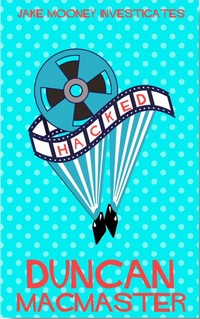
Hacked by Duncan MacMaster: A Smart, Fun Sequel that Topped the One that Went Before

Hacked

Hacked

by Duncan MacMaster
Series: Jake Mooney, #2

Paperback, 258 pg.
Fahrenheit Press, 2019

Read: December 10-11, 2019

Grab a copy from your local indie bookstore!

“You’re a very different kind of man Jake Mooney,” she said. “It’s almost like you belong here, but don’t belong here.”

“How is that?”

“Your life is like a movie,” she said, “and I think the last thing you want is to live your life like that.” …

“This is my second go-round for this sort of thing,” I said, “and the problem with sequels is that they always have to top the one that went before them.”

I remember really enjoying Hack, our introduction to Jake Mooney. But, I didn’t remember exactly why I did (I guess I could’ve read my post about it, but that sounds too much like research). It took almost no time at all to remember once I dipped into this Hacked (and many of the details about Hack came back to me straight away, too). Hack had a strong voice, fun characters, a clever mystery, with a satisfying conclusion to wrap things up. Hacked gives us more of all that.

For those of you who haven’t met Jake Moody, he’s a former journalist turned ghostwriter. Two years before this novel, he rose to fame by solving multiple homicides. He then finished ghostwriting the autobiography of one of the murder victims. He then writes his own account of what transpired (see Hack for details), as well as a fantasy novel. Now he’s been talked into coming to LA to sell the movie rights to any/all of his books.

Before his days of ghostwriting, Jake lived in LA and still has plenty of friends there and touches base with a couple of them. One of the things everyone is talking about there is the hacking of a movie company and the release of private date from them—supposedly, this is a North Korean retaliation for the portrayal of Kim Jong Un in one of that studio’s movies. A legendary agent who Jake knew years ago inadvertently puts Jake in the middle of the investigation. Not long after that, a P.I. friend of his asks him to consult on the same topic.

When Jake arrives at his friend’s home, however, he finds his friend brutally murdered. The assumption has to be that the people behind the hack are the people who killed his friend. So while he really is content to leave the investigation into the hack to the proper authorities, seeing his friend’s body sets Jake inexorably into finding out who committed the murder (and the hack while he’s at it).

Jake’s assisted in this hunt by his agent friend, his new agent, an accountant turned security guard, a former FBI agent, a ride-share driver who’s always wanted to be up to escapades like this, and an attractive studio exec. Help comes from other directions, too, but I’m not going to ruin the surprise for you.

It’s not long before someone tries to kill Jake, he’s kidnapped more than once, assaulted, and . . . you know what? You wouldn’t believe me if I listed all that happens to this poor writer (also, why ruin the surprise?)—I couldn’t help imagining MacMaster asking himself, “What else can I do to Jake? A tiger attack? Nah, not sure how to get him in the cage, but I do know how to ….”

The LAPD is eager to pin all of the death and destruction on Jake, but the more they press him, the more adamant he becomes that he won’t leave. Given the strong cloud of suspicion that North Korea is behind the hack, and presumably the murder of his friend, the FBI is involved, too. They’re less inclined to suspect Jake of having anything to do with the murder, but they’d like him away from the case.

There are more than the requisite number of twists and turns to this case, none of them feels forced or gratuitous. And even when you’re faster at putting the pieces together than Jake is, you should probably take a beat before criticizing him, because you’re probably not as right as you think you are.

The tone is what separates this from similar mysteries. This is not a comedy —there’s a brutal murder, including signs of torture to start things off. There are threats of violence, actual violence, and more deaths to come. But the way that MacMaster tells it makes it become one of the funniest and most enjoyable reads of the year. Think Marshall Karp’s Lomax and Biggs Mysteries for tone. That’s probably not the most helpful comparison, come to think of it, because I’m not sure how many people are familiar with them (too few for sure). Okay, think of this as a Shane Black story—just a novel instead of a script, and there’s no tie to Christmas. MacMaster’s Kirby Baxter books are more overtly comical than his Jake Mooney books, but both are just flat-out entertaining and laugh-filled.

Typically, in books/TV/movies, Hollywood Agents are not depicted sympathetically. Which is probably a bit of an understatement, really. But Jake’s old friend and new agent are both depicted as decent people that he can rely on. That’s not really a plus or a minus when it comes to evaluating, but it’s so strange that I felt compelled to mention it. I can’t remember another fictional Agent who wasn’t some sort of duplicitous, manipulative, weasel.

The story, Jake and the other characters, the fun had a Hollywood’s expense, the twists, etc. would’ve been good enough to make me rave. But there’s a Chinese gentleman that plays a big role in the novel—I don’t want to say much about him, because you just have to meet him yourself. He pops up repeatedly throughout the novel, yet we really don’t spend that much time with him altogether. But he steals every scene he’s in. He’s one of my favorite new characters of 2019. If there’s a Hacked Again or Hack Harder or whatever, I hope MacMaster can come up with an excuse to use him again.

I just had so much fun with this one (a common theme when it comes to MacMaster)—I can’t think of a single reason why someone shouldn’t read this (you don’t have to read Hack first, by the way). Jake was right in what he said before, the problem with sequels is that they have to top the one that went before. Hacked easily does that. It’s smartly-written, cleverly-plotted and just fun to read. Go run and grab it!

4 1/2 Stars

LetsReadIndie Reading Challenge2019 Cloak & Dagger Challenge

This post contains an affiliate link. If you purchase from it, I will get a small commission at no additional cost to you. As always, opinions are my own.

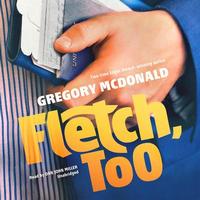
Fletch, Too (Audiobook) by Gregory McDonald, Dan John Miller: Fletch’s Ski Trip to Nairobi

Fletch, Too

Fletch, Too

Gregory McDonald, Dan John Miller (Narrator)
Series: Fletch, #9 (#2 Chronologically)

Unabridged Audiobook, 5 hrs., and 43 mins.
Blackstone Audio, 2019

Read: August 21-22, 2019


Up to this point, we know practically nothing about Fletch’s personal life—he’s been married (and divorced) twice and engaged once or twice in addition to that. He’s carried on an on-again/off-again relationship with Moxie Mooney. Served with valor in the Army, made a couple of good friends there. That’s pretty much it—most of what we know about Fletch is about his professional life—and then the amateur sleuthing/investigative journalism he’s done since he didn’t kill Alan Stanwyck. We know next to nothing about his family, his childhood, and so on.

In Fletch, Too McDonald decides to fix that. Picking up right after Fletch Won (like a day or two after) with his first wedding, the revelations start right away. We meet Fletch’s mother, a mystery novelist of some renown (but perhaps not of the highest caliber). After the ceremony, he’s handed a letter from someone claiming to be his father. Fletch had been told that his father had “died in childbirth,” so he’s taken aback by this. The letter describes (briefly) why his father had not been around for his life and that he’s “mildly curious” about his son. If Fletch is at least “mildly curious” about his father, he’s invited to visit him in Nairobi for their honeymoon, tickets are enclosed.

More than mildly curious, and driven to get some answers (or at least a good story), the two hop that plane (bringing their luggage and skis packed for a trip to Colorado). At this point, it stops being a standard Fletch novel and becomes something more akin to Carioca, Fletch. Before they leave the airport, Fletch witnesses a murder (unbeknownst to the murderer).

Fletch makes a couple of attempts to investigate the murder, but due to circumstances, a language barrier, police not given to outsiders’ help, and the lack of anything to go off of, he doesn’t get far. In fact, minor spoiler, the only reason Fletch “solves” the murder is that he recognizes the killer toward the end of the book. Which makes for a fairly unsatisfying “mystery” novel.

Where this book gets interesting is as Fletch and his wife meet some locals, explore the city, and meet a colleague of his father’s. We’re treated to a look at the culture, legal system (or lack thereof), history and some speculative Archeology about the area. It’s interesting—but it feels more like McDonald had an interesting vacation, read some good books on the region and/or had some great conversations with people from Nairobi and wanted to share what he’d learned (again, see, Carioca, Fletch).

I think I appreciated this more than the other non-standard Fletch because 1. I came in with low expectations (remembering how little I liked it) and 2. the supporting characters are more interesting.

At this point, I assume (and am supported by experience) that Miller will do a capable job with the Narration and he helped me enjoy the experience.

This is one for completists, for those who are curious about Fletch’s backstory, or for those who have a hankering for learning about Kenya. It’s not a bad book, it’s just not as good as it should be.


3 Stars
2019 Cloak & Dagger Challenge

Yet More Quick Questions with . . . Nick Kolakowski

Man…this is the third time I’ve got to pick Nick Kolakowski’s brain (the first and the second, for you completists). I can’t believe he keeps coming back for more — but when I get great answers like these, I’ve gotta keep asking, you know? Do read the others if you’re wanting to learn more about him in general — I stuck to Maxine Unleashes Doomsday (I posted about it earlier today, in case you missed that) this time.

Hope you enjoy!

Did you set out to write Science Fiction or is that something that came about as you started the project?
I’ve always wanted to write a dystopian novel, but all my early attempts were ignoble failures; they were Diet Cormac McCarthy, pastiches of “The Road” that were just retreads of what everyone else was trying to do. It’s only when I mashed the concept onto a noir framework that it started to work for me—a heist novel was the grounding that I needed, even if the target of that heist, in this post-apocalyptic context, is really, really weird.
What were some of the new challenges (and/or freedoms) compared to your earlier works given this setting/genre?
I’ve never written a book that covers the whole scope of someone’s life. Any novel comes with its share of continuity challenges; even if the timeframe is really short (i.e., a few hours or days), you need to keep all of your pieces and characters aligned and consistent. But keeping the details of a character’s life aligned across decades can prove much more difficult—did this happen to her left or right arm when she was a teenager, etc.

In terms of freedoms, though, you can create an incredible character arc if you have that kind of super-expansive timeframe to play with. There’s a real poignancy to tracing someone’s life from their teenagehood to the very end, especially if the country is radically changing around them at the same time.

What came first—the story or Maxine? Is that your typical approach, or does it vary from project to project?
Maxine came first: I had a vision of a badass woman, bitter and chain-smoking but refusing to give up no matter what life threw at her. From there, I wanted a story that put her in worse and worse circumstances. What happens to someone who loses everything? What’s left?

In terms of actual writing, this book started in the middle. Then I wrote Maxine’s childhood and teenage-dom. Then I stalled for about a year because I couldn’t think of where to take her from there; it was only when I came up with the broader framework—of academics discussing her life and her impact on society—that I figured out where to take everything.

In this book, Preacher reminded me a lot of Main Bad Guy’s Walker—but a very different take on the character type. Is 2019 your Year of the Aging Badass, or is that just a coincidence?  I’m having a hard time not asking a spoiler-laden question about him, so let me take the easy way out – what would a prospective reader want to know about Maxine’s very disfunctional paternal figure?
That was a coincidence, but now that you mention it… yeah, Preacher and Walker are brothers of a type! I didn’t mean it that way; Preacher made his first appearance in my head circa 2014, while Walker emerged around 2017-18, when I was writing “Main Bad Guy.”

Not to spoil too much, but Preacher isn’t the badass that Maxine thinks. He’s ultra-tough, and he deserves his fearsome reputation in the ruined part of the world where Maxine and her family lives. But his weaknesses—and frankly, his lies—eventually force Maxine to step up. The thing about badasses like Preacher and Walker, they can serve as crutches for your main character; at some point, you need to neuter them or take them away if your protagonist is truly going to move on and grow.

Are you far enough into your next book to talk about it – are you sticking with SF, going back to Crime Fiction, or trying your hand at something like Wizards?
Haha! Noir-ish wizards would be pretty cool, although I’m sure someone has already covered that arena already. Up next is actually the sequel to “Boise Longpig Hunting Club,” so it’s back to crime fiction (and Idaho!). The as-yet-untitled sequel is actually giving me a bit of trouble, because I’m trying to ratchet up the tension as tightly as possible on Jake and Frankie, my two main characters (and siblings). They survived some insane crap in the first book, so I have to figure out a way to make things even crazier.
Thanks for your time—and thanks for introducing me to Maxine
Thank you! I love her. I hope readers will, too.

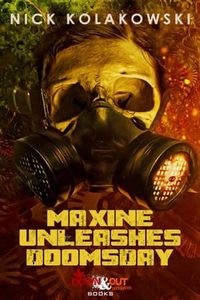
Maxine Unleashes Doomsday by Nick Kolakowski: Kolakowski Gets His Crime Fiction Chocolate in this SF Peanut Butter

This is one of those books that I’m uber-excited about, yet I don’t think I do a good enough job at explaining why I am. It’s just good.

 Maxine Unleashes Doomsday

Maxine Unleashes Doomsday

by Nick Kolakowski

eARC, 274 pg.
Down & Out Books, 2019

Read: October 29-31, 2019

“You know the trick to surviving? The one thing you got to do?”

“What’s that?” Maxine asked.

“You got to treat every day like an adventure. Like it’s fun, or a challenge, even when everything’s crappy. Especially when it’s crappy. Because otherwise, it’s all going to crush you.”

“I feel like I spent my whole life being crushed.”

“Well, that’s your fault. A normal job, trying to live a normal life, it’s just inviting people to stomp you. And they do.”

“Yeah.”

“But at least in my line of work, sometimes you get to stomp back…”

In case the author’s name looks familiar to you, yeah, you’ve seen me use it a few times this year—3 novellas, 1 short fiction collection, and now this novel, Maxine Unleashes Doomsday. It occurs to me now, that he was the first author I read this year, and he did a pretty good job setting the tone for 2019’s reading. This book is his first step out of Crime Fiction and into Science Fiction—dystopian SF, to be precise (that really should be obvious to anyone familiar with him, I don’t think he’s got a utopian novel in him).

That said, there’s enough of a Crime Fiction flavor to this SF novel, that fans of either genre will have enough of their drug of choice to be satisfied.

This is set in the near-future, at various points along the fall of the US/Western Civilization. While there are plenty of other characters to keep an eye on, our focus throughout is on Maxine. After a rocky start to life with a drug-addicted mother, and an unsuccessful academic career (although she tried for a little bit), she tries to follow her uncle’s example and become a criminal. She has some success in that, but a large failure resulted in life-threatening injuries to a friend and the loss of one of her arms. Following that, she tries to live a non-criminal life, she gets a job, settles down with a guy and has a kid. But her heart’s not in it, and she ends up dabbling in thievery. At some point, she abandons that life and sets her eyes on a criminal career.

Maxine is one of my favorite characters this year—she’s flawed (not as flawed as she thinks), she’s a fighter (not as good as she thinks), self-destructive, optimistic, and driven. She takes a lot of (metaphorical and literal) punches, and while she may not get up right away after them, she doesn’t stop moving forward. Ever. I love reading characters like that.

Her uncle, who goes by Preacher, is one of the most significant criminals in the New York area—and has some cops dedicated to taking him down, and any number of civilians supporting him. Off and on throughout her childhood, Preacher tried to get Maxine’s mother to leave her addictions behind to provide for and care for her kids. Between his power and influence on the one hand, and being just about the only adult to look out for her and her brother, it’s no wonder that Maxine will want to be part of his life. Readers of Kolakowski’s Main Bad Guy will enjoy playing a compare/contrast game with Preacher and Walker.

There are a number of other characters that greatly influence Maxine’s life and desires, but none so much as her uncle. And to get into them would just push this post beyond the length I want (and would end up spoiling stuff to really talk about).

By and large, this is the story of Maxine’s journey from a struggling public school student to being a wanted criminal (and beyond). But that’s not everything that’s going on. For the first chapter, you get the impression you’ll be reading a book about rival groups fighting for supplies in mid-apocalyptic New York. But then you’ll realize that’s not it at all, it’s a story about how Maxine became the tenacious gun-fighter and would-be criminal mastermind that she is. Eventually you discover that yeah, both of those are true, but Kolakowski’s really writing a different story—and boy howdy, you feel pretty clever when you suss it out, and it’s such a brilliant way of telling this story that you don’t mind being wrong about what the book is trying to accomplish. But even then, you won’t really understand everything until the last line of the book (I’m not sure I actually pumped my fist when I read it, but I probably thought about it pretty hard).

Yes, it’s a pretty violent book (this too, should really be obvious to anyone familiar with Kolakowsi), but most of the truly horrible stuff happens “off-screen,” making it a lot easier to take. The prose moves quickly and assuredly, the writing is sone with a strong sense of style and savoir faire. Frankly, it’s too lively and enjoyable to keep the most readers who aren’t into gunfights, etc. from being turned off by the violence.

It’s a well-realized dystopia, one that’s easier to imagine happening than say, Panem. Kolakowski does a wonderful job of littering this book with little details that tell you so much about the world his characters live in and entertain the reader. Hitting both of those notes regularly is a difficult task. For example:

“Someday I want to go to California,” Michelle told Maxine. “Did you know it used to be a state?”

and

This far north, the concept of local government grew teeth and claws. If you stuck to the highway, you would cross into territory controlled largely by the New York Giants, which had expanded beyond its origin as one of the nation’s most consistently mediocre sports teams to control a big swath of towns northeast of Buffalo.

One of the conceits of the book is that the material is a result of an academic study about Maxine. It’s one of the best moves that Kolakowski makes in this book (and it’s full of great moves). Don’t skim over these notes, you’ll be rewarded for your attention.

Oh, I should warn you: This book might put you off popcorn for a while. I’m just saying…

Rob Hart wrote one of the endorsements for this: “Take one of Richard Stark’s Parker novels and throw it in the blender with DVDs of Mad Max and The Warriors. Guess what? You just broke your blender. Find solace in this book, which is what you should have done in the first place.” I repeat that for a couple of reasons—1. I love the last two sentences. 2. He’s right, and says everything in 4 sentences that I tried to above. You should listen to one of us. Kolakowski has outdone himself with this one, it was a pleasure from end to end. You really need to read it.

Disclaimer: I was provided a copy of this novel by the author in exchange for this post and my honest opinion. My opinions are my own, and weren’t influenced by this.


4 1/2 Stars
LetsReadIndie Reading Challenge

Finally Fall Book Tag


While reading these posts on Bookidote, beforewegoblog, and The Witty & Sarcastic Bookclub, I noticed myself mentally composing this list—so I figure I had to join in the fun. I’d have posted this last week, but my free laborer realized how little he was getting paid and decided to play video games instead of generating my graphic.

Naturally, I only paid half of his fee.

Enough of that, bring on the Autumn! (even if it feels like Winter here in Idaho):

In Fall, the air is crisp and clear. Name a book with a vivid setting.

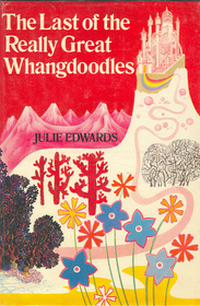
The Last of the Really Great WhangdoodlesThe Last of the Really Great Whangdoodles by Julie Edwards

I had a hard time coming up with something for this one, honestly. But Whangdoodleland was so vivid that I can still picture parts of it, despite having read it only once in the last 30+ years.


Nature is beautiful…but also dying. Name a book that is beautifully written, but also deals with a heavy topic, like loss or grief.

A Monster CallsA Monster Calls by Patrick Ness

When I posted about it, I said, “I’m not convinced that this is really all that well-written, technically speaking. But it packs such an emotional wallop, it grabs you, reaches down your throat and seizes your heart and does whatever it wants to with it—so who cares how technically well it’s written? (and, yeah, I do think the two don’t necessarily go together). A couple of weeks from now, I may not look back on this as fondly—but tonight, in the afterglow? Loved this.” I still look back on it as fondly, for the record.


Fall is Back to School Season. Name a Nonfiction Book that Taught You Something.

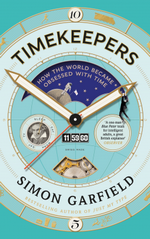
TimekeepersTimekeepers: How the World Became Obsessed With Time by Simon Garfield

If I’m going to read a non-fiction book, it had better teach me something or I’ll end up ranting about it for days/weeks/months! This one popped to mind, though. In my post about the book, I said: “Did I learn something from the book? Much more than I expected to. The chapter on the French experiments alone probably taught me enough to justify the whole book. I didn’t/couldn’t stick with the details of watch-making (I have a hard time visualizing that kind of detail), but even that was fascinating and informative on the surface. Most topics broadened my understanding and taught me something. Also, the sheer amount of trivia that I picked up was great (the amount of time spent recording the first Beatles LP, why pop music tends to be about 3 minutes long, etc., etc.).”


In order to keep warm, it’s good to spend some time with the people we love. Name a fictional family/household/friend-group that you’d love to be a part of.

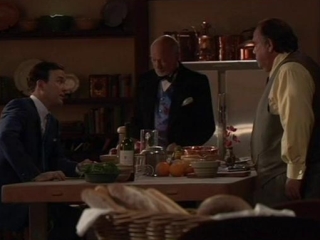
Nero Wolfe trioThe Household of Nero Wolfe from the books by Rex Stout

(yeah, that picture is from the A&E TV show, not exactly the books—but in that image in particular, they look just about perfect)

There were many families/groups/households that I could’ve picked for this, but that Brownstone on West 35th Street is near the Platonic ideal for a place to live—I’d love to spend time with Mr. Wolfe, Archie and Fritz (not to mention Saul, Fred, Orrie, Lily, Lon . . .)


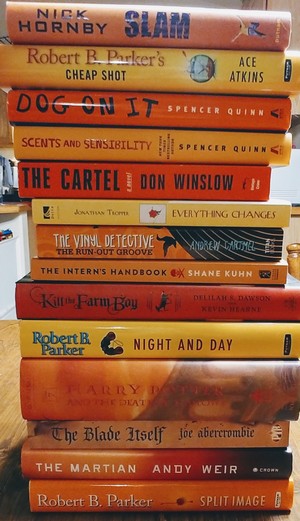
The colorful leaves are piling up on the ground. Show us a pile of Autumn-colored spines.


(I thought this was going to be hard, but in the end, I had to not make the pile bigger!)

Also…wow, clearly, I’m not a photographer. It’s a shame I don’t live closer to my pal, Micah Burke, things around here would look much spiffier.


Fall is the perfect time for some storytelling by the fireside. Share a book wherein somebody is telling a story.

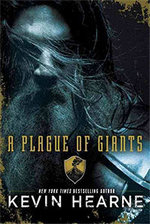
A Plague of GiantsA Plague of Giants by Kevin Hearne

That’s really 90% of the book—a bard telling stories. How he pulls this off, really impressed me.

(Hammered by Kevin Hearne would also qualify, but I liked the storytelling in this one better)


The nights are getting darker. Share a dark, creepy read.

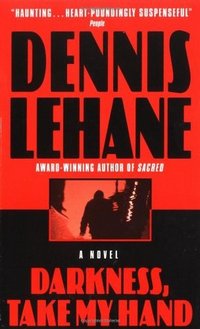
Darkness Take My HandDarkness Take My Hand by Dennis Lehane

This one disturbs me every time I read it (4-6 I think), I still remember having to sleep with the lights on after I stayed up reading it until 2-3 in the morning the first time—I doubt I was a very good employee the next day. (Sacred maybe is creepier, but this is the better book by Lehane)


The days are getting colder. Name a short, heartwarming read that could warm up somebody’s cold and rainy day.

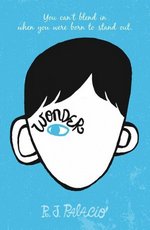
WonderWonder by R. J. Palacio

The “short” in the category is the sticky wicket. But this is a quick read (even if the page number is higher than I’d count as “short.” Formulaic? Yup. Predictable? You betcha. Effective? Abso-smurfly. Textbook example of heartwarming.


Fall returns every year. Name an old favorite that you’d like to return to soon.

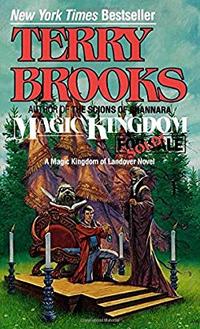
Magic Kingdom for Sale — SOLD!Magic Kingdom for Sale — SOLD! by Terry Brooks

Ive been thinking about this book a lot since Bookstooge’s Quick Fire Fantasy post. Gotta work this into the 2020 reading schedule.

I’m tagging any blogger who reads this. Play along.

Universal Monster Book Tag


Witty and Sarcastic Book Club tagged me in her little creation—a tag based on Universal’s Classic Movie Monsters. There’s a lot of recency bias in my pics, but oh well—I liked the list. I really need to do more things like this, it was fun.

While trying to come up with the last couple of entries for this, I took a Facebook break and read a couple of posts on a Nero Wolfe fan group, and realized I could fill my blanks from that Corpus. Then it occurred to me that I could do one of these with entries only from the Nero Wolfe series. Or, the Spenser series. Huh. (I’d have trouble with some other series depending how you define “sequel” below). Watch me control the impulse.

bullet Dracula: a book with a charismatic villain
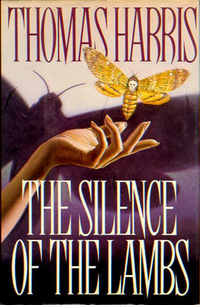
The Silence of the Lambs
My Pick: Gotta go with Hannibal Lecter in The Silence of the Lambs, every other charismatic villain I can think of pales in comparison.
Bonus Nero Wolfe Pick: (yeah, so much for restraint—this was a fun additional challenge) Paul Chapin in The League of Frightened Men (my post about the book)
Bonus Spenser Pick: The Gray Man in Small Vices

bullet The Invisible Man: A book that has more going on than meets the eye
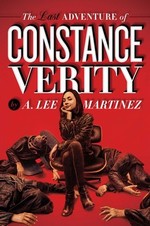
The Last Adventure of Constance Verity
My Pick: The Last Adventure of Constance Verity by A. Lee Martinez (my post about the book)
Bonus Nero Wolfe Pick: Even in the Best Families
Bonus Spenser Pick: Early Autumn

bullet Wolf-Man: A complicated character
Needle Song
My Pick: Doc Slidesmith in Needle Song (my post about the book)
Bonus Nero Wolfe Pick: Can I just use Nero Wolfe? Eh, Orrie Cather in A Family Affair
Bonus Spenser Pick: Patricia Utley in Mortal Stakes

bullet Frankenstein: A book with a misunderstood character
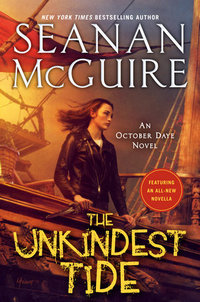
The Unkindest Tide
My Pick: The Luidaeg in The Unkindest Tide by Seanan McGuire (my post about the book)
Bonus Nero Wolfe Pick: Over My Dead Body (my post about the book)
Bonus Spenser Pick: Hawk, A Promised Land

bullet The Bride of Frankenstein: A sequel you enjoyed more than the first book
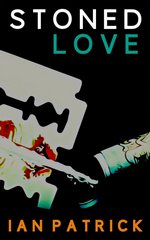
Stoned Love
My Pick: Stoned Love by Ian Patrick (my post about the book)
Bonus Nero Wolfe Pick: The League of Frightened Men (yeah, that’s the second time this shows up, but it’s the sequel…) (my post about the book)
Bonus Spenser Pick: God Bless the Child

bullet Creature from the Black Lagoon: An incredibly unique book
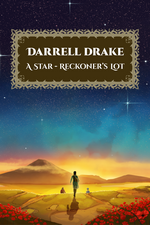
A Star-Reckoner's Lot

(there’s a better cover now, but this is the first)

My Pick: A Star-Reckoner’s Lot by Darrell Drake (my post about the book)
Bonus Nero Wolfe Pick: Some Buried Ceasar (my post about the book)
Bonus Spenser Pick: A Savage Place

bullet The Mummy: A book that wraps up nicely (see what I did there?)
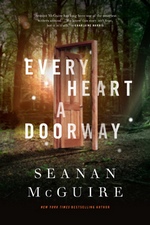
Every Heart a Doorway
My Pick: Every Heart a Doorway by Seanan McGuire (my post about the book)
Bonus Nero Wolfe Pick: This applies to almost every one of them, I’m going to go with The Doorbell Rang
Bonus Spenser Pick: The Judas Goat

I’m not going to tag anyone, but I’d encourage any reader to give it a shot. I’d like to see your lists.

Also, I’ve been thinking for awhile I needed to do a re-read of the Spenser series. This post has convinced me I really need to get on that.

The Unkindest Tide by Seanan McGuire: The Luidaeg takes Center Stage in this Water-filled Adventure

The Unkindest Tide

The Unkindest Tide

by Seanan McGuire

Series: Toby Daye, #13

Hardcover, 301 pg.
DAW Books, 2019

Read: September 10-11, 2019

I finally took my eyes off the water, peering at her through the disheveled curtain of my hair. “Are you just babbling at me until I start feeling better?”

“Yup!” Marcia beamed. “Is it working?”

My stomach was no longer roiling. I didn’t trust myself to stand up on my own, but I also didn’t feel like I was about to introduce the barnacles to my breakfast. Again. I blinked. “Actually, yes.”

“Sometimes you need to take peoples’ minds off their problems if you want those problems to resolve themselves,” said Marcia. “Focusing on things can make them worse.”

“Not all problems go away if you ignore them. Most don’t.”

“No, but not all problems can be fixed. Sometimes you have to wait until the situation changes.” She smiled sympathetically. “Like if you’re on a boat and you get seasick.”

Yup. Toby’s on a boat—a sailing ship, to be precise—just the place for someone who hates water. Why is she there? Well, that has something to do with the debt she owes the Luidaeg. The Luidaeg has decided that time is up and it’s now time to pay that mysterious bill she told the Selkies was coming due. And Toby has to come along to help her collect. A couple of months ago, when I listened to the audiobook of One Salt Sea, I wondered what happened to that ominous future event, so that was nice to see. On the other hand, we’re told that this was nearly three years ago, which means it takes only three-ish years for books 6-12 to occur? That’s an eventful life right there.

Because they’re apt to be useful, and because Toby isn’t likely to come nicely without them, the Luidaeg also brings Tybalt and Quentin along on their trip to the Duchy of Ships, where a convocation of Selkies will be held to pay this bill. Due to the significance of this happening, a few other dignitaries come, too—delegations from the Kingdom of the Mists, the Duchy of Saltmist, and Goldengreen—oh, and Gillian (which makes sense for people who’ve read the previous book, Night and Silence).

So we’ve got a group of Toby’s friends, a new Duchy for most of them to visit, a bunch of debts the Luidaeg is collecting, and the fate of an entire race in the balance. What could go wrong?

Naturally, that’s the wrong question. SOmething better to ask is: how many pints of blood will Toby lose while trying to fix what goes wrong and how many others will die? Obviously, I’m not going to answer those, but we need to get our thinking straight.

Something I want to mention before I forget: Before the Sea Witch shows up at her door, Toby’s narration gives a very thorough and succinct recap of the entire series (one of the best of those I’ve read lately, it’s a tricky thing to accomplish) before noting

…there’s a lot of history around here, and sometimes it doesn’t summarize very well.

It’s a small thing, but it made me smile—McGuire excels at those.

The Luidaeg has got to be just about the most popular character in this series, and we really get to know her so much better here than we have before—and it made me so happy to see this. I’d gladly take another Luidaeg-centric book or three any day of the week. Seeing her at this turning point in all her power and all her grief is just stunning. I don’t think I’d ever felt bad for her (at least not for long), but watching her being resolute in carrying out the duty she was bound to here—while clearly not wanting to go through with it—was moving. Early in the book, there’s a scene between her and a little girl that just about broke my heart. At the same time, she has plenty of great lines and made me chuckle a lot, too. Her interactions with Quentin (and vice versa) might be my favorite parts of the book.

The Luidaeg/Selkie story was strong enough that I don’t care so much about the rest of the book, which is good, because I think it’s one of her weakest. There’s an adventure in Saltmist that seemed pretty perfunctory and while the ending is very clever—and gives Toby a chance to embrace the technicalities of Faerie in a way she usually doesn’t (that is, keeping the letter of the law, but doing a tap dance all around the intent)— it seemed anti-climatic. We have a great build-up and then an almost let-down of a conclusion.

A few quick bullet points that I don’t have the time to expand on (nor do I think I could do them justice without talking too much about them):

  • No one expected, I trust, that things between Toby and Gillian would get better after Night and Silence, but it was tough (yet understandable and believable) to read Gillian’s reactions to Toby here.
  • There are repeated references to the weakness/susceptibility to harm of one member of Toby’s group—McGuire hit that note so often that I really feared for that character. One that I didn’t realize I liked as much as I did when I feared for their safety and longevity.
  • We get to meet another Firstborn! She’s just fantastic and I hope we get to see more of her. Also, the reactions of various members of her descendant races to meeting her in the flesh were priceless.
  • Someone’s blind fosterage is getting harder to maintain. That could prove interesting (and in the Toby-verse, interesting usually is defined as calamitous)
  • Clearly, Toby’s reputation as someone who topples monarchies has spread far and wide. This isn’t good for her, but will be good for us readers.
  • Marcia continues to show more depth and ability than I gave her credit for when we met (which surprises me almost every time we see it)
  • What we’re told about future books here (in terms of Toby’s future obligations) is enough to get long-term readers excited (not that we needed the encouragement, really, but it’s nice to know)

This isn’t one of the best in the series—but it features some of the best moments, scenes, events. It’s not a trade-off I’m entirely pleased with, but I can live with it (and thankfully the good far outweighed the less-good). It’s safe to say that a lot won’t be the same again in this world or for many of these characters. Any time I spend with Toby, Tybalt, Quentin, the Luidaeg, etc. is a good time, and I thoroughly enjoyed the read, I just wanted a bit more from an author who usually brings more than you could realistically ask for.


4 Stars

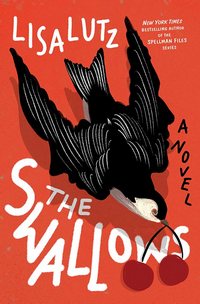
The Swallows by Lisa Lutz: Hilarious and Harrowing Account of Destroying the Status Quo because the Status is Not Quo

The Swallows

The Swallows

by Lisa Lutz

Hardcover, 399 pg.
Ballantine Books, 2019

Read: August 21 – 22, 2019

As I gazed at my students, I had the same thought I always had on the first day. They looked so young and innocent. Then I found a dead rat in the bottom of my desk drawer and remembered the tenet I had learned over the last eight years. The young may have a better excuse for cruelty, but they are no less capable of it.

For someone looking for omens, it’s odd how many exit signs I chose to ignore.

If a century of tradition were the only thing my time at Stonebridge brought to an end, I’d be okay with that. It’s the two deaths that keep me up at night.

How can I talk about The Swallows without ruining the experience? Not easily, and verbosely. Let’s see if I can manage it.

Structurally, it’s a boarding school book—a bunch of well-off (and/or scholarship) kids livingly largely without parental supervision and guidance, getting away with all sorts of things while the adults responsible for the supervision turn a blind eye, are honestly oblivious, or are complicit in the goings-on. At the end of the day, the real power is wielded by the students—a small sub-set of them, anyway—and there’s a split between those wanting to exercise their power for their own pleasure and benefit (largely male at the expense of female empowerment, self-respect, self-esteem, and dignity) and those, well not wanting that.

Largely the book focuses on a small group of female students sick and tired with the status quo (offended and angry, actually) who set out to expose the cabal and the horrible games they play with people in a way to salt the earth so it can’t be repeated. This seems like a tall order, but what choice do they have? They also have male students sympathetic to their cause and are willing to help out.

But also, there’s a teacher (or more) not willing to go along with this, and who knows something’s going on, so she does what she can to track it down to find ways to stop it (either herself or via student/faculty proxies). Her name is Alex Witt and she’s just arrived at Stonebridge Academy following an ignominious departure from Warren Prep. It takes her very little time to determine that something is rotten at Stonebridge and that a couple of her students are trying to do something about it. Instinctively in agreement with them, Alex does what she can to encourage the individuals to find one another and use the strength their numbers and collaboration can bring. One student described her as:

…my friend, my ally, my confidante. She charmed, teased, amused, incited, and befriended us.

Alexandra Witt was the pied piper of Stonebridge Academy.

Chapters are told from the perspective of Alex or some of the other faculty or various students—primarily from the perspective of Gemma Russo (the student quoted above). Gemma was well on her way to a time as a firebrand, but with nudges and aid from Alex, her crusade picks up momentum until upheaval comes to the existing conditions and then all bets are off (see that last line of the opening quotation). Essentially, Alex is John Keating without the stand-up or poetry, making Gemma Neil Perry, I guess.

The book starts off as offbeat, with Gemma as this strange instructor in an alien environment, trying to escape her legacy and to maybe find a little peace while the students are running around pretending to be revolutionaries. But it shifts at a certain point, and while still occasionally comic and never anything but fun to read, it sheds the comedy in favor of earnest emotions and motives and dangerous situations. You don’t notice it happening, but after a certain point, you’ll notice the ground has shifted. Lutz pulls that off really well.

There’s a lot of subtle work to the plot and the prose, and some that’s pretty obvious. But even the obvious is done well. There’s a reveal toward the end of the book that caught me so off-guard, but was so perfect I think I laughed out loud. I think this is technically streets ahead of Lutz’ previous work.

It’s a very different kind of humor than we got in The Spellman Files, but it’s probably as funny as Lutz has been since the third book in that series—but it’s mixed with the harsh realities of The Passenger and the feel of How to Start a Fire. Lutz puts on a clinic for naturally shifting tone and using that to highlight the important stories she’s telling.

There’s not a poorly designed or written character—I can’t say I liked all of them, or even most of them (many of them could use a few days in a pillory while fellow students threw rotten fruit or whatever at them)—but as players in this particular drama, they’re great. I was repeatedly torn between things happening too quickly, and yet not quickly enough—which I take as a sign that she nailed the pacing.

Because I’m really nervous about oversharing here, I’m going to wrap things up—but this is one you really should be reading. If it’s not on one of my Top 10 lists of 2019, I’ll be pretty shocked. I can’t think of many that I’ll put ahead of it at the moment.

From the funny and dark beginning, to the perfect and bitingly ominous last three paragraphs The Swallows is a winner. Timely and appropriate, but using tropes and themes that are familiar to readers everywhere, Lutz has given us a thriller for our day—provocative, entertaining, and haunting. This is one of those books that probably hews really close to things that could or have happened and you’re better off hoping are fictional. Lisa Lutz is always a very good author, The Swallows is Lutz at her best.


5 Stars

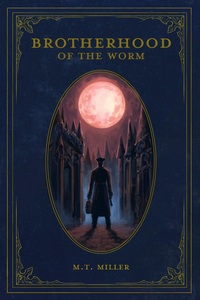
Brotherhood of the Worm by M. T. Miller: A little Sam & Dean, a little more Van Helsing, a lot of Monster Killing

Brotherhood of the Worm

Brotherhood of the Worm

by M. T. Miller
Series: The Culling, Book 1

Kindle Edition, 332 pg.
2019

Read: August 28-29, 2019

The door leading to the hallway and the rooms upstairs slammed open without warning, and in came the missing patron. He was tall, thin, and wide in the shoulders. He had been lodging upstairs for the last three days, and always wore the same grey coat and cocked hat. In his gloved left hand was a heavy-looking leather bag that he never let anyone else touch. Apparently, he even took it to the outhouse.

“Listen to me!” he bellowed after letting the bag down and shutting the door. “And listen well. Until the sun rises, no one may leave this inn!”

Having just emptied a goblet down his throat, Moritz gave the man a look of dull surprise. “What is this? A robbery?”

“I’m afraid not,” the strange patron said. “If it were, we’d all have a better chance of getting through it alive.”

The inn is in an 18th-Century(ish) Germany(ish) country. The strange patron is Conrad Shast, the last member of a noble household turned monster hunter. That’s about as friendly as he gets. He goes from town to town, wherever he’s called to go to eliminate any one of a multitude of monsters on behalf of a shadowy organization that, well, let me let Shast tell it:

“Few refer to it by name, but it is called the Culling, and it’s been protecting the world from monsters and witches for as long as history remembers. From time to time, others have tried their hands at monster hunting, but it never lasted. In the long run, only the Culling has survived the test of time.

“Officially, no noble is under obligation to aid a hunter. But the consequences of rejecting a plea for help far outweigh their potential cost.”

The Culling is a busy group, it seems, there are monsters everywhere in this world (even overrunning some continents), and, as the man said, they’re the only game in town. Generally, they send one or two people to any particular place, but if there’s a big enough problem, they will send out reinforcements. During the course of this novel, Shast ends up working with two other hunters. It’s clear that no two hunters are alike—there’s a variety of approaches, specialties, backgrounds, and personalities (I was a little afraid it’d be armies of Shasts, Miller might have been able to pull it off, but I like this approach better).

Shast is a classic loner, a wandering knight à la Jack Reacher or TV’s David Banner (but with less of a sense of humor). He comes to down, gets his prey and the money he (and The Culling) is owed for that service and moves on. No friends, no family, no entanglements. The particular hunt he’s on when he takes over the inn is a little trickier than most (and will end up being a lot trickier in the end)—he eliminates the monster, but not the source of the infestation. The source has moved on and has likely infested at least one more city by this point. So he has to hit the road to track down the source.

One woman in the inn was so changed by her exposure to the monster that she can detect the hidden creature (not that she wants to), so Shast brings her with him to expedite the hunt. The city guard also dispatches a knight old enough to be her father to act as chaperone and guard. Eventually, they cross paths with another hunter after the same target. She’s into poisons, explosions (Shast prefers a good knife) and making sure her enemies suffer. She joins this grim band as they continue to track down the source, eventually reaching the capital city and discovering things are worse than they thought.

It’s not a smooth journey, and there are distractions and obstacles (both monstrous and human) along the way. The group is not united in any way, and most aren’t that willing to be participating, but there’s not a lot of choice offered any of them. Putting this in an 18th-Century(ish) setting is a great idea—you get a little bit of technology (guns, primarily), but not enough that swords, horses, traveling on foot and slow modes of communication aren’t the flavor of the day. You get a shifting prominence of nobility, a rising middle class, and a church struggling to survive in a hostile world, also. It’s a tumultuous time, not helped at all by the creatures plaguing the citizenry. It’s also a great change from the post-apocalyptic wasteland of Miller’s previous series.

And I wish I had time to give good descriptions of these monsters—and you’d be better to read them for yourselves anyway. The first one we see is simply disgusting and disturbing (and, boy howdy, am I glad we don’t get a bunch of them). Some aren’t that bad (relatively speaking, anyway), but a lot of them could be nightmare fodder is Miller used them a little differently. None of them are easy targets for the Hunters, but it’s only in large numbers that they’re a giant threat. We don’t seem to get anything that you’ve seen before (at least nothing I’ve seen before), which is great. Nothing against trolls, orcs, vampires, wights, etc.—but I appreciate seeing something new.

A common thread, it hit me this weekend, to all the books I read—Crime Fiction, SF, Fantasy, Urban Fantasy, even General Fiction, Non-Fiction or Theology—is that the worst enemies, the greatest predators, the most dangerous threats to humans aren’t aliens, monsters, demons, or whatever external threat you can think of. It’s humanity, our neighbors, our leaders, those like us. And as horrible as the creatures that The Culling targets may be, there’s something hundreds of times worse. Miller using that reality, reflecting that in his fantasy, is my favorite part of this novel (the competition for that was stiff), it’d have been easy and understandable to make a parasite that can control its host—or some other creature—to be the ultimate evil that Shast and the rest contend with. But Miller took the better—and harder—road. Which speaks good things for this new series (and bodes ill for how things are going to go in future installments).

Speaking of future installments, I know he’s already getting things ready to release the sequel in a few months. I can see a lot of options for what that sequel will hold—Character A’s next hunt, or Character B’s hunt/attempt at redemption, Character C & D going forward (together or separately), or a completely new batch of characters in the same world. All of which are pretty appetizing—I’d prefer A or C and/or D to another group or B—but I can see any of those working. Miller’s earned my trust at this point, and I’ll take whatever eagerly.

This is the sixth work I’ve read from Miller (you can read about the four novels and one novella of The Nameless Chronicle here), and I love watching him grow and develop—he’s learned a lot from that last series, and is applying those lessons well. This is more assured and better executed than those—and I had few complaints about them! Jump on to this one at the beginning of what promises to be a great ride.

Disclaimer: I was given a copy of this novel by the author in exchange for my unbiased opinion.


4 Stars
LetsReadIndie Reading Challenge

Opening Lines—The Swallows by Lisa Lutz

Head & Shoulders used to tell us that, “You never get a second chance to make a first impression.” That’s true for wearing dark shirts, and it’s especially true for books. Sometimes the characters will hook the reader, sometimes the premise, sometimes it’s just knowing the author—but nothing beats a great opening for getting a reader to commit. This is one of the better openings I’ve read recently. Would it make you commit?

Some teachers have a calling. I’m not one of them.

I don’t hate teaching. I don’t love it either. That’s also my general stance on adolescents. I understand that one day they’ll rule the world and we’ll all have to live with the consequences. But there’s only so much I’m willing to do to mitigate that outcome. You’ll never catch me leaping atop my desk, quoting Browning, Shakespeare, or Jay-Z. I don’t offer my students sage advice or hard-won wisdom. I don’t dive into the weeds of their personal lives, parsing the muck of their hormone-addled brains. And I sure as hell never learned as much from them as they did from me.

It’s just a job, like any other. It has a litany of downsides, starting with money and ending with money, and a host of other drawbacks in between. There are a few perks. I like having summers off; I like winter and spring breaks; I like not having a boss breathing over my shoulder; I like books and talking about books and occasionally meeting a student who makes me see the world sideways. But I don’t get attached. I don’t get involved. That was the plan, at least.

from The Swallows by Lisa Lutz

Page 11 of 22

Powered by WordPress & Theme by Anders Norén