Category: K-O Page 3 of 22

The Great Divorce by C.S. Lewis: Do you listen to the angels on the outskirts?

Further Up and Further In A Year with C.S.Lewis


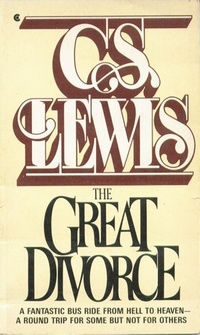
Cover of The Great Divorce by C.S. LewisThe Great Divorce

by C. S. Lewis

DETAILS:
Publisher: Macmillan Publishing Company
Publication Date: 1946
Format: Paperback
Length: 128
Read Date: June 22, 2025

Buy from Bookshop.org Support Indie Bookstores

“Then those people are right who say tht Heaven and Hell are only states of mind?”

“Hush,” said he sternly. “Do not blaspheme. Hell is a state of mind—ye never said a truer word, And every state of mind, left to itself, every shutting up of the creature within the dungeon of its own mind—is, in the end, Hell. But Heaven is not a state of mind. Heaven is reality itself. All that is fully real is Heavenly. For all that can be shaken will be shaken and only the unshakable remains.”

Sixpence None the Richer’s “Soul”

Since 1994 (two or three years after I read this for the first time) I haven’t been able to think about, much less read, this book without thinking of this song. So why not let you have it run through your head as you read this?

What’s The Great Divorce About?

The conceit of this book is that C.S. Lewis is granted a vision in a dream of the afterlife. He starts out in a miserable place, full of people that could best be described as miserable (although that might be being too kind). He sees a bunch of them waiting for a bus, and since that’s pretty much the only people he can see around, he joins the queue. Before he knows it, he gets one of the last remaining seats.

After a couple of really unpleasant interactions with fellow passengers, the bus comes to a stop and everyone disembarks. They’re near some trees, but mostly there’s a large amount of grassy land near a cliff. Everyone kind of separates and walks around, while others come from a distance toward them. The best way that Lewis can come up with to describe these people is “Bright Ones” or “Solid People.”

They seem more solid and bright than anyone else—who now pretty much seem like disembodied ghosts to Lewis. Meanwhile, the grass is intensely hard and sharp; the trees and rocks are similarly “more real.” Once the Bright Ones arrive, they all head off to talk to individual ghosts—and the interactions that Lewis watches/overhears, the interactions aren’t all that pleasant.

The Bright Ones, it should be stressed, aren’t the problems. They’re patient, kind, and entirely honest. The Ghosts, on the other hand, are nasty, defensive, selfish, and seem to go out of their way to twist the words of the Bright Ones. The Bright Ones are trying to convince the Ghosts to leave these problems—and so many others behind, so they can find true happiness and forgiveness in the City.

Lewis watches some of these, and then is met by his own Bright One, who answers some questions for him about what’s going on.

Okay, that’s more of a summary than I typically give—but the meat of the book isn’t in that outline, it’s in the individual interactions between Bright Ones and the Ghosts.

“The Transmortal Conditions”

In his Preface, Lewis stresses that this book is a Fantasy, sure, it’s one with a moral—but it’s Fantasy. “The transmortal conditions are solely an imaginative supposal; they are not even a guess or a speculation of what may actually await us.”

That’s for the best because there are many problems with his vision of the realms—but at the same time, he does a wonderful job of depicting them

The loneliness of Hell/Purgatory* and how the denizens exacerbate the problem continuously to their own detriment is utterly fantastic. Even better is the hyper reality of the outskirts of the City and the Bright Ones. Lewis said he got the idea from some article he read by an American whose name he’d forgotten years before.

Between this book and Perelandra, I’m starting to come to the conclusion that Lewis’ best writing is reserved for him trying to capture Paradise and relate it to his readers. He falls short, obviously, but the way he does communicate either the area around Heaven or a Pre-Fall Venus are so fantastic that I find myself trying to describe the ineffable.

* It’s Hell for those who don’t take the opportunity to repent, Purgatory for those who do. An intriguing way to be able to placate either the Roman Catholic or Protestant in his readership.

George MacDonald

On one of the rocks sat a very tall man, almost a giant, with a flowing beard. I had not yet looked one of the Solid People in the face. Now, when I did so, I discovered that one sees them with a kind of double vision. Here was an enthroned and shining god, whose ageless spirit weighed upon mine like a burden of solid gold: and yet, at the very same moment, here was an old weather-beaten man, one who might have been a shepherd—such a man as tourists think simple because he is honest and neighbours think “deep” for the same reason. His eyes had the farseeing look of one who has lived long in open, solitary places; and somehow I divined the network of wrinkles which must have surrounded them before re-birth had washed him in immortality.

Among the many things I forgot about this book is the way that MacDonald serves as Virgil, guiding Lewis around the area, answering many of the questions he has about what he’s seeing and experiencing. Having read Surprised by Joy pretty recently, when he goes into what kind of impact MacDonald made on him really helped underline this part for me.

When so many of the other Ghosts had Bright Spirits appear to them that were someone important to them—mostly family members, Lewis (who isn’t quite a Ghost, but is largely treated as one) gets an author who was instrumental in laying the groundwork for his conversion. A great choice, and a very honest/self-revelatory one.

So, what did I think about The Great Divorce?

Never fear. There are only two kinds of people in the end: those who say to God, “Thy will be done,” and those to whom God says, in the end, “Thy will be done.” All that are in Hell, choose it. Without that self-choice there could be no Hell. No soul that seriously and constantly desires joy will ever miss it. Those who seek find. To those who knock it is opened

I absolutely loved this. I remembered liking it, but I was just blown away this read-through.

Yes, I’d quibble with some of the theology here—Lewis and I aren’t going to see eye-to-eye on many things until we both arrive in the City to be corrected (and neither of us will care about that then). But this isn’t a systematic theology, it’s a Fantasy story with apologetic aims. As such, it’s wonderful. And, I’m never going to sneeze at the chance to read Lewis describing a paradise.

And this is not an apologetic work in the way most of his are—he’s not trying to make a case for the thoughtfulness of Christianity, the reasonableness in the belief in miracles, or anything like that. He’s looking at the core of people, how they think; how they react; how in every thought, word, and deed they are selfish; it’s all about self-interest, self-importance, self-worth. They may try to dress it up somehow, but eventually—even if it’s just for a moment, it’s about them. Seeing myself in these ghosts—I assume that most readers do—is not unlike seeing yourself in the words of advice that Screwtape gives to his nephew. Neither is a pleasant experience, but the mirror that Lewis holds before his readers is pretty clear.

Of the works by Lewis that I’ve read this year, this is his best writing, his most subtle thinking, his most heart-opening thoughts. I heartily encourage this one to those who are curious—even if just for the Fantasy of it all.


5 Stars

This post contains an affiliate link. If you purchase from it, I will get a small commission at no additional cost to you. As always, the opinions expressed are my own.

Irresponsible Reader Pilcrow Icon

Miracles by C.S. Lewis: A Pleasant, If Not Particularly Helpful, Read

Further Up and Further In A Year with C.S.Lewis


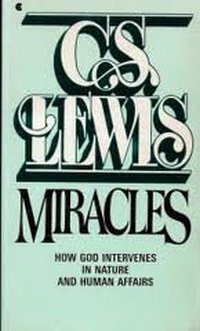
Cover of Miracles by C.S. LewisMiracles: A Preliminary Study

by C. S. Lewis

DETAILS:
Publisher: Collier Books
Publication Date: 1960
Format: Mass Market Paperback
Length: 168 pg.
Read Date: March 2-9, 2025
Buy from Bookshop.org Support Indie Bookstores

…the shock comes at the precise moment when the thrill of life is communicated to us along the clue we have been following. It is always shocking to meet life where we thought we were alone. “Look out!” we cry, “it’s alive.” And therefore this is the very point at which s many draw back—I would have done so myself if I could—and proceed no further with Christianity. An “impersonal God”—well and good. A subjective God of beauty, truth and goodness, inside our own heads—better still. A formless life-force surging through us, a vast power which we can tap—best of all. But God Himself, alive, pulling at the other end of the cord, perhaps approaching at an infinite speed, the hunter, king, husband—that is quite another matter. There comes a moment when the children who have been playing at burglars hush suddenly: was that a real footstep in the hall? There comes a moment when people who have been dabbling in religion (“Man’s search for God”!) suddenly draw back. Supposing we really found Him? We never meant it to come to that! Worse still, supposing He had found us?

So it is a sort of Rubicon. One goes across; or not. But if one does, there is no manner of security against miracles. One may be in for anything.

What’s Miracles About?

In this book, Lewis sets out to defend the idea of miracles. The possibility of them. He flat out says he won’t defend the historicity of Christian miracles—that’s not his field (of course, neither is theology, but that doesn’t stop him). He wants to lay the groundwork. If he can convince the reader that miracles are possible—even better they expect them and appreciate the relationship between them and Christianity—well then, he hopes the reader will—like Lewis himself did—examine the claims of Christianity on a more reasonable and ready basis.

The Direction of the Argument

First, Lewis starts with Supernaturalism vs. Naturalism (and it’s here that he might be at his best for the book)

Belief in miracles, far from depending on an ignorance of the laws of nature, is only possible in so far as those laws are known. We have already seen that if you begin by ruling out the supernatural you will perceive no miracles, We must now add that you will equally perceive no miracles until you believe that nature works according to regular laws. If you have not yet noticed that the sun always rises in the East you will see nothing miraculous about his rising one morning in the West.

His point is essentially that his readers will fall into two camps: those who will refuse to accept a miracle because they can’t happen or those who are willing to accept there are—or at least might be—supernatural possibilities in the world. If you are a committed reader in the former camp, there’s nothing that Lewis can do or say to make you change your mind. He will, at least, help you to see that—and lay out the possibilities of a supernatural explanation.

If you’re open to a supernatural explanation for things—like a miracle. Then Lewis has some things he’d like to talk to you about.

…it is mere confusion of thought to suppose that advancing science has made it harder for us to accept miracles, We always knew they were contrary to the natural course of events; we know still that if there is something beyond Nature, they are possible. Those are the bare bones of the question; time and progress and science and civilisation have not altered them in the least.

Then he moves into Christian miracles—or at least the miracles that Christians claim as part of their story—their Scriptures, their religion.

…you cannot [remove miracles] with Christianity. It is precisely the story of a great Miracle. A naturalistic Christianity leaves out all that is specifically Christian.

This is, he suggests, part of the path that he took to get to where he is.

If at any point along the line of argument, Lewis loses you, he will not ask you to accept his conclusion—or at least he has no basis to do so. Otherwise…

So, what did I think about Miracles?

You are probably quite right in thinking that you will never see a miracle done: you are probably equally right in thinking that there was a natural explanation of anything in your past life which seemed, at the first glance, to be “rum” or “odd.” God does not shake miracles into Nature at random as if from a pepper-caster. They come on great occasions: they are found at the great ganglions of history—not of political or social history, but of that spiritual history which cannot be fully known by men. If your own life does not happen to be near one of those great ganglions, how should you expect to see one? If we were heroic missionaries, apostles, or martyrs, it would be a different matter. But why you or I? Unless you live near a railway, you will not see trains go past your windows. How likely is it that you or I will be present when a peace-treaty is signed, when a great scientific discovery is made, when a dictator commits suicide? That we should see a miracle is even less likely. Nor, if we understand, shall we be anxious to do so. “Nothing almost sees miracles but misery.” Miracles and martyrdoms tend to bunch about the same areas of history—areas we have naturally no wish to frequent. Do not, I earnestly advise you, demand an ocular proof unless you are already perfectly certain that it is not forthcoming,

I enjoyed it—this was the second or third post-Narnia book I read by Lewis, and it’s one of them I’ve returned to the most. It’s also less and less effective to me the more times I read it. I just don’t like his line of argument. Nor do I appreciate some of what he says about the Scriptures. But, I do enjoy reading this.

There are two major aims for an apologetic work, as I’ve heard from a few apologetic professors/writers. The first is to present a defense for the faith to unbelievers—to convince them, to provide evidence for the faith to them, or at least to show that Christianity has a rational basis (things along those lines). The second aim is to buttress the confidence of the believer that they haven’t taken a blind leap of faith, that their convictions can stand against a hostile culture—or a disinterested one. I don’t see this working to well with the unbeliever (outside of maybe stressing that they’re committed to not accepting the possibility of miracles), rather the strength of his book falls into the latter category.

I appreciate what Lewis attempted to do here. I enjoy seeing him think through these things, and generally have a good time with his language. But it’s not the best thing he penned, and I’m not sure it’s all that useful.

Still, I like it. And anyone who’s going to name a chapter what he called Chapter 9? I want to spend a little time with.


3.5 Stars

This post contains an affiliate link. If you purchase from it, I will get a small commission at no additional cost to you. As always, the opinions expressed are my own.
Irresponsible Reader Pilcrow Icon

PUB DAY REPOST: Installment Immortality by Seanan McGuire: G-G-G-Ghosts!

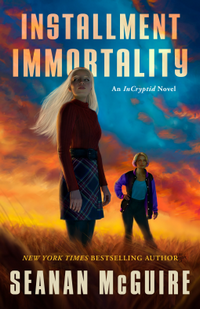
Cover of Installment Immortality by Seanan McGuireInstallment Immortality

by Seanan McGuire

DETAILS:
Series: InCryptid, #14
Publisher: Tor Books
Publication Date: March 11, 2025
Format: eARC
Length: 432 pg.
Read Date: February 12-17, 2025
Buy from Bookshop.org Support Indie Bookstores


Obviously, there are some spoilers about the previous novel in the series, Aftermarket Afterlife to follow. And, you could probably say the same for the series as a whole. Take that into consideration if you read beyond the period at the end of this sentence.

What’s Installment Immortality About?

In the months that it took Mary to put herself back together after the attack on their training headquarters, the Covenant hasn’t been quiet. In fact, as they knew a ghost was involved in the attack, some of them have been targeting ghosts up and down the East Coast.

The anima mundi, still rebuilding its control, recruits (to put it nicely) Mary to stop them and rescue what ghosts she can. Mary gets permission to bring along some help from her family (the kind of help that can’t, say, get stuck in a ghost jar)—she doesn’t intend to, but she ends up bringing along Elsie and Arthur who have a need to do something, anything, to help them move on from their mother’s death.

So begins a cross-country trip filled with more danger than they expect (and they expect a lot).

More Mary

This book, like its predecessor, has done a fantastic job of showing the place of Mary in this family. She’s far more than just a quick message-delivery-system, or a genie that can show up at just the right time (she never really came across that way, but it’d be easy to see her filling those roles). It’s both heart-warming and heart-tugging.

She’s also changed a lot—thanks to Annie’s intervention at the Crossroads, and because of her new/growing relationship to the anima mundi. And there are more changes on the horizon—which will be fun to watch as people like me have become more invested in her after the last book.

I thought I had several things to say about Mary here, but just about all of them would need to be redacted. I really enjoyed our time with her, and while I expect that we’re going to be spending a few books focused on other characters after this one (Verity or Elsie are my guesses, which means it’ll probably be Alex), I’m looking forward to seeing what this new part of her life—ahem, afterlife—brings us.

Elsie and Arthur

Poor Arthur—I thought I had a pretty good handle on what was going on with him after the last book, but of course, there’s a lot more afoot than we could’ve known. With plenty of time with him—to see him interact with Mary and his sister, we get to hear a lot more from him and understand things from his perspective.

Then we learn even more from some outsiders. We’re going to have to spend some more time with Arthur soon, because leaving him where McGuire did is not comfortable.

Elsie, on the other hand, surprised me. I figured that like with Alex and Annie—and even the babysitter—when she got a chance to shine, she’d step up and show herself to be exactly the kind of kick-ass heroine that the Prices and Healys seem to specialize in. I won’t get into details, but she’s not cut from the same cloth as her cousins—but that doesn’t mean she should be taken lightly. It’s just that there’s an element of diversity even here that I wasn’t expecting, and I’m glad to see. I think it would’ve been boring to see her transform into a variation of Verity or Alice.

More interestingly than that for her was seeing her relationship with Arthur and how she’s reacting toward the Aeslin mice in their home.

So, what did I think about Installment Immortality?

This was a little bit of a let-down after the Aftermarket Afterlife. It was primarily a follow-up to it, tying up loose ends and getting us all ready for whatever is next. As such, it’s not going to be as good, it can’t be as powerful, and it should help the reader catch our breath. Also, saying it’s not quite as good as one of the best books in this series is not much of an insult.

But, oh man…there were so many things that are great about this book. For one example, there’s a conversation between Mary and one of the Aeslin Mice that is incredibly strange. And if you remember that we’re talking about a conversation between a ghost and a sentient, talking mouse with a perfect memory…strange should be expected. Not this level of it.

Of course, we get to meet new Cryptids, and more than a few ghosts. Their perspectives on the Prices, on the war with the Covenant, on Mary and the Crossroads (many don’t believe the Crossroads are gone, for example), and so on, are fascinating. It’s a good reminder—that we occasionally get, but not as strongly as we do here—how much people don’t instinctively trust this family. But we also get a variety of reactions to them along those lines.

This was very satisfying in terms of long-term character arcs, the war arc, and so on. Installment Immortality was also satisfying on its own terms. There’s some good supernatural, ghosty action. Some good reminders that the dead should not be messed with. Strong character development—no one leaves this book the way they came in. And some sweet moments that remind you that everyone can use a dog in their life.

This is not a book to jump into the series with, unless you want to spend a lot of time confused—Aftermarket Afterlife would function far better for that (as would starting at the beginning). But for long-term fans, this is exactly what they were looking for.

Disclaimer: I received this eARC from Tor Publishing Group via NetGalley in exchange for this post which contains my honest opinion—thanks to both for this.


4 Stars
This post contains an affiliate link. If you purchase from it, I will get a small commission at no additional cost to you. As always, the opinions expressed are my own.

Irresponsible Reader Pilcrow Icon

Where the Bones Lie by Nick Kolakowski: Down These Mean Streets People Must Still Go

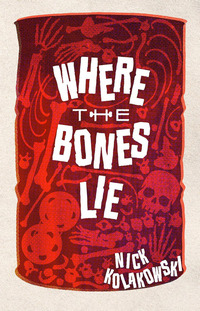
Cover of Where the Bones Lie by Nick KolakowskiWhere the Bones Lie

by Nick Kolakowski

DETAILS:
Publisher: Datura Books
Publication Date: March 11, 2025
Format: eARC
Length: 304 pg.
Read Date: February 26-Narch 1, 2025
Buy from Bookshop.org Support Indie Bookstores

What’s Where the Bones Lie About?

Dash Fuller used to work for a man he compared to Mr. Wolfe from Pulp Fiction, and in his employ would clean-up various messes by celebrities and other movers-and-shakers in L.A. Eventually the work got too much for him and he walked away. He tried to find a new career in Stand-Up comedy, but that’s not going so well. He’s doing better at drinking copious amounts of bourbon to numb himself, and then scurrying around picking up money from delivery driving and other gig jobs at the end of the month to pay his bills.

After one, shall we say, not-good night at a local comedy club two significant things happen for Dash. First, his old boss, Manny, shows up to badger him into doing one more job for him (he’d like more, but will settle for one, for now).

The other spins off of both—another audience member there picks up on some of what Dash does that night (but not all of it, he’s pretty good at what he does) and offers to hire him. After several years where the family had to assume he was dead, Madeline Ironwood’s father’s body has recently been discovered in a barrel found as a nearby lake has receded thanks to water shortages in the state. She’d like Dash to look into it and see if he can figure out what happened to him.

Ken Ironwood was a smuggler, and probably other things. He’s been missing since she was a young girl. He’s noteworthy enough that a true crime docuseries has started recently streaming about him, but not so noteworthy that Dash would’ve heard of him without the billboards all around town (that Madeline had to point out to him). The suspect list was so large that the LAPD and FBI gave up trying to pare down without more to go on than a missing man.

It’s not a lot for Dash to go on, but the money is okay, and it’s something that gets him out of town for a little bit.

The Traumatized Knight

I think it’s pretty obvious that Dash is supposed to be in the Hammett model more than the Chandler, but I’m more familiar with Chandler, so I’m going to lean on what I learned from L.A.’s hardboiled detective/detective-like characters from him.

Dash is a knight—a knight in tarnished, battered, and filthy armor. But a knight nonetheless—he knows how many of his choices didn’t match his ideals and ethics. His ex wondered if the good person inside him could be found—and Dash wonders the same.

This has taken a toll on him—one job in particular, but there’s also the cumulative effect from years of this—and has left him traumatized and self-medicating. This is also common to the hardboiled investigator, but given Dash’s cultural context it seems more apparent (and something he’s more willing to reflect on).

The job that Manny sends Dash on at the beginning brings all the trauma to the surface (it was close to it already, but this gave it the needed nudge). While the focus of the novel—and Dash’s attention—is Madeline’s case and her father’s fate, Dash’s struggles are a shadow over everything he does, over many of his choices (like the one to take the case), and will even interfere with his thinking on occasion.

Again, you see this all over Marlowe’s adventures—but it’s between the lines—I expect the same could be said about Hammett’s characters. But with Dash it’s clearer, it’s acknowledged, and understood—at least by some of the characters.

The Environment

California’s repeated droughts lay the foundation of the investigation into Madeline’s father’s death. The heat in L.A. as Dash and Madeline drive northward is oppressive. Wildfires threaten that city, close in on Dash and Madeline at important junctures in their search—and play a significant outcome in the endgame of that storyline.

This is possibly the most environmentally aware detective novel I’ve read. I’ve read “eco novels” that do a less effective job of addressing these issues. Part of what makes it so effective is that Kolakowski doesn’t get preachy with it, he doesn’t beat you over the head with it—it’s just seamlessly woven into the tapestry of this novel, no more noteworthy than Dash’s bad jokes, or the threat of bent cops. But it’s there. Everywhere.

I’m Glad Someone Asked

One question that had been running in my mind throughout was why Dash turned to Stand-Up, and his narration didn’t choose to reveal it, while it revealed so much about other things.

By the time that someone asked him, I was overjoyed that someone else (even if they’re fictional) had to know. The answer was satisfying enough, and in many ways didn’t tell us anything we couldn’t have/shouldn’t have figured out on our own (especially by that point in the novel), but hearing it from Dash was good.

So, what did I think about Where the Bones Lie?

This just might be the best thing Kolakowski has written so far. Which is likely a sentence I’ve written before—and I meant it then, but time has gone on and Kolakowski has gotten better.

I didn’t end up saying anything about the job that Manny hired Dash for that kick-started this whole novel, it doesn’t take long for Dash to take care of it, and we get an idea of some of the things he’s done in the past (more importantly, some of what he hasn’t done). Some of what he’s seen. This is developed through the course of the novel, too. But it gives us a taste of his old life and shows that he has the tools to build on.

Madeline’s case is the first job he’s ever had for a positive goal—to accomplish something. He’s not trying to prevent embarrassment or scandal—he’s not trying to save some studio a bunch of money, or rescue someone’s reputation, or prevent someone from facing legal charges. Sure, he has the skills—but he has to learn to use them in a different way. Which is a great place to put a character.

The supporting characters are great—particularly the “bigger bad”s (which is all I’m going to say about them). I would love to spend more time with the closest thing that Dash has to a friend, in particular.

With Chandler—like more modern writers like Ellroy or Connelly—you get a real sense of L.A. or California. And Kolakowski delivers the same here. He’s done some really specific geographic work in the past, but outside of geographic markers, I don’t know that I “felt” the area like I do here. (I want to stress that this isn’t intended as a criticism of his earlier work, it’s a compliment and observation about this one).

As far as the ending or resolutions to the various plotlines—some I saw coming, because Kolakowski prepared the reader for them. Some hit me like they came out of the blue (they didn’t, really, but they felt like it). All were satisfying in ways I didn’t expect really. There were lines that you could see Chandler writing—if not word for word, at least close paraphrases. The spirit of that age lives on in these pages.

His history suggests that the next work by Kolakowski will be something else entirely—probably not a cozy, but something he hasn’t delivered yet. But if he wants to do more like this, I’ll be first in line for it. Meanwhile, you should focus on getting this book in front of your eyeballs.

Disclaimer: I was provided with this ARC by the author in exchange for my honest opinion. The only impact this had on what I said about the book was that I could say it before I could buy a copy.


4 1/2 Stars
This post contains an affiliate link. If you purchase from it, I will get a small commission at no additional cost to you. As always, the opinions expressed are my own.
Irresponsible Reader Pilcrow Icon

REPOSTING JUST CUZ: Payback Is Forever by Nick Kolakowski: There’s a lot of opportunity in doom.

I didn’t quite finish my post about Kolakowski’s upcoming release last night (read: I wrote 2 paragraphs that probably need revision/expansion). So, let’s revisit this bold crime novel instead.


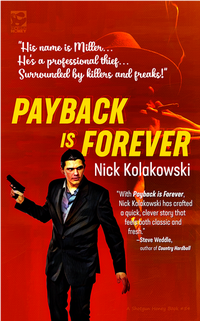
Payback Is ForeverPayback Is Forever

by Nick Kolakowski

DETAILS:
Publisher: Shotgun Honey Books
Publication Date: March 24, 2022
Format: Kindle Edition
Length: 170 pg.
Read Date: March 29-30, 2022

What’s Payback Is Forever About?

Miller’s a thief, a fairly successful one. This comes in handy because he’s not as successful when it comes to gambling. He needs to pay a debt, so he takes a job with a couple of strangers. They betray him, the job goes wrong, and Miller (and the cash) escape without his partners. They don’t know his name or home base, so he figures he’s safe for a little bit.

He’s soon contacted by a figure from his past, Rick Redfield:

“I’ve entered into an arrangement with some… men of violence, shall we say. Which means I need the services of the most violent man I know. Which is you.”

“I’m no bodyguard.”

“No. You’re capable of terrible acts, and that’s the necessary thing here. Besides, bodyguards ask too many questions.”

With the promise of a large payday on the horizon, Miller’s in—and soon finds himself involved with some Nazis who escaped from Germany in the waning days of the war, Nazi hunters, and a few more dead bodies than Miller was prepared to deal with.

Supporting Cast

Miller and most of the characters that he deals with are of a fairly typical sort—you’ll recognize the types easily. They’re interestingly-drawn and well-used, but they’re types.

Then there’s Jill Reilly—she’s Miller’s love interest and is a secretary in the Medical Examiner’s office. Given the proper circumstances, she’d probably make a pretty good Examiner herself—but between the education, she’d need, and the rampant chauvinism in the office, that’s probably not going to happen. Reilly feels like she’s got one foot in the Girl Friday type, but with a rebellious streak that keeps the other foot out of the type.

The other character that stands out as not fitting into a typical mold is Scott, Redfield’s friend who acts as a liaison to the outside world when Redfield needs to stay out of the light. He’s a timid, uncertain man—who needs to use a ventriloquist’s dummy, Colonel Longshanks, to communicate those things that are too much for Scott to handle. Miller has no patience for either of them—but can force himself to work with Scott. The Colonel on the other hand…

There was a moment where I wondered if Scott/Colonel Longshanks would over-take Monkey Man as my favorite strange Kolakowski character. He didn’t, but that he was in the running says something about the character development in this short novel.

The Hidden Agenda

If what I’ve described seems pretty straight-forward, it is. If anyone’s read Kolakowski before, that’s not how he rolls. Right?

There is something else afoot here. I don’t know that it added much (if anything), but it didn’t hurt anything either. Maybe if I was in a different mood when I read this I’d have a more positive take on the “something else,” but right now, I can take it or leave it.

The material with Miller, the Nazis, Nazi Hunters is enough to focus on and keep you entertained. If you happen to get the rest of it, that’s gravy.

So, what did I think about Payback Is Forever?

This feels like the kind of pulpy thrillers from the 1960s and 70s I’ve read—just in a post-WWII setting with a dash of Nathanael West thrown in. It’s a surprisingly effective combination, and I’d have read another 200 pages of it without blinking. Although I do think this lean, mean, streamlined approach is far more effective.

Miller’s absolutely the kind of character you want in this setting—his morality is stuck in the gray—it’s a pretty dark gray, but he’s not a full-on villain. And he’s thinking about reforming, at least a little.

There were two scenes—or parts of scenes—that make this more than a quick, fun read. There’s a visual in the last big gunfight that’s so ridiculous, so comical, in the middle of a big action scene that makes you want a film version immediately (but it may be better in your imagination).

Before that there’s another scene that I can’t describe—you start it assuming X might happen, and yet when X does happen you still sit up and pay attention because you can’t believe that Kolakowski actually did that. And then over the next 3 or 4 paragraphs, the shocking scene becomes something so unexpected that you have to read it a couple of times to make sure you read it right. Cackling while you read it every time makes the comprehension a little difficult.

A solid, stylish thriller with Kolakowski’s style and sense of character is exactly what I needed to read last week, and Payback is Forever delivered. Do yourself a favor and pick it up.


4 Stars

Installment Immortality by Seanan McGuire: G-G-G-Ghosts!

Cover of Installment Immortality by Seanan McGuireInstallment Immortality

by Seanan McGuire

DETAILS:
Series: InCryptid, #14
Publisher: Tor Books
Publication Date: March 11, 2025
Format: eARC
Length: 432 pg.
Read Date: February 12-17, 2025
Buy from Bookshop.org Support Indie Bookstores


Obviously, there are some spoilers about the previous novel in the series, Aftermarket Afterlife to follow. And, you could probably say the same for the series as a whole. Take that into consideration if you read beyond the period at the end of this sentence.

What’s Installment Immortality About?

In the months that it took Mary to put herself back together after the attack on their training headquarters, the Covenant hasn’t been quiet. In fact, as they knew a ghost was involved in the attack, some of them have been targeting ghosts up and down the East Coast.

The anima mundi, still rebuilding its control, recruits (to put it nicely) Mary to stop them and rescue what ghosts she can. Mary gets permission to bring along some help from her family (the kind of help that can’t, say, get stuck in a ghost jar)—she doesn’t intend to, but she ends up bringing along Elsie and Arthur who have a need to do something, anything, to help them move on from their mother’s death.

So begins a cross-country trip filled with more danger than they expect (and they expect a lot).

More Mary

This book, like its predecessor, has done a fantastic job of showing the place of Mary in this family. She’s far more than just a quick message-delivery-system, or a genie that can show up at just the right time (she never really came across that way, but it’d be easy to see her filling those roles). It’s both heart-warming and heart-tugging.

She’s also changed a lot—thanks to Annie’s intervention at the Crossroads, and because of her new/growing relationship to the anima mundi. And there are more changes on the horizon—which will be fun to watch as people like me have become more invested in her after the last book.

I thought I had several things to say about Mary here, but just about all of them would need to be redacted. I really enjoyed our time with her, and while I expect that we’re going to be spending a few books focused on other characters after this one (Verity or Elsie are my guesses, which means it’ll probably be Alex), I’m looking forward to seeing what this new part of her life—ahem, afterlife—brings us.

Elsie and Arthur

Poor Arthur—I thought I had a pretty good handle on what was going on with him after the last book, but of course, there’s a lot more afoot than we could’ve known. With plenty of time with him—to see him interact with Mary and his sister, we get to hear a lot more from him and understand things from his perspective.

Then we learn even more from some outsiders. We’re going to have to spend some more time with Arthur soon, because leaving him where McGuire did is not comfortable.

Elsie, on the other hand, surprised me. I figured that like with Alex and Annie—and even the babysitter—when she got a chance to shine, she’d step up and show herself to be exactly the kind of kick-ass heroine that the Prices and Healys seem to specialize in. I won’t get into details, but she’s not cut from the same cloth as her cousins—but that doesn’t mean she should be taken lightly. It’s just that there’s an element of diversity even here that I wasn’t expecting, and I’m glad to see. I think it would’ve been boring to see her transform into a variation of Verity or Alice.

More interestingly than that for her was seeing her relationship with Arthur and how she’s reacting toward the Aeslin mice in their home.

So, what did I think about Installment Immortality?

This was a little bit of a let-down after the Aftermarket Afterlife. It was primarily a follow-up to it, tying up loose ends and getting us all ready for whatever is next. As such, it’s not going to be as good, it can’t be as powerful, and it should help the reader catch our breath. Also, saying it’s not quite as good as one of the best books in this series is not much of an insult.

But, oh man…there were so many things that are great about this book. For one example, there’s a conversation between Mary and one of the Aeslin Mice that is incredibly strange. And if you remember that we’re talking about a conversation between a ghost and a sentient, talking mouse with a perfect memory…strange should be expected. Not this level of it.

Of course, we get to meet new Cryptids, and more than a few ghosts. Their perspectives on the Prices, on the war with the Covenant, on Mary and the Crossroads (many don’t believe the Crossroads are gone, for example), and so on, are fascinating. It’s a good reminder—that we occasionally get, but not as strongly as we do here—how much people don’t instinctively trust this family. But we also get a variety of reactions to them along those lines.

This was very satisfying in terms of long-term character arcs, the war arc, and so on. Installment Immortality was also satisfying on its own terms. There’s some good supernatural, ghosty action. Some good reminders that the dead should not be messed with. Strong character development—no one leaves this book the way they came in. And some sweet moments that remind you that everyone can use a dog in their life.

This is not a book to jump into the series with, unless you want to spend a lot of time confused—Aftermarket Afterlife would function far better for that (as would starting at the beginning). But for long-term fans, this is exactly what they were looking for.

Disclaimer: I received this eARC from Tor Publishing Group via NetGalley in exchange for this post which contains my honest opinion—thanks to both for this.


4 Stars
This post contains an affiliate link. If you purchase from it, I will get a small commission at no additional cost to you. As always, the opinions expressed are my own.

Irresponsible Reader Pilcrow Icon

The Abolition of Man by C. S. Lewis: What Can Happen When a Bad Review Copy Falls Into the Right Hands

Further Up and Further In A Year with C.S.Lewis

Cover of The Abolition of Man by CS LewisThe Abolition of Man: Reflections on Education with Special Reference to the Teaching of English in the Upper Forms of Schools

by C. S. Lewis

DETAILS: 
Publisher: Macmillan Publishing Company
Publication Date: September 1, 1978 
Format: Paperback
Length: 91 pg.
Read Date: February 2, 2025
Buy from Bookshop.org Support Indie Bookstores

This thing which I have called for convenience the Tao, and which others may call Natural Law or Traditional Morality or the First Principles of Practical Reason or the First Platitudes, is not one among a series of possible systems of value. It is the sole source of all value judgements. If it is rejected, all value is rejected. If any value ts retained, it is retained. The effort to refute and raise a new system of value in its place is self-contradictory. There never has been, and never will be, a radically new judgement of value in the history of the world.

What’s The Abolition of Man About?

This starts off with starts off as a review of a textbook or two, “Teaching of English in the Upper Forms of Schools” (to quote the subtitle). He has strong objections to the direction (and the foundation) these books are taking. From there he shifts into English schooling/thinking in general, and the deficiencies he sees in it and what he fears it means for the nation as a whole.

This centers on the idea that English teachers and schools are abandoning objective truth, which he mounts a defense of while writing about what he thinks will happen to a society that abandons it.

English Education

This begins, as I said (as does the subtitle) by reviewing a couple of textbooks used in English classes in the upper grades. Lewis had been sent review copies of them and took issue with a lot of what he said.

Lewis (in a move I could never duplicate) doesn’t want to seem ungrateful for these copies, so disguises the authors and titles before he starts explaining the problems. I don’t know if his original audience could see through his thin disguises—or if that just became clearer later. I suspect the former.

From what he tells us about these books, I think he was being too generous in his appraisal. This was some lousy curriculum.

I’d have appreciated more along these lines—but I get why Lewis moved on to other things.

The Tao

As Lewis begins to leave the realm of English education toward looking at education—and thinking—as a whole, he begins to utilize and develop his concept of a Tao:

It is the doctrine of objective value, the belief that certain attitudes are really true, and others really false, to the kind of thing the universe is and the kind of things we are.

As the quotation that opened this post indicates, this comes in many names—Natural Law, Natural Revelation, “Traditional Morality,” and so on.

With the Tao, as assumed and/or believed throughout the world for most of human history, we get absolutes. We get objective values, objective truth. As we begin to neglect or throw off the concept of objective truth for subjectivity—or, worse yet, “pure” Reason on its own. We lose the basis of all civilization, the basis of the value of life and individual rights, and so much more.

While I think he could’ve been more thorough in his explanation of the Tao and in explaining his arguments—t’s hard not to look at the world around us today, as it’s developed (devolved?) since the early days of WWII when these lectures were delivered, and not think that Lewis was on to something.

One Issue that Troubles Me

In order to avoid misunderstanding, I may add that though I myself am a Theist, and indeed a Christian, I am not here attempting any indirect argument for Theism. I am simply arguing that if we are to have Values at all we must accept the ultimate platitudes of Practical Reason as having absolute validity: that any attempt, having become skeptical about these, to reintroduce value lower down on some supposedly more ‘realistic’ basis, is doomed. Whether this position implies a supernatural origin for the Tao is a question I am not here concerned with.

As good as this sounds—as reasonable, as open-minded, as whatever you might want to call it—I’m unconvinced that this is a position that a Christian can self-consciously hold (without trying to call into doubt Lewis’ faith, I just think he’s inconsistent on this point).

I have trouble holding that a consistent position regarding Practical Reason—or anything else, whatever “Values” you might choose—having absolute validity separate from the inspired Christian Scriptures is possible. I realize those of us who hold that kind of thinking are a minority in the history of the Church, but I can’t argue myself out of it. Lewis’ attempt to build his argument—his Tao—in this way is the part of this book that keeps me from getting super-excited about it.

The Appendix

The appendix features quotations from a variety of ancient (and less ancient) texts from around the globe illustrating that several civilizations held to certain positions on a variety of issues. This isn’t to prove the existence of his Tao (or whatever you want to call it); it’s to demonstrate that it exists in the way that “everyone” holds to something very much like each other in certain aspects.

I don’t know if I can take it as confidently as Lewis did—but I get what he’s trying to show, and can appreciate it

So, what did I think about The Abolition of Man?

I remember the first time I read this—in 1992 or 1993—and a few times since that this argument, this look toward the objective and the importance of it, while not absolutizing Science or much of anything else, hit me hard, impressed me, and really formed a lot of my thinking.

I wasn’t as impressed this time (at least a decade since my last reading)—don’t get me wrong, it’s good, and I share a lot of the concerns and convictions with Lewis. But I wonder if he goes as deeply as we need today. It’s not enough to argue for a vague absolute—we need to understand the absolute, and where it comes from. There’s also the question of what do we do when we cannot agree on absolutes in a civic society, how do we approach this with wisdom and grace. I believe Lewis would have a lot to teach us—even if I objected to some of it. I understand that given the nature of this book (written version of lectures), his cultural context, and the enemies (literal and figurative) he had in mind, why we don’t get that book here.

Also, even the English curriculum he critiqued is better than a lot of what is given today (by all sorts of stripes of schools).

That said—this is a superior work to The Problem of Pain that takes advantage of Lewis’ strengths in a way the other couldn’t while not exposing many of his weaknesses as the previous book did. He’s got better works waiting for me, and I’m eager to get to them.


3.5 Stars

This post contains an affiliate link. If you purchase from it, I will get a small commission at no additional cost to you. As always, the opinions expressed are my own.
Irresponsible Reader Pilcrow Icon

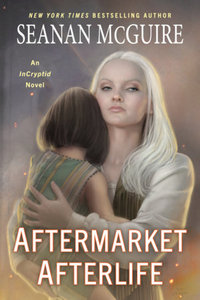
Aftermarket Afterlife by Seanan McGuire: Things Get Serious

This is long-overdue. But half of what I do in these posts is figure out what I think of a book—and since about 30 minutes after finishing this book, I’ve known what I had to say (although I’m pretty sure I had the title in mind since I was about 1/3 of the way in, which is a shame, because “Adventures in Babysitting” is right there). Knowing exactly what I want to say makes writing a post hard, there’s no discovery for me. But, I’ve got an ARC for the next book waiting for me, so I had to get serious about things and get this out of my head so I can dive into it.


Cover of Aftermarket Afterlife by Seanan McGuireAftermarket Afterlife

by Seanan McGuire

DETAILS:
Series: InCryptid, #13
Publisher: Daw Books
Publication Date: March 5, 2024
Format: Trade Paperback
Length: 299 pg.
Read Date: March 21-27, 2024
Buy from Bookshop.org Support Indie Bookstores

What’s Aftermarket Afterlife About?

Just before I started writing this (or started again…this is something like the 15th attempt since March of last year), I took a glance at what I wrote about Backpacking Through Bedlam. This was either a mistake because I said everything there that I was about to say to start this post and now I have to come up with something new. Or it was smart because now I can cut out a lot of things and point you to that instead.

I’m lazy enough to lean toward “mistake.” But let’s see what I can do instead.

Lest we think that the Covenant of St. George in general and Leonard Cunningham in particular have just been twiddling their thumbs while we’ve been focused on Annie’s adventures (although we see some of Leonard there) or the end of Alice’s quest, we learn very quickly that they’ve been active. They’ve been gathering intelligence and plotting. The result is a shock-and-awe campaign that takes the family and their cryptid (and human) friends and allies unaware—and results in several injuries, deaths, and loss of property. Probably more damage, too.

But before we can get to that, Thomas and Alice (and Sally) arrive at the Portland-area compound for a reunion/(re)introduction. This goes so incredibly poorly that the reader will initially be relieved by the attacks because you foolishly think that means things are going to get more entertaining.

All this results in Mary, of all people, coming up with a plan to take the action to the front door of the Covenant.

Luck Runs Out

I’m not sure that I noticed it during my initial reads of the series—but in the last couple of books, as I listen to them on audio, I keep hearing about the strange luck the family has. And honestly, even if I hadn’t used the word luck—it’s hard not to think that. Verity and her friends/family/loved ones (same for her brother and sister and their friends/loved ones) largely escape the novels unscathed.

The thing about luck is…it runs out. This can be seen in the way that Sarah’s rescue of Artie at the end of Calculated Risks isn’t as successful as we might have thought at the time. And for another telling piece of evidence is pretty much this entire novel.

Choice of Mary

I was initially surprised to see Mary the family’s babysitting ghost as our POV character for this one. I expected another of the Price kids to get the slot (it’s been too long since we spent real time with Alex, for example). But I wasn’t going to complain—if only because it was nice to see her backstory.

In retrospect, there was no other choice. The reader (and McGuire) needed someone who could rapidly move between the various parts of the country to see everything going on and to take part in the action in some (not all) of the places the Covenant was acting. Thanks to her being the major actor, we get a little more insight into what happened to the animus mundi following Annie’s defeat of the Crossroads.

There are a couple of other things that only Mary could contribute to this story, but I can’t talk about those. So, as I expected but didn’t see going in, McGuire didn’t have a choice in POV character. It just had to be her.

Hail The Aeslin Mice

It’s really hard not to feel bad for these guys (when they’re not making you smile) throughout the series. This is probably the hardest novel to get through because of what happens to them. Their losses—different from the losses the family takes, and almost worse—are so hard to watch. Ditto for the family talking about them.

What’s even worse is the note that the race as a whole likely doesn’t have many more generations left. I’m sorry…I’m just not okay with that. I hope/trust that we’re going to find out how wrong those predictions are.

So, what did I think about Aftermarket Afterlife?

When I put this down I said something—I don’t remember what—but my daughter seemed shocked at my reaction. I was stunned, I didn’t expect most of what I spent the last hour or so reading (or the hours previous to it) and I guess that came out forcefully. And I’m still in that frame of mind almost 11 months later. I’m stunned by what McGuire did here.

The InCryptid books have always been (in my mind) the lighter of McGuire’s series—Toby’s for drama and excitement, the Wayward Children are to fill you with whimsy and heartbreak, and Verity/Alex/Annie et al are for some goofy action and strange critters.

I should know McGuire better than that. She’s never going to just let something be light entertainment. Still, I wasn’t prepared for this escalation. I should’ve been. The signs have been there since the end of Chaos Choreography. I’m not going to get into all the ways she gut-punches the readers here. But there are several. Some small, some huge, some of indeterminate size as of this time.

Still, McGuire deals with the various personalities, histories, abilities, interests, and everything else like a master. The writing is quirky as it needs to be without taking away from the drama or heartbreak. Mary is a great character and it’s good to see her come into her own, and we see a lot from other family members that we haven’t spent enough time with, too—ll while catching up with old friends. This is McGuire at peak performance.

Installment Immortality is due soon, and I have no idea what to expect from it—nor from the series going forward. But it’s going to be a very different kind of entity than we’ve seen before. I can’t wait for it.


4 1/2 Stars

This post contains an affiliate link. If you purchase from it, I will get a small commission at no additional cost to you. As always, the opinions expressed are my own.

Irresponsible Reader Pilcrow Icon

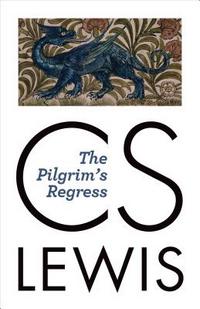
The Pilgrim’s Regress by C.S. Lewis: Everyone Has to Start Somewhere

Further Up and Further In A Year with C.S.Lewis

Cover of The Pilgrim's Regress by C.S. LewisThe Pilgrim’s Regress

by C. S. Lewis

DETAILS:
Publisher: William B. Eerdmans Publishing Company
Publication Date: October 22, 2014
Format: Paperback
Length: 230 pg.
Read Date: January 1-3, 2025
Buy from Bookshop.org Support Indie Bookstores

A Bit of Personal History (feel free to skip)

Back in ’91 or ’92, I saw a copy of The Pilgrim’s Regress on a bookstore shelf. I was in a “read everything by Lewis you can get your hands on phase,” so I instantly picked it up. But the back of the book talked about it as the modern equivalent of Bunyan’s The Pilgrim’s Progress in a way that I figured I should read Bunyan before it.

It took me a little while to track down the Bunyan (the toilsome times before online bookshops), and by the time I worked my way through it, the bookstore didn’t have that copy any more and I was distracted by other things.

I’ve often thought about trying this book since then—but it wasn’t until I started thinking about this project that I finally combined ambition with general curiosity.

What’s The Pilgrim’s Regress About?

This modern-retelling of The Pilgrim’s Progressis an allegory about a man named John on his journey from childhood exposure to religion in Puritania to an Island of pleasure. Along the way, he has to deal with several physical, spiritiual and itellectual challenges to take him away from his journey (pretty much like Bunyan’s Christian).

This was the first thing that Lewis wrote after his conversion, and it’s considered to be an intellectual biography of that journey.

Basically, think Bunyan for the early 20th Century and you’ve got it.

A Couple of Things That Helped Me

Early on, John encounters a “brown girl” who distracts him from his interest in—or at least pursuing that interest. They begin a sexual relationship, which goes awry and causes some serious problems for John (actually, that entire relationship from her introduction on is a serious problem.) I was pretty sure that Lewis wasn’t making any kind of ethnic characterization or anything, but it’s hard to shake the feeling. Thankfully, reading this blog post by a Lewis expert made me feel so much better (and shows I was on the right path in general with it). I’d explain it, but Dr. Hurd does it better.

The other thing that helped was the afterword that Lewis wrote for the Third Edition, ten years after the original publication. He points to some flaws, or at least things he could’ve done better. I agreed with most of his self-diagnosis, and at least one point, his explanation made me understand an aspect of the book (and, yes, he was right to critique himself).

So, while I’m glad for the additional things that helped me appreciate the book, I trust that with very little effort, I could find more. I shouldn’t have to look to these kinds of things to appreciate a book. To gain a better understanding, sure. But to move me from “meh” to “okay, that wasn’t that bad/objectional” should come from the text itself—not from others.

So, what did I think about The Pilgrim’s Regress?

It’s been almost a century since this was first published, and I cannot decide if it’s a good thing or not that so many of the characters and ideas John encounters are still relevant and identifiable (although some details may have altered a bit). The reader can see that these intellectual movements are nothing new—sadly, many of them haven’t been forgotten. One of the best things about reading theological works written generations before me is wondering exactly what the author is targeting (or why they’re bothering)—but the ideas that Lewis wants to confront are still in his readers’ lives. Probably even more than they were for him.

The beginning of the book seemed promising with an uncaring and cold clergy, parents who were off the mark, and so on—I thought John’s journey would lead us to a correction of or confrontation with these things. But no, we get the brown girl and then things go far from where I thought we were going. Naturally, I don’t mind that—but I would’ve appreciated something more definitive. That’s personal taste, though.

Like many allegories, particularly Bunyan’s, there is nothing subtle about The Pilgrim’s Regress. That doesn’t mean it’s not good, or that it’s so clear always that there’s no thinking involved, but, wow—it does tend to feel like it’s hitting you with a brick when John encounters a new person/idea.

Am I glad that I read this? Yes. So I can see Lewis’ development as a writer, to satisfy a certain curiosity in general, and to cross off a decades-old item from my “To Read List.” For people who don’t have at least two of those motivations to pick this up, I can’t really recommend it. I’m not sure I really can for those who do have those motivations—but it satisfies those particular itches.

Is this bad? By no means. It’s not good either. I did particularly enjoy certain lines, scenes, or encounters. I thought some of the ways that Lewis framed the better alternatives to be refreshing and helpful. But overall this really did nothing for me.


3 Stars

This post contains an affiliate link. If you purchase from it, I will get a small commission at no additional cost to you. As always, the opinions expressed are my own.
Irresponsible Reader Pilcrow Icon

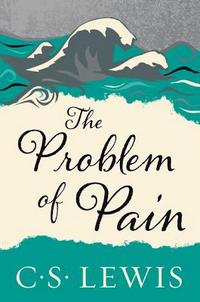
The Problem of Pain by C.S. Lewis: His First Apologetic Work is a Mixed Bag

Further Up and Further In A Year with C.S.Lewis

Cover of The Problem of Pain by C.S. LewisThe Problem of Pain

by C. S. Lewis

DETAILS:
Publisher: HarperOne
Publication Date: April 28, 2015
Format: Paperback
Length: 159 pg.
Read Date: January 5-12, 2025
Buy from Bookshop.org Support Indie Bookstores

His Omnipotence means power to do all that is intrinsically possible, not to do the intrinsically impossible. You may attribute miracles to Him, but not nonsense. This is no limit to His power. If you choose to say ‘God can give a creature free will and at the same time withhold free will from it’, you have not succeeded in saying anything about God: meaningless combinations of words do not suddenly acquire meaning simply because we prefix to them the two other words ‘God can’. It remains true that all things are possible with God: the intrinsic impossibilities are not things but nonentities. It is no more possible for God than for the weakest of His creatures to carry out both of two mutually exclusive alternatives; not because His power meets an obstacle, but because nonsense remains nonsense even when we talk it about God.

What’s The Problem of Pain About?

This book is an attempt to answer the question, “Why do Bad Thing Happen to Good People?” as well as “Why do Bad Things Happen to Not-Good People, or Animals, or Pretty Much at All?” Why is there suffering among those beings and creatures that God created?

Lewis approaches these questions with a mix of Biblical wisdom, careful thought, compassion, and understanding. And the ability to not go too far (frequently) with his own insight, but to stop and say, “I don’t know.”

This is an honest, if imperfect, attempt to wrestle with these questions, put them in the right context, and assure the world and the Church that there are answers.

Some Weaknesses

This is the work of someone who is still relatively new to the Faith as he wrote it, and that shows. There’s a lot of vaguely Christian speculation. But not quite enough dealing with the text of Scripture to base this speculation on.

Chapter 5, “The Fall of Man,” is a great example of this. It contains a lot of nonsense—and by the end of the chapter, he’d lost me completely (not that I didn’t understand him, I just couldn’t stay with him). Still, I liked most of it, and given the presuppositions he started with and stated (as much as I’d want to tweak them), I could ride along with his argument and enjoy it. The last paragraph of the chapter was okay and went a good way to getting me to stick with the book.

A Few Good Points

I don’t know that I have the patience to work through these ideas—and this would post would end up going in a direction I try to avoid if I did. But I rather enjoyed these quotations and like thinking through these ideas, so let me just paste them here as an example of the highs that this book can hit—and the thoughts it can provoke.

From Chapter 3, “Divine Goodness.”

We want, in fact, not so much a Father in Heaven as a grandfather in heaven—a senile benevolence who, as they say, ‘liked to see young people enjoying themselves’, and whose plan for the universe was simply that it might be truly said at the end of each day, ‘a good time was had by all’. Not many people, I admit, would formulate a theology in precisely those terms: but a conception not very different lurks at the back of Many minds. I do not claim to be an exception: I should very much like to live in a universe which was governed on such lines, But since it is abundantly clear that I don’t, and since I have reason to believe, nevertheless, that God is Love, I conclude that my conception of love needs correction.

From Chapter 6, “Human Pain”:

Confessors as well as martyrs are saved, and some old people whose state of grace we can hardly doubt seem to have got through their seventy years surprisingly easily. The sacrifice of Christ is repeated, or re-echoed, among His followers in very varying degrees, from the cruelest martyrdom down to a self-submission of intention whose outward signs have nothing to distinguish them from the ordinary fruits of temperance and “sweet reasonableness’. The causes of this distribution I do not know; but from our present point of view it ought to be clear that the real problem is not why some humble, pious, believing people suffer, but why some do not. Our Lord Himself, it will be remembered, explained the salvation of those who are fortunate in this world only by referring to the unsearchable omnipotence of God.

From Chapter 7, “Human Pain Continued” (which might be my favorite chapter, although the preceding one is close)

But if suffering is good, ought it not to be pursued rather than avoided? I answer that suffering is not good in itself. What is good in any painful experience is, for the sufferer, his submission to the will of God, and, for the spectators, the compassion aroused and the acts of mercy to which it leads.

So, what did I think about The Problem of Pain?

If any real theologian reads these pages he will very easily see that they are the work of a layman and an amateur. Except in the last two chapters, parts of which are admittedly speculative, I have believed myself to be restating ancient and orthodox doctrines. If any parts of the book are ‘original’, in the sense of being novel or unorthodox, they are so against my will and as a result of my ignorance. I write, of course, as a layman of the Church of England: but I have tried to assume nothing that is not professed by all baptised and communicating Christians.

As this is not a work of erudition I have taken little pains to trace ideas or quotations to their sources when they were not easily recoverable. Any theologian will see easily enough what, and how little, I have read.

Despite many good things Lewis wrote in this work, these two paragraphs that close the Preface might be the truest. Lewis makes some serious errors here, misreading Scripture and showing an ignorance of theology (what he says about Total Depravity is the easiest illustration of this). He’s a layman, he’s allowed (many who read this will be quick to point the same is true of me—and I assure you, I’m just as aware as Lewis was). There’s a part of me that wishes he’d continued in his efforts to not write this.

Still, he did. And I do appreciate him wrestling with so many important ideas here—if nothing else, the way he framed the questions and thought through his answers demonstrates that “The Problem of Pain” can be responded to, can be shown to not be an insurmountable problem. Best of all, Lewis demonstrates that a thoughtful believer can have questions, can struggle, can find things difficult, and yet continue to believe.

Lewis has greater works ahead (I know because I’ve read some of these), and while I ultimately find his work here to be wanting—I respect the effort. I find a lot worthy of chewing on—but sadly, there’s a lot of it that must be ignored.

I do recommend it as a tool to make yourself consider some difficult ideas, and to find some good ways to think about them.


3 Stars

This post contains an affiliate link. If you purchase from it, I will get a small commission at no additional cost to you. As always, the opinions expressed are my own.

Irresponsible Reader Pilcrow Icon

Page 3 of 22

Powered by WordPress & Theme by Anders Norén