Category: P-U Page 15 of 36

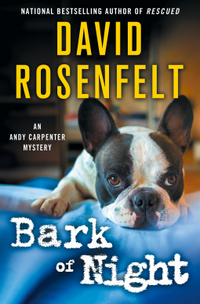
Pub Day Repost: Bark of Night by David Rosenfelt: Another winner of a case for the lawyer who’s gone to the dogs

Bark of NightBark of Night

by David Rosenfelt
Series: Andy Carpenter, #19

eARC, 304 pg.
Minotaur Books, 2019
Read: July 3 – 4, 2019

I know it’s practically de rigueur for me to start off talking about how difficult it is to talk about yet another Andy Carpenter book, but I’m going to try to resist this time (no promises that I won’t resort to it next time).

Instead, I want to focus on people who read this blog and haven’t picked up a book in this series — let’s see if I can help you come to the light. Andy Carpenter is a defense attorney — thanks to some high profile cases, some lucrative lawsuits, (and some other things), he’s an independently wealthy defense attorney (see the first couple of books for details). He’s also lazy. These two traits generate a lawyer/protagonist who doesn’t want to take on clients who doesn’t want to go to work (he’s the anti-Lincoln Lawyer). He’d rather watch sports, hang out with his wife, kid, friends and dog (especially the latter) and maybe check-in on the dog rescue he runs with a former client. He only takes on a case when he likes the potential client, he feels an injustice is being done, his wife talks him into it — or the life of a dog lies in the balance (there’s a strong link between the first reason I listed and the last). This time out, it’s pretty much a combination of those motivations. Nevertheless, when he takes on a client, he pulls out all the stops for him or her. Much like with Perry Mason, you have to wonder why prosecutor’s don’t just drop charges when Andy shows up in court — you can bet his client will be exonerated.

Andy’s vet calls him to his office to talk about something — namely, this dog that had been brought in to be euthanized. Before he did that, someone in his office scanned the microchip in the dog. The man who paid for the euthanization, wasn’t the owner f the dog — because he’d been murdered shortly before the dog appeared. After some digging, Andy discovers that the man who brought the dog in is very likely connected to the murder (especially when they look at his rap sheet). No one’s sure why he wanted a vet to take care of destroying the dog rather than doing it himself. But someone completely different has been charged with the crime, and Andy knows that this man is innocent — he has to be, there’s no other explanation how the would-be dog killer got involved.

From there, Andy and his team (his PI wife, her PI friend/Andy’s bodyguard, Andy’s CPA/hacker, his associate attorney) set out to defend their client, figure out why anyone would want to kill the victim (a documentary filmmaker, and not a particularly successful — or good — one), and maybe answer a few questions about the victim’s dog. Like most Carpenter novels, the mystery is just twisty enough to keep you guessing to the end. Andy’s courtroom antics are pretty subdued this time, but watching him in action is fun — particularly as he battles the Assistant D.A.

Andy’s team — and his friends who aren’t on the team — are as enjoyable to spend time with as ever. With some long-running series you stick with it because the characters are so near and dear to you. With some, you put up with characters because the author puts out great mysteries/adventures/whatever. It’s with the best series that you get both — a good mystery (in this case) and a cast of characters you look forward to seeing again. That’s definitely what we have in the Andy Carpenter books, and Bark of Night is a prime example of it.

As a capper, if the last few paragraphs don’t provoke a warm fuzzy or three in you, there’s something wrong with you and you should probably seek professional help. Rosenfelt is good at the heart-warming stuff, and he’s at the top of his game here.

Newcomers will get enough information along the way to hop on board here — there’s no need to feel like you need to go back to Book One (Open and Shut) and read them in order to catch all the nuance. Start here, and you’ll easily see why this book has charmed and entertained audiences enough to last for 19 books (and counting!). It’s a clever mystery, featuring characters that are reliably comfortable and funny — with just enough moments of seriousness and displays of skill that you can believe they’ll be defending someone and bringing a killer to justice at the same time. This is one of the better installments in the last few years (both for being enjoyable and for the mystery) and should move right to the top of your TBR (note that a “lesser” Andy Carpenter book is still fun, engaging and entertaining).

Disclaimer: I received this eARC from St. Martin’s Press via NetGalley in exchange for this post — thanks to both for this opportunity.

—–

4 Stars

Bark of Night by David Rosenfelt: Another winner of a case for the lawyer who’s gone to the dogs

Bark of NightBark of Night

by David Rosenfelt
Series: Andy Carpenter, #19

eARC, 304 pg.
Minotaur Books, 2019
Read: July 3 – 4, 2019

I know it’s practically de rigueur for me to start off talking about how difficult it is to talk about yet another Andy Carpenter book, but I’m going to try to resist this time (no promises that I won’t resort to it next time).

Instead, I want to focus on people who read this blog and haven’t picked up a book in this series — let’s see if I can help you come to the light. Andy Carpenter is a defense attorney — thanks to some high profile cases, some lucrative lawsuits, (and some other things), he’s an independently wealthy defense attorney (see the first couple of books for details). He’s also lazy. These two traits generate a lawyer/protagonist who doesn’t want to take on clients who doesn’t want to go to work (he’s the anti-Lincoln Lawyer). He’d rather watch sports, hang out with his wife, kid, friends and dog (especially the latter) and maybe check-in on the dog rescue he runs with a former client. He only takes on a case when he likes the potential client, he feels an injustice is being done, his wife talks him into it — or the life of a dog lies in the balance (there’s a strong link between the first reason I listed and the last). This time out, it’s pretty much a combination of those motivations. Nevertheless, when he takes on a client, he pulls out all the stops for him or her. Much like with Perry Mason, you have to wonder why prosecutor’s don’t just drop charges when Andy shows up in court — you can bet his client will be exonerated.

Andy’s vet calls him to his office to talk about something — namely, this dog that had been brought in to be euthanized. Before he did that, someone in his office scanned the microchip in the dog. The man who paid for the euthanization, wasn’t the owner f the dog — because he’d been murdered shortly before the dog appeared. After some digging, Andy discovers that the man who brought the dog in is very likely connected to the murder (especially when they look at his rap sheet). No one’s sure why he wanted a vet to take care of destroying the dog rather than doing it himself. But someone completely different has been charged with the crime, and Andy knows that this man is innocent — he has to be, there’s no other explanation how the would-be dog killer got involved.

From there, Andy and his team (his PI wife, her PI friend/Andy’s bodyguard, Andy’s CPA/hacker, his associate attorney) set out to defend their client, figure out why anyone would want to kill the victim (a documentary filmmaker, and not a particularly successful — or good — one), and maybe answer a few questions about the victim’s dog. Like most Carpenter novels, the mystery is just twisty enough to keep you guessing to the end. Andy’s courtroom antics are pretty subdued this time, but watching him in action is fun — particularly as he battles the Assistant D.A.

Andy’s team — and his friends who aren’t on the team — are as enjoyable to spend time with as ever. With some long-running series you stick with it because the characters are so near and dear to you. With some, you put up with characters because the author puts out great mysteries/adventures/whatever. It’s with the best series that you get both — a good mystery (in this case) and a cast of characters you look forward to seeing again. That’s definitely what we have in the Andy Carpenter books, and Bark of Night is a prime example of it.

As a capper, if the last few paragraphs don’t provoke a warm fuzzy or three in you, there’s something wrong with you and you should probably seek professional help. Rosenfelt is good at the heart-warming stuff, and he’s at the top of his game here.

Newcomers will get enough information along the way to hop on board here — there’s no need to feel like you need to go back to Book One (Open and Shut) and read them in order to catch all the nuance. Start here, and you’ll easily see why this book has charmed and entertained audiences enough to last for 19 books (and counting!). It’s a clever mystery, featuring characters that are reliably comfortable and funny — with just enough moments of seriousness and displays of skill that you can believe they’ll be defending someone and bringing a killer to justice at the same time. This is one of the better installments in the last few years (both for being enjoyable and for the mystery) and should move right to the top of your TBR (note that a “lesser” Andy Carpenter book is still fun, engaging and entertaining).

Disclaimer: I received this eARC from St. Martin’s Press via NetGalley in exchange for this post — thanks to both for this opportunity.

—–

4 Stars

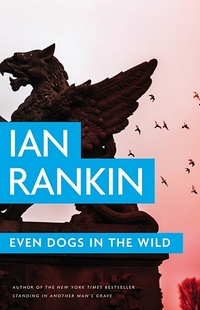
Bullet Points about Even Dogs in the Wild by Ian Rankin: Another winner from one of the best in the biz

Even Dogs in the WildEven Dogs in the Wild

by Ian Rankin
Series: John Rebus, #20

Hardcover, 347 pg.
Little, Brown and Company, 2016

Read: June 10 – 12, 2019

This post is overdue, and I can’t seem to find time to do it right. So, I won’t. Here’s a quick and dirty way to get it taken care of. I wish I had it in me to do a better job, but I don’t. Here’s the blurb taken from Rankin’s site:

           Retirement doesn’t suit John Rebus. He wasn’t made for hobbies, holidays or home improvements. Being a cop is in his blood.

So when DI Siobhan Clarke asks for his help on a case, Rebus doesn’t need long to consider his options.

Clarke’s been investigating the death of a senior lawyer whose body was found along with a threatening note. On the other side of Edinburgh, Big Ger Cafferty – Rebus’s long-time nemesis – has received an identical note and a bullet through his window.

Now it’s up to Clarke and Rebus to connect the dots and stop a killer.

Meanwhile, DI Malcolm Fox joins forces with a covert team from Glasgow who are tailing a notorious crime family. There’s something they want, and they’ll stop at nothing to get it.

It’s a game of dog eat dog – in the city, as in the wild.

Even Dogs in the Wild brings back Ian Rankin’s greatest characters in a story exploring the darkest corners of our instincts and desires.

If I had the time to do this properly, here are the things I’d be talking about.

  • Rebus as consultant/PI — this is really the perfect role for him, he’s not that great at procedure anyway. Calling his own shots, following his instincts, going about things, he’s a better fit for this kind of thing than a certain retired LAPD Detective.
  • This proves to be the kind of case made for Rebus — the solution lays in the past, but the ramifications are in the present.
  • Cafferty isn’t the suspect here (he’s not innocent, he never is), but he’s the victim — and maybe a concerned citizen?
  • There’s little in Crime Fiction better than Rebus and Cafferty on the same page — that’s as true here as ever.
  • Clarke’s role seemed diminished in favor of Fox and Rebus (particularly the former), but maybe that’s just me — what she does, however, allows Rebus to do what he does best
  • The Clarke/Fox friendship is an interesting one — and different from the Clarke/Rebus friendship. I’ll enjoy watching this develop.
  • I’m already really enjoying the Fox/Rebus friendship/mentorship. That’s not something anyone would’ve seen coming the first time we met Fox, or the first time we saw the two of them cross paths. The fact that they’ve got a strange friendship/mentorship going on is just wonderful.
  • There’s more going on in Fox’s personal life than we’ve really ever seen with Rebus or Clarke on an extended basis.
  • Fox’s share of the story is really strong and displays the character we’ve come to know over the past few novels, but evolving to take on some of Rebus’ better traits, but none of his . . . well, worse.
  • For a period of time, through no fault of his own, Rebus takes guardianship over a small dog. This was just fantastic and one of my favorite things to happen to him in years.

Combine all of the above with Rankin’s consummate skill and you’ve got another winner — the twentieth Rebus book and the character, the writing, and the perspective is a strong and fresh as it ever was. A sure-fire win for old fans that would probably convert a newbie, too.

—–

4 Stars

2019 Library Love Challenge 2019 Cloak & Dagger Challenge

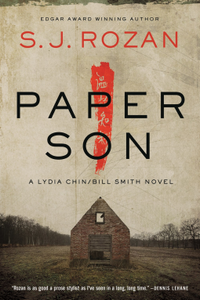
Paper Son by S.J. Rozan: Lydia and Bill in their most foreign setting yet — Mississippi

Paper SonPaper Son

by S. J. Rozan
Series: Lydia Chin & Bill Smith, #12eARC, 352 pg.
Pegasus Books, 2019

Read: June 12 – 17, 2019

One thing I’ve said (possibly too often) as I talk about this series is how much I enjoy the conversations between Lydia and Bill — but I think one of the conversations between Lydia and her mother tops anything the partners have to say (until the last conversation, anyway), and the rest weren’t far behind. We start off with Mrs. Chin telling Lydia that she has to go to Mississippi — and take Bill along — to investigate a murder. Long-time readers of this series will be forgiven the need to re-read that sentence, I assure you that it’s correct. One of Lydia’s cousins (yes, she has cousins in the Mississippi Delta — she’s as shocked as you are) is accused of murdering his father. Her mother wants Lydia to go down and prove his innocence. That he’s innocent isn’t ever in doubt for a moment — he’s related to Lydia’s father, ergo, he’s innocent. Lydia doesn’t accept her mother’s logic, but feels obligated to try to help this cousin she’s never heard of before now, so she and Bill set off for the Delta. It’s simply a dynamite first chapter, and the hook was set immediately.

Upon their arrival, Lydia and Bill find themselves neck deep in a tangled web of history, race, meth, gambling (both your more traditional varieties and purely 21st Century versions), politics and a even more race (it is Mississippi). Lydia’s cousin Jefferson is in his mid-20’s, a computer whiz of some sort with questionable ethics. He’s called to come to his father’s grocery store for some reason — they argue, and Jefferson leaves to cool off. When he returns, he finds his father bleeding out from a knife wound. Naturally, that’s when the police arrive, taking him into custody immediately. He’s bloody, standing over the victim and weapon — and sure, his fingerprints are all over the knife. Seems like an open and shut case, right?

Jefferson’s uncle, Captain Pete, is at the front of the line of those who doubt this — which is why he called his cousin’s widow to get her PI daughter down to help. Pete’s a professional gambler — precisely the kind of person Mrs. Chin wouldn’t like to acknowledge, but is friendly, hospitable and charming. Lydia and Bill warm to him quickly and he becomes a source of comfort as well as a source of information for the duo as they dive in to the investigation. Soon after arriving in Mississippi, they also meet another of Lydia’s cousins — a nephew to Pete, who is running in the Democratic gubernatorial primary.

Lydia can’t believe she’s related to a candidate for governor and she’s never heard of him. What else has her mother been keeping from her? Just from her conversations with Pete and Raymond Tam (the candidate), Lydia’s overwhelmed with family history that she didn’t expect to exist, much less be able to understand it all. It doesn’t derail the work that she and Bill are doing at all, but it threatens to distract her more than once. Adding the candidate into the mix guarantees that the water will get a lot muddier before it starts to become clear.

Lydia’s voice is as strong, engaging and entertaining as ever — possibly better than ever. I want to compare it to vintage Spenser, but that seems wrong (I’m not sure why I want to compare it to Parker at his best or why I shouldn’t — but that’s where I am). She’s funny, she’s smart, she’s insightful, she’s in a very alien place and is doing her best to acclimate. Bill seemed under utilized a little bit this time around — but (as he himself would point out), this was Lydia’s family, her case — he was just around for support. And he did come to her aid at pivotal moments — laying his native Southern accent on a little thick to help pave the way with some of the locals and to diffuse tense situations. Captain Pete is a great character, and I wish he wasn’t designed to be a one-and-done kind of guy, but I can’t see him coming up to Chinatown anytime soon to have tea with Mrs. Chin. Actually, I could easily read another novel or two with this cast — from the Public Defender staff to the people that hang out at the grocery store and all points in between. I’m not sure how Rozan could orchestrate those novels without feeling a bit contrived, but I’d be in for them.(*)

(*) Sure, I’d be in for Lydia and Bill Go Grocery Shopping or Bill and Lydia’s Day at the Recycling Center, but that’s beside the point..

I enjoy tea, but I’m no expert on it — I’m no where near the tea aficionado that Lydia is (even keeping Bill’s cupboards better stocked than he understands), but I loved her reaction to Sweet Tea (not just because I think she’s right). Using food is a great shortcut to revealing character traits, and Rozan does a great job throughout this book, but particularly on this point, of using that peculiar Southern version of tea to show us sides of Lydia.

Rozan’s at her strongest when in addition to the mystery, she’s using the circumstances around it to have Lydia and/or Bill explore another culture/sub-culture. She’s displayed this strength when helping her readers understand the Jewish refugees in the 1930’s who fled to Shanghai (The Shanghai Moon), Hong Kong (in Reflecting the Sky), Small Town High School Football (Winter and Night), the Contemporary Chinese Art scene (Ghost Hero), and so on. Here we get a Yankee perspective on Mississippi black/white relations (and a glance or two at how it differs from neighboring states), as well as a fascinating look at the Chinese in the Mississippi Delta in the late Nineteenth Century (which left me almost as shocked as Lydia). You give us that kind of history and commentary while delivering a solid mystery? It’s hard to ask for more.

As interesting as that is, the heart of the novel is in the idea of family. It’s a strong theme throughout the series, actually — whether it be Lydia’s strong sense of family, or the found family in the partnership of Bill and Lydia — or the many damaged families they encounter in their work. In Paper Son family shapes the warp and woof of the narrative — it’s Mrs. Chin’s confidence in the innocence of her husband’s relations, and Captain Pete’s call for help that brings the duo to the Delta. Lydia fights the impulse to believe Jefferson and Pete (and others) just because they’re family, yet wants thing to be the way her mother believes they are (even when — particularly when — the facts don’t seem to support it). Bill even encounters a fellow Smith, and while no one believes for a second they share anything beyond the name in common, there’s a connection. At it’s core, Paper Son is a story about the sacrifice, support, trust, and dysfunction that comes along from strong family (blood relation or found family) — not to mention all of the unintended consequences of that sacrifice, support, trust and dysfunction. I’m tempted to keep going, but I’d end up revealing too much.

The mystery itself is up to Rozan’s high standards — you may guess the identity of the killer fairly early on (and you may not), but you will not see the motivation coming until it’s past the point of inevitability. The ending feels a little rushed, but I can’t think of a way to improve upon it — and any rush was actually probably just me trying to discover how things would play out. The first half of the denouement with Lydia’s family is heartwarming — and, sure, borderline cheesy, but Rozan earned it. The second half is less cheesy and will fill even jaded readers with hope and joy. It’s just a great way to close the book.

If Paper Son isn’t S. J. Rozan and the series at their best, it’s hard to tell. For book 12 in a series to be this good almost defies the odds, the years that separated this book from it’s predecessor didn’t slow her down a bit (I honestly was afraid we’d be looking at something like Lehane’s return to Kenzie and Genarro in Moonlight Mile after 11 years). Long-time fans will be delighted in the return of this pair. I don’t know that this is the best introduction to the series, but it’d work just fine — you learn everything you need to know here. Fans of PI fiction starring smart, capable (and yes, mouthy) women will find a lot to reward them in these pages.

Disclaimer: I received this eARC from W. W. Norton & Company via NetGalley in exchange for this post — thanks to both for this.

—–

4 1/2 Stars

2019 Cloak & Dagger Challenge

The Definitive (for now) Irresponsible Reader’s take on Charlie and Rose Investigate/Jo Perry

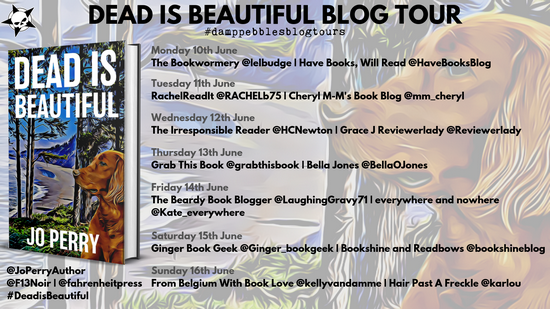
I was a little bummed, I have to admit, when Damppebbles Blog Tours approached me about doing this tour — I’d already said my piece about Dead is Beautiful, so what can I do to help spread the word about this wonderful series. The only thing I can do at this point is make it easier for you to find out more about the boks, so you can order them yourselves. So here’s everything (to date) that I’ve had to say about the series in one handy spot. Hopefully this helps.

(for those that I’ve posted about more than once, I went with the more recent posting, just because I’ve edited and commented on them).

I know you aren’t supposed to use modifiers with words like unique, but I have it break the laws of language with this series: they simply are the most unique books in Crime Fiction. You will not read anything like them – every other Crime Fiction novel I’ve read in the past 6 years (and that’s a lot) can be compared to at least 6 others without breaking a sweat or resorting to my reading logs to aid my memory. The only things I can compare the Charlie and Rose books to are other Charlie and Rose books.

These are special novels, but don’t take my word for it — go learn for yourself.

Dead is BetterDead is Better

My complete take
“This is a fast and lean read — Perry doesn’t waste a word. . . You’ll grow to like Charles, you’ll want to adopt Rose, and you’ll want to finds out what happens to them next.”

4 Stars

Dead is BestDead is Best

My complete take
“Funny, poignant, all-around good story-telling. Plus there’s a dog. You really can’t ask for more than that.”

4 Stars

Dead is GoodDead is Good

My complete take
“For a good mystery with oddly compelling characters, once again, look no further than Jo Perry.”

4 Stars

Dead is BeautifulDead is Beautiful

My complete take
“…this is one of those series that improves as it goes on. These unique protagonists get us to look at life and events in a different kind of way, while reading very different kind of mysteries. I hope I get to keep spending time with them for a long time to come — and I strongly encourage you to join in the fun.”

4 Stars

A Few Quick Questions With…Jo Perry

My Q&A with Jo Perry from February.
“…despite all that I am very late bloomer when it comes to fiction. My first novel, Dead Is Better was published in 2015.

As for a ‘career in fiction,’ I’m not there yet”

My thanks to damppebbles blog tours for the invitation to participate in this tour and the materials they provided.

EXCERPT: Dead is Better by Jo Perry

So in lieu of posting a review-ish post of Dead is Beautiful, I’m doing something better, namely, I’m shutting up. Instead, I’ve been given the first few pages of the first Charlie and Rose book — Dead is Better. Everything you really need to know about the series is here — the epigraphs, the humor, the tragedy, the mix of humor and tragedy, Charlie’s brutal honesty about himself, and Rose. I just re-read this post and had to fight the impulse to re-read the book. I just love this book.

Naturally, when corresponding with Perry this week about this post, I made sure to get the title wrong, because I’m a professional.

“Sometimes dead is better.”

––Stephen King, Pet Sematary


“Death is no more than passing from one room into another.

But there’s a difference for me, you know. Because in that other room I shall be able to see.”

––Helen Keller


1.

“When the first living thing existed, I was there waiting. When the last living thing dies, my job will be finished. I’ll put the chairs on the tables, turn out the lights and lock the universe behind me when I leave.”

Neil Gaiman, The Sandman, Vol. 3: Dream Country

All I know is that I know. And I can’t stop knowing. There was no cinematic replay of my life, no white light, no luminous passage to a perpetual meadow populated by old friends and relatives––I didn’t float over my failing body as the life seeped out.

I couldn’t see a goddamn thing––my eyes were shut.

There was then––the team of EMTs working on me, one applying compressions to the disco beat of the Bee Gees’s “Stayin’ Alive,” and a small young woman with long, curly hair squeezing the breathing bag attached to a plastic tube they’d shoved down my throat. Then a tall young man with short black hair loads me onto a gurney.

That was that.

Bullet holes still interrupt my flesh. My sternum is cracked, my chest bruised yellow and purple from their efforts.

One thing about this place—it’s come as you were.


2.

“We do not need to grieve for the dead. Why should we grieve for them? They are now in a place where there is no more shadow, darkness, loneliness, isolation, or pain. They are home.”

John O’Donohue, Anam Cara: A Book of Celtic Wisdom

No Virgin Mary Blue sky. No combustible darkness.  Just a flash, a bang, and a fade-out that delivered me to this quiet place without midnight or noon, twilight or dawn.  This place, if it is a place—a beach without a sea, a desert without sand, an airless sky.

Did I mention the goddamn dog?

For the record, she wasn’t mine on the other side––which proves that error is built into the fabric of the universe—if that’s where we still are.

No ragged holes singe her gut, and she walks without a limp, but there’s a dirty rope around her neck that trails behind her too-thin body covered with long, reddish fur.  The first moment I saw her, I could tell––She’d been tethered long enough without water or food to die.

Well, she’s not hungry or thirsty now.

Is that peace?


3.

“Whatever can die is beautiful — more beautiful than a unicorn, who lives forever, and who is the most beautiful creature in the world. Do you understand me?”

Peter S. Beagle, The Last Unicorn

In life I’d heard of dogs like her, cheap burglar alarms.  Solitary, lonely, they bark at passersby and garbage trucks from behind high fences in exchange for water and kibble when the people remember to feed and water them.

They bark out of fear.

And to remind themselves that they in fact exist.

Now that I think about it, I wasn’t much different. A nobody.  A man of no importance.

On the other side, being a nothing had advantages. People barely saw me and that made me free.  I moved among them like a shade, a cipher. And when they did acknowledge whoever they thought I was, they were often revealing, entertaining––overconfident, saying too much about spouses and ex-spouses and email passwords, and what the neighbor’s son really did in the garage, and about not really being married, or the time they shoplifted—confessing, boasting.

Being nothing– that’s my gift


4.

When you’re dead, they really fix you up. I hope to hell when I do die somebody has sense enough to just dump me in the river or something. Anything except sticking me in a goddam cemetery. People coming and putting a bunch of flowers on your stomach on Sunday, and all that crap. Who wants flowers when you’re dead? Nobody.

J.D. Salinger, The Catcher in the Rye


In case you wondered, yes. When you’re dead, you can attend your own funeral. It’s not required, but I decided to go––time is unknowable here––to try to find out what happened.  And I thought the dog might like a change of scenery–or any scenery.

I want to look at certain people’s faces, especially my own.

Late morning at Mount Sinai, Hollywood Hills––which should be named Travel Town 2.0. The final resting place of thousands of corpses sits next door to Travel Town, a collection of non-traveling train cars frequented by babysitters, little boys and blinking coyotes who venture out at noon, when the picnickers and homeless eat their food.

The ferocious September heat and smog smudges LA’s edges and boundaries––until it doesn’t seem that different from this place, except that the dog and I are temperature-controlled––perpetually lukewarm, courtesy of Who or What we do not know.

The living––palpable, whole, shiny and fragrant with sweat and irritation––nothing’s worse than LA traffic on a Friday afternoon––remind me of those silvery-mirage-pools that form on the surfaces of overheated streets and then evaporate when you get close. Although it was I who lacks presence, they seem insubstantial, like flames, the men in suffocating dark suits and ties, and the women–especially my four exes––lotioned and gleaming, tucked and tanned, manicured and lap-banded, and holding wads of Kleenex in their diamond-ringed left hands to signify their former closeness to and recent repudiation of the deceased, who lay by himself in a plain wooden box up front.

The dog, whose rope I hold in my right hand, urges me forward, and then waits patiently while I look.

Jesus. Why is the casket open? I look like shit. I must have Mark’s wife “the decorator” to thank for this grotesque violation. Why didn’t they shut the box as is customary, especially here in a Jewish place. What were they trying to prove? That despite being shot to death I was still in some sense, intact?

Was I ever really the poor fuck who lived behind that face?  The neck and chin have been painted with peach make-up, and the too-pink lip-glossed mouth forced into a grimace that was, I guess, supposed to indicate post-mortal composure.  It must have taken three guys at least to wedge my fat ass into the narrow box.  I’m large.

Or I was.

I feel strangely light on my feet now. Want to lose sixty pounds in a hurry?

Die.

Read the rest in Dead is Better by Jo Perry — and the rest of the series: Dead is Best; Dead is Good; and the focus of this tour, the wonderful Dead is Beautiful. .

My thanks to damppebbles blog tours for the invitation to participate in this tour and the materials they provided.

BOOK SPOTLIGHT: Dead is Beautiful by Jo Perry

Today I’m excited to welcome the Book Tour for the funny, clever, tragic and engaging Dead is Beautiful by Jo Perry. I already posted about the book back in February, so along with this spotlight post, I’ve been given a great excerpt to share here in a bit as well as a page that indexes The Irresponsible Reader’s Jo Perry/Charlie and Rose content in one easy to use post.

But first, let’s focus on the book in question here: Dead is Beautiful

Book Details:

Book Title: Dead is Beautiful by Jo Perry
Publisher: Fahrenheit 13
Release date: February 13, 2019
Format: Ebook/Paperback
Length: 268 pages

Book Blurb:

DEAD IS BEAUTIFUL finds Rose leading Charlie from the peace of the afterlife to the place he hates most on earth, “Beverly Fucking Hills,” where a mature, protected tree harboring a protected bird is being illegally cut down.

The tree-assault leads Charlie and Rose to a to murder and to the person Charlie loathes most in life and in death, the sibling he refers to only as “his shit brother,” who is in danger.

Charlie fights-across the borders of life and death–for the man who never fought for him, and with the help of a fearless Scotsman, a beautiful witch, and a pissed-off owl, Charlie must stop a cruel and exploitative scheme and protect his beloved Rose.

About Jo Perry:

Jo PerryJo Perry earned a Ph.D. in English, taught college literature and writing, produced and wrote episodic television, and published articles, book reviews, and poetry.

She lives in Los Angeles with her husband, novelist Thomas Perry. They have two adult children. Their two dogs are rescues.

Jo is the author of DEAD IS BETTER, DEAD IS BEST, DEAD IS GOOD, and DEAD IS BEAUTIFUL, a dark, comic mystery series from Fahrenheit Press.

Jo Perry’s Social Media:

Twitter ~ Facebook ~ Website ~ https://www.instagram.com/noirjoperry/” target=”_blank” rel=”noopener noreferrer”>Instagram

Purchase Links for Dead is Beautiful:

Fahrenheit Press ~ Amazon UK ~ Amazon US


My thanks to damppebbles blog tours for the invitation to participate in this tour and the materials they provided.

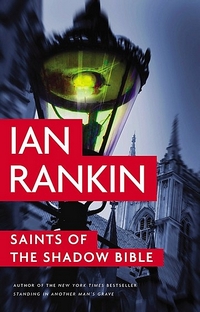
Saints of the Shadow Bible by Ian Rankin: Rebus’ Past Comes Back to Haunt Him

Saints of the Shadow BibleSaints of the Shadow Bible

by Ian Rankin
Series: John Rebus, #19

Hardcover, 389 pg.
Little, Brown and Company, 2013
Read: April 15 – 17, 2019

           Rebus said quietly. “It made sense that we stuck up for one another back then–might not be so true now.”. . .

“. . . secrets and lies and all the other crap we’ve dealt out and been dealt. I didn’t see you owning up in there to singing your name to statements that weren’t yours. But we both know it happened a lot happened back then, and one crack in the dam might be all that’s needed . . .” Patterson paused, looking Rebus up and down. “So make sure you know whose side you’re on John.”

Rebus is officially un-retired, and very happy (at least by his standards). To be reinstated, he had to agree to be a Detective Constable again, instead of an Inspector. But he was willing (and usually still is) to take the rank cut so that he keep working. For anyone who’s read a Rebus book or two, this makes perfect sense. Buying books he doesn’t read, listening to his music collection, and police work — that’s all he has in his life. Well, okay, smoking and drinking, too. But those two can only occupy so much time.

Serving as a DC, he investigates a car that went off the road for no good reason on a straight stretch with DI Siobhan Clarke. It doesn’t take the two long at all to determine that what happened at the scene is as obvious as everyone else thinks (everyone but readers, because we all know that Rebus and Clarke together at a scene = more than meets the eye). They were called in because someone with influence exerted that influence at got detectives to investigate a seemingly routine auto accident that injured a young woman. Within days, there’s a more serious crime related to their investigation, and the two are plunged into a veritable minefield of money, politics, and family secrets.

Meanwhile, Malcom Fox is working his last Complaints case before being reorganized into detective work. He asks Clarke for help in approaching Rebus for some information related to the case. He’s looking into a murder case related to the group where Rebus served his first assignment as a rookie detective. Rebus is initially resistant to help Fox nab one of his old friends, but soon begins to think that Fox is onto something and works the case with him.

Watching the rapprochement between Rebus and Fox is great — at times it feels like things used to when Rebus was working with Clarke (in the latter stages, when they were more like equals). Fox and Clarke’s burgeoning friendship is a lot of fun to read, too. Basically, Fox’s addition to this world in general is something to be praised. I’m not 100% sold on Clarke’s rise, she almost seems more like Gill Templar than herself at times. Now, at one point, Clarke might have taken that as a partial compliment, but I don’t think so. She retains her sense of humor and instincts, but her commitment to the job might be more powerful than those instincts.

Over the last couple of books, one of the most interesting things is the rise of Darryl Christie in the Edinburgh crime world. He’s back in these pages. Not as Rebus’ target, but a presence — like Cafferty so often was. Time moves on and the young move up on both sides of the law. But as Rebus can’t let go, I can’t believe that Big Ger will roll over and let Christie take over the entire city without at least some resistance (something tells me that it’ll be very effective resistance).

I can’t think of another way to talk about Rankin’s skill. Here we are in the nineteenth Rebus book and things feel as fresh as ever — yet this is a world that the reader knows and feels comfort in. These characters and situations are old friends and Rankin’s Edinburgh is as real to me as Parker’s Boston, Connelly’s L.A. or Johnson’s Wyoming — I’ve never set foot in Scotland, but that city feels like a place I’ve frequented.

As you can’t help but expect, this is a completely satisfying mystery novel full of fantastic characters, tangled webs of lies and motives — and an excellent look at the ways policing used to be carried out and the changes it’s gone through. But more than that, it’s a little more time with one of the greats of Crime Fiction as he continues to try to stay active, an old dog learning a couple of new tricks (despite his best efforts) and not forgetting any of the old tricks.

—–

4 Stars

2019 Library Love Challenge 2019 Cloak & Dagger Challenge

A Few Quick Questions With…Ian Shane

So, I just blathered on about Postgraduate, the great novel by Ian Shane. And now, here’s a little from the Man Himself in response to some questions I had for him. I hope you enjoy. For those keeping score at home, after a few Q&As of one of my theories being validated, I totally whiffed one here. I still liked the answer, just wish I’d asked a better question 🙂

Most authors have dozens of ideas bouncing around their craniums at once — what was it about this idea that made you say, “Yup — this is the one for me.”?
First, in the interest of full disclosure, Postgraduate is semi-autobiographical. For a while, I was running an Internet classic alternative radio station (which has been offline for a couple of years). During this time, I was having a hard time finding a story I wanted to write. There would be ideas here and there, but nothing ever developed into a compelling story. On a whim, I picked up a copy of Old Records Never Die by Eric Spitznagel. It’s a memoir based on Spitznagel’s quest to rebuild his lost record collection. Not copies of the albums he lost, mind you…the actual albums. His musical mid-life crisis inspired me to write about mine.
In the writing of Postgraduate, what was the biggest surprise about the writing itself? Either, “I can’t believe X is so easy!” or “If I had known Y was going to be so hard, I’d have skipped this and watched more TV”.
I was really amazed at how quickly I wrote the first draft. I have a day job, so the amount of time I have to write is limited. I decided to track my progress on Facebook to keep myself accountable to my friends. The first night, I wrote 1330 words. The next night, I wrote 1557 words. Then it started to become a thing…how many nights can I write more than a thousand words? In the first week, I wrote 10,269 words. I started Postgraduate on October 25, 2017, and I finished the first draft on February 1, 2018. The total was 92,947 words in 97 days. I’ve never had a writing streak like that before, and I am not likely to ever have one like that again.
Danny’s reaction to the news that his favorite record store had closed (and some time ago), was one of my favorite parts of Postgraduate. Is it one of the semi-autobiographical parts of the book? Tell us a little about the store/its closing.
This is very autobiographical. There really was a Cats Record Store in my hometown (Evansville, Indiana). Cats was the place to find stuff from The Smiths or Elvis Costello. It was as I described it in the book…hardwood floors, cedar walls, and a general warm feeling when you walked in. There were two locations, on the east side and north side of town (the north side was the one I went to often). Not too long after I left town, my brother had told me that Cats had closed. I just assumed he meant the one on the east side. A few years later, on a visit to town, I decided to go to the north side and see what they had to offer. When I got there, I was grief-stricken to see the “For Lease” sign on the door. It really felt like a death.

However, showing that Cats had closed also served two subtler purposes. One, I wanted to have something unexpected to happen for Danny. It shatters the frozen-in-time, idealized image of the area around campus he had in his head. Something had to be not quite right, and that’s what I chose to be the missing ingredient.

And, as an aging Gen-Xer, I wanted to have an image of how people get music today, as opposed to how we did it when I was a college student. Hard copies, at least on a digital format, have fallen out of favor with “the kids.” I realize by saying this, I run the risk of sounding like the old guy who complains that a ticket for the moving picture show used to be only a nickel.

Why is it, do you think, that male readers respond so strongly to books about music? (your novels, Hornby’s, etc.)
I think it’s because guys (especially when we’re in our teens and 20s) have a terrible time expressing how we feel. I don’t want to get all “blame it on society,” but we were taught at an early age to not show our emotions—boys don’t cry (you know, kinda like that Cure song), and we have a hard time hashing out what was going on in our heads. It’s a thing of beauty when a songwriter reads our minds and says something more eloquently than we ever could and does it in 4/4 time. It grabs us and shakes us to our cores. In a way, music becomes a part of who we are. That’s the reason we made mixtapes to impress women. We couldn’t find the words to say we liked them and wanted to get to know them better, but Neil Finn could. So, we’d let him and the rest of Crowded House stand proxy for us for four and a half minutes.

When we read a book like High Fidelity or Postgraduate, we relate to using music as a primary coping mechanism (like Rob and Danny respectively) more than we get Heathcliff walking along the moors. While dealing with my last breakup, I listened to “Don’t Look Back in Anger” by Oasis on a continuous loop while drinking a heroic amount of whiskey. I didn’t spit out a two-page soliloquy while standing on my patio and looking at the moon. It’s just how we do it now.

I’d imagine that in a novel like this, it’d be difficult to keep from making Sam (the one that got away) an idealized woman, or Angela (the adulterous ex) into . . . an idealized harlot, I guess. Especially with this being written from Danny’s perspective. How do you walk the line?
I don’t really know if I thought about it too much while I was writing Angela and Sam. I just had a full picture in my mind who these women were…their wonderful qualities and their flaws. I had an idea of what made Danny and Angela work and what didn’t. The same was true with Danny and Sam.
Thanks for your time and willingness to let me badger you with these questions – again, I really enjoyed Postgraduate and truly hope that it finds the audience it deserves.

Pub Day Post: Postgraduate by Ian Shane: A Funny, Nostalgic, Touching Novel about Maybe Finding Lost Loves/Dreams/Friendships

PostgraduatePostgraduate

by Ian Shane


Kindle Edition, 409 pg.
45rpm Media, 2019

Read: March 25 – 26, 2019

“. . . you did a bad, bad thing.”

“Then why are you helping me?”

“Because that’s what friends do. Someone needs to stand next to you when the world falls down around your ankles, and the other starting players seem to be leaving you one by one. You’re still my boy, but I question your decision-making skills.”

We meet Danny Jackson on one of the worst days of his life — the day his marriage legally ended (it was over long before). Danny’s quick to assure us that he’s had worse days, and not just because he doth protest too much (no matter what it looks like at the moment). He’s 44, about to be kicked out of his house, in a job he hates (many reasons are bigger than being forced to use Comic Sans, as bad as that is) and really has no idea what the rest of the year will bring — much less anything after that.

One of the many accommodations Danny made to get along with his wife was to trim his 4,000+ CD collection down to 150, and now that he finds himself without a real home or family and a strong need to fill up his time so he can’t dwell on that he starts rebuilding that collection — not with current music, either. But with the songs and albums that defined him at that age where music is so important to define, mold and express one’s identity — college. Before long, Danny’s investing some real money in stereo equipment as well as CDs. At one point a neighbor/friend from the apartment building says something about Danny having enough of both to start his own radio station.

This idea sparks something within Danny and he sets to do just that — not a real radio station (or even a pirate station), but an Internet radio station modeled on the one he learned all about Radio on in college, “The L.” While putting in the work necessary to launch an Internet station, Danny starts dreaming and scheming. I was honestly a little surprised to see how much work was involved, but after reading this I realize that’s just because I know so little about radio (even online) and hadn’t given it any real thought before.

He doesn’t just want to launch this passion project, he’d like to bury the hatchet with a bunch of people from his college days — and what better way to do both together than by launching the station in their old studio while they’re all returning to say goodbye to a mentor as he prepares to retire. Danny’s already speaking for the event, so that part will be easy. He trusts the others will be there, too — getting them to go along with his plans will be the trick.

Danny doesn’t know what kind of audience his online version of “The L” is going to have, but he figures there’s some audience — he’d listen to the kind of station he’ll be launching, why wouldn’t others his age? So kicks off (and then some) this story of friendship, lost loves, abandoned dreams, the love of music, and the attempt to recapture what we’ve lost (through fault of our own, or not). While we follow Danny’s rebuilding in 2017, we also get (in alternating chapters) the story of how the magic was assembled back in the day, and how it primarily fell to pieces (Danny had a significant roll in that, it turns out).

Danny’s glory days really were that (until they weren’t) and it was a lot of fun reading about them — especially when Sam’s on the scene. His 44th year wasn’t that great for him (it did improve from that inauspicious start), but it was almost as much fun to read, especially when Sam’s on the scene. Sam’s the one who got away from Danny, the love of his life, etc. She’s close to idealized, but Shane’s careful not to let Danny do that to her (more than anyone would in memory).

The focus of the novel is (rightly) those two, but Danny’s friendships with Marty — the Program Director of the L — and Tom are easily as important. The novel could’ve worked almost as well with the Danny/Tom relationship as the center instead of Danny/Sam. Tom was Danny’s high school friend who came to college with him and developed a radio show with him, both planning to keep doing radio together after college. One of my few problems I have is that I think we needed a bit more of Tom early on. I know he’s Danny’s partner, and the emotions both have toward each other (in the 90’s and 2017) indicate that, but he always seems to be playing second fiddle to Sam or Marty. Marty’s sort of the older brother figure to Sam, Danny and Tom — down for a good time as well as advice, and is just cool to read.

Mindy, Marty’s co-host, is a character I could’ve used a little more of, too — just because I really liked her. The narrative nowhere needs more of her, but I just liked her and wanted more. The professor, Dr. Black, they assemble to honor is a perfect mentor figure. Even Angela, the adulterous ex- that derailed Danny’s career, is a pretty well-designed and used character — but she’s about the only one in the book I don’t want to see more of.

I don’t mean this next sentence as a negative, no matter what it sounds like. There are few narrative surprises for the reader — by a certain point, you know pretty much how each storyline is going to go. This doesn’t mean that there aren’t surprises (pleasant and otherwise) for the reader, but it’s not that kind of story. You may not know exactly where Plot X will land, but you’ll know the ZIP Code for it early on. And that’s fine — the pleasure’s in the journey, and Danny ending up where you know he will is just a satisfying confirmation.

If you like Danny, you’ll like this book. I’m not sure why you wouldn’t like Danny, but I have to admit it’s possible. I think we clicked almost instantly, I was definitely on board in the first couple of pages. It’s possible you may not like Danny as a person, but would like his voice (well, Shane’s voice), I suppose. That should carry you through, too.

On his website, Shane talks about the impact Aaron Sorkin has on his writing — when you get to passages like this, it’s pretty obvious:

“Why didn’t you tell us?”

“I didn’t think you’d find out.”

“Really?”

“Did you have any idea before today?”

“None.”

“Then it’s a mystery to me as to why I’d think that.”

I can’t help but hear that last line in a Richard Schiff voice. But the book doesn’t only read like the work of a Sorkin-devotee. It has the general feel of Hornby, Tropper, Norman, Weiner, Russo (in his lighter moments), Perrotta, etc. The writing is engaging, catchy, welcoming. Shane writes in a way that you like reading his prose — no matter what’s happening. It’s pleasant and charming with moments of not-quite-brilliance, but close enough. Unlike Sorkin, Shane’s style doesn’t draw attention to itself, if anything, it deflects it. It’s not flashy, but it’s good. I could’ve easily read another 400 pages of these people without breaking a sweat.

You know how maybe the best thing about Zach Braff’s Garden State was that killer soundtrack? That’s almost the case here. Shane has assembled a great playlist on Spotify to go with the novel — stuff that Danny refers to in the book, and stuff he’d listen to. I’ve been introduced to a lot of music that I probably should know through it. Most of what I’ve written in the last week (and some of what I’ve read) has had it as a soundtrack, and that’ll likely hold true for a while longer. I’m embarrassed to admit how little of it I knew going in — Danny, Tom and especially Marty would be ashamed that someone who went to college in about the same time as they did wouldn’t know this stuff. Maybe I should’ve listened to more college radio. Unlike, Garden State, Postgraduate can be read without it (and without knowing the music), but this is a great touch. If for no other reason than there’s going to be a couple of songs you’re going to be curious about after reading about them, this is a great resource.

How much did I like the book? Despite being given a copy (which I’m very grateful for), I bought one. I might give a few away. Danny feels like an old friend, the world is comfortable and relaxing to be in (I should stress about 87.3 percent of what I know about radio comes from this book, so it’s not that). This belongs in the same discussion with the best of Hornby and Tropper — it’s exactly the kind of thing I hope to read when I’m not reading a “genre” novel (the problems with that clause deserve their own post, but you all know what I mean). There’s an eleven year gap between Shane’s first two novels, after reading this you can only hope that his third will arrive much sooner. While I wait for whatever’s next, you should go read Postgraduate. You’ll feel better than James Brown if you do.

Disclaimer: I was provided with a copy of this book by the author in exchange for my honest opinion.

—–

4 1/2 Stars

LetsReadIndie Reading Challenge

Page 15 of 36

Powered by WordPress & Theme by Anders Norén