Category: P-U Page 22 of 36

The Right Side by Spencer Quinn

The Right SideThe Right Side

by Spencer Quinn

eARC, 336 pg.
Atria Books, 2017

Read: May 11 – 12, 2017


Okay, since I first opened the pages of Dog On It 8 years ago, I’ve been a Spencer Quinn fan — it probably took me two chapters to consider myself one. So it’s kind of a given that I’d like this book — but only “kind of.” This was so far from a Bowser & Birdie or Chet & Bernie book that they could be written by different people.

Sgt. LeAnne Hogan was an excellent athlete in her childhood and teen years, and then she joined the Army (deciding her West Point plans would take too long — an oversimplification that’ll do for now) and became an excellent soldier, serving multiple tours in combat zones. During her last sting in Afghanistan — as part of a team working to build intelligence sources among Afghan women — she is involved in an attack that leaves some dead and her injured — physically and mentally.

Her memories of that fateful day are vague and dim at best, but the scars will not leave. Not only that, she lost an eye, her confidence, her future plans, and career. She slowly befriends a woman who lost part of her leg to an IED in Iraq who shares a room with LeAnne in Walter Reed. Marci dies suddenly and unexpectedly — and that is too much for LeAnne. She leaves the hospital immediately and sets off on a drive across the country, she really doesn’t have a plan, but she needs to be somewhere else.

It’s pretty clear that LeAnne is suffering from PTSD on top of everything else — as you’d expect. She comes across as angry and rude to almost everyone she runs across and exchanges more than a few words with. She eventually finds herself in Marci’s hometown — where her daughter has gone missing. For the first time since the day everything changed, LeAnne has a purpose — bring her friend’s daughter home. Along the way, she LeAnne gets adopted by a large dog who will prove an invaluable aid in this challenge.

LeAnne is a great character — not a perfect person by any means, but you can see where a lot of writers (novelists or journalists) would try to paint her as one. She has huge flaws — some of which are easier to see after the injury (and some of them are new after it, too). There are some other good characters, too — even if you don’t necessarily like them (LeAnne’s mother would be an example of this — she’s trying to do the right thing, but the reader can sense LeAnne’s apprehensions toward her — and will likely share them). The people in Marci’s hometown (particularly those that are related to her) are the best drawn in the book — and I’d be willing to read a sequel or two just in this city to spend more time with them. Not everyone gets what LeAnne’s going through — some don’t know how to react to her — but those that come close will endear themselves to you.

The dog, Goody, isn’t Chet, he isn’t Bowser — he’s a typical dog, no more (or less) intelligent than any other. Goody won’t be serving as the narrator in a story any time — he will drink from the toilet bowl and ignore a lot of what LeAnne wants him to do.

Like I said, I’m a Quinn fan — but I didn’t think he had this in him. Funny mysteries with dogs? Sure, he’s great at those. But sensitive explorations of veterans dealing with the aftermath of life-altering injuries? I wouldn’t have guessed it. But man . . . he really got this flawed character, this incredibly human character, right. There’s a couple of moments that didn’t work as well as they should’ve — a couple of moments that were hard to believe in a book as grounded in reality as this book was. But you know what? You forgive them easily, because so much is right with this book — so much just works, that you’ll accept the things that don’t. It wasn’t all dark and moody — there’s some hope, some chuckles, a lot that is somber and sad, too. While not a “feel good” read by any means, you will feel pretty good about who things end up.

This is probably categorized as a Thriller, as that’s where Quinn’s readers are — but I can see a case for this being labeled General Fiction (or whatever synonym your local shop uses), it’s flexible that way. This is Spencer Quinn operating on a whole new level with a character we need more like — such a great read.

Disclaimer: I received this eARC from Atria Books via NetGalley in exchange for this post — thanks to both for this.

—–

4 1/2 Stars

The Hammer of Thor (Audiobook) by Rick Riordan, Kieran Culkin

The Hammer of ThorThe Hammer of Thor

by Rick Riordan, Kieran Culkin (Narrator)
Series: Magnus Chase and the Gods of Asgard, #2
Unabridged Audiobook, 10 hrs., 34 mins..
Listening Library, 2016
Read: May 10 – 12, 2016


Thor’s hammer is missing, so not only can he not stream Netflix (I’d forgotten that was a thing in this series) on it, he can’t intimidate the giants into not invading. You can guess which bothers him more. The Valkrie Samira and her pal Magnus have to go find it before things get out of hand.

I didn’t like this one as much as the first book in this series — but I didn’t dislike it. It’s still the same outline that Riordan is following with these books — there’s a quest; the hero and his friends have to go find the whatever to stall doomsday a little longer; to get the X the group has to beat a series of mini-challenges and then they’ll have a shot at the X. Since this is a book 2, they’ll get X, but many other things will go wrong, forcing the series into another book. For the most part, the minor challenges worked better for me than I expected.

I enjoyed Magnus’ friends — Samira in particular; although I’m pretty torn about the new character added to Magnus’ group: Alex Fierro — a child of Loki. I understand what Riordan was trying to do with this character, but I’m not sure he succeeded. I’m not convinced that Alex was a person, and not just a conglomeration of traits. But I have hope. Alex’s presence, I thought, ended up short-changing some of the other characters when it came to action and involvement in the plot, which I wasn’t crazy about.

I really enjoy seeing different authors’ take on the same mythological characters. Comparing/contrasting Kevin Hearne’s and Riordan’s Thors and Lokis would make for a very entertaining piece (I think Riordan’s Thor is more comical, but his Loki just might be more sadistic), and I will admit I got distracted a couple of times listening to this by thinking about the differences.

The best part of this was seeing how the problems Magnus, etc. are dealing with intersect some of what Percy, Annabeth and Apollo are going through in Riordan’s other series, and the strong hint that we’ll see some sort of cross-over soon. We’d understood that the Egyptian gods were threatening the earth about the same time that the Problems with Camps Jupiter and Half-Blood start up, but this was a much more explicit description. I like thinking that the various pantheons are having troubles at the same time, and that Earth could be doom in any number of ways simultaneously.

I bought this in hardcover the week it came out (last October, I think), but haven’t been able to find/make the time to read it. When I saw it as available on my library’s audiobook site, I figured I’d jump — just to get that TBR pile a little smaller. I hadn’t listened to Riordan on audio before, and was curious ow it translated. I was surprised to hear Kieran Culkin’s name (and voice) at the beginning of this — he didn’t strike me as the kind of actor who’d do audiobooks. I’m glad that he did, though. I really enjoyed his work throughout the novel — the narration, the characters — he just nailed it. That’s how Magnus Chase should sound.

It was entertaining enough to keep going, and I trust that Riordan knows what he’s doing, I’m just not convinced that he did all he could to make this book as good as it could be.

—–

3 Stars

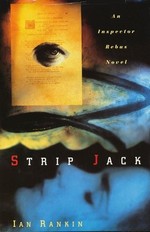
Strip Jack by Ian Rankin

Strip JackStrip Jack

by Ian Rankin
Series: John Rebus, #4

Hardcover, 206 pg.
St. Martin’s Press, 1992

Read: May 3 – 4, 2017


This is the one — the book that finally sold me on the John Rebus series (I say “finally” as if it’s been a years’ long effort, not just book 4). Everything worked for me here.

Rebus is trying to track down a rare book thief, and puts as much effort into that as you’d imagine most fictional detectives putting into it. Thankfully, it doesn’t eat up so much of his time that he can’t accompany others from his station — including Chief Superintendent “Farmer” Watson — on a raid of a brothel in a pretty nice part of town. Most of the men can’t believe they’re doing this raid, Rebus is chief among them. But, an order is an order, so they suit up and go in. While there, Brian Holmes finds a pretty popular MP in a room with one of the “employees.”

This is MP is named Gregor Jack — his background is pretty similar to Rebus’ and the detective has always admired him (at least his public persona), and something just doesn’t feel right about the way things went down with the raid and Jack’s involvement (and exposure), so he starts checking in on Jack at home. There’s something strange going on with Jack’s wife, Elizabeth — she’s not at home, and Jack doesn’t know if she even knows about the headlines about the raid and ensuing controversy. Rebus finds it a bit odd that someone like him would know so little about his wife’s whereabouts, between his curiosity and interest in the MP, he starts poking around a bit — which turns out to be fortuitous later on.

The ensuing mystery is pretty good — especially when it becomes Rebus vs. the higher-ups as they narrow the list of suspects. I liked Rebus’ method this time a little more than the previous books, it’s a bit more methodical (even when he’s mostly going with his gut, there’s still thinking behind it). Could the mystery-solving — and the novel as a whole — be a bit meatier? Yeah, but it’s not to sketchy on details. I just think that the Rebus novels would be better if they were Bosch-length.

In the previous books, I thought there were a couple of passages that were so well written that they lifted the quality of the whole book. I didn’t come across anything in particular like that, not that the writing was bad, but there wasn’t anything that jumped out at me. One very nice touch — not in the language, but in the idea and how it worked — was when Rebus was interviewing one of the Jacks’ old friends in a mental hospital and the friend asks Rebus to touch the ground for him, since that’s something he doesn’t get to do any more. When Rebus does this, and when he tells the friend about it later — just perfect.

I really would’ve liked more time with Gregor Jack and his staff — I liked the interactions between Rebus and each of them, but it’d have been hard to pull off. Most of the rest of the suspect pool weren’t terribly interesting. The friend in the hospital, isn’t really a suspect (for obvious reasons), but he does give some insight into the case — he was a well-written character and I liked the way that Rankin was able to work him into the story in a couple of ways.

Holmes reminds me of Luther‘s DS Justin Ripley (although I imagine Holmes as taller — not sure there’s a reason for that) — I like the fact that he’s sticking around, I expected him to vanish after his first appearance. I don’t know if he and his girlfriend will stick around, but I’m enjoying him as an errand boy/accomplice/hindrance for Rebus. He’s not the only returning face — Gill Templer is a pretty significant factor in the off-the-clock Rebus story, which primarily centers around his growing (yet, I expect, doomed) relationship with a doctor.

Oh, I should mention that Rebus does find the book thief (with book obsessed readers like we have on this blog, you have to assure people that the books are okay), and it (naturally) has plays a role in the novel’s greater story.

This tale of the determined and dogged detective who keeps on trying, even when he has no reason to, really worked for me — clicked every one of my procedural buttons. I hope Rankin delivers more like this book.

—–

4 Stars
2017 Library Love Challenge

Pub Day Repost: Nearly Nero by Loren D. Estleman

Nearly NeroNearly Nero: The Adventures of Claudius Lyon, the Man Who Would Be Wolfe

by Loren D. Estleman
eARC, 192 pg.
Tyrus Books, 2017
Read: March 24 – 30, 2017

I’ve heard about the stories in this volume for years, but have never tracked one down before — and then a whole collection of them show up on NetGalley! How could I not request it? I’m so glad this book exists so that those of us who don’t get the magazines, etc. that publish short mystery fiction can have them (and even those who do have access to those magazines, etc. can have them in one handy volume).

Anyway, here’s the setup: Claudius Lyon is a huge fan of Nero Wolfe — he reads every one of the reports that Archie Goodwin’s literary agent Rex Stout publishes. He’s such a fan that he wants to be Wolfe (like the guys dressing up in Batsuits in The Dark Knight Rises) — he’s fat, fairly clever, and wealthy enough not to need to work and still indulge himself. He renovates his townhouse to include a greenhouse, an elevator, and a first floor floorplan that pretty much matches Wolfe’s. He hires a private chef — a kosher chef of dubious quality (not that Lyon needs to eat kosher, it’s just what Gus can cook), changes his name to something that approximates his hero’s and hires a “man of action,” Arnie Woodbine. Arnie’s an ex-con, small-time crook who doesn’t mind (too much) putting up with his looney boss for a steady paycheck and meals.

The number of ways that Lyon isn’t Wolfe is pretty large and I won’t spoil your fun in discovering them. Now, Lyon’s unlicensed as a PI, so he can’t take on paying clients — but he occasionally gets people who will take him up on his free services. He’s decent at solving puzzles and low-priority mysteries (not that he doesn’t find his way into something bigger on occasion). Once he gets a client (non-paying, Arnie’d have me stress), he goes through whatever steps he needs to figure it out (including his own version of Wolfe’s lip movement and sending Arnie on fact-finding missions), and goes to some lengths to assemble some sort of audience for his reveal. I can’t help smiling as I think about it, really.

The whole thing is a tongue-in-cheek tribute to the Nero Wolfe/Rex Stout — recognizing the brilliance of the Stout’s work (how can you not?), while poking fun at it. Lyon’s really a goofy character and Woodbine is great at pointing that out — while begrudgingly admitting that he gets things right every now and then. There’s a lot of fun to be had in the story telling — the mysteries aren’t all that much to get excited about, it’s in watching Lyon stumble through his cases that the entertainment is found. Well, that and Woodbine’s commentary.

Not unlike many of the Wolfe stories (particularly the short stories).

I wouldn’t recommend reading more than two of these stories in a sitting, I think they work best as solo shots. It’s a difficult call, because I typically wanted to go on for one more. Also, I’m not sure how enjoyable these’d be for non-Wolfe readers — but then again, I think a lot of the humor would hold up and it might entice a reader to learn more about Lyon’s idol. And anything that gets people to read Rex Stout’s Nero Wolfe novels is a good thing.

But for readers of Stout’s Wolfe novels? This is a must read. He’s not trying and failing to recapture Stout’s magic (see Goldsborough post-The Bloodied Ivy), he’s intentionally missing and yet somehow getting a little of it. I really enjoyed this book and can easily see me re-reading it a handful of times.

Disclaimer: I received this eARC from Adams Media via NetGalley in exchange for this post — thanks to both for this.

Pub Day Repost: Robert B. Parker’s Little White Lies by Ace Atkins

Really, all I want to say about this book is: “Yes! Atkins did it again — it’s just so good, folks. Long-time fans’ll love it, new readers will likely see the appeal of the series. A lot of fun with a great ending!” But that seems a little surface-y and is just bad writing. But really, that’s everything I’ve got to say.

Little White LiesRobert B. Parker’s Little White Lies

by Ace Atkins
Series: Spenser, #45eARC, 320 pg.
G.P. Putnam’s Sons, 2017
Read: March 16 – 17, 2017

Pearl and I were off to Central Square . Her long brown ears blew in the wind as we drove along Memorial Drive against the Charles. Rowers rowed, joggers jogged, and bench sitters sat. It was midSeptember and air had turned crisp. The leaves had already started to turn red and gold, shining in Technicolor upon the still water.

I debated about what quotation I’d open with — I went with this Parker-esque (and Atkins-esque) description. Little White Lies is one of the better of Atkins run on this series, because (like here) he did something that feels like something Parker would’ve written, but not quite what he’d have said (the more I think about it, the less I think that Parker’d have said “bench sitters sat”).

Actually, that’s true of the other quotation I almost used, too:

I nodded , adding water to the new coffeemaker sitting atop my file cabinet. I’d recently upgraded from Mr. Coffee to one of those machines that used pre-measured plastic cups. I placed my mug under the filter, clamped down the lid, and returned to my desk. Demonic hissing sounds echoed in my office. Where have you gone, Joe DiMaggio?

This is Atkins sixth Spenser novel, and you’d think he’s got enough of a track record that I could stop comparing him to Parker. Well, you’d be wrong — I can’t stop. This, like most of Atkins’ work on this series, is so reminiscent of early Parker novels that it makes some of the latter Parkers look more like they were written by a hired gun. Still, I’m going to try to keep it to a minimum because it doesn’t seem fair to keep doing.

Susan has sent one of her clients to Spenser for some help that she can’t provide. Connie Kelly had been dating someone she met online, invested in one of his real estate deals — and he vanished, taking the money with him. Could Spenser track him down and get her cash back? Sure, he says. It doesn’t take long for the investigation to show that he owes plenty of people money — a couple of months rent here, hundreds of thousands of dollar there.

Here’s the fun part: M. Brooks Welles, the deadbeat in question, is a silver-haired, silver-tongued mainstay on cable news. He’s former CIA, and an expert on military and national security issues — one of those that producers call on regularly when they need a talking head. Why’s a guy like that flaking out on real estate deals? Spenser knows something fishier than expected is going on — which takes him into a world of mercenaries, gun deals, and the ATF.

Then someone tries to kill him. A couple of times. And the book stops feeling like a semi-light adventure, poking fun at the blowhards on cable TV and the state of American Journalism, and how we shouldn’t trust as many people who have cameras pointed at them as we do. Things take on a different tone, bodies start piling up, and a darkness slips in to the book. This also brings in Belson and his new boss — who’s still not a fan of Spenser. About the same time, Connie starts to waver in her conviction that she wants her money back and Welles punished. Spenser, naturally, doesn’t care and plows ahead. Hawk is able to connect Spenser with some mercenaries that travel in the same circles as Welles and the chase is on. Eventually, the action moves from Boston and its environs to Georgia. Which means that Teddy Sapp is going to make an appearance.

All the characters were great — I would’ve liked some more time with some of Welles’ co-conspirators in Boston, I think it’d have helped round out our picture of his crimes. But it’s a minor complaint. We also got plenty of interaction with his Georgia-based colleagues. Even the characters that show up for a page or two as witnesses to the crimes were interesting — it’s the little things like those that add so much. It was nice to see Teddy Sapp again, too. He was the best part of Hugger Mugger (faint praise, I realize). The Hawk material was very good — maybe Atkins’ best use of the character yet.

I fully expect that people are going to spend a lot of time talking about the ending — it didn’t feel like a Parker ending. That said, it felt like an ending that pre-A Catskill Eagle Parker might have tried. It was satisfying, don’t misunderstand, it’s just not the kind of ending that Parker employed. Honestly, there were two other perfectly acceptable places to end the book — and if not for the progress bar at the bottom of my screen, I might have believed that thee ending was earlier and equally strong.

Now, because Atkins and the Parker estate aren’t stupid, there are certain characters that you just know are safe, no matter what shenanigans that they’ve let Atkins and Coleman get away with when it comes to killing off long-term supporting characters. But there was a definite feeling of peril when it comes to [name redacted] and [name redacted]. Sure I knew they’d live to be read about another day, but I wondered how healthy they’d be in the meantime.

This is sharply written, as usual. Atkins knows what he’s doing (in this series or anything else) — a great mix of character moments and plot. Spenser’s voice is strong — as are the voices of the other regulars. It was just a pleasure to read through and through. Let me leave you with one more snippet that is could’ve come from an early-80’s Spenser just as easily today’s, a voice like this is enough reason to read the book — the rest is just gravy (and there’s plenty of gravy):

I returned with sore legs back to my seat on the steps. I spent the next fifteen minutes watching women of all ages, sizes, and colors walk past me. I liked the way most women walked. I liked the way they dressed. And talked and smelled. I was pretty damn sure I was a fan of women in general. Did this make me a sexist or a feminist? Or somewhere in between.

Disclaimer: I received this eARC from Putnam Books via NetGalley in exchange for this post — thanks to both for this.
N.B.: As this was an ARC, any quotations above may be changed in the published work — I will endeavor to verify them as soon as possible.

—–

4 1/2 Stars

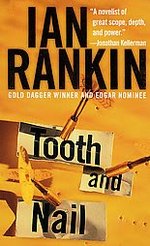
Tooth and Nail by Ian Rankin

Tooth and Nail Tooth and Nail

by Ian Rankin
Series: John Rebus, #3

Paperback, 293 pg.
St. Martin’s Paperbacks, 1996 (first published 1992)

Read: April 14 – 15, 2017

She drives home the knife.

The moment, she knows from past experience, is a very intimate one. Her hand is gripped around the knife’s
cool handle and the thrust takes the blade into the throat up to the hilt until her hand meets the throat itself. Flesh upon flesh. Jacket first, or woollen jersey, cotton shirt or T-shirt, then flesh. Now rent. The knife is writhing, like an animal sniffing. Warm blood covering hilt and hand. (The other hand covers the mouth, stifling screams.) The moment is complete. A meeting. Touching. The body is hot, gaping, warm with blood. Seething inside, as insides become outsides. Boiling. The moment is coming to an end all too soon.

And still she feels hungry. It isn’t right, isn’t usual but she does. She removes some of the clothing; in fact, removes quite a lot of it, removes more, perhaps, than is necessary. And she does what she must do, the knife squirming again. She keeps her eyes screwed tightly shut. She does not like this part. She has never liked this part, not then, not now. But especially not then.

Clearly, this is someone who needs to be stopped. And The Powers That Be have brought John Rebus from Edinburgh to London to help the hunt for the Wolfman (yeah, those who tagged the killer with that moniker may have made some assumptions). Thanks to the events in Knots & Crosses, many (who don’t know all the details) believe that Rebus is somewhat of an expert in Serial Killers. He knows he’s not, but no one asked him — he was just told to show up. It’s not long before this case gets under Rebus’ skin and he’s no longer in London to kill a couple of days as a show of support for the local police, but he’s off to catch a killer.

George Flight is the detective who’s serving as Rebus’ contact — and is leading the investigation. Rebus notes that he’s a better policeman than he is — meticulous, detailed, going through things step by step. Which isn’t doing him a lot of good at the moment, he needs something more. Enter Rebus. By and large, Flight’s the only one that wants Rebus’ help — his superior, another detective on the case, and the press liaison are pretty united in their lack of interest in bringing in someone from “Jockland” to meddle in the crimes of the big city.

As Rebus arrives in London, another body is discovered, so he shows up at the crime scene with his luggage, from there, they head to an autopsy — rushed, no doubt given the likelihood that this is another Wolfman victim. The autopsy scene — the sights, sounds and smells — is one of the best (possibly the best) that I’ve seen along these lines. It felt real, it felt disgusting, it felt sad. Between this and the opening paragraphs (quoted above), I’m again reminded that Rankin knows what he’s doing when it comes to writing. He nails this stuff.

While he’s in town, Rebus visits his ex-wife and daughter — things go poorly there, as one would expect. Things go worse when his daughter’s boyfriend comes around. When Rebus is able to connect said boyfriend to a career criminal . . .

I’m no expert on this, but I’ve read more than a few serial killer novels, it strikes me that 1992 was still pretty early in serial killer fiction-terms, and it shows. Both in Rebus’ attempts to draw the killer out, as well as Flight’s attempts to catch him. We also get to see both detectives trying to understand the serial killer — or at least how to apprehend one. Flight’s more old-school in his approach and is pretty disdainful of Rebus’ efforts to get inside the head of a serial killer. Which is not to say that this particular killer isn’t destructive, sick and really creepy.

Rebus is spurred on to this track because of who he is — but the attractive psychologist, Lisa Frazer, who wants to help him out certainly doesn’t hurt. It could be argued by some (including some characters in the book) that Rebus is far more interested in pursuing her than the Wolfman.

Rebus mostly stumbles around, indulging his infatuation with Frazer, looking for his daughter’s boyfriend, and occasionally chatting with Flight about the case. Now eventually, enough things happened that allow Rebus to put things together and figure out the identity of the Wolfman (sorta like when Wilson made a stray comment to Dr. House that got him to make the right diagnosis). Sure, it was clever, but hard to believe.

Early on, I thought this might be the book that turned me into a Rankin fan, not just some guy reading these. It came close, but I just couldn’t totally buy the ending and the way Rebus solved the case. But man, Rankin can write. I’m not totally sold on what he’s writing, but I’m really enjoying the craft. I was hooked throughout, but that ending just didn’t work.

—–

3.5 Stars

2017 Library Love Challenge

Nearly Nero by Loren D. Estleman

Nearly NeroNearly Nero: The Adventures of Claudius Lyon, the Man Who Would Be Wolfe

by Loren D. Estleman

eARC, 192 pg.
Tyrus Books, 2017

Read: March 24 – 30, 2017


I’ve heard about the stories in this volume for years, but have never tracked one down before — and then a whole collection of them show up on NetGalley! How could I not request it? I’m so glad this book exists so that those of us who don’t get the magazines, etc. that publish short mystery fiction can have them (and even those who do have access to those magazines, etc. can have them in one handy volume).

Anyway, here’s the setup: Claudius Lyon is a huge fan of Nero Wolfe — he reads every one of the reports that Archie Goodwin’s literary agent Rex Stout publishes. He’s such a fan that he wants to be Wolfe (like the guys dressing up in Batsuits in The Dark Knight Rises) — he’s fat, fairly clever, and wealthy enough not to need to work and still indulge himself. He renovates his townhouse to include a greenhouse, an elevator, and a first floor floorplan that pretty much matches Wolfe’s. He hires a private chef — a kosher chef of dubious quality (not that Lyon needs to eat kosher, it’s just what Gus can cook), changes his name to something that approximates his hero’s and hires a “man of action,” Arnie Woodbine. Arnie’s an ex-con, small-time crook who doesn’t mind (too much) putting up with his looney boss for a steady paycheck and meals.

The number of ways that Lyon isn’t Wolfe is pretty large and I won’t spoil your fun in discovering them. Now, Lyon’s unlicensed as a PI, so he can’t take on paying clients — but he occasionally gets people who will take him up on his free services. He’s decent at solving puzzles and low-priority mysteries (not that he doesn’t find his way into something bigger on occasion). Once he gets a client (non-paying, Arnie’d have me stress), he goes through whatever steps he needs to figure it out (including his own version of Wolfe’s lip movement and sending Arnie on fact-finding missions), and goes to some lengths to assemble some sort of audience for his reveal. I can’t help smiling as I think about it, really.

The whole thing is a tongue-in-cheek tribute to the Nero Wolfe/Rex Stout — recognizing the brilliance of the Stout’s work (how can you not?), while poking fun at it. Lyon’s really a goofy character and Woodbine is great at pointing that out — while begrudgingly admitting that he gets things right every now and then. There’s a lot of fun to be had in the story telling — the mysteries aren’t all that much to get excited about, it’s in watching Lyon stumble through his cases that the entertainment is found. Well, that and Woodbine’s commentary.

Not unlike many of the Wolfe stories (particularly the short stories).

I wouldn’t recommend reading more than two of these stories in a sitting, I think they work best as solo shots. It’s a difficult call, because I typically wanted to go on for one more. Also, I’m not sure how enjoyable these’d be for non-Wolfe readers — but then again, I think a lot of the humor would hold up and it might entice a reader to learn more about Lyon’s idol. And anything that gets people to read Rex Stout’s Nero Wolfe novels is a good thing.

But for readers of Stout’s Wolfe novels? This is a must read. He’s not trying and failing to recapture Stout’s magic (see Goldsborough post-The Bloodied Ivy), he’s intentionally missing and yet somehow getting a little of it. I really enjoyed this book and can easily see me re-reading it a handful of times.

Disclaimer: I received this eARC from Adams Media via NetGalley in exchange for this post — thanks to both for this.

The Collapsing Empire by John Scalzi

The Collapsing EmpireThe Collapsing Empire

by John Scalzi
Series: The Collapsing Empire, #1

Hardcover, 329 pg.
Tor Books, 2017

Read: March 28 – 29, 2017

I can’t think of a SF release more highly anticipated this year than The Collapsing Empire, the first in a new series (there’s a really good chance that I’ll be saying the same thing in 3 months about something else that I’m spacing at the moment). Thankfully, it surpassed my expectations (which were, admittedly, pretty low — this just didn’t sound that interesting) — I can’t speak for the rest of his fanbase who were anticipating it so highly, but I can’t imagine that most weren’t wholly satisfied, and predict he picks up a few fans from this.

The Interdependency is the empire that is made up of the descendants of the people of Earth, it’s been in place for centuries — and, as the title of the book (and series) states, it’s on the verge of collapse. Not from political pressures or outside threats, or anything of that nature. Instead, it’s the Flow. The Flow is the way that humanity travels between the stars — a extra-dimensional field that can be accessed to facilitate travel between planets. And it’s on the verge of changing — not disappearing, just connecting different planets and leaving millions of people without access to the rest of the Empire.

Tricky to explain briefly — but that’s okay, the characters in the book are (with 3 exceptions) learning this about the same time as the reader is and those who explain it do a much better job. Basically, the Empire as they know it is facing the End. There to help the Interdependency through this trying time (not that citizens know about it) is a brand-new, untried Emperox. She and her allies (intentional or otherwise) are going to have to deal with political, business and religious groups to try to help some of humanity survive.

I’ve gotta say that Emperox Grayland II (Cardenia to her friends) is a delightful character — you cannot help but root for her. She’s brave, smart, relatable and an underdog (how someone who rules several planetary systems can be thought of as an underdog is a neat trick). The scientist who travels the length of the Empire to help her understand what’s going on, Marce, is clever, overwhelmed, and the only one who really knows what’s happening (shades of Jor-El?). There’s another character, Lady Kiva, a junior member of a ruling family of one of the largest guilds who is just too much fun — she swears enough to make Marshall Mathers take a step back; has no tact, no diplomacy, and shows no mercy to her enemies (especially if they stand between her and a profit). Really, she’s a horrible person (at least in this book),but a fun, fun character.

These three are our focus, they’re who we cheer for and pin our hopes on. If they can survive the political, scientific, religious, and humanitarian turmoil that’s beginning to bubble — there’s a shot for humanity. Not much of one, honestly, but a shot.

Somehow, Scalzi’s able to take societal collapse and tell it in an entertaining, suspenseful and frequently funny way. He’s able to give a thinly disguised commentary on environmental catastrophe and keep it from getting preachy. Basically, he threads the needle just right to keep people enjoying themselves as they read what would be a heavy, off-putting book in many author’s hands.

Is it perfect? No. Am I crazy about everything he does/tries to do in this book? Nope. But man, such a fun, quick ride that I can’t help but like it and recommend it to everyone I can think of. I was so wrong not to be interested in this book — I’m more than interested in the sequel.

—–

4 Stars

2017 Library Love Challenge

Robert B. Parker’s Little White Lies by Ace Atkins

Really, all I want to say about this book is: “Yes! Atkins did it again — it’s just so good, folks. Long-time fans’ll love it, new readers will likely see the appeal of the series. A lot of fun with a great ending!” But that seems a little surface-y and is just bad writing. But really, that’s everything I’ve got to say.

Little White LiesRobert B. Parker’s Little White Lies

by Ace Atkins
Series: Spenser, #45

eARC, 320 pg.
G.P. Putnam’s Sons, 2017

Read: March 16 – 17, 2017

Pearl and I were off to Central Square . Her long brown ears blew in the wind as we drove along Memorial Drive against the Charles. Rowers rowed, joggers jogged, and bench sitters sat. It was midSeptember and air had turned crisp. The leaves had already started to turn red and gold, shining in Technicolor upon the still water.

I debated about what quotation I’d open with — I went with this Parker-esque (and Atkins-esque) description. Little White Lies is one of the better of Atkins run on this series, because (like here) he did something that feels like something Parker would’ve written, but not quite what he’d have said (the more I think about it, the less I think that Parker’d have said “bench sitters sat”).

Actually, that’s true of the other quotation I almost used, too:

I nodded , adding water to the new coffeemaker sitting atop my file cabinet. I’d recently upgraded from Mr. Coffee to one of those machines that used pre-measured plastic cups. I placed my mug under the filter, clamped down the lid, and returned to my desk. Demonic hissing sounds echoed in my office. Where have you gone, Joe DiMaggio?

This is Atkins sixth Spenser novel, and you’d think he’s got enough of a track record that I could stop comparing him to Parker. Well, you’d be wrong — I can’t stop. This, like most of Atkins’ work on this series, is so reminiscent of early Parker novels that it makes some of the latter Parkers look more like they were written by a hired gun. Still, I’m going to try to keep it to a minimum because it doesn’t seem fair to keep doing.

Susan has sent one of her clients to Spenser for some help that she can’t provide. Connie Kelly had been dating someone she met online, invested in one of his real estate deals — and he vanished, taking the money with him. Could Spenser track him down and get her cash back? Sure, he says. It doesn’t take long for the investigation to show that he owes plenty of people money — a couple of months rent here, hundreds of thousands of dollar there.

Here’s the fun part: M. Brooks Welles, the deadbeat in question, is a silver-haired, silver-tongued mainstay on cable news. He’s former CIA, and an expert on military and national security issues — one of those that producers call on regularly when they need a talking head. Why’s a guy like that flaking out on real estate deals? Spenser knows something fishier than expected is going on — which takes him into a world of mercenaries, gun deals, and the ATF.

Then someone tries to kill him. A couple of times. And the book stops feeling like a semi-light adventure, poking fun at the blowhards on cable TV and the state of American Journalism, and how we shouldn’t trust as many people who have cameras pointed at them as we do. Things take on a different tone, bodies start piling up, and a darkness slips in to the book. This also brings in Belson and his new boss — who’s still not a fan of Spenser. About the same time, Connie starts to waver in her conviction that she wants her money back and Welles punished. Spenser, naturally, doesn’t care and plows ahead. Hawk is able to connect Spenser with some mercenaries that travel in the same circles as Welles and the chase is on. Eventually, the action moves from Boston and its environs to Georgia. Which means that Teddy Sapp is going to make an appearance.

All the characters were great — I would’ve liked some more time with some of Welles’ co-conspirators in Boston, I think it’d have helped round out our picture of his crimes. But it’s a minor complaint. We also got plenty of interaction with his Georgia-based colleagues. Even the characters that show up for a page or two as witnesses to the crimes were interesting — it’s the little things like those that add so much. It was nice to see Teddy Sapp again, too. He was the best part of Hugger Mugger (faint praise, I realize). The Hawk material was very good — maybe Atkins’ best use of the character yet.

I fully expect that people are going to spend a lot of time talking about the ending — it didn’t feel like a Parker ending. That said, it felt like an ending that pre-A Catskill Eagle Parker might have tried. It was satisfying, don’t misunderstand, it’s just not the kind of ending that Parker employed. Honestly, there were two other perfectly acceptable places to end the book — and if not for the progress bar at the bottom of my screen, I might have believed that thee ending was earlier and equally strong.

Now, because Atkins and the Parker estate aren’t stupid, there are certain characters that you just know are safe, no matter what shenanigans that they’ve let Atkins and Coleman get away with when it comes to killing off long-term supporting characters. But there was a definite feeling of peril when it comes to [name redacted] and [name redacted]. Sure I knew they’d live to be read about another day, but I wondered how healthy they’d be in the meantime.

This is sharply written, as usual. Atkins knows what he’s doing (in this series or anything else) — a great mix of character moments and plot. Spenser’s voice is strong — as are the voices of the other regulars. It was just a pleasure to read through and through. Let me leave you with one more snippet that is could’ve come from an early-80’s Spenser just as easily today’s, a voice like this is enough reason to read the book — the rest is just gravy (and there’s plenty of gravy):

I returned with sore legs back to my seat on the steps. I spent the next fifteen minutes watching women of all ages, sizes, and colors walk past me. I liked the way most women walked. I liked the way they dressed. And talked and smelled. I was pretty damn sure I was a fan of women in general. Did this make me a sexist or a feminist? Or somewhere in between.

Disclaimer: I received this eARC from Putnam Books via NetGalley in exchange for this post — thanks to both for this.
N.B.: As this was an ARC, any quotations above may be changed in the published work — I will endeavor to verify them as soon as possible.

—–

4 1/2 Stars

Hide and Seek by Ian Rankin

Hide and SeekHide and Seek

by Ian Rankin
Series: John Rebus, #2

Hardcover, 272 pg.
Minotaur Books, 1991

Read: March 4, 2017


Now, this is more like it. You’ve got a seasoned detective who sees something that just doesn’t jibe — a routine O. D. that just doesn’t look right. At least to him — everyone else (including the detective who’d normally be assigned to the case) is good with the obvious answer. Not at all shockingly, there is more than meets the eye to this death.

Rebus’ ex and daughter have moved away, his brother is in jail, Gill is now seeing a DJ (who seems to be pretty popular), and Rebus has a new boss (and a promotion) — so outside of Rebus himself, there’s not a whole lot to tie the two novels together. It’s not just his coply intuition (to borrow Jesse Stone’s phrase), it’s some occult symbolism, a stolen camera, and the testimony of a near-witness that make Rebus continue to investigate. He spends time with druggies, students, male prostitutes, artists, academics, and the upper crust of local society in an effort to explain the death.

There’s something to Rankin’s prose that elevates it above most of what you find in Police Procedurals — I can’t put my finger on it, but you can feel it. The description of the corpse was fantastic, filled with those little details that will stick with me longer than your typical macabre tableau à la Thomas Harris or Val McDermid. The closing image was just as strong — ambiguous, but striking. I can’t wait to see what he does as he becomes a better writer.

Rebus isn’t good with people — family, friends, co-workers, lovers — he drinks and smokes too much, and cares more about police work than anything else. Even when he makes an effort with people (not part of a case), it just doesn’t go well at all — we’ve seen this character before, but it still works — readers just like this kind of cop.

So much of this feels (when you think back on it — or when you start to realize what he’s doing in a scene/with a character) like something you’ve seen before — maybe several times. Even by 1991 standards. But when you’re reading it, somehow , Rankin makes it feel fresh. I should note, incidentally, that a lot of what you think you’ve seen before, you maybe haven’t, if you give him enough time. He didn’t cheat with the solution, or how it was reached — but it felt like it came out of nowhere (it didn’t). That’s good enough for me.

That’s 2 down, 19 to go. Knots & Crosses felt like a character study, a good crime novel. Hide and Seek, on the other hand, feels like someone is building/introducing a series. It’s a subtle difference, but important. I’m reminded of the difference between Parker’s The Godwulf Manuscript and God Save the Child. It’s only going to get better from here. I really like this character, even if I’m not doing a good job talking about him — I think that’ll change in forthcoming books. Once Rankin stops establishing the character/building the series’ foundation and starts building.Also, I look forward to getting a better understanding of Rankin’s use of the term “Calvinist.” This one was good, solid writing with a satisfying story — not dazzling, but everything you want in a procedural.

2017 Library Love Challenge

—–

3 Stars

Page 22 of 36

Powered by WordPress & Theme by Anders Norén