Category: P-U Page 21 of 36

Open and Shut (Audiobook) by David Rosenfelt, Grover Gardner

Open and ShutOpen and Shut

by David Rosenfelt, Grover Gardner (Narrator)
Series: Andy Carpenter, #1
Unabridged Audiobook, 6 hrs, 50 min.
Listen & Live Audio, Inc., 2008

Read: August 21 – 22, 2017


I honestly can’t believe I’ve talked to little about Andy Carpenter and David Rosenfelt here — it works out, when you look at timelines and whatnot, I’ve been reading him a long time before I started blogging. Still, it’s hard to believe since it’s one of my favorite series, and has been going for so long. Yeah, maybe the series is getting too long in the tooth, but for something to get to book 16+, it’s got to have a pretty solid foundation, right? That foundation is Open and Shut, where Rosenfelt introduces the world to Andy Carpenter, dog lover extraordinaire and pretty decent defense attorney.

Carpenter is a hard-working lawyer, taking on many cases that don’t pay much, but do some good. He’s obsessed with New York sports and his golden retriever. He’s going through a divorce — and has started dating his investigator. He’s got a great sense of humor, is known for a hijink or two in court, and seems like the kind of guy you want in your corner. His father is a big-time D. A., the kind of Prosecutor that people hope/assume theirs is — honest, hard-working, tough on crime. So it shocks Andy when his dad asks him to take on a client for a retrial on a murder case — a murderer his dad put away and his currently on Death Row.

Andy goes ahead with the case, not sure that he should. But it doesn’t take long before he starts to believe in his client’s innocence. About that time, things get interesting and maybe even a little dangerous.

Almost all the elements that go into a typical Andy Carpenter novel are here — even if they’re just being introduced at this point. The jokes are fresh, the clichés have yet to be developed. It’s a good mystery with some good non-mystery story elements. And, best of all, some really fun courtroom moments — not just antics on Andy’s part, but some good depictions of legal/trial strategy and the like. I’ve been thinking lately that the latter Carpenter books have been giving the courtroom short shrift, and seeing what Rosenfelt does here just solidifies that thinking.

Gardner’s narration didn’t blow me away or anything, but it was good work. I can easily believe him as Andy’s voice and can see him really growing on me (not unlike George Guidall and Walt Longmire). He’ll keep you engaged in the story, and deliver a line or two in a way that will bring a smile to your face.

Give this one a whirl, folks — text or audio — you’ll enjoy yourself.

—–

3.5 Stars

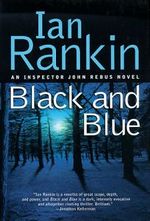
Black and Blue by Ian Rankin

Black and BlueBlack and Blue

by Ian Rankin
Series: John Rebus, #8

Hardcover, 391 pg.
St. Martin’s Press, 1997

Read: September 4 – 5, 2017


I wasn’t sure if I should open with:

He went into the toilets again, just to steady his breathing and look at himself in the mirror. He tried to relax his jaw muscles. In the past, he’d have been reaching for the quarter-bottle of whisky in his pocket. But tonight there was no quarter-bottle, no Dutch courage. Which meant for once he’d be relying on the real thing.

or:

…Rebus sat on a char in the interview room, watching his hands shaking.
‘You OK?’ Jack asked.
‘Know what, Jack? You’re like a broken record.’
‘Know what, John? You’re always needing it asked.’

Either one of those works to sum up Rebus’ frame of mind in the latter half of this book (and that’s largely because things had gotten worse for him by that point). Not that things were ever going his way in this book.

Following his gutsy political moves in the last book he’s been assigned to the worst police station in Edinburgh and a case he worked early in his career as a Detective with his mentor has come under increased scrutiny thanks to some media attention, and an underdog convicted of that crime who is able to cast some doubt on the original investigation. Meanwhile, a serial killer from the late 60s (who remains uncaptured) has inspired a copycat. Rebus (like every detective in Scotland, it seems) is on the fringes of this investigation. Oh, yeah, and there’s an unrelated suspicious death that Rebus needs to investigate.

Four cases, with more in common than anyone expects until the most tenacious cop east of Harry Bosch starts doing his thing. He starts following threads that take him far from his desk and home — Glasgow and eventually Aberdeen — and the oil platforms north. While dodging the press (more persistent that he’s used to) superior officers and an internal investigation, Rebus moves around the country picking at clues and hunches while getting under the skin of criminals, cops, oil company executives, and one serial killer.

There are so many police officers running around this book, some we know, some we don’t. Siobhan Clarke has a small, but pivotal role to play. Brian Holmes is around helping Rebus unofficially, while things with Nell are at their worst. Jack Morton, Rebus’ old drinking pal plays a significant role in this novel — he’s clean and sober now, and is convinced that’s what Rebus needs to do, too. Gil Templar needs Rebus’ help, very unofficially. There are new detectives and from Glasgow, Aberdeen and Edinburgh for readers and Rebus to meet — the main thing they all seem to have in common is that they don’t want Rebus mucking around in their cities.

I don’t know if I’ve seen Rebus more self-destructive. He’s drinking more than normal (which is saying something) and seems to care less than ever about what his superiors think of him (which is also saying something). Some of his wry sense of humor remains — almost entirely buried under cynicism. Rebus has had doubts about what he and his mentor did years ago, and the renewed attention isn’t helping his sense of guilt. He is far more interested in the serial killer cases than he ought to be professionally, it’s become a habit that threatens to distract him from his actual duties. His personal demons are almost as much of an antagonist than anyone he could possibly arrest in Black and Blue. Yet, he investigates in the same way he always does — and the way he wraps up most of the cases carry his signature style.

Black and Blue is intense, it is ambitious — for most of the book, it’d be easy to see this as being the end of the road for Rebus (if I wasn’t fully aware that 13 other novels had been published with at least one more announced) — not that you’re all that worried about him living through the end, you’re more worried that he’ll be unemployed by the end. It’s one of those novels that makes you want to ignore obligations, work and family — none of which can be as interesting or pressing as the book. You could cut out half the murders from this novel and it’d still be a winner, including all of them makes this something more than that.

I went into this one with a mix of trepidation and anticipation — I’ve heard that this was where the series took a turn for the better. I recently heard an interview with Rankin where he described it that way — sales, awards, critical acclaim, all came with this book. So I was worried that I wouldn’t see what so many had before — but was excited to try. This one lives up to expectations, as high as they might be. Just a stunning work. I honestly don’t know how Rankin will top this — I’m not sure how easy it’ll be to equal it.

—–

5 Stars
2017 Library Love Challenge

Let it Bleed by Ian Rankin

Let it BleedLet it Bleed

by Ian Rankin
Series: John Rebus, #7

Hardcover, 287 pg.
Simon & Schuster, 1996

Read: August 9 – 10, 2017

He stood there shivering after the warmth of the pub and his car. He was a few yards from where the boys had jumped. The area was cordoned off with metal barriers, anchored by sandbags. Two yellow metal lamps marked off the danger area. Someone had climbed over the barriers and laid a small wreath next to the broken rail, weighing it down with a rock so it wouldn’t be blown away. He looked up at the nearest of the two vast supports, red lights blinking at its summit as a warning to aircraft. He didn’t really feel very much, except a bit lonely and sorry for himself. The Forth was down there, as judgmental as Pilate. It was funny the things that could kill you: water, a ship’s hull, steel pellets from a plastic case. It was funny that some people actually chose to die.

“I could never do it,” Rebus said out loud. “I couldn’t kill myself.”

Which didn’t mean he hadn’t thought of it. It was funny the things you thought about some nights. It was all so funny, he felt a lump forming in his throat. It’s only the drink, he thought. It’s the drink makes me maudlin. It’s only the drink.

Yeah, right.

Before we get to this moment of self-deception (or self-mockery, it could go either way with his sense of humor), we’re treated to what’s quite possibly the most action-packed few pages in the series thus far — more happens in the first 6 pages of this novel than can happen in chapters of Rebus novels. Two suspected kidnappers are leading the police on a high-speed chase, and no one’s relishing it more than Chief Inspector Frank Lauderdale. No one’s hating it more than Inspector John Rebus. Things go really bad from there, but not in the way that anyone expects (least of all the reader, as jaded as we might be from too many crime novels).

While the police are still trying to sort out what exactly happened there, a man walks into a (poorly attended) public meeting with a Councilman and shoots himself in front of the Councilman. Once Rebus visits the widow, something starts bugging him. There’s just something wrong with that suicide (more than just what has to be wrong to lead to a suicide). Rebus starts asking some questions. Before he realizes it, he’s investigating two incidents of suicide connected to two Councilmen.

And then pressure comes down on Rebus to stop. Which works about as well as you’d think. He’s “encouraged” to take a few days of leave, which he uses to dive in without restraints to get his answers. This series as dabbled in political intrigue, power brokering and the like before, Let it Bleed takes it up a notch. What can happen to Rebus if he falters — or what can happen to him if he makes all the right people happy — shows that he’s in a whole other league now.

And then after all the action at the beginning of the novel, Rankin gives us an incredibly talky ending. And it works. Not many novels about police officers or detectives end with as much dialogue, as many meetings, as this does, but it’s entirely satisfying. No one’ll be sitting there for the last couple of chapters just wishing for a car chase, a gun fight, or anything like that. Rebus being smarter, wilier, and unwilling to bend is what makes this ending not only inevitable, but just what the reader needs.

There are a lot of criminals in this novel, but most of them aren’t your typical mystery novel “bad guys.” They’re guys who take advantage of the system, manipulate the system, and then try to protect their assets (that last one is the most problematic). There are textbook villains — and not all of them pay for it — but with Rebus around, you know that some justice will be meted out.

Our favorites are back — so is Patience — Rebus’ daughter’s back in Edinburgh, on her own now. Siobhan Clarke, Farmer Watson, Gill Templer, and Brian Holmes all are involved. Clarke is the most interesting, yet again, her determinism and ability to stay (pretty much) in line with her superiors while helping Rebus make her a fun character to spend time with. She’s more involved in these cases than she has been in the past — and it’s good to see Rebus having someone allied with him. Thankfully, she’s a good police officer, too. Because, honestly, Rebus is a horrible police detective. He’s just too much of a lone wolf, too intuitive, not the kind of detective you want building a case for you. With Templer, Farmer and Clarke around, at least he’s got some good, capable help.

A gripping, tense, intriguing, and frequently funny, novel. Let it Bleed is just a great book. This series has been growing on me, little by little for seven books now, that’s pretty clear. Let it Bleed is above and beyond the best of the bunch, and I am looking forward to what’s coming up.

—–

4 1/2 Stars

2017 Library Love Challenge

Dead is Good by Jo Perry

Dead is GoodDead is Good

by Jo Perry
Series: Charlie & Rose Investigate, #3

Kindle Edition, 282 pg.
Fahrenheit Press, 2017

Read: August 3, 2017

Oh, and after all this time I learned something else about being dead.

Death is failure.

Death is loss.

Everything—who you are, what you know—goes.

Whoever you thought you were, you weren’t and you’re not.

When he was alive, Charlie Stone was married multiple times to pretty horrible women (if we’re to believe him — and we might as well, he seems pretty upfront and honest about this kind of thing), not that he was any catch, either. But he really only loved one person, Grace Morgan. Grace broke things off with Charlie and moved on with her life, but apparently after hearing about his murder, she was moved to change her approach to art — deciding to challenge the audience, forcing them to realize how close to death they are.

Yeah, it sounds pretty silly and pretentious to me, but hey…that’s not the important part of the story. Maybe if we got more examples of her art, I’d care more and maybe even understand. What is important about Grace, for our purposes, is that her life is in danger, it’s because of this danger that Charlie and Rose have been brought from their afterlife-limbo back to Earth.

The book opens with one of the more blatant suicide-by-cop scenes you’ve ever read, which is intended to serve as protection for Grace. It doesn’t work out, or the book would be really short. Powerless to do anything but watch and hope things turn out okay, Charlie and Rose travel around L.A. discovering for themselves what it was that endangered Grace in the first place — which brings them into a world of drugs, sweatshop workers, deceptive piñatas, and smuggled birds.

This is a very tangled story, it takes Charlie quite a while to put the pieces together — Rose has her own priorities in this mess and spends some time away from Charlie, unwilling to turn her focus on his behalf. The way that this criminal enterprise is eventually revealed to work not only seems like something that really exists, but is revealed in a way that is narratively satisfying.

Charlie will tell his readers over and over that there’s no character growth in death — that’s nonsense. Post-mortem Charlie is a much more emotionally mature and self-sacrificing kind of guy than pre-mortem Charlie was. In this book we see him come to — or at least acknowledge — a greater and deeper understanding of what love is, and what he allowed his previous relationship to become. It may not do him any good in the afterlife, but Charlie is better for it, and in someway we can hope that Grace is better off having gone through all this, so that whatever life has in store for her can be tackled face-on.

I love these characters — even while we readers don’t fully understand their circumstances, how they know where to go, what brings them to this world at certain times. Even while they don’t have much better of an idea than we do (at least Charlie doesn’t). I love how while they can’t interact with their environment, the people they see and events they watch unfold, they are driven to find answers, driven to care about what’s happening. There’s something about that compulsion — and success they have in figuring things out — that matters more than when Bosch or Spenser or Chin and Smith put all the pieces together to thwart someone.

This wasn’t as amusing as previous installments, but it was just as satisfying — maybe more so. For a good mystery with oddly compelling characters, once again, look no further than Jo Perry.

The L.A. County Department of Medical Examiner-Coroner has a gift shop?? Why isn’t anyone investigating this? It may be real, it may be popular and legal. But surely that’s a crime against tact, right?

—–

4 Stars

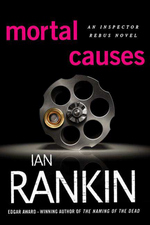
Mortal Causes by Ian Rankin

Mortal CausesMortal Causes

by Ian Rankin
Series: John Rebus, #6
Hardcover, 310 pg.
Minotaur Books, 1994
Read: July 15 – 18, 2017

When he’d washed his eyes last night, it had been like washing behind them as well. Always it came to this, he tried to do things by the books and ended up cooking them instead. It was easier, that was all. Where would the crime detection rates be without a few shortcuts?

Before Rebus gets to his shortcuts, he’s called to investigate a homicide. A particularly grisly one, reminiscent of some that Rebus saw in Northern Ireland when he was serving there.

It’s his familiarity with that execution that gets him loaned to a special squad also investigating the homicide, especially as it seems tied into some gun smuggling. Rebus isn’t pleased at all to be the new guy — much less, the temporary new guy — on a team, as much as he seems to appreciate some of the individuals on the team (while others make him think more fondly of Chief Inspector Lauderdale). The investigation takes him to Northern Ireland to collect some intelligence, to a dangerous neighborhood, and he brushes up against an American who’s funneling guns of all kinds to (and through) Edinburgh.

In the midst of all of this, Rebus has some drama in his personal life — nothing involving his tenants or brother, but things with Patience Aitken aren’t going as smoothly as one might want (are they ever?) — and there’s another woman who has Rebus in her sights (the guy isn’t a catch, from what I can tell — how does this happen so regularly?).

Throw in an appearance by Big Ger Cafferty while the bodies are piling up and you’ve got yourself a story.

I’m not sure why I don’t have much to say about this one. Maybe because we live on this side of the Good Friday Agreement? But that doesn’t seem to ring true. Rebus is Rebus, Clarke is Clarke, Holmes is Holmes, Farmer Watson is off the wagon, but still pushing his bad coffee . . . the new squad ha some interesting characters, but we don’t spend much time with them. There are some great and colorful characters we brush into during the investigation, too. I don’t know. I liked it, but I can’t think of anything to say beyond that.

There’s a lot to commend in this novel, from great lines like: “He’d had wrong hunches before, enough for a convention of the Quasimodo fan club”; to the wide-ranging sources of trouble for Rebus; to the horrible history and equally horrible present behind the crimes — this is a solid and haunting novel. Something about this was a little off, I’m not sure what — at least as I think back on it, it doesn’t seem as fully developed as the last two. But in the moment I was gripped. I’m not saying that this isn’t fine, I just know Rankin can do better.

—–

3.5 Stars
2017 Library Love Challenge

Pub Day Repost: The Right Side by Spencer Quinn

The Right SideThe Right Side

by Spencer Quinn
eARC, 336 pg.
Atria Books, 2017
Read: May 11 – 12, 2017

Okay, since I first opened the pages of Dog On It 8 years ago, I’ve been a Spencer Quinn fan — it probably took me two chapters to consider myself one. So it’s kind of a given that I’d like this book — but only “kind of.” This was so far from a Bowser & Birdie or Chet & Bernie book that they could be written by different people.

Sgt. LeAnne Hogan was an excellent athlete in her childhood and teen years, and then she joined the Army (deciding her West Point plans would take too long — an oversimplification that’ll do for now) and became an excellent soldier, serving multiple tours in combat zones. During her last sting in Afghanistan — as part of a team working to build intelligence sources among Afghan women — she is involved in an attack that leaves some dead and her injured — physically and mentally.

Her memories of that fateful day are vague and dim at best, but the scars will not leave. Not only that, she lost an eye, her confidence, her future plans, and career. She slowly befriends a woman who lost part of her leg to an IED in Iraq who shares a room with LeAnne in Walter Reed. Marci dies suddenly and unexpectedly — and that is too much for LeAnne. She leaves the hospital immediately and sets off on a drive across the country, she really doesn’t have a plan, but she needs to be somewhere else.

It’s pretty clear that LeAnne is suffering from PTSD on top of everything else — as you’d expect. She comes across as angry and rude to almost everyone she runs across and exchanges more than a few words with. She eventually finds herself in Marci’s hometown — where her daughter has gone missing. For the first time since the day everything changed, LeAnne has a purpose — bring her friend’s daughter home. Along the way, she LeAnne gets adopted by a large dog who will prove an invaluable aid in this challenge.

LeAnne is a great character — not a perfect person by any means, but you can see where a lot of writers (novelists or journalists) would try to paint her as one. She has huge flaws — some of which are easier to see after the injury (and some of them are new after it, too). There are some other good characters, too — even if you don’t necessarily like them (LeAnne’s mother would be an example of this — she’s trying to do the right thing, but the reader can sense LeAnne’s apprehensions toward her — and will likely share them). The people in Marci’s hometown (particularly those that are related to her) are the best drawn in the book — and I’d be willing to read a sequel or two just in this city to spend more time with them. Not everyone gets what LeAnne’s going through — some don’t know how to react to her — but those that come close will endear themselves to you.

The dog, Goody, isn’t Chet, he isn’t Bowser — he’s a typical dog, no more (or less) intelligent than any other. Goody won’t be serving as the narrator in a story any time — he will drink from the toilet bowl and ignore a lot of what LeAnne wants him to do.

Like I said, I’m a Quinn fan — but I didn’t think he had this in him. Funny mysteries with dogs? Sure, he’s great at those. But sensitive explorations of veterans dealing with the aftermath of life-altering injuries? I wouldn’t have guessed it. But man . . . he really got this flawed character, this incredibly human character, right. There’s a couple of moments that didn’t work as well as they should’ve — a couple of moments that were hard to believe in a book as grounded in reality as this book was. But you know what? You forgive them easily, because so much is right with this book — so much just works, that you’ll accept the things that don’t. It wasn’t all dark and moody — there’s some hope, some chuckles, a lot that is somber and sad, too. While not a “feel good” read by any means, you will feel pretty good about who things end up.

This is probably categorized as a Thriller, as that’s where Quinn’s readers are — but I can see a case for this being labeled General Fiction (or whatever synonym your local shop uses), it’s flexible that way. This is Spencer Quinn operating on a whole new level with a character we need more like — such a great read.

Disclaimer: I received this eARC from Atria Books via NetGalley in exchange for this post — thanks to both for this.

—–

4 1/2 Stars

Collared by David Rosenfelt

CollaredCollared

by David Rosenfelt
Series: Andy Carpenter, #16

eARC, 336 pg.
Minotaur Books, 2017

Read: June 13 – 14, 2017

I know I take dog-loving to a somewhat absurd degree, but what he just said pleases me. Someone who doesn’t care about dogs, or this one in particular, would have said, “It’s about the dog being found.” But he said Cody instead of the dog, which to me is a sign of respect and caring.

I may need to get out more.

Cody has been assumed to have been one of two victims of a kidnapping — the other was the baby the dog’s owner had recently adopted. It’s been two and a half years, with no trace of either. The mother’s ex-boyfriend and ex-employee has been convicted for the crime, on some pretty flimsy evidence. Now Cody has been left at the front door of The Tara Foundation. Naturally, once Andy is told about this, he brings in the police and the dog’s owner (a friend of Laurie’s, as coincidence would have it). The question at the front of everyone’s mind is: can the dog somehow lead to answers about her son?

Jill, the boy’s mother and Cody’s owner, asks Andy to look into this for her. Almost as soon as he begins, Andy uncovers some evidence that leads him to become Keith’s attorney and get him a retrial. Andy is pretty clueless (as is everyone) why someone would kidnap the boy and the dog (and return the dog), not to mention frame Keith for the crime. But while he can’t answer that, he can chip away at the evidence that put Keith behind bars — the only hope the boy has is that by doing so, someone may stumble on an explanation for what happened to him.

Along the way, Andy’s associate Hike has to go down to North Carolina to do a little research. While there, something happens to him — I won’t ruin anything for you, but it’s a lotta fun for people who have been around since Hike’s introduction — you will enjoy it. Laurie does what Laurie does, ditto for Marcus (who might be his most-Marcus-y here) and Sam. I do worry that Rosenfelt isn’t doing much with these characters beyond their regular heroics and chuckle-worthy antics, but we got some good Hike material this time, maybe it’ll be someone else’s turn to shine next. I don’t think the addition of Ricky to things added that much to the series, and that’s the last major change since Hike came along.

I really would’ve appreciated a little more courtroom action, but I’m not sure what else could’ve happened. It just seems like less time is being given to the courtroom lately — maybe I’m wrong. I can’t imagine that Andy would approve of someone doing the work to determine if I’m right or not — he sure wouldn’t — so let’s just assume I am.

I sound like I’m complaining about the book — that’s not really my intention. I wouldn’t expect so much from it if I wasn’t such a fan. Collared has a clever mystery, some funny moments, a nice twist or two, and we get to spend time with characters that readers have come to know and like. For a series 16 books in, that’s pretty good. Where else are you going to get a friend of the protagonist describe a potential suspect like this?

“Because Kaiser is a bad guy—-a very bad, very dangerous, very evil guy. He might even be a Cardinals fan.”

It’s a fun read — from the moment that Andy assembles the family to help him decide if he’ll renew his law license to the party at Charlie’s, Rosenfelt keeps you turning the pages with a smile on your face.

Disclaimer: I received this eARC from St. Martin’s Press via NetGalley in exchange for this post — thanks to both for this.
N.B.: As this was an ARC, any quotations above may be changed in the published work — I will endeavor to verify them as soon as possible.

—–

3.5 Stars

The Black Box by Ian Rankin

I thought I’d scheduled this for yesterday, well, I’d intended to, but I typo’ed the date. So, hey, enjoy a bonus post to make up for the recent bits of silence.

The Black BookThe Black Book

by Ian Rankin
Series: John Rebus, #5

Hardcover, 278 pg.
O. Penzler Books, 1994

Read: June 2 – 5, 2017


As interesting and well-written as the mystery in this novel was, as I think about the book, I have a hard time thinking about it — the non-case material dominates the book, and seems more important for the series as a whole. Which is kind of a shame — there’s a lot to be mined in this case, and we didn’t get enough of it. A famous — and infamous — local hotel burns down, and one body is recovered. This man didn’t die in the fire, but was shot dead before it started. There were so few clues left that the case had been long considered unsolved and unsolvable. Five years later, John Rebus starts reviewing the files and talking to people involved (getting himself in hot water for it). I really wanted more of it — and the people Rebus talked to about this case.

So what made this book interesting? Well, Rebus got into this case because Brian Holmes was attacked off duty one night. It’s suggested that this is because of some extra-curricular investigations he’d been running. The only thing that Rebus has to follow-up that claim is Holmes’ black notebook, full of his personal code. Rebus can almost crack one set of notes which points him at the hotel fire and the killing involved. While Holmes’ recuperates, Rebus takes it upon himself to finish the DS’ work.

We meet DC Siobahn Clarke here — Rebus’ other junior detective. She’s driven, she’s tough, she’s English, educated and careful. Most of what Rebus isn’t. She’s got a good sense of humor and duty — both of which make her one of my favorite characters in this series almost immediately (second only to Rebus).

The big thing is our meeting Morris Gerald “Big Ger” Cafferty – we’d brushed up against him in Tooth & Nail. Big Ger is possibly the biggest, baddest criminal in Edinburgh, and it seems that Rebus will go toe to toe with him a few times. He’s both a source of information (for Rebus, anyway) as well as a target for the police (including Rebus, in a couple of directions in just this book) — for both the cold case and current operations. He’s dangerous, and yet not at all — I think spending time with him in the future will be a hoot.

Lastly, Rebus’ brother is out on parole, having served a decent amount of time behind bars. More than that, he’s crashing with his brother. Family awkwardness (to put it mildly) ensues. I’m not sure he’s someone I want to spend more time with, but something tells me that Rankin has good plans for the character. Meanwhile, Clarke and Cafferty are characters I want more of right now.

A solid mystery novel — with a conclusion I didn’t see coming (to at least one of the mysteries_ — with a lot of great stuff going on at the same time. This one’s a keeper.

—–

4 Stars
2017 Library Love Challenge

The Data Disruption by Michael R. Underwood

The Data DisruptionThe Data Disruption

by Michael R. Underwood
Series: Genrenauts, #0

Kindle Edition, 68 pg.
2017

Read: May 27, 2017


It’ll come to no surprise to any of my longer-term readers that I liked this — it’s pretty established that I’m a Genrenauts fan. I dig the characters, the world(s), the type of stories Underwood’s telling — the whole kit and caboodle. This story is no exception — I liked it. This takes place just before Leah is recruited, so the team is functioning very smoothly — no growing pains needed — just King, Shireen and Roman doing their thing like seasoned pros.

It’s a pretty straight-forward, classic cyberpunk story (yeah, I’m old enough that cyberpunk can be called “classic”) — notorious hacker, D-Source, has gone missing. Which is causing all sorts of problems for the rest of his crew, and (by extension) all of Cyberpunk world as well as ours. So King and his team (minus Mallery, off in Western world) head out to save the day. They’ve worked with D-Source in the past and therefore have an easier time getting an “in” to the story in-progress. What results is a solid heist story with all the cyberpunk bells and whistles.

Underwood has been modeling this series after TV shows, and wrote this as a “lost pilot” to “serve as an introduction to the series, which I’ll use to invite more people into the worlds of Genrenauts.” Here’s my problem with that — no one watches a lost pilot until the show’s been around for a while, and usually only fans see it. No one sits down to watch “The Cage” (or the two-part version, “The Menagerie”) as an introduction to Star Trek, and for good reason. Similarly, Leah Tang is our point-of-entry character, and to remove her from the equation takes something away from the overall story. Also, there’s something that’s slowly revealed over the course of the first few books that’s just blatantly stated. I just think that works better the way that Underwood originally wrote it.

Still, Underwood knows what he’s doing, and if he thinks this will work to bring in new readers, I hope he’s right.

Putting that aside, I’m supposed to be talking about the story, not Underwood’s plans. The story worked really well. It was a little too short for me — but it’s supposed to be short, so I shouldn’t complain. Besides, I almost always complain about short story length — even I’m tired of that. While the story was told in its fullness, I just would’ve liked to see everything fleshed out a little more — also, I wouldn’t mind spending more time with my friends. Fast, fun, with good action — celebrating what makes a cyberpunk story work — and winking at the genre at the same time.

Still, any time with the ‘Nauts works for me. Good story, decent intro to this series that I can’t stop recommending — and a great price (free). Still, reading this after the sixth book would be my recommendation after starting with The Shootout Solution.

—–

3.5 Stars

The Right Side by Spencer Quinn

The Right SideThe Right Side

by Spencer Quinn

eARC, 336 pg.
Atria Books, 2017

Read: May 11 – 12, 2017


Okay, since I first opened the pages of Dog On It 8 years ago, I’ve been a Spencer Quinn fan — it probably took me two chapters to consider myself one. So it’s kind of a given that I’d like this book — but only “kind of.” This was so far from a Bowser & Birdie or Chet & Bernie book that they could be written by different people.

Sgt. LeAnne Hogan was an excellent athlete in her childhood and teen years, and then she joined the Army (deciding her West Point plans would take too long — an oversimplification that’ll do for now) and became an excellent soldier, serving multiple tours in combat zones. During her last sting in Afghanistan — as part of a team working to build intelligence sources among Afghan women — she is involved in an attack that leaves some dead and her injured — physically and mentally.

Her memories of that fateful day are vague and dim at best, but the scars will not leave. Not only that, she lost an eye, her confidence, her future plans, and career. She slowly befriends a woman who lost part of her leg to an IED in Iraq who shares a room with LeAnne in Walter Reed. Marci dies suddenly and unexpectedly — and that is too much for LeAnne. She leaves the hospital immediately and sets off on a drive across the country, she really doesn’t have a plan, but she needs to be somewhere else.

It’s pretty clear that LeAnne is suffering from PTSD on top of everything else — as you’d expect. She comes across as angry and rude to almost everyone she runs across and exchanges more than a few words with. She eventually finds herself in Marci’s hometown — where her daughter has gone missing. For the first time since the day everything changed, LeAnne has a purpose — bring her friend’s daughter home. Along the way, she LeAnne gets adopted by a large dog who will prove an invaluable aid in this challenge.

LeAnne is a great character — not a perfect person by any means, but you can see where a lot of writers (novelists or journalists) would try to paint her as one. She has huge flaws — some of which are easier to see after the injury (and some of them are new after it, too). There are some other good characters, too — even if you don’t necessarily like them (LeAnne’s mother would be an example of this — she’s trying to do the right thing, but the reader can sense LeAnne’s apprehensions toward her — and will likely share them). The people in Marci’s hometown (particularly those that are related to her) are the best drawn in the book — and I’d be willing to read a sequel or two just in this city to spend more time with them. Not everyone gets what LeAnne’s going through — some don’t know how to react to her — but those that come close will endear themselves to you.

The dog, Goody, isn’t Chet, he isn’t Bowser — he’s a typical dog, no more (or less) intelligent than any other. Goody won’t be serving as the narrator in a story any time — he will drink from the toilet bowl and ignore a lot of what LeAnne wants him to do.

Like I said, I’m a Quinn fan — but I didn’t think he had this in him. Funny mysteries with dogs? Sure, he’s great at those. But sensitive explorations of veterans dealing with the aftermath of life-altering injuries? I wouldn’t have guessed it. But man . . . he really got this flawed character, this incredibly human character, right. There’s a couple of moments that didn’t work as well as they should’ve — a couple of moments that were hard to believe in a book as grounded in reality as this book was. But you know what? You forgive them easily, because so much is right with this book — so much just works, that you’ll accept the things that don’t. It wasn’t all dark and moody — there’s some hope, some chuckles, a lot that is somber and sad, too. While not a “feel good” read by any means, you will feel pretty good about who things end up.

This is probably categorized as a Thriller, as that’s where Quinn’s readers are — but I can see a case for this being labeled General Fiction (or whatever synonym your local shop uses), it’s flexible that way. This is Spencer Quinn operating on a whole new level with a character we need more like — such a great read.

Disclaimer: I received this eARC from Atria Books via NetGalley in exchange for this post — thanks to both for this.

—–

4 1/2 Stars

Page 21 of 36

Powered by WordPress & Theme by Anders Norén