Category: Authors Page 77 of 123

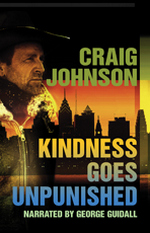
The Cold Dish (Audiobook) by Craig Johnson, George Guidall

The Cold DishThe Cold Dish

by Craig Johnson, George Guidall
Series: Walt Longmire, #1
Unabridged Audiobook, 13 hrs. and 18 mins
Recorded Books, 2007

Read: June 7- 12, 2017


This is by and large what I had to say about the book a couple of years ago — but I’ve expanded it a touch.

It’s hard to believe this is a first novel. I love it when that happens. Johnson is assured in his writing, he knows his characters and their world, there’s no mistaking that. The world and the characters are very well-developed, it’s hard to believe that Johnson worked in as much backstory as he did for these characters in such a short space. Walt, Vic, Henry Standing Bear, Lucien — they’re all fully fleshed out and ready to go.

As always, the mixture of Cheyenne Mysticism (for lack of a better word) and Longmire’s realism (and Vic’s cynicism) is great — even at this point, Johnson’s ready to present things that could be Cheyenne ghosts, or it could be Longmire’s mind playing tricks on him as a result of injury and exposure without taking a clear narrative stance. It’s not a fast-paced tale by any means–Johnson saunters through his prose like Longmire would through the world. That doesn’t mean it’s not gripping, though. It’s lush with detail, as scenic and expansive as the Wyoming country it takes place in.

It took awhile for Guidall’s narration to work for me, I did eventually come around, and I expect I’ll enjoy him more fully in the next book.

I figured out whodunit pretty quickly, but it took a while to get the why. The journey to the why was compelling, interesting and well worth the time. Looking forward to the next installment.

—–

4 Stars

Fool Moon (Audiobook) by Jim Butcher, James Marsters

Fool MoonFool Moon

by Jim Butcher, James Marsters (Narrator)
Series: The Dresden Files, #2
Unabridged Audiobook, 10 hrs., 6 min.
Buzzy Multimedia Publishing Corp., 2009

Read: May 30 – 31, 2017


Let’s keep this short:

I didn’t love this one as much as Storm Front, and I remember things as a whole being better. Still, we get the introduction of the Alphas, we get to see a little bit of every type of Werewolf in this world (I’d forgotten 1 of them), Dresden makes some smart choices re: Karrin Murphy (but man, most of what happened between the two of them in this book was annoying to a fan, and poorly constructed I think), and a (in retrospect) dumb one about Susan.

The main story was pretty good — I’d have liked to see Harry be a little quicker to figure things out, but he’s not perfect. Nor is he the investigator he’ll become eventually. I need to remind myself these are early days. As I recall, book 3 is a little less-good than this, which doesn’t make me look forward to it. But I know I like where things go pretty quickly, so I’ll keep going.

Marsters was fantastic — this would’ve been a 3 in just about any other narrator’s hands, er, vocal cords. I can’t say enough good things about him.

—–

4 Stars

No Middle Name by Lee Child (corrected)

No Middle Name No Middle Name: The Complete Collected Jack Reacher Short Stories

by Lee Child
Series: Jack Reacher

Hardcover, 418 pg.
Random House Publishing Group, 2017

Read: May 31, 2017


Over the years, Lee Child has published a number of short stories/novellas featuring Jack Reacher, and finally they’re all published in one handy collection. Some are available in non-ebook format for the first time, too. Also, we have a brand-new novella to kick things off. For many, this is the first they’ve been able to access them — I haven’t read any of them before, but I’ve listened to most of them in audiobook format.

Now, as I’ve said before, short stories aren’t normally my bag — and that’s very true for the Reacher stories. He just works better in novel-length stories, generally speaking anyway. For those stories I’ve listened to already, my opinion of them didn’t really change as I read them — the couple I liked, I still liked. The others . . . well, I remained unimpressed — it’s good to know that it wasn’t the format or Dick Hill (the narrator) — it really was the length or story.

But enough about that — there are three stories that I want to talk about — the first two are short stories that I really enjoyed. They’re just the right length, which is nice, you don’t feel short-changed. They also don’t feature Reacher that prominently. The first is “James Penney’s New Identity” (which apparently was published in a shorter form originally), it’s a story about a man who’s the victim of changing economic times who has had enough — at a pivotal point for him, he meets Jack Reacher (still in the Army). By his words and actions, Reacher changes the rest of James Penny’s life — and Reacher doesn’t have to fight anyone to do it. This story leaves the reader with more questions than answers — but in a good way.

“Everyone Talks” is written from the POV of a new police detective who has the good(?) fortune to run into Reacher in a professional capacity on her first day. I really liked this one — Reacher was pretty ingenious here dealing with the problem he sticks his nose into in a way that shows more brains than brawn. I think I actually laughed out loud as soon as I realized what he was up to. Pretty clever.

Oddly. there are two Christmas-y stories — I don’t know why I find that so odd, but Reacher doesn’t feel like a Christmas character. I liked, but wasn’t wowed by, both of them.

Obviously, the big thing here is the new novella, Too Much Time. Reacher’s wandering through a town and gets peripherally involved in stopping a petty crime. He allows himself to be cajoled by the police into helping them out for a few minutes afterwards. Things go wrong just a few minutes later. This is as good a novella-length story that I can imagine for Reacher — there’s a pretty good fight, Reacher solving a puzzle while helping the authorities — and keeping himself out of trouble. A little bit cerebral, a little bit thug. The perfect Reacher recipe. If Andy Martin’s book has taught me anything, it’s that there’s some significance to the law enforcement officials having names that start with A, B, C and D. If I was more clever, I’d know why. Still, I liked it a lot.

A nice, solid collection — with some strong stand-outs. Reacher fans need to grab it.

—–

4 Stars

2017 Library Love Challenge

Towel Day ’17: Do You Know Where Your Towel Is?

The Hitchhiker’s Guide to the Galaxy has a few things to say on the subject of towels.

A towel, it says, is about the most massively useful thing an interstellar hitchhiker can have. Partly it has great practical value. You can wrap it around you for warmth as you bound across the cold moons of Jaglan Beta; you can lie on it on the brilliant marble-sanded beaches of Santraginus V, inhaling the heady sea vapors; you can sleep under it beneath the stars which shine so redly on the desert world of Kakrafoon; use it to sail a miniraft down the slow heavy River Moth; wet it for use in hand-to-hand-combat; wrap it round your head to ward off noxious fumes or avoid the gaze of the Ravenous Bugblatter Beast of Traal (such a mind-bogglingly stupid animal, it assumes that if you can’t see it, it can’t see you); you can wave your towel in emergencies as a distress signal, and of course dry yourself off with it if it still seems to be clean enough.

More importantly, a towel has immense psychological value. For some reason, if a strag (strag: non-hitch hiker) discovers that a hitch hiker has his towel with him, he will automatically assume that he is also in possession of a toothbrush, face flannel, soap, tin of biscuits, flask, compass, map, ball of string, gnat spray, wet weather gear, space suit etc., etc. Furthermore, the strag will then happily lend the hitch hiker any of these or a dozen other items that the hitch hiker might accidentally have “lost”. What the strag will think is that any man who can hitch the length and breadth of the galaxy, rough it, slum it, struggle against terrible odds, win through, and still knows where his towel is is clearly a man to be reckoned with.

Hence a phrase that has passed into hitchhiking slang, as in “Hey, you sass that hoopy Ford Prefect? There’s a frood who really knows where his towel is.” (Sass: know, be aware of, meet, have sex with; hoopy: really together guy; frood: really amazingly together guy.)

One of my long-delayed goals is to write up a good all-purpose Tribute to Douglas Adams post, and another Towel Day has come without me doing so. Belgium.

Next year . . . or later.

Adams is one of those handful of authors that I can’t imagine I’d be the same without having encountered/read/re-read/re-re-re-re-read, and so I do my best to pay a little tribute to him each year, even if it’s just carrying around a towel (I’ve only been able to get one of my sons into Adams, he’s the taller, thinner one in the picture from a couple of years ago below).

TowelDay.org is the best collection of resources on the day, recently posted this pretty cool video, shot on the ISS by astronaut Samantha Cristoforetti.

Even better — Here’s an appearance by Douglas Adams himself from the old Letterman show — so glad someone preserved this:

Love the anecdote (Also, I want this tie.)

The Right Side by Spencer Quinn

The Right SideThe Right Side

by Spencer Quinn

eARC, 336 pg.
Atria Books, 2017

Read: May 11 – 12, 2017


Okay, since I first opened the pages of Dog On It 8 years ago, I’ve been a Spencer Quinn fan — it probably took me two chapters to consider myself one. So it’s kind of a given that I’d like this book — but only “kind of.” This was so far from a Bowser & Birdie or Chet & Bernie book that they could be written by different people.

Sgt. LeAnne Hogan was an excellent athlete in her childhood and teen years, and then she joined the Army (deciding her West Point plans would take too long — an oversimplification that’ll do for now) and became an excellent soldier, serving multiple tours in combat zones. During her last sting in Afghanistan — as part of a team working to build intelligence sources among Afghan women — she is involved in an attack that leaves some dead and her injured — physically and mentally.

Her memories of that fateful day are vague and dim at best, but the scars will not leave. Not only that, she lost an eye, her confidence, her future plans, and career. She slowly befriends a woman who lost part of her leg to an IED in Iraq who shares a room with LeAnne in Walter Reed. Marci dies suddenly and unexpectedly — and that is too much for LeAnne. She leaves the hospital immediately and sets off on a drive across the country, she really doesn’t have a plan, but she needs to be somewhere else.

It’s pretty clear that LeAnne is suffering from PTSD on top of everything else — as you’d expect. She comes across as angry and rude to almost everyone she runs across and exchanges more than a few words with. She eventually finds herself in Marci’s hometown — where her daughter has gone missing. For the first time since the day everything changed, LeAnne has a purpose — bring her friend’s daughter home. Along the way, she LeAnne gets adopted by a large dog who will prove an invaluable aid in this challenge.

LeAnne is a great character — not a perfect person by any means, but you can see where a lot of writers (novelists or journalists) would try to paint her as one. She has huge flaws — some of which are easier to see after the injury (and some of them are new after it, too). There are some other good characters, too — even if you don’t necessarily like them (LeAnne’s mother would be an example of this — she’s trying to do the right thing, but the reader can sense LeAnne’s apprehensions toward her — and will likely share them). The people in Marci’s hometown (particularly those that are related to her) are the best drawn in the book — and I’d be willing to read a sequel or two just in this city to spend more time with them. Not everyone gets what LeAnne’s going through — some don’t know how to react to her — but those that come close will endear themselves to you.

The dog, Goody, isn’t Chet, he isn’t Bowser — he’s a typical dog, no more (or less) intelligent than any other. Goody won’t be serving as the narrator in a story any time — he will drink from the toilet bowl and ignore a lot of what LeAnne wants him to do.

Like I said, I’m a Quinn fan — but I didn’t think he had this in him. Funny mysteries with dogs? Sure, he’s great at those. But sensitive explorations of veterans dealing with the aftermath of life-altering injuries? I wouldn’t have guessed it. But man . . . he really got this flawed character, this incredibly human character, right. There’s a couple of moments that didn’t work as well as they should’ve — a couple of moments that were hard to believe in a book as grounded in reality as this book was. But you know what? You forgive them easily, because so much is right with this book — so much just works, that you’ll accept the things that don’t. It wasn’t all dark and moody — there’s some hope, some chuckles, a lot that is somber and sad, too. While not a “feel good” read by any means, you will feel pretty good about who things end up.

This is probably categorized as a Thriller, as that’s where Quinn’s readers are — but I can see a case for this being labeled General Fiction (or whatever synonym your local shop uses), it’s flexible that way. This is Spencer Quinn operating on a whole new level with a character we need more like — such a great read.

Disclaimer: I received this eARC from Atria Books via NetGalley in exchange for this post — thanks to both for this.

—–

4 1/2 Stars

Storm Front (Audiobook) by Jim Butcher, James Marsters

Storm FrontStorm Front

by Jim Butcher, James Marsters (Narrator)
Series: The Dresden Files, #1
Unabridged Audiobook, 8 hrs., 1 min.
Buzzy Multimedia Publishing Corp., 2009

Read: May 18 – 19, 2017


Okay, I know myself well enough that I’m pretty incapable of critical thought when it comes to The Dresden Files — which is not to say I think the books (especially this one) are perfect, but I can overlook all the flaws — and those I can’t I can shrug off. It’s been years — almost a decade — since I re-read this, and I’d forgotten some details, but the core is pure Dresden. And the best of all is that I know they get better from here.

So I’m not going to talk about the book, really. For the 2 of you who don’t know, Harry Dresden is a Marlowe/Spenser-type of P.I. (but not really) who happens to be a wizard. He consults with the police on the supernatural front and does a little business helping private citizens. That’s all the setup you need.

What I want to talk about here is the audiobook portion of it — I’ve heard for years that the James Marsters narrated audiobooks in this series are fantastic. I was prepared to be thoroughly entertained. But not as much as I was. Marsters was just incredible, almost unbelievably good. This was, as the best audiobooks are, a performance, not just a reading. And this was one of the best performances I’ve witnessed from Marsters. Had I the means, I’d have bought the rest of the series Friday night after I finished this one.

Butcher fans, if you’ve only read the book, you need to listen to them, too. Marsters brought our man to life.

—–

5 Stars

The Hammer of Thor (Audiobook) by Rick Riordan, Kieran Culkin

The Hammer of ThorThe Hammer of Thor

by Rick Riordan, Kieran Culkin (Narrator)
Series: Magnus Chase and the Gods of Asgard, #2
Unabridged Audiobook, 10 hrs., 34 mins..
Listening Library, 2016
Read: May 10 – 12, 2016


Thor’s hammer is missing, so not only can he not stream Netflix (I’d forgotten that was a thing in this series) on it, he can’t intimidate the giants into not invading. You can guess which bothers him more. The Valkrie Samira and her pal Magnus have to go find it before things get out of hand.

I didn’t like this one as much as the first book in this series — but I didn’t dislike it. It’s still the same outline that Riordan is following with these books — there’s a quest; the hero and his friends have to go find the whatever to stall doomsday a little longer; to get the X the group has to beat a series of mini-challenges and then they’ll have a shot at the X. Since this is a book 2, they’ll get X, but many other things will go wrong, forcing the series into another book. For the most part, the minor challenges worked better for me than I expected.

I enjoyed Magnus’ friends — Samira in particular; although I’m pretty torn about the new character added to Magnus’ group: Alex Fierro — a child of Loki. I understand what Riordan was trying to do with this character, but I’m not sure he succeeded. I’m not convinced that Alex was a person, and not just a conglomeration of traits. But I have hope. Alex’s presence, I thought, ended up short-changing some of the other characters when it came to action and involvement in the plot, which I wasn’t crazy about.

I really enjoy seeing different authors’ take on the same mythological characters. Comparing/contrasting Kevin Hearne’s and Riordan’s Thors and Lokis would make for a very entertaining piece (I think Riordan’s Thor is more comical, but his Loki just might be more sadistic), and I will admit I got distracted a couple of times listening to this by thinking about the differences.

The best part of this was seeing how the problems Magnus, etc. are dealing with intersect some of what Percy, Annabeth and Apollo are going through in Riordan’s other series, and the strong hint that we’ll see some sort of cross-over soon. We’d understood that the Egyptian gods were threatening the earth about the same time that the Problems with Camps Jupiter and Half-Blood start up, but this was a much more explicit description. I like thinking that the various pantheons are having troubles at the same time, and that Earth could be doom in any number of ways simultaneously.

I bought this in hardcover the week it came out (last October, I think), but haven’t been able to find/make the time to read it. When I saw it as available on my library’s audiobook site, I figured I’d jump — just to get that TBR pile a little smaller. I hadn’t listened to Riordan on audio before, and was curious ow it translated. I was surprised to hear Kieran Culkin’s name (and voice) at the beginning of this — he didn’t strike me as the kind of actor who’d do audiobooks. I’m glad that he did, though. I really enjoyed his work throughout the novel — the narration, the characters — he just nailed it. That’s how Magnus Chase should sound.

It was entertaining enough to keep going, and I trust that Riordan knows what he’s doing, I’m just not convinced that he did all he could to make this book as good as it could be.

—–

3 Stars

Chalk by Paul Cornell

ChalkChalk

by Paul Cornell

Kindle Edition, 206 pg.
Tor.com, 2017

Read: May 5 – 8, 2017

There are kids who went through school experiences like mine who will never watch football, and there are those who end up playing for Arsenal. Okay, who will end up with season tickets. Stockholm syndrome will only take you so far.

Enough about what I am now. That comes later.

Everyone keeps talking about this as a story about bullying — sure, there’s a little bullying here. But mostly, that’s like saying that Hannibal Lecter enjoys an unconventional diet. What happens to Andrew Waggoner is so far beyond bullying — it’s flat out assault (but with a psychological component that matches bullying). After a Halloween dance, Waggoner is forced into the woods by the school bullies and is assaulted. Somehow, his trauma links him to some long-dormant forces who take the opportunity to reassert themselves. One manifestation of the mystical/magical works with (compels? coerces? convinces?) Waggoner to take his revenge against those who permanently scarred him mentally and physically.

And over the next 12 months, that’s just what happens — Waggoner and/or his mystical companion (it’s never clear exactly how much is done by each) exact their revenge — Waggoner vacillates in his commitment to this project, and comes close to stopping on many occasions. In the midst of this, he becomes a writer and makes a friend based on shared interest, rather than just being social pariahs. In short, he starts growing up.

Meanwhile, the ancient forces tied to Waggoner are in open conflict with the dominant, more modern/contemporary, forces/beliefs. The school — and the students’ lives — become the major battleground for them, the final conflict coming on the anniversary of the attack that changed Waggoner’s life forever.

I kept seeing the school as the school from Sing Street (except, in the West Country, not Dublin — but roughly the same era), which I know is inaccurate, but I couldn’t stop myself. Pop music plays a large role in the story, and as it’s set in the early 80’s I didn’t have to google most of the songs (there were a couple of tunes that didn’t make it to Idaho that long ago) — which was a plus for me, and probably most readers.

You can tell (well, you can guess) that Cornell and Waggoner had similar experiences in their early lives — the language he uses to describe the bullying speaks to that. But more than that, the way he describes how the bullying shaped him, both then and when Waggoner reflects on those events from the vantage point of adulthood, resonated with me, and will with many readers.

The characters — bullies, victims, other children, or adults — were all wonderfully constructed. I’m not sure that I liked any of them (including Waggoner), but I was drawn into this world, and was very invested in what happened to each of them.

This was intense, gripping, strangely something (I want to say beautiful, but that doesn’t seem right) — there’s a je ne sais quoi about Chalk that inspires and repulses at the same time. I know I haven’t done a good job describing this book — I’m trying hard not to ruin anything for future readers. It was one of the more affecting, compelling books I’ve read this year. Cornell does a masterful job of mixing our reality with his fantasy — as he’s shown in the Shadow Police and Lychford books — this time you add in a layer of childhood horror and wonder to that combination.

This is something special, you won’t read much like it.

—–

4 Stars

Strip Jack by Ian Rankin

Strip JackStrip Jack

by Ian Rankin
Series: John Rebus, #4

Hardcover, 206 pg.
St. Martin’s Press, 1992

Read: May 3 – 4, 2017


This is the one — the book that finally sold me on the John Rebus series (I say “finally” as if it’s been a years’ long effort, not just book 4). Everything worked for me here.

Rebus is trying to track down a rare book thief, and puts as much effort into that as you’d imagine most fictional detectives putting into it. Thankfully, it doesn’t eat up so much of his time that he can’t accompany others from his station — including Chief Superintendent “Farmer” Watson — on a raid of a brothel in a pretty nice part of town. Most of the men can’t believe they’re doing this raid, Rebus is chief among them. But, an order is an order, so they suit up and go in. While there, Brian Holmes finds a pretty popular MP in a room with one of the “employees.”

This is MP is named Gregor Jack — his background is pretty similar to Rebus’ and the detective has always admired him (at least his public persona), and something just doesn’t feel right about the way things went down with the raid and Jack’s involvement (and exposure), so he starts checking in on Jack at home. There’s something strange going on with Jack’s wife, Elizabeth — she’s not at home, and Jack doesn’t know if she even knows about the headlines about the raid and ensuing controversy. Rebus finds it a bit odd that someone like him would know so little about his wife’s whereabouts, between his curiosity and interest in the MP, he starts poking around a bit — which turns out to be fortuitous later on.

The ensuing mystery is pretty good — especially when it becomes Rebus vs. the higher-ups as they narrow the list of suspects. I liked Rebus’ method this time a little more than the previous books, it’s a bit more methodical (even when he’s mostly going with his gut, there’s still thinking behind it). Could the mystery-solving — and the novel as a whole — be a bit meatier? Yeah, but it’s not to sketchy on details. I just think that the Rebus novels would be better if they were Bosch-length.

In the previous books, I thought there were a couple of passages that were so well written that they lifted the quality of the whole book. I didn’t come across anything in particular like that, not that the writing was bad, but there wasn’t anything that jumped out at me. One very nice touch — not in the language, but in the idea and how it worked — was when Rebus was interviewing one of the Jacks’ old friends in a mental hospital and the friend asks Rebus to touch the ground for him, since that’s something he doesn’t get to do any more. When Rebus does this, and when he tells the friend about it later — just perfect.

I really would’ve liked more time with Gregor Jack and his staff — I liked the interactions between Rebus and each of them, but it’d have been hard to pull off. Most of the rest of the suspect pool weren’t terribly interesting. The friend in the hospital, isn’t really a suspect (for obvious reasons), but he does give some insight into the case — he was a well-written character and I liked the way that Rankin was able to work him into the story in a couple of ways.

Holmes reminds me of Luther‘s DS Justin Ripley (although I imagine Holmes as taller — not sure there’s a reason for that) — I like the fact that he’s sticking around, I expected him to vanish after his first appearance. I don’t know if he and his girlfriend will stick around, but I’m enjoying him as an errand boy/accomplice/hindrance for Rebus. He’s not the only returning face — Gill Templer is a pretty significant factor in the off-the-clock Rebus story, which primarily centers around his growing (yet, I expect, doomed) relationship with a doctor.

Oh, I should mention that Rebus does find the book thief (with book obsessed readers like we have on this blog, you have to assure people that the books are okay), and it (naturally) has plays a role in the novel’s greater story.

This tale of the determined and dogged detective who keeps on trying, even when he has no reason to, really worked for me — clicked every one of my procedural buttons. I hope Rankin delivers more like this book.

—–

4 Stars
2017 Library Love Challenge

Pub Day Repost: Nearly Nero by Loren D. Estleman

Nearly NeroNearly Nero: The Adventures of Claudius Lyon, the Man Who Would Be Wolfe

by Loren D. Estleman
eARC, 192 pg.
Tyrus Books, 2017
Read: March 24 – 30, 2017

I’ve heard about the stories in this volume for years, but have never tracked one down before — and then a whole collection of them show up on NetGalley! How could I not request it? I’m so glad this book exists so that those of us who don’t get the magazines, etc. that publish short mystery fiction can have them (and even those who do have access to those magazines, etc. can have them in one handy volume).

Anyway, here’s the setup: Claudius Lyon is a huge fan of Nero Wolfe — he reads every one of the reports that Archie Goodwin’s literary agent Rex Stout publishes. He’s such a fan that he wants to be Wolfe (like the guys dressing up in Batsuits in The Dark Knight Rises) — he’s fat, fairly clever, and wealthy enough not to need to work and still indulge himself. He renovates his townhouse to include a greenhouse, an elevator, and a first floor floorplan that pretty much matches Wolfe’s. He hires a private chef — a kosher chef of dubious quality (not that Lyon needs to eat kosher, it’s just what Gus can cook), changes his name to something that approximates his hero’s and hires a “man of action,” Arnie Woodbine. Arnie’s an ex-con, small-time crook who doesn’t mind (too much) putting up with his looney boss for a steady paycheck and meals.

The number of ways that Lyon isn’t Wolfe is pretty large and I won’t spoil your fun in discovering them. Now, Lyon’s unlicensed as a PI, so he can’t take on paying clients — but he occasionally gets people who will take him up on his free services. He’s decent at solving puzzles and low-priority mysteries (not that he doesn’t find his way into something bigger on occasion). Once he gets a client (non-paying, Arnie’d have me stress), he goes through whatever steps he needs to figure it out (including his own version of Wolfe’s lip movement and sending Arnie on fact-finding missions), and goes to some lengths to assemble some sort of audience for his reveal. I can’t help smiling as I think about it, really.

The whole thing is a tongue-in-cheek tribute to the Nero Wolfe/Rex Stout — recognizing the brilliance of the Stout’s work (how can you not?), while poking fun at it. Lyon’s really a goofy character and Woodbine is great at pointing that out — while begrudgingly admitting that he gets things right every now and then. There’s a lot of fun to be had in the story telling — the mysteries aren’t all that much to get excited about, it’s in watching Lyon stumble through his cases that the entertainment is found. Well, that and Woodbine’s commentary.

Not unlike many of the Wolfe stories (particularly the short stories).

I wouldn’t recommend reading more than two of these stories in a sitting, I think they work best as solo shots. It’s a difficult call, because I typically wanted to go on for one more. Also, I’m not sure how enjoyable these’d be for non-Wolfe readers — but then again, I think a lot of the humor would hold up and it might entice a reader to learn more about Lyon’s idol. And anything that gets people to read Rex Stout’s Nero Wolfe novels is a good thing.

But for readers of Stout’s Wolfe novels? This is a must read. He’s not trying and failing to recapture Stout’s magic (see Goldsborough post-The Bloodied Ivy), he’s intentionally missing and yet somehow getting a little of it. I really enjoyed this book and can easily see me re-reading it a handful of times.

Disclaimer: I received this eARC from Adams Media via NetGalley in exchange for this post — thanks to both for this.

Page 77 of 123

Powered by WordPress & Theme by Anders Norén