Category: Authors Page 95 of 124

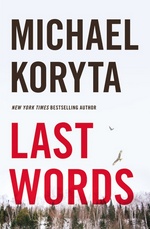
Last Words by Michael Koryta

Last WordsLast Words

by Michael Koryta
Series: Mark Novak, #1

Hardcover, 420 pg.

Little, Brown and Company, 2015

Read: September 7 – 8, 2015


There’s part of me that still hasn’t gotten over the fact that Koryta stopped writing Lincoln Perry novels, enough so, that I’ve only read 2 of his stand-alones. But I was intrigued by the idea that he was starting another series featuring a P. I. It took about 3 seconds of reading the Publisher’s Description to see that this was going to be pretty different than any other P. I. series around.

This book centers on two men haunted by their pasts and a pair of deaths that happened on the same date, a few years apart — coincidence? That depends who you ask.

Our P. I. is Mark Novak, who works for a group of lawyers trying to clear men on death row. Before she was killed, his wife worked for them, too. She was killed during an investigation, after a fight with Mark. No one has come close to catching her killer. It’s understating things to say that before Mark met Lauren, his life was a mess, and she helped him get things together. Without her, things are starting to fall apart for him.

Ridley Barnes never really fit in anywhere or with anyone in the small Indiana town of Garrison, except the caves nearby. Something about the caves calmed him, centered him, gave him a purpose — he knew those caves better than anyone alive. So when a teenage girl gets lost in them, he’s the perfect candidate to lead the search. And then, when he recovers her body, but can’t account for his time during the search, or really remember where he found her, or where he’d been at all — he suddenly becomes the top suspect in her murder. There wasn’t enough evidence to convict or even arrest him, but for some small towns that kind of thing is just a formality. He was convicted almost immediately in the court of public opinion, and has been even more ostracized than before. More than a decade later, Ridley just wants to know what happened — if he killed the girl, he’s willing to do the time. If he didn’t, he’d like to have his name cleared.

This is not the type of thing that Innocence, Inc. does. They take on convicted murderers clients, not suspects. Especially not suspects in very cold cases that will never go to trial. But Mark’s boss sends him to do a preliminary investigation anyway, mostly to keep him busy. Mark isn’t exactly welcomed to Garrison with open arms, people just assuming he’s there to clear Ridley, and not quite believing him when he says that he isn’t.

Mark commits a few missteps right out of the gate, which turn public opinion against him even more. But something has flipped a switch in his brain and he’s not going to let go until he gets some resolution for the girl, clears his name from the problems he’s caused, and demonstrated to his boss that he can be trusted still/again. Not necessarily in that order.

That’s a very sketchy overview of the set up. I don’t think I’ve read anything quite like that before. If you were to draw the plot as a map, it’d look like some deranged roller coaster — tight corners, backtracks, loops, big dives into darkness. Unlike an actual roller coaster, I was able to get through this without losing everything I’d eaten since February.

Koryta tells this story with his typical skill, you can tell that he’s built Mark Novak to last a few novels. There’s more of his story that needs to be told than is here, and the character can be used in different settings. Unlike just about everyone in last years’ Those Who Wish Me Dead — which I thought was great — I don’t think there was a single character in that novel that I could see being interested in for another novel. Ridley is almost as complex, and you want him to get the answers he needs just to get a little peace (most of the time — there’s a time or two where you don’t mind him suffering).

Garrison, IN is pretty much every small town in mystery/thriller fiction, and its citizens are pretty much stock characters. On the whole, neither the town nor the people feel that way. Which is entirely due to Koryta’s skill and Mark’s voice.

And then there’s the cave, or caverns — I’m not familiar enough with the geology to nail the distinctives between the two. There’s a strong sense of place, of foreboding, of danger to it. Especially in Ridley’s mind, the cave is almost a Byronic character — dark, mysterious, dangerous, yet attractive. Yes, there was a time or two I was glad to be reading about the cave in a very wide and open room.

Oh, sure, and it’s a real handy metaphor for the depths of the human mind, psyche, soul, etc.

This is a very well constructed mystery novel, the writing is excellent, the characters are keepers, you can almost feel the winter air — really, there’s very little to not rave about with this. It’s pretty clear what book 2 holds, but I’m really not at all sure what a third would bring. But I’m eager to find out.

—–

4 1/2 Stars

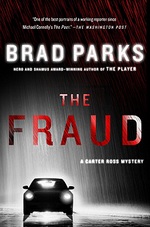
The Fraud by Brad Parks

The FraudThe Fraud

by Brad Parks

Series: Carter Ross, #6

Hardcover, 342 pg.
Minotaur Books, 2015
Read: September 9, 2015

The ethical dilemma posited aside, I hated the first chapter. If I’d never read a Brad Parks book before, it might have caused me to move on to the next thing on my reading list. The cheap “in 43 hours, X, Y, and Z are going to happen…” ploy irritates me. Just get me invested with setting, plot, or character. Present one or all of these in an interesting manner and I’ll get invested. Don’t force the investment. Don’t jam it down my throat. Also, there was a perfect point 300 or so pages later that it would’ve fit.

Thankfully, Chapter 2 was much better, as was the rest of the book. This was the typical Parks mix of darkness and light, grim stories told with a light touch. A newspaper reporter trying to live up to the tradition of the great investigative journalists of the past in the midst of an industry that’s dying and doesn’t care about that tradition.

Carter seems to be off his game a little here, making a couple of blunders that seem out of character — but given that he spends the whole novel waiting for That Call from his pregnant girlfriend, it’s understandable. It also helps move the novel along nicely, so, it’s easier to swallow (especially while reading).

There’s a string of carjackings in Newark, and a couple have proved deadly. Naturally, the one that makes people pay attention is a well-off middle-aged white man. Carter just can’t write about him though, he seeks out another carjacking that resulted in a murder, this time of a less well-off black man. It doesn’t take long before Carter’s sure it was the same carjackers, and that there’s something else going on besides Grand Theft Auto.

There’s not much (beyond the strange relationship between Carter and Tina) that really seems to be the same from novel to novel in this series. The cases don’t overlap really, which is refreshing. Carter can’t rely on the same sources of information all the time — which doesn’t preclude some returning supporting characters, but also keeps things fresh on that front. The corner bodega shop owner in The Fraud was entertaining, and I hope we see him again down the line. Other characters here — friends and family of the victims, sources of information, and so on — were well-drawn and engaging as usual.

Easily one of the more entertaining aspects of the Carter Ross books are the interns — from savvy to naive, hapless to ruthlessly efficient, these characters make you fear for the state of journalism (or give you great hope). This books’ intern, Chillax, annoyed me greatly in the first couple of pages we spent with him. He clearly rubbed Carter the wrong way, too. Which did provide a grin or three. Case in point, we first meet him like this:

“Hey, what’s up, brah?”

I am unsure what youthful genius decided that the word “bro”–which is already an effective truncation of the word “brother” – – needed to be further morphed so it was pronounced like a woman’s undergarment. But it was my hope this linguistic pioneer developed some affliction that was similarly annoying. Like a permanent hangnail.

In the end, Chillax proved to be a little bit more than comic relief, but when we see past interns in this book, we see how little.

The comedic elements, as always, separate this from the pack, they season, but don’t overwhelm the mystery. There was one big joke moment (maybe two, actually) that any reader is going to see coming 5 miles off — but Parks is such a pro that even they work. The more elaborate of them (you’ll know when you read it) is cringe-worthy, totally expected and totally chuckle inducing. The Fletch joke was nice. This summer we’ve had jokes about the movie from Parks and Kuhn, one more and we’ve got a trend.

Parks threw a couple of curve balls that I whiffed on. There’s one shadowy figure that I had pegged to be character type X. Not only was he not X, Y or Z, he was more like D. I was that far off. I also did not see the ending coming (well, the solution to the criminals’ identities I saw because I knew more than Carter), but the rest? Didn’t expect that from a Carter Ross book.

There’s one thing that doesn’t make any sense to me, one character’s motivation and actions that made sense with one interpretation of the facts, are just irrational when looked at in the light of the way Carter finally puts the pieces together. The way that Parks wrapped up the action and provided glimpses into what happened with the major players didn’t allow for him to get into details about the red herrings he chased, but this one was big enough that an explanation would’ve helped.

Good characters, entertaining plot; actually, the mystery itself might be pretty weak, the more I think about it, but it was fun watching Carter figure it out, which is the point. The Fraud, solidifies the Carter Ross series as a reliable mystery series.

—–

3.5 Stars

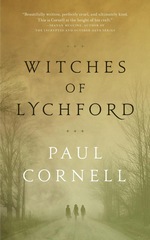
Witches of Lychford by Paul Cornell

Witches of LychfordWitches of Lychford

by Paul Cornell
Series: Witches of Lychford, #1


Kindle Edition, 144 pg.
Tor.com, 2015
Read: September 8, 2015

You ever get nervous about starting a new work by an author? Sure, in retrospect, it may seem silly to doubt, but for every Jesse Stone, there’s a Sunny Randall. As much as I like his Shadow Police series, I wasn’t sure I was up for something else by Paul Cornell. Thankfully, my apprehension was silly, because whether he’s writing about London or a small town, Cornell knows what he’s doing.

The town of Lychford is on the verge of dealing with a major assault by evil forces and for reasons you should discover for yourself, that is not something that can be allowed, because if they are allowed to invade, these supernatural forces will carry the day. So they must be stopped before they can begin in earnest.

These forces are, naturally, a large supermarket chain. What else? They’re called Sovo, and I’m sure they resemble no actual chain (or that Cornell has really good lawyers). But it seems that there’s more to them than low prices and a knack for ruining the lives of small business owners.

Now, your middle class activist types might get riled up by this, but there’s only so much that their petitions and flyers can do against the supernatural (not that they realize they’re going up against powers beyond their ken). Even when the supernatural are primarily using things like empty promises, bribes, and the allure of new jobs, there’s only so much that well-off Muggles can do (to borrow a term from some other series).

It’s going to take people able to see the otherworldly aspects of the PR Campaign that Sovo is waging to win the hearts and minds of the citizenry to thwart them. Now, typically, this is where we’d get someone like Rachel Morgan, Harry Dresden, or Peter Grant to come in and kick a little supernatural butt. Instead, we get such obvious heroes as a crackpot old lady and vicar who’s on the verge of losing her faith. Thankfully, the crackpot is actually a witch of sorts, so they’ve got a fighting chance.

For something a mere 144 pages long, this is an incredibly rich and well-developed world. The magic system seems pretty thought-out and realistic (for lack of a better word). The characters (those mentioned and a couple of others) are sharply defined and could probably carry a story by themselves.

Really, really impressive work — I’d love it if the work were longer, but honestly, I’m not sure if it’d have been as effective if it had another 1-200 more pages to develop everything. I think this ensures Cornell’s place on my “grab anything you see by” list without really caring what the subject matter is.

I was about to hit “Publish” on this when I had this thought — this reads just like one of Bledsoe’s Tufa novels would if set in England. For my money, that’s a pretty high mark.

—–

3.5 Stars

Indexing: Reflections, Episode 3: Brotherly Love by Seanan McGuire

Indexing: ReflectionsIndexing: Reflections, Episode Three: Brotherly Love

by Seanan McGuire
Series: Indexing, #2.3
Kindle
47North, 2015
Read: September 8, 2015

Now this is what I’m talking about. A solid, solid entry. We get Henry’s brother back; we get a good, contained story — yet with serialized elements that we’ll see play out; we see fallout from Episode 2; and thanks to Elsie’s particular brand of magic, we — and the characters — see something new.

There’s an incursion near the school where Henry’s brother, Gerry, teaches. Thankfully, it has nothing to do with him, it’s just near him. It’s also near his school, and the children in it — children who, it should be said, are the primary targets of the incursion. So Henry and her team are dispatched to wrangle with the press, school administration, and whoever — or whatever — is out there wanting to snack on kids.

The solution to this comes a bit easily, but the challenge to this episode isn’t solving eh narrative incursion, it’s in figuring out just what’s going on — how this is the result of Elsie’s escape — and then trying to see what the impact is going to be on Henry’s team (the stress on Demi and Henry this episode in particular). We don’t see Elsie at all — just what she’s done, but that’s enough.

Other than the ending coming a page or two earlier than I’d expected, I thought this one worked pretty well. We’ve only had 15 episodes of this series, and already McGuire is playing with the conventions, I like that. Some people would wait until the third book to mess with things like this, but why wait? Go for it while you can. Especially if you can tell good stories while re-writing your own rules, and that’s exactly what McGuire has done here.

—–

3.5 Stars

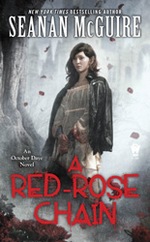
A Red-Rose Chain by Seanan McGuire

A Red-Rose ChainA Red-Rose Chain

by Seanan McGuire
Series: Toby Daye, #9

Mass Market Paperback, 358 pg.
DAW, 2015
Read: September 2 – 3, 2015

“Wow. Your ego has grown since we’ve known each other, hasn’t it?”

“Ah, but, you see, I have wooed and won the woman of my dreams. Admittedly, some of those dreams would be more properly termed ‘nightmares,’ but I don’t believe we get to be that picky when talking about such things . . . If my ego had not grown, it would surely be a sign that I was no true cat, and you would leave me for another.”

And that, folks, is why half of McGuire’s readers want to be Tybalt and the other have want to have a Tybalt in their lives. A Red-Rose Chain is chock-full of these kind of moments sprinkled between espionage, intrigue and peril.

Queen Windermere is still trying to figure out the whole Queen of the Mists thing, getting her howe and her kingdom running the way they should, and what not when a message is delivered: the Kingdom of Silences has declared war and in three days will begin attacking. King Rhys of Silences (which is in Portland, OR) was put on his throne by the bogus Queen of the Mists that Windermere recently overthrew, and he seems to be getting nervous about his position.

Who else would Windermere appoint as her ambassador to negotiate peace in the three days than Toby? Pretty much anyone in her kingdom. Which seems to be the conventional wisdom — and Toby agrees — but for her own reasons (some of which Toby eventually guesses) the Queen insists. She also doesn’t have a lot of options (see previous paragraph). So Toby and her fiance head off to stop a war instead of instigating one — and they take along Quentin, May, and Walther (the alchemist/Chemistry professor) to lend a helping hand.

Now, he’s no Blind Michael, but Rhys is one of the more despicable people in this series so far. And while he observes all the necessary formalities and whatnot, it’s pretty clear that his heart isn’t ion the whole negotiating thing, and he’s just biding his time until he can attack. The last time these two kingdoms battled was a century or so earlier, and while they prevailed, it didn’t go well for the Kingdom of the Mists — this time, it’s sure to be worse. A perception strengthened once we see how Shadows treats a diplomatic party. So Toby can’t fail.

Toby’s got her friends with her, but in many ways, she’s more on her own that usual — she doesn’t have all the resources to call upon in Portland that she does in SF, but she makes the most out of what she has. At the end of the day, it’s Toby’s series and she’s the one that carries the weight of the plot and the weight of the weight of the mission on her shoulders. McGuire pushes her in ways that she hasn’t been pushed before. I wasn’t thrilled with a couple of the moves McGuire made in the final couple of chapters — not bad writing/plotting, I just didn’t like what Toby had to go through. She prevails, naturally — though, not unscathed, but through grit, determination and the loyalty she commands (and returns) from her allies.

As a small break from the diplomatic tension, we spend a little time with Tybalt’s Portland counterpart. The two are very different from each other, (which is nice to see the variations in personality), but clearly have a a good deal of respect for each other. There’s an interesting shared past for either of them that we’re teased with, too. Would’ve been nice to get more, maybe one day. For the present, it’s nice just to get a little bit more of Tybalt’s pre-Toby history.

Looking ahead to #10 and beyond, I’m a little worried that things are going too well for Toby — particularly where Tybalt is involved. Will McGuire let her be that happy for long? At all?

That’s a worry for another day, for now, I’m going to say that this is one of my favorite reads of the year and leave it at that.

—–

4 1/2 Stars

Who Let The Dog Out? by David Rosenfelt

Who Let The Dog Out?Who Let The Dog Out?

by David Rosenfelt
Series: Andy Carpenter, #13
Hardcover, 324 pg.
Minotaur Books, 2015
Read: September 4 – 5, 2015

As Michael Corleone said in The Godfather, Part Ill, “Just when I thought I was out, they pull me back in.” The fact that it was the worst movie in the history of movies does not take away from the truth of that statement, as it relates to my legal career.

Poor, beleaguered Andy Carpenter. Dragged, kicking and screaming back into the courtroom to defend someone he really doesn’t care about, but by doing so he gets to investigate a crime he’s really concerned with.

As we all expect, that crime involves a dog.

The Tara Foundation, the dog rescue shelter that Andy runs with his former client, Willie, is broken into. The thief does a very professional job and takes off with one dog. Professional or not, the thief didn’t take into account how devoted Andy and Willie are to these animals and how obsessive they can be about them. It doesn’t take them long at all to track down the dog…and the corpse he’s next to.

Andy wants to know more about the dog, and the dog’s owner who turns out to be a fugitive, suspected of murder. The only way he can keep his foot in this case is to defend the man accused of the killing. He eventually does figure out who kills the thief, but it’s almost accidental — it’s certainly incidental to anything else going on. Just one of the little bits of pleasure this provided was that “ah ha” moment.

During the trial — the stage of many of this series’ highlights — Andy treats us to an amusing clinic on all the ways that a couple of lawyers (and people in other professions) can use the word “frankly,” including all the shades of meaning that word can provide. Like so many of Andy’s lessons, this was worth the ticket price.

Rosenfelt brings us yet another storylines that could summed up as: It looks like a simple crime, but is actually the linchpin to uncovering a major terrorist plot/international crime syndicate (minor spoiler that if you read more than a couple of chapters you’d see for yourself). I’m getting a little sick of these. The terrorist plot, by the way, makes me reconsider the plausibility of a similar plan in Robert B. Parker’s Night Passage. I’d always thought that the weakest part of an otherwise compelling read, seeing it now in light of this book makes me think there was something there. Still, for crying out loud, Mr. Rosenfelt, let major criminal enterprises and terrorist organizations figure out that a trip through Patterson, NJ is asking for trouble. Local conspiracies, okay. But major international conspiracies? You’ve got to stop going to that well so often. Or period.

My other worry about this is Ricky. If you haven’t read this far in the series, you may want to skip the rest of this paragraph. About half of the material around Ricky was cute and fun — just like it was in Hounded. The other half (mostly involving stale sit-com like bits about kids’ sports) teetered on painful. I fear that this series might be like the older comedies who felt compelled to add the cute little kid late in the run (Andy on Family Ties, Cousin Oliver on The Brady Bunch, Olivia on The Cosby Show, Chrissy on Growing Pains, etc., etc., etc.). If that’s the case, I worry about the future of the series.

Don’t get me wrong — I enjoyed this overall. I can suspend my beefs with this series as it goes on and enjoy Andy’s laziness, his awe of Marcus, Marcus’ awe-inducing self, the hacking seniors, and all the rest. I don’t open up an Andy Carpenter novel expecting to be hanging in suspense, to be chilled, to be challenged in any way; I expect to spend a couple of hours in some pleasant company and sometimes to get a fun puzzle. In that sense Who Let the Dog Out? delivered enough.

—–

3 Stars

John Scalzi and Shane Kuhn in Boise

If you’d asked me, I would’ve said I’ve written and posted this already. Apparently not. Whoops! Thanks for letting me know, Paul. So, I’ll take a quick break from packing up all my white clothes and get this up now. Better late than never, I guess. . . .
At the end of August, the best bookstore in Boise, Rediscovered Books, brought two authors to town for Readings/Signings. Back in college, I went to readings fairly frequently*, but since then I could count the number on one hand.

Shame on me. I need to do better at this. A good reading is one of the best forms of entertainment around. A less-good reading is pretty bad, but hey, at least you’re supporting the arts.

Anyway, the first author was John Scalzi. Perhaps you’ve heard of him — SF author extraordinaire, blogger, tweeter, etc., etc. Back on August 20, Rediscovered Books brought him to the auditorium of the Boise Public Library! (yes, the exclamation point is necessary). I wondered if that wasn’t overkill for SF in Boise. Not surprisingly, I was wrong and the people that do this stuff for a living were right. If they’d brought him to the bookstore, there’s no way we all could’ve fit, the audience packed the auditorium.

After a little chit-chat, he read a little from his upcoming novella The Dispatcher, his first foray into Urban Fantasy. He asked not to provide any details, as the only people getting this preview were those who came to this book tour. He did give us permission to — maybe even encouraged — gloat about hearing it. So, here we go: neener neener my wife and I got to hear the first chapter of The Dispatcher and most of you didn’t. It was pretty good, and I’ll be grabbing it as soon as I can.

He then read a couple of short humor pieces he wrote for AOL.com back in the 90’s that were appropriate for the Back to School season, and a pretty popular (and funny) blog post, Standard Responses to Online Stupidity. He then he spent 20 minutes or so doing Q&A — he was polite and friendly to the people asking questions, turned even awkward questions into something interesting in his answers (he’s been doing this for awhile).

What didn’t he read? Anything from the book that the tour was promoting — The End of All Things — which I found odd, but I was okay with because I’m way behind on that series. Very entertaining evening — the dude’s a pro.

During the signing, he was again friendly and pleasant and didn’t seem to mind people fanboying/fangirling all over him (which didn’t happen too much or without restraint on the part of the fans). When it was my turn, he laughed at my attempt at humor (which I’m going to believe was because I was moderately funny and not just because he’s sooper polite), gave me a nice, personalized autograph in my copy of The Android’s Dream that went with my joke.

And here’s photographic proof that I met John Scalzi:

A week later, things were a bit different for Shane Kuhn, a favorite around these parts, but largely unknown. Now, Rediscovered Books has been pushing Kuhn lately — he’s a Staff Pick, one of their book clubs read The Intern’s Handbook recently, etc. But a whopping 4 people showed up. Which, sure, provided a nice, intimate setting — but 4? Oh, wait, there were 2 bookstore employees there, too.

That had to be discouraging, but he went on with the show. After taking a poll of who’d read what of his (my wife hadn’t read anything yet, 2 were in various stages of Hostile Takeover, and I’d finished it earlier in the week), he read an early section of Hostile Takeover — the wedding — quitting at just the right spot — it was a good tease, you wanted to know what happened next; and I think the next part would’ve been very, very tricky to read aloud. He then took some questions, it was more of a chat, really. He had this annoying tendency to answer questions I wanted to ask in the middle of another answer, so I ended up not saying anything. Highlights included him talking a little bit about his next book, more of a mainstream thriller; and the process of getting The Intern’s Handbook to the Big Screen. He read another bit from the beginning of The Intern’s Handbook (after teasing my wife about reading the ending), where Alice and John first met.

Despite the low turnout, he didn’t (that I could tell) cut corners or half-ass his way through the reading, and was more than friendly to those of us who were there. If he comes back, we’ll do a better job strong-arming friends and family to come so that his audience will be bigger.

Here’s photographic proof that I saw Shane Kuhn (better angle on me than the other). If you go to Rediscovered’s Facebook page and see the photograph I appropriated, you can see 75% of the audience for the reading)

* And not just for the extra credit either. Although that probably kept me at some until the end.

Indexing: Reflections, Episode 2: Broken Glass by Seanan McGuire

Indexing: ReflectionsIndexing: Reflections, Episode Two: Broken Glass

by Seanan McGuire
Series: Indexing, #2.2
Kindle
47North, 2015
Read: August 27, 2015
So, having reassembled the team, reviewed the events of the last book and refocused both readers and characters to their mission, it’s time to get the ball rolling on this season.

Once again, McGuire introduces the AFI team to a problem that seems sort of light-hearted at first (investigating a House that Jack Built, complete with lines like, “Sloane had managed to locate the cat that chased the rat”) — but with some dark undertones. But before we get too far into it, Henry and the crew are interrupted and have to swing off in another direction. And this direction is a doozy — the prison to hold the Fairy Tales who’ve fully manifested in a bad-for-society way — has a jail break. It’s not just any jail break either, because the Narrative has seemingly done something impossible along the way. But I’ll let Henry spell that part out to ya. I’ll just say that I really like where this is going.

On the one hand, I thought what we learned about Demi in the previous episode helped us understand her better, and demonstrated her commitment to the cause/team. So when many of the same notes where struck this episode, I wasn’t thrilled — but, what we heard/saw this time, was different enough to justify it. Seriously, Demi is either going to be a superstar in the AFI, or when she turns and stabs everyone in the back, it’s going to hurt a lot. I’m hoping for the former, am (trying to) ready for the latter.

Elsie, the escapee, is either going to be a great Big Bad for this season, a great underling, solider for a better Big Bad, or a nice warm-up for the next few weeks until we get to the Big Bad. Mid-sentence there, I thought of several other options for Elsie’s role. Whatever that role ends up being, I think I’m going to enjoy her.

Overall, it’s more of a set-up chapter than anything else, but it was very promising and entertaining. Which is good enough.

—–

3 Stars

Reread Project: The Van by Roddy Doyle

The VanThe Van

by Roddy Doyle
Series: The Barrytown Trilogy, #3

Trade Paperback, 311 pg.
Minerva, 1991
Read: August 25 – , 2015
Jimmy Rabbitte, Sr. started off as a supporting character in The Commitments, moved up to co-star in The Snapper, and finally moves to the forefront in The Van, which is more about him than the other two were about any one person. Which isn’t to say that Jimmy, Jr., Sharon, Veronica, Darren and the twins aren’t here, they’re just in the background — as are most of Jimmy, Sr.’s friends (actually, I think Jr.’s in this far more than he was The Snapper).

Not only is the focus more narrow, the final installment in the trilogy is different in other ways — it’s almost 100 pages longer (depending on the printing) than The Snapper which was about 50 pages longer than The Commitments. Which gives Doyle more space to do things he hadn’t really before. It’s still primarily told through heavily stylized In the first 90 pages, I estimated I’d read more (significantly more) narration than I did in the first two volumes of the trilogy.

It’s not been clear before what Jimmy did for a living, but whatever it was, it was pretty clear the bills were barely paid. They stretched what they had pretty far, but they seemed to manage. Somewhere along the line, pretty sure it was post-Snapper, but I’m not sure, Jimmy lost his job. Unemployment isn’t setting well with him — he can’t support his family, he’s bored, he can’t even go down to the pub to have a few pints with his friends.

Jimmy’s trying to grow — he’s reading the classics. Thinking of taking some classes. But it’s not enough. At some point his friend, Bimbo, also gets laid off. The two spend a lot of time together — having a companion in his unemployment makes the whole thing tolerable for Jimmy — almost like summer vacation from school. Bimbo isn’t quite as accepting of this new reality — he almost applies to work at McDonald’s, but is shamed out of it by Jimmy. Bimbo’s wife is even less satisfied with his job status. Which leads to a reckless move on Bimbo’s part — reckless, yet maybe inspired — he uses some of his last dollars on a Chip Van (minus an engine). In the midst of the U.S.’ current Food Truck craze, this might not seem so risky, but in the early 90s? (then again, what do I know of early 90’s Dublin, other than what I’ve picked up from Doyle’s novels and the movies based on them?)

They’ve just a few weeks until the World Cup games start when they hope they can cash in on the post-game crowds. So Jimmy and Bimbo rush to clean the, learn to cook, design a menu, etc. And now you’ve got yourself a plot — can these two make a go of this? Can they remain friends and co-workers? Will they start a grease fire that destroys the whole of Barrytown?

There was, it seemed to me, a maturing of Jimmy that started back in The Snapper. Not that he wasn’t a good father before, but he kicked it into a higher gear with Sharon during her pregnancy. Here, that seems to manifest itself in a paternal pride — Junior’s having some sort of success out there, is getting married; his other son, Darren, is doing very well in school (better than anyone else in the family, that’s sure). Part of Jimmy’s reaction to it is finding pleasure in someone else’s success for what it means to them. I’m not convinced that the Jimmy of The Commitments or the first part of The Snapper could do that.

That’s not to say that he’s Man of the Year material or anything. There are some real (human) flaws to him. He’s petty, he’s jealous, he’s proud — there’s some sort of mid-life crisis that he’s got a half-hearted interest in involving Other Women. As in all good fiction, these just make him someone you can like, someone you can relate to, someone you can get annoyed with — even pity.

There’s some great, great stuff about sports fans here — national pride around The World Cup, the joy in sports, the very real camaraderie that can exist for a few moments around a shared experience. That’s not my typical milieu, but I’ve tasted it a time or two — and I can’t imagine many capture it better than Doyle did here. Even if I didn’t like the rest of the book, I think that part would’ve been worth it.

In the end, this is Doyle’s best work (to date), not the most enjoyable, but the best. It’s impossible after reading this, to ignore Jimmy, Sr.’s brief appearances in The Commitments, to not pull for him earlier than you should in The Snapper, and really to forget him. Just a great character in a world you really don’t want to leave.

—–

4 Stars

Hostile Takeover by Shane Kuhn

Hostile TakeoverHostile Takeover

by Shane Kuhn
Series: John Lago Thriller, #2

Hardcover, 246 pg.

Simon & Schuster, 2015

Read: August 24, 2015


John Lago is back, folks — and he picks up right where he left off, with some of the most adrenaline and testosterone-fueled writing you’ll come across this year. That may not be your cup of tea.

Hostile Takeover is one of those sequels I didn’t think needed to exist. Seriously, who was dissatisfied with where things ended up for Lago? It was narratively sufficient as it was — but as the opening lines of this book could’ve literally been the next page in The Intern’s Handbook, it’s hard to complain.

So, John decides to tie up two loose ends: 1. Alice and 2. HR, Inc. He marries Alice and the two take over HR but it doesn’t take too long (at least not many pages) before both of those go wrong — they break up and she kicks him out of the company (not really spoiler material, folks, it’s in the Jacket Copy). John switches to Plan B, the complete destruction of both. Which is not the most mature of plans, you’ve got to admit.

Which is the bulk of the book — John going undercover again, John trying (and/or being the target of) elaborate assassination schemes, great fight scenes and enough munitions used to make Michael Bay choke. All delivered in that movie-obsessed, rapid-fire (no pun intended) narration that won over so many fans before.

I thoroughly enjoyed, have used already, and will continue to do so, Lago’s comments on the movie Fletch. It was that line that reminded me how much I liked the first book.

Did I enjoy this as much as The Intern’s Handbook? Nope. Only because it didn’t blow me away with it’s freshness. But it’s a worthy sequel, as good as it’s predecessor and leaves me wanting more. An intense, fast read — buckle up and enjoy the ride.

—–

4 Stars

Page 95 of 124

Powered by WordPress & Theme by Anders Norén