|
I’d like to take this opportunity to thank you for all the support you’ve given me and the thoughtful and open minded reviews you’ve written. Without good people like yourself indie presses wouldn’t exist. We can write as much as we want but it’s down to people like you to get the word out.
Finally you the reader. If you’ve got this far you’ve given up your precious time to find out a little bit more about what I think. But it’s just my opinion and you must feel free to take or leave as you wish. In a world of billions to have your time to listen is a very rare privilege. One I don’t take for granted. Many thanks for all your support.
|
by Ian Patrick
Series: Sam Batford, #2
Kindle Edition, 246 pg.
Fahrenheit Press, 2018
Read: September 14 – 15, 2018

I need to blend in where I shouldn’t belong. The best undercover officers have no air of ego or the appearance of a police mannequin. After all, one sniff of pig and your ass is bacon. I’ve no intention of being served up at any criminal’s barbecue.
How do you follow up 2017’s Rubicon, the twisty, morally ambiguous (at best) tale of an undercover cop? Well, if you’re Ian Patrick, you do it by bringing that shady cop back and putting him in a tighter spot with threats (physical, legal and career) on all sides.
Sam Batford has had a little time off to recuperate and get his head on straight after Rubicon — hopefully giving the heat on him a little time to cool down, and maybe give Big H time to move on from the setback Batford dealt him.
The Met has a new assignment for him — working with the same DCI as he did last time, DCI Klara Winter. During the last assignment, she wasn’t sure she could trust Batford — now she’s convinced that she can’t. In fact, while she wouldn’t mind taking down the criminals that Batford infiltrates, her main objective is to arrest Batford and his Superintendent Mike Hall, a pair she’s convinced are dirty. She’s right, of course, but that’s beside the point.
Ostensibly, Batford’s assignment is to infiltrate a group that’s supposedly planning a major armed robbery and will need a driver of some sorts. But the clock is ticking so he doesn’t have time to do this carefully. Winter has someone already embedded with the crew giving her information, and their primary purpose is to get dirt on Batford and Hall. Which sounds good, but when you get a couple of guys as cagey and wily as this pair, that’s no easy task.
At the same time, Hall’s told Batford that between family and work stresses, this is his last hurrah. Now, he’d like to start his retirement with a sizeable bankroll, and trusts that Batford will find a way to make the both of them some money from just whatever it is that this crew is up to. The crew’s leader, who goes by the cuddly moniker of Razor, is a long-time “unauthorized informant” of Hall’s. And now, he’s sending Batford in to get him arrested. Which seems odd, but it does give Hall enough of an inside track to help Batford.
So, essentially, Batford needs to find a way to get rich off these criminals, hopefully get enough evidence for some arrests, stop them from pulling off whatever they’re trying to — and avoid getting arrested himself (not that he knows he’s being targeted for that). Oh, yeah, and Big H hasn’t moved on, forgotten or forgiven him — in fact, he has an active contract out for Batford’s life, and there are people trying to collect on that. Sounds like a pretty rough time for him.
In Rubicon, there was a question (at least for me) throughout — just how bent is Batford? Will he actually do law enforcement, or is he just out for himself? What are the limits for him? Will he have any success in either his criminal or police activities? In Stoned Love, the questions are different — we know he’s bent pretty far. So it’s just will Batford survive? Will Winter arrest him? Will Hall use him to save his own skin? Will Razor do something to him? Will Big H’s killers eliminate him?
This changed the dynamic of the book for me, and made it a lot easier for me to enjoy this novel and cheer on Batford. There’s no moral or legal gray area any more. Like Michael Corleone or Hannibal Lechter, Sam Batford is a despicable character that the reader wants to find success. Thankfully, he’s nervy enough and clever enough, that there’s a pretty good chance that he will. At least for a while.
Winter is manipulative, deceptive and devoted more to her career than anything else. But she’s, technically, the good guy here. Everyone else is the kind of criminal that the police are supposed to stop, not become. But because we’re in Batford’s head, and Winter’s primarily seen as an obstacle for him to overcome, the reader roots for him and against her — knowing the whole time that it should be the other way around.
There’s frequent and repeated commentary on the effects of Brexit, budget cuts, personnel cuts and other moves by the British government that are impacting the police services throughout the novel. Patrick is a former police officer and if these aren’t his actual views coming forth through Batford, he’s a better author than I think. If Batford’s diagnosis of what’s going on with the police in Britain is accurate, it sounds pretty frightening.
It’s a minor thing — I only noticed this as I started to write this post, and I’ve recently had a bad experience with reading a novel that couldn’t pick a verb tense, so I was primed — but Patrick’s use of the present tense for these books is a subtle, and incredibly effective way of cranking up the tension, propelling the action forward, and pushing the reader to keep up with the pace of the book. I should’ve picked up on it with Rubicon, and am a little annoyed with myself for taking this long to notice.
I enjoyed Rubicon, but I appreciated what Patrick was doing and how he was doing it more. With Stoned Love, I still admired and appreciated his skill and aims, but I enjoyed the story more — I resented things like work and family for preventing me from finishing this as quickly as I wanted to, and absolutely relished an airline flight that meant I had uninterrupted reading time*. I think Stoned Love is an all-around better effort (which is saying something) and makes me very excited to see what comes from Ian Patrick next.
Not everyone enjoys reading books where the police are just as dirty as those they’re supposed to be stopping — and I understand that — but if you’re someone who can embrace a tarnished knight, someone who seems to be law enforcement malgré lui, you don’t want to waste any more time, get your hands on Rubicon and Stoned Love and prepare to be impressed.
—
* I also really appreciated having this to focus on rather than the fact that I was in a giant metal tube that has no business being that far off the ground, but that’s another story.
—–

—
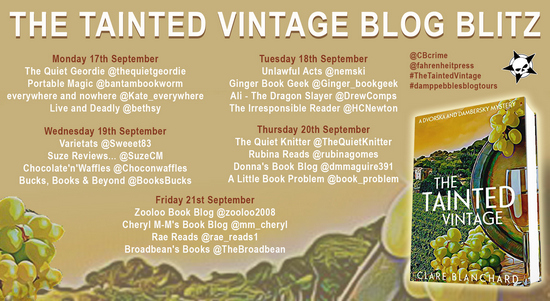
by Clare Blanchard
Series: Dvorska & Dambersky, #1
Kindle Edition, 159 pg.
Fahrenheit Press, 2018
Read: September 11, 2018
In the first chapter, we’re treated to a better synopsis than I could cook up, so let me just borrow it. One night in the little town of Vinice, in the Czech Republic, the mayor dies during his birthday party:
Dvorska was sure that she and Ivan had been sent there for the sake of appearances, because a dead mayor was by definition high profile, and of course because no-one else wanted to touch it. She wondered why they had been called out at all, so soon. The fat feminist and the misogynist – what a team. And of course Dambo, as the senior of the two, would call the shots, so her hands would be tied. Perfect. The sudden death of a rich and powerful local figure was hardly a magnet for rising-star detectives.
Dvorska picks up a clue or two that convinces her — and then Dambersky — that this death was not due to natural causes. The Powers That Be don’t want to hear such a thing, and rule otherwise. So this very unlikely duo has to embark on an unauthorized investigation — not just unauthorized, but prohibited — into the murder.
Finding the murderer of a man who died of natural causes isn’t the easiest thing to accomplish, obviously — it’s hard to ask too many questions without a “Hey, he wasn’t murdered, why are you asking?” coming up. So the partners have to be wily — not just with their superior officer, but with witnesses, possible suspects, and everyone else they encounter.
The investigation takes them to various cities, a variety of social classes, and even ends up giving them a few history lessons. The mayor’s home has ties to significant (at least to Vinice) historical movements, going back to World War II, the Communist takeover, and then once the Republic took over. This really helps the reader — particularly the reader who knows almost nothing about the Czech Republic — find themselves, not only in the geography but the history (cultural and otherwise). obviously, I’m no expert on the Czech Republic,, but I can understand a little more than I used to. Just the first couple of usages of “Perv” to indicate an illegal drug threw me — but between the narrator finally calling it Pervityn and a search engine, I got a little lesson in drugs during WWII.
It doesn’t take long for the book to try to get the reader on the side of these two characters — maybe there’s more to them than the “fat feminist and the misogynist.” I really found myself enjoying them as people, not just as detectives. We spend — for reasons that will become clear when you read this — more time with Dvorska than her partner, and she is a charming, dedicated detective, fully aware of her limitations and sure how to overcome them.
The writing was good but I thought it could be sharper — there’s an odd word choice or two (early on, the detectives start talking about the mayor’s death being an execution, not a murder); there’s a lot of recapping/rehashing something that was just done/considered/decided a page or two earlier — the kind of thing that makes sense for serialized novels, but this doesn’t appear to be on. Still, the voice is engaging, as is the story — and you get caught up enough in it that you can easily ignore a few things that’d normally bug you.
I was caught totally off-guard by the ending. I didn’t expect that to happen at all — my notes toward the end feature short words like “what” and”why?” But primarily my notes consist of question marks, exclamation points, and combinations thereof. This is a great sign for mystery and thriller novels. Blanchard did a great job setting things up so that there’s a dramatic reveal and one that isn’t seen chapters away. I do think some more ground work could have been laid early on so that it didn’t seem quite so out of nowhere. But it was effective enough, that I really don’t want to complain about it.
This is a pleasant read — it’s close enough to being a cozy that I could recommend it to friends who predominately read those, and twisted enough that those with more grizzled tastes can sink their teeth into it, too. The characters are winning, charming and the kind that you want to spend time with. It’s a good introduction to a series exotic enough for most English readers to feel “alien” and yet full of enough things so you don’t feel cut off from what you know. There are obviously future cases for these two in the works, and I plan on getting my hands on them when I can.
—–

I bought this shortly after it was released, and then let it collect e-dust on my e-reader, and pretty much used Damp Pebbles’ Book Tour for this as my excuse to read it. I wasn’t over the moon with this one, but I liked it a lot. And then I spent months thinking about it until the sequel came out. Batford’s the kind of character that will not move out of your headspace like any respectable character does when you start a new book. Rather, he’ll take up residence — scratch that, he’ll squat there, not allowing the lease holder to get comfortable sharing the space with him…. I think this metaphor has gotten out of hand, so I’m going to shut up and get on with the post.
—
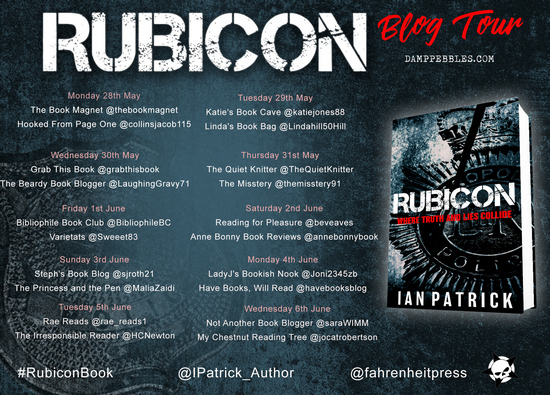
by Ian Patrick
Series: Sam Batford, #1
Kindle Edition, 232 pg.
Fahrenheit Press, 2017
Read: May 31 – June 2, 2018
. . . there’s no money in policing unless you cross the line.
But that doesn’t mean that Sam Batford isn’t going to try.
Batford is an undercover police officer who’s after a kingpin of some repute and his guns and drugs importing. DCI Klara Winter is a no-nonsense head of a task force going after the same kingpin, Big H, more directly — phone taps, applying pressure to associates, interrogations, etc. Batford is assigned to her task force to supplement their intelligence. Neither want this assignment, and work to undermine it immediately. They do actually help each other out — but it’s almost despite their best efforts. Their mutual dislike, distrust and antagonism is one of the more interesting dynamics that I’ve run across lately.
We see most of the novel through Batford’s eyes, with the occasional glimpse from Winter’s perspective. It doesn’t take much to get a strong sense of Winter’s personality and thought process. Just from the volume, the reader ends up seeing things Batford’s way — whether or not they should.
Batford infiltrates Big H’s organization — at least to a degree — for one job. A large one, no doubt, one that would secure Winter’s career (and would do his own some favors). Like most undercover officers (especially in fiction), he cuts many legal and ethical corners to do so. There’s some question — as there should be — whether or not Big H really trusts him, and the constant testing, evaluation and insecurity makes for great reading — it’s an atmosphere you can almost feel through the words.
So Batford is doing what he can to get enough information to take down Big H, to gain his trust (and therefore access), to disrupt the flow of drugs and guns — and mostly to stay alive. If he can find a way to make a little money while he’s at it . . . well, he might as well. Winter just wants enough evidence to make some arrests — and maybe some headlines — so she can get the budget to keep her team working.
This is not a book for the squeamish — there are a few scenes I know that would cause some of my friends and readers to throw the book down in disgust (the same scenes will cause other friends/readers to fist pump their excitement — I’m not sure which of these bothers me more). There’s one scene in particular that made me think of the dental scene from Marathon Man (I’ve never watched the movie just in case they nail that scene from the novel).
There were two . . . I don’t want to say problems for me, but things that kept me from going over the moon with Rubicon: Batford works his way into this assignment by worming his way in to the trust of one Big H’s associates while they’re in Bali. Do Metropolitan Police Undercover Officers really get to globe-trot the way that Batford does? Is that a bit of Artistic License? Is it a sign of just how far outside the lines that Batford colors? Does it tell us that he’s not just a Metropolitan Police Officer? It’s a minor point, I admit — and it’s really easy to accept as kosher (but that doesn’t mean I don’t wonder), because watching Batford’s machinations there is fascinating.
Secondly, Batford displays a very particular vocabulary — I’m not sure if it’s London slang, or Ian Patrick-slang. I could believe either. I will admit that there were periods that the slang got in the way of the story. That’s probably on me — and some of it is Shaw’s two countries separated by a common language phenomenon. With a little bit of work, and a small amount of guesswork (and a willingness to go back and revisit a passage later), it was all accessible enough and perspicuous.
There’s a lot about this book that I’m not sure about — I’ve been chewing on it for a couple of days, and it’s going to take a few more at least. Patrick’s characters take a little chewing, I think. It’d be easy to put Batford in the “murky anti-hero” category and move on — but I’m not sure he fits there; I’m even less sure where Winter fits — she’s not the straight-laced cop you’re at first tempted to label her, nor is she just the figure that makes life difficult for our anti-hero to do what he wants (although she functions pretty well that way). But even if/when I decide how to categorize these two — then I have to decide what I think of them as these characters — are they good people? No. That’s easy. Are they good fictional beings in their particular roles? My gut says yes, and my brain leans that way, but I’m still working on that.
Either way, I’m enjoying chewing on the novel and these ideas — and I’m definitely getting my money’s worth out of this book, just having to think about it this much.
There is part of this evaluation that’s easy — the writing? Gripping. The pacing? Once it gets going, it’s a runaway train that you’re just hoping you can hang on to long enough to get through to the end. The narrative voice is as strong as you could ask, and even when you’re thinking this cop might be more deserving of a being handcuffed on his way to a long incarceration than his targets, you’ll need to hear his singular perspective on the events around him.
Strong writing (some of my favorite sentences of the year are in this book), characters that demand thinking about, a plot that you can’t wrap up in a tidy bow — this isn’t your typical thriller. Whether it’s your cup of tea or not, it’s one that you won’t forget easily.
—–

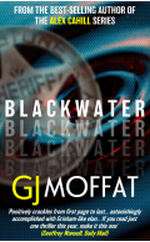
by GJ Moffat
Kindle Edition, 292 pg.
Fahrenheit Press, 2017
Read: December 14 – 15, 2018
| |
Early went to [redacted]’s body and hunkered down in front of [redacted]. His skin was flaccid and his jaw and face swollen and misshapen from the effects of his injuries. His shirt was entirely soaked in blood.
Early shook his head, thinking: this is what men do. |
Take Walt Longmire (Deputy Longmire, before Lucian Connally’s retirement) throw him into Jesse Stone’s Paradise, and then tell a story imbued with the spirit of Fargo (movie or show), your results will be pretty close to GJ Moffat’s stunning Blackwater.
It’s a tale of violence, bloodshed, power, inevitability and death — what men do.
Deputy Sheriff Early Simms of Blackwater County is the son of the previous sheriff and probably the only member of the Department really fit for the job. A tragic accident in High School changed the direction of his life, and as a result he’s in the same dying New England area he grew up in. He’s made peace with this, and even seems to be happy — he’d be happier if his boss (and colleagues) cared a bit more about the job and his father wasn’t battling Alzheimer’s, sure. But this is his life.
And then everything changes in a couple of days — his old high school flame (and love of his life) returns to town, there’s an investigation into a corrupt public official, an investigation into an assault/attempted murder at a nearby jail, and a couple of brothers on a killing spree have come to the region. There’s also some drug running, spousal abuse, a pretty nasty bar fight. I don’t want to say that Early Simms is the only one investigating the crimes, in trying to preserve the peace — there are three (that we know of) other members of the Sheriff’s Department, some other local law enforcement officers and some FBI agents running around. But Early’s the only individual who’s in each of the stories — he’s the region of intersection in the Venn diagram of Blackwater (and frequently the most capable person around).
One of the criminals we meet in these pages (not saying which one) is clearly not an evil man. There’s some sort of undiagnosed (by the author or by any professional this criminal has ever encountered) mental health issue affecting him. Which does not lessen the evil he does and the trauma he inflicts on others. Part of me wants to know more about the whys, hows, wherefores, and whatnot about this disorder and is a little frustrated that Moffat doesn’t give us any of it. The other part of me is so glad that he didn’t succumb to temptation to get into tall that, instead merely showing his readers what was going on with this man, leaving it to us to do the work. There’s someone else who probably has some sort of Traumatic brain injury symptoms — not quite the same, but some of the same results.
We also see crime perpetrated by someone motivated by power, money and meanness. Also, there are some criminals who just don’t seem to have options, means or inclination to do anything but break the law. It’s up to Early to face down these people, no matter where on the spectrum they seem to be found, to prevent them from inflicting too much harm on the community.
How successful he is at that, well . . .
Moffat can write. That’s all there is to it. It took almost no time at all to recognize that. You get a strong sense of every character in just a few lines and his world is as fully realized as you could hope for. He presents the evil Early sees and fights against in this book fairly realistically, in a way that is as capricious and destructive as anything you see on the news.
So many times — almost every chance he gets — Moffat will do precisely what you don’t expect. What people just don’t do in this kind of book. He’ll put the characters in a situation you’ve seen dozens of times before, and just when you think “X will happen right after I turn the page,” B happens before you can turn the page. I realize there’s a danger in saying that — you’ll be looking for that kind of thing. But I expect that the same thing’ll happen to you as it did to me every time he pulled the rug out from under me — you’ll get sucked in by his writing and the characters (and possibly still be reeling from the last shock) and you won’t even think to expect that he’ll do it again.
I finished the book I was reading before this earlier than I expected to, and didn’t have the next on my list with me, so I took the opportunity to pay a visit to what I call my Kindle’s “Fahrenheit Ward” — where I stick all the Fahrenheit Press books that I buy without time to read — and I grabbed this. I’m so glad my timing worked out that way — this is exactly what I needed. I got sucked in by this immediately, and it was practically impossible to put down. Before I got to the novel’s final confrontation(s), I jotted in my notes, “Man, I hope this isn’t the first of a series — I don’t know if the community can survive another book.”
But if Fahrenheit published a sequel today? I’d shell out cash before the end day. I strongly expect you’ll feel the same way once you recover from Blackwater.
—–
Man, I hope there are more of these on the way from Fahrenheit…fun books.
—
by Simon Hall
Series: The TV Detective, #2
Kindle Edition, 282 pg.
Fahrenheit Press, 2018
Read: July 10 – 11, 2018
So here we are a few months after the events of The TV Detective, and while Dan Groves, TV reporter, and DCI Adam Breen aren’t working together any more, their friendship has grown and both of the careers are improving from their collaboration. So when there’s a serial rapist on the loose — one who made a point of leaving a calling card at the crime scenes to get public attention — both of their bosses are interested in them renewing their partnership (even if no one ever gets to hear about his calling card).
Around the same time, there’s a famous artist dying of cancer who is using his impending death as a launching pad for a contest of sorts — it raises money for charity, and raises his public profile a bit, too (not that it needed much). Dan has been tapped by his producer and the artist’s wife to help with the final part of the contest, and to do his final interview — most to be aired upon his death. This is so far from the rape case that it seems odd to spend time on it — until the artist dies under mysterious circumstances. A murder inquiry into a celebrity’s death obviously gets the police’s and public’s attention — although it’s really seen as more of a distraction from protecting women who are prospective targets of the rapist by Adam and his team. For the most part at this point, Adam and Dan tackle the murder investigation and his team handle the rapes, and Dan pretty much only covers the case as a reporter (with an inside track, of course), but not as an investigator.
Arrests are made pretty early on in both cases — it’s in the aftermath of the murder investigation and the contest that the latter part of the novel focuses on. The puzzle’s solution is clever, but the reader can see it coming (we do have a little more information than all the characters), but that only adds to the sense of drama leading up to the Reveal. I thoroughly enjoyed watching Dan through this story — both his official work as a reporter or with the police and his unofficial personal obsession with the puzzle.
As for the rape story? I don’t mean to sound cold, but there was something very cookie-cutter about the motivation and perpetrator. Horrible, yes; disturbing, yes, but nothing that hasn’t been on Law & Order: SVU an estimated 3,709 times — I’m not saying badly written or boring, just something I’ve seen before. But when Adam gets him in the interview room and he starts laying out his defense? That was utterly chilling. As I write this, I imagine the accused’s approach is not completely novel in Crime Fiction, but man . . . the way that Hall depicts this guy? Chilling.
Dan’s frequent work on the contest is reminiscent of his search for the Ted Hughes Memorial in The TV Detective, but is obviously tied more closely to the plot of this novel. I don’t recall another series doing something like this in book after book — I hope Hall continues it.
There’s something that happened to Dan in the past that was alluded to in the previous book and is talked around a good deal here. We’re not going to get more details on that in Book 3 (I bet), but I expect to see it wreak havoc on Dan’s life and various relationships soon. Similarly, there’s something that happens in this book to Adam — that will possibly do worse pretty soon. Both of these guys are ticking psychological bombs.
I have one gripe: the formatting. There are occasional — maybe even rare — white space breaks between sections of the story, but by and large they are conspicuously absent. Which is problematic when the perspective changes from character to character — what’s worse is when the perspective change introduces an entirely new character and you don’t know how this new name connects with anything. It honestly only caused a real problem for me once, but was frequently annoying.
I should stress when your complaint about a book has to do with Kindle layout (who knows what the paperback looks like), there’s a lot that’s working pretty well.
The Death Pictures is a solidly entertaining mystery novel that recaptures a lot of the high points of its predecessor, but isn’t just a repeat of it. This series has legs, that’s obvious, and I look forward to returning to it to see what happens next.
.
—–

Meet Dan Groves, a good reporter with a good dog. Which is enough reason to read the book, but there are others, too, as I was happy to discover.
by Simon Hall
Series: The TV Detective, #1
Kindle Edition, 290 pg.
Fahrenheit Press, 2018
Read: May 16 – 17, 2018
The first interview with a witness.
Or, as Breen had put it, ‘Initially a witness, anyway.’
‘Meaning?’ Dan asked, as they walked down the stairs from the MIR.
‘It’s remarkable how quickly a witness can become a suspect in this business.’
All it needed was a musical sting to emphasise the drama of the detective’s words. Dan was beginning to suspect his new colleague was a frustrated actor. He certainly enjoyed a little theatre.
Dan deposited the thought safely in his mental bank. It might just be useful.
Carter Ross, I. M. Fletcher, Annie Seymour, and Jack McEvoy are my favorite reporters who happen to find themselves in the middle of criminal investigations (“find themselves” is typically code for throw themselves into, slip past the all the blockades surrounding, etc.) — I think Dan Groves has added himself to the list. But I’m getting ahead of myself.
Dan Groves is a TV Reporter for Wessex Tonight, covering environmental news. With the Christmas holiday rapidly approaching, he’s forced to help cover the latest in a string of attacks on prostitutes. He and his cameraman/friend Nigel are found taking a less-than by-the-book approach to getting a colleague of the latest victim on camera (really, Nigel didn’t do anything — but he didn’t stop Dan, either). The story they aired was good, but their tactics were reported — between his editor’s need, his skill, and his editor’s fresh material for leverage — Dan’s taken off the Environment beat and made the program’s new crime reporter.
The problem is, he knows nothing about reporting on Crimes. And demonstrates it with a facepalm-worthy performance at his first crime scene (a murder, of course) after getting this assignment. So he pitches this idea to his editor, who in turn runs it by the local police. The police haven’t been looking good to the (and in the) press lately, Dan needs a crash course in detective work — so why doesn’t he shadow the investigation, giving the police some good coverage and PR while he learns on the job from the best around. DCI Breen — and (the underused) DS Suzanne Stewart — aren’t crazy about this idea, but they aren’t really in a position to argue with the brass, so they bring him on. Tolerating his presence largely at the beginning, but gradually finding ways to use him.
This is one of those cases that the police would probably be okay with not solving — at least most of the police. Edward Bray was in Real Estate — he owned many buildings, treated his tenants horribly and evicted them when he could find a way to make more money off of the land/building. He was heartless, notorious, and had an enemies list worthy of a, well, an unscrupulous land-owner. Yet, he also gave generously to a local hospice — so generously that many people had a reflexive notion to commend him while they suffered cognitive dissonance between his perceived nature as a shark, and his obvious and selfless good work with the hospice center. The list of suspects is long — former tenants, an employee, competitors he profited from and ruined, his own father — and the head of the hospice center who chafed under his authoritative hand.
So there’s the setup — a pretty good hook, I have to say. It’s an interesting pairing — Castle-ish, but not as goofy. I could totally buy this without suspending a whole lot of disbelief. The reactions of the other police officers help ground this. So who are the investigators?
First is Dan Groves — he seems to be a decent reporter, we’re told repeatedly that he has a history of looking out for the little guy in his news stories. He’s into the outdoors, hiking and whatnot. He’s very single and has been for some time — there’s a hint of something significant in his past that put him there, but we don’t get into that in this book. I’ve never read about a reporter not wanting the crime beat — it’s the most interesting, right? I just didn’t get his rationale for quite a while. But by the time we’ve heard about a few of his past stories, I guess I could see it (and have to admit that Environmental News sounds pretty dull, but wouldn’t have to be in the right hands). Lastly, Dan has a German Shepherd named Rutherford, who seems like a great dog. This speaks volumes for him.
DCI Adam Breen is your typical driven detective — stern, unbending (at first, anyway), not that crazy about the unusual staffing on his inquiry. He has a flair for the dramatic (as noted above — but it’s worse), seems to spend more time and money on clothing than most (somewhere, Jerry Edgar is fist pumping the idea that he’s not alone). We eventually get to know a little about him outside the job — and it seems to go well with the character we’ve met. He seems like the kind of detective most police departments could use more of. Breen will warm to Groves (and vice versa) and will find ways to use his strengths, as Groves finds ways to flex them.
DS Suzanne Stewart, on the other hand, is little more than a name and a presence. Hall needs to find a way to use her character in the future or drop her. This character is the biggest problem with the book. Not an insurmountable one, or one that greatly detracts from the book, but still. I get that Hall’s priority was establishing the relationship between Groves and Breen — and he nailed that. But he could’ve given us more of Stewart along the way. We could also use a little more development with Nigel and Dan’s editor, Lizzie — but I honestly didn’t notice how underused they were. Stewart stuck out to me.
Hall does a really good job of balancing the murder inquiry and dealing with the characters outside of the case — Breen off-duty, Dan’s blossoming personal life, another story or two that Dan works on. The suspects are well-developed and interesting — and there are times that you could totally buy all of them (well, maybe all but one) as the actual perpetrator. That’s really hard to pull off, many writers will start off with a long list of suspects and really only have one or two that you can believe being the killer after one conversation. They all have similar but individualized reasons to want Bray dead. Most of them also have strong alibis, because you don’t want this to be easy. The solution to the case is clever — and better yet, the way that Groves and Breen have to work together to get the solution proven is well executed.
Hall’s writing is confident and well-paced. He knows how to use characters and plot to strengthen each other. There are occasional turns of phrase that will really make the day of readers. I have a lot of “oh, that’s nice” notes throughout the book. This is a solid start to a series — the kind that makes me want to read more. I’m looking forward to finding out a little more about Dan’s history as well as seeing the relationship between he and DCI Breen grow and change (and be challenged, I assume). Good stuff.
—–
So, a couple of days ago, I re-ran the first batch of answers that MacMaster was kind enough to give. He f̶o̶o̶l̶i̶s̶h̶l̶y̶ generously agreed to answer some more questions for Fahrenbruary, which enabled me to focus more on the Kirby Baxter books. Hope you enjoy his answers as much as I did. There is gold below, folks (maybe a little dross, too, but mostly gold)
| Tell us about your background and road to publication. |
|
Small town 80s kid, film school survivor, who spent an awfully long time doing crappy jobs and collecting rejection letter horror stories. I had written A Mint-Conditioned Corpse quite some time before it was published. Quite a few years in fact, and it was rejected by dozens of agents and publishers over those years. One publisher had said they liked it, but another book set at a comic convention hadn’t done well, so they were rejecting mine, even though it was a different genre.
For a long time it gathered digital dust in my computer’s files. Then I encountered Chris McVeigh and Fahrenheit Press on twitter. They started following me before I submitted to them, and then they participated in an open call on twitter for book pitches. I pitched them Mint, they and another publisher expressed interest. I sent a copy to both, and about a week later Chris emailed me, telling me that he was halfway through, and asked if I had any plans for a sequel. I said yes, and a day or so later he finished reading Mint and invited me to join the Fahrenheit family. Since then I’ve published two Kirby Baxter mysteries, Mint, and Video Killed the Radio Star, and a stand-alone thriller called Hack, all with Fahrenheit. |
|
| I’ve made no secret that I’ve become a giant Kirby Baxter fan — it took a whole 8% of the first book to make me one — where did Kirby come from? |
|
Thanks for enjoying Baxter and his gang. As for his origins, it was mostly from frustration. I have a notebook in a box somewhere that contains a very rough outline for what was then called “Drawn To Death,” and it is a wildly different story. That version was more of a broad farce. In this version my lead character was a “comic book guy” stereotype. An overweight, obnoxious, socially awkward, all-together unpleasant character.
I looked it over, and it annoyed me. Because it was all just lame exaggerated situations and jokes built around that negative “comic book guy” stereotype. I didn’t want to build a book around negatives like that.
I then decided to start all over again from scratch. (Something I do quite often with projects) I decided to show that there’s more positives to geek culture than that guy you see on The Simpsons.
So I created Kirby Baxter.
I named Kirby Baxter in honour of Jack Kirby, and the Baxter Building from the Fantastic Four. I made him thin, geeky, charming, but in a slightly awkward way. Then I decided that he would need complete freedom of travel, so I made him accidentally rich. Then I realized that he needed some brawn to accompany his brain, as well as allies he could talk to, so I created Gustav, Molly, and then his pal Mitch. I also realized that it’s not easy for an amateur to butt in on a criminal investigation, so I made up Baxter’s status as a part-time “special consultant” for Interpol, which gives him some privileges, as well as many responsibilities.
The only thing I kept from that original outline was the setting of a comic convention, and “Dick Wilco” as the name of a reclusive comics legend who mentored Baxter. |
|
| Mitch is a very fun character (and I hope to see him again soon, hint, hint) — but I can easily see where he’d become “too much” and step over the line from “amusing comic relief” to “annoying secondary character” — how do you approach that kind of character? How do you keep him from becoming annoying? |
|
Mitch acts as the Id to Baxter who is a very rational and sober character. Mitch blurts out the things Baxter will never say, make the mistakes Baxter would never make, and it’s a serious risk for someone like Mitch to go from being comic relief to a real pain in the butt.
One way to avoid that is to limit his appearances. Mitch is mentioned, but does not appear in Video Killed the Radio Star, but his role as the id of the story is taken up by a new character named Shelley Flugen. She’s a celebrity gossip blogger, and latches herself onto Baxter’s team in hopes of landing a big scoop.
While Shelley played a similar role to Mitch in her relationship with Baxter, she’s a very different person from Mitch. Where Mitch sees himself as a trickster, Shelley sees herself as a journalist and an investigator in her own right. Which leads to different situations and a totally different kind of comic relief.
Mitch will return, but it’s best to keep him in controlled doses. |
|
| I’ve often heard that writers, or artists in general, will forget hundreds of positive reviews but always remember the negative — what’s the worst thing that someone’s said about one of your books, and has it altered your approach to future books? |
|
I’m not trying to brag, but I don’t really get many bad reviews. The worst thing that was said, was that someone described my book as “wordy.” Which is odd, because I tend to be pretty ruthless when it comes to cutting out needless words.
I try to avoid that sort of trollish negativity, because it’s just not worth it to let them run your life. If they don’t like you, or your work, they’re not your audience. |
|
| Last time, you said something about “a more experimental project examining male archetypes in crime fiction and the concept of the unreliable narrator.” Can you update us on that? Is there anything else your readers should be watching for? |
|
My project about male archetypes and unreliable narrators is on the back burner right now, because when you write what I call a “puzzle box” story with multiple narrators, all contradicting each other, either by ignorance, or design, it can overwhelm you, and in this case another project jumped out and tackled me with incredible immediacy.
Right now I’m putting together a potential third Baxter novel that was inspired by recent documentaries that caused a lot of buzz on social media. This material is so ripe for satire, and for homicide. It was just too perfect for Baxter to pass up, and I have to act fast to capture that immediacy, that freshness. Strike while the iron is hot, so to speak. |
|
| As this Q&A is inspired by Fahrenbruary, I figure I should give you another opportunity to say something nice about your publisher and the culture around it. Or heck, go full punk and say something horrible about them. |
|
The most horrible thing I could say about Fahrenheit is that not enough people buy Fahrenheit books. Seriously, they are a publisher who has something for everyone, the sort of diversity and variety you just won’t find with most of the big publishers.
Get out there and buy Fahrenheit books. Not just mine, but they’re a good way to start, but check out the whole catalogue. You will find something to love.
Was that punk enough for you? |
|
| Thanks for your time, Mr. MacMaster — and thanks for the great reads, I can’t wait to see what you have in store. |
(or the cover by The Presidents of the United States of America, either will work)
—
by Duncan MacMaster
Series: Kirby Baxter, #2
Kindle Edition, 261 pg.
Fahrenheit Press, 2018
Read: October 15 – 16, 2018
“I fear we will never be mistaken for the Algonquin Round Table.”
“We’ll have to work on our witty repartee,” said Molly. “I plan on taking a course on banter, ripostes, badinage, and persiflage.”
“Even persiflage?”
“Especially persiflage,” said Molly. “There is nothing worse than sub-par persiflage.”
“You might need to get a sub-par persiflage lanced.”
“We’ve hit the nonsense phase of the night earlier than usual.”
“I like nonsense,” said Kirby, “it distracts me.”
Kirby Baxter just wants to live a quiet life out of the spotlight: hanging out with his girlfriend, Molly, when he can; restoring a car with his valet/bodyguard/etc.; and drawing his comics. And now that the excitement about the murder he solved at Omnicon dying down, he’s on the verge of doing that. But the mayor of his hometown knows Kirby, and has no shame in extorting his cooperation with a small problem that he’s having.
You see, one of the town’s major landmarks — an old, abandoned mansion — is in dire need of upkeep and remodeling. And a reality show full of C-List celebrities (maybe D- or E-list) have recently set up shop to do that work. But the city’s having second thoughts and they want Kirby and his über-perception skills to find a reason to shut down production and send them packing to disrupt another locale.
Kirby visits the production, talks to the cast and producers, looks around and comes up with a lot of observations and conclusions — and could cause a lot of inconvenience and embarrassment for everyone involved from those observations — but he can’t find what the mayor wants. That accomplished, he gets back to pursuing his best life now — which lasts just a few hours. Because before he can start to collect from the mayor for the work, one of the celebrities is found dead.
So, it’s back to the mansion for Kirby, this time to act as a consultant ot the local police as they investigate this suspicious death. Which is soon followed by another. And an attack on another cast member. And . . . well, you get the idea.
It’s nice that MacMaster didn’t repeat the whole “Kirby has to win over a skeptical and antagonistic police officer” thing — this time, thanks to most of the force having grown up with him, they all accept his talents and skills — an expect him to deliver.
The cast of the reality show, “Million Dollar Madhouse,” is filled with the typical collection of has-beens, almost-weres, and celebs trying to stage a comeback. Initially, I rolled my eyes at each of them, but the more time I spent with them, the more I appreciated and enjoyed them. In particular, the Kardashian-esque character totally won me over. Like in the previous book, there’s a large cast of characters that MacMaster juggles expertly — there are so many suspects to the murders, as well as witnesses for Kirby and the police to wade through.
Almost every serious suspect has the same defense — they didn’t want the initial victim dead. They wanted him to make a fool out of himself on national TV, possibly seriously injuring himself with a power tool. Some would follow that up with some other form of revenge — but if he’s dead, no one could get the revenge they wanted. It’s not ideal, but it’s an honest defense.
Gustave was slightly less super-human this time out — but he’s still in the Ranger/Hawk/Joe Pike nigh-impossible stratosphere. As much as I like everyone else in this series, it’s arguable that Gustave is MacMaster’s best creation — not just the character, but how MacMaster uses him.
I did miss Mitch. But was glad to see Molly and Kirby talk about him — and even make a joke he wasn’t around to make himself. It’s probably good that he wasn’t around — it’ll mean when we see him again, it’ll be easy to appreciate him without worrying about over exposure.
In the place of Mitch, we have Molly’s assertive and cunning cousin — she runs a gossip-website and wheedles her way into the investigation in order to land a story big enough to put her and her site on the map. Kirby clearly vacillates between finding uses for her and finding her distracting.
Molly and Kirby are cuter together than they were previously, and I could watch the two of them banter any day. It seemed harder to incorporate Molly into the story this time, and hopefully it’s easier for MacMaster in Kirby #3, but as difficult as it was, it was absolutely worth it.
I’m not sure exactly what it is about MacMaster’s writing that works so well for me, but it does. Just before I started writing this, I started to draw some parallels between these Kirby Baxter books and Ellen Raskin’s The Westing Game and The Mysterious Disappearance of Leon (I Mean Noel). I didn’t have time to fully flesh this idea out, but Raskin’s work definitely was formative for me and if the comparison hold up, that could explain a lot. The mix of humor, real emotions and complex mystery is the sweet spot for me and MacMaster consistently hits it. It’s not easy, there are precious few who try — and fewer that succeed. This is the third novel I’ve read by him and it seals the deal, I’ll buy everything he writes as soon as I can without really looking at what the book is about.
I was a little worried that this book wouldn’t live up to A Mint-Conditioned Corpse, and I don’t think it did — but I don’t know what could have for me. I’d enjoyed the other so much that it’s almost impossible to live up to — and the reality show setting didn’t do anything for me — they just leave me cold. The fact I’m rating Video Killed the Radio Star as high as I am is all about how effortlessly charming and entertaining this seems. Effortless always, always, always equals blood, sweat and tears — or at least a lot of work. This must’ve taken a great deal of labor, and it was absolutely worth it. A clever mystery, clever dialogue, and very clever characters in a funny, twisty story. The Kirby Baxter books are must reads, no doubt about it. Give this one a shot — I don’t see how you can’t enjoy it.
—–
|


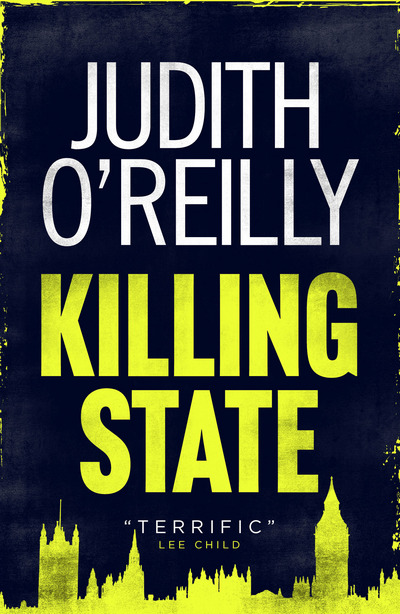
 Judith O’Reilly is the author of Wife in the North, a top-three Sunday Times bestseller and BBC Radio 4 Book of the Week. Judith is a former political producer with BBC 2’s Newsnight and ITN’s Channel 4 News, and, when she isn’t writing novels, she writes for The Sunday Times. Judith lives in Durham.