
Category: Blog Series Page 220 of 230

Let There Be Linda Excerpt: Meet Jenny Stone

Meet Jenny Stone

“I’m Danny Miller,” he said, taking the chair next to her, “President of Miller Talent Agency.” There was a bamboo reception desk, a wicker loveseat, the two chairs, the big mirror, and a fan that made a dying animal noise. There was no receptionist.

She was sitting, but Danny thought she might be five foot five or so. She had straight-as-string brown hair that was pulled back in a tight ponytail. Her skin was smooth and clear and white, as if she never went out into the Southern California sunshine. She wore zero makeup. No gloss, no eye shadow, no blush. She wore thick black glasses. She was thin, he thought, but he couldn’t really tell what was happening under her blousy blue shirt and gray Catholic-school skirt. She wore knee socks and sensible shoes. She had brown eyes that made him think of coffee. She was younger than him, late twenties. She wasn’t wearing a wedding ring. She was unadorned in every regard. It was as if she were trying not to be here—or anywhere—trying to be unnoticed by any and all. There was no guessing what kind of talent she thought she had.

“I’m Jenny Stone,” she said in soft voice void of confidence, a voice that in and of itself was trying to be unnoticed. “What do you do, Jenny Stone?” Danny said, putting his hand out.

She shook his hand and said, “I bring dead people back to life.”

A Few Quick Questions With…Rich Leder


Laugh Riot Press’ Calvin Shomaker suggested some questions for me, and for the most part, they were like what I had planned on asking (maybe his were a bit easier to translate into a sales pitch). Doesn’t really matter who came up with the questions, I just like to give credit where it’s due — Leder’s answers are the thing you want to pay attention to.

Why did you make the transition from screenwriting to novel writing?
After 25 years of telling stories in the strictly regimented format of screenwriting, I had the strong desire to work a deeper, wider canvas. In a script, the writer can only access the thoughts of the characters with action or dialogue. In a novel, the writer can explore the mind and heart and soul of the characters at his/her leisure—discuss the characters’ actual thoughts and feelings. Budget is a non-issue with a novel but a big concern with a movie. Sheer number of characters can be problematic in a script but not in a book (so long as the characters are meaningfully created). Number of locations, page count, and other considerations a movie must make are non-existent in the world of a novel.

I wanted to experience writing without regimentation.

Describe Let There Be Linda in two words. Try Two Sentences.
I can do six words: black comic thriller of the year. And I can do five words: silly, bloody, violent, hilarious fun. And I can do five words again: Monty Python meets Quentin Tarantino. And, finally, I can do two words: wild ride.
Where did Let There Be Linda come from? Who and what were the inspirations?
Left field? Shadows in the wood? Breeze in the meadow? Dark side of the moon? I have no real idea where LINDA came from. It was, I suppose, that indescribable moment of creative human magic. But I know who inspired the spirit of the thing: Monty Python and Quentin Tarantino.
What type of readers would love this book?
Readers who like dark comedy. Readers who like thrillers. Readers who like wild rides. Readers who like to laugh out loud.
Are you done writing films? If so, what does the future hold for Rich Leder and Laugh Riot Press?
It feels like I’m done writing screenplays on spec. If I’m hired to write, then I’ll write one. But if I’m just going to sit down and write a story, I’m going to write a novel from this point in my life onward. That’s what it feels like.
Why should people read your books?
To experience characters they’ll never meet in real life that are so real they’ll think they’ve met them in their real life after all. To laugh out loud. To be thrilled. To be transported to another place. To laugh out loud. Did I mention that one?
What do you want readers to know about you before they start reading you?
I love to write, and I love to make readers laugh. I love to tell fantastic stories—hilarious mysteries and dark comic thrillers—and I care enough about my characters to make them real people readers will fall for.

Let There Be Linda by Rich Leder Book Tour

Welcome to our Book Tour stop for Let There Be Linda. Along with this blurb about the book and author I’ve got a Q & A with the author, Rich Leder; some excerpts from the book: Meet Jenny Stone, Donald the Dentist, Detective Gary Shuler, and a little something we’re calling The Page 69 Challenge; and my 2¢ about the book.

Be sure to scroll down to the bottom of this post to see the current promos from Laugh Riot!

Book Details:

Book Title:  Let There Be Linda by Rich Leder
Publisher:  Laugh Riot Press
Release date:  July 1, 2016

Book Description:

Leder’s black comic thriller tells the tall tale of estranged brothers Mike and Dan Miller—accountant and con-man talent agent respectively—up to their necks in the virtual quicksand of LA’s San Fernando Valley during the hottest summer in Southern California history.

The root cause of their problems could be the missing seventy-five thousand dollars, or the sadistic, loan shark dwarf and his vicious giant, or the psycho comedian cop on the case, or the coke-snorting dentist, or the deranged zombie real estate developer. Or perhaps it’s the poodle—the poodle is suspect, no doubt. Or maybe it’s the grocery store checker who breathes life into death.

Oh yes, it could be her too.

And so to repair the head-on collision the Millers have made of their personal and professional lives, the brothers summon their mother back from the dead to clean up the wreckage. But what the Miller men discover is that screwing with the laws of nature is a violent, bloody, hysterical, and hilarious idea.

Author Bio:

Rich LederRich Leder has been a working writer for more than two decades. His screen credits include 18 produced television films for CBS, Lifetime, and Hallmark and feature films for Paramount Pictures, Tri-Star Pictures, and Left Bank Films.

He has written four funny novels: McCall & Company: Workman’s Complication; McCall & Company: Swollen Identity; Juggler, Porn Star, Monkey Wrench; and Let There Be Linda.

He founded Laugh Riot Press as an imprint for his funny books and the funny books of other indie authors.

He has been the lead singer in a Detroit rock band, a restaurateur, a Little League coach, an indie film director, a literacy tutor, a magazine editor, a screenwriting coach, a PTA board member, a commercial real estate agent, and a visiting artist for the University of North Carolina Wilmington Film Studies Department, among other things, all of which, it turns out, was grist for the mill. He resides on the North Carolina coast with his awesome wife, Lulu, and is sustained by the visits home of their three children.

Current Laugh Riot Press Promos:

Buy One Get One Free: Let There Be Linda is on presale on Amazon for $2.99. On July 1st it will be $4.99.

If you preorder Let There Be Linda before July 1st, and send Rich (rich@laughriotpress.com) a proof of purchase, he will send you a free e-copy of his romantic Hollywood sex comedy Juggler, Porn Star, Monkey Wrench. That’s two great reads for $2.99!

Ask a Question, Win a Signed Book! Email Rich any questions you want answered on the Laugh Riot Podcast (http://www.laughriotpress.com/podcasts/) for the chance to win a free signed book!

For More Info:

https://www.facebook.com/LaughRiotPress/
https://twitter.com/LaughRiotPress
http://www.amazon.com/Rich-Leder/e/B00N66JNN0/ref=dp_byline_cont_ebooks_1
https://www.goodreads.com/author/show/8304523.Rich_Leder?from_search=true&search_version=service
http://www.laughriotpress.com/

United States of Books – Lonesome Dove by Larry McMurtry

Lonesome Dove Lonesome Dove

by Larry McMurtry

Author: C.H. Armstrong at C.H. Armstrong Books & Blog

When I learned I would have the pleasure of reviewing Larry McMurtry’s Lonesome Dove, I quite literally did a fist pump of victory. Simply stated, this is one of my all-time favorite novels, and one of the very few I would consider reading more than once. For that reason, I’ll not beat around the bush: I enthusiastically give this novel a full 5-star review. If I could give it more than 5-stars, I most certainly would.

So what’s it about?

I asked this question of those who originally recommended it to me, and the answer I received didn’t inspire enthusiastic thoughts: It’s the story about a bunch of old cowboys who go on a cattle drive.

Huh? How is that even remotely interesting? Why would I want to read about a cattle drive?

The answer is this: Just do it. I promise: You won’t be sorry.

Lonesome Dove is about a cattle drive, but it’s more than that. It’s about the strong ties of friendship between two former Texas Rangers, Captain August “Gus” McCrae and Captain Woodrow F. Call, two men who couldn’t be more different. While Call is stoic and serious, McCrae is often seen as more laid back and carefree. But the truth is that the two men, for all of their differences, are like yen and yang or two sides of the same coin. It’s almost a love story without the romance element. They complement each other and, while they seem to have nothing at all in common, they are simply not the same without the other.

Besides the main characters is a series of supporting cast members who round out the story…a 17 year old boy, the son of a prostitute, who suspects that Call might be his father; a young prostitute, Lorie, who just wants to get out of town; and the reprehensible coward, Jake Spoon, who abandons her and leaves her defenseless against the elements and those who would do her harm.

In truth, I sat down to read this book because I wanted to silence someone who insisted I read it…and so I talked my best friend (700 miles away) into reading it with me, just so I would have some company in what I thought would be a grueling read. To my surprise, it was action-packed, funny, heartbreaking, and truly one of the best books I’ve ever read.

Trust me – you don’t want to miss this book. If you read nothing else this year, pick up a copy of Lonesome Dove. You won’t be sorry!

Reread Project: So Long, and Thanks For All The Fish by Douglas Adams

So Long, and Thanks For All The FishSo Long, and Thanks For All The Fish

by Douglas Adams
Series: The Hitchhiker’s Guide to the Galaxy Trilogy, #4

Mass Market Paperback, 214 pg.
Del Rey, 1999
Read: June 14, 2016

Arthur had a swordfish steak and said it made him angry. He grabbed a passing waitress by the arm and berated her.

“Why’s this fish so bloody good?” he demanded, angrily.

“Please excuse my friend,” said Fenchurch to the startled waitress. “I think he’s having a nice day at last.”

I’ve said it before, I’ll say it again: this is my favorite Douglas Adams novel. Sure, The Hitchhiker’s Guide is fantastic and I love it and you can make a strong case that at least one of the Dirk Gently novels is his best (I expect I’ll be doing so in a couple of months) — but this is the one that does it for me.

Unlike the previous three, there is an actual narrative here — it’s not a collection of scenes, jokes, and vignettes loosely tied together. Arthur Dent arrives on Earth (no, really) after traipsing from one end of the galaxy to the next; from the end of the universe, to the beginnings of life on Earth; basically all throughout time and space (sadly, without the blue box). And now he’s trying to re-acclimate to life at home. Which has somehow not been destroyed, neither has his house. In fact, everything’s pretty much like it was before.

Just with everyone convinced that the Vogon Constructor Fleet was a CIA-induced Mass Hallucination. Not everyone believes it, but most do. Two people who don’t believe that are a man named Wonko the Sane and Fenchurch. Both of whom are pretty cool characters.

I’ll skip Wonko, because the name says everything. Fenchurch, on the other hand, is perfect. She’s everything that Trillian never got the chance to be (except in the semi-disastrous final chapters of Life, the Universe, and Everything. She’s funny, smart, sexy — just what Arthur needs. I’d happily read a book just about her.

There’s a mention of Zaphod — briefly — but that’s it. So the zaniness fell into Ford’s capable lap. I’ve always liked Ford better, anyway. And he’s able (as always) to pull off the zaniness, the comedy, the . . . everything without being quite the obnoxious twit that Zaphod is.

Ford’s his usual delusional, clueless, charming, drunken self.

Here was something that Ford felt he could speak about with authority.

“Life,” he said, “is like a grapefruit.”

“Er, how so?”

Well, it’s sort of orangy-yellow and dimpled on the outside, wet and squidgy the middle. It’s got pips inside, too. Oh, and some people have half a one for breakfast.”

“Is there anyone else out there I can talk to?”

Arthur comes out of this one looking pretty good, too. He’s not whining, he’s not just getting pulled around by his dressing gown wherever whim strikes Ford (or Zaphod). He’s mature, capable, witty. He sees a problem or two and solves them (even if one of those problems is just “who was that girl I almost met the other day”?). He’s almost a wholly different guy when he’s home. Which makes him a lot like the rest of us — which is sort of the point of Arthur since we first met him.

One of the highlights of the last book was the section about flying, I’m pretty sure I said that. The section here about flying is better — Arthur teaching Fenchurch, Arthur remembering how to do it in the first place — and then the two of them flying around. It’s just about perfect.

And, of course, there are little bits like:

Of course, one never has the slightest notion what size or shape different species are going to turn out to be, but if you were to take the findings of the latest Mid-Galactic Census report as any kind of accurate guide to statistical averages you would probably guess that the craft would hold about six people, and you would be right.

You’d probably guessed that anyway. The Census report, like most such surveys, had cost an awful lot of money and told nobody anything they didn’t already know — except that every single person in the Galaxy had 2.4 legs and owned a hyena. Since this was clearly not true the whole thing eventually had to be scrapped.

    There’s a few things I’d love to go on and on about, but no one wants to read me gushing and gushing and gushing, so here are the assorted highlights:

  • The zig at the end of the Prologue.
  • Arthur’s biscuit/train station story. Seriously, I just love this.
  • Rob Mckenna
  • Wonko the Sane naming the world The Asylum and his house Outside the Asylum.
  • Wonko the Sane’s name.
  • All the California jokes. Clearly, he’d been vacationing there too much.
  • The whole thing about the lizard government and democracy is both funny and relevant.
  • Chapter 25 is just dandy.

The last chapter or two are a little weak, pretty close to the older books in tone and style. But they work, they are tied into the narrative and star Marvin. So who’s going to complain? Not me.

Really, I’ve got nothing but positive things to say about this. I love it. One of the easiest 5-star ratings I’ve ever given.

—–

5 Stars

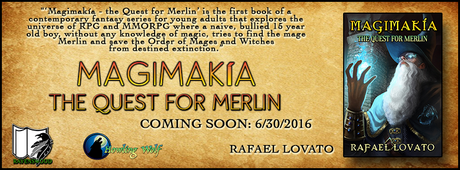
Coming Attraction: Let There Be Linda by Rich Leder

Coming July 28th:


Laugh Riot Press is bringing the Book Tour for Rich Leder‘s Let There Be Linda to our humble patch of cyberspace.

This black comedy is a hoot, you’ll want to be sure to stop by to learn more about this book and author (and maybe even pick up a free book). Frankly, I have no idea how I can talk about this book without ruining everything — but it’ll be fun trying to figure that out, and possibly a disaster if I can’t.

United States of Books – To Kill a Mockingbird by Harper Lee

It’s just not fair (and probably fixed) that the organizer of this little project got to read To Kill a Mockingbird, easily one of my favorite 2 novels of all time. I just checked, and over 3% of the posts here reference Harper Lee in some way — given the number of authors I’ve mentioned at least in passing, that’s saying something. So to have someone else write the first full-length post on this book here bothers me (and makes me wonder just what I’ve been doing the last few years that I haven’t posted about it yet). But anyway, enough of the jealous ranting — on to Laura’s post!
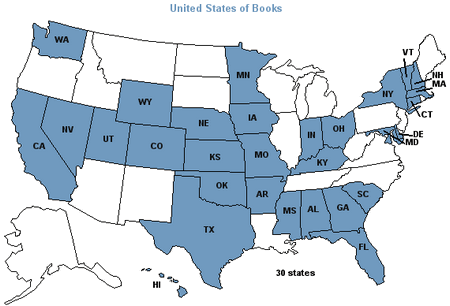
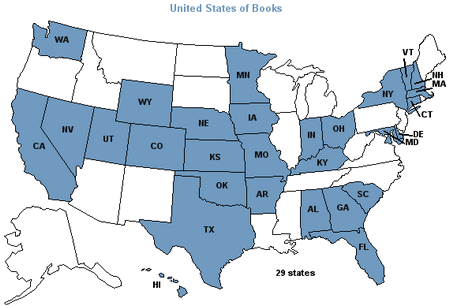
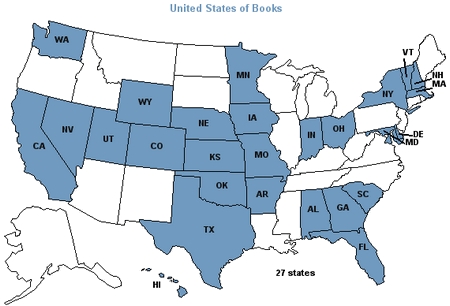
Welcome to the halfway point of the United States of Books! We have now reached review number twenty-five and six months of reviews. I can’t thank the team of reviewers enough and our fantastic readers. To say thanks to you all, we are giving away a $25.00 Amazon gift card for 1st place and then a copy of any of the US of Books books (winners choice) Kindle or physical copy (INT) as long as Book Depository delivers, for 2nd place.

Click here to enter

To Kill a MockingbirdTo Kill a Mockingbird

by Harper Lee

Author: Laura at 125Pages.com

4 1/2 Stars

Synopsis

Harper Lee’s Pulitzer prize-winning masterwork of honor and injustice in the deep south—and the heroism of one man in the face of blind and violent hatred.

One of the best-loved stories of all time, To Kill a Mockingbird has been translated into more than forty languages, sold more than thirty million copies worldwide, served as the basis for an enormously popular motion picture, and was voted one of the best novels of the twentieth century by librarians across the country. A gripping, heart-wrenching, and wholly remarkable tale of coming-of-age in a South poisoned by virulent prejudice, it views a world of great beauty and savage inequities through the eyes of a young girl, as her father-a crusading local lawyer-risks everything to defend a black man unjustly accused of a terrible crime.

Review

This week takes us to Alabama with To Kill A Mockingbird by Harper Lee. EW says – “Forget the dubious sequel. Lee’s exceptional work is a perfectly contained miracle about the struggle for justice in a system built to destroy it. From Birmingham to Tuskegee, Alabama was a burning center of racial conflict, and this novel takes place right on the outskirts of that crucible.”

To Kill A Mockingbird by Harper Lee is one of the first “grown-up” books I remember reading. It was the summer before 7th grade and I was a precocious twelve-year-old. I loved that the person telling the story was a smart young girl and that she was so very different from other book narrators that I had been exposed to. I read it at least once a year and loved when it was on the book list in sophomore year, as it made the book report easy to do. As I got older, I stopped reading it as often, and as I picked it up this time realized it had been at least ten years since I had last picked it up. As I cracked the cover on my old worn copy, it was like stepping back in time to a period in my life that had long since passed.

I wanted you to see what real courage is, instead of getting the idea that courage is a man with a gun in his hand. It’s when you know you’re licked before you begin, but you begin anyway and see it through no matter what.

To Kill A Mockingbird is a complex story of a young girl, six-year-old Jean Louise Finch (Scout), who lives with her lawyer and widower father Atticus and her older brother Jem. Scout and Jem, together with the neighbor boy Dill, are fascinated with their reclusive neighbor “Boo” Radley, a recluse that is never seen. They begin to spin tales about him and try to entice him outside. Meanwhile their father is assigned a case defending a black man, Tom Robinson, who has been accused of raping a young white woman. The two stories weave together in a powerful tale of race relations in a small southern town coming out of the Depression. Harper Lee crafted a tale of morality and family that still resonates today.

As you grow older, you’ll see white men cheat black men every day of your life, but let me tell you something and don’t you forget it—whenever a white man does that to a black man, no matter who he is, how rich he is, or how fine a family he comes from, that white man is trash.

Love and murder, racism and redemption, all combine to make To Kill A Mockingbird a classic that will remain read for years to come. The way that Harper Lee combined wide-eyed youthful curiosity with the recollections of a grown woman make this a very interesting read. The style of the story telling is unique and matches the very detailed plot. The world created and described by Scout is vivid and real, and I could picture the scenes unfolding quite clearly.

Now that I have rediscovered Lee and Mockingbird, I regret ever leaving her world. A Pulitzer Prize winner, To Kill A Mockingbird is a book that well deserves its accolades as well as its criticisms. It does feature many difficult topics and language that in today’s world is considered unacceptable. I believe stories such as this still need to be told as we need to remember what used to be commonplace. I will now try to plan an annual re-read to return to this fascinating world. And, as said so well by Scout, “Until I feared I would lose it, I never loved to read. One does not love breathing.”

In Medias Res: The Asset by Shane Kuhn

as the title implies, I’m in the middle of this book, so this is not a review, just some thoughts mid-way through.

—–

The Asset
The Asset

by Shane Kuhn

This is not the Shane Kuhn you know. Well, sort of. This is a standalone thriller about Airport/Airplane Security, Terrorism, and the USA’s efforts to keep the friendly skies, well, friendly. It’s not as fun and funny as The Intern’s Handbook or Hostile Takeover (or whatever they’re called in your part of the world). BUT it is just as well-written and suspenseful — and a little easier to believe, actually.

There are hints, suggestions, indicators, and other things pointing to an immanent terrorist attack on the U.S., and not enough people are taking the situation seriously. At least, least that’s the point of view of Kennedy, the security expert and protagonist, who is taking it very seriously. Taking place over 64 days (not a spoiler, that’s literally the 2nd line — although, there could be some action that takes place after that). Will Kennedy be in time to stop it? How will he? this is a pulse-pounder, a nail-biter, a “oh, crud — do I really have to go to work tomorrow? Do I actually need to sleep before then?” kind of book.

I think I’d prefer it to be harder to believe than the other two books, come to think of it.

I’m almost at the mid-way point of the ARC (with thanks to Simon & Schuster and Shane Kuhn) and I’m telling you now, you want to pre-order this, get on your library’s wait-list, or whatever (legal) thing you do to get your hands on a book. It comes out on July 12, you want to be ready for it.

United States of Books – The Betsy-Tacy Treasury by Maud Hart Lovelace

The Betsy-Tacy Treasury The Betsy-Tacy Treasury

by Maud Hart Lovelace

Author: Serena Agusto-Cox at Savvy Verse & Wit

The Betsy-Tacy Treasury by Maud Hart Lovelace, which is the first four books in this 10 book series, was praised by Entertainment Weekly as “a rosy remembrance of a region already known for its niceness.” My daughter and I read these together over many weeks, reading little more than a chapter every couple of evenings.

Betsy-Tacy is the first book in the series, and young readers are introduced to five-year-old Betsy who lives in Deep Valley, Minnesota. She lives in a small mill town at the end of Hill Street, but she’s soon to have a new neighbor, as a new family moves into the house across the street. My daughter was thrilled to hear about a girl her age, and she was even more excited when I told her that there were pencil-like sketches inside for her to visualize what we were reading. Transitioning from only picture books to chapter books can be hard, especially for kids who love visuals. Betsy soon has a new friend, Tacy, and they share big imaginary adventures together before her baby sister arrives and before they even meet Tib, whose family is from Milwaukee and live in the chocolate-colored house they covet. Entertainment Weekly‘s assessment of a “rosy” picture of a “nice” little town is highly accurate, and it’s clear that this story takes place some time ago before many worried about strangers, criminals, or had cars, cellphones, and televisions. Imagination was a commodity that children needed in large supply. This is not to say that Betsy, Tacy, and Tib do not get into trouble.

Rating: Cinquain

Betsy-Tacy and Tib is the second book, and the girls are now eight years old. It becomes clear that even though these books were written during a time when women were supposed to be mothers and wives, these girls have bigger dreams. Betsy is a storyteller and she seems to have dreams of writing books, while Tacy wants to be a mother to a number of kids, just as her mother is. Tib is torn. To be an architect/engineer, mother, dancer, or something else. When kids think about what they want to be when they grow up, their dreams are big and seem to be out of reach. They are fantasies, like many of the stories these girls create in this book for Tib’s Aunt Dolly and themselves. My daughter is riveted by these books and the fun and trouble these girls get into, from visiting the Mirror Palace to cutting chunks of their hair off to put in lockets. These books remind me of the good old days when dreams were interchangeable and wonderful.

Rating: Cinquain

Betsy and Tacy Go Over the Big Hill is the third book and the girls are now age 10. It’s great how accurate Maud Hart Lovelace captures the competition between young kids when it comes to celebrating birthdays and feeling left out when others have birthday parties and they do not. But, ultimately, everything turns out well between Betsy, Tacy, and Tib, only to have a quarrel between Betsy and Tacy and their older sisters over who will become queen. This book has a lot in it about conflict resolution, which younger kids can definitely use as friendships grow and change, as well as in their relationships with siblings. My daughter enjoyed this one, but was a little unsure of the hubbub about kings and queens, even though she is an avid fan of princesses. I liked the historical details about the Syrian immigrants and foreign affairs involving the King of Spain, as well as a tidbit about the current president being Theodore Roosevelt. However, there are some “old-fashioned” ideas about immigrants and other cultures here that might need further explanation.

Rating: Quatrain

Betsy and Tacy Go Downtown is the fourth book, and at age 12, Betsy, Tacy, and Tib are a little too old for my daughter. She lost interest in this book series with this book, as their adventures downtown and their prodding of Winona to take them to see the play Uncle Tom’s Cabin did not resonate with her. She’s more interested in make-believe games and stories, and while these girls act as girls probably do at this age, manipulating a classmate is not a lesson I’d like my daughter to learn. It’s also interesting from an adult perspective to see how times have changed — a prized possession for one of the girls is a beer calendar! But here, we also see Betsy grow up and take an adventure to the new library on her own. While she apprehensive, she’s happy to be on her own and she thrives in the books she finds and reads, but also in the attention she seems to receive from others about her own writing. It’s wonderful to see her parents support her writing/art. It’s a lesson that is often not passed on today, as kids are tested and too focused on subjects that will net them lucrative careers.

Rating: Tercet

Average rating for all 4 books: 4.25

United States of Books – The Magnificent Ambersons by Booth Tarkington

The Magnificent AmbersonsThe Magnificent Ambersons

by Booth Tarkington
Series: The Growth Trilogy, #2

Mass Market Paperback, 346 pg.
Tor Classics, 2001 (first published 1918)
Read: May 12 – 14, 2016

… the grandeur of the Amberson family was instantly conspicuous as a permanent thing: it was impossible to doubt that the Ambersons were entrenched, in their nobility and riches, behind polished and glittering barriers which were as solid as they were brilliant, and would last.

If only, if only . . .

How do you enjoy a 300+ page book with a protagonist who is an arrogant, petulant, jackwad with no obviously redeeming qualities for the first 300 pages? Well, it’s tough. But if it’s as well told as The Magnificent Ambersons, it’s possible.

Sure, that’s a little bit of a spoiler — George Amberson Minafer does develop a couple of redeeming qualities in the last 30 pages or so. But you know what? The book is almost a century old, you’ve had plenty of time to read it if you’re worried about spoilers.

The plot is straightforward: At the dawn of the Industrial Revolution, an impossibly rich family produces an arrogant twit as the only heir. Unbeknownst to him, the economy is changing and the family is beginning to fall on hard times. Too proud to admit it, they continue living as if they have all the money in the world. Meanwhile, the twit falls for a girl who’s humble, kind, and wise. For some inexplicable reason, she falls for him, too. Things happen, they don’t get together and the bottom falls out on the Ambersons. There’s family drama, too — between the financial crisis, health problems, love, old flames, and scandal, there’s plenty to entertain a reader (if they can put up with younger George).

Most of the characters are pretty thin — there are exceptions (George’s mother, aunt and non-ambassador uncle, are the best) — but even the developed ones aren’t as fleshed out as we would have them today. But it fits with Tarkington’s overall style. It’s very, very difficult to like most of the people on these pages. So the ones you’d normally sort-of like, you end up really enjoying.

What makes this book work is Tarkington’s style. It’s hard to describe — highly detailed (for example, there’s so much attention paid to clothing and fashion that you’d almost think Gail Carriger had a hand in this), with a dry sense of humor, and plenty of cultural commentary. He changes his focus repeatedly: he’ll jusmp months or years at at time, and summarize events from those months in a paragraph or less and then cover a single evening in 15 pages, so he can highlight what matters and ignore the rest. But better than the plot (or characters), you get lines like this: “Some day the laws of glamour must be discovered, because they are so important that the world would be wiser now if Sir Isaac Newton had been hit on the head, not by an apple, but by a young lady.” How do you not keep reading for things like that?

Tarkington takes time out from the narrative to say

Youth cannot imagine romance apart from youth. That is why the roles of the heroes and heroines of plays are given by the managers to the most youthful actors they can find among the competent. Both middle-aged people and young people enjoy a play about young lovers; but only middle-aged people will tolerate a play about middle-aged lovers; young people will not come to see such a play, because, for them, middle-aged lovers are a joke–not a very funny one. Therefore, to bring both the middle-aged people and the young people into his house, the manager makes his romance as young as he can. Youth will indeed be served, and its profound instinct is to be not only scornfully amused but vaguely angered by middle-age romance.

I assume that captures the spirit of the late 19th/early 20th Century — if you take out the word “play” and put in “film” or “show,” it does a pretty good job of capturing the spirit of the early 21st Century, too. Which is a pretty nice achievement for a piece of writing.

The book isn’t a chronicle of the changes to the American culture/economy due to industrialization, it’s a family drama. But if you pay attention to what’s going around the lovebirds, cads and gossips, you can see those changes taking place. It’s a temptation for someone to cheat a little when writing historical fiction and make characters seem smarter than they are by knowing how predictions would actually turn out, Takington’s not above falling into that. Note what Eugene Morgan, early designer of automobiles says:

“With all their speed forward [automobiles] may be a step backward in civilization–that is, in spiritual civilization. It may be that they will not add to the beauty of the world, nor to the life of men’s souls. I am not sure. But automobiles have come, and they bring a greater change in our life than most of us suspect. They are here, and almost all outward things are going to be different because of what they bring. They are going to alter war, and they are going to alter peace. I think men’s minds are going to be changed in subtle ways because of automobiles; just how, though, I could hardly guess. But you can’t have the immense outward changes that they will cause without some inward ones, and it may be that George is right, and that the spiritual alteration will be bad for us. Perhaps, ten or twenty years from now, if we can see the inward change in men by that time, I shouldn’t be able to defend the gasoline engine, but would have to agree with him that automobiles ‘had no business to be invented.'”

That was 98 years ago, think what he’d say now about the automobile’s impact on culture (he’d probably cite James Howard Kunstler’s The Geography of Nowhere).

A dull(ish) story, full of unsympathetic characters acting foolishly (on the whole), with a quaint writing style that somehow makes it all work. I can’t explain it, I’m just glad I read it. You just might feel the same way, give it a shot.

—–

3.5 Stars

Page 220 of 230

Powered by WordPress & Theme by Anders Norén