
Category: Fantasy Page 37 of 48

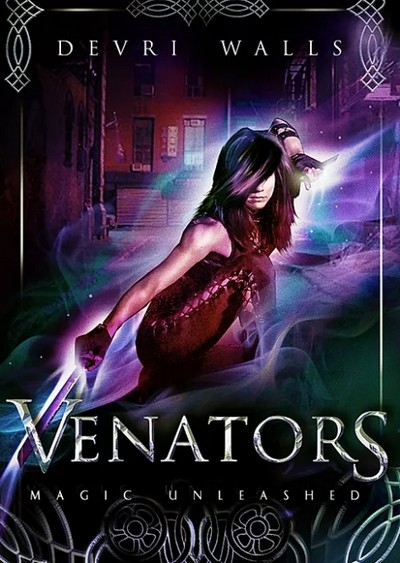
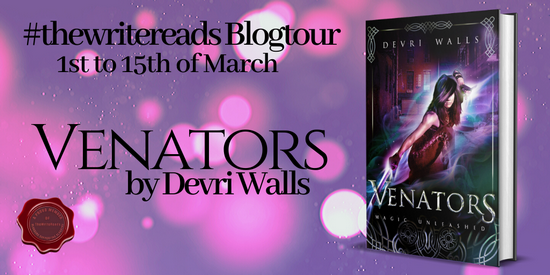
Venators: Magic Unleashed by Devri Walls: Welcome to Eon in this Promising YA Fantasy Introduction

Venators: Magic UnleashedVenators: Magic Unleashed

by Devri Walls
Series: Venators, #1

Paperback, 354 pg.
Brown Books Publishing Group, 2018
Read: April 17 – 18, 2019

Back in 2016, I read and blogged about Venators: Through the Arch, which was later picked up by a new publisher, given a re-write, a spiffy new cover, and was re-born as Venators: Magic Unleashed. I haven’t read that old post in a long time, and won’t until I finish with this one, I’m only linking out of habit. I hate to say it, but I remember very little about the original version of this book beyond a vague grasp of the plot outline, some vague notions of characters and an overall positive regard. Oh, and a strong interest in volume two. This revamped version is stronger, with some of the rough edges smoothed out, and strengths sharpened. Brown Books and Walls made good use of the relaunch. But let’s set aside the comparisons and focus on Magic Unleashed.
This is a portal fantasy about a world called Eon, populated by humans, elves, vampires, werewolves, elves, dragons, etc. There are connections between Earth and Eon, allowing travel between the two — although they’re not as strong as they once were. It turns out some humans from Earth have a certain invulnerability to the kinds of magic employed by the various races (like a werewolf or vampire bite, but not, say, an invulnerability to a werewolf tearing off their head). Thee humans also have other enhanced physical attributes allowing them to go toe-to-toe in combat with members of these races. Which has made these humans a powerful force for good, and a potentially tyrannical force as well. Eon’s known more of the latter lately, which has led to a lack of recruitment.

But now, society’s on the verge of collapse into chaos, warring tribes trying to wipe out other races in a fight for dominance, and the end of law. So some people have taken it upon themselves to reintroduce these humans, Venators, to Eon. Enter Tate, a warrior who is convinced that Venators are the key to Eon’s survival — he’s been to Earth before, and now returns to bring back some people he observed then. Six years ago, he encountered a young teen named Grey Malteer — who was forever changed by their brief encounter. Now in college, Grey is about as well-read in the lore of the supernatural and weird as is possible for someone to be while stuck on Earth and not being known as a crackpot (although he’s regarded as pretty eccentric, probably well on his way to crack-pot status).

An acquaintance of his from childhood, now attending the same college, Rune Jenkins is repulsed by the same things that Grey is focused on (while also drawn to them). Rune is totally unprepared to accept that the supernatural is anything but wild fiction until she’s attacked by goblins and rescued by a large blue man (the aforementioned Tate). Which really can only make her a believer — or drive her to some sort of psychotic break. Thankfully, she goes with the former. Tate brings Rune and Grey into Eon and sets before them the calling of Venator.

To oversimplify things: from here out, the two are introduced to this world, the beings that populate it, the political realities that govern it (and see them only as pawns), and they begin to embrace their new identities, while engaging in a brief battle or two. While Rune and Grey are introduced to all this, so is the reader — and it’s clearly the point of this book — to bring the reader and these two into Eon, give us all a taste of what’s to come and help us get to know the players. There is a clear plotline and definite story here — don’t get me wrong — but the major function is to provide a foundation for things to come.

The book would have to be a lot longer to serve as anything other than an introduction — the ruling council alone is made up of enough characters we’d need a few more chapters to really get to know them and their goals — although they can be summed up in lust for power and influence for themselves and their race to the possible detriment of every other council member/race. Then you throw in Tate; his allies (however temporary) the vampire Veridia and the shapeshifter Beltran; the two humans; and the council’s enemy, Zio — and really, you’ve got enough players that you really can only skim the surface within 354 pages.

We get to know Grey and Rune enough to see they’re well-developed and three-dimensional, and many of the rest show signs of being that developed, but we don’t get to see that fully displayed — but we see enough to know that given the opportunity, the characters will be easily fleshed out. One thing I noted in particular while reading this is just how many seeds Walls planted in the characters and situations to come back to in future installments. This foundation is built in such a way that several books can be built on it — it’s really impressive to note.

Yes, this is written for the YA market, so there’s a bit more action than others might use. There’s a focus on certain kinds of emotional beats, and that sort of thing. But it’s more of an accent to the storytelling than other writers would’ve made it. For some reason, Mercedes Lackey’s Hunter series and Brandon Mull’s Beyonders Trilogy come to mind as I think about similar series — but the YA-ness of both of those comes through more strongly than it does with this book.

Book Two, Venators: Promises Forged releases today, and I’m hoping to start it in a day or two — I’m looking forward to seeing how Walls takes all these ideas, characters, and potential and develops them. This is a good starting point, and what comes next can’t help but be better when she can focus more on exploring the world she’s created and shown us rather than just establishing it here. This is a good book and I do encourage people to read it, but its foundational nature should be borne in mind.

—–

3.5 Stars

LetsReadIndie Reading Challenge

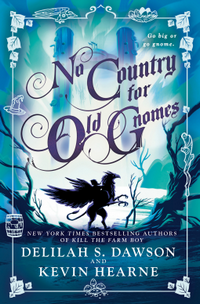
Pub Day Repost: No Country for Old Gnomes by Delilah S. Dawson and Kevin Hearne is a very foine booke that surpässes the original while showing full respect to the umlaut

I’ve tweaked and retweaked this to the point that I can’t read it any more. Hope it’s mostly coherent.

No Country for Old GnomesNo Country for Old Gnomes

by Delilah S. Dawson and Kevin Hearne
Series: The Tales of Pell, Book #2

eARC, 352 pg.
Del Rey, 2019
Read: March 9 – 12, 2019

As much as I loved 2018’s Kill the Farm Boy — and talked about it everywhere and repeatedly — I wasn’t sure how much I really wanted to pick up the sequel. There’s no way it would be as good, the humor would be a little stale, and the whole approach wouldn’t seem as novel. Still, I knew curiosity would get the better of me — and it’d still have its moments. Also, I’m not at the point where I can live in a world with a Kevin Hearne book in print that I haven’t read.

I was so, so wrong. Having established their off-kilter world, strong voice, and approach to the stories of Pell, Dawson and Hearne have come back to play in it. The result is superior in every way that I can think of. I lost track of how many times I said to myself while reading something along the lines of, “how did they improve things this much?”

So this book happens in different corner of the kingdom than Farm Boy did. The Skylar is a choice piece of the land that is home to two diminutive races — halflings and gnomes. Gnomes want to live in their nice little homes, tinker with their little projects and inventions, and wear brightly colored cardigans (well, there was one gnome who wanted to wear a black cardigan, but let’s leave that aside for now). The halflings have found their government hijacked by criminals and those particular halflings are waging a war of sorts on the gnomes, driving them from their homes for unknown reasons. Driven by desperation, two of these displaced gnomes are part of our questing party here. A halfling — committed to (some may say obsessed with) the law that is being ignored by his people is another member of the party.

These three join themselves to an ovitaur named Agape — an ovitaur is like a faun, but is humanoid with sheep characteristics (feet, legs, ears, etc). She’s the last of a long family line serving as teh guardians of a rare treasure, and needs guidance. A gryphon, named Gerd, outcast from his people has been accompanying the halfling for some time, but is devoted to protecting Agape now. The last member of the party is a dwarf named Båggi Biins. Båggi is on his Meadschpringå — a time when young dwarves leave their homes to purge the violence from themselves so they can return to their homes to pursue an ascetic life of creativity. He joins the others certain that journeying with them, protecting them along their way will provide all the outlet required to use his violence in a noble cause.

Their quest? To go to the Great Library, where the founding documents of the gnomeric and halfling civilizations are located — which should prove invaluable to re-establish the peace and help the two societies get along. Agape should find resources to direct her in her guardianship, and hopefully provide Gerd with the proof that he broke no laws of the gryphons.

The fact that most people on Pell consider the Great Library to be a myth shouldn’t be taken as an argument against this quest. What better place than a possibly mythical library to provide the answers they seek?

While these characters are on their quest, working for peace — the king and his advisor are trying to solve the problems between the halflings and gnomes in a more direct approach. We also see (briefly in most cases) other characters from Farm Boy. We see just enough to know how things are going for them some months later — and on the whole, it’s just as you’d hoped/expected it to be for them. It is not essential to have read the previous volume to get 95% of this book. It’s safe to hand this one off to family, friends and coworkers who are wondering what you’re cackling about without making them do homework first.

Along the way, these characters meet a cult of cabbage worshipers, who have the ability to read prophecies in the vegetables; some very frightening mermaids (that look nothing like anything anyone expects); a very Tom Bombadil-esque character (and a few other Tolkien-inspired jokes). As in Farm Boy, the authors manage to use these ideas as sources of comedy and to propel the plot along in meaningful ways. Similarly, they use racial and personal characteristics of the characters to play with, play against and mock genre standards. But almost none of the characters are mere jokes, they’re well-developed characters that happen to be able to comedic. This is not an easy balance to achieve — and Hearne and Dawson are almost flawless on this front.

For example, gryphons are convinced that they perceive greater nuance and details in colors, sounds, tastes and the like and adjust their pronunciation of words via capital letters, umlauts and extra syllables. Gerd’s dialogue is littered with these. It starts off as a joke that just won’t stop, and instead of it getting tired or annoying (which I assumed it would), it becomes just part of the way that Gerd talks. His own particular dialect, that occasionally will strike you as amusing — maybe even just funny occasionally. I wouldn’t say it’s because the authors show restraint with it, employing it just when needed to keep it funny. Quite the reverse, they seemingly take the approach of drowning you in the joke, figuring that it’ll be funny often enough to justify it.

If you’re like me, you have a tendency to skip chapter titles. Doing so with The Tales of Pell would be a mistake. The titles are long, fitting, and insanely goofy. The only thing better are the chapter epigraphs I imagine the drafts going back and forth between the authors, each trying to top the other with the next chapter title/epigraph. And generally succeeding.

These books are noted (as I’ve focused on) for their comedy — as is right, because they are funny. But as anyone who’s read other works by Dawson and Hearne know, they’re about a lot more than comedy. The battle scenes are exciting. The emotional themes and reactions are genuine and unforced. And tragedy hits hard. It’s easy to forget in the middle of inspiring moments or humorous aftermaths of battle that these kind of novels involve death and other forms of loss — and when you do forget, you are open to getting your heart punched.

In case I haven’t made it clear here, Dawson and Hearne knocked it out of the park here. I thought Kill the Farm Boy was outstanding, and No Country for Old Gnomes surpassed it on every front. I don’t expect that the third volume of The Tales of Pell will continue this trend — but I’m more than open to being proven wrong next year. But for 2019? I’m just going to revel in the goodness — the laughs, the pathos, the excitement — brought by this adventure and the wonderful cast of characters. Get your hands on this one.

Disclaimer: I received this eARC from Random House Publishing Group – Ballantine via NetGalley in exchange for this post — thanks to both for this, I really appreciate it.

—–

4 1/2 Stars

No Country for Old Gnomes by Delilah S. Dawson and Kevin Hearne is a very foine booke that surpässes the original while showing full respect to the umlaut

I’ve tweaked and retweaked this to the point that I can’t read it any more. Hope it’s mostly coherent.

No Country for Old GnomesNo Country for Old Gnomes

by Delilah S. Dawson and Kevin Hearne
Series: The Tales of Pell, Book #2

eARC, 352 pg.
Del Rey, 2019

Read: March 9 – 12, 2019


As much as I loved 2018’s Kill the Farm Boy — and talked about it everywhere and repeatedly — I wasn’t sure how much I really wanted to pick up the sequel. There’s no way it would be as good, the humor would be a little stale, and the whole approach wouldn’t seem as novel. Still, I knew curiosity would get the better of me — and it’d still have its moments. Also, I’m not at the point where I can live in a world with a Kevin Hearne book in print that I haven’t read.

I was so, so wrong. Having established their off-kilter world, strong voice, and approach to the stories of Pell, Dawson and Hearne have come back to play in it. The result is superior in every way that I can think of. I lost track of how many times I said to myself while reading something along the lines of, “how did they improve things this much?”

So this book happens in different corner of the kingdom than Farm Boy did. The Skylar is a choice piece of the land that is home to two diminutive races — halflings and gnomes. Gnomes want to live in their nice little homes, tinker with their little projects and inventions, and wear brightly colored cardigans (well, there was one gnome who wanted to wear a black cardigan, but let’s leave that aside for now). The halflings have found their government hijacked by criminals and those particular halflings are waging a war of sorts on the gnomes, driving them from their homes for unknown reasons. Driven by desperation, two of these displaced gnomes are part of our questing party here. A halfling — committed to (some may say obsessed with) the law that is being ignored by his people is another member of the party.

These three join themselves to an ovitaur named Agape — an ovitaur is like a faun, but is humanoid with sheep characteristics (feet, legs, ears, etc). She’s the last of a long family line serving as teh guardians of a rare treasure, and needs guidance. A gryphon, named Gerd, outcast from his people has been accompanying the halfling for some time, but is devoted to protecting Agape now. The last member of the party is a dwarf named Båggi Biins. Båggi is on his Meadschpringå — a time when young dwarves leave their homes to purge the violence from themselves so they can return to their homes to pursue an ascetic life of creativity. He joins the others certain that journeying with them, protecting them along their way will provide all the outlet required to use his violence in a noble cause.

Their quest? To go to the Great Library, where the founding documents of the gnomeric and halfling civilizations are located — which should prove invaluable to re-establish the peace and help the two societies get along. Agape should find resources to direct her in her guardianship, and hopefully provide Gerd with the proof that he broke no laws of the gryphons.

The fact that most people on Pell consider the Great Library to be a myth shouldn’t be taken as an argument against this quest. What better place than a possibly mythical library to provide the answers they seek?

While these characters are on their quest, working for peace — the king and his advisor are trying to solve the problems between the halflings and gnomes in a more direct approach. We also see (briefly in most cases) other characters from Farm Boy. We see just enough to know how things are going for them some months later — and on the whole, it’s just as you’d hoped/expected it to be for them. It is not essential to have read the previous volume to get 95% of this book. It’s safe to hand this one off to family, friends and coworkers who are wondering what you’re cackling about without making them do homework first.

Along the way, these characters meet a cult of cabbage worshipers, who have the ability to read prophecies in the vegetables; some very frightening mermaids (that look nothing like anything anyone expects); a very Tom Bombadil-esque character (and a few other Tolkien-inspired jokes). As in Farm Boy, the authors manage to use these ideas as sources of comedy and to propel the plot along in meaningful ways. Similarly, they use racial and personal characteristics of the characters to play with, play against and mock genre standards. But almost none of the characters are mere jokes, they’re well-developed characters that happen to be able to comedic. This is not an easy balance to achieve — and Hearne and Dawson are almost flawless on this front.

For example, gryphons are convinced that they perceive greater nuance and details in colors, sounds, tastes and the like and adjust their pronunciation of words via capital letters, umlauts and extra syllables. Gerd’s dialogue is littered with these. It starts off as a joke that just won’t stop, and instead of it getting tired or annoying (which I assumed it would), it becomes just part of the way that Gerd talks. His own particular dialect, that occasionally will strike you as amusing — maybe even just funny occasionally. I wouldn’t say it’s because the authors show restraint with it, employing it just when needed to keep it funny. Quite the reverse, they seemingly take the approach of drowning you in the joke, figuring that it’ll be funny often enough to justify it.

If you’re like me, you have a tendency to skip chapter titles. Doing so with The Tales of Pell would be a mistake. The titles are long, fitting, and insanely goofy. The only thing better are the chapter epigraphs I imagine the drafts going back and forth between the authors, each trying to top the other with the next chapter title/epigraph. And generally succeeding.

These books are noted (as I’ve focused on) for their comedy — as is right, because they are funny. But as anyone who’s read other works by Dawson and Hearne know, they’re about a lot more than comedy. The battle scenes are exciting. The emotional themes and reactions are genuine and unforced. And tragedy hits hard. It’s easy to forget in the middle of inspiring moments or humorous aftermaths of battle that these kind of novels involve death and other forms of loss — and when you do forget, you are open to getting your heart punched.

In case I haven’t made it clear here, Dawson and Hearne knocked it out of the park here. I thought Kill the Farm Boy was outstanding, and No Country for Old Gnomes surpassed it on every front. I don’t expect that the third volume of The Tales of Pell will continue this trend — but I’m more than open to being proven wrong next year. But for 2019? I’m just going to revel in the goodness — the laughs, the pathos, the excitement — brought by this adventure and the wonderful cast of characters. Get your hands on this one.

Disclaimer: I received this eARC from Random House Publishing Group – Ballantine via NetGalley in exchange for this post — thanks to both for this, I really appreciate it.

—–

4 1/2 Stars

Coming Attractions (I hope…)

The last three nights I’ve sat down to write my next post and have promptly fallen asleep before finishing a paragraph. Which is quite annoying, because I’m not more tired than normal (I don’t think) and I am very excited about these three books.

So in lieu of an actual post, given largely as proof of life, here’s a quick glance at what’s coming down the pike. Hopefully starting in 24 hours.

Who Killed the Fonz?Who Killed the Fonz?

by James Boice

This is funny, heartfelt, a goofy idea, and a far better book than it has any right to be.

Rogue SuperheroesRogue Superheroes

by Matt Cowper

This takes everything he did right in The World Savers and improves on it (at least a little) while continuing the story.

No Country for Old GnomesNo Country for Old Gnomes

by Delilah S. Dawson and Kevin Hearne

Set in the same kingdom as Kill the Farmboy, and features (at least for a couple of pages) the same characters, but focuses on a new cast. I figured this was going to be almost as good as its predecessor, but it’s better in every way — better characters, better story, and more laughs. None of which I’d have thought likely.

Awakenings by Edward Lazellari: A Solid Beginning to a Portal Fantasy Series with a Twist

AwakeningsAwakenings

by Edward Lazellari
Series: Guardians of Aandor, Volume One

Hardcover, 348 pg.
Tor Books, 2011

Read: January 12 – 15, 2019


When I heard Lazellari talk about the setup to this novel/series on The Once and Future Podcast, I knew I had to give this a shot. I just love the premise — to secure the future of a war-torn fantasy world, a group of loyal subjects take a royal infant into our world via a great magic working. Once here, something goes horribly wrong and they forget who they are and split up.

Thirteen years later, more people come into our world from theirs — hunting for the now young man. Not as much goes wrong for them — they retain their identities, if not all their magic (this just isn’t the right kind of world in the multiverse for magic to work easily). Once they’ve somewhat acclimatized to Earth (aided by a spell or two), they begin hunting for the protectors and the child, er, teen.

Finally, one more traveler came to Earth — a student mage (almost a full wizard, but not quite), Lelani comes, realizes what’s happened and sets out to protect those being hunted and to restore their memories. Early on, she comes across Seth, who studied with her under the same master. On Earth, Seth’s a deadbeat, drug-using photographer — mostly of desperate young women willing to pose for just about any kind of picture for a few dollars (yup, mostly those kind of pictures). Honestly, you have to work pretty hard to not want to see him eaten by something out of the Monster Manual for D&D.

You really can’t say that Lelani convinces Seth of anything, but he accompanies her as they come to retried the group’s leader. He’d been part of one of the ruling families, and was a star among the Guard. Here, he’s Cal MacDonnell, a police officer — not just a police officer, but in addition to his career, he has a wife and daughter — a whole family, one he doesn’t want to abandon for the sake of a fairy tale (even if he’s pretty sure that Lelani’s telling the truth). I think it’s this aspect of Cal’s story that grabbed me the most — he knows his duty, what’s expected of him, but he can’t just give up his life here to take up that duty. While Lelani tries to help them remember who they are, Seth and Cal set out to find the teen and their former companions.

And what of the child? He’s not officially identified, but the novel spends a lot of time talking about a young man living in a small town in New York. He’s bullied at school, his adoptive mother has married a drunk who abuses him, yet Daniel spends a lot of time defending others — friends and his sister.

The villains of this piece are more reminiscent of the more unsavory characters of Gaiman’s Neverwhere than anything that Weis, Hickman, Eddings, Tolkein, etc. created. But that doesn’t mean you can’t see them roaming around some semi-medieval land, terrorizing the populace.

This book comes across as an Urban Fantasy novel, but it’s not really one — it’s really an Epic Fantasy that takes place in New York. The feel is different than Urban Fantasy (but man, it sounds like I’m splitting hairs — but I bet it won’t when you read it). It’s a portal fantasy, with a twist. A band of heroes in a noble cause, trying to stave off chaos — not only for their world, but ours as well (now that the bad guys know where it is…a whole universe unprotected from magic and monsters).

The ending is clearly designed to propel you to the sequel (and it worked!), with Daniel in peril; Cal, Seth and Lelani poised to find him and the rest of the companions, and their foes preparing to eliminate them all. We’ve learned a lot about their world, but there’s a whole lot more to learn — ditto for the others who came here 13 years ago. Book two, The Lost Prince has a lot to accomplish, and I can’t wait to see how it does.

Here’s a bonus feature for a few readers — this is a complete trilogy, the third volume came out last year. You can dive into this without worrying about Lazellari getting distracted by life/other projects.

—–

3.5 Stars

2019 Library Love Challenge

In an Absent Dream by Seanan McGuire: Another Wayward Child’s story — magical, enchanting, heartbreaking. You know the drill.

In an Absent DreamIn an Absent Dream

by Seanan McGuire
Series: Wayward Children, #4

Hardcover, 204 pg.
Tor Books, 2018
Read: January 9, 2019

           …the worst she was ever called where anyone might here was “teacher’s pet,” which she took, not as an insult, but rather as a statement of fact. She was Katherine, she was the teacher’s pet, and when she grew up, she was going to be a librarian, because she couldn’t imagine knowing there was a job that was all about books and not wanting to do it.

Here’s a quick recap of this series for those of you who haven’t heard about it yet/have ignored everything I’ve said about the series these last few years: Imagine Children who go off to a magical kingdom for a bit from our world — Narnia, Fillory, the Lands Beyond, Neverland, Lyrian, whatever you call that land on the other side of the fourteenth door in Coraline, etc. — and then return home. Some will go on to live “normal” lives — others can’t forget or outgrow their attachment to the magical world — some of those, those who want more than anything to return to whatever was on the other side of the door wind up at Eleanor West’s Home for Wayward Children. This series is about some of those children.

There’s a basic outline to these books — McGuire introduces you to a Child and a new world. Her language will be lyrical, playful and enchanting. She’ll draw you in with the awe and wonder and while you’re not looking, she’ll set the hook, and you will be as emotionally tied to her characters as you are close family members*. Then something devastating will happen to those characters, and you will feel horrible, yet love the experience. No matter what kind of resolution is found in the book (death, rescue, brokenness), when you close the book you’ll almost instantly start waiting until the next book comes out, because McGuire is just that good.

In this book we meet Katherine — Katherine’s never been good at making friends her age (there are justifiable reasons for this), but she likes talking to adults more, she likes rules, and she loves reading. There’s something about each Wayward Child that readers can identify with, but Katherine is more relatable to readers than the others have been. One day, Katherine comes upon a tree that hadn’t been there before. This tree had a door in it, and before she realized what was happening — she was on the other side of the door, walking down a hall, on her way to a Goblin Market. In the last book, we saw a nonsense world — this is a logic world, through and through. There are rules, enforced by everyone who lives there — and somehow, by the world itself.

Unlike that (mostly) tongue-in-cheek outline above, each of these books are so different from the rest, it’s hard to compare them — so I’ll try not to. But the structure of this seems more different than the others have. So I’m not going to tell you any more about the plot than I have — I’ll just say it’s a great story, incredibly well told — and even when the narration tells you the ending is not going to be “kind”, you keep expecting/hoping/wanting for things to work out for Katherine and her loved ones.

I’ve made the ending sound bad — it’s not “happy,” but I’m not complaining, I’m not criticizing, I’m most definitely not warning a reader away. It’s the right ending for this story, it’s absolutely how things needed to go — but this is not the Feel-Good Novella of the Year. It is wonderfully written, beautifully written, imaginative, awe-inspiring, delightful, and eventually heartbreaking. McGuire’s one of the best at work today — and this is proof of it.

Yes, you can read these out-of-order — but I don’t recommend it. And hey, were talking 200 pages or less each, you’ve got time for that. You’ll be glad you did (once you stop feeling horrible)


  • That might be a bit hyperbolic.

—–

5 Stars

My Favorite Non-Crime Fiction of 2018

When I was trying to come up with a Top 10 this year, I ran into a small problem (at least for me). With 44 percent of my fiction, Crime/Thriller/Mystery novels so dominated the candidates, it’s like I read nothing else. So, I decided to split them into 2 lists — one for Crime Fiction and one for Everything Else. Not the catchiest title, I grant you, but you get what you pay for.

I do think I read some books that were technically superior than some of these — but they didn’t entertain me, or grab me emotionally the way these did. And I kinda feel bad about leaving them off. But only kind of. These are my favorites, the things that have stuck with me in a way others haven’t — not the best things I read (but there’s a good deal of overlap, too). I know I read books that are worse, too — I don’t feel bad about leaving them off.

Anyway…I say this every year, but . . . Most people do this in mid-December or so, but a few years ago (before this blog), the best novel I read that year was also the last. Ever since then, I just can’t pull the trigger until January 1. Also, none of these are re-reads, I can’t have everyone losing to my re-reading books that I’ve loved for 2 decades.

Enough blather…on to the list.

(in alphabetical order by author)

Lies SleepingLies Sleeping

by Ben Aaronovitch

My original post
I’ve read all the comics (at least collected in paperback), listened to all the audiobooks, read the books at least once . . . I’m a Rivers of London/Peter Grant fan. Period. Which means two things — 1. I’m in the bag already for this series and 2. When I say that this is the best of the bunch, I know what I’m talking about. Aaronovitch writes fantastic Urban Fantasy and this is his best yet. The series has been building to this for a while, and I honestly don’t know what to expect next. Great fight/action scenes, some genuine laughs, some solid emotional moments . . . this has it all. Everything you’ve come to expect and more.

—–

5 Stars

The Fairies of SadievilleThe Fairies of Sadieville

by Alex Bledsoe

My original post
I was very excited about this book when Bledsoe announced it was the last Tufa novel. Then I never wanted it to come out — I didn’t want to say goodbye to this wonderful world he’d created. But if I have to — this is how the series should’ve gone out. It’s the best installment since the first novel — we get almost every question we had about the Tufa answered (including ones you didn’t realize you had), along with a great story. It’s just special and I’m glad I got to read this magical series.

—–

5 Stars

Dragon RoadDragon Road

by Joseph Brassey

I haven’t been able to get a post written about this — I’m not sure why. It’s superior in almost every way to the wonderful Skyfarer — the idea behind the caravan, the scope of the ship and it’s culture are more than you might think anyone has done before. A fantasy novel about wizards and warriors (and warrior wizards) in a SF setting. I had a blast reading this and I think you will, too.

—–

4 1/2 Stars

Kill the Farm BoyKill the Farm Boy

by Delilah S. Dawson and Kevin Hearne

My original post
Probably the best comedic/parody/satire fantasy since Peter David’s Sir Apropos of Nothing. The characters are fun, well-developed and pretty strange. This is a great fantasy story, it’s a great bunch of laughs, but there’s real humans and real human reactions — it’s not all laughs but enough of it is that you won’t have to work hard to thoroughly enjoy the book.

—–

4 Stars

Kings of the WyldKings of the Wyld

by Nicholas Eames
Like Dragon Road, I’ve been trying to write a post about this book for months. An epic story about brotherhood, about family, about heroism, about integrity — but at its core, it’s a story about Clay Cooper. Clay’s a good man trying to stay one. He worked really hard to get to where he is, but he has to get back on the road to help his friends’ daughter. It’s a fantastic concept and set up, with an even better follow-through by Eames. Possibly the best book I read last year — and I don’t say that lightly.

—–

5 Stars

All Those Explosions Were Someone Else's FaultAll Those Explosions Were Someone Else’s Fault

by James Alan Gardner

My original post
A Superhero story, a SF story, an Urban Fantasy, a story about friendship and destiny told with just enough of a light touch to fool yourself into this being a comedy. From the great title, all the way through to the end this book delivers.

—–

4 Stars

Smoke EatersSmoke Eaters

by Sean Grigsby

My original post
I started my original post about the book like this: Really, the case for you (or anyone) reading this book is simply and convincingly made in 13 words:

Firefighters vs. Dragons in an Urban Fantasy novel set in a futuristic dystopia.

That could’ve been my entire post, and it’s all I’m going to say now.

—–

4 1/2 Stars

Dark QueenDark Queen

by Faith Hunter

My original post
This could have been the series finale and I’d have been satisfied. I’m thrilled that it’s not. Hunter’s been building to this for a few books now — and it absolutely pays off the work she’s been doing. Better yet, there’s something else she’s been building toward that doesn’t get the attention it needed — and it’s devastating. The series will be different from here on out. Hunter’s as good as the genre has, and this book demonstrates it.

—–

5 Stars

Jimbo YojimboJimbo Yojimbo

by David W. Barbee

My original post
I don’t have words for this. I really don’t know how to say anything about this book — especially not in a paragraph. Click on the original post and know that even then I fail to do the book justice. It’s strange, gross, funny, exciting and thrilling.

—–

4 Stars

Beneath the Sugar SkyBeneath the Sugar Sky

by Seanan McGuire

My original post
As much as I appreciate McGuire’s Toby Daye, Indexing and InCryptid series, her Wayward Children books are possibly the best things she’d done. This allows us to spend time with characters I didn’t think we’d see again and the family — and world — of my favorite character in the series. It’s like McGuire wrote this one specifically for me. But it’s okay for you to read it, too. I’m generous like that.

—–

5 Stars

My Favorite 2018 (Fictional) Dogs

In one of the lightest moments of Robert B. Parker’s Valediction (just before one of the darker), Spenser describes his reservation about the first two Star Wars movies: “No horses . . . I don’t like a movie without horses.” After watching Return of the Jedi, he comments that it was a silly movie, but “Horses would have saved it.” Which makes me wonder what he’d have thought about The Last Jedi. Horses aren’t my thing, it’s dogs. I’m not quite as bad as Spenser is about them — I like books without dogs. But occasionally a good dog would save a book for me — or make a good book even better. I got to thinking about this a few weeks back when I realized just how many books I’d read last year that featured great dogs — and then I counted those books and couldn’t believe it. I tried to stick to 10 (because that’s de rigueur), but I failed. I also tried to leave it with books that I read for the first time in 2018 — but I couldn’t cut two of my re-reads.

So, here are my favorite dogs from 2018 — they added something to their novels that made me like them more, usually they played big roles in the books (but not always).

(in alphabetical order by author)

  • Edgar from The Puppet Show by M. W. Craven (my post about the book) — Edgar has a pretty small role in the book, really. But there’s something about him that made me like Washington Poe a little more — and he made Tilly Bradshaw pretty happy, and that makes Edgar a winner in my book.
  • Kenji from Smoke Eaters by Sean Grigsby (my post about the book) — The moment that Grigsby introduced Kenji to the novel, it locked in my appreciation for it. I’m not sure I can explain it, but the added detail of robot dogs — at once a trivial notion, and yet it says so much about the culture Cole Brannigan lives in. Also, he was a pretty fun dog.
  • Rutherford from The TV Detective by Simon Hall (my post about the book) — Dan Groves’ German Shepherd is a great character. He provides Dan with companionship, a sounding board, a reason to leave the house — a way to bond with the ladies. Dan just felt more like a real person with Rutherford in his life. Yeah, he’s never integral to the plot (at least in the first two books of the series), but the books wouldn’t work quite as well without him.
  • Oberon from Scourged by Kevin Hearne (my post about the book) — Everyone’s favorite Irish Wolfhound doesn’t get to do much in this book, because Atticus is so focused on keeping him safe (as he should be). But when he’s “on screen,” he makes it count. He brings almost all of the laughs and has one of the best ideas in the novel.
  • Mouse from Brief Cases by Jim Butcher (my post about the book) — From the moment we read, “My name is Mouse and I am a Good Dog. Everyone says so,” a good novella becomes a great one. As the series has progressed, Mouse consistently (and increasingly) steals scenes from his friend, Harry Dresden, and anyone else who might be around. But here where we get a story (in part) from his perspective, Mouse takes the scene stealing to a whole new level. He’s brave, he’s wise, he’s scary, he’s loyal — he’s a very good dog.
  • Ruffin from Wrecked by Joe Ide (my post about the book) — Without Isaiah Quintabe’s dog opening up conversation between IQ and Grace, most of this book wouldn’t have happened — so it’s good for Grace’s sake that Ruffin was around. And that case is made even more from the way that Ruffin is a support for Grace. He also is a fantastic guard dog and saves lives. His presence is a great addition to this book.
  • Dog from An Obvious Fact by Craig Johnson (my post about the book) — I might have been able to talk myself into ignoring re-reads if I hadn’t listened to this audiobook (or any of the series, come to think of it) last year — or if Dog had been around in last year’s novel. Dog’s a looming presence, sometimes comic relief (or at least a mood-lightener), sometimes a force of nature. Dog probably gets to do more for Walt in this book — he helps Walt capture some, he attacks others, just being around acts as a deterrent for many who’d want to make things rough on Walt. Walt couldn’t ask for a better partner.
  • Trogdor from The Frame-Up by Meghan Scott Molin (my post about the book) — Honestly, Trogdor probably has the least impact on the book than any of the dogs on this list. But, come on, a Corgi names Trodgor? The idea is cute enough to justify inclusion here. He’s a good pet, a fitting companion for MG — not unlike Dan’s Rutherford. He just adds a little something to the mix that helps ground and flesh-out his human companion.
  • Mingus from The Drifter by Nicholas Petrie (my post about the book) — Like Trogdor, a great name. Like Mouse and Dog, a great weapon. He’s really a combination of the two of them (just lacking Mouse’s magical nature). He’s vital in many different ways to the plot and the safety of those we readers care about. Petrie made a good move when he added this beast of a dog to the novel.
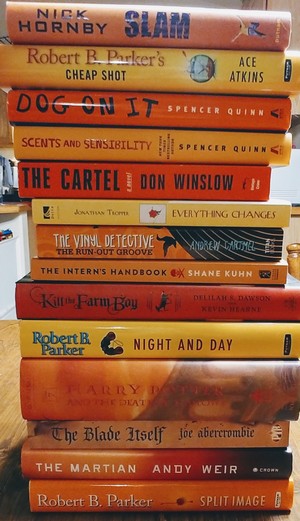
  • Chet from Dog On It by Spencer Quinn (my posts about Chet) — If I couldn’t cut Dog, I couldn’t cut Chet. Listening to this audiobook (my 4th or 5th time through the novel, I believe) reminded me how much I love and miss Chet — and how eager I am for his return this year. This Police Academy reject is almost as good a detective as his partner, Bernie, is. Chet will make you laugh, he’ll warm your heart, he’ll make you want a dog of your own (actually, all of these dogs will)
  • Zoey from Deck the Hounds by David Rosenfelt (my post about the book) — how do I not invoke Tara when discussing an Andy Carpenter book? Good question. It’s Zoey that brings Andy into the story, it’s Zoey that helps Don to cope with his own issues, it’s Zoey that defends Don and saves him (in many ways). Sure, Tara’s the best dog in New Jersey, but Zoey comes close to challenging her status in this book.
  • Lopside from Voyage of the Dogs by Greg van Eekhout (my post about the book) — It almost feels like cheating to bring in a dog from a novel about dogs — conversely, it’s hard to limit it to just one dog from this book. But Lopside the Barkonaut would demand a place here if he was the only dog among a bunch of humans — or if he was surrounded by more dogs. He’s brave, he’s self-sacrificing, he’s a hero. He’ll charm you and get you to rooting for these abandoned canines in record time.

Pub Day Repost: Kill the Farm Boy by Delilah S. Dawson and Kevin Hearne: A Comedic Fantasy Tells a Good Story While Playing with Too-Familiar Tropes

Kill the Farm BoyKill the Farm Boy

by Delilah S. Dawson and Kevin Hearne
Series: The Tales of Pell, Book #1
eARC, 384 pg.
Del Rey, 2018

Read: June 5 – 12, 2018
Ugh. I wish the eARC didn’t say I needed to hold off any quotations until I could compare it with the final copy — or maybe, I wish I had noticed that very tiny print before I got half a draft of this finished. On the other hand, I was having trouble narrowing down which of my lengthy options to use, because, if nothing else, this is one of the more quotable books I’ve read in the last couple of years.

Kill the Farm Boy is a comedic fantasy, a satirical look at fantasy and even a parody of the genre. But what makes it effective is that for all the comedy, there’s a decent story and some solid characters throughout. It’s be easy for it to be a collection of jokes, with no story; or a tale full of character types, not characters. But Dawson and Hearne avoid those pitfalls.

The titular farm boy, Worstley, is going about his typical day, full of drudgery when an inebriated pixie shows up to announce that he is a Chosen One — one who is destined to save, or at least change, the world. To demonstrate her power, the pixie gives one of his goats, Gustave, the power of speech. The goat isn’t too happy about being able to speak, but since he was destined to end up in a curry in a few days, decides to travel with the newly appointed Chosen One, his former Pooboy. The pixie, having Chosened Worstley, disappears. Worstley the Pooboy (hey, Taran, worse things to be called than Assistant Pig-Keeper, eh?) and Gustave head off on a quest for glory.

Despite the book’s title, we don’t spend that much time with Worstley — instead the focus shifts (for good reason) to a band of hero–well, a group of companions. There’s Fia — a fierce warrior from a distant land, who just wants to live a life of peace with some nice roses — and some armor that would actually protect her (not that there’s anyone who minds seeing here in her chain-mail bikini). Argabella, a struggling bard who is cursed to be covered in fur — she’s basically Fflewddur Fflam and Gurgi combined (last Prydian reference, probably). Every adventuring party needs a rogue/thief, this one has to settle for the klutzy and not necessarily bright, Poltro, and her guardian, the Dark Lord magician, Toby (though some would only consider him crepuscular), of dubious talents. I can’t forget Grinda the sand witch (no, really), Worstley’s aunt and a magic user of considerable talent.

There are no shortage of villains — and/or antagonists to this party. There are some pretty annoying elves; a hungry giant; Løcher, the King’s chamberlain and mortal enemy of Grinda; Staph, the pixie behind the Chosening; as well as several magical traps, Lastly, there’s Steve. We don’t meet him (I’m betting it’ll be in Book 3 when we do), but throughout these adventures we how much this world, and our heroes lives, have been turned upside down my the worst Steve since one (allegedly) unleashed the preposterous hypothesis that Jemaine was a large water-dwelling mammal. Steve . . .

The writing is just spot-on good. Dawson and Hearne have taken all these various and disparate themes, tropes, characters and surrounded them with a lot of laughs. There’s some pretty sophisticated humor, some stuff that’s pretty clever — but they also run the gamut to some pretty low-brow jokes as well. Really, these two are on a tight comedic budget, no joke is too cheap. The variation ensures there’s a little something for everyone — and that you can’t predict where the humor will come from. I will admit that early on I got annoyed with a few running jokes, but I eventually got to the point that I enjoyed them — not just in a “really? they’re trying it again?” sense, either.

For all the comedy — Kill the Farm Boy hits the emotional moments just right. There’s a depiction of grief towards the end (spoiler?) that I found incredibly affecting and effective. There are smaller moments — less extreme moments — too that are dealt with just right. Maybe even better than some of the bigger comedic moments. This is the reward of populating this book with fully-realized characters, not just joke vehicles.

I have a couple of quibbles, nothing major, but I’m not wholly over the moon with this (but I can probably hit sub-orbital status). There was a bit about a fairly articulate Troll being taken down by a female using (primarily) her wits that could’ve used a dollop or five of subtly. Clearly they weren’t going for subtle, or they’d have gotten a lot closer to it. But it bugged me a bit (while being funny and on point). Secondly, and this is going to be strange after the last 2 posts — but this seemed to be too long. Now, I can’t imagine cutting a single line, much less a scene or chapter from this, but it just felt a little long. I do worry that some of Poltro’s backstory is too tragic and upon reflection makes it in poor taste (at best) to laugh about her — which is a shame, because she was a pretty funny character until you learn about her.

This is probably the best comedic/parody/satire fantasy since Peter David’s Sir Apropos of Nothing — and this doesn’t have all the problematic passages. I’ve appreciated Dawson’s work in the past, and you have to spend 30 seconds here to know that I’m a huge Hearne fan, together they’ve created something unlike what they’ve done before. Well, except for their characteristic quality — that’s there. I cared about these characters — and they made me laugh, and giggle, and roll my eyes. This is the whole package, folks, you’ll be glad you gave it a chance.

Disclaimer: I received this eARC from Random House Publishing Group – Ballantine via NetGalley in exchange for this post — thanks to both for this.

—–

4 Stars

Born to the Blade 1.11: All the Nations of the Sky by Michael Underwood: Season 1 Wraps Up in a Strong and Sufficient Manner — but will leave the audience wanting more

My post about 1.10 was supposed to run 6/22, but I apparently only saved it as “Draft,” so it went up late on 6/28 (so glad I pushed off sleep last week to get it done), and then my thoughts about episode 1.11 were delayed a couple of days by not being able to push off sleep, but assuming I clicked the right buttons you still will get to read them when they’re fairly fresh. In a day or two I’ll have some thoughts on Season 1 of Born to the Blade as a whole — which will include some interaction with comments Bookstooge left a couple of weeks ago. Anyway, on to All the Nations of the Sky, the season finale.

All the Nations of the SkyAll the Nations of the Sky

by Michael R. Underwood
Series: Born to the Blade, #1.11

Kindle Edition.
Serial Box, 2018
Read: June 28, 2018
I’m going to try to keep my thoughts to this episode, but I won’t promise that I’ll succeed.

Somewhere between episodes 10 and 11 Michiko made a pretty big decision. Okay, she made a huge decision — and we only get to see the result, not the thought process — this is annoying, but I can live with it, if I have to (and, by the by, we know she found something in the paperwork that her predecessor left of interest to the current goings-on, but we’re not told what, this also is annoying). Part of the story-telling style that Born to the Blade is employing leaves us open to this kind of thing, so it’s to be expected — I’m just not crazy about it. Still, while I’m excited for what this means for Michiko, her nation, and the narrative opportunities for Season 2, I do regret what it means for some of the character interaction I’ve been enjoying all along. That’s all I’ll say about that now.

Also, I couldn’t help but feel that some of the progress made between Kris and Adechike last week has been walked back a bit — some of which I understand, most of which I want explained before I can get on board wholly. But I don’t see that happening. Still, I liked (both as a fan and as someone who’s trying to look at the series through an armchair-critical eye) what both Adechike and Kris did throughout this episode.

We got a long-awaited duel in this episode (like last episode), it didn’t end the way my fan-boy impulses wanted it to, but did end the way it needed to. It’s the kind of thing I think I expected the series to be built on — and if a certain little war hadn’t happened, probably would have.

Every jot and tittle about Ojo in this episode was perfect, and I wouldn’t change a thing. I can’t say any more, but this was spot-on.

I’m not sure what else to say at this point without venturing into spoiler territory, so I guess I’ll wrap it up.

Now, it’s easy — very easy — to forget about one nation of the seven — Tsukisen, and their warder, Hii no Taro. Yes, it’s explained a few times — but anytime Tsukisen is mentioned, it only seems to underline how often they aren’t. This can be improved — Underwood had a great opportunity here to fix that, and he passed. Which is okay, he’s not the only one who had the opportunity, and I can only assume that this means that there’s a plan behind it. I do hope that’s rectified quickly in Season 2. And this point probably belongs more to the season-long wrap up post I’m trying to do, but I wanted to get it down before I forgot.

This has been dubbed as “Season 1” since the beginning, so we knew everything wasn’t going to wrap up nicely. In fact, there’s a lot that’s left hanging. But we got enough resolution to leave readers satisfied with where things left off. I do hope that Serial Box gives this team another shot to tell their story because I’m very curious about a few things and characters. But for now, we’re left with an optimistic, but not a rose-colored glasses, ending — true to the vision of the initial episodes, but with a darker undercurrent than one might have guessed from the first couple of installments. I’m not wholly sold on everything that happened this season, but I’ve come to accept and appreciate 96% of it — and I will probably come around on the rest eventually.

A good story, a good cap to the season and a good launching point for a potential Season 2. I’m just going to stop before I say “good” again — pick up season 1 now, if you haven’t yet.

—–

4 Stars

Page 37 of 48

Powered by WordPress & Theme by Anders Norén