Category: General Fiction/Literature Page 46 of 54

Review Catch Up: The Rosie Project; Where’d You Go, Bernadette; The Rosie Effect; Funny Girl

I’m hitting another block when trying to talk about the last few books I’ve read, because here’s another batch of very overdue takes on some good books (and one not).

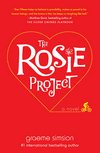
The Rosie ProjectThe Rosie Project

by Graeme Simsion
Series: Don Tillman, #1
Hardcover, 304 pg.
Simon & Schuster, 2013
Read: November 6, 2013


This was charming, witty, and had plenty of heart — even without the romance, which just took it all to another level. It was just plain fun to read.

Don Tillman is just a great character — he’s likely someone with Asperger’s, if not fully Autistic. Which is mentioned once or twice, and then not brought up again. He’s then treated as a stubborn, curious, character with behavior patterns no one can seem to understand, but most people in his life figure out hot to cope with. Sometimes they laugh at him, sometimes they get frustrated or angry. What he’s not treated as is someone with anything. He’s not treated by his symptoms, he’s just treated as this guy. Simsion’s treatment of Don reminds me of Abed Nadir, from Community (which is high praise from me).

The only complaint I had was that the last chapter wasn’t really needed, and maybe would’ve been best left to the imagination. But, setting that aside, it felt rushed, while the rest of the book was so well done, it just stuck out like a sore thumb.

Still, whatever — one of my favorite books of 2013, and still one of the best RomComs I can remember.

5 Stars

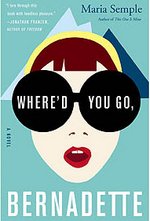
Where'd You Go, BernadetteWhere’d You Go, Bernadette

by Maria Semple

Hardcover, 330 pg.
Little, Brown and Company, 2012
Read: January 01 – 02, 2014

Do you get seasick? People who don’t get seasick have no idea what it’s like. It’s not just nausea. It’s nausea plus losing the will to live.

I should get that embroidered on something.

This starts light and breezy, a little strange, a little typical “these crazy (white) suburbanites with too much money”; but you know it’s going to get dark eventually — probably nasty dark, but first it’s going to lull you into a false sense of fun. I don’t think it gets as dark as it felt like it could’ve, it didn’t need to, and I’m glad it didn’t — but there was a whole lot going on that the whacky beginning didn’t indicate.

You don’t have care about the story because these characters are strength enough to carry your attention for quite awhile with nothing happening — and Semple’s style is just as strong. But there is a story here, a story of a daughter discovering just who her mother was — as is — a story about a talented woman who ended up loving a life she’d never have expected or picked for herself or her family. So you do care about the story — especially the way it’s told, in bits and pieces, jumping back and forth through time, from multiple perspectives — particularly when you get two or three perspectives painting a picture of an event — as Bee digs into her investigation.

Fun story, quirky characters, well-told story, with plenty of heart — and too many quotable lines. I jotted down a few that I can’t resist sharing, even in this abbreviated post.

You probably think, U.S./Canada, they’re interchangeable because they’re both filled with English-speaking, morbidly obese white people. Well, Manjula, you couldn’t be more mistaken.

Americans are pushy obnoxious, neurotic, crass — anything and everything — the full catastrophe as our friend Zorba might say. Canadians are one of that. . . To Canadians, everyone is equal. Joni Mitchell is interchangeable with a secretary at open-mic night. Frank Gehry is no greater than a hack pumping out McMansions on AutoCAD, John Candy is no funnier than Uncle Lou when he gets a couple of beers in him. No wonder the only Canadians anyone’s ever heard of are the ones who have gotten the hell out. Anyone with talent who stayed would be flattened under an avalanche of equality.

Really, who wants to admit to her daughter that she was once considered the most promising architect in the country, but now devotes her celebrated genius to maligning the driver in front of her for having Idaho plates?”

4 Stars

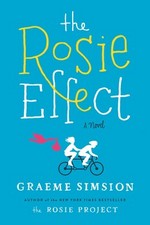
The Rosie EffectThe Rosie Effect

by Graeme Simsion
Series: Don Tillman, #2

Hardcover, 352 pg.
Simon & Schuster, 2014
Read: January 12 – 13, 2015

“To the world’s most perfect woman.” It was lucky my father was not present. Perfect is an absolute that cannot be modified, like unique or pregnant. My love for Rosie was so powerful that it had caused my brain to make a grammatical error.

Don and Rosie are living in New York, getting used to married life, and expecting a kid. None of which goes well — so, of course, Don tries to tackle things the same way he did in the last book. Instant sequel, just add water.

This sequel was written with the same wit and skill as The Rosie Project, but the story wasn’t there — and more importantly, neither was the heart.

Mostly, I think, because Rosie wasn’t around for a lot — and when she was there, she wasn’t a character, she was an obstacle.

Other than really liking the occasional line (maybe more than occasional), I just didn’t like how Rosie or Don were written, the plot was shoddy and contrived, and I was just glad to be done with it so I could move on.

2 Stars

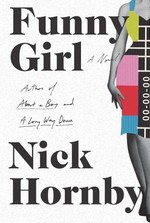
Funny GirlFunny Girl

by Nick Hornby

Hardcover, 452 pg.
Riverhead Books, 2015
Read: February 7, 2015

How on earth could he love her? But he did, Or, at least, she made him feel sick, sad, and distracted. Perhaps there was another way of describing that unique and useless combination of feelings, but “love” would have to do for now.

Everything I know about this era of British culture and TV comes from The Hour and An Adventure in Space and Time, so I just have to trust that Hornby did his homework on this. I thought the behind-the-scenes stuff was great, it felt real — it felt like the kinds of conversations that writers and actors should be having anyway.

The love story turned out a lot different than I was sure it would – thankfully. Actually, most of the book did. This wasn’t the rags-to-riches-to-wreck story that it seemed like it was going to be, but a story of some people with dreams and talent doing what they could to get going in a cutthroat business. Dreams were chased, many were caught, others changed/grew — as did the dreamers.

In the midst of the discussions about the nature of their show and the stories they told — both during the making of the show Barbara (and Jim) and in later chapters where it was being looked back at, I kept wondering if tucked away in all that was an apologia for light fiction like Hornby writes? If so, I appreciated it. (it also reminded me of some similar comments John Cleese has made lately, after coming to terms with being someone who makes people laugh, and not saving the world or something grander)

Thoughtful, heartfelt, charming — this is Hornby at his most confident and mature. I can see why some aren’t liking it, but it really clicked for me.


4 1/2 Stars

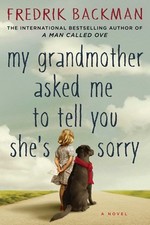
Opening Lines – My Grandmother Asked Me to Tell You She’s Sorry

Head & Shoulders used to tell us that, “You never get a second chance to make a first impression.” That’s true for wearing dark shirts, and it’s especially true for books. Sometimes the characters will hook the reader, sometimes the premise, sometimes it’s just knowing the author — but nothing beats a great opening for getting a reader to commit. This is one of the better openings I’ve read recently. Would it make you commit?

Every seven-year-old deserves a superhero. That’s just how it is. Anyone who doesn’t agree needs their head examined.

That’s what Elsa’s granny says, at least.

Elsa is seven, going on eight. She knows she isn’t especially good at being seven. She knows she’s different. Her headmaster says she needs to “fall into line” in order to achieve “a better fit with her peers.” Other adults describe her as “very grown-up for her age.” Elsa knows this is just another way of saying “massively annoying for her age,” because they only tend to say this when she corrects them for mispronouncing “déjà vu” or not being able to tell the difference between “me” and “I” at the end of a sentence. Smart-asses usually can’t, hence the “grown-up for her age” comment, generally said with a strained smile at her parents. As if she has a mental impairment, as if Elsa has shown them up by not being totally thick just because she’s seven. And that’s why she doesn’t have any friends except Granny. Because all the other seven-year-olds in her school are as idiotic as seven-year-olds tend to be, but Elsa is different.

She shouldn’t take any notice of what those muppets think, says Granny. Because all the best people are different–look at superheroes. After all, if superpowers were normal, everyone would have them.

from My Grandmother Asked Me to Tell You She’s Sorry by Fredrik Backman

It was really hard to stop where I did, I wanted to use the first three pages, but am pretty sure that it’d get me in copyright trouble.

If I Fall, If I Die by Michael Christie

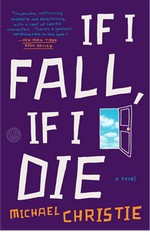
 If I Fall, If I DieIf I Fall, If I Die

by Michael Christie

Paperback, 323 pg.
Hogarth, 2015
Read: October 20 – 23, 2015

When he was a toddler, Will and his mother, Diane, moved into a house in rural Canada (somewhere north of Toronto, I think) and never left. I don’t mean that didn’t move to a different residence, I mean they didn’t leave. Diane was a filmmaker — some sort of arty, documentary/montage-type thing — with some psychological issues that got more and more intense until sometime after Will’s birth. By the time he was 2(ish), these issues had pushed her to the breaking point, and she had to retreat to a home that she’d bought with her brother before his death years previous. Diane has some sort of panic disorder and a pretty strong case of agoraphobia — so strong that Will ends up exhibiting most of the symptoms without, you know, actually being agoraphobic.

About 10 years later, Will hears a strange noise in the front yard, and before he knows what’s happening, he’s outside, investigating. Sorry, that’s Outside. Where danger lurks, bad things happen, and people shouldn’t be. He meets a kid about his own age, is mystified by him and drawn to him — mostly because he seems brave, but also, because he’s someone his own age. Within a few weeks, Will is sneaking outside for short jaunts — walking around the neighborhood, looking for his friend. Soon, he convinces his mother to enroll him in school, where he tunes out the teacher, but makes a couple of friends.

From this point on, the book diverges — on the one hand, we get Will’s continued socialization, growth, and maturation. As well as a better understanding of what happened to his mother.

On the other hand, Will and his school-friend, Jonah find themselves adventuring. Jonah’s a very smart kid, on the verge of falling through the societal tracks (like most of the local Indians) with criminal brothers, and a knack for looking graceful on a skateboard. He teaches Will to skate, and how to be less awkward. The two also enact some real Tom Sawyer/Huck Finn escapades, while hunting for Will’s first Outside-friend — which brings them into contact with all sorts of nefarious individuals.

The latter of these two paths is slightly less interesting, and is executed less convincingly — although it’s clearly the more exciting and eventful. It also seems like that it’s Christie’s focus, it’s the core of the story he seems to want to tell. Sadly, it’s not the one I wanted to read (as much), especially because all of it was pretty predictable. I’m not saying it’s not worth reading, but it just didn’t do as much for me as the other stories. Titus, in particular, the homeless man they befriend (for lack of a better word) is pretty entertaining with his frequent Dogberryisms.

Will gets braver and braver, and a little wiser until he comes to the realization that something bad is always going to happen — to you, to someone you love, to someone you know, to someone you read about in the newspaper — it’s just a question of how you live until then. The question is, armed with this understanding: how will he live? Can he help his mother?

Will, Diane, Jonah — are all richly drawn characters (which isn’t too surprising, given the focus on the first two). Many of the supporting characters are about as well drawn — Will’s first school friend, Angela, was great, but I could’ve used more of her (the story didn’t require more of her, we didn’t need more of her). The villains were a bit sketchy, but there were as fully developed as the needed to be to serve their purpose (see again, Tom Sawyer/Huck Finn comparison).

The writing was insightful, and while I wouldn’t want to hold up Diane as a test case for agoraphobia, I really felt like I understood her. I felt the same about Will — I particularly liked the way that his becoming acclimatized to the Outside wasn’t a straight line, or easy growth — but it came in fits and starts, with many steps backward (some brought on by his own insecurities, some by his mother’s). His perspective (especially early on), vocabulary, worldview, and social awkwardness (the nicest way I can put it) all fit someone who’s been locked away from the world and only interacted with a loving, doting mother; television; and delivery men.

Whatever the flaws, this was a really good book, and one I’m very glad it came across my path. Michael Christie is a name I will keep an eye out for in the future.

Disclaimer: I received this book from the nice folks over at Blogging for Books for this review. Not sure they got their money’s worth, but I hope so.

—–

4 Stars

Opening Lines – If I Fall, If I Die

We all know we’re not supposed to judge a book by its cover (yet, publishing companies spend big bucks on cover design/art). But, the opening sentence(s)/paragraph(s) are fair game. So, when I stumble on a good opening (or remember one and pull it off the shelves), I’ll throw it up here. Dare you not to read the rest of the book

The boy stepped Outside, and he did not die.

He was not riddled with arrows, his hair did not spring into flame, and his breath did not crush his lungs like spent grocery bags. His eyeballs did not sizzle in their sockets, and his heart’s pistons did not seize. No barbarian lopped his head into a blood-soggy wicker basket, and no glinting ninja stars were zinged into his throat.

Actually, incredibly: nothing happened–no immolation, no blood-bath, no spontaneous asphyxiation, no tide of shivery terror crashing upon the shore of his heart–not even a trace of his mother’s Black Lagoon in his breath.

Somehow Will was calm.

from If I Fall, If I Die by Michael Christie

Whirligig by Magnus Macintyre

WhirligigWhirligig

by Magnus Macintyre

Paperback, 301 pg.
Marble Arch Press, 2015
Read: October 13 – 14, 2015

This is the story of a self-centered, shallow, city-dwelling fat man who takes an opportunity to reinvent himself and travels to a small town in Scotland to be the voice of a proposed wind farm. Which, of course, he knows nothing about. So, our fat man, Claypole, spends the next week bouncing around from here to there in this community, finding himself in one embarrassing/catastrophic situation after another. I think this is where we’re supposed to find humor — it never struck me as funny. These all just seemed like a guy acting without thought and finding himself being taken care of like some sort of bumbling Candide.

As anyone who’s read this setup knows, once this particular Englishman went up this proverbial hill, he developed an understanding of this community, learned some important life lessons, and whatnot before he came down the proverbial mountain.

I couldn’t tell, really, how sincere we’re to take the “green” portions of this story — there are a couple of true believers, and a cartoonish doubter or two — but the rest, their interest in/commitment to the cause seems pretty shallow. Now, that’s the characters, not the author, I grant you. But when the central plot revolves around the establishment of an environmentally friendly source of power, I expect a bit more than that.

Those people that do actually end up liking Claypole — I don’t get it. Particularly those who take a seemingly instant liking to him. He’s such an offensive buffoon that it’s hard to understand. I guess I can understand those who grow to like him when they see the man behind the awkwardness.

The people of this small town are sketchy, outside of one family, they’re fairly generic stock characters. And that family? I can’t buy them either, a little more fleshing out and I probably could’ve believed them. But pretty much, they’re just a collection of characteristics, tics, and odd wardrobes.

Whirligig has very sweet ending, and it was not exactly the one a reader would expect, but pleasant, and – like “crap telly” (Claypole’s words) had taught him, one that tied everything up nicely.

Not funny enough, not “green” enough, and I couldn’t connect the way I wanted to with anyone. Near miss after near miss after near miss takes me to a 2 1/2 Star rating.

—–

2 1/2 Stars

How to Write a Novel by Melanie Sumner

How to Write a NovelHow to Write a Novel

by Melanie Sumner
Paperback, 287 pg.
Vintage, 2015
Read: September 28, 2015

Aristotle — but you can call her Aris — Thibodeau is a 12 1/2 year-old would-be novelist. Under the guidance of her English teacher, school librarian and English-professor mother, she’s trying to write a novel in the next 30 days. Once it’s sold, she figures she’ll be able to make enough money so her mom can quit her job, still take care of her brother with his counseling/medication and find a husband. Aris does have a candidate in mind for her step-dad, but is open to someone else. We get to see precious little of her writing, but we do get to follow her on her journey through the novel writing process, and the family turmoil and drama surrounding it. Actually, as I write that, I have a hard time believing everything that happened outside of her novel took less than 30 days.

There’s a strong self-awareness to the narration — from Aris stopping the action to describe something she’s lacking in her novel, and then providing it in the narration to the sections of the book being labeled “Rising Action,” “Denouement,” etc. Typically, it works, but there were a couple of instances where it seemed forced or overdone.

There are two really strong points to this novel. Sumner can write a sentence that just sings I grabbed three examples from the opening pages — we get voice, humor, and a crystal-clear idea of the character she’s describing (and the one doing the describing):

Diane is forty-three now, short and either curvy or chubby, depending on her mood, with a button nose and blondish bangs that are always falling in her face.

Then he grinned. Papa was old before braces came out, so his teeth are slightly crooked, just enough to make him look like he can tell a good joke.

. . . ladies in the South don’t shake hands. Instead, they fold their cool fingers over yours and press ever so gently, leaning in close until you smell breath mints and the eau de toilette behind each ear. Then they say something awful. A few days after Joe [Aris’ father] died, Grandma and knelt beside Diane’s [Aris’ mother] bed and folded her fingers over her hand. After looking into her eyes for a moment, she whispered, “Why didn’t he ever have a better job?”

Don’t ya just luuuuv Grandma?

The other strong point (maybe half of a point) is her characters — Aris, Diane, her brother Max — are great. Diane’s student, Charles and his mother are pretty well-drawn. The librarian Ms. Chu wasn’t that fleshed out, but she didn’t need to be, and she was well drawn enough that you want to see more. These are real people, you could build a book around any of them alone. But the rest — and I’m only talking about characters that should be well-drawn — just aren’t. Aris’ grandparents don’t become much more than they were described above. The worst is Aris’s choice for her future step-dad, their current volunteer nanny: Penn MacGuffin*. He’s an accumulation of ticks, quirks, and clichés, but there’s not a person in the middle of that.

The more I think about it, the less I’m sure I like How to Write a Novel as a novel, however frequently clever it is. There are some great scenes, dazzling sentences, charming characters here; it was a pleasure to read. But I’m just not sure there’s much there beyond that.


* I’m not going to mention how long it took me to realize what his name meant — let’s just say it was before this moment, and I felt really, really stupid

—–

3 Stars

Reread Project: The Van by Roddy Doyle

The VanThe Van

by Roddy Doyle
Series: The Barrytown Trilogy, #3

Trade Paperback, 311 pg.
Minerva, 1991
Read: August 25 – , 2015
Jimmy Rabbitte, Sr. started off as a supporting character in The Commitments, moved up to co-star in The Snapper, and finally moves to the forefront in The Van, which is more about him than the other two were about any one person. Which isn’t to say that Jimmy, Jr., Sharon, Veronica, Darren and the twins aren’t here, they’re just in the background — as are most of Jimmy, Sr.’s friends (actually, I think Jr.’s in this far more than he was The Snapper).

Not only is the focus more narrow, the final installment in the trilogy is different in other ways — it’s almost 100 pages longer (depending on the printing) than The Snapper which was about 50 pages longer than The Commitments. Which gives Doyle more space to do things he hadn’t really before. It’s still primarily told through heavily stylized In the first 90 pages, I estimated I’d read more (significantly more) narration than I did in the first two volumes of the trilogy.

It’s not been clear before what Jimmy did for a living, but whatever it was, it was pretty clear the bills were barely paid. They stretched what they had pretty far, but they seemed to manage. Somewhere along the line, pretty sure it was post-Snapper, but I’m not sure, Jimmy lost his job. Unemployment isn’t setting well with him — he can’t support his family, he’s bored, he can’t even go down to the pub to have a few pints with his friends.

Jimmy’s trying to grow — he’s reading the classics. Thinking of taking some classes. But it’s not enough. At some point his friend, Bimbo, also gets laid off. The two spend a lot of time together — having a companion in his unemployment makes the whole thing tolerable for Jimmy — almost like summer vacation from school. Bimbo isn’t quite as accepting of this new reality — he almost applies to work at McDonald’s, but is shamed out of it by Jimmy. Bimbo’s wife is even less satisfied with his job status. Which leads to a reckless move on Bimbo’s part — reckless, yet maybe inspired — he uses some of his last dollars on a Chip Van (minus an engine). In the midst of the U.S.’ current Food Truck craze, this might not seem so risky, but in the early 90s? (then again, what do I know of early 90’s Dublin, other than what I’ve picked up from Doyle’s novels and the movies based on them?)

They’ve just a few weeks until the World Cup games start when they hope they can cash in on the post-game crowds. So Jimmy and Bimbo rush to clean the, learn to cook, design a menu, etc. And now you’ve got yourself a plot — can these two make a go of this? Can they remain friends and co-workers? Will they start a grease fire that destroys the whole of Barrytown?

There was, it seemed to me, a maturing of Jimmy that started back in The Snapper. Not that he wasn’t a good father before, but he kicked it into a higher gear with Sharon during her pregnancy. Here, that seems to manifest itself in a paternal pride — Junior’s having some sort of success out there, is getting married; his other son, Darren, is doing very well in school (better than anyone else in the family, that’s sure). Part of Jimmy’s reaction to it is finding pleasure in someone else’s success for what it means to them. I’m not convinced that the Jimmy of The Commitments or the first part of The Snapper could do that.

That’s not to say that he’s Man of the Year material or anything. There are some real (human) flaws to him. He’s petty, he’s jealous, he’s proud — there’s some sort of mid-life crisis that he’s got a half-hearted interest in involving Other Women. As in all good fiction, these just make him someone you can like, someone you can relate to, someone you can get annoyed with — even pity.

There’s some great, great stuff about sports fans here — national pride around The World Cup, the joy in sports, the very real camaraderie that can exist for a few moments around a shared experience. That’s not my typical milieu, but I’ve tasted it a time or two — and I can’t imagine many capture it better than Doyle did here. Even if I didn’t like the rest of the book, I think that part would’ve been worth it.

In the end, this is Doyle’s best work (to date), not the most enjoyable, but the best. It’s impossible after reading this, to ignore Jimmy, Sr.’s brief appearances in The Commitments, to not pull for him earlier than you should in The Snapper, and really to forget him. Just a great character in a world you really don’t want to leave.

—–

4 Stars

Go Set a Watchman by Harper Lee

Go Set a WatchmanGo Set a Watchman

by Harper Lee
Hardcover, 278 pg.

HarperCollins, 2015

Read: August 14 – 15, 2015

Maycomb did not have a paved street until 1935, courtesy of F. D. Roosevelt, and even then it was not exactly a street that was paved. For some reason the President decided that a clearing from the front door of the Maycomb Grammar School to the connecting two ruts adjoining the school property was in need of improvement, it was improved accordingly, resulting in skinned knees and cracked crania for the children and a proclamation from the principal that nobody was to play Pop-the-Whip on the pavement. Thus the seeds of states’ rights were sown in the hearts of Jean Louise’s generation.

I don’t know what to think. I just do not. It’s that simple. I probably shouldn’t even be blogging about this one, but I feel compelled to.*

There are so many things that’d help me know what to think about this; for example: 1. if there wasn’t the cloud of controversy over the publication — did Lee really want it published? Is she of sound enough mind to make that choice now? and so on. 2. If there’d been a third book of hers published, it’d be easier to know which is the aberration — Mockingbird or Watchman (because there is a clear qualitative distinction) — it’d be easier to cut her some slack if we knew this wasn’t her typical work.

Am I glad I read this? I think so. There are phrases, sentences, paragraphs, vignettes, scenes, that I relished. I do think I like the story of Jean Louise here. I think I appreciate Atticus as father, not necessarily Atticus as a man making certain choices. I’m pretty sure I like Jean Louise’s Uncle Jack.

But there’s bits about this novel that just confound me. Some of the speechifying seems so out of place (and I won’t get into what I think of the points of them). A lot of the speechifying makes it seem like an unfinished draft — where Lee could’ve come back, fleshed it out, edited it and made the same points through dialogue, not monologues.

Maybe in time, after weeks/months of thought, a few re-reads, some distance, I’ll have an opinion about the book that I can stand behind. Right now, best I can manage is a shrug.

—–

* And because I’m really close to having blogged about every novel this year, haven’t missed one since February — and I don’t want to break my streak.

—–

? ? ? ? ?

The Most Useless Page Ever?

Is there anyone holding this book in their hands that needs to be given this information? Why waste the ink?
Also by Harper Lee
“Oh, To Kill a Mockingbird, huh? Never heard of it. Wonder if it’s any good.”

Obviously, there are people who haven’t heard of the Mockingbird — but none of them are going to be tempted to pick up Go Set a Watchman.

Now, the question is, once the initial furor/money-grab over this new book has died down, are there going to be future printings of Mockingbird printed with an “Also by Harper Lee” page? And if so, will the font size be legible?

At this point, I’ve got a little less than a hundred pages to go in the book, and I have no idea what I think of it. Individual sentences or paragraphs? I have very strong opinions about some of them.

But the novel?

I just don’t know.

Long Black Curl by Alex Bledsoe

Long Black CurlLong Black Curl

by Alex Bledsoe
Series: Tufa, #3

Hardcover, 377 pg.

Tor Books, 2015

Read: June 11 – 13, 2015

5 Stars
This book was practically un-put-downable. Not because I was driven to find out what happens next — like a Finder, or Child etc. This is one of those kind of books you don’t want to put down because you don’t want to leave that world, not for a minute, to step back into this one, as nice as it is — filled with your stuff, and your great wife and frequently tolerable children. But this book’s little corner of Appalachia that touches another world (in more ways than one) is a place you just want to exist in. Granted, I’d rather be in one of the earlier books than this one (not a reflection of the quality of the book, just the events portrayed).

Not all that long ago, especially by Tufa standards, Bo-Kate Wisby and her beau, Jefferson Powell wreaked all sorts of havoc. They were so terrible that they were banished from the community, unable to return — or, worst of all, make music. WHen you think of some of the despicable things that have happened or have been described in the previous two novels by citizens in good standing, you get an idea just how bad this was. Both have spent decades yearning to return, to play music — but have had to settle for incredibly successful careers in the music business. Which would be a special kind of torture and pleasure — being that close but not able to partake, still being able to appreciate it though. Somehow, however, this curse was lifted without anyone realizing it.

Well, anyone but Bo-Kate. She returns to get revenge and bow the Tufa to her will, destroying their heritage, their way of life and instituting her own. Her approach is not subtle, she clearly learned a little bit from the “Shock and Awe” tactics of a recent war. My jaw almost dropped when i saw the first step that was taken by Bo-Kate. I — like most of the Tufa — didn’t think that was possible, or at least likely. Although there was something to appreciate about that action, there wasn’t in the rest of what she did to the community — I can’t think of any fictional character I’ve had such a visceral reaction to (especially this quickly) this side of Joffrey Lannister Baratheon, first of his name.

It should go without saying with this world, the way the rest of the Tufa respond and defend themselves isn’t how you’d expect. Which goes double for how things play out.

Thankfully, I did really enjoy the rest of the Wisbys — especially Bo-Kate’s sister. I hope to spend more time with them. Actually, I liked getting to know all the new characters — including Bo-Kate’s allies (or those characters who weren’t new, but we hadn’t really spent time with). The characters in this community are so well drawn, so real that you almost don’t need a plot to enjoy a book about them.

As always, I’m jealous of the relationship between these people and music. I don’t have it — a couple of my kids do, at least. I think the way the two banished Tufa react to their returning musical ability tells you almost everything you need to know about them. These are books that need to come with their own score, their own soundtrack. Sadly, I don’t think humans are capable of putting out anything worthy of the books. As good as some of the music inspired by this series has been, it’s not good enough to live up to Tufa standards.

Two things that detracted from the book for me. First is the sex. Not that Bledsoe’s a model of Victorian attitudes toward sex before this, but Long Black Curl is pretty sexually explicit — moreso and more often than before (I’m reasonably sure, but am not interested enough to go back and check). I don’t think it was necessary, but don’t think it hurt things. It was just one of those things that seemed to stick out to me.

Secondly, this is absolutely the most straight-forward of the series, which is both a strength and a weakness. It’s more accessible. There’s almost no doubt whatsoever whats going on. The previous two books haven’t been exactly subtle about the magic and how it works out in the lives of the Tufa — but (and I’m struggling to express this the way I want to) they mostly just let us see what happened and say “hey, that’s magic.” There’s some winking and nudging, but primarily the reader has to do the heavy lifting. To switch metaphors, Bledsoe gave us all the numbers and equations, but we had solve for x on our own. But here? It’s all spelled out. It’s somewhat refreshing, but a little disappointing, too.

But that’s just a little tarnish to the series. It’s still one of the best out there. This book changes the world, but not so much that you won’t recognize it — this is all about growth, development. It does my heart good to know that Bledoe is writing #5 at the moment, so we’ve got at least a few hundred more pages of this world to come.

You can absolutely start here, but I think you’d be better off starting with the first, The Hum and the Shiver to you can catch all the nuance and atmosphere and all that. What it means that character X shows up and does Y. That kind of thing. Either way, dive into this world.

—–

4 1/2 Stars

Page 46 of 54

Powered by WordPress & Theme by Anders Norén