Category: General Fiction/Literature Page 47 of 54

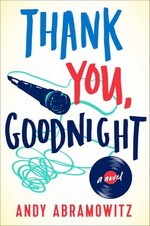
Thank You, Goodnight by Andy Abramowitz

Thank You, GoodnightThank You, Goodnight”

by Andy Abramowitz
Hardcover, 338 pg.
Touchstone, 2015
Read: June 30 – July 3, 2015

In most instances, space between people grows like mold, neglected just long enough to be noticed. You intended to wipe it clean, but the more of it there is, the more daunting a task it becomes to erase it. Not so with me and the band. I’d discontinued those people as if they were a premium cable channel that I’d finally realized was broadcasting nothing I wanted to watch.

From passages like that, a nice mix of thoughtful, sentimental, with a bit of a grin; to the out-and-out funny, like the funniest suicide attempt I’ve read in a long time, possibly ever (something worthy Save Steve Holland’s Lane Myer, but longer); this book covers the spectrum. Not only covers it, but does so with assurance and panache. It’s one of those first novels that makes you wonder what could possibly be done as a follow up.

Teddy Tremble is a successful enough lawyer for someone who’s heart isn’t really in it, while still being good at it. He’s sort of coasting through life — being good enough at his job, good enough with his girlfriend of forever, good enough for his social circle, but not good enough for his father (but after meeting him, you understand that’s just a given). He’s forty-ish and realizes that life is going to pretty much stay this way. On the whole, he seems okay with that — but in the back of his mind he knows he’s not. He won an Academy Award. His band was huge for a little while in the 1990’s, before his hubris ruined things. Sure, things are good enough now, but once upon a time they were great.

Then through a truly humbling and bewildering set of circumstances, Teddy comes across a group of huge Tremble fans. Seriously, die-hard doesn’t begin to describe these people. Think something akin to the kind of people that organized the first Star Trek convention back when it wasn’t a cultural phenomenon, just a short-lived and then canceled show. This changes everything. The adulation, the attention, the satisfaction of performing gets under his skin and he starts writing music for the first time in a long time.

Pretty soon, he’s (forgive the cliché) trying to get the band back together — his agent and producer are on board, convinced that what he’s written exceeds his former quality. Incidentally, both of these characters are the kind that we readers hope to come across — supporting characters that threaten to steal the entire novel, but when used properly just make the whole thing better.

Anyway, with these two on board — Teddy just has to convince the rest of the band to give it a shot, to trust him. Maybe even to forgive him for what he did to them so long ago. Then he has to convince music fans to take them seriously. Neither of these tasks is going to be easy. Both are practically impossible, really.

The book starts out as pretty entertaining, definitely amusing. But it doesn’t stop there — it gets better, deeper, emotionally richer all the while. By the time I got to (and through) Chapter 20, I tweeted that, “Not sure I need to read another word (am going to), but that was as close to perfect as it gets.” I’m still thinking about it a month later.

At various places through the novel, Teddy observes: “One day I’ll die, and this will be one of the things I did with my time.” I’m not sure if I’ve ever seen one sentence used so many different ways with so many different meanings depending on the context. Sometimes he’s says it wryly, sometimes caustically, sometimes wistfully, sometimes with pride. It’s one of those writerly things that when you see it in action, you wonder why more people don’t try it.

Each of these characters — the agent, the producer, the bandmates, their (sometimes very odd) families, Teddy’s girlfriend, associates in the law firm, and others — are well-drawn. Occasionally familiar, without being stock characters or cliché, each character ends up being strong enough that you want to spend at least a little more time with them. But Abramowtitz is too capable of steward of his resources and gives us just enough to leave us wanting more.

I’ve seen a lot of comparisons of Thank You to Hornby’s High Fidelity and Tropper’s This is Where I Leave You. I don’t get that. Maybe it’s just because these people haven’t read anything else by these authors — they should be comparing this to Hornby’s Juliet, Naked and Tropper’s One Last Thing Before I Go (to be fair, I have seen a little of this comparison, but no one else that I’ve seen has tagged Juliet). These three cover some of the same territory, and Abramowitz comes out looking really good in that company. Don’t get me wrong, I really liked Juliet, I know I liked it more than most people I know. But I don’t think it was as good as it wanted to be or as it thought it was. Thank You seems to do the things that Juliet was wanting to do but didn’t get done. I’m not necessarily saying it’s a better book (I might lean that way), but this is more successful in the areas they overlap. Similarly, while I wouldn’t say that One Last Thing is a bad book, it can’t hold a candle to this one. I’m not trying to make this a competition, but for this first-time novelist to get things better than old pros like Hornby and Tropper says so much about him.

One day I’ll die, and reading this will be one of the things I did with my time. I’m so glad it was.

—–

4 1/2 Stars

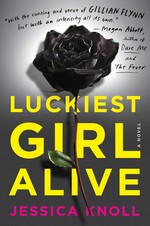
Luckiest Girl Alive by Jessica Knoll

Luckiest Girl Alive Luckiest Girl Alive

by Jessica Knoll

Hardcover, 338 pg.

Simon & Schuster, 2015

Read: July 27 – 31, 2015
There has been so much buzz about this book the last couple of months, it might as well be inhabited by bees. There’s been a couple of times this summer that half of my Twitter feed seems obsessed with it — it’s really only one or two people, but they really like posting reviews about it. I get the love for it — I don’t share it (at least to the extent that so many seem to) — but I can see where some would go ga-ga over it.

For me, not since Mark Watney from last year’s The Martian has a book depended so much on a narrator’s voice for me. This thing rises and falls with what you think of Ani FaNelli. If she doesn’t turn you off in the first 10 pages (odds are, I know the exact line), you’ll enjoy the ride.

The book opens on Ani and her fiancé working on their wedding gift registry, but it’s pretty much unlike every such trip you’ve seen/read. I’m pretty sure I emitted an audible chuckle or two. The fiancé is not really a cad, not really a bore, more of a guy who would be a jerk, or a really good guy if he just put a little effort into things in either direction, but can’t seem to bother to care. Ani is driven, emotionally-complex, with a dark sense of humor, there’s a subtext straight from the start that says some nasty stuff has happened to her, and it’s shaped the way she relates to life — it should be said that this subtext isn’t all that “sub.”

As we march towards the wedding day, we start to look back at how Ani’s (then TifAni’s) high school life made her into who she is today — her trials, her trauma, her friends, and everything else. As we get further along in each story, we gain more understanding of why she does what she does. I’m not all that certain I liked Ani as a person, but as a character? Oh, yeah. She’s a damaged mess of various disorders, doing her best to keep things together and progressing (it’s clear that she’s earned every one of those disorders). In the end, Ani just wants acceptance, love (for who she is, not what someone wants her to be), and a little public vindication. It’s just harder for her to find that because of who she is.

It’s hard to argue with desires like that — particularly from someone who’s gone through what she’s gone through. I’ve seen more than one review who talked about not being able to connect to Ani, and while I enjoyed her voice, I’m not sure I could either. What I could connect with was her goals, her desires. So my emotional investment came from wondering what kind of success she’d find.

Ani had a plan — one overarching plan since high school — she developed it, let it evolve, but by and large her plan was everything to her, a religion. I don’t think you could say it was a great plan, but it seems plausible. More than that, it was Ani’s and she liked it. But — somewhere in these pages, a little of that character growth thing happens — plus a handy accident occurs — that necessitates change in her plan. It’s impossible to say if that growth would’ve without the accident, or without the growth if she’d been able to take advantage of the accident. Either way, it’s how you handle a change in your circumstance and plans that reveals the most about you, right? The payoff here was satisfying.

The book promises a lot of twists — and there are several — but most of them I could see coming. That didn’t matter, Knoll teases them just long enough, and then brings them to light just at the right time for them to be fully effective. The ones I didn’t see coming, on the other hand? They were just as effective, and oh, so wonderful.

Thanks to the cover copy and promotions, this is being compared to Gone Girl — some people like the comparison, some don’t. I’m not going to make that comparison (mostly because I haven’t read the other). But for cryin’ out loud — don’t base you opinion of this book on that comparison. That’s not Knoll’s comparison, it belongs to someone at Simon & Schuster’s marketing department (and valid or not, that bit of cover copy paid off for the company).

Give this 10-30 pages. If you’re curious about what happened to Ani, if you like her voice, if you want to if she succeeds in her goals, keep going. If you don’t? Drop it and grab something else.

—–

4 Stars

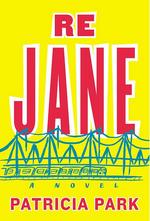
Re Jane by Patricia Park

This is frustrating…I’ve been working on this post for a couple of weeks now, and have spent a lot of time re-writing, re-writing and throwing out material. I finally decided what to keep and how to organize it, I think. I’m tempted to just put this cover image next to a big .gif of a thumbs up and call it a day.

—-

Re JaneRe Jane

by Patricia Park
Hardcover, 338 pg.
Pamela Dorman Books, 2015

Read: July 6 – 8, 2015

There are two ways to look at this book — as a retelling of Jane Eyre and as a novel on its own terms. It’s clearly indebted to Jane Eyre — frequently, the allusions are subtle; sometimes, she might as well be jumping up and down waving a flag. Still, Park’s her own writer — this is its own story, with its own characters — and a heroine who’s not just Brontë’s best-known character thinly disguised.

If you haven’t read Jane Eyre, first of all — shame on you. Secondly, yes, you can read this and appreciate it — you’ll just miss some of Park’s cleverness. Instead, what you’ll get is a straight-forward story about the trials and travails (and travels) of a young Korean-American woman.

Jane Re’s a half-Korean college graduate who becomes a nanny for the daughter of a couple of silly (white) New Yorkers — she’s a stereotypical college professor in Women’s Studies, he’s a henpecked high-school English teacher. Their daughter was adopted from China, and is now old enough that she doesn’t need a nanny — which makes the whole thing a greater challenge. Still, it’s better than the alternative — returning to live with her uncle and aunt, who were forced to take her in after the death of her mother in Korea (and her family there being unwilling to keep her).

Then through a series of events you can read about yourself, she finds herself living for a bit in South Korea. This is as fascinating as you’d think it’d be. It’s not just about a young South Korean woman, it’s about a young half-South Korean woman, raised in the States (by people who left Korea decades before), trying to acclimate to Korea. A stranger in the U.S. to many because of culture and appearance, finds herself a greater stranger there for the same reasons.

Which leads to . . . spoiler stuff. Which is even more interesting. Along the way there’s a whole mess of family issues, stranger-in-a-strange-land issues, self-acceptance issues, romance issues, and other things I can’t pair with the word “issues.” Jane goes through a lot, I’ve got to say — maybe a wider-range of challenges than Eyre. I frequently found myself wanting a bit more spunk, a bit more chutzpah from Jane throughout. But, like her namesake, when she needed it, she found it within — and it was great to see.

Park makes a pivotal choice in her selection of chronological setting — and one that worried me. It’d have been so easy to go wrong with this, and I’m used to seeing it go badly — but Park pulls it off, and actually makes it work for her.

In the end, I liked Jane. I rooted for her. I liked (some of) her family and friends. I was invested in the story. It’s not going to go down as good as, or as important as, its inspiration — but it’s a well-written, warm, look at a woman learning how to take charge of her life.

—–

4 Stars

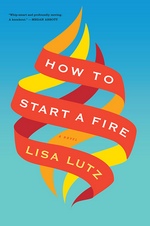
How to Start a Fire by Lisa Lutz

How to Start a Fire How to Start a Fire

by Lisa Lutz

Hardcover, 337 pg.
Houghton Mifflin Harcourt, 2015
Read: June 5 – 6, 2015
I really enjoyed Lisa Lutz’s latest, best, and most mature novel and want to encourage you to give it a read. That said, I’m not really sure how to start this post — or how to finish it, now that I think about it. It’s not really a plot-driven book, it’s more about the relationships between the three main characters, and others in their lives. But, it’s really difficult to talk about the book without talking about the two (maybe three) plot points that drive the whole thing.

Early on, I jotted down the note, “I’m either going to love or hate this book,” and while I stayed in the former camp, I could easily see where some wouldn’t (a quick skim of goodreads today, suggests I was right). This book plays with chronology, skipping around throughout the 20+ year history of the characters (plus some in-chapter flashbacks), with no easily noticeable pattern. So, in the first few chapters (most of Part One), once I started a new chapter, I’d have to flip back to the first page of the 3-4 previous chapters to make sure I was placing the current one in the right spot on my mental timeline. Eventually, I didn’t have to physically turn the pages, and was able to re-arrange things without much thought — and I know two other readers that experienced the same

At its core, How to Start a Fire is about the relationships of three women over time, from meeting in college through everything that happens over the next twenty plus years — ups, downs, fights, make-ups, forgiveness, betrayal, estrangement, personal growth, self-destruction, and the ability of friendship to forget all of that and just care in the moment. To boil it down to its essence: real friendship.

I had to repeatedly remind myself that this was a Lisa Lutz novel, it didn’t feel like one. Not any of The Spellman Files or Heads you Lose, this was a totally different creature (not being a mystery novel plays into that, obviously). Of course, like with my fixation on chronology eventually I got into the book and stopped caring about that. Most of the humor is different, most of the heart is different — the types of people are different, too. Still, the humor is solid, the heart is genuine, and the people are, y’know, people.

Yet . . . there’s no denying the Lutz DNA here. The three main characters were aggressively quirky like Izzy or Rae, Anna ‘s brother could’ve been David), and Malcom has a very Henry-esque quality. There’s so much more about the novel to think about than the parallels to the Spellman books. I don’t want to focus on it, but I did make those notes at one point. I think if I hadn’t written it down, I’d have forgotten about it by the time I reached the end.

This is Chick Lit that can be appreciated by the non-Chick reader* — there’s a little bit of something for just about everything in these pages, laughs, chuckles, an “Aww” or three, and maybe a something to make your eyes misty. It’s a bit too fresh for me to confirm this, but I’m betting this is one of those novels that rewards re-reads (especially when you’re not trying to figure out what’s going on in the opening chapters). Not my favorite Lutz book, but probably her best — and it demonstrates what many of her readers have suspected: she can write whatever she sets her mind to. Frankly, I want something back in the comedy/crime area again, but I’ll line up for whatever.

—–

* Which is the mark of the best of Chick-Lit — or any genre — even those outside the target demographic can appreciate it.

—–

4 Stars

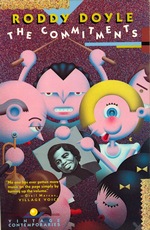
Reread Project: The Commitments by Roddy Doyle

The CommitmentsThe Commitments

by Roddy Doyle
Series: The Barrytown Trilogy, #1

Paperback, 165 pg.
Vintage Contemporaries, 1987
Read: April 15, 2015

Will yeh please put your workin’ class hands together for your heroes. The Saviours o’ Soul, The Hardest Workin’ Band in the World, —Yes, Yes, Yes, Yes —The Commitments.

This is a tough one for me to talk about — I’m a long-time fan, I’ve read it a dozen or so times, it’s all I can do to not turn total fan-boy and just gush. eh, I might not try too hard.

My college roommates and I became fans of the music video for “Try a Little Tenderness” from the soundtrack for the movie adaptation, and we waited for what seemed like a interminable amount of time before the movie came to the art-house theater in town. I loved it from the opening sequence on and tracked down the novel the next day. It blew my mind (for reasons I’ll get into in a bit), and I read it a dozen or so times over the few years until I loaned it (and the rest of the trilogy) to someone at work. Naturally, I never saw him again (I ended up with a copy of Gaines’ A Lesson Before Dying and another book in the transaction). I finally let myself buy a replacement copy a few years ago (found a used copy with the same cover), and have now read it twice. And, if anything, my appreciation grows each time.

It’s the late 80’s and three young Dubliners (from the poorest part of Dublin) have formed a band — sort of. Not everyone in it are musicians yet, but they’re working on it. Thanks to the direction of their keyboard (defined in the loosest possible way) player, they’re going to play synth-pop and go by the name “And And! And” (and, yes, I got the exclamation point in the right place). Their first order of business (while learning how to play) is to hire a manager. Jimmy Rabbitte is the guy from their school/neighborhood who’s the area’s music/music industry expert. As evidenced by the fact that he’s the first one anybody knew of that was aware of Frankie Goes to Hollywood — and, even greater — he’s the first to realize how bad they were. Jimmie gets things going immediately by dropping the name (especially that !) and the keyboard player.

Instead, they’re going to play American soul music — and then put an Irish twist on it — local slang, geographic references, and so on. Jimmie puts an ad in the paper to recruit some musicians, hits up a coworker he heard at a company party, and so on. As a result, he collects a very strange crew of musicians — including a trumpet player decades older than the rest of them, with plenty of professional experience (the trumpet in “All You Need is Love,” for example). The rest, as they say, is history.

The story of The Commitments is told through a very unconventional prose and dialogue style. It’s like Doyle took Leonard’s 10 Rules to the furthest point possible (other than #7, which he violates in every line). You can hear these characters talk, you can feel the energy in the room — heck, this book comes closer to capturing musical performances better than anything this side of Memorex or vinyl. Couldn’t tell you what anyone looks like (well, The Commitmentettes are pretty attractive — especially Imelda), what their homes are like, the weather, or anything of that other stuff that tends to fill the pages of novels. But I can tell you what happened, to whom, and how all related reacted. Which is good enough for me.

This isn’t one of those books that gives you diminishing returns upon re-reading. It’s fresh (while dated — no idea how Doyle pulls that off), funny, and full of soul. Dublin soul, of course. Just like the rag-tag musicians that come to life in its pages.

Oh, if you can get your hands on the soundtrack albums (or find them streaming somewhere) to listen to while reading, it makes it all better (even though there’s almost no overlap between songs).

—–

5 Stars

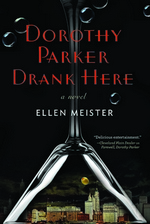
Dorothy Parker Drank Here by Ellen Meister

Dorothy Parker Drank HereDorothy Parker Drank Here

by Ellen Meister

Hardcover, 336 pg.
G.P. Putnam’s Sons, 2015
Read: March 9 – 10, 2015
Meister’s previous novel, Farewell, Dorothy Parker, was an enjoyable though fairly predictable but well-executed tale with characters I appreciated. While I intended to track down more by Meister, I hadn’t yet. One thing I didn’t expect was to see a sequel — there was really nothing in the it to make me think one was forthcoming — or necessary. So I didn’t read this with any great sense of anticipation, mostly just hoping that it wouldn’t be worse than Farewell.

Well, it wasn’t worse — it was actually better.

Ted Shriver is a — was a — literary star. A novelist of a stature and fame that every MFA student dreams of — until plagiarism scandal a few decades ago ruined that career and turned him into a recluse. He’s currently residing in the Algonquin Hotel, which is where the same hotel that the ghost of Dorothy Parker is spending as much of eternity as she can. Enter Norah Wolfe, a young producer about to be out of a job when the talk show she works for is going to be canceled. She’s got this crazy idea, though — if she can get her hero, Shriver, to come on the show and be interviewed for the first time since the scandal, she just might be able to keep the show on the air. And a certain ghost decides to join the cause, as soon as she convinces Norah that she’s really there.

I know, outlandish, right? An appearance by a novelist is going to save a TV show —puh-leez. (the ghost tied to a guest book is completely believable by comparison).

I do think (but haven’t compared the two in order to examine), that this time, Dorothy Parker isn’t as much fun — either in antics or dialogue. But she’s more flawed, more regretful over the past, more self-reliant, lonelier. — basically, she’s a more well-rounded character reflecting a lot of the less snarky, less quotable Parker. Shriver was believable (and a self-pitying jerk), I think the story could’ve used more time with him as an active character, not just the person everyone is reacting to (even when he’s nowhere to be seen). Norah is our Point of View character — she’s likable, driven, damaged (in a pretty obvious way), and it’s not long before you’re wanting things to work out for her. There are a few other notable characters — and a few that are little more than one dimension, but on the whole you are left with the impression that they could easily be more than that.

I did wonder at the lack of any mention of the events of the previous novel or its protagonist, even in passing. Which means you can read these independently of each other, or in whatever order you wish.

This wasn’t a perfect novel — there was one subplot that was largely unnecessary and a little annoying (but in the end, Meister used it effectively, but she could’ve found another way to achieve the same ends). Other than that, compared to its predecessor, I thought the characters were more complex, the emotional stakes were richer, and the book was about more than just the pretty straight-forward plot. A pleasant read, give it a shot.

—–

3.5 Stars

Plus One by Christopher Noxon

Plus OnePlus One

by Christopher Noxon

Hardcover, 303 pg.
Prospect Park Books, 2014
Read: February 10 – 11, 2015
From The Next Best Thing to Landline to Funny Girl to this, I think I might have reached my limit about fictional TV writers. Sadly, this was the wrong one to go out on.

You could, I think, make the case that most of this book reads like the prequel to Landline from the husband’s perspective — and in many ways you’d be right, but still, you shouldn’t do that.* This is the story of Alex Sherman-Zicklin, the husband (and Plus One) of Figgie. Figgie had been wife, mother and struggling TV writer, who is now an Emmy-award show runner of a multi-Emmy-winning cable comedy. Which means all of the sudden, she’s the bread winner (winning far more bread than he ever did), so he quits the job he’s not happy about to be a “domestic first responder.”

He quickly becomes bored, gets a creepy-friend (also a Plus One), falls in lust with a butcher/food blogger, ignores his kids, and does several other deceptive, marriage-damaging things covering the range from pathetic to devious to potentially criminal. Which coincided with Figgy taking up with trust-destroying antics of her own. If this selfish loser had just talked to his wife about what was going on, almost everything that happened could’ve been avoided. Not that self-involved Figgy was much better, really — I don’t see what either of them saw in the other.

Alex, his Plus One pal (whose name I’ve already forgotten), and (to an extent) the butcher are characters — everyone else is pretty much a plot device or place holder. Even Figgy is more of a presence, maybe an obstacle, than a character.

Somewhere in there I was supposed to laugh, I’m sure, but I didn’t manage more than an almost-grin.

The last chapter, maybe two, saved this one for me and turned it from a book I really didn’t like to a book I don’t mind too much. It’s still not a book I’d recommend, just one I have no antipathy for.

—–

* That’s two books in as many months that I’ve compared to Landline — just when did this become the standard by which I judge all fiction?

—–

2 Stars

Us by David Nicholls

Us
Us

by David Nicholls

Hardcover, 398 pg.
Harper, 2014
Read: November 14 – 27, 2014

There’s a saying, cited in popular song, that if you love someone you must set them free. Well, that’s just nonsense. If you love someone, you bind them to you with heavy metal chains.

While not popularly endorsed, I can’t imagine many people who haven’t thought that at one point or another.

Connie Peterson has decided that it’s time for her marriage to end. She and her husband, Douglas, have finished their work — raising their son, Albie — inexplicably nicknamed “Egg” — (you tell me: why would you call your son Egg?). She’s not angry, she’s not been betrayed, she just thinks they’ve run their course — they’ll go on the big tour of the Continent they’ve been planning to celebrate Albie finishing school, then come home and probably wrap things up.

Douglas wasn’t prepared for this, can’t imagine living life without his wife, so he latches on to the probably nature of his wife’s wishes: he’s going to pull out all the stops on this trip, be the best dad, the best husband, the best version of himself and convince her to stick with the “’til death do us part” bit.

There’s a few problems with his plan: he’s not entirely sure what it is that he’s not doing right (the readers will pretty much suss it out from flashbacks); his son is a snot who won’t help his dad out at all with repairing their relationship; Douglas is somewhat klutzy and really can’t express his emotions in any way to his family; and Connie’s just an unpleasant person, seemingly mercurial, and the reader (well, this reader, anyway) can’t see why Douglas would fall for this woman. I can see initial infatuation/attraction — but as far as I can see, the only reason to stick with her is Douglas’ own belief in the meaning of commitment.

So, starting in Paris, the Peterson’s embark on a tour of Europe, and things almost immediately fall apart (with occasional moments where you think Douglas will win Connie back). But Albie clearly doesn’t want to be with either of his parents — although he has no problem spending their money. Connie frequently seems to be toying with Douglas. And Douglas just seems hapless.

Alternating with the narrative of a European tour to make the Griswolds’ look fun and relaxing are a series of flashbacks chronicling the courtship and early marriage of Douglas and Connie. Like I said earlier, it’s sort of the male perspective of Landline without the phone.

Here’s where I’m torn: the novel is told with heart, wit and understanding. The Petersons — and others they meet — come across as real people, warts and all (“all” being mostly other warts). There’s tragedy, hope and laughs — here’s a few of my favorite lines:

I found myself sitting between two actors on drugs, a position that, a number of peer-reviewed research papers have since confirmed, is precisely the worst place a biochemist can be.

[Albie] refuses to wear a coat, an absurd affectation, as if coats where somehow ‘square’ or un-cool, as if there were something ‘hip’ about hypothermia. What is he rebelling against? Warmth? Comfort?

( I’m glad to know I’m not the only father who’s had to wonder this.)

The problem with telling people they can do anything they want to do is that it is objectively, factually inaccurate. Otherwise the whole world would just be ballet dancers and pop stars.

On the same page Nicholls can elicit a chuckle or at least a smile, he can turn on a dime and give you something like this:

In short, my son makes me feel like his step-father.
I have had some experience of unrequited love in the past and that was no picnic, I can tell you. But the unrequited love of one’s only living offspring has its own particular slow acid burn.

Really, really, really well-written. I’d give it 4-5 stars just on that. But there’s more to a book than just the writer’s skill — there’s characters and story. And Us just doesn’t pull those off successfully (and I know Nicholls is more than capable of it — see One Day)

I liked Douglas — both in flashback and the present — I was pulling for him, wishing his family would take a minute to understand him. Albie, I could understand. I thought he was an ungrateful twerp, but I could believe it as a stage in life, and see glimpses of the decent adult he’d become — but really, I didn’t want to spend a whole lot of time with him. Connie I liked (mostly) in flashback, and could barely tolerate in the present — for all his flaws, she’s throwing away a good, devoted husband for no real reason.

The story was problematic, too. Nicholls really seems to point in one direction, and even seems to resort to a couple of clichés to get to his destination. But then he veers off to the real resolution that he wants — and gets his characters there by sheer force of his will. There’s a missing link or three between where the story is going and where it ends up. In the end, at least one character acts in a manner contrary to everything we’ve seen — and we’re given no real justification for it just to get to the conclusion Nicholls wants.

I just couldn’t buy it.

So there we are — a wonderful depiction of horrid people acting in ways that ultimately don’t make sense. I can’t recommend it, as much as I want to/expected to. Your results may vary, of course. I’d love to hear from people in the comments who disagree with me — what did I fail to appreciate?

—–

3 Stars

In Medias Res: Us by David Nicholls

House of Hades
Us

by David Nicholls Typically, I use an “In Media Res” post to check in on a book I’m really excited about, usually about the halfway point. But, thanks to some poor time management on my part, I’ll check in here, as I had to take this back to the library today. I’m on page 120, just a couple pages into Part 2.

In a thumbnail, this is Rowell’s Landline from the male perspective, but without the magic phone. Similarly to Landline, we examine the beginning of the relationship from the protagonist’s present POV, as well as how things progress from the time that his wife tells him she thinks their marriage might be done. In a few months, their child will be leaving home, so she considers their work done — and maybe they will be, too.

This comes out of nowhere (as far as he’s concerned), and strikes poor Douglas like a load of bricks. He latches on to the probability she’s expressed rather than the certainty. He still has a chance, he just needs to make certain changes. He has no idea what those are, but he’s going to try to make them.

At this point, I can see why 1980’s Douglas would be attracted to 1980’s Connie, and maybe why he’d fall for her. I’m not convinced present-day Connie is worth that much effort (but I’m not married to her, so it’s hard for me to say). As for their work as a couple? On behalf of the people of Earth — you’ve done a lousy job. Albie is a questionable human being and a lousy ingrate of a son.

This is well-told — with heart, with wit (frequently a bumbling wit, but that’s Douglas’ charm). As much as I loved Nicholl’s One Day, I couldn’t finish Starter for Ten, so I was a little worried about dipping my toe into this one. But, I have every intention of plowing through this one, as soon as I climb back on top of the library wait list.

When I do, I’m sure I’ll learn to like present-day Connie a bit more, and find out what happened between 1980’s Douglas and present-day Douglas to turn him into someone Connie’s not sure she wants to stick with. I fully expect it to be understandable and may even result in my not liking Douglas too much for a bit. Will he figure out what needs to change and do so? Maybe. I’m not sure Nicholls is going for a happy ending. Who knows? I might even find a redeeming quality in Albie. That will come as a surprise, but I’m open to the possibility.

Good start — I can imagine this book getting 5-stars from me. Also can imagine it getting 3. Who knows?

Landline by Rainbow Rowell

LandlineLandline

by Rainbow Rowell

Hardcover, 310 pg.
St. Martin’s Press, 2014
Read: August 13, 2014

If the last few years have taught us readers anything, it’s that if you want quirky, honest, heart-felt romance with real (and usually moderately overweight) people and solid laughs, Rainbow Rowell will consistently deliver for you. And if you don’t think you want that, after you read her, you’ll realize that’s just what you wanted after all. She has two YA books and now two Adult books to her credit. Her latest, Landline delivers the typical Rowell magic in her story, but this time she included something else: actual magic. Sort of.

Georgie McCool is half of a pretty successful TV writing team who are thiiiiis close to being much more successful, all they have to do is crank out a handful of scripts in the next couple of weeks and they’re in a great position to sell their first series. The catch is, this involves working over Christmas — despite Georgie’s plans to go to her mother-in-law’s in Omaha with her husband, Neal and their two daughters. Georgie says that she can’t pass up this opportunity, so Neal and the girls go off without her.

Georgie sees this as a regrettable occurrence, but one of the sacrifices she has to make to get her dream show made. Her mother, step-father and sister see it as her husband leaving her, and Georgie ends up staying with them. Which gets Georgie to worrying — especially when she can never seem to reach Neal on the phone during the day. At night, however, when her iPhone battery is dead, she has to resort to the landline in her old room and she ends up talking to Neal back before they got engaged.

Don’t ask. It makes no sense. She never bothers to explain. And it doesn’t matter. Georgie eventually figures out that’s what’s going on and she rolls with it, and the reader does, too.

These conversations, as well as the absence of her family, lead Georgie on a path down memory lane, reflecting on the beginning of their relationship and how it changed as they did. Maybe Neal had made a mistake choosing her. Maybe she’d ruined her life (and his) by choosing him. Would they have both been better off going their separate ways? Or was there something worth fighting for now? Would that matter? The clock is ticking — for Georgie’s marriage (both now and then) and her career. Is she up for it?

The tension is real, the apprehension, fear, and self-doubt (for starters) that Georgie is wrestling with is very obvious and palpable. Yet while focusing on this, Rowell’s able to create a believable world filled with a lot of interesting people. There’s Georgie’s partner/best friend, Seth and another writer on their current (and hopefully future) show — and Georgie failing to hold up her end of things there, as much as she tries.

Then there’s her sister, mother and step-father. They’re much better developed (probably only because we spend more time with them). Her mother’s a pretty implausible character, yet not a cartoon, she’s a pug fanatic, married someone much younger than her, and generally seems really happy. Her sister’s about done with high school and is figuring herself out (and mostly has) — she’s a hoot, and my biggest problem with the book is that we don’t get more of Heather. Not that there wasn’t plenty of her — and it’d require the book to take a far different shape. We get whole storylines about all the non-Neal people in her life, little vignettes showing us their character, giving us smiles in the midst of Georgie’s crisis, like:

“Kids are perceptive, Georgie. They’re like dogs”–she offered a meatball from her own fork to the pug heaped in her lap–“they know when their people are unhappy.”
“I think you may have just reverse-anthropomorphized your own grandchildren.”
Her mom waved her empty fork dismissively. “You know what I mean.”
Heather leaned into Georgie and sighed. “Sometimes I feel like her daughter. And sometimes I feel like the dog with the least ribbons.”

Not only do the supporting stories, or even the little moments like this fill out Georgie’s world and make it more interesting, they provide a breather for the reader from having to deal with the disintegrating marriage.

I know some people think we spend too much time in flashbacks, where Georgie’s remembering how she and Neal met, got to know each other, and started seeing each other, etc. But we need that. If all we get is Neal in the present, or past-Neal on the phone, we’re not going to care enough. Especially in the first couple of scenes we get with Neal, it’d be real easy to see him as unsympathetic — the guy holding Georgie and her career back. We need these flashbacks so the reader can sync their feelings about Neal with Georgie’s, so that when we read something like:

Georgie hadn’t known back then how much she was going to come to need Neal, how he was going to become like air to her.
Was that codependence? Or was it just marriage?”

or

She needed him.
Neal was home. Neal was base.
Neal was where Georgie plugged in, and synced up, and started fresh every day. He was the only one who knew her exactly as she was.

find ourselves agreeing with her, or at least seeing why she says it.

At the end of the book, there’s a lot of plot lines dangling — some very important ones, actually. Enough so, that normally, I’d devote a paragraph to complaining about it. But I won’t this time — it works for Landline. There’s a lot for Georgie to work out herself, she’s really only settled on the one most important thing, leaving the rest to be resolved another day. And that’s got to be good enough for the reader.

Not her best, but Rowell on an off day is still really, really good.

—–

4 1/2 Stars

Page 47 of 54

Powered by WordPress & Theme by Anders Norén