Category: Mystery/Detective Fiction/Crime Fiction/Thriller Page 71 of 153

Ghosts of You by Cathy Ulrich: The thing about murder victims is . . .

Ghosts of You

Ghosts of You

by Cathy Ulrich

eARC, 150 pg.
Okay Donkey Press, 2019

Read: September 23-30, 2019


This collection of 31 pieces of flash fiction shouldn’t work. This is probably not the sentence that the author and her publicist want me to start with, but hear me out. It shouldn’t, but it does.

Why shouldn’t it work? For starters, each story has essentially the same title. “Being the Murdered _____.” Earle Stanley Gardner got away with it, as did Lilian Jackson Braun—but I can’t see how anyone else does. Add Ulrich to the list.

Secondly, each story starts with the same sentence:

The thing about being the murdered [word/phrase from title] is you set the plot in motion.

Outside of “Once Upon a Time,” that should not be done (it’s arguable that it shouldn’t be done there, either). But it does work.

From these nearly identical launching pads, Ulrich spins 31 incredibly distinctive tales about what happens after various women are murdered. I should probably clarify a bit, about what I mean about the various women (and the blanks above). These stories focus on people like the murdered Girl, Wife, Lover, Homecoming Queen, Babysitter, Mother, Extra, Jogger—mostly the kinds of women you read about/see in the beginning of a murder mystery. Ulrich also goes for some unexpected types, e.g.: Politician, Mermaid, Muse, Chanteuse (she probably deserves extra points for using that word in the Twenty-First Century), and Taxidermist.

Their murders change the lives of those around them, those who knew them, knew of them, investigated their deaths both immediately and for years to come.

Now, as the word “plot” in the topic sentences indicates, these are primarily reactions to/depictions of/commentaries on the way that the homicides of fictional women are portrayed in Crime Fiction (or even “Literary” Fiction), TV, Movies, etc. I think it has a lot to say about those depictions, but I think there are a lot of weaknesses to Ulrich’s approach, too. Too often, her critiques are overgeneralized, inflammatory and outdated—while retaining a kernel worth chewing on.

Thankfully, the book is about more than that (or I’m not sure I’d have bothered to finish it). I frequently felt like my reaction to the stories was not what it was intended to be. When she’s telling a story (as abbreviated as they are), describing human reactions to situations that “tragic” doesn’t quite begin to apply to—these pieces shine. For someone who shuns self-help books, I’ve read a lot about grief in the last couple of years—these stories contain some of the best portrayals of it in all its varied expressions—that I can remember. If your heart doesn’t break a little at least twice while going through this collection, you need to go listen to some community singing in Whoville, so they can help yours grow.

Beyond that, there’s the obvious strength of the economy of words here—these stories are lean, without a wasted word, and are pound-for-pound some of the most effective stories I’ve read this year.

As with any collection, there are stronger pieces and weaker pieces—some that will satisfy some and other readers will be stupefied by or indifferent to the same ones. I do think there’s a better hit to miss ratio in this collection than I’m used to. For what it’s worth, “Being the Murdered Bride”, “Being the Murdered Student” and “Being the Murdered Mama” were the high-points for me.

While these are all very different (Ulrich almost never plays the same note twice), I don’t recommend reading too many in one sitting (I limited myself to three at a time, for example)—beyond that, you risk robbing them of their impact.

I heartily recommend this collection that works far better than it should. It’ll cause you to stop and think, stop and feel, and hopefully change your perspective on a few things.

Disclaimer: I received this eARC from the author via Lori @ TNBBC Publicity in exchange for this post—thanks to both for this.


4 Stars
LetsReadIndie Reading Challenge

Justice Gone by N. Lombardi Jr: Timely and Compelling

Justice Gone

Justice Gone

by N. Lombardi Jr

Kindle Edition, 336 pg.
Roundfire Books, 2019

Read: September 27-30, 2019


I’ve mentioned before here that after I decide to read a book I forget what its about (if I even know) to keep myself coming from being disappointed by preconceived notions. It worked this time, I really had no idea what it was about when I opened it on my Kindle last week.

Which made the opening pages, featuring the killing of an innocent and compliant veteran by the police, as shocking as they could’ve been. But they also led me to believe I was in for a grim, adult version of The Hate U Give. So when that story took a hard turn a few chapters later with the murder of some of those police officers, I was reeling as much as Lombardi could’ve hoped for.

That sensation kept repeating at each new phase of the action in Justice Gone—”Oh, so this is what the book is about.” Until I finally got that the book was about all of these things—not just one or two themes. It was actually pretty effective in that way, more than I might have thought possible in the abstract. It’s difficult to enumerate them without revealing too much, so I’ll be vague here—the central question is about the place of (and possibility of) seeing justice in our current politicized climate given the high level of suspicion of the police (and their suspicion of the general public) coloring everything, and apparent interference by government officials (especially those elected to office) on criminal investigations and prosecutions.

Sadly, in the mix of all those themes and ideas, the incident that set all of the rest in motion is forgotten about when not overshadowed by the events that spiraled from it. I wish Lombardi had been able to keep the focus on it while telling the other story, because that really is something tat needs to be told. Not that the rest doesn’t, don’t misunderstand. It’s just we’ve all seen several variations of the rest of the novel, and haven’t seen nearly enough of that.

One thing I really appreciated was the focus on the jury’s deliberation toward the end of the novel. Lombardi’s not afraid to introduce new characters—twelve of them, in fact—as the book wraps up. Occasionally, a legal thriller will take a peak inside the Jury Room, but never to this extent. Now I wonder why not.

Lombardi does slip into melodrama more than a few times. He gets out of it pretty quickly and easily, but it’s there. His characters could all use a little more work to not be so forced, and be a little more believable—except for the accused, I never had a problem with him. But Lombardi’s a good enough story teller that the problems with the writing and characters are swept under the carpet and ignored as long as you can focus on the story unfolding.

It’s a book that feels timely and important—the kind of thing that will spark reflection on the part of the reader, and hopefully discussion. Justice Gone is the kind of compelling novel we need more of.


My thanks to damppebbles blog tours for the invitation to participate in this tour and the materials (including a copy of the novel) they provided.

BOOK SPOTLIGHT: Justice Gone by N. Lombardi Jr

Today I welcome the Book Tour for the timely and compelling Justice Gone by N. Lombardi Jr. Along with this spotlight post, I’ll be giving my take on the novel. But before I get to talking about the book, let’s start by learning a little about this here book, okay?


Book Details:

Book Title: Justice Gone by N. Lombardi Jr
Release date: February 22, 2019
Publisher: Roundfire Books
Format: Paperback/Ebook
Length: 336 pages

Book Blurb:

WINNER OF THREE AWARDS
2019 AMERICAN FICTION AWARD
NATIONAL INDIE EXCELLENCY AWARD – Best Legal Thriller OF 2019
SILVER MEDAL WINNER 2019 READERS’ FAVORITES AWARDS
Chosen by Wiki.ezvid.com among their list of 10 Gripping and Intelligent Legal Thrillers

The courtroom scenes are wonderfully written…the characters are well described and the author paints a picture of each in the mind of the reader…Strong plot, strong characters and a strong writing style that I really enjoyed. This one is a definite “thumbs-up.” Strongly recommend! I look forward to reading additional works by N. Lombardi, Jr.
Kim M Aalaie, Author’s Den

One of my favorite suspense novels of the year. It will make you question the legal system.
The Eclectic Review

The courtroom action is excellent, trimmed to the most gripping parts of the trial, with plenty of emotional impact…a fairly realistic portrayal of the way small-town US society works…a fast-moving story with plenty of dramatic moments, and a big twist in the final pages.
Crime Review

“When a homeless war veteran is beaten to death by the police, stormy protests ensue, engulfing a small New Jersey town. Soon after, three cops are gunned down.

A multi-state manhunt is underway for a cop killer on the loose. And Dr. Tessa Thorpe, a veteran’s counselor, is caught up in the chase.

Donald Darfield, an African-American Iraqi war vet, war-time buddy of the beaten man, and one of Tessa’s patients, is holed up in a mountain cabin. Tessa, acting on instinct, sets off to find him, but the swarm of law enforcement officers gets there first, leading to Darfield’s dramatic capture.

Now, the only people separating him from the lethal needle of state justice are Tessa and aging blind lawyer, Nathaniel Bodine. Can they untangle the web tightening around Darfield in time, when the press and the justice system are baying for revenge?”

About N. Lombardi Jr:

N. Lombardi JrLombardi Jr, the N for Nicholas, has spent over half his life in Africa, Asia, and the Middle East, working as a groundwater geologist. Nick can speak five languages: Swahili, Thai, Lao, Chinese, and Khmer (Cambodian).

In 1997, while visiting Lao People’s Democratic Republic, he witnessed the remnants of a secret war that had been waged for nine years, among which were children wounded from leftover cluster bombs. Driven by what he saw, he worked on The Plain of Jars for the next eight years.

Nick maintains a website with content that spans most aspects of the novel: The Secret War, Laotian culture, Buddhism etc. http://plainofjars.net

His second novel, Journey Towards a Falling Sun, is set in the wild frontier of northern Kenya.

His latest novel, Justice Gone was inspired by the fatal beating of a homeless man by police.

Nick now lives in Phnom Penh, Cambodia

Visit his goodreads page:
https://www.goodreads.com/author/show/6982373.N_Lombardi_Jr_

Social Networks:

Facebook ~ Website ~ Goodreads

Purchase Links:

Amazon UK ~ Amazon US ~ Barnes & Noble ~ Book Depository ~ Waterstones ~ Kobo


My thanks to damppebbles blog tours for the invitation to participate in this tour and the materials (including a copy of the novel) they provided.

Cradle to Grave by Rachel Amphlett: A Twisty, Quick Paced Hunt for a Murderer/Kidnapper to Rescue a Child


Cradle to Grave

Cradle to Grave

by Rachel Amphlett
Series: Det. Kay Hunter, #8

Kindle Edition, 370 pg.
Saxon Publishing, 2019

Read: September 26-27, 2019


This was my first time reading Rachel Amphlett and I wasn’t sure what to expect—I’ll cut to the chase now, I really enjoyed it, and Amphlett impressed me from the first chapter on.

The first chapter features some good character moments and a well-drawn figure for characters whose sole purpose is to find a dead body and get the police involved. A lot of authors wouldn’t have bothered with making these characters so fleshed-out. Many wouldn’t have bothered with showing the discovery of the dead body. I liked this touch.

When the police arrive and look at the dead body, almost impossible to identify, it looks like this could be a long investigation. But one of the instigators notices all the children’s belongings in the vicinity and quickly realizes that a child should be at the scene. They have to make a quick decision, do they treat it as a homicide, or a kidnapping. They (wisely) decide to treat it as a kidnapping (while searching for signs of the former). Not only are they hunting for a murderer, they’re probably trying to prevent any harm coming to the child.

Not that they’d be taking their time with a murder inquiry, but missing child adds n element of intensity and immediacy to their search for the killer. Which makes the whole novel more tense and fast-paced. As introductions to a series/author go, this was pretty intense.

One thing I appreciate about UK procedurals (in distinction from the US-based) is the trust for the method and procedure. With US procedurals, there’s an urgency to an investigation—a strong sense that the longer the investigation takes, the less likely it is that they’ll arrest anyone. It feels (at least to me) the opposite with good UK procedurals. There’s a trust in the system, that the gears of police work will eventually establish the guilt of someone as long as the gears keep turning. It’s almost like they longer things go on, the more certain they are that they’ll catch the responsible party. That’s certainly the case here, yet, it’s well-balanced with the scramble to save the child.

Another thing about UK procedurals is the way the whole team is involved in the investigation—it’s not (for example) Det. Bosch, and maybe his partner, barreling through things, with the occasional assist from someone else in the office or a forensic specialist. There are all sorts of officers, of all ranks and assignments running around, making contributions to the overall effort. It’s probably a whole lot more realistic, a whole lot more believable—but it comes at a cost. There are so many people running around, that it’s hard to keep track of them all, hard to get to the point where you can get a feel for most of the characters—and it’s likely that you’ll confuse a couple with each other. This isn’t a criticism of Amphlett, I’ve had the same problem when it comes to other UK procedurals that I’ve read. Maybe it’s just me. It just takes a few novels before I can get a feel for anyone beyond the character the series is named after. That’s definitely the case here. I have a decent sense for Kay Hunter, and the beginnings of a sense for one or two others on the team, but that’s all. Ask me again when book 10 comes around (or if I get to some of the backlist), and that’ll disappear.

I did like the characters, and think I could grow to be fans of a few of them—but that’ll take time (and the ability to differentiate them easily). I could tell they weren’t just interchangeable names, that there were individual characteristics and drives behind them. And none of them served as Detective Exposition or Detective Comic Relief—which is a big plus to me.

Now, when it comes to the witnesses, family of the victims, and suspects? I thought Amphlett did a good job with them all—colorful in the right ways, believable, and did a good job of moving the plot forward (also, police interactions and reaction to the witnesses were handled very nicely).

One thing I truly appreciated about this is just how wrong the police frequently were—and not in little ways, either. Justifiably wrong given the information they had, I should stress. But as soon as they realized they were heading down the wrong path, they quickly fixed it. They didn’t spend a few dozen pages in self-recrimination, they didn’t get a time-consuming talking to from their superior, or anything like that (although that might be forthcoming…). Instead, they regrouped, shook off the error and acted on the correct information right away. Sure, most procedurals (mystery novels in general) feature some wrong theories, some half-baked notions that have to be discarded. But this seemed to have a larger than usual—and more believable—quantity and quality of errors. But they dealt with them appropriately. I wish I saw more like that.

Was this a perfect book? No, in fact, I was annoyed more than once or twice with either the writing or the plot. But they were all minor annoyances, and nothing worth listing and nothing really took me out of the moment while I read. Better yet, the strengths quickly canceled out the problems/doubts I had. This was a quick, compelling read that did all the right things for a procedural. Entertaining, twisty, and engaging. This won’t be my last Amphlett.


3.5 Stars

My thanks to Tracy Fenton for the invitation to participate in this tour and the materials (including a copy of the novel) provided.

BOOK SPOTLIGHT: Cradle to Grave by Rachel Amphlett (plus a Giveaway)

Today I welcome the Book Tour for the twisty Cradle to Grave by Rachel Amphlett. Along with this spotlight post, I’ll be giving my take on the novel here in a bit. But before I get to talking about the book, let’s start by learning a little about this here book, okay? Be sure you scroll down to the bottom of this post for details on the Giveaway!


Book Details:

Book Title: Cradle to Grave by Rachel Amphlett
Release date: October 6, 2019
Format: Ebook/Paperback
Length: 370 pages

Book Blurb:

When a faceless body is found floating in the river on a summer’s morning, Detective Kay Hunter and her team are tasked with finding out the man’s identity – and where he came from.

The investigation takes a sinister turn when an abandoned boat is found, covered in blood stains and containing a child’s belongings.

Under mounting pressure from a distraught family and an unforgiving media, the police are in a race against time – but they have no leads, and no motive for the events that have taken place.

Will Kay be able to find a ruthless killer and a missing child before it’s too late?

Cradle to Grave is the eighth book in the Detective Kay Hunter series by USA Today bestselling author Rachel Amphlett, and perfect for fans of Ann Cleeves, Peter Robinson and Ian Rankin.

About Rachel Amphlett:

Rachel AmphlettBefore turning to writing, USA Today bestselling author Rachel Amphlett played guitar in bands, worked as a TV and film extra, and dabbled in radio as a presenter and freelance producer for the BBC. She now wields a pen instead of a plectrum and writes crime fiction and spy novels, including the Dan Taylor espionage novels and the Detective Kay Hunter series.

The Italian foreign rights for her debut novel, White Gold have been sold to Fanucci Editore’s TIMECrime imprint, and the first four books in the Dan Taylor espionage series are published by Germany’s Luzifer Verlag.

Her novels are available in eBook, print, large print and audiobook formats from libraries and worldwide retailers.

A keen traveller, Rachel holds both EU and Australian passports and can usually be found plotting her next trip two years in advance.

Rachel Amphlett’s Social Media:

Twitter ~ Facebook ~ Website ~ Instagram

GIVEAWAY:

Rachel Amphlett will be giving away 2 paperback copies of this book! To enter, simply comment below or retweet my tweet about this Book Spotlight. Open Worldwide.

My thanks to Tracy Fenton for the invitation to participate in this tour and the materials (including a copy of the novel) provided.

Pub Day Repost: Dachshund Through the Snow by David Rosenfelt: Andy Carpenter gets a Cold Case for Christmas

Dachshund Through the Snow

Dachshund Through the Snow

by David Rosenfelt
Series: Andy Carpenter, #20

eARC, 352 pg.
Minotaur Books, 2019

Read: September 3, 2019


It felt a little weird for the second book I read in September to be a Christmas-centered novel. Sure, it’s an Advanced Reader Copy, but still, it feels ridiculous. However, one thing we learn right off the bat is that Andy’s wife, Laurie, wants to extend the Christmas season into February (I’m sure there’s a touch of hyperbole there)—so I can totally see her not blinking at a Christmas book right after Labor Day.

There’s another case that kicks the book off—Andy sues the Paterson Police Department on behalf of a canine officer whose handler is retiring and wants to bring the dog with him into early retirement due to hip problems. It’s a pleasant way to kick off the book, and Rosenfelt makes it pay off for events later in the book and into the future, too.

But the main event is tied into Laurie’s Christmas spirit. She goes to various local places (like a pet store) and takes the wish lists/letters to Santa left there and fulfills them. This year she gets a letter from a little boy who wants a coat for his mom and a sweater for his dachshund, but before you can say “Awww, how cute,” he also asks for Santa to find his dad and bring him home. A job for Laurie, the P.I., not Santa.

Before Laurie can find him, however, the Paterson police do—he’s arrested for a fourteen-year-old murder. Noah Traynor’s sister had done one of those 23andMe/Ancestry-type things and the police tied her DNA to blood left underneath the fingernails of an unsolved murder (this is such a good idea, and I hope other writers use a similar idea just to prompt discussion about these things). Now we’re talking a job that’s not for Santa or Laurie, it’s Andy’s turn.

By this point, we all know what comes next: Sam hacks into things he should and finds out a lot; Marcus mumbles, intimidates some criminals and does something violent; Laurie cajoles and supports Andy; Hike predicts calamity; Andy watches some sports and thinks while walking Tara and Sebastian; (and works a little). The trial arrives and Andy annoys the judge and prosecutor, amuses the reader and finally gets somewhere with his investigation. Just because we all know it’s coming, that doesn’t mean it’s any less entertaining—in fact, there’s the fun in finding out how Rosenfelt will juggle the standard options; e.g. “what superhuman thing will Marcus do this time?”, “will Sam get to go into the field?”, “how many potential witnesses will Andy alienate before the trial? There’s also a lot that happens this time that the reader isn’t used to seeing during trial prep or the trial itself.

During the trial, something so shocking happened that Andy swore when he learned about it—which didn’t scandalize me, I just don’t remember him doing it that often. I was just as shocked as he was and almost followed suit. I know Rosenfelt has tricked me and caught me off guard before, but I don’t remember anything like this one. At twenty books in, for him to leave me nigh-flabbergasted is an accomplishment. Early on, I’d come up with a theory for both the identity of the killer and the motive—and Rosenfelt had convinced me I was on the wrong track. But it turns out that the events that left me as gobsmacked as our favorite indolent defense lawyer paved the way for me to be proven right. I’m not bringing this up to talk about how clever I was but to say that Rosenfelt was so convincing that he talked me out of being right on both fronts. Few mystery writers succeed there, and that never fails to make me happy to read it.

The book also works as a launching point for the spin-off series expected next year, focusing on Laurie’s new Detective Agency. I’ve been looking forward to it since I saw it announced, but now I’m a bit more interested having a bit more information. But more on that in a few months.

I went without sleep—2 days before seeing my sleep specialist, who saw the data, I should add—to stay up and finish this. It was totally worth the scathing look she gave me because I just had to know how it ended. After a book or two that made me wonder if Rosenfelt was running out of steam, the last few of these books have restored all my faith in him—Dachshund Through the Snow is one of the best in the series. A couple of authentic laughs, a lot of smiles, some warm fuzzies. a very clever mystery, and some good quality time with old friends—it’s a genuinely good time.

Disclaimer: I received this eARC from St. Martin’s Press via NetGalley in exchange for this post and my honest opinion—thanks to both for this early Christmas gift (so to speak), but the opinions expressed were not influenced by that, only by the fun read.


4 1/2 Stars

Land of Wolves by Craig Johnson: Longmire’s back home and hunting for killers (human and animal alike)

Land of Wolves

Land of Wolves

by Craig Johnson
Series: Walt Longmire, #15

Hardcover, 336 pg.
Viking, 2019

Read: September 24-25, 2019

It’s hard to think of a place in Wyoming where the wind doesn’t reign supreme; where the sovereignty of sound doesn’t break through the parks of the Bighorns with a hoarse-throated howl. I sometimes wonder if the trees miss the wind in the infrequent moments when it dies down, when the air is still and the skies are a threadbare blue, thin and stretching above the mountains. Needled courtesans—the lodgepole pines, Douglas firs, and Engelmann spruce—stand at the edge of the great park like wallflowers awaiting the beseeching hand of the wind to invite them to the dance floor. And I can’t help but wonder that when the sway passes and the trees are still, do they pine for that wind; do they grieve?

Ahhh…it’s good to be back in Absaroka County.

Walt starts off investigating the death of a sheep—probably at the hands, er, teeth of a wolf. This wolf is likely from Yellowstone and kicked out of his pack. Now that he’s probably/possibly killed a sheep, it certainly appears to be open season for him soon. Oddly, there’s no sign of a shepherd for this dead sheep, which gets Walt and Vic to go looking.

Sadly, they find the shepherd hanging from a tree—possibly the loneliness of the Wyoming wilderness got to him, or maybe he was killed. Neither case looks easy to wrap up, which means that it’s time for Walt to get back to focus more on the job and less on recovery from the horrible injuries (physical and mental) sustained in Mexico.

Walt is largely ready for this kind of thing, he needs something to focus on. He has to first deal with a labor and wildlife advocate who knew both the wolf and shepherd, and she doesn’t trust Walt’s approach to either. There’s also the shepherd’s employer—a member of the same family that left then-Sheriff Lucian Connally without a leg. There’s a populace worried about the presence of wolves in the area (ignoring the fact that there’s only one that’s been seen). Also, Henry adds the possibility that this wolf is actually a messenger from the spirits with a vision for Walt. Lastly, the entire Sheriff’s department wonders how long it’ll be until Walt does something to endanger his life—and just how bad that’ll be.

Most dramatically, a computer is installed on Walt’s desk, “the slippery slope to a cell phone.” Despite this intrusion of the 1990’s into his life, Walt perseveres.

This brings Walt back to Absaroka, he hasn’t spent a novel here since 2015’s Dry Bones (it doesn’t feel like it’s been that long), and the citizens are aware he’s spending a lot of time away. We see the old regulars, which should make long-time fans happy. But best of all, the story is classic Longmire—an exploration of Wyoming’s past and future just as much as it is the past and future of the characters (regulars and new to the series).

Early on, Walt’s on an unexpected hike and it’s taking it’s toll:

I pushed off the tree and started back at a slow pace, wondering if I ’d ever pick up the step I’d lost in Mexico. Maybe that was the way of things; sometimes you paid a price and never get to make another deposit into your account and eventually you are overdrawn. Lately, I’d been feeling like I was standing at the counter, the cashier always closing the window in my face.

That neatly summed up my fears about the series in general, particularly how it’d work after Mexico. If the series was going to continue in the vein of Depth of Winter, I’d have a hard time sticking around. But I’m happy to say that while the effects of Mexico linger, and will continue to be felt for some time, I’m not going anywhere. There were repeated signals throughout this novel that the status quo shouldn’t be taken for granted when it comes to any of these characters (except maybe Henry, he’ll only change when he wants to), but the same things that have been drawing readers to Walt Longmire for 15 books are still at the character’s and series’ core.

Leaving the state of the series aside, this was one of my favorite installments in the series (sure, I might be extra generous given my fears after Depth of Winter). The characters shone—it’s one of Sancho’s best outings, and Vic was just great. The story was compelling, a great mix of a drama and comedic moments, and the mystery was satisfying (maybe a little easy to suss out for the reader, but Johnson hit every beat correctly). I’m already counting the days until #16.


4 1/2 Stars

2019 Library Love Challenge 2019 Cloak & Dagger Challenge

Hire Idiots by Professor I.M. Nemo: A Sharp Satire Wrapped in a Murder Mystery

Hire Idiots

Hire Idiots

by Professor I.M. Nemo

Kindle Edition, 233 pg.
Fox Spirit Book, 2019

Read: September 23-24, 2019

‘…Kakistocracies seem to be taking over everywhere.’ …

‘They’ve turned schools into factories. Fill out the form, mark the dot, memorize the same things. At the rate real learning is being undercut, soon we’ll be an idiocracy.’

‘Can we blame the internet?’

This was a very clever book. The more I think about it, the quicker I come back to that point. There’s a lot more to think about and write about when it comes to Hire Idiots, but the core of it all has to be the cleverness of it.

The novel begins with the murder of an aged college professor—there are not exactly a lot of suspects. He’s largely estranged from his family; not particularly liked by his colleagues (but no one really rises to active dislike or enmity); he holds an endowed chair—in English—at a small, obscure Liberal Arts college, so it’s not as if his death is going to benefit anyone, or be noticed by anyone outside his department, really.

Before the police can really get the investigation underway, the entire college (including those who did notice his death) are distracted by a shakeup at the top of the administration. The president is removed following a financial scandal. The Board doesn’t name an interim and begin a search for a new successor, rather they appoint a figure-head chancellor and a Chief Operations Officer. The COO brings in a Chief Academic Officer, a host of Vice Presidents, and a consulting group to help them (assuming the latter can ever figure out the name of the college). These people couch their ideas in a lot of positive spin and corporate-speak, but what it all boils down to is that programs, departments, and staff are going to be cut—except, of course, in the Business and Criminal Justice areas.

Then an active shooter arrives on campus and ends up taking over an entire building. Instead of letting the police apprehend him, the new corporate leadership removes them from campus and lets their security team deal with the situation, resulting in (for starters) a media blackout. Can’t have current and prospective students thinking this is an unsafe place to study and/or spend tuition/fees/etc. money anywhere else.

Where most mystery novels—no matter how cozy they are—would focus on the murder and/or the takeover of the building, Hire Idiots focuses on the responses from the faculty to the new administration and the impending cuts, with a focus on one of the murdered professor’s closest acquaintances and his response to the administration, his observations of the rest, and his crush on the detective heading up the murder investigation. I’d estimate 85% of the novel is about the shakeup, 6% about the professor’s personal life/response to everything; 5% on the shakeup story and 4% on the takeover.

That’s not a criticism, that’s a description—primarily so you don’t spend a lot of time, like me, wondering “is this actually a Crime Novel or did I mis-remember something?” Yes, it is, but it’s not going about anything the way you’d expect.

The bulk of the novel is a satirical/prophetic look at the state of the American higher education (noting repeatedly that British education is further down this path), taking inspiration from the line from William Blake (the focus of the scholarship of our primary character):

Degrade first the arts, if you’d mankind degrade;
Hire idiots to paint with cold light and hot shade.

As such, it is pretty devastating and too close to the truth for comfort.

Like any good satire, there are a couple of scenes that are delightfully and bizarrely absurd. When the Theater Department joined in the Faculty protest and their contribution went awry, I laughed loud enough to draw stares from my family. I won’t spoil it, but when you read that bit, you can just imagine me cracking up.

Some of the characters are better-drawn than you frequently see in satire, which is wonderful. I really grew to like a few of them, and appreciated what Nemo was able to with them (although character and character development really didn’t seem as important to the novel as did everything else).

On top of that—or on the side, anyway—you’ve got a nice little puzzle of a murder that at once is clever, and not meaty enough to sustain an entire novel (hence, the rest) and the strange little business about the building takeover. I’m still not sure really get what Nemo was going for there (although, I’m convinced that it should be obvious to me, and I’ll feel sheepish when it finally occurs to me), but I enjoyed it.

My one complaint is the length—I think we needed a little more of everything. It all felt just a little under-developed. Not enough to make me dislike the book, just enough to keep me from being fully satisfied.

A clever, clever read that will entertain as it makes you worry about the future of formal education. On the surface, Hire Idiots is a fun read, with some very sharp-witted lines. As a bonus, it’ll get you to use “Kakistocracy”, which is just a fun word.


3.5 Stars

My thanks to damppebbles blog tours for the invitation to participate in this tour and the materials (including a copy of the novel) they provided.

BOOK SPOTLIGHT: Hire Idiots by Professor I.M. Nemo

Today I welcome the Book Tour for the sharply-written Hire Idiots by Professor I.M. Nemo. Along with this spotlight post, I’ll be giving my take on the novel. But before I get to talking about the book, let’s start by learning a little about this here book, okay?


Book Details:

Book Title: Hire Idiots by Professor I.M. Nemo
Release date: August 24, 2019
Publisher: Fox Spirit Books
Format: Paperback/Ebook
Length: 233 pages

Book Blurb:

‘This is a work of fiction. Any resemblance to the living or the dead is purely coincidental and ought to make you ashamed at the comparison.’

PROMINENT PROFESSOR STABBED TO DEATH AT KINGSLEY COLLEGE

Unfortunately, the murder may get lost in the confusion of new vice presidents, marketers, focus groups, assessors and protestors as the administration tries to make education profitable. There’s no time for mystery!

Professor Clarence Van Dyke finds himself bewildered by the changes, but determined to get to the bottom of the killing. He wants his friend to rest in peace – or perhaps he just wants to spend more time with the attractive Detective Riordan. But isn’t he the primary suspect?

About Professor I.M. Nemo:

Herdford OwlThere’s no author bio as the author wishes to remain anonymous! Instead, enjoy this picture of an owl (allegedly, a photo of the author).

Purchase Links:

Amazon UK ~ Amazon US ~ Fox Spirit Store


My thanks to damppebbles blog tours for the invitation to participate in this tour and the materials (including a copy of the novel) they provided.

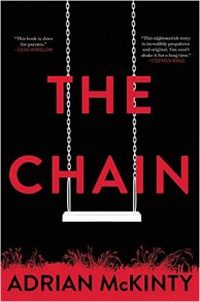
The Chain by Adrian McKinty: Move Over, Stanley Milgram, The Chain is here

The Chain

The Chain

by Adrian McKinty

Hardcover, 357 pg.
Mulholland Books, 2019

Read: July 17-18, 2019

The house is musty and empty. A thin layer of dust coats the kitchen surfaces. No one has been in here since early September. She closes the kitchen door behind her and explores the home.

Three uninteresting levels and a very interesting basement with brick walls and a concrete floor and nothing in it but a washing machine, a dryer, and a boiler. The house is held up by a series of concrete pillars and she could, she thinks in disgust, chain someone to one of those pillars. She checks out the little window above the dryer. She’ll cover that with a board she’ll get from the hardware store in town.

Rachel shivers With a mixture of fascination and revulsion. How can she think about this sort of thing so glibly? Is that what trauma does to you?

Yes.

It reminds her again of the chemo days. The numbness. The feeling of plunging into the abyss and falling, falling, falling forever.

How do I add anything to the discussion about The Chain? How do I say something that hasn’t been said by (seemingly) everyone this side of the English Channel? Honestly, how do I say anything about this book that left me speechless, reeling, and nigh-despairing multiple times? How can I say anything meaningful about this book without giving anything away?

In order: Probably can’t. Forget that. Good question—very carefully and with a focus on brevity, I guess. Here goes.

A lot of this first paragraph is well-known, this book has been talked a lot about. But even knowing this, I wasn’t prepared for the first few chapters as McKinty put flesh on the premise.

Rachel O’Neill, nearly a year into remission, is on her way to see her oncologist about some blood test results. It can’t be good news that he’s making her come in for, right? On her way, she gets a phone call that will change her life—her daughter has been kidnapped. To get her back, she has to do a few things: 1. Pay an almost impossibly high ransom (note the use of “almost”); 2. Kidnap some other child; and 3. Wait for that child’s parents to kidnap someone and then Kylie will be released unharmed. If Law Enforcement (of any kind) is involved or any of the three steps are violated, Kylie will die. If not, she’ll be free to go straightaway. It’s clearly understood, but not really stated (immediately, anyway)—once Kylie is home Rachel will do anything the Chain tells her to do in the future—or . . .

That’s pretty much the high point of the book for Rachel. The first part of the book concerns itself with this horrible scenario. What corners will she cut? What laws (actual written laws, or the understood conventions of society) will she bend and break? What lengths will she go to in order to save her daughter? In the end, she takes all the necessary steps to secure her daughter’s release, because what other choice does she have? And as she thinks as she stalks a potential kidnapping victim:

She looks at her watch. Not yet five o’clock. This morning when she woke up, she had been a completely different person. As J. G. Ballard pointed out, civilization is just a thin, fragile veneer over the law of the jungle: Better you than me. Better your kid than my kid.

(I should point out, she’s not being pretentious, nor is McKinty taking liberties to force allusions into the character. Rachel’s a philosophy instructor, that’s how she thinks—a brilliant bit of characterization because she can retreat to thoughtful insights as a way of dealing with the stark reality she finds herself in)

During this part, while Kylie is (rightly) terrified, I generally actually felt worse for Rachel than her daughter. Which I hope doesn’t say something horrible about me—I think it says more about where McKinty puts the reader: smack-dab in the middle of Rachel’s perspective while seeing Kylie from the outside.

The second part of the book picks up months later, showing us the fall-out of the encounter with The Chain in the lives of those we met in Part One. For good reasons as well as convention, this is something that Crime Fiction does too rarely. It’s not just a murder, it’s the shattered lives of those close to the victim that will not fully recover; it’s not just a burglary, it’s the loss of a feeling of personal security that takes people years to come to grips with; and so on. McKinty allows us to see the repercussions of all the choices made and actions taken by Rachel (and The Chain regarding her).

Which is just devastating, really. Again, the panic and terror that assaulted her in the first few minutes after receiving the phone call is the high point for this poor mother.

We also get a little—not exhaustively, but enough—backstory concerning those running The Chain in this part. McKinty doesn’t make any effort to glamorize them or explain away their evil. Yes, there might have been things in their pasts that shaped them, but they chose this atrocious path knowing full well what they were doing.

I don’t want to talk too much about the book or the characters—I’ll end up ruining something if I do. We get to know Rachel pretty well—she’s intelligent, caring, and tenacious. She’s also tired, emotionally worn out after the medical and personal events of the years immediately before this. You can usually say this about the victim of crime (in reality or in fiction), but she really didn’t deserve any of this. It’s easy to second guess what she does, the compromises she makes and what she abandons. But it’s impossible not to empathize with her.

On the cover, there’s a quotation from Don Winslow, calling this “Jaws for parents.” Before he wrote Say Nothing, someone gave Brad Parks some advice that he should write about what terrifies him the most. I don’t know if anyone gave McKinty that advice or something like it, but it sure reads that way. I can’t imagine there’s not a parent alive who can read this without worrying about their kids, and reconsidering how closely to track their movements and activities.
Before executing her kidnapping plan, Rachel says:

“But even if it all goes right, . . . it’ll still be absolutely terrible.”

For her, that’s true. For the reader? It’s absolutely false. The tension is dialed up to 11, the pacing is relentless, the stakes are high enough that the reader should make sure their blood pressure prescriptions are filled. The Chain is as compelling and engrossing as you could want. It’s a near-perfect thriller that doesn’t let up. If you haven’t read it yet, you need to fix that pronto.


4 1/2 Stars

2019 Library Love Challenge 2019 Cloak & Dagger Challenge

Page 71 of 153

Powered by WordPress & Theme by Anders Norén