Category: Mystery/Detective Fiction/Crime Fiction/Thriller Page 72 of 153

Appetite for Risk by Jack Leavers: An Unusually Realistic Thriller

Appetite for Risk

Appetite for Risk

by Jack Leavers
Series: John Pierce, #1

Kindle Edition, 352 pg.
Book Guild, 2019

Read: September 13-16, 2019

It’s 2004, Saddam Hussein is out of power and the focus is shifting to rebuilding Iraq (few have any idea of the insurgency just around the corner), which sounds great to John Pierce. He’s a former Royal Marine trying to support his wife and two kids. He’s done the typical security/investigations work, but that isn’t really satisfying to him. He does have a few good contacts in or related to Iraq and decides to try to build a business there.

I intended to provide consultancy services to international companies, using local support and knowledge to help them win a share of the reconstruction contracts. Iraq needed everything after the West had sanctioned and bombed it to a ruin over the previous decade.

It’s not a safe place to be at the moment, but it seems to all that stability is just around the corner, and even after an eventful first trip that might dissuade some from following that path, we’re told:

Despite the risks, there was never any real doubt I would go back. The siren call of adventure was drawing me inextricably to Baghdad. Now I’d started down this road, I remained determined to see where it would lead, hoping desperately that success would be quick to arrive.

The book follows Pierce’s endeavor to find that success from January 2004-December 2005. We travel with him to various locations in Iraq (and surrounding nations) and back home in England. As with most fledgling businesses, there’s a lot of ups and downs, signs of success and trouble alike—when you consider the risks involved in trying to start something in Iraq in 2004-05, the typical struggles of a new venture pale in comparison. Quite inadvertently, Pierce gets the attention of both British and American intelligence and they secure his aid with little regard to the effect that’ll have on his livelihood.

It’s hard to think of this as a novel—it really doesn’t read like one. It reads like a memoir. It may be fiction, but it reeks of authenticity and bears few of the marks of a thriller (or any other kind of novel). This is both a fantastic achievement and a frustration for a reader who expects certain kinds of things from a thriller.

The level of detail is intense—I wouldn’t have thought I’d ever learn anything about how one goes about finding contacts or establishing working relationships in the middle of a war, relying largely on translators and practical strangers to help navigate through the city/populace. On the one hand, it was intriguing and I quite enjoyed being exposed to this kind of thing. On the other hand, there were large stretches where it seemed like nothing was happening—like the dominoes were being set up and instead of knocking them down, the line kept getting longer and more twisty.

I never got bored, but I spent a lot of time wondering “where is this going?” While not every detail or anecdote ended up paying off, enough did to justify reading it and again, the level of detail made it really seem like you were reading the recollection of someone who’d been there. And while the initial 50-60% of the book could be called slow (after the initial chapters, anyway, which dropped the reader into a tense situation before backtracking a few months to establish things), once things picked up, they really picked up.

I don’t know that I ever really made any emotional connection to Pierce—I was pretty unmoved by his marital or financial woes or triumphs. I still wanted to keep reading about what he was going through, but any trouble or danger he encountered didn’t grab me (other than as an obstacle to whatever he was trying to accomplish). I don’t know if this is something Leavers was trying to accomplish, or if it’s the sign of a new author—I tend to think it’s due to the non-fiction-y feel of the work, and I rarely get that connected to actual people I’m reading about.

I think I’m safe when I say that you haven’t read a thriller like this before—it’s a slow burn, but it’s consistently interesting and you certainly feel the imminent threat constantly around Pierce. Once the action kicks into a higher gear, it’s a pretty fast read, but you’ve got to work a little before then. It’s a satisfying read, and one that will reward the time you put in. I recommend it for someone open to an atypical read where the suspense comes from sources you’re not used to encountering (and a few that everyone is used to).


3 Stars

My thanks to damppebbles blog tours for the invitation to participate in this tour and the materials (including a copy of the novel) they provided.

EXCERPT from Appetite for Risk by Jack Leavers: South of Baghdad

From Chapter 10 South of Baghdad

Taken from the start of Chapter 10, this extract sees John Pierce sharing one of my entertaining days in Iraq that occurred exactly as written. It concerned me that editors might want the chapter cut, whereas I think it show in a microcosm the hope, mistrust and deep-rooted anger that permeated Baghdad back then.

‘Look at his face. Can you see his face? He hates you.’ Mr Saleh had suddenly turned from an urbane, confident businessman into an excited Willy Wonka as we’d driven through the gates of his factory to the south of Baghdad. It made a striking change from the recent days spent with the cagey Faris and his crew.

General Imad had introduced the two of us over a phone call from his place the previous day and we’d met up that morning and spent the day together. Instead of focusing on the business set-up, it gave me a chance to spend time with a wealthy businessman and discuss discernible business opportunities.

Lunch had been delicious fish cooked over hot coals in a tented restaurant with an open fire pit by the banks of the Tigris. And Mohammed was right: masgouf was delicious. The place was hired for our exclusive use and his private goon squad sat in a car immediately outside, watching over us and the superbly maintained vintage black Mercedes we’d arrived in.

This wasn’t just for my protection. Local kidnappings were rampant and anyone with money was fair game as were their families. During the war the previous year, most of the prison inmates had ended up free to roam the city and get back to business. With the economy shot to pieces and the scarcity of jobs, crime was about the only sector showing rocketing expansion. Mr Saleh wasn’t taking any chances.

As I checked out the faces of the workers in the compound, I wasn’t feeling the love from any of them. A good job the goon squad were following right behind us or this might have got unpleasant. An especially furious-looking individual with wild hair and wilder eyes stood out. If there was anyone looking angrier than this guy, then I probably needed to be drawing the Makarov.

‘All his family were killed in an American air strike. He hates the Americans. He hates you. If I wasn’t here, he’d try to kill you.’

Why this was said in such an enthusiastic manner I couldn’t quite grasp.

‘Well let’s keep him at a distance. I don’t think it will help productivity if I have to shoot him.’

Mr Saleh’s head turned so fast I thought he had to have done himself an injury. ‘Of course. You have nothing to worry about. I apologise. You are safe here.’

That remained to be seen.

We were about half an hour south of Baghdad at Mr Saleh’s drinks factory. He was giving me the grand tour after I’d explained to him over lunch how I was looking to bring leading Western brands into Iraq and here on the search for suitable local partners.

‘Bring me Coca Cola and all our dreams will be realised,’ he’d told me.

As I inspected the dusty compound, run-down buildings, and forlorn production line, it was difficult to envisage the Coca-Cola quality control people ripping his hand off to sign on the dotted line.

I tried to introduce a diplomatic reality check. ‘Coca-Cola is likely to already have partners here or in Jordan.’ Drinks manufacturing was a sector I knew precious little about and, with no advance warning about the type of business he owned, I’d had zero time to conduct any background research.

Mr Saleh swept my negativity aside. ‘I want you to find me a new production line in the UK or Germany. Send me some details and we can refurbish this factory and make it fit for the big companies. Anyway, we shall expand our water production and become the best brand in Iraq.’

He was thinking big. Provided he had the money, then this could be worth a closer look.

***

‘He’s outraged I brought you here.’

Mr Saleh reverted to being Willy Wonka as we headed back out through the gates. He drove the highly polished Mercedes himself with only me in the car alongside, the goon squad bringing up the rear in the other Merc. Not exactly low profile but the goons bristled with weapons and ammunition, ready for a fight rather than just for show.

The dirt road leading from the factory wound through some undulating terrain on its way to the main road. We rounded a sandy hillock to be confronted by a pickup truck manned by four armed balaclava-clad men bearing down on us. As it slewed to the right, I could see a fifth balaclava behind a large pintle-mounted anti-aircraft gun, a 12.7mm (.50 cal) DShK, or ‘Dushka’. My eyes must have popped out of my head like something from a Looney Tunes cartoon.

I drew the Makarov and hoped they hadn’t spotted me through the tinted windows. Mr Saleh put his arm across.

‘No, Mr John. It’s okay, these are security forces.’

He stopped the car and opened the window to shout a greeting to the vehicle commander as I tried to bring my heart rate back under control. I was going to need a drink tonight.


Read the rest in Appetite for Risk by Jack Leavers.

My thanks to damppebbles blog tours for the opportunity to participate in this tour and the materials (including the book) they provided.

BOOK SPOTLIGHT: Appetite for Risk by Jack Leavers

Today I welcome the Book Tour for the unconventional Appetite for Risk by Jack Leavers. Along with this spotlight post, I’ve got a nice little excerpt from the novel posting soon and then I’ll be giving my take on the novel. But before I get to talking about the book, let’s start by learning a little about this here book, okay?


Book Details:

Book Title: Appetite for Risk by Jack Leavers
Release date: July 28, 2019
Publisher: Book Guild
Format: Paperback/Ebook
Length: 352 pages

Book Blurb:


A fast-paced action thriller inspired by real events in the aftermath of the Iraq War.

With Saddam Hussein deposed and an entire country in need of rebuilding, former Royal Marine John Pierce hears the siren call of adventure and opportunity. His fledgling UK business is struggling to support his young family and he has connections in the Iraqi capital – fate seems to point one way.

In early 2004, Pierce rolls the dice when he jumps into a taxi in Jordan and heads for the turmoil of postwar Baghdad to grab a share of the reconstruction gold rush. But when Iraq spirals into the hell of a full-blown insurgency, he must rely on his wits and his local friends if he’s to evade the rampant bloodshed.

As the action rolls across the blood-stained Iraqi landscape and embraces London’s seedy underbelly, Pierce tangles with the authorities at home and finds himself thrust into the heart of British and American covert operations against Al-Qaeda in Iraq.

Having set out with little more than ambitious goals and an appetite for risk, can a determined ex-bootneck survive the mounting chaos unscathed and succeed in hitting the jackpot?

About Jack Leavers:

Jack LeaversJack Leavers is a former Royal Marine with over thirty-years’ experience spread across the military, private security, corporate investigations, maritime counter-piracy, and risk management. His varied career has included numerous deployments to conflict zones around the world such as Northern Ireland, Bosnia, Iraq, Afghanistan, trouble spots in Africa, and the Somali pirate-infested waters of the Indian Ocean.

Jack continues to work in challenging environments and has now begun to pen novels inspired by some of the more enterprising projects that got the green light, and other audacious plans that didn’t.

The current WIP is a follow up to Appetite for Risk that sees ex-bootneck John Pierce return to face a ruthless enemy in Africa.

Jack is normally based in London, UK, but finds he’s at his most productive writing-wise when deployed overseas. Trips to Iraq and Africa beckon, so the follow up should be finished soon.

Jack Leavers’s Social Media:

Twitter ~ Facebook ~ Website

Purchase Links:

Amazon UK ~ Amazon US ~ Waterstones ~ Foyles ~ Nook ~ Google Books


My thanks to damppebbles blog tours for the invitation to participate in this tour and the materials (including a copy of the novel) they provided.

Irony in the Soul: Nobody Listens Like the Dying by Pete Adams: Jack Austin’s crusade continues

Irony in the Soul

Irony in the Soul: Nobody Listens Like the Dying

by Pete AdamsSeries: Kind Hearts and Martinets, #2

Kindle Edition, 540 pg.
Next Chapter Publishing, 2019

Read: September 5 – 9, 2019

I’m going to be quick, because it’s late and I’m bushed—also, the more I talk about this, the less I seem to like the book. Which isn’t fair—I do like it—but I have issues with it, too. You ever see the memes or jokes online about someone saying they have 6-pack abs, but they’re just hiding/protecting them under a layer of fat? That’s precisely how this book seems to be constructed.

Picking up some weeks after Cause and Effect: Vice Plagues the City, Jack “Jane” Austen is prepared to come back to work, when something happens to compel him to come back. A priest and an imam are violently murdered, with clear indications that the same people behind these attacks were those responsible for the conspiracy uncovered in Cause and Effect, to cause unrest (at least) between the stagnant Christians and the local Muslims, and hopefully spilling over into a large-scale societal unrest.

You’d think this would be enough to bring Jack back early, so he could try to prevent things from getting worse—and he does. He just has to be eccentric for a while in front of his staff, purposely getting himself in trouble and provoking his new Chief. Because that’s what the situation calls for, I guess. I’m glad we’re told over and over again how brilliant he is, and what a good cop, too—because you might miss it otherwise.

It’s a shame we spend so much time with Jack and Mandy off doing all sorts of non-police things (read: sex, talking about sex, and mooning over each other), because the rest of Jack’s team are some truly interesting characters, and it’d be great to see them work. We catch little glimpses of them at work (and some brief idea about their off-duty life), and I think this novel told about them instead of Jack and Mandy would be a much more interesting work.

The word that kept coming to mind (and my notes) as I read this was “self-indulgent.” Adams clearly enjoys talking about some things and making the same jokes—he made one 3 times in the first 4% of the book (and countless times in the other 96%). We get pages and pages of Jack and Mandy romancing each other (and at least one of their subordinates makes a pointed remark about their priorities), of Jack going out of his way to be obnoxious, and other assorted things that seem to actually hinder the investigation. Now Adams is far from the first to be this way—Robert Galbraith’s latest could use a good trim (of about 150-200 pages), as did many of Robert P. Parker’s later works. So the fact that I want to cut about 300 pages from this book puts him in some okay company. In those 300 pages, little happens t advance the plot and we don’t deepen our understanding of the characters, because it covers the same ground over and over and over (again, see later Parker).

All that said, the last 25%± of the novel is really good. Almost all of the weaknesses of the book that had been bugging me faded into the background and the crime story came to the forefront (finally). This is the kind of thing I’d been waiting for. If the book was this part, plus another 50 or so pages to set the scene, create a tone, and whatnot—this would be a much more enthusiastic post. As it is, this last chunk of the book redeems the rest and almost makes it worth the effort to get your hands on the book.

Am I still curious about where things are going, and how Adams plans to get there? Absolutely. I will keep reading—and I did enjoy these books, I just wish they’d be put on a diet so I don’t have to trudge through all the excess material.


3 Stars

My thanks to damppebbles blog tours for the invitation to participate in this tour and the materials (including a copy of the novel) they provided.

BOOK SPOTLIGHT: Irony in the Soul: Nobody Listens Like the Dying (Kind Hearts and Martinets #2) by Pete Adams

Today I welcome the Book Tour for the second in the Kind Hearts and Martinets series, Irony in the Soul: Nobody Listens Like the Dying by Pete Adams. Along with this spotlight post, I’ll be giving my take on the novel here in a bit. But before I get to talking about the book, let’s start by learning a little about this here book, okay?


Book Details:

Book Title: Irony in the Soul: Nobody Listens Like the Dying by Pete Adams
Publisher: Next Chapter Books
Release date: June 28, 2019
Format: Paperback/Ebook
Length: 540 pages

Book Blurb:

Recuperating from his past mission, disturbed but driven D.I. Jack Austin returns to work amid a personality clash with a retired colonel – who happens to be his new Chief Constable.

When the Constable is kidnapped – and returned in pieces – DI Austin’s hapless hunt for the culprit begins. He investigates a string of cryptic murders including a beheaded minister, a drowned woman in a Hijab, and a band of terrorists with explosives.

Meanwhile, Austin battles a grievous inner conflict. Will he thwart the perpetrator, or become a conspirator himself?

About Pete Adams:

Pete AdamsPete Adams is an architect with a practice in Portsmouth, UK, and from there he has, over forty years, designed and built buildings across England and Wales. Pete took up writing after listening to a radio interview of the writer Michael Connolly whilst driving home from Leeds. A passionate reader, the notion of writing his own novel was compelling, but he had always been told you must have a mind map for the book; Jeez, he could never get that.

Et Voila, Connolly responding to a question, said he never can plan a book, and starts with an idea for chapter one and looks forward to seeing where it would lead. Job done, and that evening Pete started writing and the series, Kind Hearts and Martinets, was on the starting blocks. That was some eight years ago, and hardly a day has passed where Pete has not worked on his writing, and currently, is halfway through his tenth book, has a growing number of short stories, one, critically acclaimed and published by Bloodhound, and has written and illustrated a series of historical nonsense stories called, Whopping Tales.

Pete describes himself as an inveterate daydreamer, and escapes into those dreams by writing crime thrillers with a thoughtful dash of social commentary. He has a writing style shaped by his formative years on an estate that re-housed London families after WWII, and his books have been likened to the writing of Tom Sharpe; his most cherished review, “made me laugh, made me cry, and made me think”.

Pete lives in Southsea with his partner, and Charlie the star-struck Border terrier, the children having flown the coop, and has 3 beautiful granddaughters who will play with him so long as he promises not to be silly.

Pete Adams’s Social Media:

Twitter ~ Facebook

Purchase Links:

Amazon UK ~ Amazon US ~ Book Depository ~ Google Books


My thanks to damppebbles blog tours for the invitation to participate in this tour and the materials (including a copy of the novel) they provided.

Bloodline by Pamela Murray: Entertaining and complex

Bloodline

Bloodline

by Pamela Murray

eARC, 202 pg.
Bloodhound Books, 2019

Read: September 4, 2019


After sitting in a doorway unnoticed for a couple of days, someone finally sees that the homeless man isn’t huddled there for a safe place to sleep, but because he’s been killed. The police begin investigating, determining quickly that he wasn’t killed where he was found—so they know this isn’t going to be a quick case, but things quickly escalate beyond that to make this even more complicated.

Two things happen when they ascertain the identity of the man. First, they learn that he’s a police detective working undercover far from home. Later, when his DNA is checked, they discover a shocking tie between the deceased detective and a cold case murder. The squad investigating the murder is split in direction then—two go undercover themselves to attempt to complete his investigation. The rest follow-up on his murder as well as this cold case, hoping to find a connection.

The undercover operation’s target and the way it’s set up if pretty clever, and not that common, I don’t think, among Crime Fiction (I don’t know, it might be run-of-the-mill in reality). It’s pretty easy for the two new detectives to pick up where their fallen comrade left off—but it’s hard to tell where he was, and how they should proceed in tying their target to this murder. The cold case is even more intricate, and complicated by the space and history between the original crime and the present—this is the highlight of the book, if you ask me—I really enjoyed it. The present-day murder is far less complex once they determine who he is, everything from that point is straightforward (which is not a criticism, even police procedurals need some straightforward cases.

But everything seems too compressed, too easy for the undercover officers to infiltrate enough to get into a trusted position necessary to bring the group down and the murder cases come together pretty easily, too. Everything about the novel—all three cases and the inter-personal character development—seems rushed (and therefore the prose is a little clunky). The characters, also, seemed sketchy and ill-defined (which is a shame, at least 3-4 would be well worth fleshing out). There was a lot of telling, rather than trusting the readers to pick up on subtle showing about them. If the book was another 25-40% longer, I think it would’ve helped tremendously

This book had all the makings of a great read—but it missed. It’s a decent way to spend a few hours, and it’s worth paying for it. I liked it, but I think if Murray had explored things a little, built in some more suspense, and just made all the various officers work a little harder before getting to the closings of the cases, it could’ve been great, not simply good.


3 Stars

My thanks to Bloodhound Books for the invitation to participate in this tour and the materials (including the novel) they provided.

BOOK SPOTLIGHT: Bloodline by Pamela Murray

Today I’m pleased to welcome the Book Tour for Bloodline by Pamela Murray. Along with this spotlight post, I’ll be posting my take on the novel here in a bit.

Book Details:

Book Title: The Editor by Simon Hall
Publisher: Bloodhound Books
Release date: September 8, 2019
Format: Paperback/ebook
Length: 202 pages

Book Blurb:

When a young boy discovers a man’s body lying in a doorway, DI Burton and DS Fielding are called to the scene.

Believing the man was homeless, the police are shocked to discover the true identity of the victim; a Detective Constable from London who was working undercover.

But when the DNA from the victim is linked to a cold case Burton and Fielding find themselves looking into another unsolved murder.

And as the case unfolds, the detectives are faced with unpicking through a web of lies and deceit. But can they solve the murders before any more blood is spilt?

About Pamela Murray:

Pamela MurrayPamela Murray is from the North East of England, and has spent most of her life living in Boldon. She began writing at an early age when she and her school friend used to write stories for one another. The writing continued on and off over the years, but was only recently reignited when the same school friend introduced her to the local writers group she was in.

Pamela had intended to enter Journalism after leaving school but found herself going to work in a Public Library instead, and has always had more than a passing interest in books and literature.

When not writing, Pamela is passionate about Cinema and her three grandchildren. She has also appeared as a Supporting Artiste in two episodes of the hit TV crime series “Vera”.


My thanks to Bloodhound Books for the invitation to participate in this tour and the materials (including the novel) they provided.

Pub Day Repost: The Bitterest Pill by Reed Farrel Coleman: Paradise, MA comes face to face with the Opioid Epidemic

The Bitterest Pill

Robert B. Parker’s The Bitterest Pill

by Reed Farrel Coleman
Series: Jesse Stone, #18

eARC, 368 pg.
G.P. Putnam’s Sons, 2019

Read: July 31 – August 3, 2019

Well, it’s pretty clear that Don Winslow has left his mark on Reed Farrel Coleman—there’s a quotation from Winslow on the so-called War on Drugs as the epigraph to this novel. Jesse cites it and alludes to it later in the novel. It’s a good line—catchy and insightful (and, not that it matters, I agree 100% with it)—don’t misunderstand me, but I’m used to Robert B. Parker characters citing Shakespeare, (Edmund) Spenser, Shelley, and songs from the late 60s/70s. I don’t think I’ve ever seen one quote someone contemporary. The latest focus of most of our country in that War is the Opioid Crisis, in The Bitterest Pill, that epidemic shows up in Paradise, Massachusettes—partially fulfilling Vinnie Morris’ prediction to Jesse that Boston crime was on its way to Paradise.

A student at Paradise High—the daughter of a city councilman—dies of an overdose and the city is rocked. It can’t be the first drug-related death in its history, but this was a different kind of thing. She’s not an obvious user, cheerleader, from a well-to-do family, and so on. Not the kind of person that Paradise is ready to believe would be an addict or that would die of an O.D.

What’s obvious to Jesse and his team is that if they don’t shut down the supply chain that fed this girl her drugs, she won’t be the only death, she’ll just be the first. This sets Jesse on a Hunt through Paradise High School and Boston’s underbelly. There’s a moment that made me think of Connelly’s Two Kinds of Truth (which just means that Connelly and Coleman have both done their research into the ways prescription drug rings work, not that Coleman’s copying anything)—but there’s a difference. Bosch is trying to deal with a situation, he’s involved in busting a ring as a means to an end. Jesse? He’s trying to protect his town it’s personal—and the ways that this particular ring is trying to invade Paradise are more diverse than what Bosch dealt with.

Skip this next paragraph if you’re worried about Colorblind spoilers.
I avoided talking about the new character Cole last time out, because, how could I? I’m on the fence with him, honestly. I don’t see where he was necessary—Jesse has Suit to father (although, at this stage, Luther doesn’t need much), he’s got the weight of the city on his shoulders, what’s added to the character by this relation? On the other hand, scenes with him are done so well, and Jesse’s different with him. I really enjoy him—he’s not the Paradise equivalent of Paul Giacomin, thankfully (nothing against Paul, we just don’t need another one), he’s a different kind of character (as Jesse was compared to Spenser and Sunny).

Speaking of Suitcase, I think I’ve loved everything Coleman’s done with him (every major thing, anyway, there might have been a scene or two that I forgot about), other than not using him as often as he could. But there’s a scene with Suit and Cole in this book that is so well done that it’s one of those passages I could read from time to time just to smile at. He’s come a long way. Molly seemed a little under-used, but she was good whenever she showed up and did get to shine a bit. I think Coleman overplayed the difficulty of Molly doing her job because of the way this case impacted Paradise’s children a bit (really not much), and, as always, he’s too dependent on bringing up the incident with Crow in relation to Molly. But on the whole, Suit, Molly and the rest of Paradise PD came off pretty well.

For awhile under Coleman and Ace Atkins, Vinnie Morris seemed more dangerous, more of a wild card—less “tamed.” But both the way that Atkins has used him the last time or two and here he seems to be tacking back to a friendly criminal who’s too willing to help out the non-criminal element. Frankly, I prefer the less-tame version, but as someone who’s enjoyed Vinnie since he worked for Joe Broz ages ago, I don’t care, I just like seeing him on the page.

After the very effective use of the mayor recently, I was surprised at her absence in this novel—not that there was room for anything like that.

There’s really one more supporting character that we should talk about—Alcohol. Jesse’s greatest foe (although, you could argue he’s the enemy and alcohol is the tool he uses to attack himself, but…eh, let’s make this easy and say alcohol). He may be clean and sober, but he’s still an addict, and his drug of choice is still a near-constant presence in his life. I love, respect and admire the way that Jesse (and Coleman) have dealt with this subject, particularly since Jesse stopped drinking. It’s so much more believable (and healthy) than Jesse’s attempts to manage his drinking before. I liked the approach in Colorblind, and continuing it in The Bitterest Pill made it stronger.

So, we’ve got Jesse battling personal demons (but with a clearer head), adjusting to a new personal reality, and dealing with a potentially crushing crime wave that’s leaving a trail of destruction through the youth of Paradise. Throw in the instability of a new romantic relationship? Jesse’s in a pretty healthy place, but given the pressures (and a couple I didn’t list)—it’s gotta be weighing on him, and Coleman does a pretty good job of balancing the health and precarious nature of Jesse’s state of mind.

As Coleman’s writing, it seemed frequently that he was trying too hard to make this something the level of Colorblind or Debt to Pay, and didn’t quite make it. Maybe because he was trying so hard? The topic he’s dealing with is important, so it’s understandable he’s taking big swings to hit this out of the park. But there are a few sentences that no one but Reed Farrel Coleman could have written. They were gorgeous and practically sang. I don’t want to sound like one of those anti-genre literary snobs, but Coleman comes close to transcending the genre and its easy to see the impact his poetry frequently has on his prose.

At the same time, he’s an effective mystery writer—there are red herrings all over the place for readers to get distracted with. As far as the main conduit for drugs into the school goes, I had a candidate I was sure of and a back-up, and another one, too. I couldn’t have been more wrong and had dismissed the actual perpetrator without much thought at all. While ratcheting up the tension, keeping me locked into the story, he pulls the wool over my eyes and manages a few lines that are practically lyrical. There are few in the genre who can match that.

The ending of this novel came as a little bit of a gut punch. Granted, there was a sense in which the last couple of pages couldn’t have gone any other way—I’ll leave the specifics out of it, but the last few paragraphs were hard to read. But they were so, so good. They might be the most effective few paragraphs in the book. I don’t think it’s much of a spoiler to say that just when you think the story’s done, it’s not.

Rumor has it that this is Coleman’s last Jesse Stone book—I hope it’s not true, but it’d make sense as he’s switching publishers. As I said when his first entry in this series came out, his was the best Jesse Stone since Parker’s early days with the series. Yes, he didn’t do things the way Parker would have (especially later), but what he did was honest and genuine to the spirit of the characters and series that Parker left. Stone has a complexity that Spenser lost in the mid-80s, and Coleman recaptured that. The Bitterest Pill might not have been Coleman’s Stone at his best, but I think that’s largely because he was trying too hard to say something about the societal impact of the drugs (whereas in Colorblind it seemed effortless). And, while it wasn’t as good as it wanted to be, it was very, very good, and will go down as one of the higher points of the series.

The Bitterest Pill would be a good place to meet Jesse Stone and the rest of the Paradise Police Department, and it’s a great way for long-time fans/readers to touch base with them. I strongly recommend this.

Disclaimer: I received this eARC from Putnam Books via NetGalley in exchange for this post—I thank both groups for this.


4 Stars

2019 Cloak & Dagger Challenge

Dachshund Through the Snow by David Rosenfelt: Andy Carpenter gets a Cold Case for Christmas

Dachshund Through the Snow

Dachshund Through the Snow

by David Rosenfelt
Series: Andy Carpenter, #20

eARC, 352 pg.
Minotaur Books, 2019

Read: September 3, 2019


It felt a little weird for the second book I read in September to be a Christmas-centered novel. Sure, it’s an Advanced Reader Copy, but still, it feels ridiculous. However, one thing we learn right off the bat is that Andy’s wife, Laurie, wants to extend the Christmas season into February (I’m sure there’s a touch of hyperbole there)—so I can totally see her not blinking at a Christmas book right after Labor Day.

There’s another case that kicks the book off—Andy sues the Paterson Police Department on behalf of a canine officer whose handler is retiring and wants to bring the dog with him into early retirement due to hip problems. It’s a pleasant way to kick off the book, and Rosenfelt makes it pay off for events later in the book and into the future, too.

But the main event is tied into Laurie’s Christmas spirit. She goes to various local places (like a pet store) and takes the wish lists/letters to Santa left there and fulfills them. This year she gets a letter from a little boy who wants a coat for his mom and a sweater for his dachshund, but before you can say “Awww, how cute,” he also asks for Santa to find his dad and bring him home. A job for Laurie, the P.I., not Santa.

Before Laurie can find him, however, the Paterson police do—he’s arrested for a fourteen-year-old murder. Noah Traynor’s sister had done one of those 23andMe/Ancestry-type things and the police tied her DNA to blood left underneath the fingernails of an unsolved murder (this is such a good idea, and I hope other writers use a similar idea just to prompt discussion about these things). Now we’re talking a job that’s not for Santa or Laurie, it’s Andy’s turn.

By this point, we all know what comes next: Sam hacks into things he should and finds out a lot; Marcus mumbles, intimidates some criminals and does something violent; Laurie cajoles and supports Andy; Hike predicts calamity; Andy watches some sports and thinks while walking Tara and Sebastian; (and works a little). The trial arrives and Andy annoys the judge and prosecutor, amuses the reader and finally gets somewhere with his investigation. Just because we all know it’s coming, that doesn’t mean it’s any less entertaining—in fact, there’s the fun in finding out how Rosenfelt will juggle the standard options; e.g. “what superhuman thing will Marcus do this time?”, “will Sam get to go into the field?”, “how many potential witnesses will Andy alienate before the trial? There’s also a lot that happens this time that the reader isn’t used to seeing during trial prep or the trial itself.

During the trial, something so shocking happened that Andy swore when he learned about it—which didn’t scandalize me, I just don’t remember him doing it that often. I was just as shocked as he was and almost followed suit. I know Rosenfelt has tricked me and caught me off guard before, but I don’t remember anything like this one. At twenty books in, for him to leave me nigh-flabbergasted is an accomplishment. Early on, I’d come up with a theory for both the identity of the killer and the motive—and Rosenfelt had convinced me I was on the wrong track. But it turns out that the events that left me as gobsmacked as our favorite indolent defense lawyer paved the way for me to be proven right. I’m not bringing this up to talk about how clever I was but to say that Rosenfelt was so convincing that he talked me out of being right on both fronts. Few mystery writers succeed there, and that never fails to make me happy to read it.

The book also works as a launching point for the spin-off series expected next year, focusing on Laurie’s new Detective Agency. I’ve been looking forward to it since I saw it announced, but now I’m a bit more interested having a bit more information. But more on that in a few months.

I went without sleep—2 days before seeing my sleep specialist, who saw the data, I should add—to stay up and finish this. It was totally worth the scathing look she gave me because I just had to know how it ended. After a book or two that made me wonder if Rosenfelt was running out of steam, the last few of these books have restored all my faith in him—Dachshund Through the Snow is one of the best in the series. A couple of authentic laughs, a lot of smiles, some warm fuzzies. a very clever mystery, and some good quality time with old friends—it’s a genuinely good time.

Disclaimer: I received this eARC from St. Martin’s Press via NetGalley in exchange for this post and my honest opinion—thanks to both for this early Christmas gift (so to speak), but the opinions expressed were not influenced by that, only by the fun read.


4 1/2 Stars

Catch Up Quick Takes: Shattered Illusions by J. C. Jackson; The Queen Con by Meghan Scott Molin, A Plague of GIants by Kevin Hearne

It’s been a while since I’ve done something like this, but it’s pretty overdue (and only way I’m going to catch up). I’ve started (and re-started) posts on all three of these, but for some reason, I just can’t get something I’m satisfied with, and I don’t think I’ll get to it, and I really want to say something about them (if for no other reason, I won’t let myself read the next installment until I do). So here’s a few nutshell versions of what I wanted to say.

Shattered Illusions

Shattered Illusions

by J.C. Jackson
Series: Terra Chronicles, #2

Paperback, 252 pg.
Shadow Phoenix Publishing LLC, 2017

Read: January 31, 2019

Read the Official Synopsis here.
I love this world, this take on fantasy in a modern setting—I think I might keep reading these just to spend time in this world even if Jackson’s stories weren’t that great. Thankfully, I don’t have to make that call, because Jackson can tell a compelling story.

I don’t appreciate the way that many (most?) of the characters treat our protagonist, Katayl. They treat her with the kind of care usually reserved for glass on the verge of shattering, they only tell her as much of the truth as they want—all the while, wanting the benefit of her intelligence, abilities, and magic. It feels condescending and manipulative. And for that to be the way those closest to her to treat her? I can’t stomach it. There’s a decent contingent of characters that do treat her with respect, will tell her as much of the truth about things as they can, and allow her the agency anyone else would enjoy, and I trust those numbers will grow. I’m sure there’s a decent reason the others treat her like an unstable suitcase bomb, but it rankles me to see it.

The blossoming friendship/partnership between Katayl and Silver is great, and I’m really enjoying it. I found this look into her past quite intriguing. And the end of the book? There’s really a lot to unpack there, and I can’t wait to see what the fallout from it all.
3 Stars

The Queen Con

The Queen Con

by Meghan Scott Molin
Series: The Golden Arrow Mysteries, #2

Kindle Edition, 336 pg.
47North, 2019

Read: July 11 – 12, 2019

Read the Official Synopsis here.
I was really looking forward to this follow-up to The Frame Up, and even listened to the audiobook to prep myself for the release. And while I really liked it, I did think it was a little bit of a let-down. It felt a little rushed, and not fully cooked.

There were some strange continuity problems (wondered about some continuity when listening to The Frame Up, too) that niggled the back of my mind throughout. MG’s narration felt too much like it was trying to rehash the previous book rather than allowing MG to move on a little bit. And Molin seemed to be hinting at one of the reveals of this book so hard that I thought it had to be a red herring, because she seemed more subtle than this.

Nevertheless, these books have so much charm, that I can’t help but smile while reading them. MG is one of my favorite protagonists of the last couple of years. Matteo is a great character, too and I can’t get enough of MG’s friends and/or colleagues (including the new ones). The story itself is a lot of fun, and that covers a multitude of problems.

I do think Volume 3 can—and likely will—win me back, and I did like this one, just not as much as I expected to.
3.5 Stars

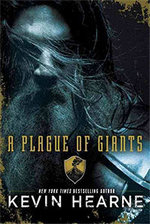
A Plague of Giants

A Plague of Giants

by Kevin Hearne
Series: Seven Kennings, #1

Hardcover, 624 pg.
Del Rey Books, 2017

Read: October 19 – December 30, 2017

Read the Official Synopsis here.
There’s just so much about this book that I loved, and so little that I had issues with, I couldn’t piece together anything coherent. I think the idea of the kennings is brilliant (yes, common to other fantasy series, but Hearne’s approach sells it). Most of the point-of-view characters are so well-drawn and developed that I can’t find fault with any of them.

This has all the strengths of The Iron Druid Chronicles (and maybe a couple of the minor weaknesses), which is enough to get me solidly on board for the series, but there’s more to it than just that.

The best thing, the most inspired idea is the way the bard tells the story, how we get each different POV. It’s a brilliant stroke.

The whole book is great—the magic system, the characters, the stakes, the big mystery about the source of invading giants, and the very human responses to the invasion. A great start to a fantasy trilogy that’s surely going to be one of my favorite trilogies. I just wish I could be a bit more articulate about it.

It does move maddeningly slow. But it has to—you can’t establish this fantastic world at a fast pace. You can’t take the time for all the tiny character moments that are just pure gold if you’re driving towards big action moments. But when the pace does pick up occasionally, you get a hint at how dynamic parts of book 2 and most of book 3 are going to have to be.
5 Stars

Page 72 of 153

Powered by WordPress & Theme by Anders Norén