Category: S-Z Page 10 of 14

Series S-Z

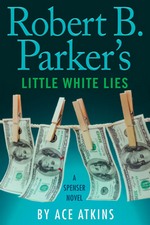
Robert B. Parker’s Little White Lies by Ace Atkins

Really, all I want to say about this book is: “Yes! Atkins did it again — it’s just so good, folks. Long-time fans’ll love it, new readers will likely see the appeal of the series. A lot of fun with a great ending!” But that seems a little surface-y and is just bad writing. But really, that’s everything I’ve got to say.

Little White LiesRobert B. Parker’s Little White Lies

by Ace Atkins
Series: Spenser, #45

eARC, 320 pg.
G.P. Putnam’s Sons, 2017

Read: March 16 – 17, 2017

Pearl and I were off to Central Square . Her long brown ears blew in the wind as we drove along Memorial Drive against the Charles. Rowers rowed, joggers jogged, and bench sitters sat. It was midSeptember and air had turned crisp. The leaves had already started to turn red and gold, shining in Technicolor upon the still water.

I debated about what quotation I’d open with — I went with this Parker-esque (and Atkins-esque) description. Little White Lies is one of the better of Atkins run on this series, because (like here) he did something that feels like something Parker would’ve written, but not quite what he’d have said (the more I think about it, the less I think that Parker’d have said “bench sitters sat”).

Actually, that’s true of the other quotation I almost used, too:

I nodded , adding water to the new coffeemaker sitting atop my file cabinet. I’d recently upgraded from Mr. Coffee to one of those machines that used pre-measured plastic cups. I placed my mug under the filter, clamped down the lid, and returned to my desk. Demonic hissing sounds echoed in my office. Where have you gone, Joe DiMaggio?

This is Atkins sixth Spenser novel, and you’d think he’s got enough of a track record that I could stop comparing him to Parker. Well, you’d be wrong — I can’t stop. This, like most of Atkins’ work on this series, is so reminiscent of early Parker novels that it makes some of the latter Parkers look more like they were written by a hired gun. Still, I’m going to try to keep it to a minimum because it doesn’t seem fair to keep doing.

Susan has sent one of her clients to Spenser for some help that she can’t provide. Connie Kelly had been dating someone she met online, invested in one of his real estate deals — and he vanished, taking the money with him. Could Spenser track him down and get her cash back? Sure, he says. It doesn’t take long for the investigation to show that he owes plenty of people money — a couple of months rent here, hundreds of thousands of dollar there.

Here’s the fun part: M. Brooks Welles, the deadbeat in question, is a silver-haired, silver-tongued mainstay on cable news. He’s former CIA, and an expert on military and national security issues — one of those that producers call on regularly when they need a talking head. Why’s a guy like that flaking out on real estate deals? Spenser knows something fishier than expected is going on — which takes him into a world of mercenaries, gun deals, and the ATF.

Then someone tries to kill him. A couple of times. And the book stops feeling like a semi-light adventure, poking fun at the blowhards on cable TV and the state of American Journalism, and how we shouldn’t trust as many people who have cameras pointed at them as we do. Things take on a different tone, bodies start piling up, and a darkness slips in to the book. This also brings in Belson and his new boss — who’s still not a fan of Spenser. About the same time, Connie starts to waver in her conviction that she wants her money back and Welles punished. Spenser, naturally, doesn’t care and plows ahead. Hawk is able to connect Spenser with some mercenaries that travel in the same circles as Welles and the chase is on. Eventually, the action moves from Boston and its environs to Georgia. Which means that Teddy Sapp is going to make an appearance.

All the characters were great — I would’ve liked some more time with some of Welles’ co-conspirators in Boston, I think it’d have helped round out our picture of his crimes. But it’s a minor complaint. We also got plenty of interaction with his Georgia-based colleagues. Even the characters that show up for a page or two as witnesses to the crimes were interesting — it’s the little things like those that add so much. It was nice to see Teddy Sapp again, too. He was the best part of Hugger Mugger (faint praise, I realize). The Hawk material was very good — maybe Atkins’ best use of the character yet.

I fully expect that people are going to spend a lot of time talking about the ending — it didn’t feel like a Parker ending. That said, it felt like an ending that pre-A Catskill Eagle Parker might have tried. It was satisfying, don’t misunderstand, it’s just not the kind of ending that Parker employed. Honestly, there were two other perfectly acceptable places to end the book — and if not for the progress bar at the bottom of my screen, I might have believed that thee ending was earlier and equally strong.

Now, because Atkins and the Parker estate aren’t stupid, there are certain characters that you just know are safe, no matter what shenanigans that they’ve let Atkins and Coleman get away with when it comes to killing off long-term supporting characters. But there was a definite feeling of peril when it comes to [name redacted] and [name redacted]. Sure I knew they’d live to be read about another day, but I wondered how healthy they’d be in the meantime.

This is sharply written, as usual. Atkins knows what he’s doing (in this series or anything else) — a great mix of character moments and plot. Spenser’s voice is strong — as are the voices of the other regulars. It was just a pleasure to read through and through. Let me leave you with one more snippet that is could’ve come from an early-80’s Spenser just as easily today’s, a voice like this is enough reason to read the book — the rest is just gravy (and there’s plenty of gravy):

I returned with sore legs back to my seat on the steps. I spent the next fifteen minutes watching women of all ages, sizes, and colors walk past me. I liked the way most women walked. I liked the way they dressed. And talked and smelled. I was pretty damn sure I was a fan of women in general. Did this make me a sexist or a feminist? Or somewhere in between.

Disclaimer: I received this eARC from Putnam Books via NetGalley in exchange for this post — thanks to both for this.
N.B.: As this was an ARC, any quotations above may be changed in the published work — I will endeavor to verify them as soon as possible.

—–

4 1/2 Stars

Opening Lines – Dead Gone

Head & Shoulders used to tell us that, “You never get a second chance to make a first impression.” That’s true for wearing dark shirts, and it’s especially true for books. Sometimes the characters will hook the reader, sometimes the premise, sometimes it’s just knowing the author — but nothing beats a great opening for getting a reader to commit. This is one of the better openings I’ve read recently. Would it make you commit?

She hadn’t been afraid of the dark.

Not before.

Not before it entered her life without her knowing, enveloping her like a second skin, becoming a part of her.

She hadn’t been claustrophobic, petrified the walls were closing in around her. Crushed to death without knowing they’d even moved. Not scared of things that crawled around her toes. Wasn’t afraid to sit alone in a darkened room and wonder if something was touching her face, or if it was just her imagination.

Nope. She wasn’t scared before.

She was now.

It took time to become afraid of those things, and time was all she had, stretching out in front of her without end.

She blamed herself. Blamed her friends. Blamed him. She shouldn’t be there, and someone was to blame for that.

Had to be.

from Dead Gone by Luca Veste

This tells you so much about the victim, her life and what’s about to happen to her (and who’s behind what’s about to happen) — such a good opening.

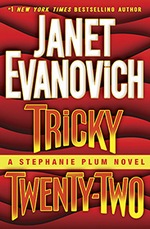
Tricky Twenty-Two by Janet Evanovich

Tricky Twenty-TwoTricky Twenty-Two

by Janet Evanovich

Series: Stephanie Plum, #22

Mass Market Paperback, 313 pg.
Bantam, 2016

Read: December 31, 2016

Stephanie’s on the hunt for a frat boy on the run, a lawn equipment thief, and a rapist. The latter two are pretty straightforward, but the frat boy, Ken “Gobbles” Globovic? Something’s not right with this one, and Stephanie puts on her deerstalker to try to figure that out.

Meanwhile, Ranger needs a woman for some security work, so naturally, Stephanie’s on the case. Things don’t go as well with that as it should’ve and bodies start to show up. That’s when things really start to get interesting.

Joe and Stephanie are both examining other career prospects, and watching Stephanie try out different ideas is good for a grin or two. I think I’d have preferred letting that play out a little more, honestly. She also could’ve played out the Grandma Mazur story longer, too — that’s something I almost never say. The former would’ve been easier than the latter, definitely. Still, there was a time when Evanovich seemed to drag out similar storylines longer than I’d like, so this “leave ’em wanting more” philosophy really works (“’em” roughly translates to The Irresponsible Reader here).

Ranger stood hands on hips and looked at me. “I’m completely enamored with you, and I have no idea why.”

“I’m cute?”

“Babe, there has to be more, but honestly, I don’t know what it is.”

I’m with him there, there are times I really wonder why I’ve read 22 of these (and plan on reading more). Now that I’m only reading one of these a year, it’s far easier to enjoy the Lula’s extremes (and/or Grandma Mazur), the same beats getting played out over and over, and so on — if anything, it’s comfortable. Part of the fun is to see the different ways that Evanvovich comes up with to hit these beats.

This time out, the stakes with Joe seem to be bigger than usual. And the crime that Stephanie uncovers during the course of her other investigations/hunts is bigger and more serious than usual. Not that serial killers and mafia bosses are the stuff of sitcoms, but we’ve seen them (in various TV/Book series) used in light ways pretty often lately.

In the end, this is a better than average Stephanie Plum adventure with enough of the old reliable characters and beats and some pretty good character moments. A satisfying read for new fans or old.

—–

3 Stars

Pub Day Repost: An Obvious Fact by Craig Johnson

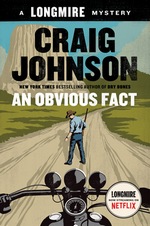
An Obvious FactAn Obvious Fact

by Craig Johnson
Series: Walt Longmire, #12

eARC, 320 pg.
Viking, 2016

Read: July 29 – 30, 2016

4 Stars

Craig Johnson is so consistent with these books that he makes it really hard to write about them. I’ve struggled with this one for weeks — how can I say something I haven’t before? I’m not sure I can, but I guess I can start with what makes this one different from the rest.

For starters, Henry’s borrowed Walt’s set of Sherlock Holmes (without his knowledge or consent, but who cares) and spends the novel quoting Holmes at inopportune times to his buddy. I laughed every time. Walt didn’t find it that amusing — and paid him back by talking about what a silly and reckless endeavor riding motorcycles is — much less racing/jumping/etc. He had plenty of opportunity to make these kind of remarks as the two of them were in Hulett, WY for the world’s largest motorcycle rally, where Henry is attempting to recapture a victory of his younger days.

Walt’s been brought in to help with the investigation of a motorcycle crash, the small local police force is stretched beyond itself due to the rally and really can’t take it on. It seems pretty cut and dry on the surface — just a bad break and a bit of careless driving. But every time Walt looks at another piece of evidence, he finds more reasons to doubt the obvious facts.

We learn a lot about Henry in this book — but he’s not really in it all that much (at least less than he’s been in others, lately). And while he’s not really at odds with Walt, you really can’t say that he’s on his old friend’s side throughout (nor is he really acting all that rationally).

Vic comes back to Wyoming, and injects her flair into the investigation and Walt’s life. She also continues to be the embodiment of many men’s dreams between her looks, brains, language, driving and shooting. I’m not going to say if she’s my Platonic ideal, I will say that for a totally unrealistic character, she’s a whole lotta fun.

The Whodunit was pretty easy, the Whydunit was trickier (and the Accessories to the Who were more difficult, but not hard). But, hey, we don’t read these books for the puzzle — we do it to watch Walt figure things out and to spend time with our friends from the Equality State (and the nations within it). In the end, this is just what you expect out of a Walt Longmire novel — some laughs, a nice little puzzle, a little fisticuffs, maybe a little gunplay (not necessarily a shoot-out). Well-paced, well-told, all in a day’s work for Johnson.

Disclaimer: I received this eARC from Viking via First to Read in exchange for this post — thanks to both for this.

—–

4 Stars

An Obvious Fact by Craig Johnson

An Obvious FactAn Obvious Fact

by Craig Johnson
Series: Walt Longmire, #12

eARC, 320 pg.
Viking, 2016

Read: July 29 – 30, 2016

4 Stars

Craig Johnson is so consistent with these books that he makes it really hard to write about them. I’ve struggled with this one for weeks — how can I say something I haven’t before? I’m not sure I can, but I guess I can start with what makes this one different from the rest.

For starters, Henry’s borrowed Walt’s set of Sherlock Holmes (without his knowledge or consent, but who cares) and spends the novel quoting Holmes at inopportune times to his buddy. I laughed every time. Walt didn’t find it that amusing — and paid him back by talking about what a silly and reckless endeavor riding motorcycles is — much less racing/jumping/etc. He had plenty of opportunity to make these kind of remarks as the two of them were in Hulett, WY for the world’s largest motorcycle rally, where Henry is attempting to recapture a victory of his younger days.

Walt’s been brought in to help with the investigation of a motorcycle crash, the small local police force is stretched beyond itself due to the rally and really can’t take it on. It seems pretty cut and dry on the surface — just a bad break and a bit of careless driving. But every time Walt looks at another piece of evidence, he finds more reasons to doubt the obvious facts.

We learn a lot about Henry in this book — but he’s not really in it all that much (at least less than he’s been in others, lately). And while he’s not really at odds with Walt, you really can’t say that he’s on his old friend’s side throughout (nor is he really acting all that rationally).

Vic comes back to Wyoming, and injects her flair into the investigation and Walt’s life. She also continues to be the embodiment of many men’s dreams between her looks, brains, language, driving and shooting. I’m not going to say if she’s my Platonic ideal, I will say that for a totally unrealistic character, she’s a whole lotta fun.

The Whodunit was pretty easy, the Whydunit was trickier (and the Accessories to the Who were more difficult, but not hard). But, hey, we don’t read these books for the puzzle — we do it to watch Walt figure things out and to spend time with our friends from the Equality State (and the nations within it). In the end, this is just what you expect out of a Walt Longmire novel — some laughs, a nice little puzzle, a little fisticuffs, maybe a little gunplay (not necessarily a shoot-out). Well-paced, well-told, all in a day’s work for Johnson.

Disclaimer: I received this eARC from Viking via First to Read in exchange for this post — thanks to both for this.

—–

4 Stars

Cheap Shot (Audiobook) by Ace Atkins, Joe Mantegna

Cheap Shot (Audiobook)Robert B. Parker’s Cheap Shot

by Ace Atkins, Joe Mantegna (Narrator)
Series: Spenser, #42

Unabridged Audio, 7 Hours and 30 Minutes

Random House Audio, 2014
Read: June 7 – 9, 2016


This is a very mixed bag of an audiobook. I loved the novel 3 years ago, and enjoyed reliving it. But man, the narration was just not my thing. But I’ll get back to that in a bit.

I stand by pretty much everything that I said 3 years ago (although, I seem to have missed/underrated one plot point last time — I totally bought it this time). Here’s some of what I said before that still applies:

On the one hand, this is not Atkins’ best Spenser. But it’s the one that feels like Parker more than the rest (make of that what you will). The banter, the poking around and stirring things up until you get a break, the fisticuffs, the donuts, the gun fight, the needling of underworld players, and so on — he captures Parker’s voice and pacing better here than he’d managed before (yet doesn’t come across as pastiche). Spenser’s sniffing around the big money and big boys (and a few men) in sports, which serve as a good place for Spenser to reflect how men are to act. Parker did this Mortal Stakes and Playmates (and to lesser extents elsewhere — like Early Autumn), and Atkins is able to do that here (arguably he does so with a subtlety that Parker didn’t achieve).

Kinjo Heywood’s a fun character — slightly more grounded than Mortal Stakes‘ Marty Rabb, far more mature and grounded than Playmates‘ Dwayne Woodcock. One advantage Heywood has is his son, Akira (who’s plenty of fun on his own) — he has someone to provide a good example to, and he strives to. Heywood also seems to have thought ore about life and how one should live it. Marty seemed to think only about Linda (his wife) and baseball, Dwayne was all about his girlfriend (Chantel) and basketball, too — but with less self-examination, it’s just that’s all he had the chance to think about (although Chantel would see that changed, and his horizons broadened if she had anything to say about it). Heywood’s got a kid, he’s been through a divorce, and is fully aware of his place in the limelight (including social media) and his own shortcomings. This alone saves the book from being a reworking of Parker.

I should add that Sixkill has a lot of perspective here (with the assistance of Atkins’ own background in football) — he was close to Heywood’s level, and if he’d made one or two better choices, he would’ve been at this level. He has a better idea what’s going on in Heywood’s mind than Spenser and his brief stint in the boxing world would.

The book begins with Spenser doing bodyguard duty — and as always (Stardust, Looking For Rachel Wallace, A Savage Place, Rough Weather) things don’t go well. You’d think people’d stop hiring him for this kind of work. Spenser turns to investigating — and unearthing lie after lie from his client — while getting Hawk and Sixkill to pitch in on the bodyguard front.

In addition to the main characters, Hawk, Susan, Sixkill, Tony Marcus, and so on; Atkins continues to show a command and familiarity with the impressive gallery of supporting characters in the Spenser-verse. And the new characters fit into the ‘verse just fine, nothing that Parker wouldn’t have created.

Not only did Atkins give us a good story this time, he appeared to be planting and/or watering seeds for future books at the same time — something Parker never bothered with, but I’m glad to see.

About the only thing I’d like to add on this front is that I think I liked the story more this time around.

So much for the lovefest. I just didn’t like Mantegna’s work. I know, I know — he’s done many, many of the Spenser Audiobooks; Parker loved his work with Spenser (even getting him cast in those semi-regrettable movies); and he’s Joe bleepin’ Mantegna. Still, it didn’t work for me. When he was reading the narrative parts — Spenser describing what he was doing, what he was seeing, etc., even making smart aleck asides — I dug it. He did a perfectly entertaining job — maybe even more.

But the strength of Parker’s work was his dialogue, and Mantegna fell flat (at best) on this front. Spenser sounds like Fat Tony, which just should not be. Ever. Kinjo sounds like a stereotypical old blues man, not a young NFL linebacker. Hawk sounds like a slightly younger blues man. And don’t get me started on Zee. That was just embarrassing. Most of the other characters were pretty poorly done, as well. And when the book is so reliant on dialogue, so reliant on the charm of the characters, that missing with just about all of them hurts.

So, like I said, great writing, mediocre (when not disappointing) narration. Please note this rating is for the Audiobook — the whole experience, the narration as well as the writing — still love the book, and would recommend the novel in a heartbeat. This? Eh. It was entertaining enough, but that’s it. Still, any time with Spenser is time well spent.

—–

3 Stars

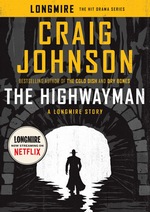
The Highwayman by Craig Johnson

The Highwayman The Highwayman

by Craig Johnson
Series: Walt Longmire, #11.5

Hardcover, 190 pg.
Viking, 2016

Read: June 7 -8, 2016

We’re taught to work independently, but nothing strikes you quite like a 10-78 [Officer Needs Assistance], the urgency to reach a fellow officer in need. It’s instinctual to individuals who are trained to respond and risk their lives for each other and complete strangers.”

Having been in Wyoming Law Enforcement for so long, he knows pretty much every officer in the state. One such person is Rosey Wayman, a Highway patrolman who’s having some problems. She’s taken a new assignment, a jurisdiction once patrolled by a (literally) legendary officer. Since then, well, strange things have been happening. Walt and Henry (as a favor to her and her C.O.) have dropped by to act as sort of independent witnesses — basically to determine if her imagination is getting the best of her, or if there are strange things underfoot.

One of the best parts of this series is the way that Johnson writes about things that can’t be readily and easily explained (generally) without spelling things out for the reader. Yes, a character may be having a psychological problem, a physical problem, or there might be a spiritual dimension to what they experience — maybe all of the above — but what Johnson won’t do is tell you what happened. Henry, Walt, Ruby, Lucian or any number of others just might express their thoughts/opinions/beliefs, but the author won’t.

Which means that when Johnson tells a ghost story? You’re in for a good one. One where you have no idea if the ghost in question is a manifestation of someone’s (or multiple someones’) subconscious.

I will admit I was confused when I saw this was advertised as a novella. The last Longmire novel, Dry Bones was 306 pages long, and this was listed at 200 (190 is my count). How did that qualify as a novella (which is a fairly slippery term, anyway)? And then I picked up a copy. This one measured at 5.3″ x 7.4″ (Dry Bones was 6.2″ x 9.2″). Which explained everything. Reading it made it clear that it wasn’t a novel — one story, no personal drama, no ongoing story/character arcs — just Walt, Henry and Rosey on a ghost hunt.

Lean prose, great characters, a setting that means more than just the place where the action takes place (and is described thusly) — everything you want in a Longmire story.

One other thing that I have to mention — the elderly Arapaho sha-woman that Henry introduces Walt to is a real hoot. Her teasing/harassment of Walt was a needed dash of fun in this book, I can only hope that Johnson finds an excuse to use her again.

If this was a novel, it’d be 3-3 ½ stars, but since it’s supposed to be a novella, I’ll give it a 4. Just what the doctor ordered to tide you over until the next full book.

—–

4 Stars

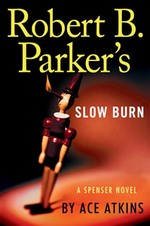
Slow Burn by Ace Atkins

Slow BurnRobert B. Parker’s Slow Burn

by Ace Atkins
Series: Spenser, #44

Hardcover, 304 pg.
G.P. Putnam’s Sons, 2016

Read: May 5, 2016

On the Greenway, a carousel turned to calliope music. The two men approached me. They tried to act like they were shopping, but they were as unobtrusive as a couple of linebackers at a Céline Dion concert.

Say what you will about the relative merits of Atkins’ two current series, but you won’t get lines like that from Quinn Colson (maybe from Lille Virgil). (That’s not really the best line of the book — it’s just the one that requires the least setup)

We’re introduced to a new world here — the Boston Fire Department, and the Arson investigators in particular (but not exclusively). It’s a little harder for Spenser to work his magic here, at least at first, being very much a duck out of water. But, he keeps at it, and eventually things start falling into place — even if he makes one serious (and perhaps life-threatening) mistake early on. There’s a series of suspected arsons, but the proof is minimal, and it doesn’t push the investigators in the right direction — or any direction, really. The usual motives (fascination with fire, insurance money) don’t seem to be involved here.

I should add that the motive for the crimes is interesting, if misguided. I’d almost like to see a bit more of it explored by the good guys, but that’s not what this book is about.

Spenser and his allies do their thing, the way they always do (but fueled by a different donut source). The same ol’ charm, wise cracks, and fists eventually do their job. I think this one is a notch above Atkins’ last — a couple of notches below Atkins or Parker at their best, but better than Parker’s average. The fact that I have to work this hard to decide where exactly in the 40+ this one lies says something — it’s on the good end, I should stress — but it’s hard to distinguish this from the master himself, Robert B. Parker.

There’s some good fodder for long-time fans here — Marty Quirk has a new job, Frank Belson has a new boss (one not particularly taken with Spenser). Not only do we get a callback to Mattie Sullivan, but we get a couple from the more distant parts of Spenser’s past — A Catskill Eagle and Promised Land, one of my least favorites and one of Parker’s best. Atkins’ ability to use for the current narrative, comment on, and tap into fanboy nostalgia all at the same time is really something to watch.

Atkins is again feeling confident enough in his role here to make significant moves in Spenser’s life — not to mention Pearl’s and Sixkill’s. I’m not sure I’m crazy about the latter two, but I’m trusting Atkins. I’m pretty sure he has a plan regarding our favorite disgraced athlete that’ll pay off. Can’t help but wonder what Parker had in store for him, though.

Speaking of plans and things in store — it’s pretty clear that Atkins has a plan for Jackie DeMarco, too. I hope it takes a few books to pull it off, but I fear it won’t.

I’m very glad to hear that we’ve got at least two more of these coming, Atkins is really helping me stay in touch with an old, old friend. I smiled, I chuckled, I even laughed a couple of times, and I reminisced a little, while wondering just how Spenser was going to save the day. All in all, a good way to spend a couple of hours. Now I’ve just got to count down the months until #45.

—–

4 Stars

Opening Lines – Staked by Kevin Hearne

Head & Shoulders used to tell us that, “You never get a second chance to make a first impression.” That’s true for wearing dark shirts, and it’s especially true for books. Sometimes the characters will hook the reader, sometimes the premise, sometimes it’s just knowing the author — but nothing beats a great opening for getting a reader to commit. This is one of the better openings I’ve read recently. Would it make you commit?

I didn’t have time to pull off the heist with a proper sense of theatre. I didn’t even have a cool pair of shades. All I had was a soundtrack curated by Tarantino playing in my head, one of those songs with horns and a fat bass track and a guitar going waka-chaka-waka-chaka as I padded on asphalt with the uncomfortable feeling that someone was enjoying a voyeuristic close-up of my feet.

from Staked by Kevin Hearne

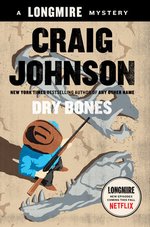
Dry Bones by Craig Johnson

Dry BonesDry Bones

by Craig Johnson
Series: Walt Longmire, #11
Hardcover, 306 pg.
Viking, 2015

Read: December 5, 2015
So, possibly the largest Tyrannosaurus rex skeleton ever discovered is found in Wyoming (which is apparently a pretty good place to find them, who knew?), and there’s a battle brewing over who it (and the very large price tag that’ll surely be attached to it) belongs to. There’s enough drama there, but you don’t pick up a Walt Longmire novel for paleontological wrangling, you need a dead body or two. Thankfully, one shows up not too far away, and Walt’s old friend, Omar finds it.

Johnson’s pretty good at keeping several plates spinning, but this time he seems to have outdone himself — we’ve got a controversy over who gets custody over the T. Rex, with three different parties; a runaway; dealing with FBI and a Deputy U. S. Attorney looking to make a name for himself; Double Tough’s recovery from A Serpent’s Tooth; Vic’s continuing recovery from the same book; a visit from Cady and her daughter; oh, yeah, and the murder. About halfway through I actually stopped and wrote them all down, and asked myself “how’s he pulling this off?” I’m honestly not sure, but he did.

Which does mean he pulled it off flawlessly. It didn’t take too long to figure out where the Deputy Attorney story was going — aside from the running source of comedy. But honestly, I think we needed a couple more scenes to make it worthwhile. We got to see Lolo again — which was nice, but she didn’t get enough to do. Still, just glad to see she’s still in this world. I do think the skeleton controversy vanished a bit (understandably) in the middle, when I think it could’ve kept going.

But overall, this was a fun, quick ride, with Johnson (and Longmire) firing on all cylinders, and I can’t wait for the next one to see how the events of this book impact our friends going forward.

Oh no! I’m all caught up (other than the short story collection) with the Longmire books — whatever shall I do? Actually that’s a really good question, I’m going to miss my monthly visits to Absaroka County.

—–

4 Stars

Page 10 of 14

Powered by WordPress & Theme by Anders Norén