Category: Fiction Page 140 of 341

Murder by Other Means by John Scalzi, Zachary Quinto (Narrator): When You Can’t Kill Someone Anymore, Criminals Have to Get Creative

Murder by Other Means

Murder by Other Means

by John Scalzi, Zachary Quinto (Narrator)
Series: The Dispatcher, #2

Unabridged Audiobook, 3 hrs., 33 min.
Audible Studios, 2020

Read: September 18-19, 2020

A Sequel to The Dispatcher?

I think the last thing on my mind as I finished The Dispatcher was that there’d be a sequel. It seemed fairly stand-alone (but, I guess, I can see that the door was open). But now that I’ve heard this? It seems only natural that there’d be a follow-up to The Dispatcher and the door is open for more.

What’s Murder by Other Means About?

So, in this world 99.9% of the time, if you’re murdered, you come back to life in your home/somewhere you feel safe. If you die of natural causes, in an accident, from suicide—you stay dead. But if someone intends you harm and you die, you’re most likely safe. This started a few years before this book is set, and no one knows why.

But that doesn’t stop people from taking advantage of it. There’s a new industry, our protagonist/narrator is part of it, Dispatching. Licensed killers who shoot people when death is all but certain to give them another chance at life. In the time since The Dispatcher, it seems that some new and creative uses for them have become common. Most of them straddle the line between legal/illegal or moral/immoral.

Tony Valdez starts this book hurting for money, and takes one of those not technically illegal jobs. Soon after, people around him—loosely connected, but not really friends or colleagues—start dying from unnatural causes. Not murders, obviously, because they stay dead. But as the bodies start to accumulate, the police have to look at the one common denominator—Tony. Tony starts investigating himself—if only because he figures it’s going to be long before he’s one of the dead that doesn’t come back.

How was the Narration?

Quinto makes Tony come to life, and is able to humanize this licensed executioner enough that you don’t think of him as a killer for hire, you think of him a beleaguered private contractor on hard times. Quinto’s great at the rest of the job, too—I’d absolutely listen to more audiobooks he narrates.

So, what did I think about Murder by Other Means?

I was less than enthusiastic about The Dispatcher back in 2016—which I didn’t remember until I just glanced at my post. I’m not over the moon about this, but I enjoyed it, and hope there’s more to come (I’m not sure I want to wait four more years, however). If there is? I’m jumping on it eagerly.

It was clever, it is honest about the human condition and the ways we find to hurt and destroy (and comes up with a few that are custom-made for this no-murder reality), yet remains a very human, very real thriller. It’s a good way to spend a couple of hours.


3.5 Stars

Next to Last Stand by Craig Johnson: Boy Howdy, Walt Longmire and an Art Crime, Who’d Have Seen That Coming?

Next to Last Stand

Next to Last Stand

by Craig Johnson
Series: Walt Longmire, #16

Hardcover, 320 pg.
Viking, 2020

Read: September 23-25, 2020
Grab a copy from your local indie bookstore!

I placed my hands on my hips and stared at the recently departed. It was true that he wasn’t a man I particularly liked, but fate had brought him in contact with me and now he was dead wand that made me partially responsible….

“Earth to Walt.” I turned and looked at her as she smiled. “So, you’re getting pissed, huh?” She stood beside me, toeing a tuft of grass. “There’s always a point where you start taking it personally. I like that part because that’s when shit starts happening, and I like it when shit starts happening.” She turned her face toward me, listening as I clenched my fists, like a cinch being tightened ion a saddle. “So, is shit about to start happening?”

“I believe so.”

What’s Next to Last Stand About?

An elderly resident at the Veterans’ Home of Wyoming (“The Sailor’s & Soldier’s Home of Wyoming”) dies of an apparent heart attack—which saddens, Walt, he liked Charley Lee Stillwater (and Cady loved the man). But what gets him coming back is the fact that among his possessions is a shoebox full of hundred dollar bills. Ten thousand of them, in fact. Where does a man like Charley Lee come up with that? And is there a clue among the surprising amount of books about art, art history, and General Custer in his room?

And the presence of a million dollars does cast a little doubt on the heart attack if only to be thorough. That’s a great motive to kill someone—or at least the beginning of one. Things develop from there as they tend to when Walt gets curious. He ends up involving art experts from all over the state (and even the world)—experts who may be more interesting than the art they’re discussing.

I want to spend more time at The Sailor’s & Soldier’s Home—I liked both the staff and the residents we spent time with. The souped-up motorized wheelchairs were great, and the people in them were even better. I just hope we don’t need another semi-suspicious death to get Walt back there.

The Custer material really serves as an excuse for Henry Standing Bear to sound off about Custer and the battle of Little Big Horn. I’d love to hear a few history lectures from Henry, the little bits we got here were enough to make me want more. Walt, Vic, and Henry (with an assist from Lucian) also give their (almost universally negative) opinions about all the movies made about the man and event. The Custer, Little Big Horn, and cinematic material alone is worth the effort to read this book.*

* Of course, with Johnson’s style, there’s not a lot of effort involved, so that may come across as faint praise.

Next to Last Stand in relation to the Rest of the Series

There’s a new staff member for the Absaroka Sheriff Department, and at least one member of the current staff is preparing to leave (how many is yet to be determined). Johnson either has big plans, or he’s writing himself into a corner where he’ll have to make some. I’m pretty curious about it either way.

But the bigger tie to the rest of the story is where this stands in relation to Depth of Winter. I enjoyed The Western Star, and thought the conclusion was a doozy. This led into Depth of Winter, which was good, but…wasn’t a Walt Longmire book. Land of Wolves focused on Walt’s recovery and was closer to what I expect in a Longmire book. Walt’s not back at 100%, physically or mentally. But he’s closer to it than he was in Land of Wolves, close enough that the book gets closer and closer to a typical Longmire read the further we get. Something about this case sparked whatever it was in Walt that he’d allowed to grow dormant since the last chapter of The Western Star.

It’s never really spelled out—it’s just obvious to those of us who’ve spent 16 books (plus the short stories) with the Sheriff. I’m not looking for the series to stagnate. I appreciate that every book in the series has a different feel than the others, and I don’t want that to change. I want Walt, Vic, Sancho, and the rest to develop. But there’s something about every non-Depth of Winter novel that remains quintessentially the same—I was more than a little worried that Johnson had left that behind in favor of the guy who took on a small army in Mexico. I’m glad to see I was probably worried about nothing.

The Return of an Old Friend

Lonnie Littlebird—Chief of the Cheyenne Nation and Tribal Elder—is back! It’s been too, too long since his smiling presence has graced this series. Um hmm, yes, it is so.

I’ve got nothing more to say about him, but as always, I perked up when I saw him. I just enjoy him (and am looking forward to hearing George Guidall’s narration of the audiobook, I like his Lonnie Littlebird).

Well, I guess I know what the Next Book is About?

There’s this subplot involving Henry Standing Bear, Tribal Police Chief Lolo Long (from As the Crow Flies, Dry Bones, and maybe a short story), Lolo’s niece, and Walt that looked like it was going to be a major part of this novel. And then it just…went away. I’m not talking about being unresolved, it was simply dropped with 150 pages to go.

Now that I stop and think for a minute, there was another subplot that didn’t get adequate resolution…maybe it’s setting the stage for something else, too?

I think Johnson’s too good to just drop stuff without a good reason (ditto for the editorial staff at Viking). I just can’t see the reasoning from here.

So, what did I think about Next to Last Stand?

“You do realize that being so conversant with wounds that you can estimate the amount of stitches needed to retain vital organs is not normal, right?”

I laughed. “What’s normal in this line of work anyway?”

“Good question.”

Abandoned storylines aside, I liked this so much. The world and characters we know and love have almost been absent—or at least not fully present—since 2016’s An Obvious Fact. But they’re all here, and it felt so good to be back. But even without that sense of relief, this was a fun book—had we got this book without the Mexico trip trilogy (for lack of a better name), I’d have enjoyed it as much. Clever mystery, great characters—both the guilty, the victims, and everyone else—with a conclusion that’s as entertaining as it is satisfying. I was in hog heaven.

Would this work as a jumping-on point to the series, or even to read as a stand-alone? Oh, yeah. Absolutely. Johnson’s strong on that point, you can jump on at almost any point and feel at home. You technically could read this as a stand-alone, but it’d be like eating just one Lays Potato Chip, I bet you cant. I’m already counting down the days until Walt Longmire #17, and there are too many of them.


4 Stars

This post contains an affiliate link. If you purchase from it, I will get a small commission at no additional cost to you. As always, opinions are my own.

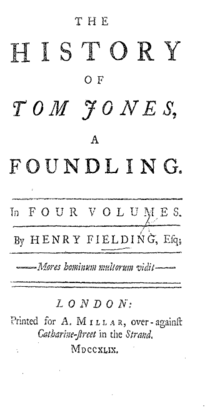
The History of Tom Jones, a Foundling by Henry Fielding: BOOK XIII., v. – viii.

Fridays with the Foundling
Tom Jones Original CoverThe next day, Tom tries several times to see Mrs. Fitzgerald but gets nowhere. Fed up, he goes back to the Inn he’s staying at (a place Mr. Allworthy stayed at when in London). He hears an altercation and comes to intervene.

I was joking last week about how nice it was to see another fistfight again, and already we have a new one. They’re good for drama, I guess, and to make fast friends of whoever Tom comes to the rescue of (or vice versa). A footman was attacking his employer, and the daughter of the Innkeeper was standing by and screaming (this is what alerted Tom). As handily as the footman was beating his employer, so Tom took care of the footman.

It turns out—and you’ve gotta love this—the footman had been using his boss’s (Mr. Nightengale) copy of Hoyle and had spilled wine on an open page. Nightengale was angered, and the two started arguing over how much the book had been worth before getting ruined, so they could agree on how much to be withheld from his pay. One thing led to another…

Anyway, out of gratitude Nightengale splits a bottle of wine with Tom and they become friends, the innkeeper and her daughter join them and they all get along really well.

The next day, as masquerade invitation and mask arrive for Tom, he assumes this comes from Mrs. Fitzgerald and will be his chance to see Sophia. So he invites Nightengale to come to the ball with him—and then has to borrow cab fare from Partridge so he can afford to go anywhere. There’s no Sophia, or even Mrs. Fitzgerald at the ball, instead, it’s Sophia’s friend, Lady Bellaston, who arranged to meet Tom there.

She grills Tom for hours and finally agrees to arrange a meeting if he promises to leave Sophia alone after that. She gives him fifty pounds and sends him on his way.

Tom gets back to the inn to hear Mrs. Miller (the innkeeper, who I should’ve introduced earlier) talk about a cousin, who married for love and is now destitute and barely hanging on due to illness in the family. Tom pulls her aside and gives her the money Bellaston just gave him.

Now, earlier, Fielding told the reader that he focused on describing Mrs. Miller because she’s going to be important. I wonder how? And I look forward to finding out. A fun few chapters this week, I’m really enjoying Tom’s time in London.

The Beast and the Bethany by Jack Meggitt-Phillips, Isabelle Follath: A Story of Friendship and a Magical, Voracious Beast

The Beast and the Bethany

The Beast and the Bethany

by Jack Meggitt Phillips, Isabelle Follath (Illustrator)
Series: The Beast and the Bethany, #1

eARC, 240 pg.
Egmont Books, 2020

Read: September 14, 2020
Grab a copy from your local indie bookstore!

What’s The Beast and the Bethany About?

Ebenezer Tweezer has one goal in life—to keep on living. And he’s been doing a good job of that for over five centuries. He’s able to do this because of potions given to him by a magical Beast he met as a child. To keep the potions coming, he has to bring food to the Beast (who is only slightly more mobile than a caged bird). In return, the Beast magics money, treasures, and other gifts for Ebenezer.

The thing is, The Beast has peculiar tastes—monkeys, cacti, Ebenezer’s beloved cat, endangered species, and so on. Now, it has a specific task for Ebenezer. The Beast wants to eat a human child. A nice plump one with rosy cheeks. Initially horrified, Ebenezer decides that he’s really more interested in prolonging his own life enough that he can probably find a child easily enough.

It’s actually not as easy as he initially thought, but he eventually brings one home and sets to fattening it up a little bit for The Beast. In those few days, Ebenezer starts to think that maybe there are things more important than living to 512.

The Beast

Shockingly, The Beast is the least interesting thing in this book. It’s a large, grey, probably hideous looking, blob with tiny hands and feet. Its mouth is anything but small, much like its appetite. And that’s the problem.

This amorphous and amoral antagonist has an avaricious appetite. It has an overwhelming desire for more and for novelty. It’s not satisfied with being gluttonous, it wants something new, new experiences, new tastes, new flavors. If, like with its first victim in the book, the food happens to be rare, that’s all the better. But what seems to drive it more than anything else is something it hasn’t had before. For parents, caretakers, teachers who like to make young readers think about what they read will probably have a lot of fodder there.

But let’s not get bogged down in that—it’s mean, it’s greedy, and it’s not that bright and fairly helpless. It’s these two things that will help the protagonists.

The Bethany

(I love that the title uses the definite article for her…I can just see the beleaguered teachers at her school doing that. “Oh, you’ve got The Bethany in your class this term? Better you than me…” “Did you hear what The Bethany did today?”)

Bethany is…and I mean this in the strictly technical sense…a horrid, obnoxious, pill. And yes, yes, there are reasons for that, and we ought to understand that and exercise empathy toward her and try to help her. But at the beginning of this book, that’s not the point. The point is that she’s an ill-mannered bully, and that if Ebenezer had to pick a child to feed to the monster, you can certainly grant that she’d make a worthy nominee. Put in a slightly less homicidal way, Bethany is precisely the kind of girl who’d make Mrs. Piggle-Wiggle think of retiring.

Until—and this is the key—until she’s shown some kindness (unintentionally, sure, but that’s not important). When Ebenezer does nice things for her, extends her some courtesy—and inadvertently acts like a friend. That makes all the difference to Bethany, and she responds in kind (and probably ends up losing her definite article along the way). Those parents, caretakers, and teachers I mentioned earlier can really camp out on this point, I’m sure.

Ebenezer Tweezer

When the book starts, it’s easy to write off Ebenezer as merely The Beast’s errand-boy. Sure, a 511-year-old errand boy, but an errand boy nonetheless. Then once you understand what he’s doing and why…well, you lose pretty much all sympathy for him. Sure, some sort of alien, magical creature that only wants to eat is one thing, you can get that impulse. But Ebenezer has sold his metaphorical soul to him, in his Faustian bargain for a long life, Ebenezer has helped facilitate a swath of destruction through this world. And that just seems worse than The Beast’s actions.

And for what? Money, years, and nice things? He might as well be Smaug.

But as soon as you’re about to name him the true villain of the piece, he shows a little bit of a conscience. A teeny, tiny hint of one, but a conscience. Then, like the Grinch’s heart, that conscience grows three sizes. And once he accidentally befriends The Bethany? Suddenly, this villain becomes something approximating a hero. Then when Bethany reciprocates his kindness, his friendship, well, then you can’t help but cheer him on and wish him all the success. Parents, caregivers, teachers—you get where I’m going with this.

Throw in a backstory worthy of Heinz Doofenshmirtz and Ebenezer Tweezer turns out to be a character that could become a favorite after a re-read or two.

A Bit About the Illustrations

I’ve proven time and time again, that I’m just not that good with describing visual art or my reactions to it. So let me start with the simple—I liked Follath’s work, it seemed to fit the flavor and feel of the text. Which is just what you’re looking for, right?

My memory of Quentin Blake’s work is pretty dim, but I can see why people would compare these illustrations to his work (although most of that probably has to do with comparisons to Dahl, see below). But the artist that came to mind—repeatedly—for me while reading this was Jules Feiffer. Stylistically, there’s a lot to distinguish the two—but there’s some quality that I can’t put a name to that made me think of Feiffer.

I’m also not sure how big the art is in hard copy, how much of a page it’ll take up. In my eARC, the illustrations are typically pretty small—like they wouldn’t take up much room on a page. That’s a shame—if that’s true for the hard copy, I’d recommend getting a magnifying lens, so you can take in the detail. If you’re reading an e-copy, you should be able to zoom in/magnify the pictures with a click or a reverse pinch. Do so, you’ll be glad you did.

So, what did I think about The Beast and the Bethany?

I think it’s pretty clear that I liked The Beast and the Bethany—I’ve certainly talked enough about it. It’s a solid story with great characters, told in a clever way—just enough humor and wit to make this truly disturbing tale pretty entertaining and diverting. There’s even a nice little moral or two embedded in the text, but delivered in such a way that the target audience can ignore them so they can focus on Bethany’s efforts not to get eaten.*

* While the morals percolate in the reader’s subconscious, where it’ll do some good.

I’ve seen a lot of comparisons to Roald Dahl used in discussions of this book. Those may be fair and apt, I don’t remember enough of Dahl’s work to make them myself (nothing against the guy, I remember positive experiences with his works, but he was never a favorite). For me, this reads like a latter-day Daniel M. Pinkwater.* I don’t know what kind of audience he has today (I certainly had a hard time finding his stuff when I had kids the right ages), but I remember spending a lot of time in elementary school rereading and rereading books like Lizard Music, The Hoboken Chicken Emergency, I Was a Second Grade Werewolf—which combined horror elements, odd humor, and snappy writing. Just like this book. I couldn’t tell you the last time I thought about him—but I wasn’t far into this book when I started thinking about Pinkwater.

* It may not be fair to say latter-day, as Pinkwater’s still putting out books.

Put another way, this is the kind of book to give a middle grader that you want to turn into an A. Lee Martinez fan. I’m not sure how many people have that as a goal (it’d be a worthy one), but it’d work. If you are an A. Lee Martinez reader and are thinking about reading this book yourself or getting it for someone younger, this is right up your alley.*

* Conversely, if you’re looking for something like this written for adults, check out Martinez.

For laughs, for a warm fuzzy or two, for a little bit of horror, for a fun read for readers of all ages, The Beast and The Bethany is an almost sure-fire winner.


4 Stars
My thanks to The Write Reads for the invitation to participate in this tour and the materials (including the novel from Egmont Publishing via Netgalley) they provided.

BOOK SPOTLIGHT: The Beast and the Bethany by Jack Meggitt Phillips, Isabelle Follath (Illustrator)

I’m very pleased and excited today to welcome The Ultimate Blog Tour for the creepy and fun The Beast and the Bethany by Jack Meggitt-Phillips, Isabelle Follath (Illustrator). This Tour Stop consists in this little spotlight post and then my take on the novel coming along in a bit (and man, did it turn out that I had a lot to say). Let’s start by learning a little about this novel, okay?

Book Details:

Book Title: The Beast and the Bethany by Jack Meggitt-Phillips, Isabelle Follath (Illustrator)
Publisher: Egmont Books
Release date: December 8, 2020
Format: Ebook/Hardcover
Length: 240 pages

Book Blurb:

The most exciting new children’s book of 2020 and a modern classic in the making. The Beast and the Bethany has all the classic macabre humor of Roald Dahl with the warmth and charm of Despicable Me, finished off with a gleeful bite of Little Shop of Horrors! This book should be on every little monster’s birthday and Christmas list.

Ebenezer Tweezer is a youthful 511-year-old. He keeps a beast in the attic of his mansion, who he feeds all manner of things (including performing monkeys, his pet cat and the occasional cactus) and in return the beast vomits out presents for Ebenezer, as well as potions which keep him young and beautiful. But the beast grows ever greedier, and soon only a nice, juicy child will do. So when Ebenezer encounters orphan Bethany, it seems like (everlasting) life will go on as normal. But Bethany is not your average orphan…

About the Author:

Jack Meggitt-Phillips is an incredibly exciting new talent. He is an author, scriptwriter and playwright whose work has been performed at The Roundhouse and featured on Radio 4. He is scriptwriter and presenter of The History of Advertising podcast. In his mind, Jack is an enormously talented ballroom dancer, however his enthusiasm far surpasses his actual talent. Jack lives in north London where he spends most of his time drinking peculiar teas and reading PG Wodehouse novels.

About the Illustrator:

Isabelle Follath is an illustrator who has worked in advertising, fashion magazines and book publishing, but her true passion lies in illustrating children’s books. She also loves drinking an alarming amount of coffee, learning new crafts and looking for the perfect greenish-gold color. Isabelle lives in Zurich, Switzerland.

My thanks to The Write Reads for the invitation to participate in this tour and the materials they provided.

Kitty’s Mix-Tape by Carrie Vaughn: One More Trip to Kitty’s World in this Collection

Kitty's Mix-Tape

Kitty’s Mix-Tape

by Carrie Vaughn
Series: Kitty Norville

eARC, 288 pg.
Tachyon Publications, 2020

Read: September 12-14, 2020
Grab a copy from your local indie bookstore!

What’s Kitty’s Mix-Tape?

That’s an easy question: this is the second collection of short stories (previously published) set in the world of Kitty Norville, the werewolf turned talk radio star. We get a lot of stories featuring Kitty and/or her friends and allies (and one foe), and we get some stories that just happen to take place in the same reality even if they really don’t have any cross-over with the series.

There’s an introduction by Emma Bull that by itself would make a great review of this book (and maybe the series). Really, writing anything else after reading Bull seems superfluous.

Kitty & the Gang

I’m going to have a hard time keeping myself from talking too much about the stories featuring Kitty and her friends—Kitty and Ben going to her 10-year high school reunion was the perfect way to start off this book. Quick, fun, and a great way back into this world.

“It’s Still the Same Old Story,” could’ve fit into The Immortal Conquistador that I talked about a few months back—except it didn’t fit into the story arc of that one. But for those who wonder what Rick was up to in the early part of the twentieth century, this will give you a good idea. This is possibly my favorite thing focusing on Rick to date.

On the eve of their wedding in Kitty and the Dead Man’s Hand Ben disappears off on his own for a while, Vaughn finally lets us know what he was up to at the time. I’d forgotten all about that until I read this story, but I remember wondering then (as I was supposed to) what he’d been up to—it’s nice to have that answered.

There was a dynamite story about Detective Jessi Harden of Denver PD investigating a murder with a supernatural angle that doesn’t involve any of the series regulars. This would be the basis of a great follow-up series if Vaughn was in the mood for something. Hardin tackling “woo woo” crimes (I think that’s what the New Orleans PD calls them in the Yellowrock books) would be compelling as all get out.

One more that I want to mention is called “Kitty Learns the Ropes.” In this story, Kitty meets a professional athlete who happens to be a werewolf. Does that give him an unfair advantage? Should he disclose his situation to the world? Can’t this guy who never asked to be supernatural just live is life?

I’m going on too long, so I’ll summarize a few other standouts: there’s a fun little story with Odysseus Grant, and some cute bits with Kitty and her pack dealing with the Super Blood Moon and the like, and a showdown with some Federal Agents.

Other Stories

There are some stories that aren’t about Kitty or her friends, too, but just take place in her universe. There are two that take place in Regency England, “The Island of Beasts” and “The Beaux Wilde.” I enjoyed them both, and it is interesting to see Vaughn try to put her werewolves in that world. I would eagerly read more stories or a novel about the characters in “The Beaux Wilde.”

There’s also a sequel to a story from her previous short story collection, Kitty’s Greatest Hits about a child of a selkie who grows up to be a Navy SEAL (what else could such a son be)? I liked that one, too, but it seemed to be missing a little something from the end. But I’m pretty sure it was supposed to feel that way.

The tale about Nazis attempting to use werewolves in the war didn’t do much for me—but I think that’s mostly a me thing. It was a good story, just not the sort of thing I think I’d seek out.

The Songs

Vaughn includes a list of songs that embody the various stories for her, which she did for the novels, too. I think if you consider this list as a track list for a mixtape, you’d end up with something that Rob Fleming (in any incarnation) would look upon with scorn. If you take them as pieces to go with the stories, it’s a lot of fun, and adds a nice little dimension to them.

I will admit that I didn’t listen to them as I read—I think it would work though. They’re also a good tool to use to ruminate on the stories a bit.

So, what did I think about Kitty’s Mix-Tape?

There wasn’t a dud in the bunch, which is rare for a short story compilation—sure, I liked the ones about Kitty and her friends best, because that’s what I came to the collection for. But I liked them all.

The back cover promises that this is “the final installment” of the series, but Vaugn talks about staying tuned because it’s great to have a pre-existing world to write stories in. If the blurb is right, I’m glad I got a little more time in this world, but I’m hoping that staying tuned will pay off.

This may not be a great introduction to the werewolf DJ named Kitty, but it might work as one just fine, it’s certainly a good tour of the world. But it’s definitely the kind of thing that Kitty’s readers should come for. It’s one of the best collections I’ve read this year—and maybe for a good chunk of last year, too. Give it a whirl.

Disclaimer: I received this eARC from Tachyon Publications via NetGalley in exchange for this post—thanks to both for this.


4 Stars

This post contains an affiliate link. If you purchase from it, I will get a small commission at no additional cost to you. As always, opinions are my own.


May Day by Josie Jaffrey: Even Vampires Need Law Enforcement

May Day

May Day

by Josie Jaffrey
Series: Seekers, Book 1

eARC, 388 pg.
Silver Sun Books, 2020

Read: September 14, 2020

What’s May Day About?

Our protagonist and narrator is a Silver, Jack Valentine. Silver’s the term that vampires in this reality use to describe themselves. But she’s no ordinary Silver, she’s a Seeker—essentially a vampire police detective. She and her colleagues in Oxford witness a Silver throwing a mortal to their death from a tower but are unable to immediately apprehend them.

Jack is forced to team up with a local baron—with whom she has a long-standing grudge–to gain the necessary social access to properly investigate the killing. Along the way, she finds a vampire who is molesting mortals (who, thankfully, won’t remember anything) and stumbles onto a conspiracy that may be too much for Jack and the other Seekers to adequately deal with.

A Great Idea

A group of vampires tasked with keeping the existence of vampires secret, erasing evidence of their existence whenever possible, and bringing reckless and criminal (by vampire, not mortal, standards) vampires to heel is a great idea. In retrospect, I’m surprised no one has thought of this before*.

* I realize I’m leaving myself open to correction on this point, if others have done this—let me know, I’d like to see other takes on this idea.

Jaffrey goes even a step further and gives us political intrigue and possible corruption in the upper echelons of both the Seekers and other bodies. The sort of thing that Harry Bosch would call “high jingo.” Establishing the Seekers and introducing some high jingo in a way that feels both realistic and mysterious is a nice accomplishment.

A Question of Emphasis

It’s entirely possible (perhaps probable) that word/page count would put the lie to this section. But I’m emphasizing on how it seemed to this reader—what my experience was. But I’d say that the crime/investigation story (the part that the Book Blurb talks about) is about 40% of the book. The other 60% focuses on Jack’s personal life (and a little about the personal lives of her colleagues).

Jack’s a relatively young vampire and is regarded as pretty immature. Which is fitting, because she is. She drinks to excess, regularly, and to an extent that threatens her job. She gets involved in a love triangle (or at least a lust triangle) that the text spends an awful lot of time on. The side of the triangle that Jaffrey spends the most time on—and gives the most details about—is the one that Jack tells everyone who asks (and the reader) repeatedly that she’s not interested in, and is dead-set against.

The idea of a cop (or cop-like character) who is a mess, both in their professional and personal life, is nothing new—and at times seems de rigueur. It’s just those sub-plots (however integral to the overall story they may prove) should serve as a support to the main plot—it’s right there in the “sub.” They should illustrate who the protagonist is, show them in a different light than the main plot (perhaps help explain who they seem to be). Here, it’s almost as if the May Day murder is the subplot.

So, what did I think about May Day?

I liked the concept of the Seekers, I thought the entire case was well-conceived and well-executed. The two (maybe three, it depends how you want to count them) other ongoing problems that Jack and the others uncover were both exactly the kinds of thing that “Vampire cops” should get into and both leave plenty of fodder for follow-up volumes. This part of the novel is strong, inventive, and is why I recommend May Day.

What tempers my enthusiasm is the balance of the book, Jack Valentine is an interesting character, but her love life and her personal dysfunctions and self-destructive tendencies are overemphasized. I’m very likely in the minority here, I realize, but spending as much time with the mess that is Jack’s personal life—especially when you throw in the triangle—it leaves me cold and sucks out some of my appreciation of the novel as a whole. I do recommend this original slant on Urban Fantasy, and think that UF reader will find a lot to enjoy in its pages.


3 Stars

My thanks to The Write Reads for the invitation to participate in this tour and the materials they provided.

BOOK SPOTLIGHT: May Day by Josie Jaffrey

I’m very pleased today to welcome The Blog Tour for May Day by Josie Jaffrey. This Tour Stop consists in this little spotlight post and then my take on the novel coming along in a bit. Let’s start by learning a little about this novel, okay?

Book Details:

Book Title: May Day by Josie Jaffrey
Publisher: Silver Sun Books
Release date: July 9, 2020
Format: Ebook/Paperback
Length: 388 pages

Book Blurb:

If the murderer you’re tracking is a vampire, then you want a vampire detective. Just maybe not this one.

It’s not that Jack Valentine is bad at her job. The youngest member of Oxford’s Seekers has an impressive track record, but she also has an impressive grudge against the local baron, Killian Drake.

When a human turns up dead on May Morning, she’s determined to pin the murder on Drake. The problem is that none of the evidence points to him. Instead, it leads Jack into a web of conspiracy involving the most powerful people in the country, people to whom Jack has no access. But she knows someone who does.

To get to the truth, Jack will have to partner up with her worst enemy. As long as she can keep her cool, Drake will point her to the ringleaders, she’ll find the murderer and no one else will have to die.

Body bags on standby.

May Day is the first book in Josie Jaffrey’s Seekers series, an urban fantasy series set in Oxford, England.

Book Trailer:

Purchase Links:

Amazon UK ~ Amazon US

My thanks to The Write Reads for the invitation to participate in this tour and the materials they provided.

The History of Tom Jones, a Foundling by Henry Fielding: BOOK XII., xiii – BOOK XIII., iv..

Fridays with the Foundling
Tom Jones Original CoverAfter the wedding, Tom and Partridge are back on their way to London. Funds are running low, and Partridge suggests borrowing from Sophia’s hundred to get them some food, they both could use some. Particularly Tom, who hadn’t had anything but a poached egg in a long time, unlike Partridge at the wedding “he had feasted only his understanding.” Tom refuses to steal (or, borrow, but he knows it’d really be stealing) and the two get into a heated argument about it.

They do stop for some food and things cool down. When they leave a stranger asks if he can travel with them—and after a little bit, he pulls a gun on them and demands that hundred. A scuffle (a really tame one by this book’s standards) ensues and Tom gets the guy on his back and disarmed easily. This was his first attempted mugging—the pistol isn’t even loaded—he’s poor, he has five kids with another on the way. Tom gives him a little bit of money (over Partridge’s objections—he’s getting hard to like), and goes on his way.

They end up in London and now Tom has to find Sophia. He tracks down Mrs. Fitzpatrick and tries to get information about Sophia from her. Mrs. Fitzpatrick is convinced he’s Mr. Blifil and doesn’t give him anything. As Tom leaves, her maid clues her in—which involves catching her up on who Tom is, as Sophia left him out of her stories.

In that case, Mrs. Fitzpatrick both wants to meet with him again and to get Sophia’s friend, Lady Bellaston, involved, too. The next day when Tom comes again to try to get information out of Mrs. Fitzpatrick the two ladies make some observations and discuss him at some length after he leaves again.

After fisticuffs being a frequent occurrence for a bit, it’s now been weeks since we had one. And it looks like it’s going to be a few before we get another after this very short altercation. I’m not saying I need them, it’s just something that was common enough that I joked about it, and now it’s gone by the wayside. Instead, it looks like we’re getting into a groove of domestic kind of action—Sophia’s female relatives or friends looking out for her and making Tom jump through hoops. Maybe I’m wrong, but I bet the last little bit is going to repeat itself for a few chapters.

The Inheritance Games by Jennifer Lynn Barnes: A princess. A riddle. An heiress. A game.

The Inheritance Games

The Inheritance Games

by Jennifer Lynn Barnes
Series: The Inheritance Games, #1

eARC, 372 pg.
Penguin, 2020

Read: September 11-12, 220

What’s The Inheritance Games About?

We begin by meeting Avery, a high school junior on a mission. She’s determined to get through high school without drawing a whole lot of attention (good or bad), to fly just under everyone’s radar—but to do so in a way that’ll pick up enough in scholarships to get to college and get to a stable and lucrative career (in actuarial science). Once she’s there, she can take time to breathe, time to relax. But not until then—now it’s about studying, working, and hopefully getting to help out the older sister that she lives with.

And then a mysterious—and obviously stinking rich—stranger shows up and tells her to get on a plane to Texas where she needs to be at the reading of a last will and testament. She knows no one in Texas, has never heard of the deceased, and can’t think of why she needs to be there. But hey, it’s a free trip for her and her sister (and she’s curious about the will).

The deceased is Tobias Hawthorne, a billionaire. With a B. He was the richest man in Texas and among the richest in the world. It turns out that he’s left almost everything to Avery. If she can live in his mansion (the word mansion doesn’t seem to cover it, but English doesn’t have a word that’d actually describe the place) for a year.

The difficulty in that lies in the rest of the household—there’s the staff who don’t seem all that welcoming, Hawthorne’s daughters and son-in-law who clearly resent the interloper, and Hawthorn’s four grandsons (all around her age) who were the presumptive heirs before she came along.

Avery and the grandsons (and, actually, pretty much everyone in the world once the story breaks) just want to know one thing—why her?

The Characters

I’ve been thinking all week about how to talk about the characters in this book, and I think the best way to get a handle on them is to think of them in three tiers (and as soon as I write that sentence, I think of a way to separate them into four, or maybe five, so admittedly, there are problems with this approach, but I’m sticking with it),

Tier One is simple: Avery and the four Hawthorne grandsons—Nash, Grayson, Jameson, and Xander. They aren’t as all well-drawn as the others (Avery, in particular), but any time they’re around, the reader and the scene focuses on them over everyone else. The novel is about them, everyone else is a supporting character. More than the other Tiers, each of these characters has an obvious goal, an obvious storyline, a motive to find out what Hawthorne was doing with this will. They’re three-dimensional characters (Nash could use some more definition, though). It’s hard to like them all consistently, but you can’t help but be curious about each of them.

Tier Two consists in Libby, Avery’s sister; Oren, her security chief; Alisa, the lawyer/primary contact with Hawthorne’s law firm (and Nash’s ex, but that’s another story); and Max, Avery’s best friend (who she only communicates with via text and telephone throughout the novel). It occurs to me that this group consists of people that Avery trusts (maybe she should, maybe she shouldn’t, but they haven’t given her a reason not to). We know them a little better than the rest, but the focus on them isn’t as great as it is on the Tier One characters. Of these, I really wanted more time with Max—and hope that the story will allow more interaction with Avery and Max in the sequels.

Tier Three is everyone else—people from their schools, consultants/employees of the estate, and well, anyone else who shows up. Most of these are little more than names and titles—some are filled out a little bit, but few are more than a two-dimensional sketch. If they get more than two dialogue lines, they’re interesting, and you typically want to know more about them and hope that Barnes finds an excuse to use them some more (with the exception of Libby’s boyfriend, who you just hope never to hear from again, every time he makes an appearance). Some of these may be trustworthy, but you have almost no reason to trust anyone on this Tier (Libby’s boyfriend is the exception—you have absolutely no reason to trust him). This is an interesting quirk of this world—there are precious few people that the sudden-heiress can trust, everyone has an agenda dealing with her, usually a hidden one.

Of course, looming over everything is the specter* of Tobias Hawthorne. As he’s dead, I don’t count him as a character. But his personality, his achievements, his machinations govern everything. As Xander notes (and Avery frequently remembers), even if she’d manipulated Tobias into this, she’d find he was manipulating her all along.

* Not literally, this isn’t that kind of book.

You take the large cast of characters that this represents, using them all (particularly Tier Three) as pieces of the puzzle themselves–and all of them providing multiple clues of various quality to the big question, and the word “complex” almost doesn’t cover the nature of this puzzle.

A Thought about Genre

I keep seeing references to this as a thriller. It is absolutely not a thriller. There are moments that could be seen as belonging to that genre, but they’re so brief that they don’t count.

This is a puzzle, this is a mystery, this is a mental exercise, a riddle. It’s practically a cozy (closer to one than it is a thriller, anyway).

That’s not a criticism of anything but the marketing. But anyone walking into this should not be expecting pulse-pounding tension, breakneck speeds (although it is generally fast-paced), and nail-biting action. This novel about the characters, it’s about figuring out motives, and the meaning of various acts.

So, what did I think about The Inheritance Games?

I picked this up just to read a chapter or two in order to get a flavor for it, then I was going to put it down for the evening, and pick it up again the next day. I ended up reading 30% of it before I had to stop—and read almost another 20% that night. It’s engaging, it’s smooth, it’s so, so, readable.

The pages just melt away and you get swept up in the story—as outlandish as it is. Without any effort, you not only suspend your disbelief, but you put a gag on it and stuff it in a closet somewhere.

There’s a definitive end, a puzzle is solved, and there’s a sense of resolution. Which is immediately replaced with the next puzzle and a promise of more to come in the sequel. So while I don’t think you can call it a cliff-hanger, you can definitely see the cliff just ahead on the path.

I’m a little annoyed that I saw The Westing Game referenced a few times in the marketing for this book. Because I really wanted to talk about the way that this had a similar feel to The Westing Game and be able to come across as insightful to do so, Instead, I’m just part of the echo chamber. Still, there’s a very Westing Game-vibe to The Inheritance Games, and as there are few books that I consider as clever, as well constructed, and as readable as Raskin’s book, that’s a high compliment.

This is just a fun, fun read. Pick it up.

My thanks to The Write Reads for the invitation to participate in this tour and the materials they provided via Penguin Random House Children’s UK and Netgalley.

Page 140 of 341

Powered by WordPress & Theme by Anders Norén