Category: Fiction Page 141 of 346

One for the Money by D. B. Borton: This Would-Be Gumshoe Gets By on Her Charm, Wit, Gumption, Friends and a Healthy Dose of Expletives

Later this morning, I’ll be posting a Q&A with the author–be sure to check it out.

One for the Money

One for the Money

by D. B. Borton
Series: Cat Caliban, #1

eARC, 224 pg.
Boomerang Books, 2020

Read: December 1-3, 2020
Grab a copy from your local indie bookstore!

What’s One for the Money About?

Cat Caliban’s a recent widow, who is ready for a change (since she is still waiting on the Change), and takes the bull by the horn and gets herself her change. She buys an apartment complex, moves herself and her cats into one of the apartments there, and pursues a new career—becoming a Private Investigator. Between the suspicious nature and investigative abilities raising three kids has gifted her with and the extensive research she’s done into the P.I. lifestyle (read: reading plenty of P.I. Novels, from Nancy Drew to V. I. Warshawski).

Most of her kids, and most people from her old life, don’t approve of this new stage of her life—and she could not care less. Instead, she assembles a new group of friends who are on board with this change—with one carryover from her old life. And the tenants of her apartments end up being a strong base for those friends.

Of course, there’s a snag there—when showing a vacant apartment to a couple of potential renters, they discover a murdered woman. Almost immediately, Cat begins annoying the investigating officers by trying to look into the death herself. When it’s discovered that the victim is a homeless woman, the priority that the police put on solving the murder drops, but Cat’s drive to find justice for the woman increases.

Sure, she’s still learning the basics of investigating, but she catches a couple of lucky breaks and makes good progress. She also connects with people—friends of the victim, people she worked with, an activist group she was involved with, and someone who probably saw the victim and the killer minutes before the murder—in a way that the police don’t. People respond to this older woman who cares about the woman—not just her death, but the life she led.

One thing leads to another, and Cat’s hot on the trail of both the killer and what could have prompted the killing in the first place.

I’m a Sucker for this Kind of Thing

I am a sucker for fictional PI/PI-types who largely (or entirely) learn their way through detecting via PI novels like Lee Goldberg’s Harvey Mapes (in The Man With The Iron-On Badge, now called Watch Me Die) or Jim Cliff’s Jake Abraham (in The Shoulders of Giants)—Bobby Saxon, from The Blues Don’t Care, took a similar approach with Bogart movies.

Maybe it’s because this is the kind of detective I would be if I had the gumption to try. At the very least I can easily identify with these people, they’ve read the same things I’ve read. We think along the same lines. Watching them draw upon their fictional examples to try to decide how to deal with their cases is just fun.

Naturally, Cat (and Borton), get extra credit from me for the number of times they invoke Spenser. But it works no matter what character she’s referencing.

The Supporting Cast

Cat’s the focus—and she should be—but she wouldn’t be anywhere without the other characters that she bumps up against (we’ll ignore the principles/suspects in the investigation). The book might still be good with just Cat and the suspects, but what frequently makes a book worth reading are the secondary and tertiary characters—and Borton fills the novel with people worth reading about.

The people that fall into her life in this novel almost seem too convenient—wow, Cat makes a friend who happens to be able to help her learn to shoot. One of the first people she rents an apartment to happens to be a lawyer who can help her get through the city’s legal system, what a crazy coincidence! But once you shrug that off (what novel isn’t filled with that kind of thing)

There’s an elderly screenwriter character who is a delight. She adds a crucial detail or two that Cat needs to put everything together, but more than anything else, she’s just fun to read. Borton brings in a few characters like that—they’re around for one or two conversations, but it feels like Borton spent as much time and energy into developing the character for those conversations as she did for the killer or one of the other prime suspects.

I want to talk about the witness to the crime—and his family—but I just don’t think I can do them justice without ruining something. But Borton’s choices in including him, and the way she did so, are a real strength of the novel.

Even the cats are well-written and likable (long-time readers of this site will recognize how odd that is for me to say)

So, what did I think about One for the Money?

Last year, I wrote about Luna Miller’s The Lion’s Tail (apparently now called Looking for Alice), about a sexagenarian rookie P.I. Sure, Gunvor Strom is a little older than Cat, and the novel’s darker—but it’s along the same lines.* I really appreciated the way that neither of these women are allowing themselves to be held back by their age, their sex, their past—their utter lack of experience—they can make a difference, they have something to contribute, and they have the drive.

* I mostly bring it up in case readers are asking themselves, didn’t he talk about this before? Also, because readers of one of these are really going to want to read the other.

Cat and the team she assembles do the one thing the police are unwilling/unable to do: they can focus on the victim and her life to the exclusion of all else. She can get people to talk to her who wouldn’t talk to the police out of principle or intimidation. They open up to her, they tell her things they wouldn’t tell others.

She’s also smart enough and driven enough to keep going until the facts she uncovers fit together in a way that makes sense.

And Borton delivers all this in an engaging, easy style that makes you want to keep turning the pages. It’s a fun story, with a great group of characters that you can’t help but root for, and you not only want to find out what happens but you want to know what happens next. I’ll be back for the rest as soon as I can, but in the meantime, I’m glad I got to read this one and think you will be, too.

Disclaimer: I received a copy of this novel from the author in exchange for my honest opinion and this post.


3.5 Stars

This post contains an affiliate link. If you purchase from it, I will get a small commission at no additional cost to you. As always, opinions are my own.


The Silver Arrow by Lev Grossman: Every once in a while the world is unfair in a good way.

The Silver Arrow

The Silver Arrow

by Lev Grossman

Hardcover, 259 pg.
Little, Brown Books for Young Readers, 2020

Read: December 3-4, 2020
Grab a copy from your local indie bookstore!

You really don’t appreciate how incredibly colossal a steam locomotive is till one shows up parked on the street in front of your house. This one was about fifteen feet high and fifty feet long, and it had a headlight and a smokestack and a bell and a whole lot of pipes and pistons and rods and valve handles on it. The wheels alone were twice her height.

What’s The Silver Arrow About?

Kate lives a life that she doesn’t find that interesting. It involves a lot of reading (mostly books about science, or books where people discover that magic is real), wishing her parents would pay her more attention, or that something interesting would happen. I don’t think her younger brother, Tom, is any more satisfied, but he seems generally more upbeat. They have an uncle they’ve never met—because their parents describe him as irresponsible, but incredibly rich.

For her 11th birthday, Kate writes him a letter, asking for a present. What arrives is her uncle—who may be irresponsible, but he seems like a nice guy (even if her parents have a seemingly irrational amount of anger toward him) who arranges for a steam train, The Silver Arrow, to be delivered to her (and a small line of track installed in her backyard). While Kate and Tom climb all over it, her parents demand that Uncle Herbert remove the train. Before he can, it leaves with them on board.

Not only does it start by itself and travel through places it shouldn’t—the train communicates with the children. Before they know it, they’re at a hub where they add on passenger cars (among other things) and then start picking up passengers, all of whom are talking exotic animals (fully ticketed). Sure, by definition, a talking animal is fairly exotic, but I’m talking about things like a pangolin, a polar bear, a mamba, a fishing cat, and so on.

While they travel through the world (including many places that non-magical Steam Trains can’t go) the siblings have to overcome various challenges, defy the laws of physics (but never in a way that feels like violating physics), learn to work together, and learn a few lessons about some pretty heavy topics (in an entertaining and age-appropriate manner).

This really reminded me of…

Life always seemed so interesting in books, but then when you had to actually live it nothing all that interesting ever seemed to happen. And unlike in books, you couldn’t skip ahead past the boring parts.

The marketing for the book mentions both Roald Dahl and The Chronicles of Narnia. I honestly don’t remember the Dahl books I read in enough detail to comment on that—but it feels mostly okay. But Narnia? No. Sure, there were talking animals—but not that kind of Talking Beasts. Also, there’s no allegory at work here. That comparison didn’t work for me.

Julie Edwards’s The Last of the Really Great Whangdoodles came to mind while thinking about the book—the mix of science and magic, the way that adults talk frankly to children, the feel of the narration—all hearkened back to that for me.

But primarily, this reminded me of The Phantom Tollbooth—from the unexpected arrival of a magical form of transportation, to the encounters with strange realities, and lessons learned, the occasional feel of absurdity (that never feels absurd)…it speaks Tollbooth to me.

Neither of these books have the marketing pull of Dahl or Narnia, so I get why the Publisher went with the ones they went with, but it irks me that they were so far off.

The Things Beyond the Story

Deep in her heart Kate knew that. She knew that her problems weren’t real problems, at least not compared with the kinds of problems kids had in stories. She wasn’t being beaten, or starved, or forbidden to go to a royal ball, or sent into the woods by an evil stepparent to get eaten by wolves. She wasn’t even an orphan! Weirdly, Kate sometimes caught herself actually wishing she had a problem like that-a zombie apocalypse, or an ancient curse, or an alien invasion, anything really-so that she could be a hero and survive and triumph against all the odds and save everybody.

As Milo did in The Phantom Tollbooth, Kate (and, to a lesser extent, Tom) learn a lot from their travels and the atypical people they encounter. Some of the things I noted they experienced—and that young readers will encounter include maturity/embracing responsibility; engaging in life, not merely observing (via smartphone or books); animal preservation/conservation—notably of threatened or endangered species; and a strong hope in the future of and for Humanity. I don’t usually see the latter two themes paired together but I found Grossman’s use of the two to keep the book from being too heavy or too light.

This is a Book to Read Aloud

The best part of the book for me was Grossman’s use of language, his style, and voice. He sucked me in with the way he told the story before Kate and The Silver Arrow got their hooks in me. There’s a charm to the language that would attract (I can only imagine) middle-grade readers in a similar way that Norton Juster did me decades ago.

The other thing that kept coming to mind was just how fun this would be to read aloud to a kid of the right age. There are several lines that just beg to be hammed up while reading to a receptive third-grader, like:
bullet “Herbert,” he said. “What the blazes is this?” He didn’t really say blazes, but you can’t put the word he did say in a book for children.
bullet [After several sentences of the mamba speaking full of “ssssss”s] (I’m not going to keep typing all the extra s’s, so just keep in mind that the snake hisses a lot when he talks.)
bullet Weird how boys had feelings, too, but pretended they didn’t.

Those probably work better in context, but he breaks the fourth wall enough to add plenty of opportunities to have fun while you read it.

So, what did I think about The Silver Arrow?

She’d almost forgotten that the train could talk. There’s a lot going on in your life when you have more urgent things to think about than a talking train.

I think if I was about 40 years younger, I’d probably rate this at least 4 Stars, or maybe if I’d actually read it to someone, that might have done the trick. But I’m an old(er) crank and I could only imagine what it’d have been like to read to my kids.

This is a fun book, a kind of adventure that I’d want to give to kids, I’d want kids to be exposed to. And, yeah, it’s good for the inner child of older readers who like to remember how much fun certain books can be.


3.5 Stars

This post contains an affiliate link. If you purchase from it, I will get a small commission at no additional cost to you. As always, opinions are my own.

The History of Tom Jones, a Foundling by Henry Fielding: BOOK XIV., i. – iv.

Fridays with the Foundling
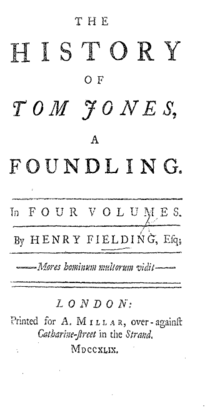
Tom Jones Original CoverAs usual, chapter 1 of this Book is a little essay about a topic that Fielding wants to sound off on. This time it’s the education required to be a writer,

As several gentlemen in these times, by the wonderful force of genius only, without the least assistance of learning, perhaps, without being well able to read, have made a considerable figure in the republic of letters; the modern critics, I am told, have lately begun to assert, that all kind of learning is entirely useless to a writer; and, indeed, no other than a kind of fetters on the natural sprightliness and activity of the imagination, which is thus weighed down, and prevented from soaring to those high flights which otherwise it would be able to reach.

I’m tempted to camp out on this chapter for a while. Fielding’s a little more firey this time,

…The nimbleness of a dancing-master is not at all prejudiced by being taught to move; nor doth any mechanic, I believe, exercise his tools the worse by having learnt to use them. For my own part, I cannot conceive that Homer or Virgil would have writ with more fire, if instead of being masters of all the learning of their times, they had been as ignorant as most of the authors of the present age.

He concedes, not everyone who writes needs to be educated:

…very little reading is, I conceive, necessary to the poet, less to the critic, and the least of all to the politician.

Would love to see what Fielding could do with a Twitter feed. He rants on the subject a little longer, but you get the flavor, let’s get back to Tom.

Tom’s slipped out of Lady Bellaston’s house while she and Sophia spar. He’s not home long before he receives a letter from the Lady, who is not happy with him. She warns him against making her angry by seeing Sophia again. Almost immediately, he gets another from her telling him to come to visit. Lady Bellaston is not the woman he wants to go visit, but he figures he’d better. But before he can leave—guess who shows up?

Tom’s in the middle of assuring the Lady that he and Sophia accidentally ran into each other, and that’s all when Partridge comes up alerting him that Mrs. Honour is coming to see him. There’s no good place to hide Lady Bellaston from her prying eyes, so they settle with putting her behind a curtain.

Mrs. Honour gossips a bit about Bellaston while Tom tries (and tries and tries) to shush her and redirect the conversation. But she has to tell Tom about Bellaston’s scandalous behavior with men (Bellaston is insulted, but she is in the room of a man right now—as we’re about to learn, at 2 am with her carriage driver loitering nearby telling everyone who’ll listen why he’s there). She finally gives Tom a letter from Sophia and leaves. Bellaston comes out incredibly offended, Tom placates her about Honour and the meeting with Sophia, too.

Here ensued a long conversation, which the reader, who is not too curious, will thank me for not inserting at length. It shall suffice, therefore, to inform him, that Lady Bellaston grew more and more pacified, and at length believed, or affected to believe, his protestations, that his meeting with Sophia that evening was merely accidental, and every other matter which the reader already knows, and which, as Jones set before her in the strongest light, it is plain that she had in reality no reason to be angry with him.

“the reader, who is not too curious, will thank me for not inserting at length.” Ha.

Anyway, they finally decide that Tom will come to visit the next day. He’s coming over to visit Bellaston, but will pretend to be there to see Sophia.

Because that’s going to work, I guess.

Sophia’s letter interferes with that plan, she tells him repeatedly, “if you have
any concern for my ease, do not think of returning hither.” She doesn’t trust Bellaston and things won’t go well. Tom isn’t sure what to do now, so the next morning, he jots off a quick note begging off from calling that day, he’s sick.

He’ll come to regret that because that means he’s home to get a talking-to by Mrs. Miller. Two women in his room with him alone last night? One who didn’t leave until 2? This will not do. She doesn’t need people talking, him setting a bad example for the girls, and she expects more from someone tied to Mr. Allworthy. Tom agrees but insists on his own privacy, no matter who comes to visit. Things break down to the point where he’ll have to look for a new place to stay the next day.

Nightingale stops by, too. He’s headed for other pastures, too. Tom rakes him over the coals for the way he’s behaving toward Mrs. Miller’s daughter, Nancy. Nightingale claims to have no idea what Tom’s talking about. Tom sticks to the message—you messed up, thanks to your flirting, the girl has fallen in love. YOu can’t just duck out (as he was planning), but you can’t keep stringing her on, either.

And that’s that, I’d expected to take about 1/3 the space and time to write this up. Heh.

Last week, Lashaan asked about going through the novel in little bits and pieces. This selection was one of those times I had a hard time stopping—the clock and fatigue stopped me from finishing Book IV. I have a bad feeling both about Tom’s impending meeting with Lady Bellaston and ol’ Nightingale, and want to see if I’m right.

Amari and the Night Brothers by B. B. Alston: Look Out World, There’s a New Magician on the Loose!

Amari and the Night Brothers

Amari and the Night Brothers

by B. B. Alston
Series: Supernatural Investigations, Volume Number 1

eARC, 384 pg.
Egmont Books, 2021

Read: December 7-9, 2020
Grab a copy from your local indie bookstore!

What’s Amari and the Night Brothers About?

Amari is a thirteen-year-old girl from Atlanta’s inner-city, attending a private school on scholarship, and is in trouble when we meet her. She’s been antagonized (probably bullied, honestly) by some rich girls from her school and struck back. She’s now facing discipline—up to and including loss of her scholarship. The principal ties this behavior to her brother’s recent disappearance/presumed death, she’s been “acting out” since then.

While reeling from this, Amari receives a delivery from her brother—cutting the details, it’s an invitation to the Bureau of Supernatural Affairs. The invitation opens her eyes (literally) to the hidden magickal world around her. She can join the Bureau via a summer program (as her brother, Quinton, did) and if she passes some tests, she can become a junior member. She sees this as her best/only chance to find out what happened to Quinton—and hopefully, find him alive.

But also, it’s magick. How could she not want to be part of it?

One of the first steps involves finding her secret talent—where she learns that she has rare and illegal abilities. Determined to stay in the Bureau to find Quinton—and to show that just because she’s born with abilities that remind everyone of the worst people in the supernatural world’s history, it doesn’t mean she’ll be as evil.

It’s hard to make friends—hard not to be ostracized by everyone—because of her abilities, and she faces outright prejudice. But she does make an ally or two among the other supernatural youths, and a few among the adults overseeing the program*. Not only does Amari work to pass her tests to remain in the Bureau, she and her allies look into Quinton’s disappearance.

* I really don’t have the time to get into it, but I really liked the adults in this book (with the exception of two that you’re clearly not supposed to like)

The Clincher

There are many reasons to read this, many reasons you’ll enjoy it. More than I have time to enumerate, more than you want to spend time reading. So I’ll just give you one word that should convince you: weredragon.

Were…@#$%&!…dragon.

I love this idea. I don’t know why we don’t have a half-dozen series about them in UF. Elsie, the weredragon in question, would be a character I love no matter her special ability/species/whatever. She’s a fun, vibrant, supportive, smart character, and combining those qualities with the idea of a human shifting into a dragon? You’ve got a fan in me.

The Inevitable Comparisons

It’s impossible to read this book and not think of a certain other MG series that rhymes with Larry Cotter. I think Amari and the Night Brothers comes off pretty well in such a comparison—I’m not saying it’s superior (or inferior), but it holds its own.

But honestly? I think this is closer to a Percy Jackson kind of thing (just without the mythological basis), and Alston’s style and voice are closer to Riordan’s.

I’d also throw in a comparison to Will Hill’s Department 19 books, but few of my readers will recognize it—and it’s for an older audience and is more bloody. But it’s one of those things that keeps coming to mind as I read Amari’s adventure.

I’m not suggesting that Alston’s just giving us an “inner city” version of Percy Jackson, etc. There are just things about Amari and the Night Brothers that remind me of the others, (the way that the Iron Druid Chronicles reminds readers of The Dresden Files, for example). The novel’s themes and particulars of the fantasy worlds will vary, but the overall feel and style of the novel will invite comparison to Barry Totter, Percy, and similar works.

The Real World

In the background of all the fantastic things going on in Amari’s life—all the unbelievable things she’s being introduced to, the incredible people and creatures she’s encountering—there’s the real world, and not an easy part of it. She lives in the inner city of Georgia with her mother working horrible shifts at a local hospital struggling to make ends meet. Her father has abandoned the family.

The police assume her brother’s disappearance has something to do with him being a criminal—he’s not missing, he’s off doing something he doesn’t want his mother to know about. Because that’s what young men in this neighborhood do. As infuriating as that prejudice expressed is, there’s someone in the neighborhood who is falling into that lifestyle. Quinton had been tutoring him, but now he has no one helping him—but Amari tries once she realizes what’s going on with Jayden. This is a storyline that we follow throughout the book, and it might be the most important and rewarding one.

Both in Amari’s school and even at the Bureau, she has to deal with privilege—people who were born into the right families, people who aren’t like her. Because of things she has no control over, no input into, simply accident of birth, there are those who don’t want her in the Bureau, don’t want her pursuing her goals—but she doesn’t back down. Never fear, the book doesn’t preach, it doesn’t moralize. It simply shows the challenges Amari has to deal with—and the challenges so many others don’t—and lets the reader draw their own conclusions.

Grit and Smarts

Amari is practically the embodiment of Angela Duckworth’s concept of grit. I made a few notes like that while reading, making Amari the kind of protagonist you can really get behind.

Duckworth’s website defines grit as:

Grit is passion and perseverance for long-term goals…
Grit isn’t talent. Grit isn’t luck. Grit isn’t how intensely, for the moment, you want something.
Instead, grit is about having what some researchers call an”ultimate concern”–a goal you care about so much that it organizes and gives meaning to almost everything you do. And grit is holding steadfast to that goal. Even when you fall down. Even when you screw up. Even when progress toward that goal is halting or slow.
Talent and luck matter to success. But talent and luck are no guarantee of grit. And in the very long run, I think grit may matter as least as much, if not more.

Replace the word “talent” above with “magick” and you’ve got Amari.

The book is also a celebration of thinking. Quinton, Elsie (the weredragon), and Amari are smart. They’re bookish. They’re problem solvers. Sure Amari has magical abilities, but before she uses magic, she thinks through a situation and addresses it with her mind. Amari and Elsie study, they plan. There’s one point where Amari remembers the book and page number where she learned a fact that proved vital to one challenge. Her remembering that page number just made me happy.

Elsie’s a tinkerer, even before she gets her magical enhancement, she’s inventing things, making things. Amari talks about how many things are in the library that she wants to read about, learn about that have nothing to do with her goals. Give me characters like this any day.

So, what did I think about Amari and the Night Brothers?

This was just so much fun. Even when things are looking dire for poor Amari (or anyone else), there is an ineffable sense of awe and hope to the book. That just magnified all the good from above (and helped me brush off the couple of minor reservations I had).

Is this one to give to the MG reader in your life? Yes. Is this one to read yourself if you like the occasional (or not-so-occasional) MG novel? Absolutely. I’m already planning on getting the sequels, and expect just about everyone who reads this novel will too.


4 Stars
My thanks to The Write Reads for the invitation to participate in this tour and the materials (including the novel from Egmont Publishing via Netgalley) they provided.

BOOK SPOTLIGHT: Amari and the Night Brothers by B. B. Alston

I’m very pleased and excited today to welcome The Ultimate Blog Tour for the wonderful Amari and the Night Brothers by B. B. Alston. This Tour Stop consists in this little spotlight post and then my take on the novel coming along in a bit (warning: even after trimming things a bit, it’s on the long side). Let’s start by learning a little about this novel, okay?

Book Details:

Book Title: Amari and the Night Brothers by B. B. Alston
Publisher: Egmont Books
Release date: January 21, 2021
Format: Ebook/Hardcover
Length: 384 pages

Book Blurb:

Amari Peters knows three things.

Her big brother Quinton has gone missing.
No one will talk about it.
His mysterious job holds the secret …

So when Amari gets an invitation to the Bureau of Supernatural Affairs, she’s certain this is her chance to find Quinton. But first she has to get her head around the new world of the Bureau, where mermaids, aliens and magicians are real, and her roommate is a weredragon.

Amari must compete against kids who’ve known about the supernatural world their whole lives, and when each trainee is awarded a special supernatural talent, Amari is given an illegal talent one that the Bureau views as dangerous.

With an evil magician threatening the whole supernatural world, and her own classmates thinking she is the enemy, Amari has never felt more alone. But if she doesn’t pass the three tryouts, she may never find out what happened to Quinton …

About the Author:

B. B. Alston lives in Lexington, SC. Amari and the Night Brothers is his debut middle grade novel. When not writing, he can be found eating too many sweets and exploring country roads to see where they lead.

My thanks to The Write Reads for the invitation to participate in this tour and the materials they provided.

A Few More Quick Questions with Gray Basnight

Not only do I really appreciate Basnight’s taking the time to do this, but Lisa Weiss, the publicist who got me this book has been very helpful and encouraging. I wanted to thank her, too. This is one of the best sets of Answers I’ve received to my Questions, I hope you enjoy it, too.

The last time we did a Q&A, you said you were finishing a sequel to Flight of the Fox, I assume it was this, what was it about Sam Teagarden that made you want to write a sequel about him (an idea that Sam himself jokes about)? Is there a third book for the professor?

There are two reasons Sam Teagarden puts in this reappearance in Madness of the Q.  The first was reader feedback.  In fact, this sequel is dedicated to those readers who wanted another roller coaster ride with my mathematics professor, who’s dubbed by the media as the “American Prometheus.”

The second reason is the Q Document.  The inspiration for the story came several years ago while listening to a Great Courses audio lecture about the New Testament.  When the professor casually mentioned something called the Quelle Document (German for “Source”) as being a theorized long missing source for parts of Matthew and Luke, I pegged onto it as a potential “what if” fictional scenario.  What if The Quelle Document were discovered in our time.  And an even bigger “what if’ — what if the document said something from the founding days of Christianity that certain groups didn’t want it to say, and what if it said something that certain opposing groups did want it to say?  Well, my guess is that all hell would break loose.  So, in Madness of the Q, it does – fictionally, of course!

As for a third book, we shall see.  If there’s sufficient demand from readers and/or the publisher, I’ll certainly consider it.  I do have a nascent idea.  All I will say is, I like Puerto Rico and perhaps there’s a reason for Teagarden to end up there.  It’s a wonderful and adventurous island filled with good people, good food, and plenty of potential for a fictional thriller.

What kind of research went into this book? What’s the one thing you learned and, try as you might, you just couldn’t bring into the book?

Once I learned about the Q Document, I began reading up on the theory that it might actually have existed but was lost, and may someday be found.  Not all biblical scholars agree, of course.  But those who believe that it is an extant missing source for two of the Synoptic Gospels are both faith based and secular based, which intrigued me.

I also re-read a wonderful book first published in 1841 and still in print today.  Extraordinary Popular Delusions and the Madness of Crowds by Charles Mackay is occasionally called the first pop-psych book to explore crowd think.  It dovetailed nicely with my “all hell breaks loose” theme, so I wove it into the title and quoted Mackay as the epigraph:

Men, it has been well said, think in herds;
it will be seen that they go mad in herds,
while they recover their senses slowly,
and one by one.

As for what was left on the cutting room floor, I felt a need to have Teagarden’s spouse Cynthia, be more of a partner.  They met in Flight of the Fox and she became an important ally in many ways.  Unfortunately, she couldn’t join him in the sequel because he’s on a solo run through Israel and Europe and there was no way around that.  Thus, I invented imaginary conversations between the two to help him get through the roughest days, and justified the technique as a product of his stress.  Thus far, most reader feedback has been positive with this approach.

I think most of us readers can guess some of these, but would you talk about the challenges in featuring someone of Teagarden’s age in a thriller (particularly those you didn’t expect)?

You mean the fact that he’s older than the average thriller protagonist?  Yes, indeed.  He turned 50 in Flight of the Fox which makes him 56 in Madness of the Q.  

The principal challenge is to convince the reader that someone of that age is still sufficiently vigorous to take on dark forces.  This is important to me.  The older I get, the more convinced I am of an age bias built into American culture and our collective way of thinking (to which I was admittedly guilty of in my younger years).

Sam is however highly qualified for the job in both thrillers.  His first gig out of college was a desk job at the CIA as an entry-level code analyst.  It was so boring he quit after one year.  He then became a mathematics professor who is highly skilled in the art of encryption and decryption.

Aside from his age, Teagarden does not have a black belt and knows very little about firearms.  So, both his age and his lack of fighting skills may challenge a reader’s expectation of the formulaic run-for-your-life character.

I intentionally made all these choices to construct a character far less Jason Bourne and more of an Everyman.  If readers are unbothered by his age, I’ve succeeded.  If readers who are a little bothered by his age but stick with the narrative because the momentum carries them to its conclusion, I’ve still succeeded.

There’s a time jump between the two books, putting this one into our near future. How fun was it speculating about 2025 tech—and how hard was it not to go too crazy with it?

It was great fun.  I have no desire to be a sci-fi writer, so there was no difficulty in not getting carried away.  But I really enjoy casting into the near-term future and imagining where foreseeable technology is going based on where it has been.

For example, God Glasses.  In the story, God Glasses allow a type of Superman x-ray vision.  That may not happen anytime soon, but we already have the technology for video cameras to be built into eyeglass frames.

Another is public pop-ups.  Web based pop-up ads annoy me, umm, a whole lot.  It happens because neither the advertiser nor the website proprietor cares about the irritation factor – and for plenty of people, it’s an exasperating reality but one they mostly just accept.  Given that, let’s get ready for the same to happen in public.  In the novel, Sam Teagarden and his wife have researched airfare to the Bahamas.  Later, when he’s on a public sidewalk, the wi-fi gear attached to a giant billboard reads the credit card in his wallet and suddenly Sam’s image and name appear on the billboard as the advertiser stalks his movements in the effort to sell him a trip to the Bahamas.  If this ever happens in reality, pro-privacy forces will naturally object.  I’m certain, however, they’ll lose that fight because the vast majority of people will find it really cool to see their mug on a billboard, even if only for a few seconds.

Let’s play “Online Bookstore Algorithm” (a game I’ve recently invented). What are 3-5 books whose readers may like Madness of the Q?

Well, I’m going to share the books mentioned by several of the early reviewers, and the ones that inspired me to try my hand at thrillers:

  • Robert Ludlum’s Bourne series
  • Dan Brown’s Langdon series
  • Eye of the Needle and The Key to Rebecca, by Ken Follett
  • Name of the Rose, by Umberto Eco 

And I’d be remiss for not giving a humble plug to the prequel:

  • Flight of the Fox, by Gray Basnight (that’s me!)

What’s next for Gray Basnight? Any progress on that YA novel you mentioned before?

Thank you so much for asking about my YA!  I love it and remain committed to its commercial prospects.  Authoritative persons have recently advised me that it likely fits more neatly into Middle Grade, which means substantial rewriting, including the need to adjust the age of Junior Benét, the central character – a schoolgirl with a genius IQ who gets caught up in a dangerous adventure in New York City.

Presently I’m working on a crime novel, though I’m not sure how to classify it with more specificity.  It’s drawn from my appreciation of both Quentin Tarantino and Elmore Leonard and my love for the classic Sergio Leone movie The Good, the Bad, and the Ugly.  When finished, it will likely have emphatic elements of humor and romance.  And, by the way, it too is set about five years into the future.

Thanks for your time — and thanks for some more time with Sam Teagarden, I really enjoyed it, and hope you have plenty of success with it.

Thank you so much for this Q&A.  Great questions and lots of fun to spend time with you again.


Madness of the Q by Gray Basnight Left Me Ambivalent (I didn’t dislike it, but…)

I’ve got a Q&A with Gray Basnight coming up later this morning—come back to check it out. I haven’t read it yet (didn’t want it to impact what I wrote), but trust that it’ll be interesting in light of what I say below.

Madness of the Q

Madness of the Q

by Gray Basnight
Series: Sam Teagarden, #2

eARC, 368 pg.
Down & Out Books, 2020

Read: November 23-30, 2020
Grab a copy from your local indie bookstore!

What’s Madness of the Q About?

Simply put, it’s the further adventures of professor Sam Teagarden following his uncovering of a large conspiracy within the FBI in 2018’s Flight of the Fox. In the six years since then, a slight mythology has built up around him—he’s got a reputation as one who’ll bring the truth to the world—when all he wants to do is teach math and spend time with his wife.

But it’s his reputation that brings him into the middle of this particular situation. One group wants someone like him to bring information to the forefront of the world, no matter the cost. Another group is afraid of people like him and targets him for assassination before he even knows that there’s something to be exposed to the world. But the FBI catches wind about this before the assassin makes an attempt and saves his life. They also would like him to be involved in a current case, his reputation alone should make things calmer.

What’s the case? Well, the previously theoretical “Q” document (a theoretical source—along with the Gospel of Mark—for the Gospels of Matthew and Luke) has possibly been discovered. Not only that, but there’s a lot of speculation that something big has been discovered in the text itself that wasn’t used by Matthew or Luke and may shake the foundation of religious groups around the world.

It’s been some time since the document was discovered, but now it’s been translated and decoded. The contents are set to be revealed to the world, and on the verge of that, there’s been a rash of mass suicides throughout the world by Christian-ish groups.

Teagarden’s barely gotten involved when his group in Israel are attacked and he goes on the run, trying to get safely to Germany in time for the conference that will feature the unveiling of this document that may be Q.

Will he make it? Will he be able to bring the truths hidden for millennia to light? Are there truths contained at all? These questions and more are dealt with alongside the thrill-ride.

Yeah, that’s a little longer than I usually spend on these sections, but it’s that kind of plot.

What Parts Really Worked for Me?

There’s a lot about this book to commend—for starters, the way that it talks about the “legend” around Teagarden following the events of Flight of the Fox. It felt very real, very authentic—he’s a folk hero to some and a folk villain to others.

Also, there’s the tech from 2025—there’s just a lot of little touches to make the world feel slightly advanced—and slightly annoying. Authentically so, I should add. There are some cool moves forward in technology, and they come with costs to things like privacy. There’s a great temptation to ignore everything else about the book and do a deep dive on this stuff—missing the forest for a few trees, but Basnight did a good enough job with these trees that it’d be fun.

The best part of this book is watching Teagarden at work—instead of making his way down the Eastern seaboard in the States, he’s making his way north from Israel through Italy to Germany. An older math professor, not in the best of health, is just fun to watch in this kind of role. There are a handful of times when it’s not him running, it’s Teagarden going toe-to-toe with someone set on doing him harm, too. I loved them all, his approach (and the way Basnight depicts this approach) are some of the most entertaining passages I’ve read in thrillers this year.

What Didn’t Work For Me?

Everything to do with the Q document and the reactions of various Christian groups, cults, and others to it. I’d have to get into details that are both spoilerific and too detailed for a post like this to adequately describe my problems. But I don’t see a cult caring about the results of textual examination from something found in an archeological dig from Israel. I’m not that sure that a Pentecostal Snake Handling group is going to care that much, either. Nor do I see other Christian groups being driven to suicide because of the initial results of a translation from a very disputed text.

I know people who engage in Biblical textual criticism, and I’ve read a little bit on the serious end of popular works on the subject, and I’m sorry, it just doesn’t work this way. It’s not the kind of field where a bombshell discovery is going to come to light and the entire discipline is instantly changed. It’s going to be debated, dissected, wrangled with, and then maybe, things will shift*. I get that it’s fiction, but I just couldn’t swallow any of this as hard as I tried.

* This assumes that something like Basnight’s Q Document actually exists (or that the actual Q exists and says something like his)

The Big Theme

The one part of the religious aspect of the book that appealed to me was the discussion of faith, of devotion, of commitment on the part of both the religious and the anti-religious (the non-religious among humanity didn’t really factor into things, this was a pro vs. con kind of thing). There’s a group at work in this novel with the aim of eliminating all religion, all theism, throughout the world—and they are devout. Seriously devout. Contrasting these “true believers” with ardent religious people is striking, and deserves some thought. It reminded me of the article “Atheists Are Sometimes More Religious Than Christians” from The Atlantic a couple of years ago, but coming at it from a different angle.

So, what did I think about Madness of the Q as a Whole?

I’m really not sure what to say here. I thought about this a lot while I read it, and have thought about it a lot since I finished—both the details and the themes. And I’m still not sure. I dug the thriller aspects of it, the tech, the character of Sam Teagarden and when the book leaned into those aspects, I was happy. When the foundation—Q and the groups wanting to use the document for their own ends (or those despairing what they thought it might way)—was the focus, I had a hard time pushing on.

I liked (and gave 4 Stars to) the previous Sam Teagarden book. I would absolutely read a third novel featuring him (but I might hesitate if it seems to be in a Robert Langdon-ish vein again). But I just don’t know what to say about this one. It’s going to stay with me longer than books I’ve been very positive about this year—it’s definitely stayed with me longer than books I didn’t like this year. But I’m not sure I can give it a recommendation or a pan. I don’t like just giving a shrug when trying to say what I think about a book, but I think that’s where I am.

Disclaimer: I received a copy of this novel from the author in exchange for my honest opinion and this post.

This post contains an affiliate link. If you purchase from it, I will get a small commission at no additional cost to you. As always, opinions are my own.

The History of Tom Jones, a Foundling by Henry Fielding: BOOK XIII., ix. – xii.

Well, thanks to that unexpected nine-week break, I’m abandoning the whole “read through this in 2020” goal. This bothers me a little bit, but I’ll get over it.

So, when we left Tom, he was in London. He’d made some decent friends (or at least allies), was being his usual generous and helpful self with them. He’d also found a way to hopefully gain an audience with Sophia, but it looks like it’s going to take some work. Let’s dive back in, shall we?

Oh, my hardcopy with the funky capitalization, etc. is in a different box than I believed. So, Project Gutenberg to the rescue today.
Fridays with the Foundling
Tom Jones Original Cover I just love the titles of the first two chapters we’re looking at this week: “Which treats of matters of a very different kind from those in the preceding chapter,” and “A chapter which, though short, may draw tears from some eyes.”

So Tom’s getting nowhere with his connections to Sophia—in fact, it’s getting to the point that he’s about to lose his connection if he keeps bringing her up. But, he’s a clever guy. If Lady Bellaston won’t help him who will? Well, what she knows, the servants likely know (he figures), so Partridge is deployed to get that information from the servants.

While we wait for results on that front, we learn that Lady Bellaston is what we would call a cougar (or we would’ve a few years ago, anyway), and she has her sights set on Tom, and showers him with attention (and gifts). Tom isn’t interested in her, he’s devoted to Sophia. But, it’d be rude to not return a little of the affection she’s showering on him.

One night, he’s compelled to ditch his pal Nightengale—they were supposed to go see a play together, but Bellaston wanted Tom to come meet her in her home. To make this appointment possible, Bellaston sends away some servants and even arranges for her houseguest, Sophia, to attend that same play (with a chaperone, of course).

But before Tom can leave, Mrs. Miller asks him to join her to meet someone. The cousin that Tom’s been so recently generous to is downstairs and wants to thank him. Now remember a few chapters back, when someone tried to steal from Tom, tells him a sob story about a sick family member, and so Tom gives him some money? Well, guess who Mrs. Miller’s cousin happens to be. It’s practically a Dickensian coincidence (if Dickens had been born yet, anyway). Mr. Miller had already planned on spilling his heart in gratitude, but this just compounded his thanks. Tom’s gratified to hear how much he’s helped. (this is the chapter we might have got teary about).

So then Tom heads to Ballston’s, and gets there early, so is hanging out in the drawing room to wait. The play turned into some sort of a to-do. it was a new play, and apparently controversial. One group had shown up to protest, another to cheer it on (Nightengale had been counting on Tom to help him encourage the production). It was all too much for Sophia, who came home between accts. She discovers Tom, and almost faints.

To paint the looks or thoughts of either of these lovers, is beyond my power. As their sensations, from their mutual silence, may be judged to have been too big for their own utterance, it cannot be supposed that I should be able to express them: and the misfortune is, that few of my readers have been enough in love to feel by their own hearts what past at this time in theirs.

In what follows, Tom gives her the pocketbook and money, they clear up some misconceptions and misunderstandings, basically clear the air and are getting all sentimental with each other, when Tom remembers he has to ask her to forget about him (the last thing she wants to hear), and starts to say something along those lines, but botches it and says something

that sounded like a proposal of marriage. To which she replied, “That, did not her duty to her father forbid her to follow her own inclinations, ruin with him would be more welcome to her than the most affluent fortune with another man.”

The use of the word “ruin,” brings everything back to Tom and he starts to do what he’s supposed to do, but she interrupts to ask what he was doing in that room. Naturally, in walks Lady Bellaston—shocked to find the two of them together, and she demands to know what Sophia is doing there.

Sophia tells what happened at the play (Bellaston doubts it), says that Tom came to return her pocketbook (Bellaston knew it was missing, doesn’t believe that Tom returned it), after tracking her down by the name inside it. Bellaston and Tom don’t let on that they know each other either. Tom’s willing to play along, as it keeps both women from being upset with him.

Tom leaves, and the two women spend some time lying to each other about what they think about Tom, what they know about him, and so on. It’s a giant mess that’s sure to come toppling down soon.

And there we go, back to the book and at the end of Book Thirteen. Both of which are fun. We’re in the final third here, so things are going to start happening more quickly (I expect). Will Tom come clean to Sophia about Bellaston? Will Bellaston tell Sophia that she knew she was lying about Tom? Is Tom still destined for a hanging? All this and more to come in the next few chapters.

The Friday 56 for 12/4/20

The Friday 56This is a weekly bloghop hosted by Freda’s Voice

RULES:
The Friday 56 Grab a book, any book.
The Friday 56 Turn to Page 56 or 56% on your ereader. If you have to improvise, that is okay.
The Friday 56 Find a snippet, short and sweet.
The Friday 56 Post it

from page 56 of:
Next to Last Stand

The Silver Arrow by Lev Grossman

“Kate. Tom. Good to see you. You made it this far.”

“Uncle Herbert!”

“Uncle Herbert!” Tom said. “We went through the woods and didn’t crash and then we saw a station and it was full of animals and they talked and then the train talked!”

Tom said this as one long continuous word. Uncle Herbert didn’t look particularly surprised at any of it.

Mostly Human 2 by D. I. Jolly: The Further Adventures of the Rock Star Werewolf

Mostly Human 2

Mostly Human 2

by D. I. Jolly
Series: Mostly Human, #2

Kindle Edition, 343 pg.
Tinpot Publishing, 2020

Read: September 28-October 25, 2020

What’s Mostly Human 2 About?

On the heels of the dramatic events at the end of Mostly Human, the werewolf rock star, Alex Harris has to leave town for a while. He needs to stay out of the limelight before people figure out how his nephew was rescued and start asking too many questions about the “dog” that freed him. He also needs to get his head on straight after it. So he takes off incognito, eventually winding up in a wolf sanctuary in Norway, where he finds work (and where he can take off every few weeks and fit in).

He settles in and establishes a home there, at some point, he strikes up a friendship/borderline romance with an intern, and things really come to life for him.

Eventually, circumstances force him to leave and he answers an inner call to go to Russia to find out more about his lycanthropy. From there, he’ll return home and try to re-establish his life with family and bandmates. If only the mysterious (magical?) voice in his head and a fellow werewolf with an agenda will let him.

To Re-cap or Not?

So, Mostly Human was the first book I read in 2017, I started this at the end of September of 2020. There’s a lot of months and a lot of books between those two (sure, most readers won’t have as many books between these two, but they might share the time gap), and I’ve gotta say, I had a lot of trouble remembering details/names/plot points from the first one. Jolly didn’t do a lot to help.

It’s a tricky thing (it seems) to decide how much of a recap to work into the early chapters of a follow-up book. Generally, I’m in favor of a minimalistic approach—unless it’s a situation of “remember that character who showed up for 3 chapters in Book 2? Well, they’ll be a major player here in Book 9.” But when there’s this much time between the publication of the two books,* you’ve got to toss readers a bone.

* December 2016-November 2020, officially.

Yes, eventually, he gave enough bread crumbs that I could piece together enough of what happened—especially once I read my original post—and, yes, between this release and the re-packaging of the first book, hopefully he picks up new readers that won’t have to reach back 35 months for their memories. It’s not a deal-breaker, by any means, but detracted from the experience.

A Very Talky Urban Fantasy

While there are some good scenes of werewolf action, some nefarious goings-on, and a respectable amount of violence. But man, there was a lot of talking. A lot of banter. A lot of emotional naval-gazing.

Which is a very pleasant change of pace compared to your typical Urban Fantasy. Jolly focuses on the relationship (in various stages) between Alex and Cassandra, Alex and his sister, his sister and her boyfriend, and so on. There’s more space devoted to developing and evolving the relationship between Alex and Cassandra than anything about Alex and his wolf nature.

The book is notionally about Alex, his curse/lycanthropy, and his growth in knowledge about other lycanthropes, but I’m not convinced that’s the case. It seems to be more about Alex understanding and accepting himself, how that will the relationships around him and his future. His lycanthropy plays a huge part in that, and its shadow looms over everything, but that doesn’t seem to be where the heart of the book is. He may have set out to write an Urban Fantasy, but I don’t think he fully succeeded and ended up writing a Lad Lit-kind of book with Urban Fantasy flavoring.

I’d pay money right now to see a straightforward Lad Lit novel from Jolly, I think he’d do great with it. Or something like Mike Chen does with SF, using that setting to tell family stories. Jolly purposefully doing that with UF (rather than accidentally as he seems to have done here), would be something to get excited about.

So, what did I think about Mostly Human 2?

I enjoyed this, I like the story he told and the story he set out to tell. The best part of a werewolf character is seeing how the wolf affects the human and the human’s life.

This is a great world, full of interesting characters. I don’t know if this is the end of Alex’s story or not. It could easily be that. Or it could be the launching to a new phase of Alex’s story with a greater understanding of his condition and a new path for life. I think it could go either way, and I’d be fine with either outcome.

It’s a fine tale, a solid (and different) take on lycanthropy, with a lot of things to grab a reader in addition to the protagonist growing extra hair on occasion. You should check it (and its predecessor) out.


3.5 Stars

Disclaimer: I received a copy of this novel from the author in exchange for my honest opinion and this post.

Page 141 of 346

Powered by WordPress & Theme by Anders Norén