Category: Fiction Page 142 of 341

Pub Day Post: Robert B. Parker’s Fool’s Paradise by Mike Lupica: Jesse Stone takes a Murder Case Personally

Fool's Paradise

Robert B. Parker’s Fool’s Paradise

by Mike Lupica
Series: Jesse Stone, #19

eARC, 352 pg.
G.P. Putnam’s Sons, 2020

Read: September 2-3, 2020
Grab a copy from your local indie bookstore!

What’s Fool’s Paradise About?

Suitcase Simpson calls Jesse to the scene of a murder, an unidentified man has been found shot at the lakeshore. Jesse recognizes the man—they’d been at the same AA meeting the previous night. It’s not Jesse’s regular meeting, and he didn’t think this man was a regular, either. But at least they had a first name to go off of.

Suit is able to find out at least a little about what the man did after the meeting. He’d taken a taxi from the neighboring town into Paradise. He even had an address—the mansion of a rich and influential family who’d been in Paradise for ages. They’re quick to claim they didn’t know the man, or that he’d been at the house in the hours before he was shot. No member of PPD believes this, but there’s little they can do until they learn a bit more about the victim.

Jesse admits this isn’t entirely rational—but doesn’t back off from it—the fact that he and the victim came to the same meeting, both needing the help that can be found there, created a link for between the two of them. Jesse felt like he owed this man justice more than he would another victim (not that Jesse’s ever been known to not try to find justice for anyone, it’s just personal this time). I loved this little touch—it felt very true to the character and his circumstances, but something that a lot of authors wouldn’t do.

Not long after this, someone takes a shot at Jesse while he’s in his home. Soon, other members of the PPD are attacked off-duty. As always, Jesse, Molly, and Suit acknowledge that coincidences exist, but they have a hard time believing in them. So while they try to identify the murder victim and figure out what he’s going in Paradise (and that part of Paradise in particular), they also need to figure out why someone would be attacking the PPD. And are the two cases related?

A Nice Little Bonus

There’s a lot of Molly in this book. She gets whole chapters without Jesse in them, and a lot of space on her own in chapters with him. We get a little bit of an off-the-job look at Molly, as well as seeing her work part of the investigation. Yes, Jesse’s the central character and should be the focus—but any time that Lupica (or whoever) can flesh out Molly, Suitcase, or any of the others is time well spent (I like the new deputy, too—he was a nice touch). But Molly’s been a favorite since Night Passage introduced this world, and she’s rarely been used as well as the character should’ve been. It’s so nice to see that.

Lupica’s Take on Jesse Stone

I was worried about Lupica being given the reins of this series. I was such a fan of what Colman had done, saving the series from the Michael Brandman debacle—and even from some of the uneven quality that Parker had given toward the end.

But Lupica did exactly what he needed to do—and exactly what I’d hoped (and didn’t expect). He embraced the developments that Coleman introduced and built on them. He could’ve ignored them, or written around them, but he kept Jesse going to AA, he worked on the new relationship with Cole, and Paradise and the Paradise Police Department the same way Coleman had, treating that bit of the series with as much respect and influence as the first nine novels.

Stylistically, Lupica’s closer to Parker than Coleman—which makes sense, it’s the more natural way for him to write (and will likely win back some of Coleman’s detractors). It works for the series, it works for the author—all in all, it’s a good move.

I freely admit that I was skeptical and pessimistic about anyone but Coleman at the post-Parker helm of Jesse Stone and am glad to be proven wrong.

Something I was Pleasantly Surprised By

While I have thought in the past that the best use of Sunny Randall was when Parker used her in the Jesse Stone novels, I wasn’t thrilled to see her in these pages—I thought that Stone, at least, had grown past this relationship. It’s not what it was back in the 3-4 books that Parker wrote with them as a couple, but reflects where they both are now.

I’ve got to say, I liked her here. I liked her in Paradise more than I liked her in the two books that Lupica has written about Sunny. If he keeps this up, I won’t complain.

Lupica’s War on my Sanity

Sure, that’s hyperbolic. But it felt like he was doing this to just bug me.

The mansion that the taxi pulled up to that fateful night is owned by the Cain family, Whit and Lilly Cain. Whit suffered a stroke a few months back, so his wife, Lilly, is who Jesse primarily interacts with. She’s brash, confident, loud, and flirtatious.

Now, I’ve watched the Veronica Mars series more times than I should have. Season One more than the rest. Every time I read “Lilly Cain,” I couldn’t think about anything other than “Lily Kane,” Veronica’s brash, confident, loud, and flirtatious friend.

I know it’s a coincidence, that neither name is all that rare. But it didn’t feel that way.

So, what did I think about Fool’s Paradise?

I liked this so much more than I expected to. I went into this hoping I wouldn’t hate it, and it didn’t take long at all for me to realize I was enjoying it. The prose crackled and moved quickly. There was enough of Jesse’s quiet humor to keep me grinning. The relationships and banter between the characters was spot on. The cases were compelling, interestingly framed, and well-executed. Lupica tied his novel into the overall history of the series well (referencing over half of the books, I think) and established that he’s the right man for the job. I strongly recommend this—either for new readers or established fans. Robert B. Parker’s Fool’s Paradise is a satisfying read that’ll get you eager to see what comes next.

Disclaimer: I received this eARC from PENGUIN GROUP Putnam via NetGalley in exchange for this post—thanks to both for this.


4 Stars

This post contains an affiliate link. If you purchase from it, I will get a small commission at no additional cost to you. As always, opinions are my own.

20 Books of Summer 2020: Wrap-Up

20 Books of Summer
Well, that’s a wrap on the 2020 20 Books of Summer. You may accuse me of playing fast and loose with the challenge (and you’d be right!), but this seems like a casual enough thing that I really don’t care (and I can’t imagine anyone else does, either). As I mentioned last month, I did a lousy job of taking into account new releases, review copies, and life when I made the original list. I made a valient effort, but I just couldn’t post about all these books by September 1 (I did read all of them by the end of August, I note only semi-defensively), but in that last week, it hit me, June 1-August 31 isn’t really “Summer.” It works as a rough designation, but June solstice to the September equinox is a better definition. I’m not that pedantic though (well, about seasons). But here in the States, “Summer” also is defined as the period from Memorial Day through Labor Day, which was just the time I needed to get everything posted.

So I’m calling this a win. I liked the focus this gave me for the last couple of months, and I know I read some things I’ve been meaning to read for months because they were on this list and I couldn’t make (yet another) excuse to put it off. I think next year I’ll do a better job of taking into account New Releases when I make my list (how Peace Talks wasn’t the first book I put down I’ll never know) to make life easier for me–I also think I’ll put down more of the books I own, but keep delaying on. I really like freeing up space on my (literal) TBR shelf.

I had a lot of fun doing this and looking at others working their way through the challenge. Congrats to the winners.


✔ 1. Nothing Is Wrong and Here Is Why by Alexandra Petri (my take on the book)
✔ 2. The Last Smile in Sunder City by Luke Arnold (my take on the book)
✔ 3. Screamcatcher: Dream Chasers by Christy J. Breedlove (my take on the book)
✔ 4. The Finders by Jeffrey B. Burton (my take on the book)
✔ 5. Fair Warning by Michael Connelly (my take on the book)
✔ 6. One Man by Harry Connolly (my take on the book)
✔ 7. The Curator by M. W. Craven (my take on the book)
✔ 8. The Ninja Daughter by Tori Eldridge (my take on the book)
✔ 9. The Rome of Fall by Chad Alan Gibbs (my take on the book)
✔ 10. American Demon by Kim Harrison (my take on the book)
✔ 11. Ink & Sigil by Kevin Hearne (my take on the book)
✔ 12. Betty by Tiffany McDaniel (my take on the book)
✔ 13. Imaginary Numbers by Seanan McGuire (my take on the book)
✔ 14. Curse the Day by Judith O’Reilly (my take on the book)
✔ 15. Of Mutts and Men by Spencer Quinn (my take on the book)
✔ 16. Rather Be the Devil by Ian Rankin (my take on the book)
✔ 17. Muzzled by David Rosenfelt (my take on the book)
✔ 18. Bad Turn by Zoë Sharp (my take on the book)
✔ 19. The Silence by Luca Veste (my take on the book)
✔ 20. The Revelators by Ace Atkins (my take on the book)

20 Books of Summer Chart Aug

The Last Smile in Sunder City by Luke Arnold: A Fantasy Novel that Defies My Pithy Headline Composing Abilities

The Last Smile in Sunder City

The Last Smile in Sunder City

by Luke Arnold
Series: The Fetch Phillips Archives, #1

Kindle Edition, 368 pg.
Orbit, 2020

Read: August 26-27, 2020
Grab a copy from your local indie bookstore!


I think this could be my longest post ever, and I’d still leave things left unsaid, you wouldn’t believe the length of my notes for a book of this size. I’ll try to hit the most important points. To fill in whatever lacunae appears below, you should probably also read what was said over at Witty and Sarcastic Bookclub, The Tattooed Book Geek, Grimdark Magazine, and FanFi Addict—they’re what convinced me to buy the book.

“So, you’re a Man for Hire?”

“That’s right.”

“Why don’t you just call yourself a detective?”

“I was worried that might make me sound intelligent.”

The Principal wrinkled his nose. He didn’t know if I was trying to be funny; even less if I’d succeeded.

“What’s your relationship with the police department?”

“We have connections but they’re as thin as I can make them. When they come knocking I have to answer but my clients’ protection and privacy come first. There are lines I can’t cross but I push them back as far as I can.”

What’s The Last Smile in Sunder City About?

Fetch Phillips is hired to find a missing vampire, Edmund Albert Rye, an instructor at an exclusive private school for the children of magical creatures (lycanthropes, vampires, elves, dwarfs, etc.). It’s been a few days since he was seen, which is uncharacteristic enough that the principal’s getting nervous—he’s tough, but he’s been unwell. He, the students, and staff just need to know what happened to him.

I made my way east along Fourteenth Street without much hope for what I might be able to find. Professor Edmund Albert Rye; a man whose life expectancy was already several centuries overdue. I doubted I could bring back anything more than a sad story.

I wasn’t wrong. But things were sticking to the story that knew how to bite.

Fetch gets to work, enjoying the feeling of a good amount of cash in his pocket. The first step is the city library, Rye’s been living in the attic for that last several years, so he could enjoy some privacy and the sunlight. The librarian is just as worried as the principal had been.

It’s really not long before Fetch’s investigation brings him to an old private club for Vampires—and he find the remains of a couple of vampires. The lab concludes that it Rye wasn’t one of the fresh corpses. There’s another dead magical creature there, one that Fetch has never seen, and it takes a couple of days for the results identifying that to come in, too.

One thing that Fetch learns fairly soon is that Rye isn’t the only one missing, a girl vanished around the same time as he did. Now, Fetch has to track down a missing vampire and a teen-aged Siren. His work is definitely cut out for him.

Because he knows from the get-go that the story he’ll bring back to his employer won’t have a happy ending, he has a hard time pursuing it head-on. He keeps finding little things to distract himself, to slow the investigation. Even when the missing girl gets factored in, and he knows he needs to be fully committed just to have a chance to find her, to. He really can’t pull it off. The sad story just became so much sadder, and he doesn’t want to know the depth of that sadness.

Fetch Phillips

While the majority of the book traces this story, we also get several flashback chapters tracing Fetch’s tragic childhood, decent (but not great) adolescence and then troubled adulthood leading up to the point where he helped the Human Army destroy all the magic in the world. It’s an event called the Coda, and it occurred six years before Fetch was hired by the school. All magical creatures lost the abilities that distinguished their races, and the world was never the same. As an act of penance that no one but Fetch cares about, he’s since refused to work for humans, only for formerly-magic creatures. Which is what brought him to the search for Rye.

Fetch is a broken man—he wasn’t in great shape before the Coda, but he’s worse after it. An ex-soldier, convicted criminal, ex-prisoner, and now a drunk, with moments of sobriety (fewer than he should have while on a job, but all that money can buy many drinks).

There was a hangover on the horizon, along with something else. Something sort of stupid.

A devil was sitting on my shoulder whispering the kinds of things that stopped working on me years ago. I was only in my thirties but I was old. You don’t measure age in years, you measure it in lessons learned and repeated mistakes and how hard it is to force a little hope into your heart. Old just means jaded and cynical and tired. And boy, was I tired.

It’s the penance that drives him. He’d been an author of so much of what was wrong with the world, and he’s doing what he can to alleviate it just a little bit. It’s the only thing keeping him going. It’s not enough, but it’s all he has.

Fetch is such a rich character. It’s hard to like him, it’s hard to find anything redeemable in him*, any reason to be interested in what happens to him. But you can’t help pull for this broken, beaten, disillusioned, and cynical man.

* Which is, admittedly, the point of redemption.

What a Piece of Worldbuilding

This is such an incredibly conceived world. The Coda is so fresh that the citizens have started to move on, but aren’t used to dealing with the post-magical world. And so many of them are still hoping that it’ll all come back just as suddenly as it left.

The mixture of the fantasy elements and Human tech and science in this world, picking up the slack for the things that magic can’t do anymore is so rich, so well designed, so well-written that the reader has to stop every so often and try to take it in.

Even if I didn’t really like the book all that much, I’d still be recommending the book for the worldbuilding. It’s a master class in how to do it, how to describe it, and how to reveal it to the reader.

A Gripe

Just so, so, so many extended passages in italics. I won’t try to make a case against them, Benjamin Dryer does a better job than I possibly could. I just find them aggravating. It’d be so easy to indicate that something’s a flashback without them and spare readers the annoyance.

So, what did I think about The Last Smile in Sunder City?

Maybe nobody gets better. Maybe bad people just get worse. It’s not the bad things that make people bad, though. From what I’ve seen, we all work together in the face of adversity. Join up like brothers and work to overcome whatever big old evil wants to hold us down. The thing that kills us is the hope. Give a good man something to protect and you’ll turn him into a killer.

Fetch is a classic hard-boiled detective in a classically noir tale—the fact that it takes place in a Fantasy world (yet full of fairly modern technology) is just icing on a pretty tasty cake. The narrative voice is great, the writing leaps to life, and I can’t say enough about the way the world—and the novel—were designed and executed.

This probably deserves more than the 4 Stars I’m giving it, but I just didn’t connect with the story, with Fetch, with everything else going on as much as I wanted to. This regrettably ends up in the category of books that I admire more than I enjoy. But my admiration of this is so high that it almost doesn’t matter. This is a great Fantasy novel, and one unlike any you’ve read.

The sequel is out in a couple of weeks—I’m coming back to this world because now that Arnold doesn’t have to spend so much time explaining how the world works (or, more properly, how it no longer works) that he’ll be able to focus on telling a story or two, and I want to see what heights he’s capable of when the rules have already been established.

Do I recommend this book? Oh yeah. You’ll probably like it more than I did (I’m a little worried about hitting “publish” on this, as I know I’m one of the less enthusiastic readers of this). And even if you don’t, you’ll be just as impressed as I am with Arnold’s imagination and skill.


4 Stars

20 Books of Summer

This post contains an affiliate link. If you purchase from it, I will get a small commission at no additional cost to you. As always, opinions are my own.

Curse the Day by Judith O’Reilly: A Technothriller/Conspiracy Novel filled with Action (and some low tech solutions)

Curse the Day

Curse the Day

by Judith O’Reilly
Series: Michael North, #2

Kindle Edition, 331 pg.
Head of Zeus, 2020

Read: August 24-25, 2020
Grab a copy from your local indie bookstore!

He wanted to meet whoever had hacked that car. Then he wanted to punch them in the face. Because someone had tried to kill him and the innocent woman alongside him. And call him old- fashioned, but that made him mad. And an angry Michael North was someone who might just kill someone right back.

What’s Curse the Day About?

Killing State‘s ending pretty much broke Michael North*. When the book opens, he’s trying to drink and gamble himself into oblivious rather than dealing with the emotional fallout.

* which is ironic, because the rest of the book was pretty much about him coming back to life.

And then an old acquaintance from MI-6 shows up with a job. His niece is an ethicist married to one of the most innovative computer scientists around, who is on the verge of a major announcement in the development of AI. But someone is trying to interfere with that announcement, and have tried to kill his niece. He wants North to sober up and protect her. To guarantee his cooperation, he’s arranged for Fang’s mother to be arrested and is threatening to deport her and send her back to China. It’s this, and only this, that compels North to action.

Fang’s waiting for him—and is full of less than supportive things to say about his recent activity, but she’s more than ready to help him. Not just for her mother’s sake. Also, not just because this kind of AI is the stuff she dreams of. Despite their brief acquaintance, she really likes North and wants to help.

Narrowing down the source of the threat is difficult—there’s some industrial espionage afoot, some not very covert efforts by Chinese representatives to gain control of the technology, and some British military types heavily invested, too. One of the adversaries North faces off with is straight out of a Bond movie, while the others are more…down to Earth (at least by the standards contemporary thrillers). I’m not sure which I prefer—I just like to know that against North, both types of adversary have their work cut out for them.

It’s clear what North will do to whoever’s behind the attacks, the question is, what will it take for him to figure out the responsible parties.

So, what did I think about Curse the Day?

Life wasn’t grey– it was black and white, there was good and there was evil, and he knew how far he was prepared to go for the sake of the good.

I have a hard time not recommending a book with such moral clarity (even if the protagonist who holds that clarity needs some work on how to live out that morality).

I’ve read entire books that managed to have less tension than the prologue to this novel, and it was enough to instantly get me engaged and invested in the outcome.

But after that, I think the novel didn’t grab me as much as I wanted it to. Killing State was, in many ways, about North casting off the restraints that held him back (professionally, emotionally, mentally), and Curse the Day didn’t have much of that. At least a couple of times, North compares Esme and Honor (the woman he was protecting in Killing State)—even seems to realize that he’s trying to make Esme into a version of Honor, to react to her the same way. And it just doesn’t work for him—or me—she’s not Honor, as much as he might want her to be. Possibly in Book 3 he won’t be looking for another Honor and will be able to focus on the tasks at hand, or come up with a new way to emotionally invest.

This didn’t work for me the way that Killing State did, but I’m still coming back for more, and fully expect O’Reilly to knock my socks off again, even if she didn’t this time out. But it was a clever story, and I particularly liked spending time with Fang (and look forward to seeing what trouble she gets into with her new toy).

Curse the Day‘s biggest problem was that it wasn’t Killing State and if I read this one first, I probably would’ve enjoyed it more. It was tense, well-paced, with just the right number of twists and unexpected developments. Everything a thriller needs, and because of that, I have no problem encouraging you to read it. You’ll probably like it more than I did. And even if you don’t, you’ll still have a pretty fun time.


3 Stars

20 Books of Summer
This post contains an affiliate link. If you purchase from it, I will get a small commission at no additional cost to you. As always, opinions are my own.

Catch-Up Quick Takes: Skeleton Key by Anthony Horowitz, Simon Prebble; Deadly Assessments by Drew Hayes, Kirby Heyborne

The point of these quick takes posts to catch up on my “To Write About” stack—emphasizing pithiness, not thoroughness.

Skeleton Key

Skeleton Key

by Anthony Horowitz, Simon Prebble (Narrator)
Series: Alex Rider, #3
Unabridged Audiobook, 6 hrs., 57 min.
Recorded Books, 2013
Read: August 21-24, 2020
Grab a copy from your local indie bookstore!

(the official blurb)
So for two books now, we get this outline: Alex does something gusty and dangerous, which transitions into him taking on a case for MI-6 that’s as risky as you could want.

This time he runs afoul of a Chinese criminal organization at Wimbledon before he’s loaned out to the CIA who really needs a teen to sell a couple of agents as a family unit, out for vacation near the Caribbean. They’re actually hunting for a nuclear weapon and some ex-Soviets wishing for a comeback for the USSR.

I honestly found his antics around Wimbledon and that more interesting than the main story, but it wasn’t bad. Silly fun stuff that undoubtedly works better for the target audience (MG readers of a decade ago) than me, but it’s good enough for me to keep going.

3 Stars

Deadly Assessments

Deadly Assessments

by Drew Hayes, Kirby Heyborne (Narrator)
Series: Fred, The Vampire Accountant, #5
Unabridged Audiobook, 9 hrs., 9 min.
Tantor Audio, 2018
Read: August 5-6, 2020
Grab a copy from your local indie bookstore!

(the official blurb)
Hayes is really getting better at bringing books together as a novel. Still, it’s basically four serialized short stories pretending to be a novel, but this one was a whole lot closer to being a whole.

While Krystal is off doing something to get her released from her prior engagement (Fae contracts aren’t that easy to break), Fred gets a visit from the ruling Council for vampires to see if he and his clan are up to snuff. While they’re at it, their representative is going to fill Fred in on all the stuff he should’ve learned from his sire.

Stuff ensues. Fred learns a lot but doesn’t change fundamentally. He’s still the same mild-mannered guy, even if he’s determined he’s going to have to be a bit more. There’s some really good stuff about his ex-employee, Alfred, coming into his own.

This light UF series keeps getting better.
3.5 Stars

2020 Library Love Challenge
This post contains affiliate links. If you purchase from any of them, I will get a small commission at no additional cost to you. As always, opinions are my own.

Rather Be the Devil by Ian Rankin: He’s Hardly the Retiring Type

Rather Be the Devil

Rather Be the Devil

Ian Rankin
Series: John Rebus, #21

Hardcover, 310 pg.
Little, Brown and Company, 2017

Read: August 28-29, 2020

Clarke nodded towards the figure striding across the foyer. She waved, and Rebus noticed her. He offered a curt nod and signaled with his hand that there’d be a phone call later. Then he was out of the automatic doors and gone.

‘What was all that about’ Fox asked.

‘I think it means trouble for someone,’ Clarke answered. ‘Been a while since I saw him with that look in his eyes…’

What’s Rather Be the Devil About?

Darryl Christie is savagely beaten in front of his own house and Clarke jumps onto the case. He didn’t see his attacker/attackers, and there were no witnesses. Cafferty’s name has to be on the suspect list, and as luck would have it—John Rebus calls at that moment for a small favor. As much as Clarke would love to go up against Cafferty, everyone knows that Rebus would get better results. So she trades favors with him.

Malcolm Fox is soon assigned to the Christie case, too—and then something else happens that requires their attention. Clarke, Fox, and Rebus find themselves in the middle of a messy tangle of crimes that are decades old, in progress, brutal and old school, or high-tech and almost hard to fully grasp.

Rebus

He’s dealing with COPD, carrying an inhaler, not smoking (and is handling that about as well as you can expect), and not drinking. Well…okay, not drinking that much. He’s trying to be the good retired man that he’s supposed to be. But sometimes walking the dog and trying to be healthy just isn’t enough…so when he starts telling Deborah Quant an interesting story about a murder that happened in the hotel above the restaurant they were dining in*, he can’t keep his curiosity in check and has to see if he can finally close the case. If only for his own amusement.

* because where can they go where he doesn’t know an interesting story about a murder committed on or near the premises? And, who but Quant would listen?

And then once this turns into an opportunity to lock horns with Cafferty again? And maybe help his friends/protégés take Christie down before he can become as strong as Cafferty was? Well, this certainly beats counting flowers on the wall.

I really love the fact that so much of this book depends on Rebus needing something to do to keep his mind occupied. As nice as it would be for him to find peace with his dog and Quant—and maybe enjoying time as a grandfather, that’s just not Rebus. This kind of thing is so much better for him.

Works out well for we readers, too.

Siobhan Clarke

I really think she got the short-end (again). She’s a better police detective than Rebus or Fox, and while it’s believable that the brass will overlook her to give Fox the promotion, it’s regrettable that Rankin does almost the same.

Rebus and Fox get up to all sorts antics, hiding a lot of it from her—at least until they’re done with them—so she won’t stop them. She doesn’t play things wholly by the book, but compared to Rebus (as always) and (increasingly) Fox, she’s a model officer.

Still, when she’s going toe-to-toe with Christie or his family, or his henchmen? She’s fantastic. I just got wish we got more of her. Maybe Rankin figures we know all we need to know about her, and we’re still trying to figure Malcolm out?

Malcolm Fox

After what happened to him in the last book, he’s given a nice promotion to the Major Crimes Division of Police Scotland. A promotion he takes, but knows he doesn’t deserve, while Clarke does. Clarke knows it, too (and is having a hard time not resenting him getting it). His superiors are hoping the situation with Christie will put them in a situation where they can take him down—and more importantly, a couple of his allies with him, so he’s sent back to Edinburgh to be their man on the ground. He does all he can to keep Clarke involved, which helps their relationship a degree.

It turns out that Christie has a tie to Fox’s sister, Jude, and is working that for all it’s worth. Between that and his willingness to involve Rebus far and above what he should be, Fox is coloring outside the lines that used to define him so clearly. Which is good for this case, but is that really going to serve him long-term?

Big Ger

If you can’t keep a good man down, how do you explain Morris Gerald Cafferty?

So, what did I think about Rather Be the Devil?

I loved the way the cold case resolved. I enjoyed just about everything about the Christie beating story (including what Fox was really there to take care of) and how that took care of itself. And generally, I just really liked being in this world again.

At this point, all I have are smallish gripes (as expressed above) and general expressions of satisfaction and enjoyment. I wish I had some deeper thoughts to offer, but I really don’t. I just like these books and am impressed with the ways that Rankin has found to keep Rebus active. Now if he can just keep him alive…


4 Stars

2020 Library Love Challenge20 Books of Summer
This post contains affiliate links. If you purchase from any of them, I will get a small commission at no additional cost to you. As always, opinions are my own.

Firefly: The Sting by Delilah S. Dawson (and several artists): The Women of Serenity Misbehave on Their Own

Firefly The Sting

Firefly: The Sting

by Delilah S. Dawson, Art by: Pius Bak, Serg Acuña, Richard Ortiz, Hyeonjin Kim, and Rodrigo Lorenzo
Series: Firefly

Hardcover, 128 pg.
Boom! Studios, 2019

Read: July 17, 2020
Grab a copy from your local indie bookstore!

What’s Firefly: The Sting About?

While Mal and the Serenity are tied up, Inara takes Zoë, Kaylee, and River to a luxury spa. The ladies are having a wonderful time when they’re essentially taken hostage by Yo-Saff-Bridge who wants them (or at least Inara, Zoë, and Kaylee) to help.

It’s a great scheme, even if she has to threaten the lives of the rest of their crew to get their cooperation.

After the setup, we get four chapters showing how Saffron’s plan goes, each chapter focusing on one of her accomplices. While we see them carry out the plan (and as it goes horribly awry, as all plans we see with this crew do) we get the chance to get into the minds of the women of Serentiy. Zoë and Wash are having some troubles as they consider having a child (more her troubles than his at this point) and she’s thinking about what they’re going through. Inara’s decided to leave, but she can’t bring herself to tell Mal. Kaylee’s focused on her friends, thinking about them.

The best chapter is River’s chapter (which is a tautology, I realize). Part of that is because that’s the action’s climax and River gets the chance to shine, part of that is because it’s about River.

How was the Art?

There was a different artist for each of the five chapters, which was an interesting approach. It kept things from getting stale, it helped ensure that each chapter was easily distinguished from the others, and you could probably make the case that each art style used was the best way to capture the primary character for that chapter.

I didn’t love all of the art, but a couple of the chapters blew me away, the characters have rarely looked better.

So, what did I think about Firefly: The Sting?

I appreciated this approach to storytelling and Dawson has a good handle on each character, and captured the voices perfectly (I could really hear Jewel Staite’s voice as I read Kaylee’s thoughts/speech bubbles). I’m not sure it was the best story, but the way that Dawson and the artists told the story more than made up for it. And it’s always fun to see Yo-Saff-Bridge try to dig herself out of trouble.


3.5 Stars

This post contains an affiliate link. If you purchase from it, I will get a small commission at no additional cost to you. As always, opinions are my own.

Classic Spenser: Early Autumn by Robert B. Parker

Classic Spenser

Early Autumn

Early Autumn

by Robert B. Parker
Series: Spenser, #7

Mass Market Paperback, 221 pg.
Dell Publishing, 1981

Read: July 29, 2020

This is the least “Spenser”-ish of the Spenser novels, and it’s the most quintessentially “Spenser”-sh. If that’s possible. I’ve probably read it more than any other in the series and probably could’ve written 75% of what I’m going to end up saying here without cracking it open. But why deny myself?

I’m going to try to keep this from getting out of control, but no promises.

Please. I have no one else. Please.”

“There’s a qustion whether you need anyone else,” I said, “but I’ll take a whack at it on one condition.”

“What?”

“You tell me your name so I’ll know where the bill gets sent.”

She smiled. “Giacomin,” she said, “Patty Giacomin.”

“Like the old Ranger’s goalie,” I said.

“I’m sorry?”

“Gentleman of the same name used to be a hockey player.”

“Oh. I”m afraid I don’t follow sports much.”

“No shame to it,” I said. “Matter of not being raised properly. Not your fault at all.”

She smiled again, although this time it was a little unsure, as if now that she had me she wasn’t certain she wanted me. It’s a look I’ve seen a lot.

What’s Early Autumn About?

Patty Giacomin comes to Spenser (in a newly relocated office, this will be important a few books from now) for help, her ex-husband has taken their teenaged son in some sort of revenge move. She wants Spenser to get him back. He does so, in possibly the dullest scene in the series (only because it was so easy). This is not the kind of stuff we read P.I. novels for—Paul’s back home by page 30.

Three months later, a stranger attempts to kidnap Paul, but he escapes. Patty hires Spenser to stay with them and protect Paul—and her, after the would-be kidnapper and an accomplice try to break in and take Paul. Spenser interferes with that plan, but Paul’s safe, Patty’s eventually kidnapped by these men, and the exchange is set up, son for mom.

Spenser and Hawk interfere with that plan, and this time it gets a bit more violent. Clearly things are going to keep escalating, so they need another tack. It’s decided that Patty will lie low with a friend for a while, and Spenser and Paul will go out of town until the heat dies down. Spenser had promised to build a cabin for Susan on some property in Maine, so he and the boy head off to do that.

At this point, it’s not just about keeping Paul safe for Spenser. He’s trying to help the kid—trying to push him into being an autonomous person with skills and interests. Angela Duckworth would say that Spenser’s trying to foster grit in Paul, who certainly needs something.

Clearly, Mel Giacomin has some less-than-savory friends/business associates if he can get this kind of help. Spenser moves the bodyguarding to the side and beings investigating—why would Mel be able to find this kind of help? Would knowing this give Spenser the leverage to get Mel out of Paul’s life?

Paul

When we first meet Paul, he’s a sullen, almost affect-less fifteen year-old whose major form of communication is a shrug. He has no interests, few friends, really doesn’t seem to care which parent he’s with, and would rather just sit around watching syndicated reruns all day than worry about any of this. (one can only imagine how a Paul would be written today with hundreds of cable channels, Netflix (and the rest)—not to mention the Internet—rather than the few choices that 1981 TV provides.

When Spenser starts to teach him to exercise, to box, and to swing a hammer, Paul couldn’t care less about any of it. He goes along because he has nothing better to do (there’s no TV at the cabin) and because Spenser’s not really taking no for an answer. Soon Paul goes along with it because he’s seeing and feeling the results of an active lifestyle.

When Spenser gets ready to investigate his parents, Paul’s more than willing to tag along and help. He’s not a budding P.I., this isn’t Spenser adding a Robin to his Batman. It’s Paul exercising some self-determination. By the end of the novel, he knows who his parents are. He understands their motivations and what they’re like when they’re not being some of the lousiest parents you’ll encounter in print. More than that, he’ll know the kind of man he wants to be and he’ll know how he wants to become that kind of man.

Susan

Previously to now, we’ve seen Susan understand and support Spenser’s work. She may not enjoy it or agree with his methods, but she understands and supports him—even assists him as best as she can (when feasible). But that’s not the case in Early Autumn, she discourages Spenser from following his plan. She’s outright critical about parts of it, and spends most of the novel in one “funk” (Spenser’s word) or another. This case, and Spenser’s approach to it, puts a strain on their relationship, and it’s easy to understand why that is from her perspective (his, too, neither are wrong).

While Susan doesn’t seem to come across all that well for much of the book, she does come across as human. She’s not perfect, she’s a little jealous, she’s put out that Spenser will just drop strangers on her front door with no warning claiming to be in danger. But when the chips are down, she pitches in, and eventually embraces Spenser’s mission regarding Paul. In a few years, we won’t see that complex of a reaction from Susan. The character (and the series) will be less for that, so when possible, I’ve got to enjoy it.

Hawk

We get a scene in this book that in my mind we get a lot more than Parker actually wrote (although it does show up in Spener: For Hire a few times), someone has contacted Hawk about a hit on Spenser. Something Hawk would never do, but not too many people know that. It’s a great scene, and Hawk seems to enjoy it more than even I do.

He’s not around for much of this book, but when he is, it matters. I don’t think Hawk’s appearances before now have qualified, but I’d say he steals almost every scene he’s in. It’s one of those cases where a supporting character becomes as, if not more, beloved than the series protagonist/central character.

He’s ruthless, he’s dependable, and he does what he thinks is necessary—even when it conflicts with Spenser’s wishes—because he thinks Spener’s soft. Frequently, he lets Spenser’s “rules” get in the way of what he wants to do. But this time, he won’t–because he’s convinced it’ll get Spenser killed, and then Hawk would have to come along and get revenge later. He’d rather cut out the middle stuff and take care of it now. No matter what Hawk, Spenser, and others may say about the two of them being the same. They’re not. And it’s because of things like this.

The Criminal Investigation

As I said before, it’s obvious that Mel Giacomin is up to something. Upstanding citizens don’t enlist criminal help in a custody case (they wouldn’t know how). Spenser and Paul take very little time or effort (although there is some, helping Paul increase his grit) to uncover enough to send his father to jail—or to blackmail him into supporting Paul’s education while keeping him safe from further abductions.

It’s a step or two above perfunctory, and it really doesn’t matter. The core of this book is Paul. Paul and his relationship to his parents. Paul and Spenser. Paul starting to think and act on his own behalf, making choices, and being autonomous to whatever degree he can. Parker has to throw in the criminal activity because Spenser’s not Spenser without a villain to thwart. Also, how else would it stay in the genre?

So, what did I think about Early Autumn?

You’ve gotten yourself in a lot of trouble over this, Jack, and don’t you forget it,” he said.

I said, “Name’s Spenser with an S, like the poet. I’m in the Boston book.” I stepped through the door and closed it. Then I opened it again and stuck my head back into the hall. “Under Tough,” I said. And closed the door, and walked out.

I love it. We get the clearest, and most unabashed description of Spenser’s code of honor, code of life, and way of approaching things that we’ll ever get. He’s embarrassed to talk about it to Rachel Wallace, he’ll joke around the truth with others, and he and Susan will cover the same ground ad nauseam. But here he’s trying to pass it on to Paul, even if Paul doesn’t embrace it wholeheartedly, Spenser wants to inspire Paul to come up with his own code, his own guiding principles and the best way to do that is by being open an honest.

We learn so much about Spenser here that it’s essential reading for anyone wanting to understand the character.

I was younger than Paul the first few times I read this book, and I won’t say that it inspired me the same way it does Paul. I can’t say I developed the need for, or interest, in being an autonomous person, or in defining my own moral code. But the novel did inspire me, it made me think about life in a way that most people my age didn’t do (probably still don’t).

The dialogue was snappy, I learned early on that it a shrug shouldn’t be used as an all-purpose method of communication, the action was good (if almost an afterthought), and anything that contains a couple of strong Hawk scenes is worth the read.

This isn’t Spenser at his smartest, his toughest, or even his funniest. But it’s Spenser in the raw, the Platonic ideal of Spenser on display for readers and characters alike.

It’s a great read.

The History of Tom Jones, a Foundling by Henry Fielding: BOOK XII., iii.-vi.

Fridays with the Foundling
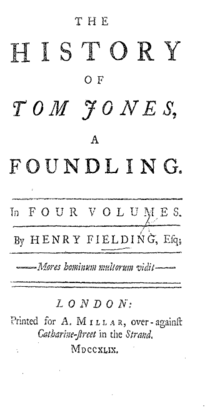
Tom Jones Original CoverWe’ve spent some time with Sophia, her cousin and her father, as they left that Inn and traveled toward London. Now it’s time to get back to Tom Jones, the man this History is about to see what he does when he leaves the same Inn after that eventful night. I really liked the way this week’s chapters started. Fielding being Fielding:

At length we are once more come to our Heroe; and, to say Truth, we have been obliged to part with him so long, that, considering the Condition in which we left him, I apprehend many of our Readers have concluded we intended to abandon him for ever; he being at present in that Situation in which prudent People usually desist from enquiring any farther after their Friends, lest they should be shocked by hearing such Friends had hanged themselves.

But, in reality, if we have not all the Virtues, I will boldly say, neither have we all the Vices of a prudent Character; and tho’ it is not easy to conceive Circumstances much more miserable than those of poor Jones at present, we shall return to him, and attend upon him with the same Diligence as if he was wantoning in the brightest Beams of Fortune.

It’s good to be back with Tom, even if he doesn’t seem much like the man destined for a hanging right now—he’s heartbroken and lost. He actually loses it on poor Partridge shortly after they leave in pursuit of Sophia. They eventually patch it up and Tom figures since everything else in life has gone wrong, he might as well pursue glory and join the army.

Partridge tries to dissuade him, in part with flowery religious talk. Which is almost immediately shown to be empty when a poor beggar crosses their path, seeking aid. Partridge has no patience for him, but Tom chastises him and gives the man some money. The man offers to sell him a notebook, that Tom soon discovers belongs to Sophia—and contains the missing hundred pounds! Tom takes the beggar’s name so he can arrange some award money to be sent to him once he delivers this book to Sophia.

I did enjoy the beggar grumbling to himself as he left about his parents never having sent him to school to read. If only they had, he wouldn’t be in this state.

Tom and Partridge carry on for a while and eventually stop in an in ann which is also playing host to a puppet show. The puppeteer has removed Punch and Joan from his shows so that they’ll teach morality. Tom suggests that the removal makes them dull, and the two argue a bit before the landlady interrupts to complain that no one does Bible stories anymore in those shows.

I’m not sure what Fielding is going to do with this stuff, but I think I’ll find out next week. In the meantime, Partridge convinces him to get a room for the night (wouldn’t want to travel at night) and get some overdue sleep. And we’ll leave it there for now.

It was good to be back traveling with Tom, but I wish I knew where things were going.

Tales from the Folly by Ben Aaronovitch: Entertaining Quick Dips into the Rivers of London

Tales from the Folly

Tales from the Folly: A Rivers of London Short Story Collection

by Ben Aaronovitch
Series: The Rivers of London

Kindle Edition, 139 pg.
JABberwocky Literary Agency, Inc., 2020

Read: August 1-3, 2020


If asked, I’d have thought I posted about this book weeks ago, so imagine my surprise this past weekend when I saw this title still on my “To Be Written” list when I was checking for something else. Better late than never…

What are the Tales from the Folly?

The subtitle pretty much gives it away, really. These are shorter works set in the Rivers of London series. The Folly is the unofficial name for the recognized British magical organization, following in the first formal study of magic made by Sir Isaac Newton (no known relation, but that doesn’t stop me from claiming him as an uncle), it’s currently formally organized as the Special Assessment Unit of the Metropolitan Police. The Folly is also the nickname for their headquarters. Either use works for this collection.

There are seven short stores (or one novella and six short stories) told from Peter Grant’s perspective—just like the series. Then there are four stories from the point of view of other characters in the series and three “moments” (Aaronovitch’s term for “something that is more of a mood than a story, something that will last a page or two and conjure an atmosphere).

Peter Grant Stories

Obviously, this is Peter’s series (at least so far…), so he gets the bulk of the space. Most of these take place around the time of the first few books in the series, but at different stages of Peter’s development. I enjoyed them all and most of them are good enough to justify the purchase price on their own.

I can’t put my finger on why, exactly, but the first story “The Home Crowd Advantage” is my favorite. It’s about a French practitioner who got up to no good during the 1948 London Games who revisits the scene of the crime in 2012 when rookie apprentice Peter Grant is the only one around to deal with him.

The last entry in this section is the novella, A Rare Book of Cunning Device that I talked about when it was released as an Audible Original in 2017. It’s rare for me to go from hearing a work to reading it, so it was interesting that way. I enjoyed it just as much this time around, but I think Holdbrook-Smith’s voice is a better one for this series than whatever is echoing around in my skull.

Everyone Else

The fact that Aaronovitch is able to tell stories outside of Peter’s perspective shows the strength of the series in my book, he’s built the world and the characters out enough that they can carry the weight of a narrative for at least a little bit.

We get a story from the perspective of one of the Rivers, one from Abigail’s perspective that will warm the cockles of your heart (and maybe make you a little sad for a bit), a nice one featuring Vanessa Sommer from Germany (making me hope we get back to Germany for another novel soon), the answer about what happened to the River Lugg after Foxglove Summer. Then there are the moments, one featuring Nightengale, one with Reynolds and one with Sommer’s pal Tobias Winter years before The October Man

So, what did I think about Tales from the Folly?

That’s easy, I thought it was great. I’d buy volume 2 tomorrow, and volume 3 next month. If Aaronovitch wrote that quickly, anyway. They’re like the comic series in a way—a nice way to spend some time in this universe without having to put in the time of a novel.

The collection covered the gamut of emotions and types of story typical of the series with Aaronovitch’s evident charm and skill. It’s a must for every Rivers of London fan.


4 Stars

Page 142 of 341

Powered by WordPress & Theme by Anders Norén