Category: Fiction Page 265 of 348

The Failed Fellowship by Michael R. Underwood

The Failed FellowshipThe Failed Fellowship

by Michael R. Underwood
Series: Genrenauts, #5 & 6

eARC, 181 pg.
2016

Read: September 16 – 17, 2016

Her job was to fix the story, not right every little wrong in the entire world.

But was that really enough? If you force someone to work with shoddy equipment and they get hurt every week, eventually, shouldn’t you fix the tool instead of sending them to the doctor? She’d spent the last several months playing the doctor, applying spot fixes along with the team, keeping to the shadows. Help the real hero, delay the problems until the real hero came back.

I want to come back to talk about Leah’s continuing difficulties adopting the right attitude as a Genrenaut, but we’ve got some work to get through first.

A band of intrepid warriors, in possession of a magic artifact carried by the one person capable of stopping a great evil enters a castle and fights through untold numbers of warriors through magic and feats of strength and skill. Only to have the Chosen One killed before they can challenge the leader of the forces of evil. Clearly, not the way this story is supposed to go — which creates problems on Earth Prime, and a need for Angstrom King’s team to come to Fantasy World, get the band back together, and fix the story.

The first thing the team does when they get to the world is track down Ioseph, the wizard who assembled the failed heroes. Leah describes him as:

Gandalf if Gondor had already fallen, Dumbledore facing a fascist wizard state under Voldemort.

Which is a great descriptive line, wholly genre-appropriate. This is Underwood at his best — not that he’s not great in SF or the other genres we’ve seen this season — but in Fantasy, he’s at his strength (see the Ree Reyes series for further examples).

It’s not just Underwood being comfortable, either — one of the first things we learned about Leah is that she’s a big Fantasy Fan. So her being here was is just what she’s been waiting for — and she makes the most of it. She jokes, she fights, she sings (her character is a bard), performs heroic deeds and she eats a lot of stew (while making the requisite snarky remarks about the stew). Everything you want in an epic fantasy novel or game, it’s celebrated and commented on at the same time. It’d be very easy to do a quick edit to remove all the references to other worlds/Genrenauts/etc. and come up with a decent novella-length story here — with a pretty good twist. Thankfully, we don’t have to read that hypothetical edit — we get Leah and the gang guiding us through it.

In addition to the pretty fun story — we get to see these Genrenauts function like a fully formed team — which is not to say they’re perfect, part of it is Leah’s rookie status, part of it comes from the length of time they spend in this world (as we learned last time), and part of it is the uncertainty that the tall woman they’ve been chasing brings to the story. There’s at least one other part, but you have to read the book to learn about it. Roman gets to tell Leah where he came from and what that means, which helps him a lot (the rest of the team, too). King’s and Shirin’s part of the story is the more straight-forward, if for no other reason than their temperaments and experience. Which is not to say that their parts are dull — in fact, one of the best characters from this world (with the obligatory annoying ‘ in his name) comes from their portion of the story.

The focus is, of course, on Leah — she loves being surrounded by a fantasy story and lets the setting get to her. Also, as the opening quotation shows, she’s struggling with her role as a Genrenaut in various worlds. Much like Kirk bristling under the constraints of the Prime Directive, Leah has a hard time adapting her sense of right and wrong to the world and culture she’s in — and I’m not sure she’s getting better about it, maybe she’s getting worse the more comfortable she is with the team. Frankly, I’m glad to see her struggle here, and I’m not sure what side I want her to come down on.

Leah’s now at the end of her probationary status — and if any of the Genrenauts were analyzing their own story, they’d clearly see that this was the end of a narrative arc and that something big was about to happen — enough to close this chapter and lead into a new one. It does, and it’s a doozy. Man, I hope things went well enough on the sales front for Underwood to be able to bring us a second season (if not seven) — I’m more than ready to support the next Kickstarter.

Underwood seemed more confident, a little more willing to have fun with the genre in these entries than he has with the others (not that he’s been all that restrained before). I loved this. When (for example) Leverage was on the air — there were better shows on, but few that I enjoyed as much. Similarly, I’ve read better books this year than The Failed Fellowship or any of the others in this series, but not that many and none have made me as happy reading these. There is one line towards the end of this that made me laugh out loud (and groan, too — Leah has no shame) and if I read an interview where Underwood said he wrote the previous 5 books in this series just to set up this line? It’d be justified.

Disclaimer: I received this eARC from the author in exchange for this post — I thank him for it (and for releasing the cover image in time for me to post this without my lousy placeholder).

—–

5 Stars

The Heart of Henry Quantum by Pepper Harding

The Heart of Henry Quantum

by Pepper Harding

eARC, 288 pg.
Gallery Books, 2016

Read: September 15, 2016

“It’s funny—the day started with me thinking about distance and the speed of light—I mean, about how far away from us everything really is, and how it’s impossible to ever truly experience anything in the moment, even yourself. There’s always the mediation of time, of space, of something that comes between the self and everything else. It kind of depressed me. . . . And the thing is, this morning all I could think about was that terrible, terrible distance. And then I ran into this old friend, this old girlfriend actually, and the same feeling came over me—that distance times time equals impossible, if that makes any sense.”

Henry Quantum — there’s a name that just screams for interpretation, doesn’t it? A lot of this book seems to do that — aim for interpretation, for reviewers/readers to talk about the language, the imagery, the science metaphors, etc. It could be argued (I think it’d be wrong, but it could be argued) that more attention was given to that than to plot, characters, and whatnot (i.e., what most people read books for).

There are 4 parts to this book — the first and last are told from Henry’s POV (while being third person, just to be clear), the second from Margaret’s (Henry’s wife), and the third from someone else we meet along the way. Henry’s a would-be novelist and executive at an advertising agency in San Francisco. Henry’s wandering mind is pretty easily distracted, but then will focus intently on something for a little bit, and then go frittering way in some other direction — so we’re told. This is a long-term thing, apparently, but much worse over the last couple of years. It’s December 23, and Henry’s decided weeks ago that the perfect gift for his wife is a bottle of Chanel No. 5, but he keeps neglecting to buy it. Why he doesn’t send an assistant/intern/whatever to do it, or order it online, we’re never told. So, come hell or high water, today he’s going to get the gift.

Just after he does this one thing, and then another, and maybe . . .

Henry’s so oblivious to things that he hasn’t noticed that every woman he’s not married to seems to be attractive and that the woman he is married to wants him gone that day. This is a problem. He’s also oblivious (at least at the beginning) to how bad the state of his marriage is — even though he’s had a lot of evidence,and has worsened the marriage himself. Frankly, I don’t like the guy (as a person, or as a character), I don’t respect him — and I don’t think we’re given much of a reason to see why anyone would. We spend the day with him — up until early evening — and I liked him less and less as the day went on.

Margaret is, quite simply, worse (and no, it’s not because I’m a guy — give the wife Henry’s character/characteristics and the husband Margaret’s, I’d think just as lowly of them). We only spend the middle portion of the day with her, and I was glad to see it end. Honestly, given the trajectory she’s on, her life is about to get much worse, and I don’t see it improving without some major changes. She needs therapy, or at least a good, honest friend (and a better job).

I actually liked the person in part 3 (identity to be withheld for story reasons), and wish we got a lot more time with the character than we did. I fear however, that given the events of the novel and their poor judgment regarding Henry that their life is about to start going in a bad direction.

Through these various points of view about the events of December 23 (wandering around a shopping area, being stuck in traffic, encounters at various eating establishments) we learn a lot about these point of view characters, and explore the heart of Henry Quantum.

Can Pepper Harding write? Absolutely. Are her characters well-rounded, do they seem like they could be more than just characters in a book? Yeah. Are they (with one possible exception) people I’d like to spend any time with? Are they characters I enjoyed spending time with? Nope and nope.

While I’m not going to actively discourage you from reading this — there are some pretty good moments, I’m not really recommending it. This book was a waste of Harding’s abilities and talent and I hope her next project is a better showcase for them, for her sake as well as her readers’.

Disclaimer: I received this eARC from Gallery Books via NetGalley in exchange for this post — thanks to both for this (really, I mean that, no matter what I thought of the book).
N.B.: As this was an ARC, any quotations above may be changed in the published work — I will endeavor to verify them as soon as possible.

—–

2 Stars

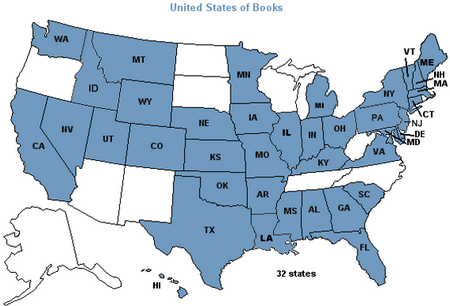
United States of Books – The Awakening by Kate Chopin

The AwakeningThe Awakening

by Kate Chopin

Author: Serena M. Agusto-Cox at Savvy Verse & Wit

For Louisiana, Entertainment Weekly says, “Chopin’s early feminist work, which presents a woman carving an identity for herself that has nothing to do with wifedom or motherhood, also serves as an engrossing immersion in the historical worlds of New Orleans and the Louisiana Gulf Coast.”

The Awakening by Kate Chopin is considered by many to be a work of Feminism, published in the early 1900s. Mrs. and Mr. Pontellier appear to have a mutual respect for one another and the relationship many married couples fall into, such as nods and certain looks that are read easily by one another. He is a broker and has very specific ideas about how much attention his wife should pay to the children. But despite their easy way with one another, there is something distant in their relationship, as he feels she does not value his conversation and she tries to tamp down her anguish about only being a mother and a wife.

While summering at Grand Isle, she comes to view their relationship much differently and that of her place in the world. Mrs. Pontellier can see from the actions of other mothers vacationing there that she is much different. She does not worship her children and she does not have all the sophistication of a societal wife. As she becomes aware of these differences, Robert Lebrun begins to pay her special attention, which recalls for her many youthful infatuations. However, when Alcee Arobin crosses her path, things begin to change dramatically for the reborn painter, Mrs. Pontellier.

Edna Pontellier returns to the city and begins to break with tradition, which raises her husband’s eyebrows. Chopin’s work is not so much about the liberation of a woman from societal expectations. It is an introspective look at how we present ourselves to our husbands, children, friends, and greater society. Our inner selves, our true selves — if they ever emerge — are buried deep within our private worlds. For many of us, our true self is only known by us and, in some cases, not even then. Edna has been awakened to her true self and she embarks on a journey to realize it fully.

“She was becoming herself and daily casting aside that fictitious self which we assume like a garment with which to appear before the world.”

In terms of the setting, it’s clear that they live in Louisiana and music and art are strong cultural elements. The roots of French colonization remain in the area, and many of the people Edna interacts with speak French. Many of these people are definitely from the upper crust as they do little more than socialize, entertain one another, and gossip. The Awakening by Kate Chopin explores the consequences of becoming independent and stripping all pretension, leaving Edna in a solitary world (which mirrors the one she held close prior to her awakening). However, it seems as though Edna fails to evolve, merely bringing her inner world to the surface to find that she cannot survive, rather than exploring what that means and how she should move forward.

RATING: Tercet

About the Author

Kate Chopin was an American novelist and short-story writer best known for her startling 1899 novel, The Awakening. Born in St. Louis, she moved to New Orleans after marrying Oscar Chopin in 1870. Less than a decade later Oscar’s cotton business fell on hard times and they moved to his family’s plantation in the Natchitoches Parish of northwestern Louisiana. Oscar died in 1882 and Kate was suddenly a young widow with six children. She turned to writing and published her first poem in 1889. The Awakening, considered Chopin’s masterpiece, was subject to harsh criticism at the time for its frank approach to sexual themes. It was rediscovered in the 1960s and has since become a standard of American literature, appreciated for its sophistication and artistry. Chopin’s short stories of Cajun and Creole life are collected in Bayou Folk (1894) and A Night in Acadie (1897), and include “Desiree’s Baby,” “The Story of an Hour” and “The Storm.”

As Wings Unfurl by Arthur M. Doweyko

As Wings Unfurl Book Tour Banner

As Wings Unfurl As Wings Unfurl

by Arthur M. Doweyko

Kindle Edition, 280 pg.
Red Adept Publishing, LLC, 2016

Read: September 19 – 20, 2016


Apple Bogdanski is a morphine-addicted Vietnam vet still having trouble re-acclimating himself to civilian life. The re-acclimation becomes more difficult when the small Book Store he works at is broken into by some pretty nasty guys. There’s some fisticuffs, some gunplay and some damaged books. What keeps Apple from being as damaged as the books is a mysterious stranger, Angela. She’s a stranger, yes, but one that Apple is convinced he’s known for years — maybe his whole life — but he can’t put his finger on the “how” and “where” of such knowledge. What’s more important to Apple at the moment is that she’s saved his bacon from these thugs and is pretty attractive — a winning combination to be sure — he’s just not sure how she saved him, the explanation defies belief.

These events plunge Apple into a plot involving multiple intelligent races on Earth, a group of guys somewhere in outer space, a corrupt and powerful Roman Catholic Church, more beings like Angela and a good deal to chew on. Oh, and multiple threats to Apple’s life.

Aside from Apple, there are some pretty interesting characters here. We don’t ever really learn what kind of creature/being that Angela (or any of her kind) actually are — we do learn a lot about them, don’t worry, just not everything. Outside of battle, their abilities are a little to hard to get a real handle on. I was intrigued and wondered a lot — there’s evidence to support at least one interpretation, but it’s just a guess, so I’ll spare you. Shilog and Yowl are pretty interesting characters and one of them becomes pretty important to how things are moving through the later part of the book. I’m not going to fill you in on the details about them, because watching it be revealed is one of the most satisfying parts of the book.

There are some really painful anachronisms here — probably due to poor editing — they don’t ruin any plot points or anything, but they take you out of the moment enough to say, “Oh come on,” or something like that and make you doubt Doweyko’s idea to place things in ’75. Other than denying everyone around the action cell phones/cell phone cameras and surveillance cameras on every street corner, I don’t see the point in that setting, honestly. Again, it’s nothing to kill the story, but it’s enough to detract from it because you spend far too much time trying to figure it out.

This got the job done, and that’s about it, it was entertaining enough to keep you moving. But there’s nothing here that made me sit up and pay attention. I liked Apple as a character, and Angela really started to grown on me by the end. I do suggest picking it up if you have the means, but I wouldn’t urge you to rush into it.

Disclaimer: I received a copy of this novel from the author in exchange for my honest thoughts.

—–

3 Stars

As Wings Unfurl Book Tour

As Wings Unfurl Book Tour Banner
Coming up: We’ve got my post about the book. But first, about the book and the author:

As Wings Unfurl

About As Wings Unfurl:

Applegate Bogdanski returns from Vietnam with a missing leg, a Purple Heart, and an addiction to morphine. He stumbles through each day, looking forward to nothing and hoping it will arrive soon. When he attempts to thwart a crime, he is knocked unconscious and wakes up to discover that people are once again calling him a hero, though he feels undeserving of the praise.

Apple returns to work and meets Angela, a mysterious woman who claims to be his guardian. Immediately, he feels a connection to her, which morphs into an attraction. But he soon discovers that Angela is much more than she seems.

Apple and Angela are swept up in a conspiracy that stretches through time and space. Together, they must fight to save everything they hold dear from an alien race bent on destroying humanity.

About Arthur M. Doweyko:

After retiring in 2009, Arthur M. Doweyko took up writing fiction. His novel Algorithm garnered a 2010 Royal Palm Literary Award. He has also published a number of short stories, many of which have been selected as Finalists in the Royal Palm Literary Award contest, and two Honorable Mentions in the L. Ron Hubbard Writers of the Future Contest.Arthur M Doweyko Author Photo

Arthur was awarded the 2008 Thomas Alva Edison Patent Award for his contribution to the discovery of Sprycel, a novel anti-cancer drug successfully brought to the marketplace in 2009. He has authored over one hundred publications (papers, abstracts, patents, book chapters) and has been an invited lecturer in a number of drug-discovery and computational venues.

Arthur lives in Florida with the love of his life, Lidia. When he’s not writing, he’s happily wandering the beaches.

Children of the Different by S.C. Flynn

I wanted to nail this one, and I don’t think I did — just so I’m clear — you want to read this. Any of your kids over 13 (and maybe some under) will likely enjoy this. Don’t be put off by the labels attached: “Post-apocalyptic,” “YA,” or whatever — this is a good story about kids in the nearish future.

Children of the Different Children of the Different

by S.C. Flynn
Kindle Edition, 316 pg.
The Hive, 2016

Read: September 12 – 13, 2016

I’m going to get this quotation wrong, so remember it’s just a paraphrase: William Gibson’s early works were said to be set “Fifteen minutes into our future” — they’re futuristic SF, but only barely. Using that as a basis, I think you’d be safe saying that this book is set 20 minutes into our future — when Gibson’s cyberpunk present falls apart. Yes, it’s technically post-apocalyptic, but so is The Sword of Shannara, but that doesn’t mean you can walk in with any idea of what its’ going to be like. Think of this as a fantasy world very much like our own (but with cooler accents) — but where almost nothing works and teenagers are threats to their own health and safety, but also to pretty much the entire world’s health and safety.

We meet the twins Arika and Narrah just as Arika is beginning her time in the Changeland. Which is a stressful time for everyone in her life — but her brother Narrah does something quite out of the ordinary, he takes advantage of their inherent psychic link and enters the Changeland with her. By doing so, they set down on a path that could change the world forever. Not that they knew this. These aren’t a couple of Promised Children, Children of Destiny or whatever — they’re just a couple of kids in the right place and the right time to become the Children of Destiny. Arika’s the strongest character, the best fleshed out and it’s her reactions to everything that inform the readers’. Not to discount anyone else, but it’s her fears, her hopes, her determination that set things in motion (even Narrah will defer to her). Before I leave Arika — her friend, who I see as a combination of Luna Lovegood and Sybill Trelawney, but far less chatty — is such a great character. She’d have been easy to use wrongly, but Flynn gets is just right. She’s very likely my favorite part of the whole book.

While in her Changeland, Arika finds an enemy and Narrah finds a potential ally. Both show up later when Arika returns the favor and comes to Narrah’s rescue in his Changeland. It’s really kind of hard to describe, read it yourself. His is radically different and more hazardous — as are the conditions he finds himself in. I don’t want to get into the story beyond that, but let me just say that nothing in the story worked out the way I expected, and I’m so glad for it. The novel ended in such a way as to be initially dissatisfying, but with just a little thought, it was perfect — you don’t want more than you’re given, really — it seems like you do, but after a little time and thought, you get why he doesn’t the way he ended it the way he does, and actually end up pretty satisfied with the whole novel.

Oh yeah, there’s this great part that turns out to be a description of Echolocation. That was cool — I know I was wearing a big grin for a few paragraphs once I figured out that’s what was going on. That’s just an aside and your results my vary, but I really dug that scene. Almost as nifty are Narrah’s new abilities, and I’ll just leave it at that.

Flynn gives us clear, well-defined, and distinct characters here. I can’t say that I got too emotionally attached to any of them — but I was very curious about all of them. I imagined more of what life was like for the twins and their friends growing up in their circumstances, what made the various people who left their settlement do so, and just what might happen after the book ends. At the end of the day, these are people you want to see succeed, even if you don’t have that big emotional bond with them.

Once you get your bearings (which took a little longer for me than it should’ve, I think I had an off day), you can really get into this world and get an idea how things function (or don’t) on the Australian continent — and you can guess what’s going on in the rest of the world, too. Between the powers, the hard life and the machinations of the leaders — there’s plenty going on to keep you turning the pages — some is exciting, some is rich in imagery, some is tense and all is entertaining.

A heckuva debut novel — I can’t look forward to more enough.

Disclaimer: I received a copy of this novel from the author in exchange for my participation in the Book Tour and my honest post.

—–

4 Stars

A Few Quick Questions With…S. C. Flynn

You’ve maybe seen him here and there in the feedback for various and sundry posts, I know I have. S. C. Flynn’s been all over this blog — and I appreciate it. Thankfully, his book was good enough that I didn’t have to feel awkward (because it’s all about me, right?) Here’s a lil’ Q&A that S.C. and I did this week. I didn’t actually ask him more questions than usual — he edited my questions to make the answers better.

1. Why Post-Apocalyptic Fantasy (I didn’t even know that was a thing)?.
It is rare; I can hardly think of any examples of this sub-genre, and those are a long way from CHILDREN OF THE DIFFERENT. I suppose post-apocalyptic fantasy is rare because, as I see it, it is a mix of science fiction and fantasy. SF provides the background – in my case, an epidemic that affects the human brain such that by adolescence the second generation of survivors are already in part a new human species with enhanced abilities. Then the fantasy comes in, based on science and a little bit of magic!
I found this a neat way to let my imagination go where it wanted, while still having a plausible basis in our world.
2. Why YA?
I have written various other novels – all fantasy, but very different from this one – and been close to breaking into conventional publishing via professional literary agents over a period of many years. I had never written Young Adult before, though, so it was something new to try, together with the new strategy of quality self-publishing that I am carrying out, with an all-pro support team.
Writing YA has been a really enjoyable challenge. A Young Adult novel must have all the things that any good novel must have: strong plot, well-developed characters and convincing setting. By definition, the writer is limited in how much sex, coarse language and graphic violence can be included in a YA novel. That means that you have to work harder with those basic components I mentioned – plot, characters and setting, in order to achieve your effects you need.
Once I had the basic idea – namely, following the brain disease epidemic that destroyed civilisation, adolescents go into a coma and emerge either with special powers or as dangerous Ferals – the choice of YA was made for me. The logical time for this Changing to occur was at the onset of puberty, so the main characters (twins Arika and Narrah – a girl and a boy) are 13 years old. Arika and Narrah can read and write, but they have always lived in a small, isolated non-industrial settlement, and their language and thoughts are conditioned by their limited knowledge of the world. In CHILDREN, we see everything from the twins’ viewpoint, so the style in which their story is told necessarily had to be simple and clear. That fits perfectly with the Young Adult audience.
3. What was it about this story that made you say — yup, this is the one?
CHILDREN OF THE DIFFERENT leaped into my mind almost fully formed once I had the basic idea. Of all my novels, CHILDREN was by far the easiest and quickest to write, at least as far as the first draft was concerned.

I am an obsessive reviser, so that was four years ago, during which time there have been long pauses while I was revising other novels, or even – surprisingly enough – taking some time off from revision. Still, the first draft of CHILDREN virtually wrote itself – every day when I needed a scene, it was there ready-made.
I had never written about Australia before, so probably, without realising it, I had a great amount of background knowledge ready to use. My other novels are quasi-historical fantasy and required a lot of research.

I think the main characters really wanted to tell their story, as well.

4. You’ve been doing the SF/F blog thing for a while now — how has that helped you as a novelist??
The style of writing that works on a blog is completely different from what fiction requires, so I see them as two separate skills. As I said before, I have written novels for many years, so my fiction style was probably formed in large part before I started blogging.

Blogging certainly keeps you up with the latest books and what people are saying about them, and the skills of writing blog posts is essential for trying to publicise your fiction. Setting up a blog also brought me out of my corner, where I had been writing for years, and got me into contact with lots of cool people who have helped and encouraged me.

5. What’s the one (or two) book/movie/show in the last 5 years that made you say, “I wish I’d written that?”
Wool by Hugh Howey. A very clever dystopian idea, and also a book that helped to revolutionise the self-publishing industry.
6. Aside from a burning desire to buy copies to give away as gifts, what are you hoping your readers take away from this book?
An optimistic post-apocalyptic story like CHILDREN is an important one to tell, for me. It contains a warning about the dangers of technology, together with hope for what our society could achieve if technology were used for good purposes.

CHILDREN also contains a hopeful message that our very young people can achieve great things. Like the twins, adolescents are not stupid, but just lacking in experience, exposed to dangerous influences and struggling to work out who or what they are turning into. It is up to us to give them the best chance we can and leave them the best world we possibly can./td>

7. What’s next for S. C. Flynn?
There has so far been a fair bit of interest from reviewers in seeing more of the world of CHILDREN OF THE DIFFERENT. So, one possibility would be to write a sequel.
The alternative would be to publish one of the completed novels I referred to before. Three of those are of publishable quality, in my opinion, having been through years of editing by professional literary agents, as well as my own fanatical revision.For now, I will wait and see what happens with CHILDREN.
Thanks so much for your time, and I hope your launch week meets with a lot of success.

Children of the Different by S. C. Flynn Book Tour

Welcome to our Book Tour stop for Children of the Different. Along with this blurb about the book I’ve got a Q & A with the author, S. C. Flynn and my 2¢ about the book.

Book Details:

Book Title:  Children of the Different by S. C. Flynn
Release date:  September 10, 2016
Genre: Post-Apocalyptic Fantasy
Extract: THE ANTEATER

Book Description:

Nineteen years ago, a brain disease known as the Great Madness killed most of the world’s population. The survivors all had something different about their minds. Now, at the start of adolescence, their children enter a trance-like state known as the Changeland and either emerge with special mental powers or as cannibalistic Ferals.

In the great forest of south-western Australia, thirteen year-old Arika and her twin brother Narrah go through the Changeland. They encounter an enemy known as the Anteater who feeds on human life. He exists both in the Changeland and in the outside world, and he wants the twins dead.

After their Changings, the twins have powers that let them fight their enemy and face their destiny on a long journey to an abandoned American military base on the north-west coast of Australia. If they can reach it before time runs out.

Author Info:

SCy-Fy: the blog of S. C. Flynn

https://twitter.com/LaughRiotPress

https://twitter.com/SCyFlynn

S. C. Flynn’s Amazon Page

Ascent by M. T. Miller

AscentAscent: Second Book of the Nameless Chronicle

by M. T. Miller
Series: The Nameless Chronicle, #2

Kindle Edition, 316 pg.
2016

Read: September 3, 2016


Can you read this without having read Risen? Yeah, but it’d be better if you didn’t (and Risen is short enough that you might was well). I’m not sure how much time has passed since the last page of the first book, but we find Nameless pretty much how we left him — wandering along, on the verge of . . . whatever exactly would happen to him if he didn’t get more energy. Like before, almost as soon as he gets to town, he falls victim to a gang of sorts and is mugged. Of course, his first order of business (after recuperating from the beating) is revenge, which will give him the energy he needs to move around the Pyramid to search for the explanations he needs to understand his abilities, his nature and identity.

What’s the Pyramid, you ask? It’s a city in a giant 4-tiered structure (each tier housing a different caste). Nameless adopts a name, makes a little money on the lowest level — full of crime, poverty and menial labor — and buys himself access to the next level. Where he finds a new — and legal — way to use his fighting abilities to make money. Things go haywire from there.

There’s a lot more going on in this book than there was in its predecessor, Risen — if for no other reason than it’s almost 3 times as long. It’s still the same kind of book — full of violence, some pretty good fight scenes, and a post-apocalyptic culture that’s foreign, yet all-too familiar. There are many more characters, relating to Nameless in a variety of ways — friendship, camaraderie, betrayal, exploitation, to name a few.

The way things went in Book One, I assumed that we were going to learn Nameless’ origins, etc. over the course of a handful of books. Nope — we get almost every question we had about where he came from answered — and almost all of them are just dumped on us. There was no slow and steady learning here, just BAM! here are your answers. And it worked — much better than a slow reveal, a giant dropping of information (which I usually am opposed to) took care of everything (while still leaving me with almost as many questions as Nameless had).

I shouldn’t neglect to say that just because Nameless has almost all of his questions answered here, that he knows what to do with this information. I’m guessing part (or all of that) will be revealed in Book Three.

I don’t normally do this, but I while writing this I went back to my post about Risen and chuckled because what I said there as a lot like the next point on my outline: “My one complaint is length — just about everything is too short. The story is too short, most of the scenes are, too. But I’m pretty sure that’s just my wanting more for myself — to give us longer scenes would ruin the pacing, would mess with the way Miller’s constructing the series. And really, when you get down to it “I wanted more!” is more of a compliment than a complaint — but I’m calling it one nonetheless.” His scenes aren’t too short this time, but everything else I said there is still true. A lot of the action (especially the violence) is given to us in summary form — we see the “important” fights, the ones that shape the story, but the rest is given in something like a re-cap mode (ditto with the flirting, with his conversations with others, and so on). So clearly, this is the kind of thing that’s 1. Miller’s style and/or 2. The style of this series. Either are perfectly acceptable. And honestly? If he’d given us more of the fights, more about Nameless’ days in the new society he’d encountered, etc. I’d likely be complaining that he’s reveling in the violence, bogging down the story with the details. So what do I know?

Ascent is a book that kept you guessing and leaves you in a very different world than you thought you were in at the beginning — with a status quo that is so far from what it initially was that it’ll leave you reeling. Taut, well-paced, with some pretty good hand-to-hand combat scenes — and it won’t let you go until the very end. Miller’s really got something going here.

Disclaimer — I received a copy of this book from the author in exchange for my honest opinion. I appreciate that, Mr. Miller — and thanks for being so cool about me forgetting the date.

—–

3.5 Stars

Catch & Neutralize by Chris Grams

Catch & NeutralizeCatch & Neutralize

by Chris Grams

Kindle Edition, 335 pg.
2016

Read: September 5 – 6, 2016


Before I get into this novel, let me tell you a little about my process: After deciding to read a book, I tend to forget what it’s about rightaway — if for no other reason than I’m too frequently tempted to predict what the book’ll be like. So when it comes to series and/or author’s I like, all I need to know is “Oh, a new Faith Hunter book is out!” or “Ahhh, a Jonathan Tropper that I haven’t read — sweet!” That’s all I need. Similarly, when it’s a book by someone new, or a new series — or when an author (case in point) asks me to read their new book — once I’ve decided I’m down for it, I’ll let the details slide, so I’m fresh for the book.

So when I opened this one (see, there’s a link) and read the first few chapters, I kept asking myself “I said ‘yes’ to this?” Not because it was bad — it wasn’t — it’s just not the kind of book that I’d normally read. A little later, I went to log that I’d started the book in Goodreads and read the blurb there — I didn’t recognize it as the book I was reading. A chapter or two later, it was exactly what the blurb said. And that’s both good and bad. Let’s see if I can explain my point.

In the first few chapters we meet Mark — a super-smart geneticist who’s also (for good reason) super-jealous. He’s pretty sure his wife is having an affair (as is the reader), and he’s understandably upset. He takes a few steps that most husbands don’t — but most husbands don’t have his apparent personal budget or friends in the right fields. He also happens to meet a willing accomplice — perhaps too willing, as she’s young, pretty and talented, and a little tempting for a guy who’s pretty sure his marriage is on the rocks. But whatever — now, at this point, I’m interested, invested — I’m rooting for Mark (at least a little), and really hoping he doesn’t end up killing his wife or something similarly stupid/misguided.

Insert the sound of a needle scratch, because we’re done with Mark at this point — without warning or anything, and we meet Angie (Mark’s wife) and Tiffany, and a little creep of a waiter. We learn at this point that Angie’s been faithful, is actually ga-ga over Mark and the actions that have led him to his horrible conclusion are actually her working for a vigilante group that takes down criminals who’ve gotten away with crimes against women and children. It turns out that Tiffany is, too — but she might be playing a little fast and loose with the organization’s rules. There’s a strange combination of play and danger in the interactions between Angie and Tiffany — it’s pretty fun as long as you think of them as fictional characters. If you think of them as real people, it’s just scary.

And that feeling gets so much worse once Tiffany and Angie get their hands on a couple of rapists and pedophiles. This is also where things between the two women go off the rails. It’s not long after this that Mark comes back into the picture — and the book changes again. It was Book A with Mark’s chapters, it becomes an entirely different book (B) in the Angie and Tiffany focus (the one that matches the Goodreads/Amazon/Gram website blurb — and was the kind of book I’d normally be interested in) and then becomes Book C after Mark shows up (and maybe becomes D a little later). Where most authors would’ve intertwined A and B, so that C flows from them; this is almost like changing the channels on TV between the three. I’m not saying it’s good or bad — it’s jarring and unexpected, but maybe that’s what Grams was going for — it actually kinda works. But man, it made for odd transitions. Along this lines, the dénouement has the feel of an entirely different book, too — something like the overly-cheery final scene in a 80’s cop drama.

Now, there’s some tense gunfighting scenes, some torture, some double-crossing, and a whole lot of questions that aren’t answered. Each of the books I mentioned above are pretty well-written and grabbing, if somewhat disturbing — it’s just bringing them together that didn’t work for me. The characters are well-constructed — sure they might act in ways that are hard to understand sometimes, occasionally in near-insane ways — the reader will be drawn-in and compelled to keep going with these people.

Oh, and the little creep of a waiter? Yeah, he turns out to be worse than initially thought (and, I promise you, his first impression is a bad one), and well, things really don't go his way.

This is definitely written like it could kick-off a series, and if that's the case, I'm very interested in what comes next, if for no other reasons than so I can see if Grams can pull it off. But mostly, because I'd like to see what comes next

Disclaimer: I received a copy of this novel from the author in exchange for my honest opinion — I hope she doesn’t regret that too much, especially since I let our agreed upon posting date pass without a word. Ms. Grams, you’re a class act. Thanks.

—–

3 Stars

Page 265 of 348

Powered by WordPress & Theme by Anders Norén