Category: Fiction Page 70 of 342

Grandpappy’s Corner: George the Bannana: Book One by Elliott Linker: The Origin of a Superhero (and his Writer!)

Be sure to come back this afternoon for a Q&A with the writer!


Grandpappy's Corner Logo

George the Bannana: Book One

by Elliott Linker

DETAILS:
Series: George the Bannana, #1
Publication Date: January 13, 2023
Format: Paperback
Length: 25 pgs.
Read Date: March 18, 2023

What’s George the Bannana: Book One About?

Here’s the back of the book description:

Elliott’s best friend, George, suddenly turns into a banana! Elliott is scared of what people will think and inadvertently hurts George’s feelings. Trying to save his friendship with George, Elliott helps turn George into a super hero! Together they embark on a wild adventure.

I can’t think of a better way to put it or anything to add.

Let’s Talk about the Art for a Minute

The art looks like the product of an elementary school artist, so it’s rough, a little haphazard, and lacking in detail. Granted. It’s also dynamic, consistent (even the anonymous bad guys look the same from panel to panel), and engaging.

The coloring and shading are really well done, and elevate the work. The action scenes really work well—and Linker makes the wise move to take a break for the occasional cloud full of “Bam” “Kick Kick” “Punch Punch” “Kapow”—leaving it to the reader’s imagination (and saving him a lot of work).

Best of all, the art fits the story.

So, what did I think about George the Bannana: Book One?

This made me so happy to read—it’s clearly the product of an imaginative youth expressing himself. The story is ridiculous in the way that only a child can let one be—feeling both out of control with random elements, yet somehow sticking to an outline. Linker knows what the arc of a superhero story should be and executes it—he may not quite understand how to get from Point A to Point B, but he gets there through sheer determination and will (and this is the most enjoyable part for me).

Linker was 8 when he created this work—9 when he published it, which is just great. It also makes me want to focus on something in the description—Elliott isn’t the superhero, he’s the side-kick (who will need to be rescued). He’s also the guy who was a jerk to his best friend. Big choices that say a lot about the author.

I’ve got to say, I don’t know how many kids would take a moment to have George confront Elliott with how he made him feel when George became a banana (I’m certain I wouldn’t have at his age). That one moment made this a winner in my book—but so did many of the others.

The bonus of including a preview of Book Two in black and white for the reader to color? Very clever and very fun.

The entire time I read this, the back of my mind kept saying “He must have had such a blast writing and drawing this.” That joy was infectious so I had a blast reading it, and I can’t imagine any adult having a similar reaction. One of Linker’s contemporaries probably would, too—and maybe find the inspiration to tell their own story, too.


3 Stars

Grandpappy IconLiterary Locals logo

PUB DAY REPOST: Hard Rain by Samantha Jayne Allen: The Rookie PI Might Be in Over Her Head

Hard RainHard Rain

by Samantha Jayne Allen

DETAILS:
Series: Annie McIntyre Mysteries, Volume 2
Publisher: Minotaur Books
Publication Date: April 18, 2023
Format: eARC
Length: 352
Read Date: April 4-7, 2023

What’s Hard Rain About?

It’s been six months since Annie McIntyre solved a murder and began training as a Private Investigator under her grandfather and his partner, Mary-Pat. It doesn’t seem like Annie’s really sure of her current path, but at least it’s a path—hopefully out of Garnett at some point.

A High School classmate—not really a friend, but more than an acquaintance—approaches her with a job. Mary-Pat tells her she’s ready to take the lead on their next case, and is about ready to apply for her license. So, she’s primed and ready—at least she thinks so.

A couple of weeks previously a flash flood had wreaked havoc on the town and the cost in property damage and lives is high. Bethany, however, was saved through the actions of someone that she fears is a victim. But his body was never found. She wants Annie to find either the body or, preferably, the man so she can thank him properly. Not expecting the latter, and equipped with only a vague description, Annie takes the job.

The police have nothing for her, and the local fire and rescue people found no sign of this man—many people think that Bethany imagined him. But Annie keeps looking—searching downstream from the area Bethany had been found in, Annie does find a body. But not of the man she’s been looking for—but a murdered woman. Now Annie has to ask, is her target a killer or a hero?

As Annie investigates, she finds herself in a new layer of crime, corruption, and danger.

The Sense of Place

When talking about the previous book, Pay Dirt Road, I had a few things to say about the city of Garnett’s depiction. I won’t repeat them here—but I really could. I don’t think it’s an issue so much with Allen’s writing, just my ideas about Texas communities. (not that I’d complain if Annie made some mention of the population size)

What I failed to appreciate—or at least write about—was Allen’s depiction of, and description of, the natural environment. Given the storms and flood surrounding this book, it’s hard not to take note of it. Allen nails this material.

I really can see the flood damage, the sky, the geography in general—Allen pairs her vivid imagery with a little bit of wry commentary (frequently, but not always) to really help the reader get a handle on the sights and sounds. I was reminded of Chandler describing L.A. This is not typically the kind of thing I spend a lot of time thinking about when reading a P.I. novel, but I really couldn’t help but do so this time—both because of the nature of Annie’s investigation and because of Allen’s skill at it. Particularly the latter.

The Portrayal of Evangelicals

So, so, so often lately—including in books I really like—evangelicals are brought in as bastions of corruption, hypocrisy, and prejudice. Especially if they happen to belong to a mega-church.

The church that Bethany is part of, that her husband and father-in-law are pastors of, that some of the flood victims belonged to, that her missing man and the murder victim may be tied to, isn’t a mega-church yet, but is well on its way to being one.

Yes, some of the members are tied to criminal activity, unethical activity, and some other hypocritical kinds of things. But by and large the members of the church are honest, faithful, and human. They’re not perfect, but they’re working at it. It’s an honest depiction, and while not necessarily flattering, it’s not vilifying, either. I appreciate that.

Learning the Ropes

I described this series as a friend recently as “a PI version of the Eve Ronin books,” and the more I think about that, the more I like it.

Yes, Goldberg and Allen have very different tones. The tenor and flavor of the books are different—each fitting their setting and authors. But at the core, you have determined young women in settings that aren’t necessarily hospitable toward them, dealing with family issues and learning the ropes of their current professions. They make mistakes that experience would provide, get correction and guidance from their mentors (and their own reactions to their errors), but have good instincts and the drive to improve.

They’re very different series and very different kinds of stories, but I like seeing Eve and Annie as different outworkings of the same idea.

So, what did I think about Hard Rain?

Last year, I said that I’d have been satisfied with Pay Dirt Road as a standalone, but that I’d be in the front of the line for a sequel. I’m glad I came back—this world and this character deserve the time a series affords (I see there’s already a third volume scheduled for next year).

I enjoyed this one more than last year’s—I don’t know that it’s that much better, but Annie being more confident (maybe only by degrees, but it’s there) and the type of story made that possible. If you haven’t read Pay Dirt Road, Hard Rain will work as a stand-alone or as an entry point to the series, but you’d be denying yourself seeing Annie’s growth.

Atmosphere, character (not just the protagonists, but all the supporting characters as well—maybe next year I’ll find/make the time to talk about Annie’s family, for example), and story—Samantha Jayne Allen delivers the goods on all fronts. I heartily recommend Hard Rain to your attention.

Disclaimer: I received this eARC from St. Martin’s Publishing Group via NetGalley in exchange for this post—thanks to both for this.


4 Stars

This post contains an affiliate link. If you purchase from it, I will get a small commission at no additional cost to you. As always, the opinions expressed are my own.

Scratching the Flint by Vern Smith: We Didn’t Start the Fire…

I’ve been working on this one for a little over two months, and I kept deleting draft after draft after draft. I’m still not wholly satisfied with this one–but it’s close enough. Also, the book was released last weekend, so this is so overdue it’s causing heartburn. TL;DR version: This is an unsettling, brutal look at law enforcement with people on both sides of the Law.


Scratching the FlintScratching the Flint

by Vern Smith

DETAILS:
Publisher: Run Amok Crime
Publication Date: April 15, 2023
Format: ARC
Length: 228 pg.
Read Date: February 7-9, 2023

What’s Scratching the Flint About?

Detectives Alex Johnson and Cecil Bolan are part of the Toronto PD’s anti-fraud division. They’re in the midst of trying to take down a vintage car theft ring. Sadly, their witnesses are being targeted by the head of this ring–they’re being mocked and murdered in a way that sends a very loud message to quiet anyone else who might be thinking of coming forward.

One of these witnesses is an old high school friend/basketball teammate of Cecil’s. He reacts badly to this, but his commanding officer and his partner are doing their best to keep him from interfering with the homicide investigations and to focus on the ring (as much as they can without interfering with homicide) or other anti-fraud work.

It’s not long before the pair are given an involuntary vacation–in lieu of a suspension–leaving Cecil with too much time on his hands and not much opportunity for Alex to keep him reined in. And that’s where things have the opportunity to go from bad to worse–to potentially much, much worse–in this noir examination of crime and policing at the turn of the century.

2001

Smith is very careful throughout the book to locate the book in 2001 and captures the feel of it so well. At least, the way I’d imagine it’d feel in that part of Canada. The use of specific games of the Toronto Blue Jays really helped ground that.

Smith has some very specific aims for that–and most of the reason I struggled with this post comes from trying to interact with those aims but I don’t think I can without spoiling a good deal of the book. So let me just say this when it comes to the chronological setting–enjoy the flashback (for those who can remember the year) and just know it’ll give you plenty to chew on as the book goes along.

The Thin Blue Line

This is hard to write about–and frequently difficult to read. Crime Fiction writers (and TV/Movie viewers) are used to cops that color outside the lines–and we frequently root for them. We’re even used to rogue cops who go to extremes to get the job done. Or bent cops who are the villains of the piece.

Striking the Flint gives us none of those–or maybe all of those. Ian Patrick’s Sam Batford series comes to mind as a comparison (although this feels less like fiction and more like thinly disguised true crime). Our protagonists are detectives who seem intent on making their cases, on making arrests. But when push comes to shove, I’m not entirely convinced it’s about enforcing the law all the time with them–it’s getting a win, coming out on top over some of them. (I’m trying to behave here when it comes to spoilers, so I have to stay vague).

Their superiors–and other police officers–are just as involved. Skirting regulations, finding dirt on people who might have legitimate complaints about police treatment, supporting clearly unethical/illegal behavior, and so on. There are outright crimes committed by these two (usually independently) that depending on the outcome and motive would be used for comic relief or in a way that would be justified in other novels. But Smith doesn’t let the reader find the humor or rationalization for them here–sometimes they get away with them because of the badge. Sometimes, they just get away with them.

One only minorly-spoilery example: neither of these detectives owns a car. Alex’s ex-wife lets him borrow hers at the beginning of the novel. But partway through it, she takes the car back–leaving them without the means to do their jobs. So, Alex “borrows” it again without her knowledge–and gets away with it through a combination of police solidarity and misogyny. A lot of times, that would be played for laughs. I can see that being funny in a Stephanie Plum-like novel. Or someone like Bosch or Rebus would do it while feeling conflicted and have to face the music about it later. I initially took it as a lighter moment before realizing that Smith isn’t in that business.

The back of the book promises that this book examines “the lowest common denominators of policing.” And it delivers on that and will make you rethink a lot of what you read and watch in the fictional realm in light of what we see on the news.

Dialogue

There is a distinctive way that these characters talk to one another–at least Alex, Cecil, and most (if not all) of the criminals. I think if I wanted to take the time, I could come up with a more definitive list of exceptions (and that might prove interesting). Perhaps it’s a time-specific Toronto-area affectation. But I don’t think so, I think it’s a Vern Smith-thing. Like every David Milch or Aaron Sorkin series shows a specific kind of speech pattern (this is far more Milch than Sorkin, it should be noted).

It was a little odd at first, but an oddness I could appreciate. Then I got used to the rhythm and enjoyed it. By the end of the book, I don’t even think I noticed it anymore, it’d just become part of the novel’s world.

I don’t think I see this kind of thing too often in fiction, but when I do, I just love it. It’s not flashy like some people are with dialogue, just distinctive.

So, what did I think about Scratching the Flint?

This was an intense read. I was wholly immersed in it and really didn’t want to come up for air.

At the same time…these are not good people, at all. I think the characters I felt the most empathy for were Cecil’s wife (who seems utterly clueless about what he gets up to) and the lieutenant of the car theft ring’s head. He doesn’t show a lot of interest in going straight, but he doesn’t want anything to do with what his boss is involved in.

Smith captured the time, captured the psychology of the characters (or at least what you think these kinds of “cops and robbers” would think like), and delivers one of the grittiest, most realistic works you’re going to run into. Canadian noir, whodathunk it?

I cannot say I enjoyed Scratching the Flint (and I wonder a little bit about anyone who does), but it’s a powerhouse of a novel that will leave you thinking. It’s been more than two months since I read it, and I’ve chewed on bits and pieces of it almost every day since.* It’s an audacious work that will stick with you and one that will make you want more.

* And not just because I was trying to figure out how to write about it.


4 1/2 Stars

This post contains an affiliate link. If you purchase from it, I will get a small commission at no additional cost to you. As always, the opinions expressed are my own.


Billy in Space by Harry L-B: The Most Benign Space Mission Conceivable Goes Horribly Awry

Come back this afternoon for a Q&A with the author!


Billy in SpaceBilly in Space

by Harry L-B

DETAILS:
Publication Date: April 5, 2023
Format: eBook
Length: 223 pgs.
Read Date: March 23-24, 2023

“Sometimes things go so bad you think it couldn’t possibly get any worse. Then, it does. Because life is terrible.”

This is somewhat new territory for me—I’m generally pretty adept at talking about a book’s story/setup without getting into spoiler territory.* I’m not worried about spoiling plot points in this book—I’m worried about spoiling jokes. It’d be really easy for me to describe something here in a way that’s not particularly amusing and then when you get to the point in the book that’s supposed to tickle your funny bone, it’d lose its effect.

* Although an author or two have had different thoughts.

What’s Billy in Space About?

Billy had constantly lived his life in the shadow of Andy—brilliant, effortlessly cool, and genuinely a nice guy, and it grated on him. When it came time to decide on a career path, he swallowed a recruiter’s lines and volunteered to have the surgery to become telekinetic—visualizing a future as a member of a security team, using his abilities to combat injustice.

And instead, he became a “thought-lifter.” Basically, a human forklift working in a ship’s cargo hold. Thankfully, he was on the same ship as his one and only friend, so he wasn’t entirely miserable. Actually, he rather enjoyed his life, certain things would get better. “Billy was nothing if not delusionally optimistic.” He’s desperately outgoing, friendly, socially-inept, and earnest as the day is long.

After weeks of hesitating, and a final push by Andy, Billy asks out an attractive engineer—and is the victim of an industrial accident just as the date is about to start. And that’s the best part of the date. He wakes in a medical bay—the ship is on emergency power, and he can’t find anyone on board—he can find some discarded pieces of crew members, however. So he sets off to try to find anyone alive, find out what happened—and hopefully, find something to wear other than a hospital gown.

Oh, and then space pirates show up.

Boris

Boris could best be described as a man made from a carefully arranged stack of Russian cinder blocks.

Billy’s coworker—and fellow thought-lifter—Boris took a bit for me to warm up to. Initially, he seemed like a one-trick pony—he’s the gruff and laconic anti-Billy. He stands and says nothing, barely tolerating Billy’s attempts at conversation and bonding. Ha-ha, I get it. Can we move on now?

But the further we get into the book, Boris starts contributing in other ways—largely interacting with people who aren’t Billy. His character handles plenty of the action, but he’s also a guaranteed punch-line generator. With one sentence in any situation he can reveal a little about himself that is both incredibly apropos and ridiculous.

I’d compare him to Ron Swanson or Rosa Diaz—at least in the way he works in contrast to the other characters and what has to be a deadpan reaction to almost everything.

The Action Part of the Equation

Popular film and television painted an uncharitable picture of space pirates. In every depiction Billy had seen, they were a rude and nasty lot, their ships’ halls favored an abundance of red lighting, and someone onboard kept a cyborg parrot as a companion. The media was surprisingly accurate on most counts. Billy didn’t think abductions were particularly polite, and his eyes were having difficulty adjusting to a world painted in shades of crimson. He was disappointed by the lack of any cybernetic parrots, but kept his ears open for digital squawking.

Something I try to do when evaluating an action-comedy is to ask what it would be like without the comedy. Does the story hold up? It’s not a deal-breaker for me if the novel/show/movie needs the comedy, but if it can survive while being serious, I give it bonus points.

With a tweak to the purpose of the Space Cutie VII‘s mission (and the ship’s name), in addition to dropping the comedy and Billy in Space would work as a SF-Action tale—might even cross the line into SF-Horror. That says a lot about the plot, the story arcs, and the characters.

The comedy helps heighten the story—I think maybe even makes some of the tense moments more tense (this isn’t a comedy where bad things don’t happen), and the ridiculousness of the characters makes them more engaging. But the fact that the novel could hold up without the chuckles makes me care more about the outcome.

So, what did I think about Billy in Space?

Billy was born on Mars. He grew up on Mars. He went to Mars City High School, home of the Fighting Tunnel-Squids. Growing up, he had been fairly sure he was going to work on Mars, and eventually get eaten by a tunnel-squid on Mars, something that became more and more likely as Martian settlements spread into their natural habitats.

I had a lot of fun with this one, it’s a great mix of silly, SF, and action. Because everyone has to mention Hitchhiker’s Guide when mentioning humorous SF, the jacket copy for this does, too. I didn’t find it that THHGttG-ish, honestly. More of a Futurama (also mentioned in the description), or early Scalzi. Very Red Dwarf, too. Although, that’s something that too few would understand anymore. But for those of a certain age, Billy’s pal Andy is essentially what Ace Rimmer would’ve been had he gone into biology.

When things got hairy, I have to say that I was surprised at how dark the events got—I wasn’t put off by it, I just didn’t assume the light feel of the book up to that point would take such a left turn. But it worked so well. It’s hard to describe the blend of Alien-ish story with the goofiness of Billy and the others. Shaun of the Dead comes kind of close.

I chucked frequently, gasped in surprise at least once, and generally had a good time escaping into the world that Harry L-B created. This was a fun ride and I’d jump on another novel like this without hesitation—you should check it out!


3.5 Stars

Hard Rain by Samantha Jayne Allen: The Rookie PI Might Be in Over Her Head

Hard RainHard Rain

by Samantha Jayne Allen

DETAILS:
Series: Annie McIntyre Mysteries, Volume 2
Publisher: Minotaur Books
Publication Date: April 18, 2023
Format: eARC
Length: 352
Read Date: April 4-7, 2023

What’s Hard Rain About?

It’s been six months since Annie McIntyre solved a murder and began training as a Private Investigator under her grandfather and his partner, Mary-Pat. It doesn’t seem like Annie’s really sure of her current path, but at least it’s a path—hopefully out of Garnett at some point.

A High School classmate—not really a friend, but more than an acquaintance—approaches her with a job. Mary-Pat tells her she’s ready to take the lead on their next case, and is about ready to apply for her license. So, she’s primed and ready—at least she thinks so.

A couple of weeks previously a flash flood had wreaked havoc on the town and the cost in property damage and lives is high. Bethany, however, was saved through the actions of someone that she fears is a victim. But his body was never found. She wants Annie to find either the body or, preferably, the man so she can thank him properly. Not expecting the latter, and equipped with only a vague description, Annie takes the job.

The police have nothing for her, and the local fire and rescue people found no sign of this man—many people think that Bethany imagined him. But Annie keeps looking—searching downstream from the area Bethany had been found in, Annie does find a body. But not of the man she’s been looking for—but a murdered woman. Now Annie has to ask, is her target a killer or a hero?

As Annie investigates, she finds herself in a new layer of crime, corruption, and danger.

The Sense of Place

When talking about the previous book, Pay Dirt Road, I had a few things to say about the city of Garnett’s depiction. I won’t repeat them here—but I really could. I don’t think it’s an issue so much with Allen’s writing, just my ideas about Texas communities. (not that I’d complain if Annie made some mention of the population size)

What I failed to appreciate—or at least write about—was Allen’s depiction of, and description of, the natural environment. Given the storms and flood surrounding this book, it’s hard not to take note of it. Allen nails this material.

I really can see the flood damage, the sky, the geography in general—Allen pairs her vivid imagery with a little bit of wry commentary (frequently, but not always) to really help the reader get a handle on the sights and sounds. I was reminded of Chandler describing L.A. This is not typically the kind of thing I spend a lot of time thinking about when reading a P.I. novel, but I really couldn’t help but do so this time—both because of the nature of Annie’s investigation and because of Allen’s skill at it. Particularly the latter.

The Portrayal of Evangelicals

So, so, so often lately—including in books I really like—evangelicals are brought in as bastions of corruption, hypocrisy, and prejudice. Especially if they happen to belong to a mega-church.

The church that Bethany is part of, that her husband and father-in-law are pastors of, that some of the flood victims belonged to, that her missing man and the murder victim may be tied to, isn’t a mega-church yet, but is well on its way to being one.

Yes, some of the members are tied to criminal activity, unethical activity, and some other hypocritical kinds of things. But by and large the members of the church are honest, faithful, and human. They’re not perfect, but they’re working at it. It’s an honest depiction, and while not necessarily flattering, it’s not vilifying, either. I appreciate that.

Learning the Ropes

I described this series as a friend recently as “a PI version of the Eve Ronin books,” and the more I think about that, the more I like it.

Yes, Goldberg and Allen have very different tones. The tenor and flavor of the books are different—each fitting their setting and authors. But at the core, you have determined young women in settings that aren’t necessarily hospitable toward them, dealing with family issues and learning the ropes of their current professions. They make mistakes that experience would provide, get correction and guidance from their mentors (and their own reactions to their errors), but have good instincts and the drive to improve.

They’re very different series and very different kinds of stories, but I like seeing Eve and Annie as different outworkings of the same idea.

So, what did I think about Hard Rain?

Last year, I said that I’d have been satisfied with Pay Dirt Road as a standalone, but that I’d be in the front of the line for a sequel. I’m glad I came back—this world and this character deserve the time a series affords (I see there’s already a third volume scheduled for next year).

I enjoyed this one more than last year’s—I don’t know that it’s that much better, but Annie being more confident (maybe only by degrees, but it’s there) and the type of story made that possible. If you haven’t read Pay Dirt Road, Hard Rain will work as a stand-alone or as an entry point to the series, but you’d be denying yourself seeing Annie’s growth.

Atmosphere, character (not just the protagonists, but all the supporting characters as well—maybe next year I’ll find/make the time to talk about Annie’s family, for example), and story—Samantha Jayne Allen delivers the goods on all fronts. I heartily recommend Hard Rain to your attention.

Disclaimer: I received this eARC from St. Martin’s Publishing Group via NetGalley in exchange for this post—thanks to both for this.


4 Stars

This post contains an affiliate link. If you purchase from it, I will get a small commission at no additional cost to you. As always, the opinions expressed are my own.

REREAD PROJECT: All Our Wrong Todays (Audiobook) by Elan Mastai: It’s Still The Best Time Travel Novel I’ve Encountered

All Our Wrong TodaysAll Our Wrong Todays

by Elan Mastai

DETAILS: 
Publisher: Penguin Audio
Publication Date: Feb 7, 2017
Format: Unabridged Audiobook
Length:10 hrs., 2 min.
Read Date: April 4-6, 2023


This is largely a reworking of my post about the ARC for this novel that I received from Dutton via NetGalley, but there’s some new material thrown in as well.

What’s All Our Wrong Todays About?

Avery Brooks famously asked, “Where are the flying cars? I was promised flying cars! I don’t see any flying cars! Why? Why? Why?” Elan Mastai’s book finally provides the answer. Simply put: we had it—flying cars, routine space flights, robots/other tech dressing us, feeding us, doing the everyday jobs that need to be done so that humans can focus on working in labs to make the world an even better place, to make the next technological leap forward. Essentially, everything that Science Fiction of the 1950’s told us to expect, we lived in George Jetson’s world.

Until July 11, 2016 when the first time machine was turned on and things went wrong, resulting in 40 years of history being rewritten and one man—Tom Barren—was the only one to know that we are now living in a dystopia. It’s a dystopia for everyone on Earth, but Tom, that is—his life in the 2016 that we know is much better than it was in the “original” 2016. So now Tom has to decide, does he try to restore the timeline (if he can even figure out how to do so), or does he keep things the way they are?

That’s less than you can see on Goodreads/Mastai’s site/Web retailers—and yet I think I gave away too much. But really, that’s barely scratching the surface.

The Science Part of Science Fiction

There’s a great mix of detail to the science (at least the ideas and theories behind it), yet keeping it at the level where we don’t get bogged down in technicalities (and kept Mastai from having to work them out)—he gets away with it by comparing it to the way that we don’t really understand how hydroelectric dams or incandescent light bulbs work.

This is the way to do Science Fiction for me—give me just a hint about the science, enough to make it plausible, but don’t get me details. My eyes gloss over and I frequently skim it, especially if it goes too long. I’m sure this disqualifies me from being a Hard SF fan. But I’m okay with that.

Chapter 56

Oooh, boy. Speaking of things to skim—many readers (particularly a handful of those who read this space) will want to skim Chapter 56—or skip it entirely if they listen to the audiobook.

I think it’s a mistake to do so, but I get the impulse.

It’s the literary equivalent to that scene from The Wire‘s 4th episode—it’s a mixture of genius and profanity and poetry. Mostly profanity.

It consists of two words, both of which are some of the “bigger” words on Carlin’s list of words that you can’t say on TV, or some of the middle words in McWhorter’s Nine Nasty Words.

In the audiobook version, it’s 2 minutes long. Mastai does a masterful job of varying the way he utters each blue syllable to convey meaning and make it more than just a monotonous stream of profanity.

While glancing at his Twitter feed, I saw Matsai commenting that “I find it endlessly amusing that every few months [an image] this page of my novel goes viral.” It’s really kind of sad that this chapter gets this much attention when the rest of the chapters (which are better in so many ways) barely get any attention at all—at least that I can see.

Putting aside the couthness of the vocabulary—in context it works so well, it encapsulates everything going through Tom’s mind in the moment as he realizes just how monumentally everything has gone wrong with his impetuous move.

How’s Mastai’s narration?

It’s almost as good as his writing—and I loved the writing. As always, I get nervous when I see that a writer does their own audiobook narration, but Penguin knew what they were doing when they put him behind the microphone. He’s a natural performer and gets the emotions of every scene perfectly, the nuances for the characters, when to ratchet up the tension and when to let things relax.

It’s obvious when you think about it—but not every author is capable of conveying what they know about a book through a performance. Matsai is one of the exceptions. I’d pay to hear him narrate other people’s work, too.

So, what did I think about All Our Wrong Todays?

In my original post, I’d said, “We’re going to be talking about Elan Mastai the way we recently talked about Ernest Cline or Andy Weir next year (assuming I can predict anything)—and he deserves it.” Sadly, it appears that I can’t predict anything. Because we’re not–and we should be. The voice grabs you right away from the humor, the honesty—the trouble with time travel grammar. I really wish that Jonathan Tropper’s endorsement of the book wasn’t right there on the front cover, because it feels like a cheat to compare Mastai to him now, but I want to. He’s got the same mix of humor, heart, drama, and inspiration as Tropper, he just blends science fiction themes in with those. The Tropper comparison is from the original post, too—now I’d add a comparison to Mike Chen–it’s the same kind of mix of heart, family, and SF (although Chen’s work was published later).

Tom Barren’s a great character (a questionable person, but a great character) that you’ll love spending time with. There are really a lot of great characters here, but he’s the only one I feel safe discussing. There are characters with warts, strengths, weaknesses, courage, bravery, and humanity in all shapes and sizes—some noble, some despicable, some pathetic. As is frequently the case, seeing multiple versions of the same characters in the various timelines tells you a lot about the people and/or worlds they live in.

Tom’s father, the one who developed the time machine—has some fantastic theories about time travel—it’s not just about time, it’s about space (between the earth’s rotation, movement through space, etc.), and for time travel to be really possible, both have to be addressed. Not only does it clear the TARDIS from every critique of time travelers/machines mentioned in the book, but it’s a really, really good point.

It’s one of those magic books that you don’t want to end, because you’ll have to leave the characters and world—but that you can’t get through fast enough because you just have to know how it turns out.

Is it flawless? No, I’m sure it’s not, but unlike almost every other book I’ve read this year (including the ones I’ve loved), I can’t think of a single problem. That says a lot to me. On a re-read, I’m not still not sure I can point to a problem. There are scenes I don’t like—but that’s because they’re effective in portraying darkness, and they were right to do so. But a deficiency? Nope, can’t think of one.

I’d originally said, “I have not been able to stop talking about this book for a week now—I think my wife and kids have started ignoring me when I bring it up. All Our Wrong Todays is a book that practically demands over-hyping—it’s only a huge amount of restraint that keeps me from spilling everything. I have a list of people I want to buy this for (started compiling it when I was about 10% finished), and the list is currently long enough now that I wouldn’t be able to buy any books for myself until June 2017 — so, sorry everyone, buy your own.” I still can’t stop talking about it, and bring it up anytime someone asks about Time Travel fiction, SF with heart, or just someone needing a book that’s not their normal genre.

My original conclusion was this: “I don’t know if I’ll be able to watch/read more time travel again—especially time travel involving love stories—but man, it’s absolutely worth it if this was my last.” I’ve read 3-4 time travel books (and a couple of Doctor Who-tie ins) since then, so it wasn’t my last–but the only one that’s come close to being as good was Chen’s Here and Now and Then. I enthusiastically recommended it then, I’m just as enthusiastic in my recommendation now—in either format. I’m annoyed that it took me so long to come back to this as a re-read, and I’m promising myself I won’t put it off that long again.


5 Stars

This post contains an affiliate link. If you purchase from it, I will get a small commission at no additional cost to you. As always, the opinions expressed are my own.

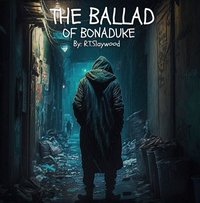
The Ballad of Bonaduke—Episode 20: Room 5 by R. T. Slaywood: Many, Many Things Happen and My Perseverance is Rewarded

The Ballad of BonadukeThe Ballad of Bonaduke—
Episode 20: Room 5

by R.T. Slaywood

DETAILS:
Series: The Ballad of Bonaduke, #19
Format: Kindle Vella Story
Read Date: March 17, 2023

The Story So Far…

A drunken Michael Bonaduke decides to use a grift (with maybe some sort of magic/magic-like “help”) to win on a scratch-off lottery ticket so he has money to buy more to drink. He pulls off whatever he did, gets his money and some booze and stumbles off into the darkness to drink himself into oblivion so he can start again the next day. He’s hit by dark memories (probably what’s driving him to the drinking) of fire, pleading, and screaming. There’s going to be a price to pay for his grift, and he’s trying to be ready.

Before then, he gets himself drunk and we get some of his tragic backstory. As he ponders this, he decides to use some of his ill-gotten-gains to buy more booze and walks into a liquor store robbery. He foils it in some sort of magical fashion, gets some more to drink, and heads off to the park to drink until he’s arrested (probably for the failed robbery). At least that’s his plan, but it gets interrupted by being hit by a car. He wakes up on some sort of short, metal bed and is unsure what’s going on. It turns out that some group is subjecting him to a test—if he passes, everything will be explained to him (and hopefully the reader, too). He passes—and is brought somewhere for answers, or maybe training, or maybe another test. Time will tell (or things are going to get really annoying). Answers aren’t quick to come—but the mysteries and questions keep piling up.

Things get hairy and Bonaduke leaves and finds himself back in the neighborhood he started from. Taking refuge in a homeless encampment, Bonaduke has to make some decisions. He starts to get his thoughts in order when the police begin a raid at the camp. During the raid, he’s apprehended by…well, we need to find out. But first, the interrogation starts.

What’s Room 5 About?

We pick up in the interrogation room Bonaduke was shoved into last time–with questions about the disaster in his home. Stalling for time–and maybe starting to scheme–Bonaduke asks to borrow some water. This gives him the opportunity to start using his grift to get him out of the building.

But that doesn’t go as well as expected, and some sort of supernatural combat ensues–and we get introduced to a very intriguing mystery that might prove to be the most important part of this story.

So, what did I think about Room 5?

The typos in this one really marred things. If you can’t get your protagonist’s name right (repeatedly)…maybe you need to take more time during the revision stage. There’s a word or two that I’m not sure was correct, either–but I wasn’t sure that something spelled much like them would work in context, either. Also, exactly what was going on with Bonaduke’s “grift” would be better–Slaywood clearly enjoys being coy with this–but it feels more obscure and vague than mysterious. But I can get over that.

Slaywood does some interesting things with whitespace in this one to build suspense. At the end of the day, his typing really made me conflicted.

This episode starts off slow, and I was thinking that even if we don’t get much happening, the interrogation is going to be interesting–and I was okay with that. And then…BOOM! Action flows like crazy. I’m not sure exactly what happened (see my last paragraph), but it kept me gripped. This is one of the longer episodes in the series and by far the best. I can’t wait to see what comes next (it’s been a while since I felt that way).


4 Stars

UPDATE: Mrs. Covington’s: A Cozy Fantasy Novel Kickstarter

Before this Kickstarter launched I assured you that you’d be hearing a lot about this book over the next few weeks–I might as well keep going now. Yesterday, the book hit the funding goal, and is a couple of hundred past it. So, congrats to K.R.R. Lockhaven!

Now, I’m no longer trying to encourage (read: pressure) you into supporting this book for the sake of Lockhaven and his fans (like me), at this point I’m telling you to help yourself. You want this book in your life and you’ve got 6 days to do it easily (and to help him hit a stretch goal or two to make the experience better for everyone).

Last week, I blogged my thoughts on the beta version of the novel and was joined by Lockhaven for a Q&A about the book and Kickstarter campaign. If you haven’t read those yet, I encourage you to do so. Also, in case you’re not familiar with the name, I’ve said plenty of good things about Lockhaven’s previous books, and you should read those–not so much because what I’ve said is all that worth reading, but so I can point you to those books.

For those who haven’t looked into it yet, here’s the skinny on the campaign:

Check out the video:

What do you know? I’ve been pronouncing the “o” in Covington wrong…anyway.

Look into the book and then pitch in to help Lockhaven put a better version of this out there in the world. I think you’ll be glad you did. I won’t be so bold as to suggest that the publication of Mrs. Covington’s will make the world a better place, but it will brighten the day of whoever reads it. So it’ll feel like the world is a better place for a while.

Go kick that start.

Mrs Covingtons Full Wrap Cover

BOOK SPOTLIGHT: The Thirteenth Hour by Trudie Skies

I’m very pleased today to welcome The Write Reads Blog Tour for Book One of The Cruel Gods series by Trudie Skies, The Thirteenth Hour. I’ve been hearing almost universally great things about this book since it was released (if not before), and it drives me crazy that I didn’t have time to read it for this Tour. Do yourself a favor and check out https://twitter.com/WriteReadsTours over the next few days to see a lot of bloggers write interesting things about it. The Thirteenth Hour was a finalist for the 2022 Book Blogger’s Novel of the Year Award, so you know there’s a lot of good to be said about it–but before getting to the spotlight for it, let’s start with a word about BBNYA.

BBNYA:

BBNYA is a yearly competition where book bloggers from all over the world read and score books written by indie authors, ending with 15 finalists and one overall winner. If you are an author and wish to learn more about the BBNYA competition, you can visit the official website http://www.bbnya.com or Twitter @bbnya_official. BBNYA is brought to you in association with the @Foliosociety (if you love beautiful books, you NEED to check out their website!) and the book blogger support group @The_WriteReads.

The Thirteenth Hour Tour Banner

Book Details:

Publisher: Self-Published
Genre: Fantasy, Gaslamp Fantasy, Steampunk
Age Category: Adult
Release date: October 13, 2021
Format: Hardcover/Paperback/Ebook/Audiobook
Length: 535 pages
The Thirteenth Hour

About the Book:

When the saints fail, the sinners step up.

Cruel gods rule the steam-powered city of Chime, demanding worship and tribute from their mortal subjects. Kayl lost her faith in them long ago, and now seeks to protect vulnerable and downtrodden mortals from their gods’ whims. But when Kayl discovers powers that she didn’t know she had—and destroys a mortal’s soul by accident—she becomes Chime’s most wanted.

Quen’s job was to pursue sinners, until the visions started. Haunted by foreboding images of his beloved city’s destruction, Quen hunts soul-sucking creatures made of aether who prey on its citizens—and Kayl is his number one target.

To ensure Chime’s future, Kayl and Quen must discover the truth of Kayl’s divine abilities before the gods take matters into their own hands.

For a city that bows to cruel gods, it’ll take godless heathens to save it.

Book Links:

Amazon.ca ~ Amazon US ~ Amazon UK ~ Goodreads

About the Authors:

Trudie SkiesTrudie Skies is a British indie author who has been living inside fantasy worlds ever since they discovered that reality doesn’t quite live up to the hype. Through the magic of books, they wish to share these worlds of hope and heroes with other weary souls. You can chat with Trudie on Twitter @TrudieSkies, or to find out more about Trudie and her fantasy worlds, visit www.TrudieSkies.com.

My thanks to The Write Reads for the invitation to participate in this tour and the materials they provided.

Grandpappy’s Corner: Red Stripes VS Miles the Mutant Mouse by Amy Rice and Kyson Rice: Not Your Typical Cat and Mouse Story

Grandpappy's Corner Logo

Red Stripes VS Miles the Mutant Mouse

by Amy Rice and Kyson Rice

DETAILS:
Publication Date: August 28, 2017
Format: Paperback
Length: 60 pgs.
Read Date: March 27, 2023

What’s Red Stripes VS Miles the Mutant Mouse About?

Red Stripes is your typical pet cat who spends his time playing with his human, Kyson. Unless disaster strikes—then he has to disappear (not unlike a certain Agent P) to help out, he’s secretly the superhero, Red Stripes the Super Wonder Cat!

In this particular adventure, a perfectly nice mouse was exposed to some toxic chemicals and mutated into a large and very hungry hulk of a mouse. Seeking food, he inadvertently creates a path of destruction, wreaking havoc on businesses, homes, and the city. Can Red Stripes stop him in time?

Let’s Talk about the Art for a Minute

As Amy Rice described it to me, while she did the art—Kyson directed it—changing colors and providing input on the overall look. A good team approach that is probably reflected in the text, too.

The designs and looks for Red Stripes and Mutant Mouse are great—I particularly like the mouse. Some of the objects—and (I’m sorry to say) all of the people are a little on the iffy side. But overall, it’s an attractive, vibrant, and playful book with a lot of energy to the art. It fits the story and the writing—and probably only older readers like me will nitpick the art (and really, I’m only nitpicking, not complaining).

So, what did I think about Red Stripes VS Miles the Mutant Mouse?

This is a cute little story, really. What I really admire about this is that the Rices worked on this together and accomplished something at Kyson’s pretty young age (I believe 5 at the time of writing).

I think younger readers will respond to the idea that a kid wrote this—it reads like the kind of thing a kid would make up, too—so it’ll probably hit the reader right in the sweet spot. Who knows, it might inspire a reader to try something like it themselves.

I don’t know that older readers will respond too well to the writing or the story—but that’s okay. We can get wrapped up in the story behind the book, that’s enough for us—we’re not the audience. And while I might not have loved this book on an aesthetic level, I did get a kick out of it and found myself smiling a good deal while reading it.

I admire Kyson’s mom for seeing this through—and the patience that both of them must’ve had to exercise along the way—and recommend a parent pick it up just to show a child what’s possible when they stick to a goal. The fact that they’ll be entertained by the art and story is a great bonus.


3 Stars

Grandpappy IconLiterary Locals logo

Page 70 of 342

Powered by WordPress & Theme by Anders Norén