Category: Urban Fantasy Page 20 of 44

20 Books of Summer 2021: Wrap Up

20 Books of Summer
One summer.

Three months.

93 Days.

20 books.


I really didn’t think I’d get it done on time after seeing where I was in July. But here I am with almost 27 hours to go and I’ve finished the 20 Books for Summer Challenge for 2021. After a June that was less-than-productive (well, okay, I read nothing), and a July that got me less than halfway home, I expected I was going to have to fudge things like last year by going with Labor Day as a cutoff. But nope, I pulled off an according-to-Hoyle completion.

20 books down, cleared off a lot from my Mt. TBR (including things I bought in 2018!), not a stinker in the bunch (two of them flirted with it, though)—and a nice, warm sense of accomplishment to boot. Now, that’s books read, not posted about. I guess that’s my challenge for September, I think I have ten of them done, however, so it’s not that daunting.

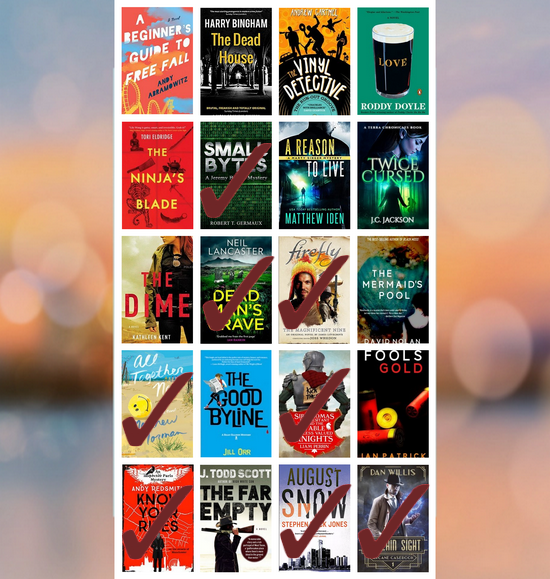
Here’s the list:

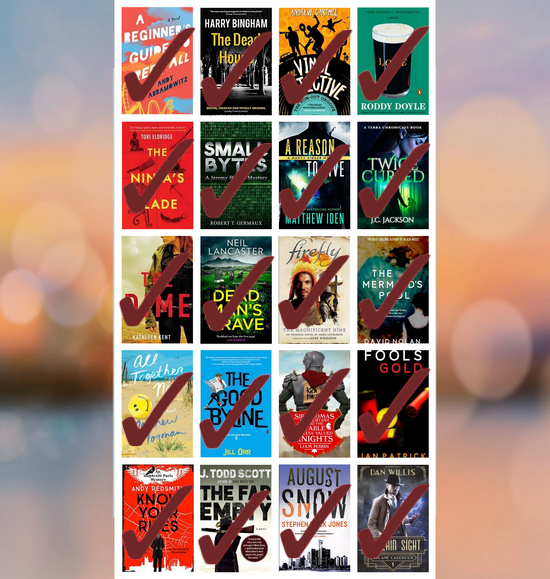
✔ 1. A Beginner’s Guide to Free Fall by Andy Abramowitz
✔ 2. The Dead House by Harry Bingham
✔ 3. The Run-Out Groove by Andrew Cartmel
✔ 4. Love by Roddy Doyle
✔ 5. The Ninja’s Blade by Tori Eldridge
✔ 6. Small Bytes by Robert Germaux
✔ 7. A Reason to Live by Matthew Iden
✔ 8. Twice Cursed by J. C. Jackson
✔ 9. The Dime by Kathleen Kent
✔ 10. Dead Man’s Grave by Neil Lancaster
✔ 11. The Magnificent Nine by James Lovegrove
✔ 12. The Mermaid’s Pool by David Nolan
✔ 13. All Together Now by Matthew Norman
✔ 14. The Good Byline by Jill Orr
✔ 15. Sir Thomas the Hesitant and the Table of Less Valued Knights by Liam Perrin
✔ 16. Fools Gold by Ian Patrick
✔ 17. Know Your Rites by Andy Redsmith
✔ 18. The Far Empty by J. Todd Scott
✔ 19. August Snow by Stephen Mack Jones
✔ 20. In Plain Sight by Dan Willis

20 Books of Summer '21 Chart August

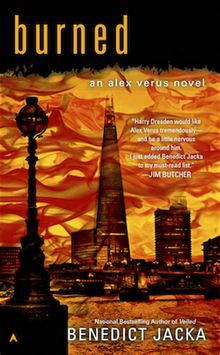
Quote of the Moment: from Burned by Benedict Jacka

I’m not sure why, but since I listened to these paragraphs last week, I’ve come back to them a few times. Sure, Gildart Jackson’s narration was part of it, but I just really liked this. We tend to focus on plot, magic systems, characters, and whatnot–but it’s the little moments like this that really make a book stand out. They don’t advance the plot, they don’t really reveal a lot about the narrator, but they shed a little light–adding flavor to someone we know.

from:

Burned
Burned

by Benedict Jacka
Most people in the world don’t travel much. In a lot of cases, it’s because they just don’t want to. Either they don’t have any real interest in seeing other places, or they’re too occupied with the life they’re living already. But for a lot of people, it’s not a case of not wanting to, it’s that they can’t—either they don’t have the time or the money, or there’s something actively preventing them from leaving. When you’re in that second group, you usually have fantasies about getting to travel and see the world, visiting different cultures and having new experiences. There are people who spend their whole lives dreaming about journeys overseas.

So it’s really kind of sad that once you finally do get to spend a lot of time travelling, you tend not to appreciate it very much. Take me, for instance. I’ve visited more countries of the world than I can easily remember. I’ve even visited places not in this world, from bubble realms to shadow realms to the dreamscapes of Elsewhere. I’ve stood upon the tops of towers and looked out over castles the size of cities, walked through ancient forests where the trees have passed hundreds of years without hearing a human footstep, seen impossible alien landscapes that could never exist on Earth. Unfortunately, in pretty much every one of those cases, I’ve generally had more pressing concerns to worry about either there are people trying to kill me, or people who might want to kill me, or things that aren’t people that might want to kill me, or people or things that don’t necessarily want to kill me but nevertheless are important enough that it’s highly advisable for me to pay attention to them instead of spending my time sightseeing. Usually the place I’m visiting becomes a blur, a few brief images standing out in my memory while I spend my time dealing with various threats and problems. And by the time they’re all sorted out, it’s time to move on.

Twice Cursed by J. C. Jackson: It’s Time to Bring Werewolves into this World

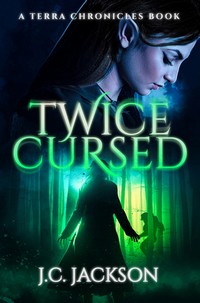
Twice Cursed

Twice Cursed

by J. C. Jackson
Series: Terra Chronicles, #3

Paperback, 241pg.
Shadow Phoenix Publishing, 2018

Read: August 5, 2021
Grab a copy from your local indie bookstore!


Since it’s been awhile (too long) since I posted about this series, I thought it’d be a good idea to copy a bit of the introduction to this series I posted back in 2018 (slightly edited):

I had a brief conversation a couple of weeks ago with J.C. Jackson and she described the book as “Science Fantasy” and told us a little about the series. Something about fantasy characters but with modern technology, but phrased better. Not really getting what she said, I asked why not just call it Urban Fantasy, and she gave a decent answer—basically that she didn’t have enough vampires or werewolves in the books so readers told her she couldn’t. I was a chapter or two into the book when I figured out what she was saying.

In your mainstream Urban Fantasy, you have fantasy creatures—wizards, druids, werewolves, fae—popping up in our world. On the other end of the spectrum (or an other end, anyway) you have things like the Eddie LaCrosse novels or the Dragon Precinct books that have modern ideas (police squads, private investigators) used in a fantasy series. Jackson takes a different tack—it’s a typical fantasy novel in that there’s a lot of magic, elves, halflings, Dark Elves, etc. living next to humans—very standard kind of thing, but their technology matches ours (actually, it’s slightly more advanced). I loved this approach and there’s a good chance that I’d have had nice things to say about the book just because of this idea.

What’s Twice Cursed About?

Ketayl and her Paladin partner, Silver, are sent off to do fieldwork, bringing along another lab tech to look into a rash of werewolf deaths in the territory of the Alpha Prime’s pack (he’s sort of like the Marrock of this world). The local Terran Intelligence Organization office is primarily full of recent graduates from the Academy, most still learning the ropes—they’re not up for dealing with both the investigation and dealing with the Alpha. So, instead, they throw Ketayl into leading her first team because of her investigative abilities and to get her to grow into leadership.

She interacts better with the pack than anyone (except maybe her boss) expected—certainly better than she assumed. She and Silver quickly decide that this is another example of the rise in Necromancy that they’ve been chasing.

Through a combination of good procedure and being in the right place at the precisely right time (or wrong place/wrong time, depending on their perspective), they make great strides in the investigation—even if it essentially puts multiple lives on the line. Through it Ketayl gets a crash course in juggling personalities, abilities and unprepared-for team members.

A Gripe Resolved

Something that bugged me through a lot of the first book, and that really got on my nerves in the second book was (to cite that post) that most characters treat Ketayl “with the kind of care usually reserved for glass on the verge of shattering, they only tell her as much of the truth as they want—all the while, wanting the benefit of her intelligence, abilities, and magic. It feels condescending and manipulative. And for that to be the way those closest to her to treat her? I can’t stomach it.” There were characters throughout that didn’t treat her that way, but they were the distinct minority.

None of them were around this time—only those who saw her strength, who believed in her when she didn’t really believe in herself (which is still going on ), and those who didn’t have preconceived notions about her. Despite herself, she responded to that kind of confidence well and is able to rise to the occasion.

I do wonder what it’ll be like when they spend more time around some of those other characters—will they see the growth in her?

A Quibble Exasperated

I do have another quibble with the series—Jackson has two story arcs that she appears to be taking a “slow burn” approach to. I’m all for that, but while she’s letting the development of those arcs build deliberately—she’s telegraphed where they’re both going in a way that takes away the deliberate, careful way she’s going about it.

It’s hard to talk about that without getting into plot specifics, but hopefully, that paragraph makes sense.

Now, that’s a quibble—not a full-on gripe or criticism. It’s a thought I have every so often while reading (and when writing about it), but I shrug it off and move on with a fun read.

So, what did I think about Twice Cursed?

I really dug it. The Alpha and his crew were a lot of fun (I hope we get to see them in a book or two). Ketayl’s growth was great—both in leadership and social interaction, but she has a few places where she’s able to flex the magic muscle that she’s long kept under wraps, and…yeah—I really loved those scenes.

I’ve been kicking myself for getting behind on this series—I had this and the next book on my shelf for years untouched—and I’m so glad I got back into this world and with these characters. The mix of tech and Fantasy, and characters you can’t help but want to befriend makes for a fun time. I’ll be back for more soon.

(Over the weekend, I bought the next two books, so even after reading this, I’m more behind).


3.5 Stars

20 Books of Summer '21

This post contains an affiliate link. If you purchase from it, I will get a small commission at no additional cost to you. As always, opinions are my own.

PUB DAY REPOST: Paper & Blood by Kevin Hearne: Like the Spanish Inquisition, Nobody Expects a Turtle Dragon Spider.

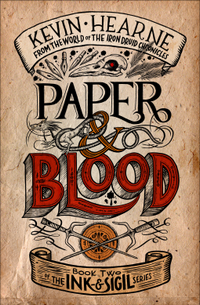
Paper & Blood

Paper & Blood

by Kevin Hearne
Series: Ink & Sigil, #2

eARC, 304 pg.
Del Rey Books, 2021

Read: July 31-August 3, 2021
Grab a copy from your local indie bookstore!

What’s Paper & Blood About?

Al MacBharrais gets a message from an apprentice Sigil Agent—her teacher went to investigate an oddity in Australia and didn’t return—a nearby Agent went looking for her and hasn’t returned either. She’s (rightly) worried and needs help. She’s close to taking her exams, but she’s not at the point she’d need to be to take on whatever it was that seems to have captured—or killed—two veteran Agents.

Al and the hobgoblin in his service, Buck Foi, hitch a ride with a Fae to deliver them to Melbourne. Al also asks if a message can be delivered to the Iron Druid, Atticus O’Sullivan (now going by the alias Connor Molloy). If whatever this is has proved too much for two Sigil Agents, he knows that he and the apprentice are going to need all the help they can get.

Connor and his two dogs—Oberon (it’s been too long since I got to spend time with him, even if we only get a little bit of his speech) and Starbuck—join Al, Buck, and Ya-ping (Shu-hua’s apprentice) and they head to a hiking trail that was the last known location to find hikers screaming and fleeing from some sort of monster. There are injuries and casualties—and a monster unlike anything they’ve seen and/or read about. It’s not long before they decide that this monster is likely just the first thing they’ll have to deal with to find the Agents—and it’s probably going to get much more dangerous. Eventually, Nadia—the manager of Al’s print shop and battle seer—joins in the search when she starts getting visions of the danger they’re headed toward.

The Iron Druid Chronicles Postscript

This series is a spin-off of the Iron Druid Chronicles and functions very well in that way. But it frequently felt like Connor/Atticus was about to take over the focus of this book—just with Al’s narration rather than Connor’s first-person. That never happened, I just wondered a few times if it would.

At the same time, Paper & Blood served as a sequel to Scourged, or maybe it’d be more accurate to say that it was a belated epilogue to it. The more time that goes by the less satisfied I’ve become with the conclusion of Scourged and where it left Atticus and Oberon. This is the ending they needed, and even if I didn’t think Al, Buck, etc. were fully entertaining on their own, I’d be glad I read this for the Connor material.

I do hope that he can drop into this series from time to time, still—I’m not ready to say goodbye forever. But if I have to, this is the note I want to go out with.

Secondary Characters

In addition to those I mentioned above, there’s a local police officer, a couple of familiar faces from the Iron Druid Chronicles, and the return of someone from Ink & Sigil—it’s tough to describe without ruining the effect Hearne’s going for. But let me just say that something that I thought was a throwaway line in that book comes back and means so, so much more than I could’ve guessed (am pretty sure Al would say the same). Hearne is able to take these characters—new and established—and make you care about what they’re facing in no time flat. I’ve always been impressed in his skill in that and, if anything, he’s getting better at it than he was when Hounded first came out.

And, the monsters, too. I guess I should talk about them—Hearne let his very fertile imagination go crazy with these strange hybrid creatures (like the Turtle Dragon Spider that I mention in the headline)—it was great to see in action, and horrible to imagine.

Paper and Ink

Along the way, Al gives lessons about/tributes to the making and uses of both paper and ink in his narration. These little vignettes are just golden. They cement Al’s calling as a Sigil Agent—one who deals in ink and paper as their stock in magical trade—and capture the romance of these things that readers depend on just as much as the Agents do. Even in our world, these things are used to make magic and I appreciate Hearne reminding us of that.

So, what did I think about Paper & Blood?

There’s just so much to like about this book that it’s hard to know where to start. There’s the Glaswegian dialect that, like Ink & Sigil, the narration is written in (or at least a flavor of it)—Hearne gives us a nice Author’s Note describing it, too.

Next, I’d talk about the perspective that an elderly protagonist is able to approach things in—he has wisdom and experience that your typical UF narrator doesn’t. Something in the way that MacBharrais and the rest are able to use to defeat the final monster that gives him an idea about how to combat his curse—I’m assuming we’ll get to see it in action soon (I’m not sure how long Hearne plans this series, but I’m pretty sure it’s about over as soon as Al takes care of the curse). I don’t know if it’ll work or not, but I like that Hearne seems to be finding a way to resolve things that doesn’t fit the typical UF mold. Just the fact that Al is able to start making this plan says a lot about him. I should really spend a couple of paragraphs talking about what makes Al unique, but I don’t have the time.

There’s also all the fun of the supporting characters and what they bring to the story—again, something I should spend more time on, but I’d end up spoiling something—but while there’s nothing wrong with the main plot (killing monsters and trying to find the Agents), it’s these secondary characters and plots that make this so much fun.

There’s really just so much to commend about this book that I can’t list it, so I’ll just say that this is a must-read for anyone who enjoyed Ink & Sigil to any degree—this shows what Hearne can do in this world now that it’s established—and/or IDC. I don’t know that this is the best jumping on point—but if you do, you’re not going to regret it (your life would just be easier if you read the first book before this, though).

Hearne’s one of the best around, and this just cements this—go pick up Paper & Blood now.


4 Stars

Disclaimer: I received this eARC from Random House Publishing Group – Ballantine via NetGalley in exchange for this post—thanks to both for this.

This post contains an affiliate link. If you purchase from it, I will get a small commission at no additional cost to you. As always, opinions are my own.


Paper & Blood by Kevin Hearne: Like the Spanish Inquisition, Nobody Expects a Turtle Dragon Spider.

Paper & Blood

Paper & Blood

by Kevin Hearne
Series: Ink & Sigil, #2

eARC, 304 pg.
Del Rey Books, 2021

Read: July 31-August 3, 2021
Grab a copy from your local indie bookstore!

What’s Paper & Blood About?

Al MacBharrais gets a message from an apprentice Sigil Agent—her teacher went to investigate an oddity in Australia and didn’t return—a nearby Agent went looking for her and hasn’t returned either. She’s (rightly) worried and needs help. She’s close to taking her exams, but she’s not at the point she’d need to be to take on whatever it was that seems to have captured—or killed—two veteran Agents.

Al and the hobgoblin in his service, Buck Foi, hitch a ride with a Fae to deliver them to Melbourne. Al also asks if a message can be delivered to the Iron Druid, Atticus O’Sullivan (now going by the alias Connor Molloy). If whatever this is has proved too much for two Sigil Agents, he knows that he and the apprentice are going to need all the help they can get.

Connor and his two dogs—Oberon (it’s been too long since I got to spend time with him, even if we only get a little bit of his speech) and Starbuck—join Al, Buck, and Ya-ping (Shu-hua’s apprentice) and they head to a hiking trail that was the last known location to find hikers screaming and fleeing from some sort of monster. There are injuries and casualties—and a monster unlike anything they’ve seen and/or read about. It’s not long before they decide that this monster is likely just the first thing they’ll have to deal with to find the Agents—and it’s probably going to get much more dangerous. Eventually, Nadia—the manager of Al’s print shop and battle seer—joins in the search when she starts getting visions of the danger they’re headed toward.

The Iron Druid Chronicles Postscript

This series is a spin-off of the Iron Druid Chronicles and functions very well in that way. But it frequently felt like Connor/Atticus was about to take over the focus of this book—just with Al’s narration rather than Connor’s first-person. That never happened, I just wondered a few times if it would.

At the same time, Paper & Blood served as a sequel to Scourged, or maybe it’d be more accurate to say that it was a belated epilogue to it. The more time that goes by the less satisfied I’ve become with the conclusion of Scourged and where it left Atticus and Oberon. This is the ending they needed, and even if I didn’t think Al, Buck, etc. were fully entertaining on their own, I’d be glad I read this for the Connor material.

I do hope that he can drop into this series from time to time, still—I’m not ready to say goodbye forever. But if I have to, this is the note I want to go out with.

Secondary Characters

In addition to those I mentioned above, there’s a local police officer, a couple of familiar faces from the Iron Druid Chronicles, and the return of someone from Ink & Sigil—it’s tough to describe without ruining the effect Hearne’s going for. But let me just say that something that I thought was a throwaway line in that book comes back and means so, so much more than I could’ve guessed (am pretty sure Al would say the same). Hearne is able to take these characters—new and established—and make you care about what they’re facing in no time flat. I’ve always been impressed in his skill in that and, if anything, he’s getting better at it than he was when Hounded first came out.

And, the monsters, too. I guess I should talk about them—Hearne let his very fertile imagination go crazy with these strange hybrid creatures (like the Turtle Dragon Spider that I mention in the headline)—it was great to see in action, and horrible to imagine.

Paper and Ink

Along the way, Al gives lessons about/tributes to the making and uses of both paper and ink in his narration. These little vignettes are just golden. They cement Al’s calling as a Sigil Agent—one who deals in ink and paper as their stock in magical trade—and capture the romance of these things that readers depend on just as much as the Agents do. Even in our world, these things are used to make magic and I appreciate Hearne reminding us of that.

So, what did I think about Paper & Blood?

There’s just so much to like about this book that it’s hard to know where to start. There’s the Glaswegian dialect that, like Ink & Sigil, the narration is written in (or at least a flavor of it)—Hearne gives us a nice Author’s Note describing it, too.

Next, I’d talk about the perspective that an elderly protagonist is able to approach things in—he has wisdom and experience that your typical UF narrator doesn’t. Something in the way that MacBharrais and the rest are able to use to defeat the final monster that gives him an idea about how to combat his curse—I’m assuming we’ll get to see it in action soon (I’m not sure how long Hearne plans this series, but I’m pretty sure it’s about over as soon as Al takes care of the curse). I don’t know if it’ll work or not, but I like that Hearne seems to be finding a way to resolve things that doesn’t fit the typical UF mold. Just the fact that Al is able to start making this plan says a lot about him. I should really spend a couple of paragraphs talking about what makes Al unique, but I don’t have the time.

There’s also all the fun of the supporting characters and what they bring to the story—again, something I should spend more time on, but I’d end up spoiling something—but while there’s nothing wrong with the main plot (killing monsters and trying to find the Agents), it’s these secondary characters and plots that make this so much fun.

There’s really just so much to commend about this book that I can’t list it, so I’ll just say that this is a must-read for anyone who enjoyed Ink & Sigil to any degree—this shows what Hearne can do in this world now that it’s established—and/or IDC. I don’t know that this is the best jumping on point—but if you do, you’re not going to regret it (your life would just be easier if you read the first book before this, though).

Hearne’s one of the best around, and this just cements this—go pick up Paper & Blood now.


4 Stars

Disclaimer: I received this eARC from Random House Publishing Group – Ballantine via NetGalley in exchange for this post—thanks to both for this.

This post contains an affiliate link. If you purchase from it, I will get a small commission at no additional cost to you. As always, opinions are my own.

20 Books of Summer 2021: July Check-in

20 Books of Summer
One summer.

Three months.

93 Days.

20 books.


It’s time for my July Check-In for 20 Books for Summer. After a June that was less-than-productive (well, okay, I read nothing), it didn’t look so good.

I’m still not sure it does—July was better, I read eight books off the list. I thought I’d read more until I started prepping this post, though—math’s never been my strong suit. Twelve books in August still seems doable, but I’m thinking this goal is out of range. Still, I’m going to try, I’m having fun working through the list, anyway.

Speaking of which, here it is:

1. A Beginner’s Guide to Free Fall by Andy Abramowitz
2. The Dead House by Harry Bingham
3. The Run-Out Groove by Andrew Cartmel
4. Love by Roddy Doyle
5. The Ninja’s Blade by Tori Eldridge
✔ 6. Small Bytes by Robert Germaux
7. A Reason to Live by Matthew Iden
8. Twiced Cursed by J. C. Jackson
9. The Dime by Kathleen Kent
✔ 10. Dead Man’s Grave by Neil Lancaster
✔ 11. The Magnificent Nine by James Lovegrove
12. The Mermaid’s Pool by David Nolan
✔ 13. All Together Now by Matthew Norman
14. The Good Byline by Jill Orr
✔ 15. Sir Thomas the Hesitant and the Table of Less Valued Knights by Liam Perrin
16. Fools Gold by Ian Patrick
✔ 17. Know Your Rites by Andy Redsmith
18. The Far Empty by J. Todd Scott
✔ 19. August Snow by Stephen Mack Jones
✔ 20. In Plain Sight by Dan Willis

20 Books of Summer '21 Chart July

Catch-Up Quick Takes: Nowhere To Run; Sworn to Silence; Three Mages and a Margarita

The point of these quick takes posts is to catch up on my “To Write About” stack—emphasizing pithiness, not thoroughness. This time we’re looking at some recent Aduiobooks I got from the Library.


Nowhere To Run

Nowhere To Run

C. J. Box, David Chandler (Narrator)
Series: Joe Pickett,, #10
Unabridged Audiobook, 10 hrs., 13 min.
Recorded Books, 2010
Read: June 4-7, 2021
Grab a copy from your local indie bookstore!

(the official blurb)
Joe vs. a couple of hard-core survivalists and possibly breaking a missing-persons case that’s been dormant for years. It’s a great set-up—Joe stumbles onto these survivalists poaching and in the end, becomes hunted by them. He escapes, barely, but no one else can find them. So Joe and Nate gear up to go hunting for them on their own—if for no other reason, than to prove that Joe isn’t making the whole thing up.

At a certain point, don’t Wyoming Law Enforcement Officers need to start giving Joe the benefit of the doubt? Maybe believe his hunches, theories—at the very least give credence to the things he says he’s actually seen and done? Sure, there’s the petty rivalries, and I get where the local sheriff can’t give Pickett any credit. But surely everyone else can—he’s got a pretty solid track record.

It was a decent read, with some good tension, some good character moments. I’m not blown away by any of it, but I enjoyed it and am eager to see what’s next. I’m not sure I like how the Picketts are dealing with April, but there’s time to turn it around.
3 Stars

Sworn to Silence

Sworn to Silence

by Linda Castillo, Kathleen McInerney (Narrator)
Series: Kate Burkholder, #1
Unabridged Audiobook, 11 hrs., 45 min.
Macmillan Audio, 2009
Read: April 20-23, 2021
Grab a copy from your local indie bookstore!

(the official blurb)
When she was a teenager, Kate Burkholder left her Amish family and faith. Not long after that, she began a career in the Columbus, Ohio Police Department. Now she’s been brought back to her hometown as Police Chief—she brings the ability to understand the language and culture of the Amish as well as the background in law enforcement among “the English.”

Then a victim of a grisly murder is found. And then another. There are similarities between these and murders that occurred in the area before Kate left home. Public pressure is mounting for a quick solution and city leaders bring in a State Investigator to “help” Kate out.

This was a solid read—with maybe a touch of melodrama here and there. I enjoyed this and see a lot of potential in the setting as this series continues.
3 Stars

Three Mages and a Margarita

Three Mages and a Margarita

by Annette Marie, Cris Dukehart (Narrator)
Series: The Guild Codex: Spellbound, #1
Unabridged Audiobook, 7 hrs. 14 min.
Tantor Audio, 2018
Read: May 21-22, 2021
Grab a copy from your local indie bookstore!

(the official blurb)
This was a lighter Urban Fantasy, like the Ella Grey books. Tori’s a waitress who can’t keep a job—she has this annoying tendency to stick up for herself when a customer gets out of line. Desperate for work, she finds a Help Wanted ad in the street. They’re looking for a bartender at a social club in a less-than-nice part of town. She shows up, gets a try out and does well.

But there’s one little thing—the social club is actually a guild of magic users. Yeah, that’s right, magic is a thing, and the guild is made up of a variety of specialists. Some of them have taken a liking to her and she’s hired on as the regular bartender. Tori strikes up a friendship with three mages in particular—and the four of them stumble into something big and dangerous.

This was fun, the dialogue moved well, the interplay between Tori and the three was great, and I can see this lasting quite a while. Looking forward to coming back for more.

3 Stars

2021 Library Love Challenge 2021 Audiobook Challenge

This post contains affiliate links. If you purchase from any of them, I will get a small commission at no additional cost to you. As always, opinions are my own.

The Irresponsible Reader On…Self-Published Urban Fantasy

Self-Published Authors Appreciation Week

From the first moment that people did the strange thing of asking me to talk about their books on my blog, I’ve been impressed by the quality of a lot of what’s been published by authors going out on their own, taking all the risks, shouldering all the responsibility and doing all the work to get their words, their dreams, their blood, sweat, and tears. This should be celebrated—it’s definitely appreciated, as we’re trying to show this week.

I haven’t had time to read anything new for Self-Published Authors Appreciation Week, and therefore don’t have anything new to blog about, so I’m going to highlight some of the self-published works that I’ve blogged about over the last few years—just a sentence or two. Hopefully enough to make you click on the link to the full post. Beyond that, it’d be great if I inspired you to add a few of these to your TBR. Also, be sure you check out the other posts over at the SPAAW Hub.

Today we’re going to be looking at Self-Published Urban Fantasy. For a genre that gets as much of my attention as this one does, I’m surprised that this list is as short as it is—feel free to fill the comments with recommendations. But what’s on this list is really good.

bullet Hostile Takeover by Cristelle Comby—a P.I. who is the emissary of Hades’ daughter on Earth investigates some mysterious deaths. (my post about it)
bullet Bad Little Girls Die Horrible Deaths and Other Tales of Dark Fantasy by Harry Connolly—a collection of short stories that I still think about. (my post about it)
bullet Twenty Palaces by Harry Connolly—I loved this UF series, but sadly was one of the few who read it. After the publisher declined to keep going with it Connolly has published a prequel and a sequel–with more on the way.
bullet Twenty Palaces—the prequel to the whole thing (my post about it)
bullet The Twisted Path (my post about it)
bullet Mostly Human by D. I. Jolly—one of the biggest rock stars in the world happens to be a werewolf. A little comedy, a lot of action.
bullet Mostly Human (my post about it)
bullet Mostly Human 2 (my post about it)
bullet In Plain Sight by Dan Willis—I just started this series set in the 1930s about a P.I. who practices rune magic and I’m eager to keep going with it. (my post about it)


If you’re a self-published author that I’ve featured on this blog and I didn’t mention you in this post and should have. I’m sorry (unless you’re this guy). Please drop me a line, and I’ll fix this. I want to keep this regularly updated so I keep talking about Self-Published Authors.

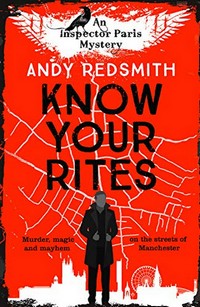
Know Your Rites by Andy Redsmith: Murder, magic and now rap music. Oh joy.

Know Your Rites

Know Your Rites

by Andy Redsmith
Series: Inspector Paris Mystery, #2

Kindle Edition, 313 pg.
Canelo, 2019

Read: July 7-9, 2021

With his “street” clothes and silly trimmed beard, Dirk remained the most bizarre magical dwarf the inspector had ever seen. Although he was acutely aware of how stupid that sounded.

What’s Know Your Rites About?

It’s been a couple of weeks since DI Nick Paris led the efforts to stop the demon invasion from the magical world—something celebrated on both sides of the portal, with parties, accolades from officials, TV interviews, etc. Now he just wants to get back home to Manchester and investigate some crimes involving humans–no elves, dwarves, talking animals, just people. It won’t be easy, but he really wants to put the whole magical world in his rearview mirror.

He’s called to the scene of a murder—a music producer has been killed in his home, and there’s a suspect in custody. There’s a catch—the suspect is a dwarf who’s in the non-magical world so he can pursue his dream of being a major rap star.

Dirk’s a pretty ridiculous character, but it’s hard not to root for him. You have a hard time believing he committed the crime and how do you not root for a guy who had to leave his own world to follow his passion? (the fact that he doesn’t appear to have a lot of talent, makes him more tragic).

There’s a lot of pressure on Paris to wrap this up quickly—the non-magical authorities are not wanting to publicize the fact that a human was killed by someone from the other side. Those on the magical side are wanting to negotiate trade pacts with the humans, and don’t want anything derailing that. Still, there’s something wrong with the case against Dirk, and Paris learns it quickly. But it’s clear that a “magical being” was the culprit. So the team from last time gets back together and crosses over to find their murderer.

We spend the bulk of this novel on the other side of the portal, getting a better understanding of the world and how it operates—including how the police department, postal service, and tourist travel work. We also get to meet several other magical creatures, and Redsmith’s take on them continues to be a winner.

For example…

Paris and the rest need to cover a lot of ground quickly, so Tergil hires some Lamassu to handle the transportation. What’s a lamassu? I’m glad you asked:

They were flying cows. Or, more precisely, flying bulls. Each had a bull’s body, with lion’s legs, huge wings attached to their shoulders, and a human head. A man’s head with striking noble features, a long yet neatly cut beard, and wearing a silver helmet. A silver jockey’s helmet.

And, for reasons that make a certain kind of sense, they have Australian accents.

I’m telling you, reading the passages about them justifies the purchase price. The rest of the book is icing on the bull-shaped cake.

The Humor: The Crux of the Matter

Paris frowned at her. ‘What?’ he said. ‘How did somebody called Ug Og end up with the middle name Serendipity?’

‘I don’t know,’ said the ogress. ‘It just sort of happened.’

She turned towards the inspector, baring her misshapen teeth in an attempt at a grin.

In Breaking the Lore Redsmith really swung for the fences to establish the series, but it felt like he dialed things back a touch. Which is not to say it’s bad, it’s just not as funny. I think the puns have really dropped off. I also think that Redsmith tries to squeeze more out of the “dwarf who can’t rap with ambitions to be the next Eminem” than is there. But it’s a ludicrous notion, so it’s hard to blame him for going back to it as much as possible.

In the first book, he established a strange, fantastic and ridiculous world (two of them, technically). Now he gets to play in it—he doesn’t have to try as hard, he can just play it straight and let the settings and characters bring the funny to the story just by being the way they are. I’m actually glad that he toned it down a bit. (just a bit—it was frequently chuckle-inducing, I’m not saying the humor is gone)

So, what did I think about Know Your Rites?

I was a little worried about returning to this so long after I read the first book in the series, and I shouldn’t have been, it took no time at all to remember the characters and situation. It’s just as enjoyable this time as it was last time.

There’s a straightforward crime story at the core of this, wrapped in Fantasy garb, enclosed in comedy. I like these characters, I want to spend more time with them, and I hope that there are more books to come. In the meantime, take some time to dive into this series.


3.5 Stars

20 Books of Summer '21

In Plain Sight by Dan Willis: A P.I. with a Magical Edge Races the Clock in this UF Series Start

In Plain Sight

In Plain Sight

by Dan Willis
Series: Arcane Casebook, #1

Kindle Edition, 311 pg.
2018

Read: July 1-5, 2021

What’s In Plain Sight About?

Alex Lockerby is a P.I. in the late 1930’s New York. He occasionally consults with the police, but most of them don’t respect him. Generally, he’s taking small-time jobs (lost pets, etc.) to make ends meet—and it’s largely because his gorgeous secretary finds those jobs for him.

Oh, Alex is a Runewright—by drawing elaborate designs in a (generally) special ink and then setting the drawing on fire he activates various things—finding charms, disguises, a way to look at the past of a room/item, healing, etc.

His ability doesn’t necessarily mean riches aplenty or fame—it means that he has an edge in certain circumstances, but that’s it.

In this novel, Alex is dealing with three cases—a distraught young woman hires him to look for a missing brother. A case he consulted on for the police didn’t go the way he said it would, and he has only three days to fix the problem or he’ll be charged with something and his friend on the force will be unemployed. And, a local church’s soup kitchen—volunteers, priests, nuns, and those being fed–are killed by an impossibly fast-moving disease, and Alex (with the guidance of his medical doctor mentor) needs to track down the source of the disease.

The clock is ticking to deal with all three of these—also in the mix are the NYPD, the FBI, a powerful sorcerer, and an ages-old secret that threatens to destabilize the magic world.

Magic System

There are, we’re told, three types of magic users in this world: Alchemists, Sorcerers, and Runewrights. We don’t get to see a lot of Alchemy (but we hear a little about it). We see enough of Sorcery to get a pretty good idea what it’s like. But the star of the show is the use of and making of Runes.

Willis’s version of Runes are similar to Hearne’s Sigils, but it’s only similar (various wizards, witches, and other magic users from various UF series are more similar than these, though).

I liked the way that all three versions of magic are used, and interweave with each other. Also, while various magic users aren’t necessarily esteemed (Alex is dismissively called “scribbler”, for example), they’re all out in the open, selling their services, both on small scales and large scales.

We need more UF where the magic is out in the open—all the various series with a dozen different ways that the magic (and so on) is hidden from the general populace is getting tired. Magic being an everyday thing, something commercial…I like seeing that.

1930’s P.I.

We’re supposed to get a hard-boiled P.I.-feel from Alex here. Philip Marlowe with magic, kind of a thing. It’s close, but it feels sanitized. Safe. Really, Alex Lockerby is more Dixon Hill than Marlowe or Sam Spade.

I’m not saying I didn’t like the idea or the execution—I enjoyed it. It just felt tame.

So, what did I think about In Plain Sight?

This was fun—inventive, cleverly told, and a premise/magic system that is a breath of fresh air.

I appreciated Willis’ voice and style—I do wish he’d made things a bit more nuanced, a bit harder to figure out (although there is a reveal late in the book that took me by surprise), but it’s the first book—a setup for the series as a whole, and that’s not easy to do.

There’s a lot of charm to the writing and the characters, I can easily see this series becoming a favorite, until then, this was a fun way to spend a couple of hours, and the rest of the series looks to be the same. I’m looking forward to diving into the rest, and suspect you would be as entertained as I was.


3 Stars

20 Books of Summer '21

Page 20 of 44

Powered by WordPress & Theme by Anders Norén