Category: Urban Fantasy Page 41 of 46

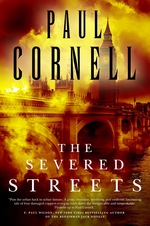
The Severed Streets by Paul Cornell (Updated)

Update: A representative of Audible.com, emailed me to ask if I’d like to post a clip from the audio book with this review. Sounded like a good idea to me (no pun intended). The sample’s at the bottom of this post, give it a listen.

The Severed StreetsThe Severed Streets

by Paul Cornell

Hardcover, 416 pg.
Tor Books, 2014
Read: June 11 – 14, 2014

This Cornell guy can write.

I’m tempted to let that be all I say about this book. Won’t be (because I can’t help myself), but it’s tempting. The other thing I’m tempted to do is copy and paste the first three paragraphs of my London Falling review to start this one — I am a little annoyed to see that I spoke so much about the Bryant & May Peculiar Crimes Unit series last time, because the comparison really hit me repeatedly as I read this book. I hope neither Cornell or Fowler mind that comparison.

Straightaway, Cornell creates a world rich with atmosphere — the his depiction of the tension on the streets of London is visceral, and then when the first murder occurs, you start to wish for something a little less visceral. And that’s in the first handful of pages. Once the focus turns to the team of detectives, it takes almost no time at all to immerse yourself again in this world (one that I honestly was a little fuzzy on when I picked up the book, remembering everything about these characters took a page or two back with them). There’s a bit more esprit de corps amongst them now then when we left them in London Falling, they’ve spent more time together, are more familiar with each other — and, if nothing else, realize that they share something that no one else in the London Police does.

Now they’ve got their hands full, seeking a vicious killer that only they can see. One that seems to have connections to a popular protest movement (think the Occupy movement, but with masks) and maybe to Jack the Ripper. Add all those things together, and you’ve got yourself a real mess. To that, add multiple conflicting goals on the part of Quill and his team, a looming police strike, an overly-inquisitive media mogul, a meddling Security Service, and a city on the verge of riot — and you’ve got, well, I don’t know exactly what it is, but the word “mess” no longer can describe it.

This early in a series, I don’t have any strong emotional connection to characters — particularly in this series, which (to me) seems to lend itself to a distancing between reader and character. But when one of the team makes an unthinkable sacrifice, I realized that distance didn’t exist anymore for me, and I had to put the book down for a brief moment to think about what I’d just read. But I couldn’t keep it down for long and had to pick it up quickly — only to be hit with something worse not that long after.

Which is not to say that this whole novel is an emotional wringer, there’s more humor, more hope intrinsic to this book than its predecessor, while it doesn’t lose any of it’s edge. The celebrity cameo was hilarious in a book not typified by hilarity of any kind. And then it became more than a cameo, which was pretty cool — and then it became, brilliant. I mean, truly brilliant. And I really can’t say more about it than that without violating all sorts of my spoiler policies.

I want to say more about this book, and maybe I’ll come back and revise this later, but for now I’d better leave it at this or it’ll never get done. The Severed Streets is one of those books that will make you want to cancel plans, so you can spend more time with it. From the unnervingly impossible assassination at the beginning to the truly disturbing final sentence, and almost every point in between, this is a killer book — gripping, suspenseful, with no punches pulled on any level. Please let there be more of these soon.

—–

4 1/2 Stars

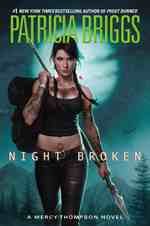
Night Broken by Patricia Briggs

Night Broken (Mercy Thompson, #8)Night Broken

by Patricia Briggs
Series: Mercy Thompson, #8


Hardcover, 341 pg.
Ace Hardcover, 2014
Read: March 19 – 20, 2014

Yay! Mercy’s back! She’s back and she’s facing off with her most potentially destructive foe . . . Adam’s ex. Oh, sure, there’s some sort of Gray Lord threatening her, a supernatural super-baddie that Mercy and her pals have never heard of, and an escaped felon who has powers a lot like Mercy . But the big danger comes from Christy.

This wasn’t a “big” novel in any real sense — seeds were planted/characters were introduced tha will be important, and I wouldn’t want to say that nothing significant happens. But, no epochal shifts, no game changers here — just straightforward case of bad guy comes to town, and Mercy et al. stop it. And along the way the final confrontation with the bad guy, we get to spend sometime with the Tri-Cities pack, as well as see some of the fallout from the last couple of books in this or the Alpha-Omega series. And that’s fine. Not every book needs to be an even, some just need to have a fun story, and maybe even move the chess pieces around a bit.

Initially, the villain of the piece looks fairly disappointing, just some stalker jerk making life difficult of Christy. But it soon becomes clear that there’s more to this guy, and it doesn’t take long to see that he’s one bad customer — creepy, dangerous, and powerful in a way I don’t think I’ve seen before. All in all, a worthy competitor for Mercy and the pack.

As always, the interplay between Mercy and the various members of the pack — or just between the pack without regard to Mercy — is fascinating. At once familial, yet competitive, not necessarily all that affectionate, yet more loyal than a troop of Marines.
The more the Jesse/Mercy relationship develops, the more I like to see it — particularly here, where much of the book can be seen as mother v. step-mother, watching Jesse maturely navigating those treacherous waters was quite satisfying.

My main (only?) quibble with the book was the way that Adam was depicted. He was continually utterly clueless about the way that Christy’s actions would/did affect Mercy. A lot of that, to be fair to the guy, can be attributed to how much he’s moved on from Christy and how devoted he is to Mercy — he doesn’t even see his ex as a potential threat. But, 1. Adam’s smarter than that and 2. given how territorial werewolves are in Briggs’ universe (and as seen in this book), it’s almost impossible to believe that he wouldn’t pick up on the territorial incursions Christy’s making.

Not the best thing that Briggs has written in this series, but not the worst. It had a good story, it was good to spend time with these characters, and I enjoyed the introduction of the new forces at play. A fun way to spend a few hours. Just about everything you could ask for.

—–

4 1/2 Stars

Opening Lines – Hot Lead, Cold Iron

We all know we’re not supposed to judge a book by its cover (yet, publishing companies spend big bucks on cover design/art). But, the opening sentence(s)/paragraph(s) are fair game. So, when I stumble on a good opening (or remember one and pull it off the shelves), I’ll throw it up here. Dare you not to read the rest of the book

—–

I really feel that fewer of modern society’s bits and pieces are sadder—more banal, I guess—than a big office. It’s kinda like, once mankind perfected the assembly line, there was nothing left to do but live on it. Desk after bulky desk, endless rows reaching into the distance like railroad tracks to nowhere; constant monotonous clacks and dings of typewriters and adding machines; tacky marble floors—and maybe columns, in the swankier joints—trying to echo the glories of ancient temples and libraries, and miserably failing at it. Honestly, I dunno if it’s more depressing or more boring.

Unless someone’s trying to rub you out in one of ’em. Then I’m pretty damn confident in telling you it’s a lot more depressing than it is boring.

Right that minute, I wasn’t looking at the desks, or the typewriters, or the pillars, because I was staring blearily at the growing puddle of red soaking into the piss-yellow carpet between my scuffed Oxfords. (Yeah, carpet. This was the second story, so no marble flooring here.) It wasn’t a whole lot of leakage, not yet, but the brick-fisted galoots flocking around me seemed right eager to help me add to it. We were having a friendly little get-together, me and the four of them, wherein I was helping them to relax by massaging their knuckles with my cheeks and my gut. Repeatedly; they musta been really tense. But hey, at least the coppery scent in my nose kept me from gagging on the mixed bouquet of old sweat, typewriter oil, and carpet shampoo.

from Hot Lead, Cold Iron by Ari Marmell

Saturday Miscellany — 5/10/14

Odds ‘n ends over the last week or so about books and reading that caught my eye. You’ve probably seen some/most/all of them, but just in case:

    I’m sure there were plenty of good books released this week, but I didn’t notice any of them, because for me, there’s only one:

  • Robert B. Parker’s Cheap Shot by Ace Atkins — Atkins’ 3rd outing at the helm of this series, and I can’t wait to get my hands on it. Sadly, couldn’t find time this week. Another week will not pass without that being fixed. Read a little Q&A about the book.

Twenty Palaces by Harry Connolly

Twenty Palaces
Twenty Palaces

by Harry Connolly
Series: Twenty Palaces, #.5


E-book, 250 pages
Radar Avenue Press, 2011

I’m not usually one for prequels — if the author/filmmakers have done their job, we know what we need to know already. Sure, it allows the creator to fill in some blanks, make the in-joke — but on the whole, they just seem to serve as red meat for fans*, while offering little new.

But a well-done prequel can be a lot of fun — and in the end, if you’re not reading genre fiction for fun — what’s the point?

Between the rest of the books in this criminally-underselling series, we’re given a decent idea what happened between Ray and Annalise before Child of Fire, how Ray got his Knife (one of the coolest tools I can remember reading about), and about Wally getting Ray into this mess. So, I put off reading this one longer than I’d intended to. Glad I finally got around to it — this was a blast.

Ray Lilly is a messed up, broken, not-so-good guy trying to live straight — to become a “seat belt person,” as he puts it. He’s fresh from prison, but he knows he hasn’t finished paying his debt to society (his policeman uncle helps drive this home) and really wants to get on with his new life.

Naturally, his old life — particularly his old friends, are there to drag him off his new path. But this isn’t your garden-variety recidivism at work. There’s some otherworldly magic using his friends — and almost everyone around him — for ends that even a guy of Ray’s questionable morality can’t abide.

The new reality that Ray steps into here is unlike anything you’ve seen before — dark, scary, amoral, and uncaring — a lot like our world seems too often. The magic system that Connolly has created in this series is something special — I so, so wish we’d gotten to see more of it following Circle of Enemies.

This was fun, very satisfying — and most of all, it made me want to re-read the rest of the books, I’d forgotten just how addicting these books were.

If you’ve read the Twenty Palaces series, this is a nice little cherry on top — if you haven’t? Skip this for now, and run to your indie bookstore (or internet retailer, I guess) and grab them.

—–

* Not that I’m against red meat for fans — as a fan of many things, including red meat, I like when creators entertain me.

—–

4 Stars

Ever After by Kim Harrison

Ever After
Ever After

by Kim Harrison
Series: The Hollows, #11
Mass Market Paperback, 528 pg.
Harper Voyager, 2013

So here we are at Hollows #11 — or as I prefer to think of them, The Adventures of Jenks and his Tenants. It’s the best in quite a while, if you ask me.* I’ve had a hard time maintaining a real interest in these lately, and have only persisted because I’ve read so many of them and I’m curious about how Harrison brings the series to a close. The nominal main character, Rachel, did make a radical developmental leap two books back — and while that served as the core of #10, I think it paid off here.

Thankfully.

Since the events at the end of #9, Rachel’s been more proactive, less wishy-washy about her personal life, and generally more interesting than she’d been. This is definitely the best use of her I can remember.

Ivy is still criminally misused and underused. I can’t believe that Harrison still cares about her at all — keeping her “off screen” so much, and then having her do practically nothing meaningful once she shows. Yes, I can see where the groundwork is being laid for a major Ivy storyline, but at this point, I have no confidence that we’ll see it — and if we do? I can’t see it working too well.

Jenks, on the other hand, played an important role throughout — his presence effected the story, he mattered. Not just because I like him better than anyone else in this universe, but the way Harrison uses him is so far superior to any other character, I like him more and more each passing novel. The stuff with his kids, and Belle, while not that important, in the grand scheme of things, grounds the novel and the characters.

Trent continues to grow on me — I was ready for the series to dump him ages ago, but now I really enjoy him. I still think that it’d have made sense, and been a healthier/wiser choice for Ivy and Rachel to have nothing more to do with him after maybe the third book, but that’s clearly not what Harrison wanted, and it’s paying off. Best use of him yet — the way he treats, and wanted to treat Rachel throughout this is so much better than he’s done before — character growth is always good. I wish Rachel got a bit more of it to match him.

Couple of quick character moments before I move on — Bis is such a great addition to the series, and this time we get to meet more gargoyles. I wouldn’t mind a few short stories featuring them (nothing against Anton Strout’s gargoyle series, I should add). I even liked Newt and Al for maybe the first time ever — but I really can’t get into the details there.

The seeds for the plot were planted from the beginning of the series, and were watered consistently — so the payoff here was well-earned, and dealt with correctly. The choices that Quen, Trent and Rachel are forced to make, the actions they take aren’t easy and felt like things people would choose to do, not merely decisions made for the sake of moving the story along (something I don’t think Harrison has consistently done). It’s really the best since, maybe book #4 in that regard.

The last chapter served as a really good epilogue, as well as setting the stage for the future — along with providing a lot of fodder for the various ‘shippers out there (most of this book does that, really). If Harrison’s doing what I think she’s doing here, I will be pleased.

In the end, a pleasant addition to this series, one that exceeded my expectations — can’t ask for much more than that.

* Apparently, I said the same thing after #10, but I don’t remember thinking that.

—–

3.5 Stars

Saturday Miscellany – 10/26

Odds ‘n ends over the week about books and reading that caught my eye. You’ve probably seen some/most/all of them, but just in case:

    This Week’s New Releases I’m Excited About and/or You’ll Probably See Here Soon:

  • Allegiant by Veronica Roth — The concluding volume of the Divergent Trilogy came out this week to much wailing and moaning from fans, apparently. I finished it yesterday and was satisfied — review to come soon.
  • Rags & Bones edited by Tim Pratt and Melissa Marr — the concept behind this is great, an impressive lineup of authors. What’s not to like here? Read The Big Idea entry on it.
  • Silent Night: A Spenser Holiday Novel by Robert B. Parker with Helen Brann — On the one hand, I’d really like to read what it was that Parker was working on at his death, and I’m curious to see how well his editor/someone other than Ace Atkins can do with the Spenser-verse. On the other hand — a Christmas story?!?!?
  • Poe by J. Lincoln Fenn — this one intrigues me — sounds creepy, suspenseful, and really good

Categories: Books, News/Misc.
Tags: Miscellany

Indexing, Episode 12: Bad Apple by Seanan McGuire

Now that this serial is over, my plan is to write up my thoughts on this last episode and then in a day or two, write something on the series as a whole. Should prove easier to do, anyway.

IndexingIndexing by Seanan McGuire
Series: Indexing, #1.12

My rating: 3 of 5 stars

Episode 12: Bad Apple
Spoiler-y, but not terribly so, words to follow. Use caution.

It almost had to end this way, didn’t it? The focus throughout has been on Henry and Sloane — sure, the rest of the team were used well, but McGuire’s kept our attention on these two. So when most of the Bureau is taken out of commission, obviously they’d be the two least affected. The conclusion isn’t the knock-down, drag-out, epic fighting many might have guessed. Instead, Henry and Sloane simply outsmart their nemesis, using the narrative as only those who spend every waking moment dealing with it could (not that this is violence-free, Sloane does get to strut her stuff a bit).

We also get a little more information on the Snow White fairly tale, and what it can do to a person. Pretty fascinating, although I’m not sure how much was necessary for us. I’ll probably talk more about this in the next post.

A lot of fun — a climax that seemed a bit rushed (I have to keep reminding myself that McGuire has limited space to work with here), but that’s really my only beef.

I’ve gotten used to dipping my toe into this world every couple of weeks, and I’ll miss the world. Glad I got these 12 episodes, though.

Indexing, Episode 11: Scarlet Flowers by Seanan McGuire

—-

IndexingIndexing by Seanan McGuire
Series: Indexing, #1.11

My rating: 3 of 5 stars

Episode 11: Scarlet Flowers
I’m honestly not sure what to say about this, practically every reaction I had was so spoiler-y I don’t think I can say anything substantive about it.

Everything about this episode was totally different from what I expected. There were a few scenes with a peaceful, homey, family feeling. Seeing these characters enjoying those moments makes you believe they’d go through all they’re going through for each other. There was the bonus of an unexpected appearance of as long-lost family member.

And then the strange events of the last few paragraphs that led to the cliff-hanger? Really whet my appetite for whatever’s next. Again, nothing here was what I thought I’d see in Episode 11. But it totally worked.

Stonecast by Anton Strout

StonecastStonecast

by Anton Strout
Mass Market Paperback, 304 pg.
Ace, 2013

Stonecast was not as fun as it’s predecessor, Alchemystic, but it’s designed to be a that way (still fun, and occasionally funny, however). Lexi’s still trying to figure out how to deal with this new reality she’s found herself in — magic exists, she’s a Spellmason (at least an entry-level and self-taught one) — but now the stakes are higher — her brother and a centuries-old dictator are gunning for her, and have taken her guardian gargoyle captive. She knows that she only has a little while before they’re going to come back to finish what they started last time, and she needs to figure out as much as she can before that so she can defend herself. So where Alchemystic had a feel similar to the hero-discovering-his/her-power montage from recent super-hero movies, Stonecast‘s feel is closer to that of an A-Team or MacGuyver episode where they’ve only got a little time to throw together some way to take down the bad guys.

Spellmasonry isn’t the only supernatural game in town, as we all (including the characters) assumed last time out, and Lexi and her friends get introduced to some of that expanded universe — they meet an alchemist, the representative of an expansive group that studies the supernatural, and see the results of other magic user’s work. Along those lines, Strout also gives us a cameo that points to a whole lot more supernatural activity in their world.

Both of these characters are working off their own agendas, which don’t necessarily line up with Lexi’s, and neither she nor the reader are really ever sure what their angle is. Which leads to something like a two-front war she has to wage — I guess it’s more of a single-front war with a strong possibility that at least another front will open up at any moment. Which is good for dramatic tension, good for the reader, but bad for Lexie.

Stanis, on the other hand, has his hands full — his father (the aforementioned dictator) is trying to bend the gargoyle to his will, and is using methods that the Geneva Conventions would frown on. He’s also dealing with the severing of the bond between himself and the Belarus family, after all this time that’s a difficult transition. By the end of Stonecast, he’ll have even bigger problems to deal with.

The biggest problem with this book is space — it’s just not long enough. We need to see more of the effort that Lexi’s putting into preparation for the return of Kejetan; we need to see more effort that Lexi and her alchemist sensei are putting forth to build up her abilities — and the relationship between the two of them felt too rushed throughout. And thanks to the alchemist, we don’t get nearly enough time with Rory and Marshall this time out — yes, Lexi explains shutting them out for their own protection, so it holds up narratively, but Shaggy without Fred and Daphne just isn’t as fun. I did like Marshall’s development towards the end of this book, but Rory might as well not have been mentioned. We just needed more detail, to see more of the struggles in general.

Still, on the whole, I really enjoy this world, and enjoyed the book — and what’s set up for Spellmason Chronicles #3 has me really looking forward to reading it.

—–

4 Stars

Page 41 of 46

Powered by WordPress & Theme by Anders Norén