Category: Miscellany Page 8 of 16

Auto Added by WPeMatico

HC Chats with JCM Berne about Jim Butcher

Here’s part two of my experiment with something new… there are some things I’ve wanted to try and the written word just ain’t gonna cut it. (and I hate saying that about the written word—maybe it’s just my capabilities with it that are the problem…that seems more likely).

When I listen to podcasts or other interviews with authors, one of the things I enjoy most is when they just talk about books they didn’t write or a specific author’s work. It’s a different way to learn about the author—and it usually makes me feel like we belong to the same tribe (reader). So that’s what I’m trying to do in this series (?) of chats. Just talk with an author, blogger, or someone who just wants to talk about some author about someone’s books. If I’ve read them—great. If I haven’t read the author in question, I may end up reading something by them after our chat—at the very least, I’ll learn about someone.

JCM was kind enough to chat with me about an author who has influenced us both, Jim Butcher, and a few other things. Sit back, watch, enjoy, tell us where we’re wrong…or all four.

I’m not sure how long we talked after I ended the recording, but I could’ve gone for a couple of hours. I had a great time with this and hope you enjoyed it.


Are you a Reader of Things and want to chat with me about an author/series/something other than promoting your own work (which we will do, just not primarily)? I’d love to keep trying this, but I’m not ready to start pestering people about it. So please let me know.

Irresponsible Reader Pilcrow Icon

HC Chats with Jodie from Witty and Sarcastic Bookclub about Self-Published Authors Appreciation Week

I’m dipping my toe into something new here. There’s some things I’ve wanted to try and the written word just ain’t gonna cut it. (and I hate saying that about the written word–maybe it’s just my capabilities with it that are the problem…that seems more likely).

Jodie was willing to be my first victim, er, chat partner. This comes across a little more interview-y than I’d hoped. I’ll get there, maybe. Still we chat about Jodie’s blog, the origins of Self-Published Authors Appreciation Week, what some of this year’s features are going to be like, some self-published work in general, and a little more. Hope you enjoy!

As an added bonus, you can watch me adjust settings while recording–because who doesn’t do that? And try to awkwardly find a comfortable way to sit while staying in frame. Clearly, I’m not a professional. I’m barely an amateur.

I’ve got one more trial balloon scheduled that you should see in a few days. We’ll see if I schedule more.*

* Obviously, part of that is going to depend on finding people to sit down with me. If you’re interested, let me know.

Irresponsible Reader Pilcrow Icon

They Asked, so I Answer (just about) Anything for My 11th Blogiversary

As has been noted previously, today marks 11 years since I started putting things up on teh IntraWebs as The Irresponsible Reader. Inspired by A Literary Escape (and some others that I forgot to note), I decided to do a little AMA to go along with last year’s anniversary. I had a great time doing this—and hope at least one other person enjoys reading this 1/8th as much as I enjoyed the questions.

Thank you to Allyson Johnson, Paul Nydegger, Bob Germaux, and Bookstooge for these questions.

About what percent of your blog’s subscribers are friends/family? What’s your most effective way of recruiting new subscribers?
asked by: Allyson Johnson, http://allysonjohnson.com
I’m pretty sure most of my nuclear family subscribed early on just to help out my numbers (and still occasionally reads the posts). To the best of my knowledge, there are two friends who subscribe to this (at least they were friends pre-subscription/following, I’d like to think I’ve reached at least Internet-friend status with a few others). Less than 5% (likely much less).

The most effective way of recruiting is doing those things that Carol talked about in her recent guest post, Don’t Be a Stranger: How to Make Connections in the Book Blogging Community. My Saturday Miscellany tends to attract some people (especially when I link to the post of someone who isn’t familiar with me)—but interacting on Social Media platforms (Twitter and BlueSky are the best for me, but individual results will verify) is the most effective way that I’ve come across. Like Carol says, “Yes, this takes time and is uncomfortable for introverts at first, but if you want to find your people and have people find you (a community), you need to promote yourself consistently.”

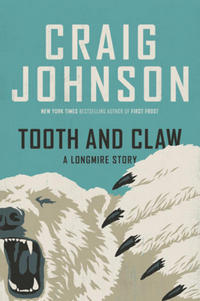
Have you ignored any other writers up close and personal as you have Craig Johnson?

asked by: Paul Nydegger
HA! No.

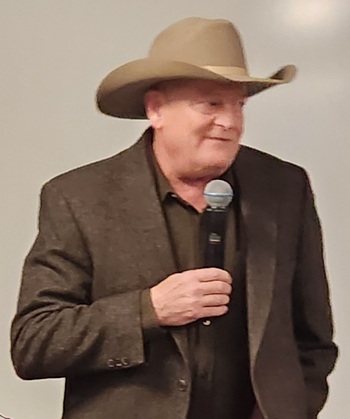
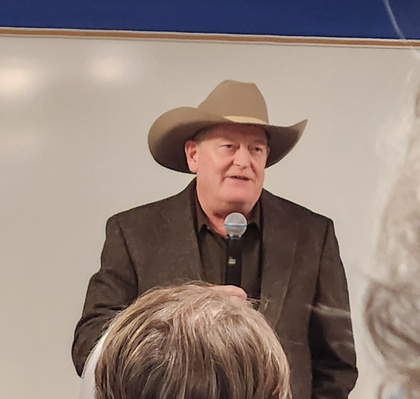
For those of you who aren’t Paul, this goes back to Johnson’s appearance in Boise in 2018. While Paul and I were waiting in line to pay for parking, I see a gentleman walk up wearing a large hat. I mutter something to myself about hoping I didn’t get stuck behind this guy, because between that hat and his height, there was no way I’d be able to see Johnson. Actually, given the “Western wear” the guy was sporting, he could almost pass for Johnson, I remember thinking. Except this gentleman was younger than I remembered pictures of Johnson appearing. Naturally, about ten minutes later, we’re talking to people sitting in the same row who talked about riding up in the elevator with Johnson. I said something about talking myself out of thinking he was in line behind us for parking. They replied with something about the green plaid shirt and I felt like the world’s worst fan. Clearly, I care more about a writer’s words than his appearance.

Fast-forward to last year when he was in Nampa. Paul and I are wandering around downtown killing time before we can show up to the bookstore for his appearance. We pass a couple walking the other way on the sidewalk. The male was a tall man in Western wear and a large hat, the woman was shorter than I remember Mrs. Johnson being, but still… So (as I recall it), Paul and I spent a few minutes trying to convince ourselves that we didn’t just run into Johnson before his event without saying something to him again. I also recall our efforts to convince ourselves were half-hearted at best and even less effective.

Next time he comes back to this area, I trust that we will be ready and on the lookout for him. Ensuring, naturally, that we won’t see him until he’s behind the microphone.

Was there ever a time when you weren’t hooked on books, perhaps back in your wild days, before you attached Reader to Irresponsible? A time when your attention was more focused on sports, girls, movies, etc.
asked by: Bob Germaux, https://www.amazon.com/stores/Robert-Germaux/author/B00QMW2V70
I’d say that reading has taken a disproportionate amount of my attention going to my childhood (see below). But, it’s never been my only hobby. I used to play a couple of instruments, and in the 80s I spent a lot of time playing Intellivision and ColecoVision games, and as many Commodore 64 games as I possibly could (at least two of those led to reading particular books).

Now that I’ve sent most of my readers to Wikipedia/a search engine to understand those references, let me answer your specifics:
I’ve never been all that coordinated, so participating in them was largely an exercise in futility and an opportunity for growth in humility. I’ve tried to get into sportsball things at several points in my life—mostly because I determined I needed to in order to fit in. It occurs to me that most of those efforts led to me reading books/articles about the sport I decided to follow to help me understand what was on my TV screen (there was probably a clue there). For the first decade that we were married, my wife and I spent a good deal of time watching baseball together (and will still try to watch the Little League World Series when we can—it feels purer), but that dropped off as the kids got older.

I’ve always been a big TV/movie guy, too—I make less time for films now and I miss them. I got a couple in during my recent recovery—that was nice and really makes me want to juggle my time a little so I can watch more regularly. I’m behind on the more “prestige” shows (read: the ones I have to put my laptop aside to watch) that I like, but I can make time for those a bit more easily.

As for girls? Well, as you can imagine, in the 80s a non-coordinated guy who was super-into comics, computer games, Star Trek, and books, I was quite the hit with the ladies. 🙂 So, yeah, that never took a big chunk of my time, much to my dismay. Thankfully, I eventually was blessed enough to meet someone who did appreciate that combo (or was willing to undertake an improvement project).

Following up on the previous question, how old were you (or in what grade at school) when you first realized how much you enjoyed reading? Was there a particular book or author that caught your eye?
asked by: Bob Germaux, https://www.amazon.com/stores/Robert-Germaux/author/B00QMW2V70

Donald J. Sobol was the tipping point. The first time I realized (and likely my parents realized, too) just how avid a reader I was/would be came the summer after second grade. My family was on a forever-long road trip (Eastern Idaho to Southern California) and I was bored, so I demanded my parents buy me something to read. Clearly, I wasn’t a pleasure to be stuck in a station wagon with, because at the next town, they did. I got two books, Encyclopedia Brown, Boy Detective and Sugar Creek Gang Screams in the Night. I read them both several times before we got back to Idaho (I don’t think I demanded or received another book on the trip). That was the last time I went somewhere over 40 minutes away from my home without at least one book.

I’d read a lot before then—and demanded my mother read to me a lot before then, too—but I think it was just something I just happened to do. This trip got us all to realize that this was “my thing” (I can’t believe we used this expression back in the early 80s when he had this realization, but whatever the equivalent was at the time). So my library trips—public and school—became more frequent and intense. Also, the mystery/thriller genre became a focus—many more Encyclopedia Browns, a few more Sugar Creek Gang books (the library didn’t have many, and I hadn’t yet figured out how to get my family to buy me books to the extent they do now), and then The Three Investigators came on their heels. SF and Fantasy came soon after.

One more question. Clearly, you have an advanced case of RO (Reading Obsession). It’s okay. I’m likewise afflicted. Just in case it isn’t genetic, which three books would you insist be read aloud to your grandcritters before they’re old enough to flip those pages themselves?
asked by: Bob Germaux, https://www.amazon.com/stores/Robert-Germaux/author/B00QMW2V70
This is a fantastic question—and one I don’t really have an answer to. Anything by Sandra Boynton. And I’m trying a handful of different things to figure out his taste for the present.

But I don’t know what to do when he’s able to handle longer narratives, I really don’t remember what his aunt, uncles, and father liked (or what I liked reading with them). I think that I’m going to try to spend some time in Narnia with him, and maybe a quick trip to Middle Earth, before he’s able to read himself. We’ll definitely check into Hogwarts when he’s a bit older. I think Prydain needs to be in the older section, too, to really appreciate. Fitzgerald’s The Great Brain is episodic and simple enough that I could probably interest him in those. Maybe Caddie Woodlawn? (I’m going to skip the Laura Ingalls Wilder books because when I tried them with my kids I found them mind-numbingly dull, but Caddie was a lot of fun)

(obviously, Mom and Dad might swoop in and beat me to those).

I have a couple of friends who have children a couple of years older than the grandcritter, so I’m going to be looking to them for advice—as well as hunting down more children’s lit bloggers—when he gets to that stage.

Seconds before I hit “publish” I remembered Kate DiCamillo exists. I think I discovered her too late to really get my kids into her as I read to them (but I think my daughter may have followed her on her own a bit), The Tale of Despereaux and Because of Winn-Dixie are must-reads. You might enjoy them, too, Bob.

How much time, on a weekly basis, do you spend reading?
asked by: Bookstooge, http://bookstooge.blog
Not as much as I’d like, but my eyes can only handle so much. And my body insists on this thing called “sleep.” (the former is decreasing and the latter is increasing lately). I think 2-3 hours a day, typically. Saturdays tend to be a lighter day for reading, but I still manage to cram in an hour (occasionally, I get several hours in, see below). So, 11-16 hours a week, I guess is the answer. I actually assumed that’d be higher.

I do get 18-20 hours of audiobook listening in during the work week (depending on my commute and workload), too.

So that’s 29-36 hours of involvement with books a week.

How much time, on a weekly basis, do you spend writing blog posts?
asked by: Bookstooge, http://bookstooge.blog
Not as much as I’d like, but my brain can only handle so much—more importantly, there are dogs, a grandcritter, and a wonderful wife to pay attention to (among other things).

Typically Saturdays are my big day (unless I get wrapped up in a book or non-book activities), 5-7 hours there. Then I spend 1-3 hours a day Monday-Thursday (probably closer to 90 minutes-2 hours, unless I have a mindless police procedural or something like that on, almost no time on Fridays and Sundays. Making that 10-24 hours a week (imagining some Friday time).

Wow, Bookstooge—this quick look at how I spend my time is more than a little eye-opening for me. I don’t know the last time I counted that. Thanks!  (I think)

Happy 11th Blogiversary to Me

Since I can’t imagine that I’ll be around for the 111th anniversary, I’m going to use this occasion to bastardize a certain writer of a travelogue/memoir on his eleventy-first birthday.

My dear People, My dear Bagginses and Boffins, and my dear Tooks and Brandybucks, and Grubbs, and Chubbs, and Burrowses, and Hornblowers, and Bolgers, Bracegirdles, Goodbodies, Brockhouses and Proudfoots. Also my readers, authors, and other bloggers I welcome you back again to The Irresponsible Reader. Today is the blog’s eleventh anniversary: Eleven years of blogging about reading irresponsibly!

I hope you are all enjoying yourselves as much as I am. I shall not keep you long. I have called you all together for a Purpose. Indeed, for Three Purposes!

First of all, to tell you that I am immensely fond of you all, and that eleven years is too short a time to blog among such excellent and admirable hobbits and readers.

I don’t know half of you half as well as I should like; and I like less than half of you half as well as you deserve.*

Secondly, to celebrate my anniversary. It’s been 11 years and 5,065 posts, 2 template facelifts, 2 webhosts, thousands and thousands of pages read, and hundreds and hundreds of hours of listening.

If I may be allowed to refer to ancient history, my arrival on the Internet by this name wasn’t an auspicious arrival–and not terribly readerly, either, that started the next day. As I’ve noticed with my reposts this week, I wasn’t terribly wordy then, but I’ve largely recovered from that.

I wish to make an ANNOUNCEMENT.

I regret to announce that – eleven is far too short a time to spend among you – this is the NOT END. I am going nowhere. I am NOT leaving NOW.

This is NOT GOOD-BYE!

* Not true…but you can’t mess with that line.

Okay, I can’t torture Tolkien’s wording enough to get this in, but it’s the most important part:

I’ve had a blast doing this. I’ve read so many great things—many, many things I’d never have even heard of without this blog. I’ve corresponded with more great authors than I can think of—and best of all, there’s you readers.

I want to thank all of you for your time, your comments, your support (particularly through the whole recent cancer/surgery thing) your encouragement—and occasionally, your editing (I always appreciate it, I just regret the necessity). I assure you that every view, every like, every comment, every retweet, every email is encouraging and I can’t thank you enough. Hopefully, I’m saying that often enough.

I Did a Thing: Tough Questions from Witty & Sarcastic Book Club

Witty & Sarcastic Book Club Presents Tough Questions
Over the past couple of months in my Saturday Miscellanies, I’ve linked to the new series of interviews with Book Bloggers over at Witty & Sarcastic Book Club called Tough Questions.

I was forc—er, subjected t—er, graciously invited to participate in this and my responses were posted on Monday. If you’ve ever wondered what my memoir would be called, what I might call this blog if I rebranded, what my favorite is to read (the answer may surprise you), or other things. Or if you just want to read something on a pink background. Give it a look-see!

Caveat lector: This post does contain what might be the most controversial opinion that I’ve ever put on teh IntraWebs.

Also, if you’re not following the blog or following Jodie on various social media platforms, now would be a good time to start.

Irresponsible Reader Pilcrow Icon

GUEST POST: Grave Cold and the Art of the Sequel by Shannon Knight

For an author that I’ve never read before, Shannon Knight’s name keeps showing up on this site. Almost one year ago, she was here talking about the cover design of her novel, Grave Cold. She’s back today talking about it’s sequel and some of the thinking that went into it. A lot of this lines up with what I assume goes into thoughts about a sequel, but there’s a lot more than that, too.

Grave Cold and the Art of the Sequel

Grave Cold novel set against a wall and grass

Grave Cold turned one-year-old on May 2. So far, Grave Cold has been my most accessible book. No surprise, then, that it’s the one that receives the most requests for a sequel. Writing sequels poses a unique challenge. Readers enjoyed certain aspects of the first book, so there are expectations that the author will serve the same delight in the second dish. Often sequels offer a comfortable familiarity. Readers can hang out with literary friends that they’ve already grown attached to and maybe meet a few new ones. The pattern of the primary elements from the previous book can be repeated: a big adventure, a mystery, a light romance, etc. Book one creates a recipe, and subsequent books contain the same ingredients in a new form.

The thing with Grave Cold (and a lot of my books) is that I worked pretty hard to create something new, something unfamiliar, something unique. The surprises of the magical system and the ravens’ role in death are revealed in Grave Cold. To deliver the same experience, I need a new reveal for the death mythos, which would be fun to create, but readers wouldn’t have the same level of surprise. For Grave Cold, I also set up a long-lived character who retains a strong connection with his medieval culture, and I placed him in the future. My initial plans included subsequent novels set in the past. For one, I’d had my eye on Venice during the bubonic plague. I lived in Venice for three years, so I would enjoy writing a novel set there, and I’ve already got the lived experience of the location. But then I wrote a plague into Insiders, and THEN a pandemic hit our current world, and I suspect we’ve all had enough of plagues. Plus, a sequel set in the past would not have the same science fantasy flavor that Grave Cold featured. Snap! I’ve also imagined a sequel set in the distant future, with our medieval man sent on a task in deep space. I’m pretty keen on this story, but I think it would also miss the primary readership of near-future Grave Cold. And, yet, wouldn’t those death rituals of the far future offer surprises! And wouldn’t Nyle be all up in his medieval discomfort dealing with it!

My limited self-publication experience has taught me that a large portion of readers (perhaps most?) prefer the familiar to the unique. Therefore, the logical sequel choice would pick up with our characters shortly after the last book left off. Nyle and Cait could pursue a new biopunk adventure together. I could develop the next book cover based off the previous one, using another photograph from the same photographer and model. Everything would fall in line prettily, and readers would have a higher likelihood of satisfaction.

As it stands, my next book has been written in an entirely new genre. Are you curious? Maybe I’m a standalone kind of author. Have you read Grave Cold? If so, what kind of sequel are you yearning for? If not, you should meet Nyle and Cait. One is a man born in Anglo-Saxon England pulled by the cold call of death. The other is a beautician who thinks she’s genetically modified, but really she’s a necromancer. Together, Nyle and Cait must save the dead from the living. Check it out!


If you’re like me and haven’t read Grave Cold yet, go check out Shannon’s page about it.

Also, I’ve mentioned that I haven’t read the book twice in this post. I’m actually planning on starting it later today.


Irresponsible Reader Pilcrow Icon

GUEST POST: Books and More Books by Robert Germaux

When I ask for help with some project or another, one of the first and surest names I’m going to see is Robert Germaux. And this latest call for Guest Posts was no exception. Today’s Guest Post is from his collection, Grammar Sex 4 (Seriously?): Yet Another Book of Essays About Life and Stuff. I should stress I didn’t know he was going to talk about me when I picked this one from a list of titles, but it’s an added pick-me-up for me.

Books and More Books

Grammar Sex 4 Cover
My wife and I have a lot of books. Well, actually, I should walk that statement back a bit and just say that Cynthia and I have been buying books for decades. Whether we have “a lot” depends, of course, on one’s perspective. Compared to some people we know, we do, indeed, have a lot of books, but compared to others, like H.C. Newton, book blogger extraordinaire out in the Boise area, we don’t have a lot of books at all. Perspective. Anyway, here’s a rough count of the number of books currently taking up space in casa Germaux. We have about one-hundred-ten hardbound books, down considerably from a good many years ago when we donated several boxes of books to a nearby library. We also have sixty or so paperbacks. And, of course, we have around seventy-five eBooks (a number that fluctuates almost weekly) stored on our various devices. However, as you’ll soon see, those electronic literary efforts don’t factor into this essay.

For some time now, we’ve been thinking about downsizing. We love our four-bedroom, two-and-a-half-bathrooms home, but we’re ready to stop having to deal with the routine maintenance issues that go with home ownership, let alone the not-so-routine issues (frozen pipes a few Februarys ago, a big maple tree that had to be removed from our front yard this summer, etc.). So we’re looking at a move back to apartment life, where someone else can deal with those burst pipes in the middle of a Pennsylvania winter while the Germauxs are soaking up the sun on some tropical island.

Back to the books. When we finally make that move to an apartment or townhome, we know a lot of the “stuff” we’ve accumulated over the past three decades won’t be making that journey with us. Some of the decisions about what things will make the cut and what things won’t will be easy. Certainly, we won’t be taking all four of our flat-screen TVs. Yeah, we have four flat-screens. (See “What Would Henry David Think?” in More Grammar Sex.) And wherever we end up, I’m sure we won’t need all the furniture we currently have, or all the lamps, not to mention some of the souvenir mugs we’ve purchased over the years on vacation trips, plus a whole lot of other stuff that I can’t think of at the moment. Some of that stuff we’ll probably put in one of those storage units you can rent, but a lot of it we’ll end up giving away to local charities. The books, though, will require a little more thought.

About forty of those hundred or so hardbound books we own are Spenser novels by Robert B. Parker. I discovered Parker back in the mid-seventies when I happened upon The Godwulf Manuscript (the first Spenser mystery) while wandering the stacks in our local library. I was immediately hooked, as was my wife when she read the book, and over the years, we’ve purchased every new Spenser as soon as it was released. We also have most of those books in paperback (because they were much easier to take with us on vacations). And with the advent of eBooks, we also have most of the Spensers in that format. Thus, I’m sure we’ll eventually be donating our hardbound Spensers, and probably the paperbacks as well, to any library that wants them. Although there’s one hardbound Spenser that’s definitely going with us when we move: Hush Money, which Parker signed for Cynthia and me when we heard him speak at the Mystery Lovers Bookshop in Oakmont, PA, in the spring of 1999. And if you’ll forgive a purely personal side note, the aforementioned H.C. Newton has on a couple of occasions said my Jeremy Barnes character has a “Spenser-like vibe,” probably the greatest compliment anyone has ever paid this boy’s writing.

In addition to that autographed Spenser novel, there are other hardbounds we’ll be keeping, mainly gifts Cynthia and I have exchanged over the years, books with sentimental value because of the notes we’ve written in them. I’d like to share just two examples of those notes here.

On my 61st birthday, the love of my life gave me a copy of About Alice by the award-winning humorist Calvin Trillin. The book, written in 2006, consists of a series of essays in which Trillin writes lovingly about the love of his life, Alice, an author and educator who died five years earlier. Inside the front flap of that book, my wife (an educator herself) wrote the following:

She’s a teacher. He’s a writer.
It’s a love story. I hope you like it.
Love,
Cindy

Yeah, I’m not the only one in the family with some writing chops.

A couple of years later, Cynthia and I celebrated our 40th wedding anniversary with a week in Paris. My wife, a total foodie whose culinary skills I’ve mentioned in previous essays, was in her element on that trip. I’m not going to say that we dined at every sidewalk café and Michelin-starred restaurant while we were there, but we did try to sample as many of that city’s gastronomic offerings as could be squeezed into a seven-day stay. And just a few years later, for her birthday, I gave Cynthia a copy of Paris, My Sweet by Amy Thomas. Here’s the note I wrote to my wife:

I mean, c’mon, 263 pages crammed with delightful descriptions
of both the City of Light and mouth-watering delicacies-
Amy Thomas might as well have just gone
ahead and dedicated the thing to you.
Love,
Bob

So we’ll be keeping that book, too.

One more, okay? This one’s very special to my wife. My book Love Stories is a semi-biographical novel based on the six weeks Cynthia spent in Europe the summer before her senior year in high school, a time when, unbeknownst to her, one of the boys in her tour group fell deeply in love with her. (We later learned that Dean was actually on his way to see Cynthia four days before our wedding. If you wanna know more about that, and the fictional narrative I created about Cynthia and Dean reconnecting twenty years later, you’re going to have to spring for the $2.99 to buy the book. Or just email me and maybe I’ll send you a free copy.) At the end of Love Stories, I tell my readers that the book wouldn’t have been possible without the journal my wife kept every day during those six weeks in Europe. And she had that journal because her father gave it to her shortly before she departed on that journey, urging her to keep a daily diary during her travels. At least half of what I wrote in Love Stories came directly from that journal. Cynthia’s father was an educator, but he was also quite a writer himself. Between 1942 and 1976, he wrote what he described as a number of “random thoughts and observations” on whatever topic caught his attention. Shortly before his death in 1976, Dad wrote the last entry in Meanderings and Mementos, a collection of those random thoughts of his, most in one poetic form or another. The family had Meanderings and Mementos published as a tribute to Dad’s life. In the beginning of the book, he said he was dedicating it to his children (Kathleen, Maureen, Cindy and Mike). Then he added this:

Personal Thanks To-
My daughter, Cynthia Ann, who frequently
urged her father to assemble a collection
of his own brainchildren.

I still love holding an actual book in my hands, flipping through the pages, going back to a previous chapter with a flick of my wrist, but as Bob Dylan said, the times, they are a-changin’, and the days of Cynthia and me lugging a stack of books through an airport on a vacation to some far-off land are over. Sometimes, boys and girls, you gotta go with the flow.

What about you? How many books are in your library? Which ones can’t you bear to part with, for whatever reason? Even if, like Cynthia and me, you’ve been making the move to eBooks, it wouldn’t hurt to keep a few of those old hardbounds around, sort of a nod to the past, to a time when getting a book meant going to a bookstore, or maybe a library, where you could wander the stacks just to see what was there. If you’ve ever done that, maybe you were lucky enough to spot a book that caught your eye, a book by an author who went on to write a few dozen more books you couldn’t wait to read. If you’re planning to downsize anytime soon, I’ll understand if you decide to hang on to one or two of those books, just to remember the first time you leafed through those pages and fell in literary love with a character or a setting or a plotline. Believe me, I’ll understand.


You can find more information about Bob and his books at his Amazon Author Page.


Irresponsible Reader Pilcrow Icon

GUEST POST: A Contemporary Gothic Thriller by Mary Kendall

This afternoon, I’m very pleased to bring you a Guest Post from Mary Kendall talking about her upcoming release. The book comes out this summer, and I think this post will inspire you to look into it (details below).

Thanks to Geoff at Artemesia Publishing, for pointing her my way.

A Contemporary Gothic Thriller:
Bottled Secrets of Rosewood

Bottled Secrets of Rosewood Cover
Writers never know what kind of strange alchemy will occur to actually result in a full-fledged novel. Some of us (me) pick up inspiration kindling along the way, snipping bits out of newspapers or jotting down something seen or heard on napkins or whatever random scrap of paper might be available. Because…you just never know what might be a thread or strand that becomes something more, maybe much more.

In January 2020, I happened upon a newspaper article in the Washington Post along with a photograph of a jade blue “witch bottle” found near a Civil War fortification in Williamsburg, Virginia. I clipped and saved for later because it struck that inspiration vibe, the vibe that says this could become something.

Other things happened right after that in 2020. Big things. Time went by as I did all the baking, all the gardening, all the painting of furniture and walls, all the other things too. Soon enough, it was summer, the first pandemic summer. I scrambled for a focus and latched back onto the tantalizing tidbit snipped months earlier. Just like everybody else, I needed some “lockdown work” to take me away from the realities so I decided to find out more about witch bottles.

There wasn’t too much out there in terms of research, just several limited studies. Even so, there were plenty of rich and fascinating details. Typically filled with items that ranged from fish hooks to urine, the primary purpose of witch bottles was to lure and trap witches and/or malevolent spirits. They were especially employed during times of hardship and strife which explains why one was buried at the Civil War site. Research also pointed to the bottles as a tradition brought over from the East Anglia region of Britain.

The area where this particular bottle was located, Tidewater Virginia with its tie-ins to Colonial American history and its own unique idiosyncrasies and folklore, provided a perfect setting for my fictional use of a witch bottle. Cue some Southern gothic vibes along with these historical underpinnings and I went ahead and did what we fiction writers do— I got back to writing and started to spin a tale to work witch bottles out of my psyche. It allowed me to put my energy and attention elsewhere even if it was only for stolen moments of writing sessions.

Eventually, I ended up with a contemporary gothic thriller now titled Bottled Secrets of Rosewood. My plucky fictional heroine, Miranda Chesney, a logics professor, falls in love with a historic house called Rosewood, a centuries old, tumble-down, gambrel roofed charmer, in need of rescuing. Her story takes place during present-day in an isolated, coastal corner of Virginia. While Miranda shrugs all locational concerns aside to pursue her new love, she has unwittingly landed in a place with some strange traditions that harken back to days of old including an almost indecipherable brogue and possible witchcraft connections.

After an archeological dig by the local college at Miranda’s property unearths an ancient blue bottle of questionable origin, it seems to trigger the occurrence of inexplicable and mysterious events. While Miranda and the archeology team try to figure out what the blue bottle is all about, incidents commence that are more than just “bumps in the night”. In fact, it seems that there are forces at hand trying to oust Miranda from Rosewood. When she is awakened one night by an eerie glow at her window and finds a circle of fire around her property, she must decide. Should she leave her dream house or stay—and potentially pay the ultimate price?

My fiction writing harkens back to an early reading diet of Nancy Drew mysteries, later expanded and layered on top with gothic suspense and thriller reads. This novel is, without question, a product of those deep reading roots. But it must be said that the weirdness of 2020 no doubt colored the authorship of this tale and ramped up the volume on its quirky overtones. I’ll leave the reader to decide how weird it actually is. As stated earlier, writer’s alchemy works out in its own ways.


Bottled Secrets of Rosewood is soon to be released on 16 July 2024 by Artemesia Publishing. Up for preorders now, look for it where all books are sold. Links are also provided at www.marykendallauthor.com.


Bio
Mary Kendall is first a reader of all books across the genres and, second, a writer of fiction. She brings her background in history-related fields to her writing along with some Celtic story-telling genes. Fueled by black coffee and a possible sprinkling of fairy dust, she tends to find inspiration in odd places and sometimes while kneading bread dough. She has two published novels, The Spinster’s Fortune (historical mystery) and Campbell’s Boy (coming of age, historical fiction). Her third novel, Bottled Secrets of Rosewood, is a contemporary gothic thriller to be released in Summer 2024. She also has three short stories published in dark fiction anthologies for charity.
Irresponsible Reader Pilcrow Icon

GUEST POST: Don’t Be a Stranger: How to Make Connections in the Book Blogging Community


Carol from Reading Ladies Book Club is back to help out some more during my recovery. This time, she’s here with a Guest Post that could be subtitled “Things HC Needs to Improve On.” Hope you enjoy this asmuch as I did.

An earlier version of this originally appeared at Not-So-Modern-Girl.


Don’t Be a Stranger: How to Make Connections in the Book Blogging Community

Photo by Jess Bailey on Unsplash

No One Can Blog Successfully in Isolation

One of the first blogging lessons to be learned was also my greatest challenge: I needed a Community; I desired to make connections and find my people. I knew for certain that no one can blog in isolation, but the solution intimidated me.

I’m an introvert. I’m a reader, not a talker. I love canceled plans so that I can stay home and read. I’m never lonely because I always have a book. These self-descriptors don’t set me up for making online connections. I also had fears: what if I attract creepers or someone makes a mean or negative comment?


How Did I Move From Frozen to Connected?

Photo by Marvin Meyer on Unsplash


To be successful as a book blogger, I knew I had to extend myself, take chances, make the first move. Easier said than done for someone who finds comfort hiding behind a screen or seeks escapism between the pages of a book. I hope you find the following five tips helpful:

  1. Set aside your hesitations and join ALL the social media
    • Make bookish accounts (using your blog name) for Twitter/X, Instagram, Pinterest, Goodreads, Facebook (you can make a separate business page as an extension of your personal FB page), etc; the only place I do not have a presence is Booktube because I don’t do video reviews
    • Some bloggers prefer to focus on only one or two social media platforms, but I’ve found it beneficial to dabble in all of them (each platform reaches different potential followers); I gain the majority of my “click throughs” from Pinterest and Twitter/X
    • Follow bookish accounts on Bookstagram (Instagram users with bookish accounts), BookTwitter/BookX (Twitter/X users with bookish accounts), Facebook, Booktube, etc
    • Look for opportunities to join engagement groups on Bookstagram and Twitter/X
    • Follow blogging and book groups on Twitter/X and begin to comment on threads
    • Drop your links often (at the end of your Goodreads review for example) …but not in blog comments unless asked
    • Pin often to Pinterest and join group boards for pinning book review posts
    • Make sure your blog has its social sharing options set up….especially for Twitter/X
    • Share each and every post you write to all your social media accounts (you can set up your blog to automatically share your posts to social media accounts)
    • Yes, this takes time and is uncomfortable for introverts at first, but if you want to find your people and have people find you (a community), you need to promote yourself consistently


  1. Find Your Niche and Your People
    • Book Reviews and Talking Bookish are my main niches, but I can narrow that niche more by connecting with bloggers who enjoy certain genres or subgenres
    • Do some blog hopping and follow a few blogs (maybe five as a starting point) that share your niche, content, and preferences (visiting the “About Page” on a blog is a good way to begin)….hopefully they will follow you back
    • Begin “tweeting,” “liking” and “commenting” on their posts….hopefully they will return the comment or even reciprocate by commenting on your posts
    • Don’t be discouraged…..not all bloggers will reciprocate…..move on
    • Once you have developed a reciprocal blogging relationship with a handful of bloggers, expand the pool
    • In four years, I have developed an inner circle of bloggers (20-30) whom I consider my “community”; We comment on each other’s posts, share reading preferences, enjoy bookish conversations, and promote each other’s posts on twitter; this all happened organically through genuine interactions
    • In the huge worldwide web, this is the group with whom you will invest the most time
    • Oh, and those negative comments or creeper concerns? Almost nonexistent. However, you do need to be wise and aware (WordPress is great at filtering out spam)


  1. Slowly Expand Your Reach; Try New Things
    • Guest posting is a new venture for me, so this post is me expanding my reach and trying new things
    • I’m thrilled to have connected with blogger H.C. Newton @ Irresponsible Reader
    • Try new memes or challenges….I’ve often participated in #NonFictionNovember #NovNov (Novellas in November), #TopTenTuesday #Top5Tuesday #ThrowbackThursday #LetsTalkBookish #LetsDiscuss ….these are all great ways to meet new bloggers and make connections
    • Check the calendar for special days or theme months…..an opportunity to connect with other bloggers using the same prompts and tags
    • Participating in a blogger’s book tag is a fun way to make new blogging friends (if you want to be tagged in my next book tag post, let me know in comments)


  1. Participate in Popular Memes to interact with like-minded bloggers
    • Top Ten Tuesday is a popular bookish meme for your first experience (ThatArtsyReaderGirl.com)
    • TTT participants are known for their generosity in blog hopping and commenting (always return the favor)


  1. ENJOY and TREASURE Your New Book Blogging Community
    • Celebrate their achievements
    • Continue the conversation
    • Enjoy the connection

The Joy of Book Blogging: Community

In (almost) seven years, I can truly say that the JOY in blogging (for me) is the community. Book people are the best people. I hope that if you have not already found your community that these few tips have been helpful and encouraging. Although I’m still a new blogger, I’m happy to answer questions on connecting and blogging and book reviewing!


CarolI’m Carol, and if you’ve read this because you love blogging and reading, then we’re already friends!

I’m a retired 5th-grade teacher, an ardent and avid bibliophile, and my favorite genres are historical fiction, literary fiction, and contemporary fiction. In addition, I enjoy reading selected memoirs and other narrative nonfiction.

My blog www.ReadingLadies.com is almost seven years old. The mission of my blog is to share a love of great literature across a variety of genres with an intentional focus on new releases, thoughtful themes, diverse cultures, and “own voices” authors. I desire to be a trusted reviewer for your next great read! Respectful conversations are always welcome.

Let’s Get Social:
Instagram: https://www.instagram.com/readingladies­_book_club
Twitter/X:
https://twitter.com/ReadingLadiesBC
Pinterest:
https://www.pinterest.com/ReadingLadies
Goodreads:
https://www.goodreads.com/user/show/16412589-carol-reading-ladies
Facebook: https://www.facebook.com/readingisasport


Irresponsible Reader Pilcrow Icon

GUEST POST: Southern California Beyond the Beach by Mary Camarillo

Mary Camarillo is one of those who jumped when I asked for Guest Posts, and she suggested this great list. This Guest Post is full of good-looking books (pay particular attention to #6). Be sure to Visit Mary’s website and sign up for her newsletter, “Life With Riley.”

6 Books that Explore Southern California Beyond the Beach

SIX BOOKS THAT EXPLORE SOUTHERN CALIFORNIA BEYOND THE BEACH

When I pitched H.C. this idea for a guest post he replied, “There’s more to So Cal than the beach??” [And boy, do I hope my sarcasm came through]

I understand where he’s coming from. When my family moved to Southern California from North Carolina in the late 1960s, we’d heard the Beach Boys on the radio and seen the Gidget movies but we were shocked to learn that not everyone lived on the beach. We landed first in Reseda in the San Fernando Valley and then in Fountain Valley in Orange County. We couldn’t see the ocean and we were confused.

I’ve lived in Huntington Beach for almost 30 years now and I’m still a bit confused by Southern California. So that’s what I write about.

My two novels have been inspired by so many wonderful California authors including the five on this list. Their short story collections, novels, essays and poetry are set in a wide variety of Southern California neighborhoods spanning all of Southern California—from Orange County to the San Gabriel Valley, from North Long Beach to Pasadena, and from South El Monte to Beachwood Canyon right underneath the Hollywood sign.

All of these authors are joining me on a panel at this year’s Lit Fest in the Dena at 5 p.m. on May 4th in Altadena, California. The festival theme is Neighborhoods. Join us at the festival if you happen to be in Southern California then. If not, stop by your favorite indie bookstore and pick up these books.

1. Elsewhere, California by Dana Johnson

Dana Johnson was born and raised in and around Los Angeles and is a Professor of English at USC. In Elsewhere, California, Johnson’s protagonist Avery and her family escape the violent streets of Los Angeles and move to a more gentrified neighborhood in suburban West Covina. When Avery’s cousin moves in with her family, he triggers a series of events that follow Avery throughout her life: to her studies at USC, to her budding career as a painter and artist, and into her relationship with a wealthy Italian and their life in a glass-walled house in the Hollywood Hills.

As a young imaginative child, Avery says she’s from Supercalifragilisticexpialidocious, a name she invented with the help of TV. “I loved where I was already, in Los Angeles,” Avery says. “But I still loved my invented place in California even better because it sounded like confetti and long streamers coming down from the sky, caressing my face.”

Southern Californian neighborhoods with their palm trees, swimming pools, and perfect weather can seem like a paradise complete with confetti and streamers, but this façade can also conceal the loneliness, mistrust and fear of change that is often at the center of so many modern lives. A recent Gallup survey found that nearly 1 in 4 adults across the world have reported feeling very or fairly lonely. In many ways Southern California suburbia is designed to be more of a forced community that can make those who don’t quite fit in feel excluded.

But those “misfits” sometimes have the most powerful stories.

2. L.A. Breakdown by Lou Mathews

Speaking of misfits in paradise, Lou Matthews’ L.A. Breakdown offers what another California author Jim Gavin calls “a love letter to doomed knuckleheads everywhere.” Stunning, bleakly beautiful, and laugh-out-loud funny, L.A. Breakdown paints a riveting portrait of drag racing culture in 1960s Los Angeles. Mathews is a master at capturing working class realism in character and place.

Here’s Charlie, one of the knuckleheads in Mathews’ novel, observing an apartment building. “The El Dorado, and its red, green, and white spotlighted tropical landscaping—banana plants, mock rubber trees, Schefflera, and Giant Bird of Paradise.”

Lou Mathews is also the author of another terrific SoCal novel Shaky Town. He has taught in UCLA Extension’s acclaimed creative writing program since 1989 and he lives right underneath the Hollywood sign.

3. Eat the Mouth That Feeds You by Caribbean Fragoza

Caribbean Fragoza is a fiction and nonfiction writer from South El Monte. In her collection of stories. Eat the Mouth That Feeds You, her imperfect characters are drawn with a sympathetic tenderness as they struggle against circumstances and conditions designed to defeat them. But there is still a strong sense of community in this collection, even in death.

“I feel my family shifting,” Fragoza writes in the story ‘Mi Muerta.’ “Moving like weather over the earth. The rumbling of busy tias, loaded down with thick bodies and domestic duties. The rain of young children in chase. The uncles, mountains that won’t lift a finger her except when drunk to dance or fight.”

Fragoza is the Prose Editor at Huizache Magazine. She also co-edited a wonderful compilation of essays, East of East: The Making of Greater El Monte.

4. Letters to My City by Mike Sonksen

Mike Sonksen, aka Mike the PoeT, is a poet, professor, journalist, historian and tour guide. The poems and essays in his Letters to My City combine two decades of field experience, research, personal observations, and stories told to the author, a third-generation Los Angeles native, by his grandfather and other family members. Sonksen is on a mission to help locals learn local history. He writes that this knowledge “helps one become more of an engaged citizen of wherever they are.”

Sonksen’s history lessons are in the form of poems and stories about Los Angeles streets and neighborhoods. His grandmother lived for over 50 years just a few blocks from where Ice Cube grew up. Patty Hearst and the SLA shot up the sporting goods store half a mile away from his grandmother’s house. In my favorite poem ‘Arrival Stories’ he writes “I mastered the art of not hitting the brakes on the freeways of L.A.”

That takes serious skill.

5. The Secret Habit of Sorrow by Victoria Patterson

Victoria Patterson has been described as the Edith Wharton of Southern California. The characters in The Secret Habit of Sorrow feel like people I know. Patterson writes with emotional wisdom and wry humor about human beings struggling with parenthood, relationships, excessive drinking, drug abuse, and trying to fit into suburban life.

In the story ‘DC’ in this collection, Patterson writes “Serena helped Elaine transition into the Palm Garden Apartments in Costa Mesa, explaining how the garbage cans should be set in a specific spot along the sidewalk pre-trash day or the trash men wouldn’t empty them.”

Southern California neighborhoods usually have unwritten rules about where and how folks should put their trashcans, park their cars, and take care of their lawns. It’s mostly about maintaining those all-important property values.

6. Those People Behind Us by Mary Camarillo

Finally, my novel Those People Behind Us takes us back to the beach, although most of the characters never set foot in the sand. Those People Behind Us is set in suburban coastal town increasingly divided by politics, protests, and escalating housing prices—divisions that change the lives of five neighbors as they search for home and community in a neighborhood where no one can agree who belongs. There’s a realtor, an aerobics teacher, an ex-con, a Vietnam vet, and a teenage boy all confronting death, betrayal, financial decline, and loneliness and not realizing until the end how much they have in common.

In these politically charged and increasingly less united states of America, we often make assumptions about “those people” around us, without knowing anything about our neighbors’ hopes, dreams, and heartbreaks. That’s what the characters in my novel do.

“We have the beach,” Lisa (the real estate agent) tells her daughter. “And before you say that I hardly ever go down there, it’s important to me to know that it’s there.”

What’s important to you about your neighborhood?


Mary Camarillo is the author of the award-winning novels The Lockhart Women and Those People Behind Us. Her poems and short fiction have appeared in publications such as Inlandia, TAB Journal, 166 Palms, Sonora Review, and The Ear. She lives in Huntington Beach, California with her husband, who plays ukulele, and their terrorist cat Riley, who makes frequent appearances on Instagram.

Irresponsible Reader Pilcrow Icon

Page 8 of 16

Powered by WordPress & Theme by Anders Norén