Category: Non-Fiction Page 19 of 63

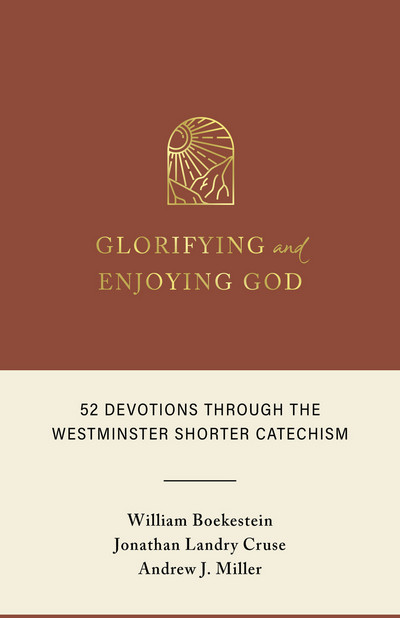
BOOK PREVIEW: Glorifying and Enjoying God: 52 Devotions through the Westminster Shorter Catechism

Okay, I got this book last week and know it’s going to be a while before I can talk about it intelligently—maybe in June, if not December of next year (possibly January 2025). And that seems too long to wait—also, this seemed like a good excuse to flip through it.

Book Details:

Title: Glorifying and Enjoying God: 52 Devotions through the Westminster Shorter Catechism by Victoria Williamson
Publisher: Reformation Heritage Books
Release date: October 16, 2023
Format: Hardcover/ebook
Length: 229 pages
Glorifying and Enjoying God Cover

About the Book:

For centuries, the Westminster Shorter Catechism has helped Christians young and old to know their “chief end.” Now, authors William Boekestein, Jonathan Landry Cruse, and Andrew J. Miller value this venerable catechism and winsomely introduce a new generation to its powerful message. Dividing the catechism into 52 brief devotions, they explain and apply each question and answer in a year’s worth of Lord’s Days. This valuable new resource is great for individual and family use for all who desire to “glorify and enjoy God forever.”

Read a preview here.

About the Authors:

William Boekestein is pastor of Immanuel Fellowship Church in Kalamazoo, Michigan. He and his wife Amy have four children.

Jonathan Landry Cruse is pastor of Community Presbyterian Church (OPC) in Kalamazoo, Michigan, where he lives with his wife and three children. He is the author of several books, including What Happens When We Worship.

Andrew J. Miller is the Regional Home Missionary for the Orthodox Presbyterian Church in central Pennsylvania, where he lives with his wife Rebekah and their five children.

My Initial Thoughts:

I’ve seen a handful of attempts over the years to break the WSC down into 52 weekly increments—in some sort of Heidelberg Catechism envy. This looks like a workable version of that—nice topical divisions, easy for discussion.

I’ve skimmed a few chapters here and there throughout the book—they seem to average about 4 pages long with a hint of depth, some good review of the subject, and some practical applications. There are references to and quotations from hymns, historical figures from several eras, and other statements of faith, too—with some handy footnotes. Given the length of the book (and the nature of “brief devotions”), that hint of depth is about as much as someone could expect. But it appears to be a decent way to review the catechism questions.

For the last couple of years, I’ve been reading the Heidelberg Lord’s Day by Lord’s Day—and wonder a little bit what adding this to the mix is going to do to me as the two catechisms are organized differently. But I’m pretty sure I’ll come out unscathed. The WSC was my first real exposure to a catechism, and is what I raised my kids on, it’ll be nice to get back to it.

Anyway, if you’re looking for an easy devotional for 2023, you might want to give this a peak—it promises to be worthwhile. It also would probably make a decent gift if you’re looking for that kind of thing.

Irresponsible Reader Pilcrow Icon

LITERARY LOCALS: An Evening at Idahope

Literary Locals and ICW logos

One of the most rewarding—and most surprising things—about doing these Literary Locals interviews is seeing how many writers there are in the area, plugging away at the craft—and how many different groups there are of them working together in one way or another. I’m not alone in this, either, some of the authors/leaders of these groups are surprised to see how many others there are.

I can only assume if this is true for Southwest Idaho, there’s a decent chance that it’s similar wherever you are. Go look for them. Even if you’re not an author, aspiring author, possible aspiring author. I met someone this week who’s a board member of one of these groups who just wants to support the writers in her community while not being a writer—how cool is that?

I met—and had the beginning of a conversation that could’ve gone on for hours in another setting—her at the monthly meeting of Idahope (I interviewed the Secretary and President about their recent relaunch last month). I’d been invited/suckered into coming to talk to them about how to participate in an author interview—and, most importantly, how to come across as non-boring or generic in them. (hence my recent surveys about them—which I’m going to try to turn into something for the blog soon. So, maybe February)

My bit went okay (I think)—sure, I forgot a couple of the points that were in my mental outline for weeks (remembering them once I left the parking lot), and too many jokes fell flat (I’m sure it was the delivery. Or the material. Not the audience). But we had some good discussion and most of those in attendance didn’t seem to mind my blathering. Also…I somehow only talked for more than 10 minutes and only dropped in references to two books, which is a personal record.

But that’s not what I wanted to talk about. I wanted to talk about the meeting—we started out going around the table talking about our current projects and whether we were participating in NaNoWriMo. Only one person was doing a modified version of it, if you can believe that. I’m not 100% certain it’s allowed for a group of more than 6 independent writers to get together in November without multiple NaNo participants present—I kept waiting for some NaNo Agents to burst through the wall like the Vegan Police in Scott Pilgrim and start issuing fines and forcing Chris Baty material into our hands.*

* I guess the NaNo people could’ve been home getting their daily counts in. Maybe that’s why the authorities were lenient on us.

Once my prattling on was done, we all did a writing exercise—which resulted in some wonderful turns of phrase and the display of some…shall we say, interesting…imaginations. I really want to read some longer works by everyone around that table (even from the self-professed non-writer). This includes some novels and children’s books that are in various stages of creation mentioned throughout the night that I’d love to read when they’re done.

But for me, the best part was just seeing this group of people at various stages in their writing/creative careers come together to talk and share a little bit and support each other. It sounds good on paper, but I got a little buzz off of it in reality. It’s an infectious spirit and I can see me coming back for another hit or two of that, at least and maybe becoming another member just to support the work of the group.

Also, in the room next to us, an Improv Class was in session. Other than the fact that they were occasionally distractingly loud, I loved that. I don’t know how many there were in the class, but I think it’s safe to say that in that building there were at least 20 people out on a chilly Tuesday night to talk about and work on their art/craft/passion in one way or another. How great is that?

I don’t have a conclusion here, and I really should. I guess I’ll just encourage you all—your tribe is out there to help you on your creative way. Go find them.

Literary Locals logo

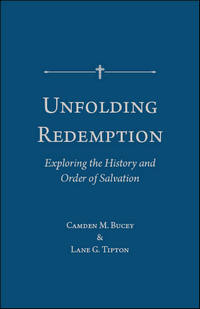
Unfolding Redemption by Camden M. Bucey & Lange G. Tipton: I’ve Looked at Salvation from Both Sides Now

Unfolding RedemptionUnfolding Redemption:
Exploring the History and Order of Salvation

by Camden M. Bucey & Lane G. Tipton

DETAILS:
Publisher: Reformed Forum
Publication Date: October, 2023
Format: Booklet
Length: 52 pg.
Read Date: November 5, 2023

Many well-meaning Christians view salvation in Christ exclusively through a personal and subjective lens. They perceive salvation as an intimate process of divine intervention, manifesting in transformative experiences, feelings, and changes in our lives. While salvation certainly includes a personal experience, the Bible teaches an objective and historical foundation for such salvation in the person and work of Jesus Christ. Accordingly, before we can speak meaningfully about our individual salvation experience, we must first understand that salvation, at its heart, is an accomplished reality. It is rooted in real, historical events that took place long before our personal experience of salvation. This accomplishment of salvation, carried out by God through Jesus Christ in the unfolding of covenant history, sets the stage for the personal application of salvation in our lives.

Essentially, before salvation can be applied to us subjectively, it must be accomplished objectively. It is this accomplished work of God, historically embodied in the life, death, and resurrection of Jesus Christ, that is the basis for the salvation we experience. Jesus Christ himself is the wellspring from which flows all the benefits of our salvation: justification, adoption, sanctification, and eventual glorification. To understand truly the richness and depth of our personal salvation experience, we must first grapple with the historical accomplishment of salvation—the foundation upon which our subjective experiences are built.

What’s Unfolding Redemption About?

This booklet is essentially an unpacking of that opening quotation. Following the Introduction which will introduce the thesis of the book, introduce and define some terms, and so on, the opening chapter examines the historic, objective work “historically embodied in the life, death, and resurrection of Jesus Christ,” what the authors (and many others) would summarize as the historia salutis.

The second chapter looks at the subjective application of that work to us and our lives—the ordo salutis.

The Significance of Pentecost

Rather than beginning with Genesis, the Prophets, or even the Gospel accounts to look at the historia salutis, Bucey and Tipton start at Pentecost—from this vantage point they can look back at Genesis-Malachi as well as the Gospels for a look at that work of Christ and how it was foretold/foreshadowed and what he accomplished in His life, death, resurrection and ascension—leading to the outpouring of the Spirit at Pentecost as part of what they term “the Irreversible Progress of Redemption.”

Union with Christ

As we’re united with (or in) Christ, those elements of the work He accomplished can be applied to our hearts and souls, our minds, and our lives. They’re applied through justification, adoption, sanctification, forensic and redemptive benefits, and finally through glorification.

The individual aspects here are all touched on with a degree of depth, but they’re very brief (the booklet itself is 52 pages long, everything is brief). But you don’t feel short-changed, which is pretty impressive for 1-4 page discussions.

So, what did I think about Unfolding Redemption?

Understanding what has transpired in Christ breathes life into our understanding of our individual spiritual journeys. Recognizing our faith within the progressive and organic climax of redemptive history in the person, work, and kingdom of Jesus Christ helps us understand our place within his grand design and enhances our communion with Christ. In this context, our salvation becomes not just a personal experience but part of history of special revelation that finds its center and substance—its goal and telos—in the crucified and glorified Son of God—the church’s “hope of glory” (Col. 1:27).

I really appreciate the emphasis on the two ways of looking at redemption—accomplishment and application. What was done on our behalf and how it changes us. It’s too often overlooked and/or confused by the American Church today, and we need to get it straightened out.

Overall, I liked Unfolding Redemption—I wasn’t blown away by it (partially, because I’ve read everything they point readers to for more depth), but it’s asking a lot for a booklet of this length to blow anyone away.

I did think that this is a handy thing to hand out to people who are new to Reformed soteriology—or who are curious about it, and can think of a handful of people I wish I had copies for right now. The whole point of this booklet is to be a starting point—one that points in a direction for further inquiry/study. And it does a great job of doing that.

On those terms, I feel like I’m short-changing it on stars. On the other hand, these are about my reactions–which were I liked it. So, I’m sticking with that. Although, I halfway expect those I had in mind to hand it to will react far more positively. Basically, your results may vary, and probably will.


3 Stars

Irresponsible Reader Pilcrow Icon

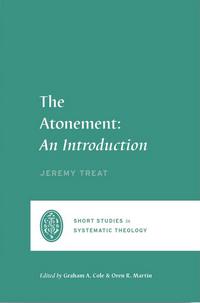
The Atonement: An Introduction by Jeremy Treat: A Wider Vision than is Typical for this Doctrine

The AtonementThe Atonement: An Introduction

by Jeremy Treat

DETAILS:
Series: Short Studies in Systematic Theology
Publisher: Crossway
Publication Date: August 22, 2023
Format: Paperback
Length: 158 pg.
Read Date: September 24-October 1, 2023
Buy from Bookshop.org Support Indie Bookstores

Here is my approach to the atonement in a nutshell: The death of Christ is a multidimensional accomplishment within the story that begins in the garden and culminates in the kingdom. While the achievements of the cross (forgiveness, victory, adoption, and so on) are unending, the heart of the cross, out of which everything flows and finds its coherence, is Christ dying in our place for our sins. The atoning work of Christ not only reconciles sinners to God but also to one another, calling us into a life of taking up our crosses as we follow our King. In other words, we need a kingdom-framed, substitution-centered, multidimensional, integrated, communal, life-changing approach to the doctrine of atonement.

A Quick Confession

I really wasn’t that interested in this volume. I got it because I’m a completionist—the rest of the topics in this series so far (and those I’ve heard are coming) intrigued me. This seemed too narrow a topic, honestly, maybe one that would fit better under a larger topic like the Work of Christ—a companion piece to The Person of Christ: An Introduction.

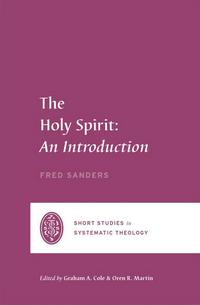
It took me very little time to realize that I really appreciated Treat’s approach to and Treatment of the subject and that I was very glad I’d bought this. It’s easily one of my favorites in the series (something I’ll be repeating soon when I talk about The Holy Spirit: An Introduction, I have to admit).

Now that I’ve set the bar low for the rest of this, how about we move on to:

What’s The Atonement: An Introduction About?

Atonement theology, especially at the popular level, has been plagued by reductionism. Whether limiting Christ’s work to a purely spiritual salvation or only focusing on one of the dimensions of his work, many have truncated the breadth of Christ’s atoning death. A kingdom framework gives a comprehensive view of salvation, encompassing the renewal of heaven and earth while embracing the many dimensions of the atonement.

Treat definitely doesn’t take a reductionistic approach to his subject—but he doesn’t try to spread it too far, either. What he does do is take a panoramic look at the subject—trying to take in the scope of the doctrine, even if this introduction can’t get into the nitty-gritty details. I feel silly putting it this way, but the book really is a systematic/dogmatic introduction to the Doctrine of the Atonement—exploring what it is and why it matters.

Treat quickly points out that he has no desire to promote any of the various and popular theories regarding the Atonement so popular over the last century or so. He doesn’t care to deal with theories when it comes to this, he wants to focus on what we do know about the doctrine—and sure, as he admits, what he’s saying sounds a lot like the Penal Substitutionary Theory, but it also sounds like the Moral Influence Theory and Governmental Theories—because he’s trying to make sure his doctrine of the Atonement takes in and accounts for all the data.*

* I’d note that every Reformed expositor/defender of the Penal Substitutionary Theory that I’ve encountered over the last couple of decades would have the same understanding of Governmental and Moral Influence, So it’s not revolutionary—as much as Treat’s disdain for the ideal of “theories” may be unfamiliar.

He attempts to keep things focused on the eschaton, and the Atonement’s role in it, as well as a Kingdom-wide understanding—so that the reign of Christ is seen in view of his Atoning work. The last couple of chapters focus on the effects of the Atonement on the Church and believers.

An Added Bonus

Treat cites—at least in the epigraphs of each chapter, but generally more frequently—”majority world scholars.” “[S]ince the atonement is a global accomplishment, it will be best understood from a global perspective.”

That’s probably true of most of the topics in this series on Systematics—if not more of Christian dogma. But I appreciate Treat focusing on this and bringing in teachers/writers from all over the globe into his presentation in this book.

Trinitarian Focus

Early on in the book, Treat quotes Hans Urs von Balthasar, “The events of the cross can only be interpreted against the background of the Trinity.” This forms a substantial part of his position, and it’s something he covers well and thoroughly.

While the doctrine of atonement is centered on Christ, we cannot think of Jesus as an independent individual but as the Son of the Father who is empowered by the Spirit. Atonement is a work of the triune God through and through. On the cross, Father, Son, and Holy Spirit were at work together for the salvation of sinners.

Failure to acknowledge or stress this is part of the reductionism that Treat tries to battle throughout the book. While I applaud this battle each time he engages in it—but his stress on the Trinitarian nature of the Atonement is perhaps my favorite part of the book. It’s so often overlooked or skimmed past—but Treat doesn’t allow the reader to do that—and we’re rewarded by that.

So, what did I think about The Atonement: An Introduction?

While early Christians were mocked for their belief in the cross, Christians today have often domesticated the cross to make it more palatable for a modern society. Whether placed on a calendar in a Christian bookstore, tattooed on an arm, or elevated above a city skyline, we have tamed the cross and turned it into a decorative pleasantry. But only when we see the horror of the cross will we be ready to understand the glory of the cross.

I already gave that away, didn’t I? This really impressed me, changed my mind about the use of a book like it, and helped me refocus my understanding of the doctrine’s place—it also helped me be able to reframe things around the various “theories” of the atonement.

It’s not the easiest read in this series—but it’s by no means difficult. Treat writes in a compellingly clear way, but not one that doesn’t require thought to interact with. I found his style engaging and careful—a great combination when you’re considering the essential doctrines of the Faith.

This isn’t a book that spends any time on things like the “extent” of the Atonement—it’s about the purpose, means, and end of Christ’s great work. Sure, that has implications for questions about the extent, but that’s not what Treat wants to focus on here.

I won’t say the book is perfect—but I can’t think of any substantial problems at this point, and didn’t make any notes expressing concerns. I’m sure I—and most readers—would find a point or three to quibble with or push back against. But those are going to be so minor as to make no real difference in the overall estimation of the book.

Careful, challenging, encouraging, and centered on the great storyline of the Bible, with a focus on the eschatological promises and glories—exactly what we need more of. The Atonement: An Introduction is definitely one I recommend.


4 1/2 Stars

This post contains an affiliate link. If you purchase from it, I will get a small commission at no additional cost to you. As always, the opinions expressed are my own.
Irresponsible Reader Pilcrow Icon

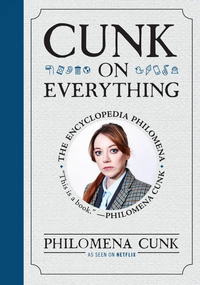
Cunk on Everything: The Encyclopedia Philomena by Philomena Cunk: The Only Reference Book You Need This Year

Cunk on EverythingCunk on Everything:
The Encyclopedia Philomena

by Philomena Cunk

DETAILS:
Publisher: Grand Central Publishing
Publication Date: September 26, 2023
Format: eARC
Length: 304 pg.
Read Date: October 20-27, 2023
Buy from Bookshop.org Support Indie Bookstores

What’s Cunk on Everything About?

Funny story (well, a story anyway), last week I was in my doctor’s office briefly and the nurse was being nice while she prepared to stab me with a knife (or maybe it was a tiny needle, the witness accounts vary) and she asked me what I was reading. I responded with, “Have you seen that show on Netflix called Cunk on Earth?” She hadn’t. Which made the whole small-talk pitch so much harder.

Because if you have seen the show (even just a clip or two), this is easy—it’s Philomena Cunk’s take on just about everything. History, culture, science, art, philosophy, religion, sports, food, and some of the important individuals in those areas. Presented in her idiosyncratic way, of course.

Now, if you haven’t watched the show—because you’re a reader, or something rare like that—this is trickier. Cunk’s approach to the documentary specials on TV or the encyclopedia entries in this book are a combination of naïveté, misunderstandings (especially in mispronunciation/misspellings), and cynicism.

Miscellaneous Observations

I don’t know how to talk about this book—especially as it’s essentially 1-5 page entries on a wide variety of topics (and that page count is just a guess, I couldn’t tell you from my eARC). The topics range from Alexander the Great, the Alphabet, The Alt Right, The Dark Ages, Democracy, Fake News, “Fullosophy,” Hair, the iPhone, The Mystery of Life, Sausages, “Weeing in Public,” and so on. So, right—forget trying to cover this all intelligibly.

In lieu of that, here are some miscellaneous observations:
bullet The pacing is a bit odd—the “H” entries are around the fifty percent mark—I’ve come up with a dozen half-baked ideas/theories/jokes to explain it. It really doesn’t matter, but I thought it was odd. I don’t care—but it was something I noticed.
bullet The entry on Jazz is just fantastic.
bullet There are a couple of running jokes—derogatory comments about the idea of books throughout, repeated use of “Frankingstein” (to describe a certain Mary Shelley character), and that the moon landing was faked. This book doesn’t really feel like a vehicle for running jokes, but they work so well.
bullet The first paragraph about The Oedipus Complex is one of the best things I’ve read in 2023—the last sentence of that paragraph made me almost laugh out loud (but I was in the waiting room of that doctor’s office, so I had to swallow it to prevent strange looks)
bullet I really didn’t think that you could make many jokes about triangles. The authors of this book proved me wrong—and most of them were really funny, too.
bullet You are going to hear Diane Morgan’s deadpan delivery in your head whether you read this or get the audiobook. Just know that going in. (you likely assumed it that already, so know that you’re right).
bullet Mozart and Shakespeare are frequently the targets of jokes—it’s not surprising to see them both as topics here. Some of the funniest things I’ve seen written about both of them are here, too.
bullet The entry on Xylophones is fantastic—it covers the instrument, the usage of it in alphabet books, the silliness of using it in them (given the pronunciation), and more.

So, what did I think about Cunk on Everything?

I didn’t see (but maybe overlooked) the writers behind this book listed anywhere—but whoever they were, they deserve a round of applause. Or two.

I chuckled and laughed out loud a lot while reading this. There’s really not much more to say—that’s what they were going for.

My daughter and I have spent months sending various Cunk videos back and forth to each other. But now I’ve transitioned to  reading her bits and pieces of this as I worked through it. I’m not nearly as good as Morgan at delivering the material, I realize. She’s probably glad I’m finished. But, man is this a quotable read—it’s virtually impossible to resist the urge to share this material.

Whether you go from cover to cover, or dip into it here and there (probably for longer than you intend to)—these brief entries are almost certainly going to be a burst of entertainment for you. Not all of them are going to work for every reader—but never fear, just turn the page and you’re probably going to come across one that will.

I had a blast with this—putting this post together took longer than you’d think based on the brevity of it because I kept getting distracted by the book and re-read large chunks of it. I think you will, too.

Disclaimer: I received this eARC from Grand Central Publishing via NetGalley in exchange for this post—thanks to both for this.


4 Stars

This post contains an affiliate link. If you purchase from it, I will get a small commission at no additional cost to you. As always, the opinions expressed are my own.
Irresponsible Reader Pilcrow Icon

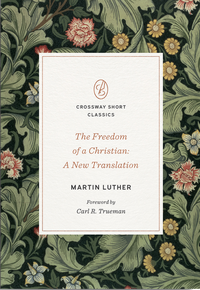
Reformation Sunday Repost: The Freedom of a Christian by Martin Luther, Translated by Robert Kolb: A Pastoral Gem from the Reformer

It’s Reformation Sunday–a totally made-up holiday (but which one isn’t?) to commemorate the day in 1517 when Martin Luther inadvertently started a revolution/reformation/revival. So, hey, while I continue to fight off this cold, let me repost this about one of my favorite of Luther’s works:

The Freedom of a ChristianThe Freedom of a Christian: A New Translation

by Martin Luther, Translated by Robert Kolb Carl R. Trueman (Foreward)

DETAILS:
Series: Crossway Short Classics Series
Publisher: Crossway
Publication Date: February 21, 2023
Format: Paperback
Length: 86 pg.
Read Date: February 26, 2023


Some Thoughts on the Series as a Whole

The point of this series is to take classic short works—sermons, tracts, articles—package them attractively, edit a bit (modernize language, eliminate footnotes, tweak grammar, etc.), and make them widely available. Each is given a short introduction to help the reader get the context and a bit of information about the author.

They published seven books in this series last year, and I discussed them here. Two have come out this year (so far), but I’m hoping for more.

What’s The Freedom of a Christian About?

A Christian is a free lord of everything and subject to no one.

A Christian is a willing servant of everything and subject to everyone.

This is Luther (early in the Reformation) laying out his vision for good works for the believer–how they are to be performed, why they are to be performed, and their place in the life of the believer. I’m sure there’s more to say, but that’s basically it.

That quotation gives his two theses–the rest of the book is his working out the thinking behind them. It’s penetrating, it’s convicting, and it’s inspiring to watch him work. Whoops, I seem to have stumbled into the next section.

So, what did I think about The Freedom of a Christian?

From all of this comes the conclusion that a Christian lives not in himself but in Christ and in his neighbor, in Christ through faith, in the neighbor through love. Through faith he rises above himself in God, from God he descends under himself through love, and remains always in God and in divine love. It is as Christ said in John 1[:51]: “You will see heaven standing open and the angels ascending and descending over the Son of Man.” Behold, that is the proper, spiritual Christian freedom, which liberates the heart from all sins, laws, and commands. This freedom exceeds all other freedoms, as high as heaven is over the earth. May God grant us that we truly understand that and retain it.

I wasn’t sure about reading this–it’s one of those works I’ve read so much about. I’ve seen it cited, heard descriptions of it in lectures, and read about it, but I haven’t gotten around to reading it. A lot of the times I read something that I know about like this, it doesn’t work out (I’ve never been able to get past page 40 of Postman’s Amusing Ourselves to Death, for example). But this is exactly what it should’ve been.

Martin Luther being pastoral is just great. Luther coming alongside those believers so often neglected in the Church and saying, here’s what to do–free of burden, free of guilt, free to live and love as they ought, as they’ve been called to.

This little read is a gem. I’m glad I took the chance on it and so glad that Crossway’s series brought it to us.

4 Stars

This post contains an affiliate link. If you purchase from it, I will get a small commission at no additional cost to you. As always, the opinions expressed are my own.

SICK DAY REPOST: The Essential Trinity by Brandon D. Crowe and Carl R. Trueman, eds.

A cold derailed my ability to think today, so here’s a blast from the past.

The Essential Trinity The Essential Trinity: New Testament Foundations and Practical Relevance

by Brandon D. Crowe and Carl R. Trueman, eds.

Paperback, 273 pg.
Inter-Varsity Press, 2016

Read: July 31 – August 14, 2016

As far as consistency of quality amongst edited volumes goes, Crowe and Trueman have assembled one of the stronger line-ups I’ve read in a while — men from a spectrum of persuasions of Evangelical-ish thought have given the Church fourteen articles (approximately 20 pages each) to deepen our thinking about the Trinity. The aim was for a volume that “eschews overly technical discussion and focuses attention on the importance of the doctrine for every Christian.”

In Part 1, the articles look at the “trinitarian contours of every corpus of the New Testament, along with a chapter reflecting on the Old Testament roots of trinitarian doctrine.” If there are weak chapters in the volume, they’re in this part — but they aren’t that weak, either. Crowe’s chapter on Matthew is excellent, but the chapters on the Mark, Luke-Acts and John aren’t far off that Mark. Brian S. Rosner’s chapter on “Paul and the Trinity” is worth the price of the book. The chapters on the rest of the epistles are very helpful (particularity Hebrews). Mark S. Gignilliat’s article, “The Trinity and the Old Testament: real presence or imposition?” is very helpful and insightful — and as an added bonus, it’s the most stylistically entertaining and engaging piece in the book.

Benjamin Gladd’s chapter exploring Daniel’s influence on Revelation’s view of the Trinity is the biggest mental workout you’ll get in the book. I appreciated the material covered and the argument Gladd makes, but I’m going to have to read it a few more times before I think I have a good handle on it.

Part 2 addresses the importance of the Trinity for everyday living — many would say the doctrine is impractical and only belongs in Statements of Faith and academia. The authors here show the fallacy of that. It begins with a brief, but excellent, description of the doctrine by Scott R. Swain. Carl Trueman has the next chapter, “The Trinity and prayer,” which is probably as valuable as Rosner’s — it’s actually about more than prayer, but the material specifically on prayer is great — hugely indebted to John Owen (but not uncritically so). Robert Letham’s chapter on “The Trinity and worship” also draws deeply from Owen; if he doesn’t move you to worship as you understand the work of the Trinity in it, you aren’t paying attention (I probably have more problems with some of what he says than anything else in the book). Michael Reeves, typically, made me chuckle in his chapter on preaching — but he did more than that, too.

Timely, convicting, thoughtful and inspiring, this examination of the Trinity in Scripture and Life should be a great benefit to any believer ho reads it. It may not be the easiest thing read all year (but really, it’s not that difficult), but it’ll be one of the most rewarding.

—–

4 Stars

REPOSTING JUST ‘CUZ: The Trinity: An Introduction by Scott R. Swain: A Brief but Deep Study

I’m about to re-read this book, so I figured it was a good idea to remember what I thought about it.

The Trinity

The Trinity: An Introduction

by Scott R. Swain
Series: Short Studies in Systematic Theology

Paperback, 133 pg.
Crossway, 2020

Read: January 17-31, 2020
Grab a copy from your local indie bookstore!

What we find in later Trinitarian creeds, confessions, and doctrinal summaries are not improvements upon a latent or undeveloped biblical Trinitarianism but, rather, the church’s attempt to fathom the depth of the riches of biblical Trinitarianism for the sake of various liturgical, pedagogical, and polemical ends. Some of the church’s creeds, confessions, and doctrinal summaries represent such faithful expressions of scriptural teaching and enjoy such wide-ranging ecclesiastical consensus that we dare not transgress the lines they have drawn. Rather, taking them on our own lips, we gladly join the church’s chorus of Trinitarian praise.

What’s The Trinity: An Introduction About?

It’s kind of there in the title, right? This is an introduction to the classical Christian doctrine of The Trinity. He’s not trying to re-invent the wheel, he’s definitely not trying to innovate, but to provide a concise (it’s a Short Study, after all) jumping-off point into deeper studies by providing a solid foundation.

He spends two chapters looking at the primary Biblical texts demonstrating the Doctrine. Chapter 3 is about the Simplicity of God—something too many overlook in a discussion of The Trinity. The following three chapters each focus on a Person of the Trinity. The final chapters are about the “external works” of the Trinity, the “appropriation” of specific works to particular persons, the beneficiaries of God’s work, and assorted topics.

All of that is a lot to ask of 133 short pages. Swain pulls it off by being concise, but he never seems to be leaving out details or avoiding the complicated ideas (although he obviously has to).

Touching on Controvery

This isn’t a polemical work—Swain is here to inform and educate, not combat. Still, he does talk about some Christological errors, including the contemporary dust-ups over EFS/ERAS—Eternal Functional Subordination/Eternal Relations of Authority and Submission.

Swain briefly (again, it’s a Short Study) addresses this error. He’s calm, he’s fair, yet he’s firm. It’s one of the best short treatments of the controversy I’ve seen, and in the context of the larger discussion of the Person of the Son as well as the larger discussions of each of the Persons, it’s incredibly helpful. It also fits where he put it and doesn’t seem like Swain used the opportunity as a digression just to beat a pet theological peeve.

Helpful Supplemental Material

Maybe it’s just me, but I rarely find the post-text material all that helpful. This book was one of the pleasant exceptions—there’s a brief glossary of some of the technical terms. Also, the “Further Reading” suggestions look great and my “To Buy” list grew a bit.

So, what did I think about The Trinity: An Introduction?

Because the persons of the Trinity are internal to God’s life, not external works of God, we can know the persons of the Trinity, as well as their ultimate plan for creation (Eph. 3:9), only if they stoop down and open up the depths of their inner life to us. Only the persons of the Trinity know the persons of the Trinity. Therefore, only the persons of the Trinity can make known the persons of the Trinity. The revelation of the Trinity is a matter of divine self-revelation, divine self-presentation, divine self-naming.

While this is a theological book, drawing on the teaching of the Church, Swain is careful to never lose sight of the source of this Doctrine, the Word of God. We know this, we understand this (as much as we do) because it is revealed to us. That’s vital to an understanding of the doctrine, and vital to the teaching of it. Swain doesn’t let his readers stray from the text.

This is one of those books where my notes keep saying “Chapter X is likely the highlight of the book,” “the section on X is likely the most valuable in the book.” It appears 60-70% of the book is a highlight—and I may not have written all of those parts down. Which is to say, there’s a lot of gold here, very little (if any) dross.

Helpful, insightful, and useful—it also achieves its end for leading on to further study for me. It’s accessible, but not easy, reading. At the same time, it’s a challenging, but not difficult, text.

Also, I like the looks of this series as a whole, I’ll most likely be grabbing more/all of them if they’re all about this quality.


5 Stars

This post contains an affiliate link. If you purchase from it, I will get a small commission at no additional cost to you. As always, opinions are my own.

REPOSTING JUST ‘CUZ: The Excellencies of God: Exploring and Enjoying His Attributes by Terry Johnson: Not Quite as Good as Its Predecessor but Worth Your Time

The Excellencies of GodThe Excellencies of God:
Exploring and Enjoying
His Attributes

by Terry Johnson

DETAILS:
Publisher: Reformation Heritage Books
Publication Date: October 23, 2022
Format: Hardcover
Length: 347 pg.
Read Date: October 23-November 20, 2022
Support Independent Bookstores - Visit IndieBound.org

The Excellencies of God‘s Jacket Copy

God’s attributes is the most practical of subjects, inspiring and shaping the entire Christian life. Contemplating who God is and what He has promised to do can bring great comfort to the most despairing soul. Moreover, it brings immense delight to all those who recognize their chief end as the glory and enjoyment of God. In The Excellencies of God, Terry L. Johnson explores several aspects of the divine character and shows how they play a crucial role in our Christian experience. May God’s mercy and grace, His patience and wisdom, His truth and faithfulness, His spirituality and blessedness prove to be a blessing to all who peruse these pages.

The Table of Contents

That’s kind of vague, so let’s look at the TOC.

Preface
Introduction: The Christian and the Attributes
The Mercy, Grace, and Patience of God
1. The Mercy of God
2. The Grace of God
3. The Patience of God
The Truth and Faithfulness of God
4. The God of Truth
5. Liberating Truth
6. Pursue and Proclaim the Truth
The Blessedness of God
7. The Blessed God
8. Our Blessedness in God
The Fatherhood of God
9. God Our Father
10. Pleasing Our Father
11. Our Father’s Children
12. Our Father’s Care
The Spirituality of God
13. The God Who Is Spirit
14. Serving an Invisible God
15. Spiritual Mindedness
16. Spiritual Worship
17. True Worship
The Wisdom of God
18. God Only Wise
19. Wisdom and Folly
20. Seeking and Submitting to God’s Wisdom

So, what did I think about The Excellencies of God?

I struggled to write a post about Johnson’s The Identity and Attributes of God two years ago, and I find myself in a similar position now with this follow-up. I went with the bare minimum above because it fits the book—Johnson lays things out very matter-of-factly, and you get exactly what the TOC lists. He takes each thought and explains it using citations from Scripture, the Fathers, Reformers, and some contemporary writers—with some illustrations of hymns.

I have the impression that Johnson gives 50-60% of the text, and the rest are quotations (mostly a sentence or less). I did not (would not) try to verify that—and I’m pretty sure I’m wrong, but that’s my impression as a whole. I wanted more of Johnson and less of everyone else. I think this is about the same as the previous volume, and I had a similar thought about it—but overall it was so good, I didn’t care. This book was a little less impressive so it stuck out to me more.

I don’t think I get the selection of the major topics and how they flowed one from the other—the chapters within each topic, on the other hand, flowed nicely.

Is this a decent read? Yeah, but it tends to the dull-side with the repeated quotations. But beyond that, it’s a pretty straightforward and thorough look at the topics. It’s helpful, it should push you to look more into some of the ideas that you find more provocative (and the footnotes will help with that). It’s sound and measured, majoring on the majors and not really spending time on minor issues.

It’s a good book that I can recommend without hesitation, I just wanted more from it.


4 Stars

This post contains an affiliate link. If you purchase from it, I will get a small commission at no additional cost to you. As always, the opinions expressed are my own.

Who Chose the Gospels?: Probing the Great Gospel Conspiracy by C. E. Hill: Robert Langdon Might Have Been on the Wrong Track (shocking, I know)

Who Chose the Gospels?Who Chose the Gospels?:
Probing the Great Gospel Conspiracy

by C. E. Hill

DETAILS:
Publisher: Oxford University Press, USA
Publication Date: April 7, 2012
Format: Paperback
Length: 247 pg.
Read Date: September 10-24, 2023
Buy from Bookshop.org Support Indie Bookstores

All this presents a rather sticky problem. Recall that in Professor Ehrman’s political interpretation of church history it isn’t until the fourth century that the ‘orthodox’ party finally ‘sealed its victory over all of its opponents’, At that time ‘it rewrote the history of the engagement’, claiming that its views were passed down from Jesus’ apostles. And yet here is Irenaeus, nearly two centuries earlier, already ‘rewriting history’ long before the victory was sealed. At a time when, many prominent scholars insist, the issue was still very much in doubt, Irenaeus writes as if the church had been nurtured by these four Gospels from the time of the apostles.

The problem with Irenaeus is that he simply wrecks the popular paradigm. His views about the emerging New Testament canon, and about the four Gospels in particular, are simply too well-developed, too mature, to fit the scheme that many have invested themselves in today. As a second-century Christian author who argued that there are, and can only be, four legitimate Gospels—because they alone teach the truth about Jesus and because they alone had been handed down in the church from the time of the apostles—Irenaeus lies like a fallen Redwood in the path of those who would see the choice of the four Gospels as a late and politically motivated manoeuvre of the fourth century.

How do you solve a problem like Irenaeus?

What’s Who Chose the Gospels? About?

That last question in the quotation would work pretty well as an alternate title for the book—how do you solve a problem like Iraneaus? Or, more to the point, how do you ignore his (early date) recognition of only 4 gospels—Matthew, Mark, Luke, and John—despite what we’re told about the state of gospel availability and canonization by so many today.

Hill examines some of the time frames, uses, content, and provenance of some of the so-called competitor gospels (i.e., those that never were considered canonical) to compare them to both the canonical gospels and those early figures of the Church we see discussing the gospels. But primarily, Hill is concerned with the use of and testimony regarding the canonical gospels—and the evidence regarding their use by the Church and when it started. The overwhelming bulk of the book is focused there.

So, we may now ask, how did the Christian church, apparent drowning in a sea of Gospels, finally end up with only four? The educated reader of today may already have come to the conch. sion that the story was attended with a good bit of bullying intrigue, and skullduggery. Many perhaps picture councils of bad-tempered bishops voting on which books to include in the Bible one minute, and voting to execute heretics the next. As now widely believed, in any case, that the four canonical Gospels emerged into prominence only fairly late from a long and drawnout battle within early Christianity, a battle finally won in the fourth century after the establishment of the church by Constantine the Great. While academics might not, as Teabing does Dan Brown’s novel, attribute the collation of the Bible to ‘pagan emperor Constantine’, many even in the academic community insist that the question of which Gospels the church ought to endorse was still up for grabs in the fourth century.

He also looks a little bit at contemporary theories (both academic and popular) about the development of the canon—insofar as it focuses on the Gospels. He finds it wanting, and somewhat self-contradictory—and talks about that, too. But even as he does so, it’s not the main focus of the book—which is, as said earlier, the four gospels and how the second (and possibly first) century church regarded them, and how that changed (and mostly didn’t change) in the two centuries following.

The Tone of the Book

You probably can’t read it in the image above, but that top blurb is from D.A. Carson and it says, “Not many books that are so informed are such a pleasure to read.” I really didn’t pay much attention to it—and just figured he meant something about how nice it is to have such an informative read or something like that. If for no other reason, it was from Oxford University Press, who are not known for fun reads. I was super duper wrong.

This was a blast to read. Seriously, I had a lot of fun.

Not—and I want to stress, not—because he’s making jokes, being silly, or outrageous or anything like that. There’s just something about Hill’s style. He’s charming (seemingly effortlessly), not in a way that calls attention to itself, but it’s there—a little mild sarcasm, some wordplay, some other bits of humor along the way—but it’s nothing I can point to, and say “there it is!” But time after time while reading this, I found myself grinning for no apparent reason.

That’s just his style—the subject is serious, and frankly, pretty dry. But Hill keeps it from being dry without tuning down the seriousness of both the positive case he’s trying to build and the criticisms he makes toward the other side(s).

So, what did I think about Who Chose the Gospels??

In short, we have no evidence that the church ever sat down collectively or as individual churches and composed criteria for judging which Gospels (or other literature) it thought best suited its needs. On the contrary, the key realization which best explains our inability to find an ultimate ‘chooser’, which best explains why the church didn’t take the easy way out with some kind of singular Gospel and why it never cobbled together a set of criteria to apply to all the Gospel candidates, is that the church essentially did not believe it had a choice in the matter! The question ‘why did you choose these Gospels?’ would not have made sense to many Christians in the second century, for the question assumes that the church, or someone in it, had the authority to make the choice. To many, it would be like the question, ‘why did you choose your parents?

A few other books/chapters that I’ve read on the subject talk about the conclusions Hill draws, and refer to some of the evidence, but Hill’s the first one I’ve read who’s actually “shown the work,” as my math teachers/professors would say. His answers match other scholars, but I can actually see how he got them. For that alone, I enjoyed reading this book and profited from it.

Add in his style? Oh, buddy—now we’re cooking with fire.

Hill is careful and thorough, acknowledging challenges to his position about the emergence of the fourfold Gospel to the place it holds today. But he’s consistent in showing how those challenges don’t have the weight and merit that so many in our culture assume they do. Not to keep picking on it—but the authors/editors of Church History in Plain Language should spend time with this book and others like it before they finish the Sixth Edition—it would really help out with its particularly weak chapter on the Canon.

I think the concluding chapter could’ve been beefed up a little bit. Maybe after a few more readings, I can figure out what it was missing—I just felt it was weak here and there. Or another reading or two will show me that I could’ve paid better attention this time (entirely likely).

Regardless, Who Wrote the Gospels? is a book well worth time and attention—and it’ll repay both.


5 Stars

This post contains an affiliate link. If you purchase from it, I will get a small commission at no additional cost to you. As always, the opinions expressed are my own.
Irresponsible Reader Pilcrow Icon

Page 19 of 63

Powered by WordPress & Theme by Anders Norén