Category: Non-Fiction Page 20 of 63

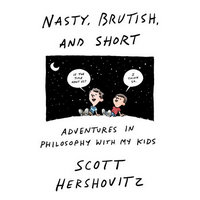
Nasty, Brutish, and Short (Audiobook) by Scott Hershovitz: Who Needs Calvin and Hobbes When We Have Rex and Hank?

Nasty, Brutish, and ShortNasty, Brutish, and Short:
Adventures in Philosophy with My Kids

by Scott Hershovitz

DETAILS:
Publisher: Penguin Audio
Publication Date: May 3, 2022
Format: Unabridged Audiobook
Length: 9 hrs., 31 min.
Read Date: September 21-25, 2023
Buy from Bookshop.org Support Indie Bookstores

What’s Nasty, Brutish, and Short About?

The official description is:

Some of the best philosophers in the world gather in surprising places—preschools and playgrounds. They debate questions about metaphysics and morality, even though they’ve never heard the words and perhaps can’t even tie their shoes. They’re kids. And as Scott Hershovitz shows in this delightful debut, they’re astoundingly good philosophers.

Hershovitz has two young sons, Rex and Hank. From the time they could talk, he noticed that they raised philosophical questions and were determined to answer them. They re-created ancient arguments. And they advanced entirely new ones. That’s not unusual, Hershovitz says. Every kid is a philosopher.

Following an agenda set by Rex and Hank, Hershovitz takes us on a fun romp through classic and contemporary philosophy, powered by questions like, Does Hank have the right to drink soda? When is it okay to swear? and, Does the number six exist? Hershovitz and his boys take on more weighty issues too. They explore punishment, authority, sex, gender, race, the nature of truth and knowledge, and the existence of God. Along the way, they get help from professional philosophers, famous and obscure. And they show that all of us have a lot to learn from listening to kids—and thinking with them.

Hershovitz calls on us to support kids in their philosophical adventures. But more than that, he challenges us to join them so that we can become better, more discerning thinkers and recapture some of the wonder kids have at the world.

The book is broken down into three sections: “Making Sense of Morality” (covering ideas like Rights, Revenge, Punishment, Authority, and Language); “Making Sense of Ourselves” (surely non-controversial chapters covering “Sex, Gender, and Sports”; and “Race and Responsibility”); and “Making Sense of the World” (Knowledge, Truth, Mind, Infinity, and God—the easy bits of philosophy). While discussing these, Hershovitz will describe the idea(s) he’s focusing on—or the aspects of them, to be more specific; he’ll then illustrate them with questions from or discussions with his sons; give us a brief history of philosophy on the topic; and then his personal take on them. Usually with more input from his sons along the way.

How was the Narration?

Hershovitz was fantastic. If he gets tired of the whole professor/philosopher gig, he could have a new career in audiobook narration. I can only imagine that his classes are great to sit through.

He delivered the material that in the wrong hands could’ve come across as super-dry, or really jokey and kept it engaging, entertaining, and informative—with a little bit of the persuasiveness needed to keep someone listening to a book about philosophy.

I was quite impressed.

So, what did I think about Nasty, Brutish, and Short?

Oh, I have some serious issues with some of the philosophy here. The chapter on “God” (to the surprise of few who read this blog regularly) really bothered me—but it did underline the importance of Special Revelation to go with General Revelation.

The Conclusion, “How to Raise a Philosopher,” was fantastic. Truly some of the best parenting advice I’ve heard/read in ages (and I don’t even need that any more and I still found myself taking notes). For raising more than just philosophers.

Sure, I disagreed with some of his conclusions—but I loved hearing the way Hershovitz thought through the ideas he was proposing and/or discussing, the way he dealt with his kids and their questions, I appreciated the way he explained concepts both basic and complex in a way that non-philosophers could understand, and he managed to be entertaining all along. Some of his witticisms did cause me to react audibly. There’s a good deal of so-called common sense mixed in with the profound as well—always nice to see for a layman like myself.

This book is a strange alchemy of parenting advice (even if largely given by example rather than by precept), Philosophy 101, and humor. It works so well that it’s hard to explain. I can only hope there’s a sequel or three as Hank and Rex age.

All in all, I heartily recommend this for parents, people who want to get a start in philosophy but aren’t sure where (and don’t want to admit that to anyone), and others. The print version might be nice for easy reference, but the audiobook format is a real winner.


3.5 Stars

This post contains an affiliate link. If you purchase from it, I will get a small commission at no additional cost to you. As always, the opinions expressed are my own.
Irresponsible Reader Pilcrow Icon

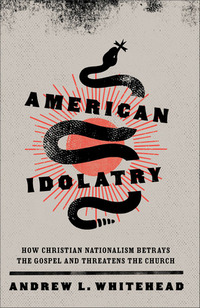
American Idolatry: How Christian Nationalism Betrays the Gospel and Threatens the Church by Andrew Whitehead

American IdolatryAmerican Idolatry:
How Christian Nationalism Betrays
the Gospel and Threatens the Church

by Andrew Whitehead

DETAILS:
Publisher: Brazos Press
Publication Date: August 15, 2023
Format: Hardcover
Length: 192 pgs.
Read Date: August 27-September3, 2023
Buy from Bookshop.org Support Indie Bookstores

Both parts of my identity* have led me to the same conclusion: Christian nationalism betrays the gospel and is a threat to the Christian church in the United States. It is from this perspective that I write this book. I want to make clear to my fellow white American Christians how much Christian nationalism threatens our faith—not only our individual expressions of it but also our organizations and institutions. It threatens our capacity to love our brothers and sisters in Christ who are minorities. It threatens our capacity to love and serve our brothers and sisters in Christ from countries around the world. It threatens our capacity to love and serve fellow bearers of God’s image at home and abroad who don’t share our faith at all. And it threatens how our organizations function, causing them to reproduce inequality and further harm the marginalized.

I am convinced that Christian nationalism makes us bad Christians.

* Those parts are a follower of Christ and a social scientist.

What’s American Idolatry About?

Essentially, this is an attempt to demonstrate the subtitle: “How Christian Nationalism Betrays the Gospel and Threatens the Church” (the above quotation does show he’s not talking about a threat to the throughout the world—or the future—but the contemporary church in the U.S., an important distinction).

It’s also a follow-up to the work he co-authored with Samuel Perry, Taking America Back for God: Christian Nationalism in the United States—this is a less-technical book (from what I can tell), to appeal to people who don’t enjoy digging through social science analysis and graphs. It also seems to be a “so what now?” response to that book—the earlier volume presented the data, and this is Whitehead’s suggested reaction to that data. I haven’t actually read the previous book, but from what Whitehead says in these pages and what I’ve read about the previous book, that’s my impression.

This doesn’t mean that Whitehead assumes a thorough knowledge of or familiarity with Christian Nationalism (he frequently appends “white” to that term for reasons he makes clear) going into this book, he spends two chapters outlining the basics of Christian Nationalism and how that impacts the Church. The next three chapters focus on what he calls “the three most powerful” idols of Christian Nationalism—power, fear, and violence—followed by three chapters describing alternatives to these idols, ways that are more faithful to the calling to which you have been called.*

* These are not exhaustive chapters, for more along these lines—see What Are Christians For? Life Together at the End of the World by Jake Meador. Some of the ideas in these books will align, but they will diverge, too. Yet, I would predict neither author would object to being read together.

A Disclaimer of Sorts

We have to look straight into the mirror and not try to hide or diminish the imperfections we see. Only then can we begin to imagine something new. Part of this work is recognizing that the God we worship has no particular interest in the greatness of the United States. The survival of any one nation over another is not paramount. The kingdom of God needs no global superpower in order to flourish….recognizing that human flourishing in the kingdom of God and in the United States (or any other nation) are not synonymous does not mean that Christians should not invest in the flourishing of a nation and its people. We can work toward peace, justice, and care for all who live and work within the boundaries of our home country. We can collaborate with God and those around us to create a more loving and liberating country for all our neighbors.

Whitehead returns to the idea frequently, but stresses it in the first two chapters—he is not calling for Christians to be anti-American, or even apathetic about our country. He’s not calling for them to remove themselves from the political process. His concern is how we see the country, how we view and treat our fellow citizens, and how we’re involved in the political process.

The choice is not Christian Nationalism or godless anarchy, or Communism, or Sharia law—and so on. His vision is for Christians to work alongside those of other faiths (or absence thereof) for the civil betterment of us all. While I think Whitehead’s politics tend toward the Left, he’s not calling for all Christians to embrace that—conservative and Republican Christians can agree with his arguments on the issues this book centers on.

The Idols of Christian Nationalism

There are many “idols” of CN, claims Whitehead, but the three he focuses on are the biggest problems in his view are power, fear, and violence. The heart of the book is devoted to this section (it’s not the longest, but it’s the most important), here he demonstrates how the devotion to and use of these characterize the movement and put it at odds with Christianity.

In these chapters, Whitehead begins by defining what he sees as the CN’s use of/dependence on the various idols. Then he’ll show how throughout our history—but particularly in recent decades/years how both political figures and religious leaders have tapped into and exploited these ideas for their own benefit and the detriment of other groups in the U.S. He’ll then look at Christ’s and/or early-Christian teachings on the same ideas, contrasting them with CN’s use (this is particularly effective on the ideas of power and violence).

The shortcomings (to put it mildly) of CN are on full display here. Frankly, I think the definition work done in chapter 2 is enough to turn someone off of this ideology, but chapters 3-6 really put the nail in the coffin.

So, what did I think about American Idolatry?

Over years of academic study and personal faith journey, I have become convinced that white Christian nationalism in the United States is fundamentally opposed to the ethics and teachings of Jesus. Through idolizing power, fear, and violence, white Christian nationalism betrays the gospel, in which Jesus’s sacrifice liberates us from our enslavement to sin as well as the destruction it causes through systems of oppression It betrays the gospel that realigned the power structures of society.

As a whole, I don’t see people who aren’t at least suspicious of CN responding well to this book—I think most of those who are suspicious will become more so after this—and those who are already pretty against it will have new reasons and will be strengthened in it. I’m not sure that those who have leanings or sympathies toward it are going to respond well. I could be wrong, and hope I am. That I don’t think it would reach the CN-leaning is the biggest flaw with the book (but if I’m wrong about the effectiveness, that flaw wouldn’t be that big).

Based on what little he indicated about his own theological positions, I don’t think Whitehead and I would agree on much. I think we’d probably agree on less when it comes to politics. But when it comes to the impact that CN is having on churches, our gospel witness, and the public perception of the Christian Church in the US? Well, we’re pretty much on the same page—which I think fits some of Whitehead’s points. He’s not really that concerned with the areas where he and I would disagree, in fact, he’d probably defend that ability. Where he is focused is the negatives that CN brings to political discourse and the work of the church.

On those points, I think he scored big in American Idolatry—showing the flaws, errant presuppositions, and wrong emphasis—and non-Christian attitudes of CN. I’m less sure that he was convincing in the last three chapters about healthy alternatives, but I do think what he offers there is better than CN, and he’s convincing to that point. Maybe not as far as he wants to be, however.

Crisp and clear writing, the text moves with the assurance of someone well-versed in the subject and clear-eyed about what they want to say about it. I recommend the book and thinking about the issues it raises.


3.5 Stars

This post contains an affiliate link. If you purchase from it, I will get a small commission at no additional cost to you. As always, the opinions expressed are my own.
Irresponsible Reader Pilcrow Icon

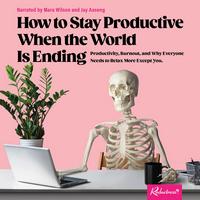
How to Stay Productive When the World Is Ending (Audiobook) by Reductress: Mara Wilson & Jay Aaseng: The “This is Fine” Meme, Expanded

How to Stay Productive When the World Is EndingHow to Stay Productive When the World Is Ending:
Productivity, Burnout, and Why Everyone Needs to Relax More Except You

by Reductress; Mara Wilson & Jay Aaseng (Narrators)

DETAILS:
Publisher: Andrews McMeel Publishing
Publication Date: June 20, 2023
Format: Unabridged Audiobook
Length: 4 hrs., 49 min.
Read Date: September 20-21, 2023
Buy from Bookshop.org Support Indie Bookstores

What’s How to Stay Productive When the World Is Ending About?

People being compelled to choose between having money to buy food/shelter/necessities and health (all while maintaining a social media presence) in the midst of worrying about the immanent death of the earth from climate change and various and sundry pandemics—this is the book for you.

a collection of essays, how-tos, and “inspirational” phrases to help you laugh when staying both sane and productive in a commodified world feels impossible. From “‘Doing What You Love’ and Why That’s Bad,” to “Why I’m Prioritizing My Career Over Finding a Better Career,” this collection perfectly skewers the indignities, big and small, of living through late-stage capitalism.

The Narrators

Mara Wilson and Jay Aaseng did a great job—a very dry delivery (unless something else was called for) and earnestness really sold the satire. I can’t help but imagine that they had to do many takes of parts of this because it was difficult to get through with a straight face. Even for professionals like they are.

I think Aeseng got to show a little more range in his performance, but that’s just because some of the things he was asked to do demanded it—when Wilson got to do more than the straight, dry reading, she stepped up as well. Maybe if I wasn’t multitasking, I could’ve taken more notes and kept better track, and I’d see that the ratio was different.

Essentially, they did a great job—I’d listen to more audiobooks by them—and they thoroughly entertained me.

So, what did I think about How to Stay Productive When the World Is Ending?

The website for Reductress states that it’s

The first and only satirical women’s magazine, Reductress was founded in 2013 by Beth Newell and Sarah Pappalardo. The mission of Reductress is to take on the outdated perspectives and condescending tone of popular women’s media.

and that tone and direction are clear throughout this book. Thankfully, even when it’s not targeted toward me, I can still (frequently) enjoy humor and satire done well. And this book, reader, is done well.

Very little of the satire and humor was mean-spirited toward an individual, political persuasion, or most lifestyles (I honestly can’t think of an example at the moment that was, but I’m going to say this to be safe). It does skewer the lifestyles/thinking of those who promote/require people to have to hold down a side-hustle or three to make ends meet, for example. But even then, not in a mean way.

I don’t think people should grab this audiobook, however. (no offense to the narrators, see above) Or if you do, don’t listen from beginning to end in a sitting or two. Listen for 15± minutes at a time and then switch to a podcast or other audiobook. It’s just too much at once, and all the jokes blur together. Also, I’ve looked at some of the samples of the book online—between the graphics and layout, and the ease of picking it up, reading a bit and then putting it down; print is the way to go with this book.

That said—I thought it was frequently hilarious, funny at almost every point—each piece had something that made me grin or chuckle. Most had several lines that did that—and a good portion made me laugh out loud. I even played a couple of pieces to my wife and daughter (my chronically ill daughter really enjoyed the piece, “How to #Grind when your #SideHustle is #ChronicIllness”). It feels like cheating to mention this one in particular, but I have lived (and know others who have, too) “Why I’m Prioritizing My Career Over Finding a Better Career.” Reader, I laughed so hard. And cringed.

That’s pretty much my reaction to the book as a whole.

I would absolutely recommend this to anyone with the above caveat about format.


3 Stars

This post contains an affiliate link. If you purchase from it, I will get a small commission at no additional cost to you. As always, the opinions expressed are my own.
Irresponsible Reader Pilcrow Icon

Some of the Guidance I Received on Giving Terry Pratchett Another Try

Last week, I asked for some advice on where I should start with Discworld books, since my attempts with reading The Colour of Magic and The Light Fantastic didn’t really leave me wanting more.

I received some good input, and thought I’d pass some of it along (if only so there’s a central location for me to come back to later for reference).

The overall consensus was that I picked a couple of bad ones to start with. But beyond that,

bullet Mike Finn (you should read his blog, by the way), said (in part):

Here’s the best map I know of for showing the reading order of the various Discworld subgroups.

https://upload.wikimedia.org/wikipedia/commons/thumb/1/12/Discworld_Reading_Order_Guide_3.0_(cropped)

My favourites are the Watch novels and the Witches novels.
The Watch novels start with Guards! Guards!
The Witches novels start with Equal Rites.

If you read those two and still don’t like Pratchett then he’s probably not for you.

bullet K.R.R. Lockhaven (you should read his books, by the way) admitted:

I…um…have to admit that I haven’t actually read ALL of them. Most, though. I’m partial to the City Watch books, starting with Guards! Guards! Maybe Small Gods would be good, too. It’s a standalone.

bullet Lockhaven also pointed me to Fiction Fans podcast’s “Bonus Episode: Which Discworld Book Should You Read First?” It was an interesting chat–the episode notes include:

They… don’t really give a straight answer. But they DO know which book you should NOT read first. You’re welcome.

Possible First Reads:
Wyrd Sisters (if you like witches)
Reaper Man (if you like Death)
Small Gods (if you want a good standalone with religious satire)
Hogfather (if you like Christmas)
Monstrous Regiment (if you want a good standalone with scathing social commentary)
Going Postal (if you like con artists)

bullet wyrdsis (an account name that suggests they might know a thing or two about the series), chimed in with:

…I got really into it with the Witches (starting with Equal Rites), and Ankh Morpork City Watch (starting with Guards! Guards!), then Hogfather, Thief of Time, The Truth, the von Lipwig series….etc

bullet David Frew sent me to

A DISCWORLD PRIMER*

*or, why should I read this thing that everyone keeps going on about?

by Micah @rincewind.run (another account name that suggests they might know a thing or two about the series).
bullet Gary Hayenga chipped in:

The first two novels are very different than the subsequent novels. As the previous commenter mentioned there are several sub-series set on the Discworld. Based on the other things you’ve posted about liking here I would recommend that you start with The Watch series, starting with Guards! Guards!. The second book in that series is even better.

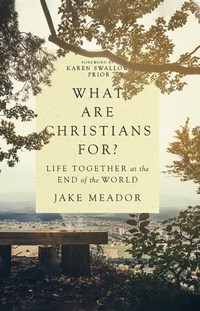
REPOSTING JUST CUZ:What Are Christians For? Life Together at the End of the World by Jake Meador: A View for Living in Culture and Nature

What Are Christians For?What Are Christians For?:
Life Together at the End of the World

by Jake Meador

DETAILS:
Publisher: IVP
Publication Date: February 21, 2022
Format: Hardcover
Length: 170 pg.
Read Date: March 27- April 3, 2022
Support Independent Bookstores - Visit IndieBound.org

God looks at this world and loves it, which is why we can and should do the same. This world is not something we should seek to escape through conquest or bend to our will through technique, power, or control. Rather, it is a gift given to us by God for our joy and his glory. Because God is love and his law is good, we can look at our neighbor and love him or her. Because God gave himself to us, we can give ourselves to others. We can confidently and joyfully enter into these debts of love that we build up over a lifetime of living in the world, and we can dispense them with extravagance, trusting that whatever wrongs we might experience today as a result of such living will be gathered up and made right in the glorious and perfect love of God.

The Back of the Book

What does a Christian political witness look like in our day?

Politics ought to be defined by fidelity to the common good of all the members of society. But our modern Western politics are defined by a determination to bend the natural world and human life to its own political and economic ends. This wholesale rejection of the natural order is behind the dominant revolutions in our history, and defines our experience in Western society today—our racialized hierarchy, modern industry, and the sexual revolution.

In What Are Christians For?, Jake Meador lays out a proposal for a Christian politics rooted in the givenness and goodness of the created world. He is uninterested in the cultural wars that have so often characterized American Christianity. Instead, he casts a vision for an ordered society that rejects the late modern revolution at every turn and is rooted in the natural law tradition and the great Protestant confessions. Here is a political approach that is antiracist, anticapitalist, and profoundly pro-life. A truly Christian political witness, Meador argues, must attend closely to the natural world and renounce the metallic fantasies that have poisoned common life in America life for too long.

Faithful Presence

In his discussion of the Christian response to those revolutions, Meador borrows a scheme from James Davison Hunter describing the four postures Christians have taken: defensive against, relevance to, purity from, and faithful presence.

He doesn’t spend a lot of space—but sufficient space—defining and then critiquing the first three, but gives more space to faithful presence. And actually, everything he argues for in the remainder of the book could fit in this category. I want to say I’d heard of Hunter’s categories before this, but I can’t remember where (in print or lecture). But first off, I really appreciated the schema in terms of describing how the American Church has responded. But even more, I appreciated Meador’s explanation of faithful presence and then his application of it.

Influences

Meador builds the arguments in this book on the work of Herman Bavinck—particularly his book, Christian Worldview. But he’s drawing on several other thinkers and writers from across the theological spectrum (a methodology borrowed from Bavinck). You can see the fingerprints of Lewis, Tolkien, Wendell Berry, John Paul II, Solzhenitsyn, Martin Bucer—and others. There’s a breadth of influences here that’s impressive and adds a lot to the arguments (and makes narrow-minded guys like me a little uncomfortable).

So, what did I think about What Are Christians For??

What did [Aleksandr Solzhenitsyn] propose as a way through the revolution? We must turn, our eyes upward to the heavens, he said, not as a place to conquer, as his compatriots in the space program believed, but as a reminder that our lives exist as a vapor in the wind, and then comes the judgment.

We do not conquer the heavens; we are judged by them. And if we fail to discover the sources of spiritual health, there is nothing else for us. Our spiritual lives will continue to be trampled on by the weight of our age. And if our spiritual lives are destroyed, no amount of wealth or power can atone for such a loss.

This seems like one of those books that I need to read a handful of times and then read some scholarly reviews—pro and con—before I can really say I have a handle on the strengths and weaknesses of the arguments. Thankfully, this isn’t that kind of blog.

How did it read? Very nicely. Meador’s writing is strong, it’s clear, and he’s able to express complex thoughts in a very digestible manner. Sure, I think I need to read it a few more times before I could say I mastered the thoughts—but that’s on me, not the text, this is just not the kind of thing I spend a lot of time thinking about. I appreciated Meador being critical of both the American Left and the American Right (you rarely see that in Christian literature), while putting forth a vision built on the best of the Christian traditions.

I don’t think Meador offers a perfect solution to the situation we find ourselves in, but there’s a lot of insight and wisdom to be found in these pages. And even if it’s not perfect, it’s a whole lot better than anything else I’ve found.


4 1/2 Stars

This post contains an affiliate link. If you purchase from it, I will get a small commission at no additional cost to you. As always, opinions are my own.

I’m Curious: I’d Like to Give Terry Pratchett Another Try and Could Use Some Guidance

Ten years ago (and yes, it feels strange saying that), I posted this (there’s a question coming at the end, but bear with me so this isn’t a 3 sentence post).
Received this e-mail today from someone submitting a comment to the “Suggest a Book” form:

Do have reviews on ANY Terry Pratchett book. Would love to “hear” your thoughts…

Thanks for the question! Not just because I like getting suggestions/e-mails, but also because I had nothing else to post today, having opted for sleep and time with my family over finishing a book.*

Pratchett’s a legend — almost universally praised and adored. I read the first two Discworld novels back in 2011, and didn’t care for ’em. Which I assume is an indictment of me, my taste, and very likely my morality, patriotism and love for my wife. So, readers, is it just these first couple of books? Should I start with a different Pratchett book? I’d like to bask in his particular brand of genius, just need a hand.

Anyway, I wasn’t going to bother dusting these off as they’re so short, but since you asked, here are my 2-star reviews for the first two Discworld novels.

The Colour of Magic (Discworld, #1)The Colour of Magic

by Terry Pratchett
Hardcover, 183 pg.
St. Martin’s Press, 1983

It was amusing enough–chuckle-inducing in more than one place–but I never connected with it, not the story, not the characters, not the world. Left me pretty durn blah.

Probably just me, eh?

The Light Fantastic (Discworld, #2)The Light Fantastic

by Terry Pratchett
Hardcover, 189 pg
Colin Smythe, 1987

I liked this one better than The Colour of Magic — it was better constructed, the characters were a touch more believable as characters, and I certainly laughed more. But, I had the same issues with this as I had with the previous.

I just didn’t care about anything or anyone, and saw no reason why I should.

Funny, clever stuff, and I couldn’t wait to be done with it.

—–

* Not that I didn’t try for all three


Here’s My Question

I’ve been thinking lately that I really should try Terry Pratchett again. Given the above…where should I start? Give The Colour of Magic another try? Start with something else? As I understand it, Discworld novels need not be read sequentially, do I have that right? So where would be a good place to jump in? Or what would be a good stand-alone-ish novel to try?

I know I have Pratchett lovers out there, and I’d love to hear your thoughts.

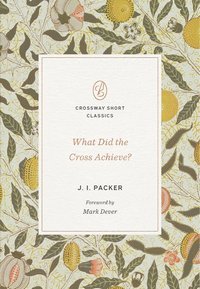
What Did the Cross Achieve? by J.I. Packer: A Beginning of an Answer to a Vital Question

What Did the Cross Achieve?What Did the Cross Achieve?

by J.I. Packer, Mark Dever (Foreword)

DETAILS:
Series: Crossway Short Classics Series
Publisher: Crossway
Publication Date: August 29, 2023
Format: Paperback
Length: 109 pg.
Read Date: August 27, 2023
Buy from Bookshop.org Support Indie Bookstores

Some Thoughts on the Series as a Whole

The point of this series is to take classic short works—sermons, tracts, articles—package them attractively, edit a bit (modernize language, eliminate footnotes, tweak grammar, etc.), and make them widely available. Each is given a short introduction to help the reader get the context and a bit of information about the author.

They published seven books in this series last year, and I discussed them here. Three have come out this year (so far), but I’m hoping for more in this series soon.

What’s What Did the Cross Achieve About?

This essay was originally a lecture Packer delivered but it lives on far after that time. It’s essentially a defense of the Penal Substitutionary Theory of the Atonement—and a critique of some alternate theories. Which is not to say that Packer doesn’t have some words of correction for other proponents of substitutionary atonement, nor is he without appreciation for alternate theories.

Packer holds that when people like Socinius attacked the Reformation’s preaching and teaching on the atonement, the Reformed (in particular) responded to his rationalistic arguments on the same grounds—and spent centuries refining things along those lines, losing the declaratory, doxological, and kerygmatic power of the doctrine. For this “preliminary survey,” he states:

My plan is this: first, to clear up some questions of method, so that there will be no doubt as to what I am doing; second, to explore what it means to call Christ’s death substitutionary; third, to see what further meaning is added when Christ’s substitutionary suffering is called penal; fourth, to note in closing that the analysis offered is not out of harmony with learned exegetical opinion. These are, I believe, needful preliminaries to any serious theological estimate of this view.

So, what did I think about What Did the Cross Achieve?

Can we then justify ourselves in holding a view of the atonement into which penal substitution does not enter? Ought we not to reconsider whether penal substicution is not, after all, the heart of the matter? These* are among the questions that our preliminary survey in this lecture has raised. It is to be hoped that they will receive the attention they deserve.

* And other questions that I snipped due to lack of context.

This was a good reminder to me of just how good J.I. Packer was—it’s been a long time since I’ve read a much by him, and it’s easy to remember really liking his writing and learning a lot from him, but to forget most of the details. And then you read him and are reminded why I spent so much of the 90s immersed in his work.

His approach to the idea was great and easy to follow. This wasn’t for a popular audience, but the language isn’t that difficult to follow. I appreciated and benefited from his argumentation—and thought his analysis and argumentation were spot-on (and would still be pretty sufficient for what I’ve seen for people today who struggle with penal substitution).

Essentially, this was a great way to spend an hour or so, one of the best of this series, and one I’ll return to again and again. I’d suggest you do the same.


4 1/2 Stars

This post contains an affiliate link. If you purchase from it, I will get a small commission at no additional cost to you. As always, the opinions expressed are my own.
Irresponsible Reader Pilcrow Icon

20 Books of Summer 2023: Wrap Up and Other Summer Reading

20 Books of Summer
Summer’s Over, so how did I do at this year’s challenge run by Cathy at 746 Books.

By the skin of my teeth—and using my own (not Cathy’s) dates—Memorial Day through Labor Day, the unofficial US Summer—I made it. I knew back in July when I said I should have a week to spare that I was going to be getting myself into trouble. What I didn’t know was that my library was going to deliver a book to me that was going to take 4 days longer to read than I’d expected (and I’d assumed it’d take me 5 in the first place). Throw in a Book Tour last week, and well, I had to scramble. Thankfully, the last book I had to read was a blast and I tore through it without regard to the deadline (honestly, I’d given up on finishing the challenge and only did it inadvertently), finishing it mid-morning today.

As of this morning, I’ve only posted about 13 of the books—that’s going to take me a bit to finish, especially at the rate I’ve been going lately.

On the whole, I’m glad I picked the books that I did. I might not have fallen head-over-heels for them all, but I’m glad for the experience, glad I scratched a curious itch, and/or glad I cut down the size of my TBR (we’ll ignore how I worked against that this summer for the moment). This might have been my most satisfying 20 Books yet. I had a lot of fun—which is the point, right?

Oh, I almost forgot. I did substitute one read, a totally acceptable thing for the Challenge, but something I typically resist. I’d been saying that I was going to read, Spirelli Paranormal Investigations: Episodes 1-3 by Kate Baray for months (even before I posted my 20 Books). But it turns out that I’d bought and read Spirelli Paranormal Investigations: Season One: Episodes 1-6, which is roughly 300 pages longer. So, yeah, it was a substitution, but a substitution that took 300 more pages to read. So, it really didn’t do me any favors when it came to completing this challenge (although having all six episodes was far more satisfying).

Also, earlier this summer I posted Top Ten Tuesday: Books on My Summer 2023 to-Read List (That Aren’t on My 20 Books Challenge). How’d I do with those? I’ve read seven of those and should be tackling the other three soon. Possibly this month. Hopefully this month.

But for the immediate future, I have two Book Tours in the next week or so, two other review copies that I want to post about really soon—and a couple of NetGalley reads I need to take care of, too. That almost sounds like work, but thankfully, it’s work I want to do (even if I don’t get paid for it. All in all…it’s been a good summer.

✔ 1. The Curse of the Silver Pharaoh by Pip Ballantine and Tee Morris (my post about it)
✔ 2. Spirelli Paranormal Investigations: Season One: Episodes 1-6 by Kate Baray (substitution)
✔ 3. The Lemon Man by Ken Bruton (my post about it)
✔ 4. The Flood Circle by Harry Connolly
✔ 5. Barking for Business by E.N. Crane (my post about it)
✔ 6. Random Sh*t Flying Through the Air by Jackson Ford (my post about it)
✔ 7. Eye of the Sh*t Storm by Jackson Ford (my post about it)
✔ 8. A Sh*tload of Crazy Powers by Jackson Ford
✔ 9. The Ink Black Heart by Robert Galbraith
✔ 10. Stone of Asylum by Hilarey Johnson (my post about it)
✔ 11. Proxies by James T. Lambert (my post about it)
✔ 12. Teaching Moments by Troy Lambert
✔ 13. Stray Ally by Troy Lambert (my post about it)
✔ 14. Cutthroat Cupcakes by Cate Lawley (my post about it)
✔ 15. Shadow Ranch by Rebecca Carey Lyles
✔ 16. Pure of Heart by Danielle Parker (my post about it)
✔ 17. The Worst Man by Jon Rance (my post about it)
✔ 18. However Long the Day by Justin Reed (my post about it)
✔ 19. Klone’s Stronghold by Joyce Reynolds-Ward (my post about it)
✔ 20. Fuzzwiggs: The Switcheroo by Amy Maren Rice

20 Books of Summer '23 August Check In Chart

God to Us: Covenant Theology in Scripture by Stephen G. Myers: A Great Introduction to This Vital Idea

God to UsGod to Us:
Covenant Theology in Scripture

by Stephen G. Myers

DETAILS:
Publisher: Reformation Heritage Books
Publication Date: November 27, 2021
Format: Hardcover
Length: 310
Read Date: June 11-August 22, 2023
Buy from Bookshop.org Support Indie Bookstores

Disclaimer

Some friends and I read this book at the same time, getting together to talk about it periodically. So it’s entirely possible, even likely, that some of what I say in this post is a thought borrowed from someone else. This will particularly be true if I say something insightful or interesting.

What’s God to Us About?

This is, pretty simply, an introduction to Covenant Theology. Myers defines covenant in his introduction (with special focus on the words used, and meanings suggested, in the Old Testament, New Testament, and Septuagint). From there, he gives a brief history of the development of Covenant Theology throughout Church History, which is probably worth a book unto itself—but this chapter serves well enough.

From there he looks at the three predominant covenants in Scripture/Theology—the Covenants of Works, the Counsel of Peace, and the Covenant of Grace. He spends two chapters on the Covenant of Grace—one on understanding the covenant and then one on the circumstances surrounding the announcement of the Covenant and what we can learn from that (and this is one of those chapters worth the purchase price of the book alone). He then looks at the developing covenants that make up the Covenant of Grace—the Adamic, Noahic, Abrahamic, Mosaic, Davidic, and New Covenant. Myers then looks at Covenant Theology in the New Testament and then in The Church. The Mosaic Covenant is another Covenant that gets two chapters (the rest all get one)—the second looks at the ways the New Testament writers think about and use the Mosaic Covenant.

Highlights of the Book

I like to focus on one or two chapters that really stand out to me when talking about books like this. Myers made this very difficult for me—I’m tempted to say Chapters 2-12 were highlights, but that seems to be cheating. It’s true, though—there’s something in each of those chapters that made me sit up and pay attention in a way I didn’t expect.

I guess I would have to say that the chapter on the Noahic Covenant was particularly effective—usually, I tend to think (and think I’ve seen authors treat it this way) about the Noahic Covenant being something covered just to check a box between Adam and Abraham—it’s where the word covenant is first used, so we need to look at it, but it’s not that big of a deal. Myers won’t let you think that way, showing how it’s a pivotal step in Redemptive History—and I’ll not make that mistake again.

Chapter Nine, “The Mosaic Covenant in the New Testament,” is so vital and so important that I have to mention it. Not only does Myers help the reader understand what the NT is doing, but he also helps the reader avoid some of the more popular and prevalent errors regarding this understanding today. The same could be said for Chapter Eleven, “The New Covenant.”

And if I’m not careful, I’ll list the other chapters, too—so I’m going to move along.

Things I Wasn’t Crazy About

I’m not going into details, but Myers uses Gen. 6:18 extensively in his arguments about God establishing covenants in Genesis before the word “covenant” was used. He’s not the first to do so—O. Palmer Robertson mentions someone (some people? I don’t remember and am not going to go look it up) doing the same in a footnote in his 1987 book, The Christ of the Covenants. It seems to be a perfectly valid argument—but I wonder if Myers relies on it too much. Yes, he uses a multi-pronged argument, and Gen. 6 is just one of them—but it seems to be called to do more than it maybe can.

Secondly, and I know I didn’t catch this, that’d be one of the others I read it with. Myers uses the early chapters of Hosea to substantiate his position on what the exiles of the Northern and Southern Kingdoms mean for the Davidic Covenant (and the Covenant of Grace as a whole). There’s much to be commended for his position—but a lot of what he says about the early chapters of Hosea seems to differ from what Hosea says later on. Now, if I studied this portion of this book a bit more, I might have an easier time defending Myers’s position—but at first and second glance, he seems to stumble a bit here.

Lastly, and this is a very minor problem, the thirteenth chapter, “Covenant Theology and the Church,” is a bit of a letdown. Your results may (and likely will) vary. But for me, after twelve chapters with insights that impressed me when they didn’t teach me and/or helped me to think about Covenant Theology in a new way, to come across a chapter about the sacraments, Church membership, and related ideas that was as basic and straightforward as this just left me wanting more. I didn’t see any problems in what Myers said, but it all seemed a bit too obvious. He’s been sailing along

So, what did I think about God to Us?

I loved this book. I’ve read more books on Covenant Theology than I can easily count, and if this isn’t the best, it’s so close to it as not to matter. Myers gives his readers a thorough introduction to Covenant Theology as it came to the Protestant Church from the Reformation—particularly the English Reformation and the explanation offered by the Westminster divines and their contemporaries. His introduction is readable, clear, and helpful to the layman willing to put in a little work—but he’s not just repeating what the previous generations gave us, he’s looking at contemporary theology and insights as well.

Is it perfect? Nope. Are there more problems with it than those I mentioned above? Almost certainly. But it’s just so good that the flaws are forgivable. I learned a lot—even if it was just a better way to state what I’d already believed and understood—but I got much more than that from the book. It’s such a helpful work.

More than that—as all good theology should, it led me to doxology. That our Lord would condescend to His people in covenant is mind-blowingly gracious in the first place—that He does so to rebels in order that he could win them to Himself? That should drive us to worship. And the more we understand the gracious and remarkable nature of these covenants, the more we should be driven to it. Myers brings his readers to this point repeatedly—sometimes just by explaining something clearly—sometimes by applying his explanation to the reader to help us understand how it should make us reflect in worship.

I’ve tried to keep this brief and to resist the urge to dive deeply into some of the areas of the book that I would want to if this was the place for deep dives into Theology. But this is about books, so I’m not going to. I cannot say enough good things about God to Us. It’s just great. I’ve given it as a gift already, I will do so in the future as well as recommend it to anyone who asks for a good intro to the topic. Also, I commend it to whoever reads this post.


5 Stars

This post contains an affiliate link. If you purchase from it, I will get a small commission at no additional cost to you. As always, the opinions expressed are my own.
Irresponsible Reader Pilcrow Icon

I’m Curious: What Are Some of the Funniest Books You’ve Read?

I know, I know, this can be a moving target (and should be, depending on where you are in life)…

But I’m still going to ask: What is the funniest, or what books are amongst the funniest, you’ve read? I’m looking over the books I have coming up for the rest of the year, and by and large, we’re talking about some dark reading. I could use some laughs…so help me find an idea or three, will you?

Here’s my rather incomplete answer (that I ripped off from something I told K.R.R. Lockhaven last year). I should probably tweak this list before I publish, but I don’t have the time…

Off the top of my head…
bullet The Hitchhiker’s Guide to the Galaxy by Douglas Adams (well, everything Adams wrote)
bullet Mechanical Failure by Joe Zieja
bullet The Fran Lebowitz Reader
bullet The Android’s Dream by John Scalzi
bullet Heartburn by Nora Ephron
bullet Dave Barry Slept Here by Dave Barry
bullet The Spellman Files by Lisa Lutz
bullet White House Mess by Christopher Buckley
bullet Sir Apropos of Nothing by Peter David
bullet Is Everyone Hanging Out Without Me? by Mindy Kaling
bullet High Fidelity by Nick Hornby
bullet You’ll Never Believe What Happened to Lacey: Crazy Stories About Racism by Amber Ruffin,
Lacey Lamar
bullet The Tales of Pell by Delilah S. Dawson, Kevin Hearne

Incidentally, you should read the entire series of interviews Lockhaven did about humor in fiction–some great things were said, and then there was my entry, too.

I look forward to your recommendations!

Page 20 of 63

Powered by WordPress & Theme by Anders Norén