Category: Non-Fiction Page 31 of 62

In Divine Company by Pierce Taylor Hibbs: Communication Failure?

In Divine CompanyIn Divine Company: Growing Closer to the God Who Speaks

by Pierce Taylor Hibbs

DETAILS:
Publication Date: June 7, 2018
Format: Kindle Edition
Length: 43 pg.
Read Date: June 5, 2022

God is a communicative being who speaks with himself in three persons and speaks to his creation by way of revelation. This communicative nature of God is utterly critical. The moment we say God does not speak in any recognizable sense is the moment we throw our theology in the wastebasket, along with any hope of relationship. Speech is at the core of who God is, and it’s how we come to know him.

What’s In Divine Company About?

Like many, Hibbs sees a problem in the prayer life of most Christians, and it plays a significant role in the feeling too many have of being distant from God. He calls this a “communicative malnourishment.”

His treatment for CM is two-pronged:

predictable, I think, but I hope to look at it in fresh ways: (1) following God’s voice in Scripture and listening to what the world is saying about him (hearing from God), and (2) praying to the Trinity (speaking with God).

This short booklet looks at God (and then His people) as communicative beings, as language as communion behavior. God’s communication comes from General and Special Revelation, ours is in prayer.

What did I think about In Divine Company?

If you read this book and change nothing in your life, then either I have failed as a writer or you have failed as a responsive reader…I want to be forthright in saying change is the most important measure of value for this book. So, I encourage you to read and grow, not merely to read and know.

If it’s the most important measure of value for the book, it’s really the best way to evaluate the book. It’s too soon for me to say how much this book has changed me, it’s only been a week—but I think the potential is there.

I love this approach to thinking about prayer and the problems with our prayer life. By better understanding the nature of our communicative God, we better understand our need (as image-bearers) to communicate with Him. Communication is part of our nature as it is His nature, how can we not communicate with him, and seek to find more ways and more time to do so? To be better listeners and better talkers?

Hibbs has got to be my favorite theological writer today. There are theologians that I learn more from, but none that I enjoy reading like him—it only makes sense, he cares a bit more about language and writing than your typical theologian.

This is good for the mind and offers plenty of tools to use for change. The rest is up to the reader.


4 Stars

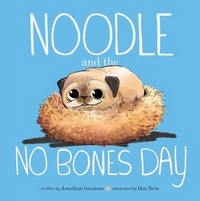
Noodle and the No Bones Day by Jonathan Graziano, Dan Tavis (Illustrator): A Great Dose of Adorableness to Pick Up Your Day

Noodle and the No Bones DayNoodle and the No Bones Day

by Jonathan Graziano, Dan Tavis (Illustrator)

DETAILS:
Series: Noodle and Jonathan
Publisher: Margaret K. McElderry Books
Publication Date: June 6, 2022
Format: Hardcover
Length: 32 pgs.
Read Date: June 8, 2022
Support Independent Bookstores - Visit IndieBound.org

What’s Noodle and the No Bones Day About?

I’m going to assume you, dear reader, are like the 74.3% of humanity and are aware of Noodle (and, as an afterthought, Graziano). Last year Noodle took over the Internet—magazines, websites, TV news shows, social media, etc., etc., etc. People all over the world checked-in daily to see if that day was going to be a Bones Day (where Noodle, an elderly pug, wanted to get up and go for a walk) or a No Bones Day (where Noodle just wanted to stay in bed and relax all day).

This little book tells their story. It starts off describing their life—and then focuses on the first No Bones Day. Noodle isn’t sick, he isn’t depressed or anything. He just needs to spend a day getting pampered—bonus belly rubs, bonus snuggle time, and bonus snacks. Who can’t relate to that?

What About the Illustrations?

I skipped over half the words the first time I opened the book to pour over the illustrations—and I’m telling you, that never happens with me. Even in picture books, words are my priority. Typically, anyway.

These are simple drawings—there’s not a lot of clutter on the page, or background details. Just a man and his pug and their emotions. The picture where you can’t see Noodle’s face, only the rest of his body (tail end sticking up in the air) as he burrows into his bed is asymptotically close to Aristotelian perfection. The rest of them ain’t bad, either.

Dan Tavis is a gem. I have bookmarked his site to shop in case I have to activate Grandpa Mode and need to equip my home and have picked out a couple of things from his Etsy shop that would look good on my walls)

So, what did I think about Noodle and the No Bones Day?

Is this the most adorable book that I’ve read this year? Hands down. Will something come along and usurp it? Doubtful (but, please, suggest contenders—I’m sure I could use the pick-me-ups in the months to come).

There’s a good reminder—especially for the grown-up reading this book to a child—that there are times when someone needs a day (or even a few minutes) to step back from their normal activities to show someone some extra attention and affection. Or be shown that. Even just taking the few minutes necessary to read this book to a child would be a good start.

This is a cute book. It is sweet. Nigh-unto-irresistible. The illustrations made (and make) me smile. It is perfect to use to cuddle up and read to a child and/or beloved pet. If you’re a fan of Noodle (and, I suppose, Graziano), you’re going to enjoy it. If you’re not a fan of either of them, buy this and improve your life.

It’s also a reminder that the dog in your life probably wants and deserves a snack right now. Best get on that.

This post contains an affiliate link. If you purchase from it, I will get a small commission at no additional cost to you. As always, any opinions expressed are my own.

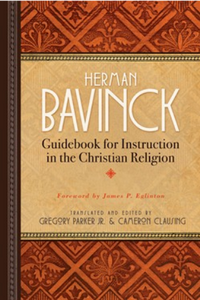
What Is Christianity? by Herman Bavinck, Gregory Parker Jr. (Translator): Short, Sweet, To the Point

What is Christianity?What is Christianity?

by Herman Bavinck, Gregory Parker, Jr. (Translator)

DETAILS:
Publisher: Hendrickson Academic
Publication Date: May 17, 2022
Format: Paperback
Length: 83 pg.
Read Date: May 29, 2022
Support Independent Bookstores - Visit IndieBound.org

After all, [mankind’s] deepest needs always boil down to the fact that all that is finite rests in the Infinite and Eternal One, who cannot be thought of in any other way than as a just and holy God who hates sin and is far removed from wickedness. But if there is to be any talk of comfort and peace for mankind, then this just and holy God must also be a merciful and gracious Father, who reconciles and forgives sin, frees us from guilt, and accepts us as his children out of grace. And finally, he must also be the Almighty and Faithful One who can realize what he promises and who, in the course of regeneration and sanctification, transforms the world and mankind into a kingdom of God.

These are the ineradicable needs of the human heart. But they are also the basic ideas of Christianity, which stand before us in historical facts as monuments. The apostolic benediction of the love of the Father, the grace of the Son, and of the fellowship of the Holy Spirit is the core of the universal, undoubted, Christian faith [2 Cor. 13:14].

What’s What is Christianity? About?

These are two short works by the noted Dutch Theologian newly translated into English. The second piece is an essay he wrote in 1883 called “The Christian Faith” (and because it’s the way my mind works since it was written first, I had to read it first).

The first piece is a small book called Christianity that was published in 1912 as part of a series of books called Great Religions. In this work, he starts by talking about who Jesus is, then covers the life of Jesus and those aspects of the Christian faith common to all its branches. From there he gives a survey of this history of doctrine that is both concise and thorough (in a way I wish I could emulate), before landing on and summarizing a Reformed Protestant understanding of the Faith.

A Nice Touch

Before the text, Parker reprinted a brief review from The Princeton Theological Review of Christianity. It was nice to see a contemporary take on the work from a trusted name to see that what people think of Bavinck now is pretty much what people thought of him then.

So, what did I think about What is Christianity??

These are apologetic works to be sure, but they aren’t aggressive or all that assertive. Bavink is clear and convincing without being combative. Typically for him, he displays a catholicity in his approach—he’s clearly Reformed Protestant, but he doesn’t disparage other views.

Bavinck has a reputation (somewhat deserved) as being a difficult author to read and comprehend. This small book demonstrates pretty conclusively that he’s not always difficult.

I don’t know he accomplishes all he does in so few pages—there’s a lot of subtle theological and apologetic work, here. But there’s also a lot that’s just easy to digest, clear and helpful. Bavinck gives his readers a Christ-centered, Christ-focused definition and description of Christianity (you’d think that’d be a given, but…). As Warfield put it, “We cannot imagine how the work could be done better.”


4 1/2 Stars

This post contains an affiliate link. If you purchase from it, I will get a small commission at no additional cost to you. As always, opinions expressed are my own.

Black Nerd Problems (Audiobook) by William Evans & Omar Holmon: Essays on Life, Race, and Nerddom

Black Nerd ProblemsBlack Nerd Problems:
Essays

by William Evans & Omar Holmon

DETAILS:
Publisher: Simon & Schuster Audio
Publication Date: September 14, 2021
Format: Unabridged Audiobook
Length: 7 hrs.,  53 min.
Read Date: May 24-26, 2022
Support Independent Bookstores - Visit IndieBound.org

What’s Black Nerd Problems About?

Let’s just go with what’s on the Publisher’s website to make things easier:

The creators of the popular website Black Nerd Problems bring their witty and unflinching insight to this engaging collection of pop culture essays—on everything from Mario Kart to issues of representation—that “will fill you with joy and give you hope for the future of geek culture” (Ernest Cline, #1 New York Times bestselling author).

When William Evans and Omar Holmon founded Black Nerd Problems, they had no idea whether anyone beyond their small circle of friends would be interested in their little corner of the internet. But soon after launching, they were surprised to find out that there was a wide community of people who hungered for fresh perspectives on all things nerdy.

In the years since, Evans and Holmon have built a large, dedicated fanbase eager for their brand of cultural critiques, whether in the form of a laugh-out-loud, raucous Game of Thrones episode recap or an eloquent essay on dealing with grief through stand-up comedy. Now, they are ready to take the next step with this vibrant and hilarious essay collection, which covers everything from X-Men to Breonna Taylor with “alternately hilarious, thought-provoking, and passionate” (School Library Journal) insight and intelligence.

A much needed and fresh pop culture critique from the perspective of people of color, “this hugely entertaining, eminently thoughtful collection is a master class in how powerful—and fun—cultural criticism can be” (Publishers Weekly, starred review).

The Fun

This looked like a promising and enjoyable collection (otherwise, why would I have bought it?), and the first few essays indicated that it would be. Then came the fifth essay, “Into the Spider-Verse Got Three Moments Better Than the Best Moment of Your Favorite Comic Book Movie Not Named Into the Spider-Verse. Wow. I listened to it twice (and would probably play it again right now if I had the time). It was more than I could’ve hoped for—funny and insightful, full of joy and intelligence. My expectations had been exceeded and the bar for the rest of the book was raised—thankfully, the essays were up to it.

I’m not going to go on and on about all the essays I wanted to rave about but “Jordan Peele Should Get His Flowers While He’s Here” and “Top Five Dead or Alive: Red Hood in the DC Animated Universe” were almost as good. Words cannot express how much fun I had with “Mario Kart Reveals Who You Truly Are.”

The Serious

After Tamir Rice was killed in Cleveland, I called my father and we had some very sparse conversation before he began theorizing on the role of fiction in our non-fiction lives. Every once in a while, I get these notions that I can outwit my father into pulling some emotional tether to him. I asked him if we love fantasy in fiction as a way to escape every day life, but I think I meant, does he use fiction in this way. He answered, “It’s not an escape, it’s hope. The good guys win and life has value in a fantasy story. It’s not about getting away from something, it’s about inserting hope into what you can’t outrun.”

They’re not as fun, but the essays where they address serious topics through the prism of nerd culture/nerd cultural artifacts are even better.

I couldn’t relate—at all—to “My Theory on How Black Folks’ Black Card Actually Works,” but I loved that essay. I thought the approach of “Green Lantern COmics Have Low-Key Been Tackling Police Accountability for a Minute” was inspired. I loved “Chadwick Boseman’s Wakanda Salute Is Canon in the History of Black Language.” “The Sobering Reality of Actual Black Nerd Problems” was powerful and (as it promised) sobering.

I was surprised by “Go On: An Evergreen Comedic Series That Helped Me Navigate Loss”—it seemed so far out of the bailiwick of the rest of this book that it took me a minute to remember what show they were talking about. I was one of the 7 other people in the U.S. that watched it all, but I didn’t relate to it the same way as Holmon did. After that essay, I wanted to go find it online and rewatch the entirety of the series (alas, no streamer carries it).

How Was the Narration?

It was fantastic. Holmon and Evans begin the book by talking about meeting at poetry slams—they know what they’re doing behind a microphone. They deliver these essays (mostly separately, but occasionally together) with passion and panache.

I kept the speed on this audiobook low because I enjoyed the narration enough that I didn’t want it to pass by. I’d have easily listened to another 7+ hours and enjoyed it all.

So, what did I think about Black Nerd Problems?

I wanted to make all of the previous sections about two times as long—but I’m entering into that dreaded Chris Farley “Remember when….? That was cool” territory. So I made myself stop.

I’ve never been a manga or anime guy—despite a few attempts at it. So I have no opinion on the content of the essays addressing them. The essays themselves made me wish I was a manga or anime guy so I could really connect with them. As for the rest of the essays? They all worked. I could appreciate them when I didn’t agree with them, and when I agreed with them, I pretty much loved what I heard. I disagree with a lot of the politics discussed, but the way they described them won me over every time—I was always entertained, too. That’s all I want in a book like this coming from a different perspective—you don’t need to convince me that you’re right, just bring a good argument I can appreciate, and, hopefully, entertain/engage me in the manner of the rest of the book.

This mix of thoughtful cultural and social observation with pop culture freak out is exactly what I want to read/listen to. It’s what I want to write, honestly, if I weren’t held back by a lack of both talent and insight combined with the laziness too great to overcome that lack. But when it’s done as well as Evans and Holmon? I’ll just sit back, take it in, and enjoy it. Even when (especially when?) I think they might be wrong about something.

If there’s a volume 2 of this, I will jump on it faster than the Falcon can do the Kessel run. If either writer puts out a book that’s not poetry? I’ll hop on board, too. They’ve made this white nerd a fan.


4 Stars

This post contains an affiliate link. If you purchase from it, I will get a small commission at no additional cost to you. As always, opinions expressed are my own.

20 Books of Summer 2022: Kickoff

20 Books of Summer
Cathy at 746 Books is hosting 20 Books of Summer again. This challenge has been fun the last couple of years, and has proved to be a good way for me to actually read some of those “I need to read those one day” books. I’m being very ambitious this year with some of my selections, but some of those are pulling double-duty and are taking care of another reading challenge, too. It’s going to be an actual challenge to get all of these read, but I think I’m up for it. It’s a little risky with two trilogies and three books from another new-to-me series—I could end up really disliking myself, but I really want to clean up some of my shelves, you know?

I’m going with the unofficial US Dates for Summer—Memorial Day to Labor Day (today through September 5th), just because it’s easier for me to think that way. And I’ve needed those first few days of September the last two years, but let’s not think about that. Well, I say I’m starting today, but it’s going to be next Tuesday at the earliest that I get to read one of these books…proper planning and all that…

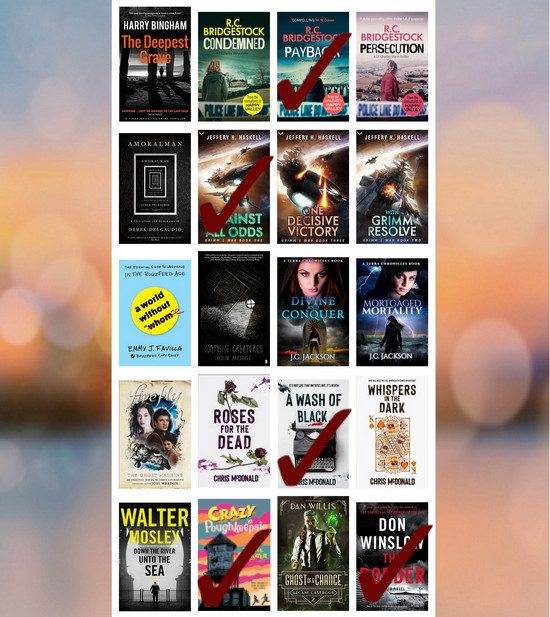
This summer, my 20 are going to be:

1. The Deepest Grave by Harry Bingham
2. Condemned by R.C. Bridgstock
3. Payback by R.C. Bridgstock
4. Persecution by R.C. Bridgstock
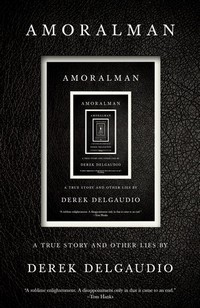
5. AMORALMAN: A True Story and Other Lies by Derek DelGaudio
6. Against All Odds by Jeffery H. Haskell
7. One Decisive Victory by Jeffery H. Haskell
8. With Grimm Resolve by Jeffery H. Haskell
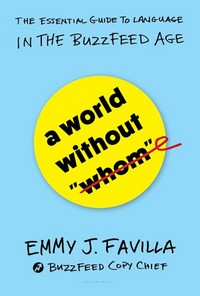
9. A World Without Whom: The Essential Guide to Language in the Buzzfeed Age by Emmy J. Favilla
10. Composite Creatures by Caroline Hardaker
11. Divine and Conquer by J.C. Jackson
12. Mortgaged Mortality by J.C. Jackson
13. The Ghost Machine by James Lovegrove
14. Roses for the Dead by Chris McDonald
15. A Wash of Black by Chris McDonald
16. Whispers in the Dark by Chris McDonald
17. Down the River unto the Sea by Walter Mosely
18. Crazy in Poughkeepsie by Daniel Pinkwater
19. Ghost of a Chance by Dan Willis
20. The Border by Don Winslow

(subject to change, as is allowed, but I’m going to resist the impulse to tweak as much as I can).
20 Books of Summer '22 Chart

Augustine of Hippo: His Life and Impact by Bradley G. Green: A Protestant Introduction to this Important Father

Augustine of HippoAugustine of Hippo:
His Life and Impact

by Bradley G. Green

DETAILS:
Series: The Early Church Fathers
 
Publisher: Christian Focus Publications
Publication Date: November 6, 2020
Format: Kindle Edition
Length: 224 pg.
Read Date: May 22, 2022
Support Independent Bookstores - Visit IndieBound.org

At the end of the day, we stand on the shoulders of giants. One of the giants of giants is undoubtedly Augustine. Protestants and Catholics will continue to read him and mine his works, which is as it should be. He built the edifice of Western theology, and one simply cannot grasp the nature and contour of Western theology without going through Augustine.

What’s Augustine of Hippo About?

This is a mini-biography of Augustine and an overview of his more significant writing and teaching.

As a biography, the emphasis is on Augustine’s early life up through being made a priest—and it tends to gloss over everything else. It was interesting—even if a lot of it was common knowledge (if it can be said that anything about a Church Father is common knowledge).

Then it moves into an overview of some of Augustine’s teachings and the controversies he was involved in—the Pelagian controversy and his struggles against the Donatists in particular.

Strengths

I thought the material on the nature of God and The Trinity was very helpful. The section on the Donatists was great—and not just because that’s something I’ve been meaning to read about for a dozen years.

The chapter “Augustine and the Protestant,” was a great addition to this book. Green’s honest about the differences between Augustine and those who’d claim to follow him during and after the Reformation. But he’s also good at pointing out where Augustine would have common ground with us, and it’s good to see how Protestant thought developed Augustine.

The Series

I literally stumbled on to this series, The Early Church Fathers, a few weeks ago and thought it sounded like a great idea. It looked kind of like a mix of Crossway’s Theologians on the Christian Life and Oxford’s Very Short Introductions (incidentally, that’s what it ended up being).

I picked this one to start with because while I’m no Augustine expert at all, I’m familiar enough with him—his life and writing—to have a rough idea about how to evaluate the book. If I’d picked Basil or Patrick, there’s be more guesswork involved.

So, what did I think about Augustine of Hippo?

First, as I began to lay out my writing and reading agenda, and to think through how to structure the book, one thought kept pressing itself upon me: I want to write a book that I would hand to someone who asked: ‘What would you recommend to me if I wanted to begin to understand Augustine?’ Life is too short for ‘just another book’ on Augustine. So, I hope you find that this is a book about which you can say: ‘It gave me a good overview of who Augustine was and what he thought.’ Second, this book is written by someone committed to the theological perspective of the Protestant Reformation. Rather than be coy or even duplicitous, it is best to be straightforward on this point.

On those terms, the book was a success. I really thought this was great—I really liked both the look at his life and his writings. Green provided an overview of Augustine and his thought that covers all the basics, and while it may not get into the weeds on everything—he at least points out where some of the weeds are.

You can’t be thorough in 200 pages when it comes to someone like Augustine (it can’t be done when it comes to most people—and most people aren’t Augustine) and Green doesn’t even pretend to try. This is about the essentials. This is about beginning to understand.

Yes, Roman Catholics are going to have some problems with what he says about Augustine. But I think he made a good-faith effort to not just get Augustine on his side (as he says a couple of times).

This is an easy read, but still thoughtful. It’ll also make the reader want to read more about Augustine* and maybe take Green’s advice on where to start reading the man himself.

* Like maybe the entry on Augustine in the aforementioned Crossway series.


3.5 Stars

This post contains an affiliate link. If you purchase from it, I will get a small commission at no additional cost to you. As always, opinions are my own.

The Doctrine of Scripture: An Introduction by Mark D. Thompson: A Strong and Helpful Entry this Series

The Doctrine of ScriptureThe Doctrine of Scripture:
An Introduction

by Mark D. Thompson

DETAILS:
Short Studies in Systematic Theology
Publisher: Crossway
Publication Date: April 26, 2022
Format: Paperback
Length: 185 pg.
Read Date: May 15, 2022
Support Independent Bookstores - Visit IndieBound.org

The Christian doctrine of Scripture is an integrated account of the word of the living God given to us in written form through the conscious, creative, yet faithful agency of human servants especially prepared for this work, and attended at every point by the Holy Spirit. As a doctrine, it does not arise from isolated and unusual “proof texts.” Instead, it emerges from a broad and deep biblical theology and is ultimately anchored in the being and character of the triune God. At its center is Jesus Christ, the incarnate Word, who himself appealed to the written word, both endorsing and fulfilling the Old Testament and, through the commission he gave to his apostles and the promise of his Spirit, authorizing the New Testament.

What’s The Doctrine of Scripture About?

This seventh volume in the Short Studies in Systematic Theology series addresses (as the title states), the doctrine of Scripture.

Thompson grounds his discussion in Christ’s view of Scripture—how he uses it, refers to it, and points people to that. If that’s his view, then those who follow him ought to share it. From there, he discusses God’s speaking to his people as depicted throughout Scripture—as He is a communicative God, we ought to rightly esteem and study that communication—starting with the spoken word and then the record of it—as well as the rest of the written revelation given to us. He then explains the attributes—or character—of Scripture: clarity, truthfulness, sufficiency, and efficacy. The book then closes with some guidance and encouragement for how the believer ought to use scripture—how we are to be discipled by it.

Highlights

I typically like to address highlights in a book like this—sadly, I don’t think I can really point to any. I can’t point to a chapter or two, or line of argumentation, or anything that I thought was more valuable, made a bigger impact on me, or anything else. It’s a strange feeling, really. Each chapter was equally strong—it’s not often you find a book like that.

I guess the strongest part of the book was Thompson’s approach—he kept it centered on Christ. Nothing against other books on the Doctrine of Scripture or Sola Scriptura, etc.—but few of them focus on Christ this way.

So, what did I think about The Doctrine of Scripture?

How a person responds to the word of God, spoken by Jesus or written in the Scriptures, has serious consequences. The most articulate confession of the nature of Scripture and the strongest affirmations of its authority mean nothing if a person is not willing to live under that authority with repentance and faith. In contrast Jesus once exclaimed, “Blessed . . . are those who hear the word of God and keep it!” (Luke 11:28).

This is one of the better entries in the series—it covers all the basics in clear, comprehensible terms, and then goes a little further, prompting the reader to further reflection and study.

A book this good deserves more than that sentence as an evaluation, but there’s not much more to be said. If you’re looking for a capable, accessible, and useful introduction to the Doctrine of Scripture—or a refresher on the essentials on this vital topic, you will be well served to give this a read.


4 Stars

This post contains an affiliate link. If you purchase from it, I will get a small commission at no additional cost to you. As always, opinions are my own.

This is Going to Hurt (Audiobook) by Adam Kay: It’s Funny Because It’s True. Also, Dispiriting Because It’s True

This is Going to HurtThis is Going to Hurt:
Secret Diaries of
a Junior Doctor

by Adam Kay

DETAILS:
Publisher: HarperAudio
Publication Date: March 7, 2022
Format: Unabridged Audiobook
Length: 5 hr., 47 min.
Read Date: May 17-18, 2022
Support Independent Bookstores - Visit IndieBound.org

Doctors must be psychologically fit for the job — able to make decisions under a terrifying amount of pressure, able to break bad news to us anguished relatives, able to deal with death on a daily basis. They must have something that cannot be memorized and graded; a great doctor must have a huge heart and a distended aorta which pumps a vast lake of compassion and human kindness.

What’s This is Going to Hurt About?

This book covers the years that doctor-turned-comedy writer Adam Kay spent as a junior obstetrics doctor in the NHS. I’m going to gloss over the various titles he had because it’s a different system than I’m used to, and I’d botch it—but basically, it’s the first few years post-medical school.

Essentially these are excerpts (details tweaked to everyone’s privacy) from his diaries from that time showing the day-to-day realities he faced. Told with a comedic bent, sure, but it’s just real life—a version of real-life that’s more exhausted, more stressed, and covered in more and various bodily fluids than most of us have, sure. It’s told very anecdotally, he’s not trying to construct a narrative here, just “here’s Day X, here’s Day X +2,” and so on.

He talks about preposterous situations he’s put in because of his low-ranking status and/or NHS regulations, he talks about funny situations with patients, ridiculous colleagues, unsympathetic friends, harrowing experiences, and just strange ones. Given his specialty, he deals with expectant mothers, newborns, clueless fathers-to-be, and heartbreak. We get the gamut here.

Bonus Material

The audiobook I listened to was released with the paperback release and contained some bonus material—a few more diary entries and an afterword. The afterword was essentially a rallying cry for people to support the NHS’s existence.

I don’t have a dog in this fight—but I found his arguments compelling, and I thought his support of the NHS throughout the book (while freely critiquing aspects of it) added some good and necessary grounding to the humor. The life and death aspect of the book did, too—obviously—but that’s common with medical memoirs, this is distinctive (at least in my limited experience)

So, what did I think about This is Going to Hurt?

Called to the Early Pregnancy Unit by one of the SHOs to confirm a miscarriage at eight weeks—he’s new to scanning and wants a second pair of eyes. I remember that feeling only too well and scamper over. He’s managed the couple’s expectations very well, and clearly made them aware it doesn’t look good—they’re sad and silent as I walk in. What he hasn’t done very well is the ultrasound. He may as well have been scanning the back of his hand or a packet of Quavers. Not only is the baby fine, but so is the other baby that he hadn’t spotted.

I audibly laughed—twice—during the Introduction, so I was instantly on board with this book. The laughs really didn’t let up. At times, I wondered if it was a little too jokey, and wished we got more of the narrative about his experience—but then he’d say something else funny and then I decided I didn’t care because he’s a good comedy writer. Bring on the jokes!

Like the best medical comedies (e.g., MAS*H (in all its forms), Scrubs), Kay intersperses the laughs with drama and tragedy—stories of hard-fought success and heartbreaking—even devastating—loss. That augments both ends of the spectrum—while you’re chuckling, you’re more open to feeling the empathy to appreciate the dramatic. When you’re reeling from a hard experience, you need the laughter. If Kay’s TV scripts are anything like this, I wish I could see some of his episodes.

Kay handles his own narration here and is great at it, wry detachment mixed with a no-nonsense delivery. He knows it’s funny, so he’s not trying to push the humor, he just trusts the material and lets it do the heavy lifting.

When the library told me that my hold for this was ready, I didn’t remember requesting it—wasn’t sure at all why I did. But I gave it a chance, and am so glad I did—it made for a very entertaining 5+ hours. I think you’ll find the same if you give it a try.


3.5 Stars

This post contains an affiliate link. If you purchase from it, I will get a small commission at no additional cost to you. As always, opinions are my own.

Repentance: Turning from Sin to God by Thomas Boston: Calls to Faith and Repentance as Clear Today As They Were 300 Years Ago

RepentanceRepentance:
Turning from Sin to God

by Thomas Boston

DETAILS:
Publisher: Christian Heritage
Publication Date: September 19, 2012
Format: Paperback
Length: 250 pg.
Read Date: May 1-8, 2022
Support Independent Bookstores - Visit IndieBound.org

What’s Repentance About?

This is a collection of sermons preached by Thomas Boston to his congregation in the parish of Ettrick in the early eighteenth century.

The sermons were selected from the sixth volumes of his collected works, and really weren’t conceived of as a set by him. They’re all on the theme of Repentance, from a variety of texts of Scripture.

They are warm, pastoral, clear, and firm. Pretty much everything you want and expect in a collection of Eighteenth-Century Presbyterian sermons.

Tweaking Boston

There were some layout changes and restructuring of the original texts for this book (it’s too long to detail it here)—basically taking works from the early 1700s and making them read like something that was written in the early 2000s.

It bugged me. It might make it easier to read and more approachable to contemporary readers, but it left a bad taste in my mouth.

Modernization of spelling and punctuation don’t bother me that much (I prefer to read it without the editing, but I’m weird that way). It’s the other tweaks that get to me.

The Introduction

Not at all surprisingly to anyone who’s ever read anything J.I. Packer ever wrote about Puritans and their successors the Introduction he wrote is almost as good as the rest of the book. It’s simply impossible to read that and not get ramped up for the rest.

So, what did I think about Repentance?

I like Boston—I’ve never not profited from time with his work. The Crook in the Lot is one of the greatest works I’ve ever read.

However (you knew there was a “but” coming), I’m not entirely convinced this collection is the best representation of either the doctrine or the preacher. As Packer notes, by the time of the later Puritans and then Boston, the emphasis on repentance had shifted from the penitent life (as espoused by Luther, Calvin, Book of Common Prayer, etc.) to the initial act of repentance of the convert. It’s that focus that dominates this book.

It’s good that it does. It’s important that it does. There’s not a word that Boston says on that point that is incorrect. But, I really could’ve used more about what repentance should look like every day, calls to/reminders for the believer to shape their lives that way. I realize that says more about me than the work, but given the title, that’s what I expected.

It’s a good collection of sermons. Boston’s way with words is rare and great to read. I just didn’t appreciate this as much as I’d hoped to.


3 Stars

This post contains an affiliate link. If you purchase from it, I will get a small commission at no additional cost to you. As always, opinions are my own.

Funny Farm (Audiobook) by Laurie Zaleski, Erin Moon: A Woman Rescues Herself, Her Kids, and a Big Bunch of Animals

Funny FarmFunny Farm:
My Unexpected Life with
600 Rescue Animals

by Laurie Zaleski, Erin Moon (Narrator)

DETAILS:
Publisher: Blackstone Publishing
Publication Date: April 25, 2022
Format: Unabridged Audiobook
Length: 8 hr., 10 min.
Read Date: May 9-10, 2022
Support Independent Bookstores - Visit IndieBound.org

I Did the Things You’re Not Supposed to Do

I judged this book by its cover.

I put this on my Want-to-Read this some months back, and really don’t remember why. All I really remembered is what I saw on the cover—it had to do with rescue animals, an “unexpected life”, and was called Funny Farm. The cover image has some friendly-looking animals. Something about it also reminded me of the cover of Straight Man by Richard Russo.

It looked to me like a light-hearted book full of animal stories, probably some that are inspirational, some that are funny, maybe some that are sad. Think James Herriot, David Rosenfelt (non-fiction that is), or Andrew Cotter. And while I read the publisher’s description, I’d forgotten it, so I just walked into this with my assumptions from the cover.

And you know what they say what happens when you assume…

So, What Is Funny Farm About?

It’s primarily the decades-long story of the establishment of the Funny Farm in its current form. It starts with Zaleski’s mother taking her and her two siblings and escaping from their abusive husband and father, dealing with both their poverty and continued harassment from him, and how they stumbled into Animal Rescue. From there we get a little about Zaleski’s outside career before we focus again on their mother’s relationship and battle with cancer, before getting a few chapters about the Farm’s permanent location and establishment as a non-profit organization.

More than anything else, this is a tribute to Zaleski’s mother—and a deserved one.

Animal Tales

The small, between-chapter, profiles/extended anecdotes about some of the Rescue’s animals are what I came for, and are absolutely worth it. I’d read another book full of nothing else. I don’t know that such a book would be a great read, but it’d be fun.

How was the Narration?

I liked the book, but I think I liked Erin Moon’s narration even more. She did a great job of bringing the text to life and augmenting the emotions.

I did think there was a weird New England-ish accent to the way she said “Mom”—particularly when she stretched it out a bit. I didn’t hear it at any other point, just that one word. It happened pretty frequently, and I bumped on it each time. Not a big deal, by any means, just something I noticed.

So, what did I think about Funny Farm?

I’d have liked it more had I come into it knowing what to expect—and that’s on me. Also, I probably wouldn’t have picked it up if I remembered what I was getting. Not that it’s bad, just not the kind of thing I put on a list to get.

There’s a warmth to the writing—even as it discusses the hardships her family endured, she writes from the perspective of someone who persevered and turned the experiences into something for the better.

While not loving the book, I really liked it—and have started following the Rescue’s social media accounts because I want to see some of this in action. It really sounds like a great organization. If you go into it with the right expectations, you’ll likely get more out of it than I did—give it a shot.


3 Stars

This post contains an affiliate link. If you purchase from it, I will get a small commission at no additional cost to you. As always, opinions are my own.

Page 31 of 62

Powered by WordPress & Theme by Anders Norén