Category: Non-Fiction Page 49 of 62

Death Valley Superstars by Duke Haney: Cautionary Tales about Hollywood

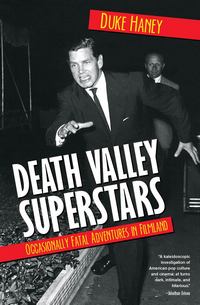
Death Valley SuperstarsDeath Valley Superstars: Occasionally Fatal Adventures in Filmland

by Duke Haney
Kindle Edition, 306 pg.
Delancey Street Press, 2018
Read: January 2 – 16, 2019

Duke Haney, actor, screenplay writer, novelist, essayist, has delivered a well-written collection of sixteen essays revolving around some of those impacted by, affected by, corrupted(?) by, shaped by Fame — that fleeting authority and celebrity bestowed by a chosen few in the Hollywood system that has captured the American imagination and attention since the 1900s.

The quality of the writing throughout was pretty consistent, as was the voice, etc., etc. But my own interest varied widely from piece to piece. I think that’s largely on me, not Haney. But then again, maybe Haney shouldn’t have picked topics that have been done to death. I’m not sure that the universe needs another essay/reflection/biography/anything about Marilyn Monroe, Lee Harvey Oswald, or Jim Morrison. It certainly doesn’t need any further effort to celebrate Hugh Hefner.

On the other hand, the pieces about Sean Flynn (son of Errol), William Desmond Taylor, Christopher Jones, and other people that I’d never heard of were fascinating. I learned something, I was introduced to people I’d missed out on. They weren’t slightly different takes on worn-out ideas about legends that have had dozens of books written about them.

Better yet were the pieces that were about his life — encountering Elizabeth Taylor as a youth, working on various films, his nude scenes, his crush on (and seen in retrospect, stalking) of a noted actress, the encounter with the lady on the bus talking about the video store they both frequented, even the part of the Jim Morrison essay about his quest to hire a psychic (it shouldn’t be that hard in L.A.) to do a séance in a hotel room Morrison lived in. He’s really his best — and most entertaining — subject (although when the subject of an essay is someone else, Haney tends to talk about himself too much). He doesn’t come across as someone trying to gloss over mistakes, missteps, or embarrassing moves — in fact, he seems to revel in them. These are honest (seeming), frequently funny and charming.

I have no doubt that there are plenty of people out there who will invert my rankings, or dispute them all together. And they’d likely be right to do so (I doubt they’d convince me, but you never know). Most collections I read are pretty uneven. This isn’t the case with Death Valley Superstars, I think the quality is consistent — it’s just my own reaction to the chapters that are varied. I’d wager the same will be true for other readers.

If nothing else, I think the above summary rundown demonstrates the variety of pieces in this collection — and I didn’t make mention of all of them. One thing that is fairly consistent is the takeaway from the collection as a whole — fame is fleeting, but its effect on the lives of the famous (and those near them) is long-lasting, and rarely pleasant or beneficial. Really, the whole book can be seen as a collection of cautionary tales with a persistent message — stay away from Hollywood.

I didn’t love this book, but I really liked parts of it, and am glad I read it. I can easily see many readers wondering what was wrong with me, however, and eating this thing up.

Disclaimer: I was provided with a copy of this book in exchange for my honest opinion, which is seen above.

—–

3 Stars

✔ An essay collection.

LetsReadIndie Reading Challenge

My Favorite 2018 Non-Fiction Reads

Like every single year, I didn’t read as much Non-Fiction as I meant to — but I did read a decent amount, more than I did in 2016-17 combined (he reports with only a hint of defensiveness). These are the best of the bunch.

(in alphabetical order by author)

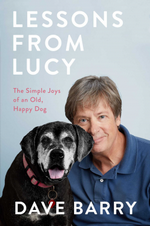
Lessons From LucyLessons From Lucy: The Simple Joys of an Old, Happy Dog

by Dave Barry

My original post
So, I figured given the tile and subject that this would be a heavier Dave Barry read, with probably more tears than you anticipate from his books — something along the lines of Marley & Me. I was (thankfully) wrong. It’s sort of self-helpy. It’s a little overly sentimental. I really don’t know if this is Barry’s best — but it’s up there. Lessons From Lucy is, without a doubt, his most mature, thoughtful and touching work (that’s a pretty low bar, I realize — a bar he’s worked hard to keep low, too).

5 Stars

 The War Outside My Window The War Outside My Window: The Civil War Diary of LeRoy Wiley Gresham, 1860-1865

by Janet E. Croon, ed.

My original post
LeRoy Wiley Gresham was 12 when he started keeping a diary. LIttle did he know at that point that he was about to witness the American Civil War (and all the desolation it would bring to Georgia) and that he was dying (he really didn’t figure that out until the very end). Instead you get an almost day-by-day look at his life — what he does, reads, hears about (re: the War) and feels. It’s history in the raw. You have never read anything like this — it will appeal to the armchair historian in you (particularly if you’ve ever dabbled in being a Civil War buff); it’ll appeal to want an idea what everyday life was like 150 years ago; there’s a medical case study, too — this combination of themes is impossible to find anywhere else. This won’t be the easiest read you come across this year (whatever year it is that you come across it), but it’ll be one of the most compelling.

5 Stars

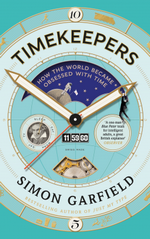
TimekeepersTimekeepers: How the World Became Obsessed With Time

by Simon Garfield

My original post
I, for one, have never thought that much about my relation to time, my relation to clocks/watches, etc. I know they govern our lives, to an extent that’s troublesome. But where did that come from, how did we get hooked on these things, this concept? These are brief studies/historical looks/contemporary observations — and I’m not selling it too well here (trying to keep it brief). It’s entertainingly written, informative, and thought-provoking. Garfield says this about it:

This is a book about our obsession with time and our desire to beat it. . . The book has but two simple intentions: to tell some illuminating stories, and to ask whether we have all gone completely nuts.

He fulfills his intended goals, making this well worth the read.

4 Stars

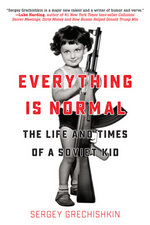
Everything is NormalEverything is Normal: The Life and Times of a Soviet Kid

by Sergey Grechishkin

My original post
If you grew up in the 80s or earlier, you were fascinated by Soviet Russia. Period. They were our great potential enemy, and we knew almost nothing about them. And even what we did “know” wasn’t based on all that much. Well, Sergey Grechishkin’s book fixes that (and will help you remember just how much you used to be intrigued by “Evil Empire”). He tells how he grew up in Soviet Russia — just a typical kid in a typical family trying to get by. He tells this story with humor — subtle and overt. It’s a deceptively easy and fun read about some really dark circumstances.

4 Stars

Planet FunnyPlanet Funny: How Comedy Took Over Our Culture

by Ken Jennings

My original post
Half of this book is fantastic. The other half is … okay. It’ll make you laugh if nothing else. That might not be a good thing, if you take his point to heart. We’ve gotten to the point now in society that laughter beats honesty, jokes beat insight, and irony is more valued than thoughtful analysis. How did we get here, what does it mean, what do we do about it? The true value of the book may be what it makes you think about after you’re done.

3.5 Stars

The Subtle Art of Not Giving a F*ck (Audiobook)The Subtle Art of Not Giving a F*ck: A Counterintuitive Approach to Living a Good Life

by Mark Manson, Roger Wayne (Narrator)

My original post
This is an enjoyable, amusing, call to re-examine your priorities and goals. It’s not about ceasing to care about everything (not giving a f^ck), but about being careful what you care about (giving the right f*cks). Manson’s more impressed with himself than he should be, but he’s a clear and clever writer displaying a lot of common sense. Get the audiobook (I almost never say that) — the narration is worth a star by itself (maybe more).

4 Stars

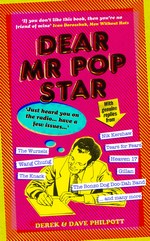
Dear Mr Pop StarDear Mr Pop Star

by Derek & Dave Philpott

My original post
If you read only one book off this list, it should probably be the next one. But if you pick this one, you’ll be happier. This is a collection of correspondence to pop musicians/lyricists picking apart the lyrics, quibbling over the concepts, and generally missing the point. Then we get to read the responses from the musician/act — some play with the joke, some beat it. Sometimes the Philpott portion of the exchange is better, frequently they’re the straight man to someone else. Even if you don’t know the song being discussed, there’s enough to enjoy. Probably one of my Top 3 of the year.

5 Stars

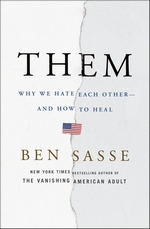
ThemThem: Why We Hate Each Other – and How to Hea

by Ben Sasse

My original post
My favorite US Senator tackles the questions of division in our country — and political divisions aren’t the most important, or even the root of the problem. Which is good, because while he might be my favorite, I’m not sure I’d agree with his political solutions. But his examination of the problems we all can see, we all can sense and we all end up exacerbating — and many of his solutions — will ring true. And even when you disagree with him, you’ll appreciate the effort and insight.

5 Stars

Honorable Mention:

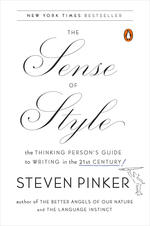
Henry: A Polish Swimmer's True Story of Friendship from Auschwitz to AmericaThe Sense of Style: The Thinking Person’s Guide to Writing in the 21st Century

by Steven Pinker

I started this at a bad time, just didn’t have the time to devote to it (and the library had a serious list waiting for it, so I couldn’t renew it. But what little I did read, I thoroughly enjoyed and profited from — am very sure it’d have made this post if I could’ve gotten through it. I need to make a point of returning to it.

Them: Why We Hate Each Other – and How to Heal by Ben Sasse: A Profound and Helpful (and Hopeful) Book I Wish I Could Adequately Discuss

ThemThem: Why We Hate Each Other – and How to Hea

by Ben Sasse

Hardcover, 288 pg.
St. Martin’s Press, 2018
Read: November 27 – 30, 2018

I really do prefer to come up with my own synopsis/summary, but I was struggling to come up with one without this taking 3-4 times as much space as I usually do for an entire post. So, I’ll just use the Publisher’s:

           Something is wrong. We all know it.

American life expectancy is declining for a third straight year. Birth rates are dropping. Nearly half of us think the other political party isn’t just wrong; they’re evil. We’re the richest country in history, but we’ve never been more pessimistic.

What’s causing the despair?

In Them, bestselling author and U.S. senator Ben Sasse argues that, contrary to conventional wisdom, our crisis isn’t really about politics. It’s that we’re so lonely we can’t see straight—and it bubbles out as anger.

Local communities are collapsing. Across the nation, little leagues are disappearing, Rotary clubs are dwindling, and in all likelihood, we don’t know the neighbor two doors down. Work isn’t what we’d hoped: less certainty, few lifelong coworkers, shallow purpose. Stable families and enduring friendships—life’s fundamental pillars—are in statistical freefall.

As traditional tribes of place evaporate, we rally against common enemies so we can feel part of a team. No institutions command widespread public trust, enabling foreign intelligence agencies to use technology to pick the scabs on our toxic divisions. We’re in danger of half of us believing different facts than the other half, and the digital revolution throws gas on the fire.

There’s a path forward—but reversing our decline requires something radical: a rediscovery of real places and human-to-human relationships. Even as technology nudges us to become rootless, Sasse shows how only a recovery of rootedness can heal our lonely souls.

America wants you to be happy, but more urgently, America needs you to love your neighbor and connect with your community. Fixing what’s wrong with the country depends on it.

Now, a lot of people are talking about/writing about negative tweets, hostility between parties, loss of civility, etc. in our contemporary culture. But most of them are discussing symptoms of something deeper — and addressing the symptoms isn’t going to help much. Sasse wants to focus on the underlying issues and spends a lot of time talking about them before describing how he best thinks we can take care of them (and the symptoms).

I am not entirely convinced that he’s diagnosing the problems correctly — but he’s as close as I’ve seen. In short, we’ve stopped seeing our fellow Americans as countrymen that need to be convinced and compromised with, instead as evil opponents that need to be defeated and humiliated. It doesn’t matter if we’re talking politics, social policy, or people who like a TV show you don’t. The loss of civility, decency and humility in our culture is a clear and present danger to our union.

I’ve got a strong, strong desire to spend a week or two posting about this book — going through it a chapter at a time. But this isn’t that kind of blog — and I just don’t have that kind of time. There are places for that sort of conversation, this isn’t one of them. The books thought-provoking, inspiring, discouraging, and entertaining — not usually at the same time, but frequently within a couple of pages. I took pages of notes — really. Some of them just because I liked his phrasing. Some because I wanted to spend some time thinking about what he said, or doing follow-up reading, Some because I thought he nailed the idea.

Now, while Sasse goes to great pains to keep the book a-political (at least when it comes to specific policies), he correctly sees that politics is one of the main ways we’re separating ourselves from one another — or are being separated by them. So he talks about some of the ways that’s happening, and because he’s more familiar with the antics of the Right, he focuses primarily on them (also, it’ll give him more credibility to beat up his “own” team than the other guys). There are some Republicans that he cites favorably, and some Democrats that he puts in negative light — but primarily, Democrats come out of his book looking a lot better than his fellow Republicans do. I liked that a lot. If nothing else, it shows that Sasse’s willing to practice a lot of what he preaches (maybe all of it, I don’t know).

Sasse writes with conviction and compassion, humor and wisdom, even if (maybe especially if) you disagree with his politics, he’ll win you over with his common-sense realism. Some of his proposed solutions seem very pie-in-the-sky, and those are my favorites. Some of them seem more likely to succeed, but either way, just people talking and thinking about them is a step in the right direction. And I can’t help but imagine just that would be enough to satisfy Sasse. Read this book. Get others to read it. Talk about it.

—–

5 Stars

2018 Library Love Challenge

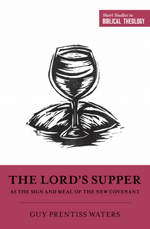
The Lord’s Supper as the Sign and Meal of the New Covenant by Guy Prentiss Waters: A Thoughtful & Encouraging Look at the Supper in its Redemptive-Historical Context

The Lord's Supper as the Sign and Meal of the New CovenantThe Lord’s Supper as the Sign and Meal of the New Covenant

by Guy Prentiss Waters
Series: Short Studies in Biblical Theology

eARC, 128 pg.
Crossway, 2019
Read: November 18, 2018

“All the salvation and redemption brought about by Christ for his disciples is founded in the body and blood he gives them to eat and drink at the Eucharist”
                                                                           — Herman Ridderbos

Waters uses that insight from Ridderbos to help explain the significance of the Lord’s Supper in the Christian religion, and thinking along these lines undergirds this entire book — not just that the Supper is something we ought to do, but something it’s vital to participate in — for our own spiritual health.

Waters begins by reviewing the basics of covenant theology — defining covenant and looking at the major covenants and how they point to Christ. Then Waters shifts to looking at the signs and seals of the various covenants — with a focus on the purpose of visible, tangible signs. The third chapter narrows that focus to covenant meals throughout redemptive history. Once the context has been firmly established, Waters introduces the Lord’s Supper with a survey of applicable biblical texts. Finally, Waters considers some practical and contemporary questions and applications. I’m not going to get into any specifics beyond this because what I want to focus on takes a lot of foundation work, and this would stop being about the book and would become a recap of the whole thing.

In a book this short (by design), I’m not sure Waters did his readers any favors by being as thorough in the first two chapters — it will be review material for many readers, and those who aren’t that grounded in covenant thinking are going to need more explanation of the ideas. Still, I appreciated what he wrote. The other three chapters were just great — I could’ve used more of all of them, but that’s not the point of the books in this series. The careful consideration of the Supper in its redemptive-historical context is so important and putting these ideas in a size and format that aren’t intimidating is going to be valuable.

I wish I had this book twenty years ago when I started studying the Lord’s Supper, it would’ve been very helpful and would’ve saved me a lot of time. I took a lot of notes while reading this and am going to spend a lot of time following up on them — and rereading this a couple of times. It’s the kind of book you want to hand out to your friends so you can talk about it with them. The last chapter was particularly helpful and encouraging. This would be a great companion read to Letham, Mathison, and Wallace (to be read after Letham, but before Mathison, probably).

Waters is one of the better academic writers the Reformed world has — thankfully, he’s also capable of producing concise and clear works for laity. This short volume demonstrates that well. It’s helpful, encouraging and I have no doubt will strengthen some believers’ in their use of the Supper as it shows others how important it is.

I’d been previously unaware of the series Short Studies in Biblical Theology, I’m pretty sure I’m going to be getting my hands on some of the other volumes. I love the idea behind the series and if they’re all this helpful, it’ll be worth it.

Disclaimer: I received this eARC from Crossway via NetGalley in exchange for this post — thanks to both for this.

—–

4 Stars

You Had Me at Woof (Audiobook) by Julie Klam, Karen White: A meandering mess of vaguely dog-related memoirs.

You Had Me at WoofYou Had Me at Woof: How Dogs Taught Me the Secrets of Happiness

by Julie Klam, Karen White (Narrator)

Unabridged Audiobook, 5 hrs., 44 mins
Tantor Audio, 2010
Read: November 1 – 6, 2018

From the Publisher’s Site:

           Julie Klam was thirty, single, and working as a part-time clerk in an insurance company, wondering if she would ever meet the man she could spend the rest of her life with. And then it happened. She met the irresistible Otto, her first in a long line of Boston terriers, and fell instantly in love.

You Had Me at Woof is the often hilarious and always sincere story of how one woman discovered life’s most important lessons from her relationships with her canine companions. From Otto, Julie realized what it might feel like to find “the one.” She learned to share her home, her heart, and her limited resources with another, and she found an authentic friend in the process. But that was just the beginning. Over the years her brood has grown to one husband, one daughter, and several Boston terriers. And although she had much to learn about how to care for them—walks at 2 a.m., vet visits, behavior problems—she was surprised and delighted to find that her dogs had more wisdom to convey to her than she had ever dreamed. And caring for them has made her a better person—and completely and utterly opened her heart.

Riotously funny and unexpectedly poignant, You Had Me at Woof recounts the hidden surprises, pleasures, and revelations of letting any mutt, beagle, terrier, or bulldog go charging through your world.

Spend much time around this blog and you’ll know I’m a sucker for dogs — real or fictional — if a book has a strong dog element in it, I’m sold. This should’ve been right up my alley. I expected to really dig it — but the reality didn’t match my expectation.

These meandering personal essays/memoirs are organized by lessons taught by various dogs, sure, but they didn’t seem as well-organized as those from similar books by Dave Barry or David Rosenfelt (or maybe it’s just guys named David that think like this). I didn’t think the voice was very consistent throughout — I frequently couldn’t tell if I was supposed to be laughing with Klam or at her. Or maybe I shouldn’t have been laughing at all. I didn’t find a lot to relate to — or even grab on to — in some of the anecdotes, other than a sense of pity for the two-legged individuals in her family and life. (that came out a little harsher than I intended, but I’m sticking with it).

I can’t point at anything in particular — other than her unessential and unsubtle celebrity name-dropping — that I didn’t like. I guess I found the thing too unfocused, too inconsistent, and not enough about the actual dogs. It seemed to be more about her in relation to various dogs. To an extent that’s true with the aforementioned books by the various David’s, too — but I don’t think it’s as much about them (although, I never wondered who I was supposed to be laughing at with them).

Is it possible that my problems with the book are in the narration? Sure, a lot of it comes down to understanding Klam’s voice, and Karen White’s interpretation of that could be affecting me enough to not appreciate the book. But I don’t think so — I can’t imagine an audiobook director or publisher is going to let something that disconnected from the text be produced, and White seemed to match the text and context with what she was doing. Granted that’s hard to know without reading the text independently, but I don’t care that much. If the text is really that slippery, that’s on Klam anyway, not White.

Oh, here’s something I really appreciated about the book — Klam talks at least twice about dog owners who will replace a beloved pet with one of the same breed and general appearance and give it the same name (sometimes several times). This answers a question I asked a couple of weeks ago. Even knowing this is a thing that people who aren’t Robert B. Parker or Robert B. Parker characters do, it’s still messed up. Happily, Klam agrees.

The concluding anecdote was good — maybe a bit too much, really — but it was sweet. And the section about dealing with the death (expected or not) of a dog was really strong. That’s why I’m not listing this as 2 Stars or fewer. There’s some really decent writing here, but the voice was inconsistent, the whole thing felt too self-serving, and . . . well, there’s just something intangible that happens between the reader and the text, and I just didn’t like this one. It’s not a bad book, per se. But it’s not a good one.

—–

2 1/2 Stars

2018 Library Love Challenge

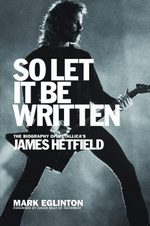
So Let It Be Written by Mark Eglinton: A Disappointingly Delivered Account of a Rock Star’s Career

So Let It Be WrittenSo Let It Be Written: The Biography of Metallica’s James Hetfield

by Mark Eglinton

Paperback, 219 pg.
Lesser Gods, 2017
Read: October 29 – 30, 2018
Here’s the Publisher’s synopsis:

           The first and only biography of one of the best front men of the modern era.

With James Hetfield at the helm, Metallica went from being thrash pioneers to heavy metal gods. He overcame adolescent upheaval and personal demons—including his parents’ divorce, his mother’s untimely death and severe alcoholism—to become metal’s biggest star.

So Let It Be Written does justice to the many hats Hetfield has worn, with his strong leadership, signature vocal style, powerful guitar-playing and masterful songwriting. Author Mark Eglinton uses exclusive, firsthand interviews—with prominent rock stars and key figures in Hetfield’s life—to construct the definitive account of Hetfield.

There are many problems with this book. If it is a definitive account of Hetfield, it’s because there’s not a lot of competition. The firsthand interviews seem to be with people who knew Hetfield in school or shortly thereafter — or friends of former bandmates. For insights from people closer to him, Eglinton seems to rely on interviews published in magazines or done on TV or in a documentary. I could be wrong about that — there might be more original research performed by him, but given the utter lack of citation, it’s hard to say for sure.

This book is primarily about Hetfield’s professional life, following the account of Hetfield’s mother’s death, we maybe get two full paragraphs (scattered over chapters) about Hetfield’s family (but repeated statements that family is the most important thing to Hetfield), and his friendships outside the band aren’t given much more space.

Rather than a biography of James Hetfield, this comes across as the story of Metallica with a focus on the input, influence, and antics of Hetfield. With a special emphasis on glorying in the music and lyrics of the albums leading up to Metallica/The Black Album, and in denigrating everything from Load through the build-up for the release of Hardwired… to Self-Destruct, which wasn’t released in time for him to come up with a strong opinion about (with some okay words directed to the documentaries and films produced in that time).

It’s clear that Eglinton was a fan of early Metallica, and has a wide appreciation for and knowledge of the metal scene. He has the knowledge base and the passion to produce a strong book about the band — but he seems to lack the ability to focus on the life of one man. Somehow, the author wrote a similar looking book, James Hetfield: The Wolf at Metallica’s Door, seven years earlier than this — and it was longer. I’m not sure how he pulled that off — my guess is more analysis of the contents of albums and/or his estimation of their worth. I’m curious about the differences between the two, but not enough to put up with reading it to compare.

James Hetfield is a deeply flawed, incredibly talented, and interesting figure. A biography of him should be intrinsically and automatically fascinating, and it takes a certain kind of author to take that potential and turn it into a disappointment. Sadly, Eglinton is just that kind of author.

Don’t bother.

—–

2 Stars
2018 Library Love Challenge

✔ Read a memoir or biography of a musician you like.

Pub Day Repost: Lessons From Lucy by Dave Barry: America’s Funniest Human Tries to Learn a Few New Tricks from an Old Dog

Lessons From LucyLessons From Lucy: The Simple Joys of an Old, Happy Dog

by Dave BarryeARC, 208 pg.
Simon & Schuster, 2018
Read: July 19, 2018

Before I say anything else, Barry has set up an Instagram page (well, probably not him, actually — he states in the book he doesn’t understand Instagram) for his dog, Lucy. You should absolutely check it out and then come back to read what I have to say about the book. Dog Pictures > my blog. Pretty near always.

With that out of the way . . . Dave Barry has been a dog person for most of his life, one of the many reasons I like him. I distinctly, and fondly, remember columns and/or references to Earnest and Zippy (the emergency backup dog) years ago. Those two make a brief appearance in this book, but they aren’t the focus. The focus (if you can’t tell from the title) is his dog, Lucy. At the time of writing, Barry and Lucy are the same age — 70 (or 7 times 10 in her case), which means that both of them have many fewer days ahead of them than behind — which sounds awfully morbid for Dave Barry to talk about, but he does so frequently and purposefully.

As they’re at similar stages in life, Barry notices a huge difference between the two — Lucy is far happier and seemingly better adjusted than he is. So he sets out to try to learn a few lessons about life from her, which he passes on to his readers. Things like Pay Attention to the People You Love; Don’t Let Your Happiness Depend on Things; and Don’t Stop Having Fun. None of these, Barry knows, are original or ground-breaking — they’re pretty much common sense. Yet, they’re the kind of common sense things that he (like many/most humans) doesn’t actually do a great job at.

The result is a mixture of a Self-Help book and a Humor book — humor about himself, his life, as well as dogs. Sometimes the swing between the two genres can be jarring, but that’s pretty rare. For the most part, he moves easily between the two, taking the readers along with him on this ride. I can’t tell you how many times I went from grinning, chuckling or laughing out loud to getting misty-eyed within a couple of pages. It seems that Barry has learned a little bit about writing over the decades.

I’ve loved Barry’s humor longer than either of us would probably care to admit. One of his strengths is finding a way to take an old joke, or at least a joke everyone’s made before — like, say, I dunno, dogs sniffing each other’s hind-quarters — and make it feel fresh and new. More importantly, funny. He’s also able to make jumps from premise to punchline that no one expects. There is, for example, a Hugh Hefner joke where one doesn’t even come close to belonging — and it works perfectly. Even knowing that, you won’t see it coming until you’re snickering at it.

As for the heart-felt material? It works pretty well, too. I don’t think anyone will walk away from this book thinking “Wow! That was insightful. I never would have thought of it on my own!” Nor do I think Barry was trying for it. But, readers will appreciate the reminders to live like Lucy (or their own dog), and the way Barry phrases things might add some freshness to the concept. Which is all anyone can really ask.

I really don’t know if this is Barry’s best — but it’s up there. The ratio of Attempted Joke to Funny Joke is pretty high, I’m not sure if I can think of a higher one in his ouvre. Lessons From Lucy is, without a doubt, his most mature, thoughtful and touching work (that’s a pretty low bar, I realize — a bar he’s worked hard to keep low, too). Couple that with me being a sucker for a Dog Book — even if it is a semi-Self Help book — and I can’t help but give it 5 Stars. This is a winner, no matter what.

—–

5 Stars

Disclaimer: I received this eARC from Simon & Schuster via NetGalley in exchange for this post — which is my honest opinion and pleasure to give — thanks to both for this.

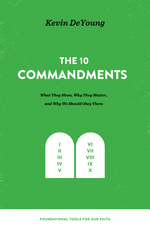
The Ten Commandments by Kevin DeYoung: A Warm, Engaging Study of God’s Revealed Will

The Ten CommandmentsThe Ten Commandments: What They Mean, Why They Matter, and Why We Should Obey Them

by Kevin DeYoung

eARC, 208 pg.
Crossway, 2018
Read: September 23, 2018

My initial thought when I saw this book was: do we need another popular-level work on The Ten Commandments? We’ve got so many already, like: Ryken’s Written in Stone, Horton’s The Law of Perfect Freedom, Packer’s Growing in Christ. We’ve got Douma’s, Watson’s and Durham’s (newly republished) on the heavier end of the spectrum, too. Why bring out a new book by DeYoung? Still, I was intrigued, so I requested a copy.

Not too surprisingly, I’m glad I did. This is typical DeYoung: a strong, affectionate, orthodox take on the Law delivered in a very accessible and affable manner. He made me think, he made me reconsider a thing or two, and he reminded me of a few things I needed reminding of.

He begins this work against the framework of the secular “anything goes” point of view, where everything certainly does not go — as much as we as a culture might rail against an external source of morality — there are things that simply cannot be said or done. Giving us a choice between humanity’s unwritten, assumed code — or God’s revealed will. DeYoung then goes on to list reasons for the study as well as the following of God’s Law.

The other important groundwork comes from the midst of his very strong chapter on the First Commandment in which he describes the role of the Law for New Covenant believers. It’s still applicable, still binding — just in a different manner. I think this could’ve been developed more — maybe in its own chapter, but what we got here was good. I do particularly appreciate his metaphor of transposition. The Law in the New Covenant is the same for believers as it was in the Old, it’s just in a different key.

Following the introduction where he lays out his framework, DeYoung turns to consider the commandments individually. This is the bulk of — and the heart of — the book, with a chapter devoted to each commandment. If the book has any value, it’ll be found here, and there’s a lot of it to be found. I briefly considered summarizing each chapter, but why steal his thunder. Also, he’s not carving out anything new here, so there’s little need. What’s new is his expression of the timeless truths, his way of explaining and applying them. If you want a quick summary of what he’ll say about each commandment read The Heidelberg Catechism questions 92-115 or the Westminster Shorter Catechism questions 39-85, and you’ll get a pretty good idea.

Instead, I’ll just comment on a few highlights and a couple of problems I had (your mileage may vary). I found his comments regarding the Fourth Commandment to be helpful, but hesitant — in his effort to not be legalistic, or overly dogmatic, he comes across as wishy-washy. I appreciated most of what he had to say about the Second Commandment, but again, he’s hesitant enough in some of his application to stumble a bit. Which is not to say that the bulk of those chapters weren’t good and helpful — they were. I think he could’ve been more consistently so.

Conversely, the chapters on the Eighth and Tenth commandments were incredibly helpful. If you ask me, these two are where the American Church and American Christians stumble more often than we realize (or care about). Publicly, Protestants are expounding so much energy on certain applications of the Sixth and Seventh commandments that one would be tempted to think that 8-10 are concerns of the past. DeYoung doesn’t let the reader think that for an instant, and if you don’t come away from these chapters with a good dose of conviction of your own sin, you probably didn’t read it too closely.

The chapter on the Third Commandment was invaluable also. It’s far too easy for Western Christians to reduce this to “don’t be a potty mouth” and far too hard for us to really get what the importance of “name of the Lord” is. DeYoung does a yeoman’s job on both fronts and does a good job expounding the meaning of this commandment.

You’ll never walk away from any of these chapters thinking that DeYoung is writing a hellfire and brimstone jeremiad against the Church, you, or anyone. He’s sharply critical of a lot of general culture, and individual inclinations, but that’s to be expected. There’s conviction and inspiration both to be found in these pages — all delivered in DeYoung’s warm, almost conversational, style — a strong blend of wit and charm with the steel in his words. I won’t get into it, but his chapter on the Third Commandment contains one of the funniest anecdotes (more in the telling than the story) I’ve read from him. Ignoring his content for a moment, his writing style is what will keep me coming back to DeYoung’s books for years to come.

I think I’ve said before, I’m not a big one for study/discussion questions in books — I like to think the engaged reader doesn’t need them and someone leading a discussion/study of a book will be clever enough to come up with their own. But, I’m obviously swimming against the tide on this because publishers keep printing them. That said, on the whole, this is a pretty good set of questions and would help someone who likes those kind of questions for their own use or for those using the book in Family Worship, Sunday School, or Bible Study.

In the end, my question, do we need another popular-level book on The Ten Commandments? Is answered yes: we need frequent — constant — reminders of the revealed will we’ve been called to obey, so we never stop striving for that perfection and never cease calling on the Spirit’s assistance. We also need to remember how great our sin and misery are so that we constantly live lives of repentance. So bring on DeYoung’s good summary. And others as well — and we need to read them, as well as the older popular-level works. And then we need to push ourselves and read some of the less-popular level ones as well.

This is a good, short set of meditations and reflections on the perfect law, the law of liberty for a contemporary audience. It’s approachable, it’s warm, it’s pointed, and it’s Gospel-centered. It’s not perfect, but it’s good. It functions well as a refresher for those who need one, and a good starting point for their own study of The Ten Commandments. I’m buying a copy (at least one) for my personal library and will be encouraging my household to read it — and anyone else who asks.

Disclaimer: I received this eARC from Crossway via NetGalley in exchange for this post — thanks to both for this.

—–

4 Stars

Looking for Calvin and Hobbes (Audiobook) by Nevin Martell, Jeremy Arthur: A close-up look at the Cartoonist and His Creation

I’ve spent 20 minutes trying to get this header to look decent — and I give up. It’s just going to look awkward given the length of the title.

Looking for Calvin and Hobbes (Audiobook)Looking for Calvin and Hobbes: The Unconventional Story of Bill Watterson and His Revolutionary Comic Strip

by Nevin Martell, Jeremy Arthur (Narrator)
Unabridged Audiobook, 7 hrs., 9 min.
ListenUp Production, 2014
Read: September 25 – 27, 2018
Nevin Martell, like just about everyone who ever read him, is a Calvin and Hobbes fan — what’s more, he discovered the strip at the right age and was able to appreciate it as only a child can — without being self-conscious about reading a comic strip and with devotion. Years later, when trying to write something more meaningful to him than another book about a pop star, he decides to write about that strip and its reclusive creator.

The reclusive part of that sentence is the key — Watterson had (and has) pretty much dropped off the face of the earth as far as your typical person is concerned. A few select friends, business acquaintances and family members can get in touch with him, but no one else can. This isn’t crippling to a book about his comic strips or himself, but it sure hampers it (especially because those people who can get in touch with him are just about as reticent as he is to talk about him or his work). Unencumbered by access to Watterson himself, and his perspective on his life and career was like, what his influences were, what made him make the creative decisions, etc. Martell dove into research — things written about and by Watterson, archives of his previous work (when and where available) and interviews with colleagues, editors and the like.

In the kind of detail only a scholar or a fan can appreciate, Martell describes Watteron’s childhood, college, and pre-Calvin and Hobbes career; then he discusses that comic strip — major themes — and its publishing history; Watterson’s battle to keep control of the strip, its merchandising/licensing; then he describes Watterson’s retirement. As much of that as he can, which isn’t much. Following that, Martell focuses on things like the impact of Watterson on the industry, his relationships with other cartoonists and is influence on those who followed.

I wish he’d given us more (and maybe he gave us all he could, but I don’t think so) from Watterson’s contemporaries/those he influenced in the field of comics (or related fields — he spoke with a novelist and Dave Barry, too). Martell spoke to many and gave us a lot of what he was told — but I’d have appreciated more coming from professionals about Watterson’s strengths, technique, stories — whatever. Sure, it might have gotten a little redundant, but something tells me that it wouldn’t have been too bad. These were my favorite parts of the book, and I could’ve listened to another hour of them easily.

I’m not convinced that I was ever as invested in Martell’s journey as he seemed to think his readers would (should?) be — and I’m okay with that. I know I tend to overshare here a tad myself — so I understand the impulse. Or maybe I’m just callous, and everyone else got into it.

As far as Arthur’s work narrating — there’s not a lot to say. This isn’t a work of fiction where he can play with characters, pacing, and whatnot. It’s a straightforward text and he does a capable job of reading it in a straightforward manner. I did have to remind myself a couple of times that I was listening to someone Martell’s words rather than listening to him — which I guess is a good thing.

It was a pleasant book, nothing too challenging — and it reinvigorated an impulse to go read a collection or two of Watterson again on my part (and some of Larson’s The Far Side, too — I’m sure there’s an interesting book to be written there, too). It’s not a must-read, but it’ll scratch an itch for those who have an interest in the subject.

—–

3 Stars

2018 Library Love Challenge

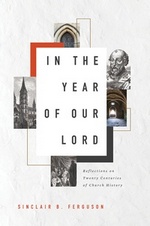
In the Year of Our Lord by Sinclair Ferguson: Sinclair Ferguson brings out the heart as well as the life of Church History

In the Year of Our LordIn the Year of Our Lord: Reflections on Twenty Centuries of Church History

by Sinclair Ferguson

eARC, 229 pg.
Reformation Trust Publishing, 2018
Read: August 26 – September 16, 2018
The seeds of this book were first published in a book Ferguson co-authored called, Church History 101: The Highlights of Twenty Centuries — he’s now taken those chapters, done more research (being retired has freed up some time for him to do some reading), and expanded that into this great survey of Church History.

After a stirring (yes, really) introduction that lays out the purpose of this volume, why the study of Church History is important and what can be gained from even the figures from Church History that may disagree with — Ferguson dives in to his survey. I really can’t say enough good about this introduction — which feels odd, that’s not supposed to be the best part of a book (and it isn’t, actually — but it’s good enough that it really could be). The body of the book is twenty chapters — in case you couldn’t guess, that’s one chapter for each completed century Anno Domini (and Ferguson is committed to the usage of that).

Each chapter starts with an excerpt from a noted piece of writing from the century in question — like The Martyrdom of Polycarp, On the Incarnation, Gottschalk;s Shorter Confession concerning Double Predestination, and Savonarola’s The Triumph of the Cross (noted, not necessarily commonly known, obviously). Following that Ferguson summarizes the events of that century — focusing on particular figures or movements that stand out. Most of these will be at least familiar to the reader by name, if not for activities and attributes. Then he closes the chapter with some words of application to the contemporary Church and a hymn from that century — most of those hymns I was totally unfamiliar with, and am so glad I was exposed to them.

The core of the chapters, the history of that century — as summarized as it may be — is so helpful. I’ve taken classes covering a lot of those chapters — and read enough on my own that I was pretty familiar with the material covered. But I learned something about even those eras and individuals I’ve studied extensively — maybe not a lot, but enough to justify the time. And even those things that were primarily review for me were well worth reading — the story of our family is one we should hear over and over again and this book is a prime example of what we need to hear.

But what about those who haven’t taken the classes, or haven’t had that much exposure to Church History outside of the last century — or maybe the first couple of centuries? This book is even better for them. It’s primarily intended as an introduction to Church History, and it excels at being one. First of all, it gives you the good bird’s eye view from the day after the last chapter of Acts to the present. Which is a perspective that’s all too easy to lose in the details — we’ve got to see the forest. But the trees are also important — and Ferguson gives enough detail (while remembering that these are brief summary chapters) that the reader can get a handle on a particular century and learn enough that they can pursue what they’re interested in. I know from reading that Celtic monasticism is something that I want to read more about (and not just by rereading Thomas Cahill), but that there are other things from that period that don’t spark my interest in the same way. Some people will react that way to Gregory I or Thomas Chalmers or something else — and Ferguson has provided the reader with enough to start on to feel comfortable pursuing that interest.

Whether for review or as an introduction — the meat of this book is just what the doctor ordered.

Even if the history wasn’t that helpful, Ferguson’s application and the hymn made the book worthwhile. Sometimes that application is comforting, sometimes it’s challenging — it’s always helpful. And the bonus of having that hymn? That’s a wonderful, devotional way to bring history to life — that’s the same Lord, the same faith being proclaimed in these words. Loved that. Starting the chapters with a doctrinally rich (if occasionally problematic) excerpt reminds us that our faith is first and foremost about truth, about ideas — but those find expression in the heart and life of the believer — as seen in the hymns.

Yes, it’s a weakness that this book focuses on the Western Church — particularly that represented in the English, Scottish and American branches. Ferguson admits that at the beginning, but that’s his tradition, that’s his background — and that’s the background for most of his, readers, too — so it’s what’s most relevant. To go beyond that would result in a tome unwieldy and not that handy for his audience (as great as it would be to see).

The structure of head (excerpt), life (history) and heart (hymn) is a fantastic outline for this book — and everything hung on that outline is clearly-written, helpful to the Christian and relevant (if only to say “don’t be like that.”) Ferguson knocked it out of the park with this one, and I can’t recommended it highly enough. Great for personal use, family devotion, Sunday Schools, Home Schools — you name it, there’s someone who can benefit from this book.

Disclaimer: I received this eARC from Reformation Trust Publishing via NetGalley in exchange for this post — thanks to both for this.

—–

4 Stars

Page 49 of 62

Powered by WordPress & Theme by Anders Norén