Category: Politics/Current Affairs Page 1 of 5

Robert E. Lee and Me by Ty Seidule: Taking Another Look at His Heritage

Cover of Robert E. Lee and Me by Ty SeiduleRobert E. Lee and Me:
A Southerner’s Reckoning with the Myth of the Lost Cause

by Ty Seidule

DETAILS:
Publisher: St. Martin's Griffin
Publication Date: January 26, 2021
Format: Paperback
Length: 256 pg.
Read Date: September 15-18, 2025

Buy from Bookshop.org Support Indie Bookstores

As a retired U.S. Army officer and as a historian, I consider the issue simple. My former hero, Robert E. Lee, committed treason to preserve slavery. After the Civil War, former Confederates, their children, and their grandchildren created a series of myths and lies to hide that essential truth and sustain a racial hierarchy dedicated to white political power reinforced by violence. But for decades, I believed the Confederates and Lee were romantic warriors for a doomed but noble cause. As a soldier, a scholar, and a southerner, I believe that American history demands, at least from me, a reckoning.

What’s Robert E. Lee and Me About?

Ty Seidule grew up idolizing (he might argue nearly-literally) Robert E. Lee and his story and legacy. Everywhere he went growing up, there was Lee’s shadow. When he went to college, and then when he was in the Army and served in various capacities and places, it was still there.

At some point, as a historian and patriot, some things started to strike him as odd with what he was seeing. He rolled up his sleeves, did the work and, well…some things started to change.

Here, he looks at where the shadows of The Lost Cause and Lee were cast in the various places he lived over the course of his life and career—and what he, and others, should learn from that.

My Sole Complaint

I think I really only have one. It’s repetitive—no, not the fact that this is really a series of X was pro-Confederacy or racist; Y may have looked to be about history, but if you look at the context, it’s about downplaying such-and-such or ignoring what Robert E. Lee did. That’s the kind of repetitiveness the book is built on—anyone who reads the back of the book knows that’s what you’re going to get.

But Seidule uses certain phrases over and over again; he describes particular figures in the same way over and over again—that kind of thing. It’s hard to put up with—and it’s hard to resist the impulse to skim.

And I don’t want to skim a book like this—not with this topic, not with the kind of details he provides. But too often his writing makes that attractive.

So, what did I think about Robert E. Lee and Me?

The Lost Cause became a movement, an ideology, a myth, even a civil religion that would unite first the white South and eventually the nation around the meaning of the Civil War. The Lost Cause might have helped unite the country and bring the South back into the nation far more quickly than bloody civil wars in other lands. But this lie came at a horrible, deadly, impossible cost to the nation, a cost we are still paying today. The Lost Cause created a flawed memory of the Civil War, a lie that formed the ideological foundation for white supremacy and Jim Crow laws, which used violent terror and de jure segregation to enforce racial control. I grew up on the evil lies of the Lost Cause.

This is a hard book to read. Ignoring my problems with the way that Seidule put things—it’s just tough to read. The extent to which he shows how the Confederacy may have lost the Civil War, but won the narrative—not just in the thinking and speech of the Confederacy’s descendants, but of the US’, too.

Could it have been a little less about him and a little more about everything else? Sure—but framing things in terms of his life and service was a pretty nice move. It gave him something good to hang things on, and kept it from being a diatribe. (and really, I’m betting the percentage of text would show that it’s not that much about him).

I strongly recommend this book—primarily to those who rankle at the idea behind it. Those who have a reflex toward a “State’s Rights” explanation for the Civil War, those who want to talk about the character of Robert E. Lee and how noble he was for choosing the side he did (esp. when you look at what other people in his family did); those who are inclined to look at the idea of Southern Christian culture, etc. I’m not promising that it’ll convince you to shed all of that, but I think it’ll make you think and re-examine a few things. It’s not terribly long ago that I’d have counted myself among you—while Seidule wasn’t part of that change, he sure could’ve been had I read him earlier.

The rest of you will probably enjoy it, too—but it’s just confirmation of your biases, and more evidence to roll out to support those biases. Neither of which is necessarily a bad thing, but the book won’t be as meaningful for you.

It’s a powerful read that will stick with you for a while.

More and more people, especially white Americans, seemed to accept the reality of systemic racism in the United States, epitomized by the Confederacy and the Lost Cause myth. Was this the clarion call that would result in change? Would the country recognize its foundational problem and act?

Racism is the virus in the American dirt, infecting everything and everyone. To combat racism, we must do more than acknowledge the long history of white supremacy. Policies must change. Yet, an understanding of history remains the foundation. The only way to prevent a racist future is to first understand our racist past.


4 Stars

This post contains an affiliate link. If you purchase from it, I will get a small commission at no additional cost to you. As always, the opinions expressed are my own.

Irresponsible Reader Pilcrow Icon

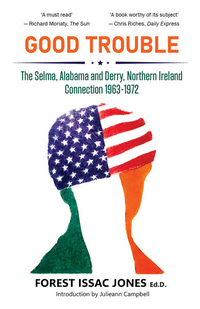
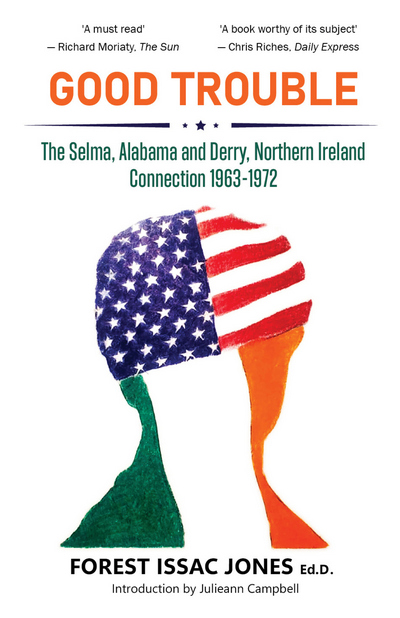
Good Trouble by Forest Issac Jones: Marching toward Victory

Good Trouble Tour Banner


Cover of Good Trouble by Forest Issac JonesGood Trouble:
The Selma, Alabama and Derry, Northern Ireland Connection 1963-1972

by Forest Issac Jones

DETAILS:
Publisher: First Hill Books
Publication Date: April 1, 2025
Format: eARC
Length: 200 pg.
Read Date: May 1-3, 2025
Buy from Bookshop.org Support Indie Bookstores

What’s Good Trouble About?

It’s really simple, based on several interviews as well as plenty of research, Jones shows the connections between the Catholic Rights movement in Northern Ireland and the Civil Rights Movement in the Southern US in the late 60s and early 70s.

Essentially, groups and individuals in Northern Ireland saw what the non-violent protests in the U.S. were able to accomplish, how they went about it—and the costs they paid. Drawing inspiration—at the least—and borrowing methodology, they sought to follow in the footsteps of their predecessors.

Selma

After a chapter or two covering Michael Collins, the Easter Rising, and the rise of the IRA to set the stage, Jones turns his focus to the Eastern US—he discusses the Student Nonviolent Coordinating Committee, the March on Washington, and the Selma to Montgomery March. It’s a real mix of hope, joy, and trauma.

The bulk of this section is on the Selma to Montgomery March—the first-person accounts from those who participated in the March adds so much to this.

Derry

Jones then shifts to his discussion of the Catholic Rights movement—the way they self-consciously (and likely) unconsciously appropriated the methodology of the Black marchers and demonstrators on the other side of the Atlantic. They used similar thinking, learned lessons from the missteps of the Civil Rights marchers, and even used the song “We Shall Overcome.”

Despite some promising moves, and rallying after devastating counter-protests and police action, things did not stay non-violent in Northern Ireland, as we all well-know. Jones doesn’t spend as much time on that (if for no other reason than it stopped drawing inspiration from the South), but he does give a solid overview of it. Again, the first-person accounts he weaves into things like the account of the Long March from Belfast to Derry in 1969 are genuinely effective.

Some Minor Issues

I’m not sure that Jones inserting himself into the narrative quite as often as he did helped things that much. His friends fit in better—largely because they were among the first-person accounts mentioned before—but I’m not sure he needed to give them the same introduction every time. His parents might have been mentioned too often—they also didn’t need the same introduction almost every time they were mentioned. Nor did we need to be told twice in the same chapter how surprised they were to see Obama elected.

The repetition there makes me think of my main gripe—too many of the sentences and structure of various sections just needed a little more work. It really felt like another draft or two would’ve helped. The prose needed a little more tightening and a little less redundancy.

I don’t know that I’d have mentioned this in other circumstances, but it feels like a book talking about topics and themes that are this important should have writing to match—and this just doesn’t. I’d like for Jones to have elevated his prose to match this.

So, what did I think about Good Trouble?

In the movie The Commitments*, the band’s manager tells them:

Do you not get it, lads? The Irish are the blacks of Europe. And Dubliners are the blacks of Ireland. And the Northside Dubliners are the blacks of Dublin. So say it once, say it loud: I’m black and I’m proud.

Despite it being the wrong part of Ireland, that kept running through my mind while reading this book—and it only got louder when protestors in Derry started calling themselves “White Negroes.” Sure, it was a lighthearted moment in the movie—it wasn’t lighthearted (at least not for long) for those in Derry. This identification with the cause in the States underlines just how similar the causes and how precarious the situations for both groups were (this is particularly helpful for U.S. readers who may not be as familiar with “the Troubles” as we might want to be). Jobs, health, housing, and access to government—it all hung on getting the people and the government to sympathize with, to make systemic changes for these minority populations.

While hopeful—at least ultimately—this was not an easy read, the reminders, refreshers, or first-looks (depending on the reader) at the struggles, the hardships, the injustices before, during, and after the marches and the movement are harrowing and hard to read. Man’s inhumanity to man because of some perceived superiority is frightening and sickening—and Jones makes sure the reader sees that. And it won’t be easy to move on from that.

Yeah, there were some flaws with the book (hopefully some of them were caught before the final printing)—but they are overshadowed by the power of the book.

More than that—there’s a playbook to be found here for those who might be looking at mass demonstrations and marches in the future. They’re paths that are well-trodden, with various levels of success. Just knowing that others have faced these challenges and stuck to their non-violent convictions as much as possible can—and hopefully will—help others to do the same.

I’m glad I read this book—and think you will be, too.

* Probably the novel, too. But, it’s dangerous for me to check that unless I’m prepared to end up re-reading the whole thing.


This post contains an affiliate link. If you purchase from it, I will get a small commission at no additional cost to you. As always, the opinions expressed are my own.

My thanks to The Write Reads for the invitation to participate in this tour and the materials they provided.

BOOK SPOTLIGHT: Good Trouble: The Selma, Alabama and Derry, Northern Ireland Connection 1963-1972 by Forest Issac Jones

I’m very pleased today to welcome The Write Reads Blog Tour for Forest Issac Jones’ provocative Good Trouble: The Selma, Alabama and Derry, Northern Ireland Connection 1963-1972 on its last day! If you take a look at the feed for https://twitter.com/WriteReadsTours from the last week, you’ll see what several other bloggers have had to say about it. My $.02 will be coming along in a little bit.

Good Trouble Tour Banner

Book Details:

Title: Good Trouble: The Selma, Alabama and Derry, Northern Ireland Connection 1963-1972 by Forest Issac Jones
Genre: Non-Fiction
Age Category: Adult
Format: Paperback/Ebook
Length: 200 pages
Publication Date: April 1, 2025
Good Trouble Cover

About the Book:

Good Trouble will show the strong connection between the Black Civil Rights Movement in the United States and the Catholic Civil Rights Movement in Northern Ireland – specifically the influence of the Montgomery to Selma march on the 1969 Belfast to Derry march through oral history, based on numerous interviews of events leading up to both marches and afterwards. This is close to the author’s heart as both of his parents marched to integrate lunch counters and movie theatres in Salisbury, North Carolina, in 1963 as college students. His mother was at the 1963 March to Washington where Martin Luther King gave his ‘I Have a Dream’ speech.

Award-winning author Julieann Campbell (On Bloody Sunday) wrote the introduction for Good Trouble, looking back at her times growing up in Derry, in the heart of the Catholic Civil Rights Movement. Jones traveled to Dublin, Belfast, and Derry to conduct interviews for the book. In all, he did fifteen interviews with people who were involved in the movement in Northern Ireland (including Billy McVeigh – featured in the BAFTA winning documentary, Once Upon A Time In Northern Ireland) and in the United States (including Richard Smiley and Dr. Sheyann Webb-Christburg – both were at Bloody Sunday in Alabama and on the Selma to Montgomery march among others). Jones was also able to talk with Eamonn McCann (he took part in the Belfast to Derry march in 1969; he was the John Lewis of Northern Ireland).

Unlike most books on Northern Ireland, this goes into detail about the connection and the influence between the two movements. Also, most focus on Bloody Sunday and not the pivotal incidents at Burntollet Bridge and the Battle of the Bogside. Building off of unprecedented access and interviews with participants in both movements, Jones crafts a gripping and moving account of these pivotal years for both countries.

Book Links:

Amazon Canada ~ Amazon US ~ Amazon UK ~ Goodreads ~ The StoryGraph

About the Author:

Forest Issac JonesForest Issac Jones is the author of the upcoming Good Trouble, a historical examination about the connection between the US Black Civil Rights movement and the Catholic Civil Rights movement in Northern Ireland. ‘An insightful and compelling examination of a terrible period in our shared histories” (Brian McGilloway), it focuses specifically on the influence of the 1965 Montgomery to Selma march on the 1969 Belfast to Derry march through oral history, based on numerous interviews from people who were there on the front lines.

He is an award-winning author of nonfiction and essays, specializing in the study of Irish history, the US Civil Rights movement, and Northern Ireland. His latest essay, ‘The Civil Rights Connection Between the USA and Northern Ireland’ was awarded honorable mention in the category of nonfiction essay by Writer’s Digest in their 93rd annual writing competition in 2024.

In addition, Forest is a member of the Historical Writers Association, Crime Writers of Color, and the James River Writers.


My thanks to The Write Reads for the invitation to participate in this tour and the materials they provided.

REPOSTING JUST CUZ: The Body’s Keepers (Audiobook) by Paul L. Kimmel, M.D., Lane Hakel (Narrator): The Social History I Didn’t Realize I Needed

Last night, I ran out of energy without a post completed. 6 years ago today, my son got a kidney transplant, so I’m thinking more than usual about nephrology. So…yeah, let’s re-run this.


The Body's KeepersThe Body’s Keepers:
A Social History of Kidney
Failure and Its Treatments

by Paul L. Kimmel, M.D., Lane Hakel (Narrator)

DETAILS:
Publisher: Dreamscape Media
Publication Date: March 12, 2024
Format: Unabridged Audiobook
Length: 17 hrs., 59 min. 
Read Date: Fevruary 27-March 5, 2024
Buy from Bookshop.org Support Indie Bookstores

What’s The Body’s Keepers About?

I feel underqualified to try to describe this book, and you’ll see why here in a sentence or two. So, I’m just going to paste what the Publisher’s Site says: (yes, I typically would cite the audiobook publisher here, but the print edition’s publisher gives more details)

A remarkable account of the kidney and the scientific, medical, and health evolution tied to our understanding of it.

The kidney is an extraordinary organ – in many ways the regulator, the metronome, the keeper of the human body’s delicate equilibrium. On a given day, minute by minute, it purifies the body of toxins it encounters from diet, climate, activity, and injury. It allows us to be and to move in the world. And yet most of us know so very little about these extraordinary vessels nestled in our bodies – and indeed millions of us only really learn about them when they stop working. Nearly a million Americans every year have end stage kidney disease, about 37 million have some form of chronic kidney disease. And it is an incredibly common universe of challenge and ailment that, until relatively recently, would simply kill those afflicted with it.

Renowned nephrologist Dr. Paul Kimmel takes us on an eye-opening journey through the history of kidney disease, dialysis, and transplantation. Drawing on both his extensive research and decades of experience in the field, he explains the development of treatments, technologies, and medical practices that have advanced the care of patients with kidney disease. Kimmel illuminates the impact of medical advances on the lives of those suffering from this debilitating disease and offers a clear understanding of the challenges that remain.

The Body’s Keepers also reveals the inequities and injustices at the heart of America’s healthcare system. Filled with case studies, personal histories, and first-hand accounts, the book reveals the shocking truth about the exploitation of vulnerable populations in the pursuit of profit. Kimmel examines how disparities in access to care have led to life-threatening consequences for many Americans. He also looks at the ways in which the medical industry has profited from the suffering of others, and how the path to health equity is still far from being realized. With unflinching honesty and a passionate commitment to social justice, his book is an essential read for anyone looking to understand the complexities of modern healthcare.

What Did I Think About the Narration?

With all due respect to Dr. Kimmel, this could very easily have been a dry-as-dust book. Yes, there’s occasionally some wit and some passion in the text–Kimmel’s personality does come through. Lane Hakel makes sure that shines through. He maintains the appropriate tone and seriousness to the subject, but with simple and subtle changes in inflection and so on to help maintain the listener’s engagement.

If nothing else, Hakel helped me pronounce a few terms and medication names that I’ve always stumbled on (or heard multiple ways).

I’m not saying that Hakel made this a joy to listen to, or that it was entertaining in the same way that, say, Luke Daniels makes a book–nor should it have been. But he keeps the listening experience accessible and interesting–even when the text seems just to be a list of names and acronyms. (which doesn’t happen often, but, occasionally it seems like it).

My Interest in the Book

So, I saw this on Netgalley the day after my son’s first dialysis treatment. And I clicked the request button as quickly as I could. I’ve talked in this space a little about his kidney transplant a few years ago. But what I know about kidney disease and the treatment of it doesn’t amount to much–and it’s very focused. So the opportunity to learn more–particularly in a history, was more than appealing.

Sure, I was discouraged a bit right off when one of the first things that Kimmel says is that he won’t be discussing the kidney disease my son had. But, he spent a lot of time talking about End Stage Renal Disease and transplants. So that more than made up for the skipped subject. And even the topics that didn’t directly have anything to do with my son were interesting to listen to. Because really, at the end of the day, the more medicine learns about various treatments for one area of kidney disease/treatment, the better off all patients are.

So, what did I think about The Body’s Keepers?

Can a non-medical professional read/listen to this and profit from this book? Absolutely. Are we the target audience? I don’t think so–well, those interested in the overlap of politics/economics/prejudices and medical treatments are definitely part of the target audience. So it’s not just the kind of book for M.D. after their name. But it’s not written for the person browsing a bookstore/library shelf for their weekend read, either.

This is an 18-hour listen, and it’s not the easiest listen, either–both because of the subject matter and the thoroughness with which Kimmel discusses things. Folks who are just idly curious are probably not going to make it through this book. But those who have a connection to the topic–because of their profession or professional interests, because (like me) they are or know someone going through these things, or because they’re invested in the social aspects and things like equitable access to care, or some other connection–will make it through this book and be glad for it.

For those who are interested in this subject, this is a fascinating book and a good audiobook experience. I do think I may end up getting the print edition just to make looking up a point or two easier. But for non-reference use? The audiobook is a good way to go.

I learned a lot, I have to say. The historical development of nephrology is fascinating. For such a young science the advances made are truly astounding (for example, when you hear how they made the first “artificial kidney”–the precursor to a dialysis machine, your mind will be boggled). The origins of the treatment of kidney diseases and injuries really start because of the World Wars and now kidney transplants happen all the time (not often enough for those on a transplant list for years), dialysis is routine, and the medical research is very promising to improve and innovate both.

Yes, the impacts of race, sex, income, and so on when it comes to access to and varieties of treatment are dismaying and befuddling (and on those providing the treatment). But the book suggests there’s every reason to be hopeful for the future, and that progress has been made. Easy for this white guy to say, but that was my takeaway from Kimmel. And, as in this post, I’m talking about this as a listening experience rather than commenting on the society that is depicted–the shortcomings of the system (especially in the U.S.) contrasted to the successes make for a more engaging narrative.

I should add that in the early chapters while doctors and researchers were still figuring out how to treat various kidney ailments, the symptoms and treatments (and failure rates), were strong reminders of how correct I was in choosing academic and career paths that took me far away from medicine. Some of that was rough for me (and no, I will not watch any documentary Dr. Kimmel decides to make in the future). People of stronger constitutions will not be bothered.

I’m really glad I listened to this, and encourage those interested to give it a try. It’s not a book for everyone, but for the right people will appreciate this.

Disclaimer: I received a copy of this book from North Star Editions via NetGalley–thanks to both for this.


4 Stars

This post contains an affiliate link. If you purchase from it, I will get a small commission at no additional cost to you. As always, the opinions expressed are my own.
Irresponsible Reader Pilcrow Icon

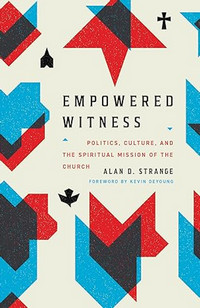
Empowered Witness: Politics, Culture, and the Spiritual Mission of the Church by Alan D. Strange: A Case Study and a Call to Act

Empowered WitnessEmpowered Witness:
Politics, Culture, and the
Spiritual Mission of the Church

by Alan D. Strange

DETAILS: 
Publisher: Crossway
Publication Date: February 13, 2024
Format: Paperback
Length: 127 pg.
Read Date: February 11-18, 2024
Buy from Bookshop.org Support Indie Bookstores

The church is not presented in the Bible as simply another voice in the competing cacophony of shouted slogans but rather that still small voice that testifies to what God has done for us in Christ, that he so loved the world that he gave Christ to die for it, so that all who believe in him should not perish but have everlasting life (John 3:16). This is the message of the church, and to reduce it to a mere political agenda is to sell short the glory of the gospel. The Christian faith is not, at its heart, a political message but a spiritual one. A doctrine of the spirituality of the church, properly conceived, holds fast to this thrust and permits the church to maintain fidelity to the Christian message while keeping in check any address that it might consider necessary respecting matters in the civil and political sphere.

What’s Empowered Witness About?

This is one of those books where if I’m not careful I’m going to end up restating and interacting with the entire argument of the book. So we’re going to be careful…

The Publisher’s site says:

Rediscovering the Spirituality of the Church in Our Highly Politicized Age

The goal of the church should be simple—share the gospel to the ends of the earth. But in our highly politicized age, Christians can tend to place earthly political and social agendas over God’s spiritual mission of the church.

In Empowered Witness, author Alan D. Strange examines the doctrine of the spirituality of the church, making a clear distinction between the functions of the church and other institutions. Strange argues that if the church continues to push political agendas, no institution will be focused solely on the Great Commission and the gospel will be lost entirely. This book calls readers to become aware of the church’s power and limits and shed light on moral issues in a way that doesn’t alter the deeply spiritual and gospel-centered mission of the church.

The Doctrine Under Consideration

This quotation from Charles Hodge offers a good (yet partial) definition:

It is the doctrine of the Scriptures and of the Presbyterian Church, that the kingdom of Christ is not of this world; that it is not subject as to faith, worship, or discipline, to the authority of the state; and that it has no right to interfere with the state, or give ecclesiastical judgment in matters pertaining to state policy.

The Spirituality of the Church focuses on the Church’s Spiritual Mission—to proclaim the gospel and help change the lives of believers—and calls the church to remember that’s her mission and to keep her from becoming entangled with or too immersed in the concerns of this world, with the power/goals of the State, and so on.

This doesn’t mean that the Church cannot—ought not—speak to the culture or State as it regards morality or spiritual issues, but it ought not get into the details of the political realities or functions.

The Structure of the Book

Let me just show you the Table of Contents first,

Chapter 1: The Doctrine of the Spirituality of the Church
Chapter 2: Slavery and the Spirituality of the Church
Chapter 3: The Spirituality of the Church Preceding the US Civil War
Chapter 4: The Spirituality of the Church and the General Assemblies of 1862–1865
Chapter 5: The Southern Church and the Reunion of the Northern Church
Chapter 6: The Spirituality of the Church and Politics Today

As you can see, the bulk of the book focuses on the middle of the Nineteenth Century and the Church (primarily the Presbyterian Church in the US)—and Charles Hodge was one of the leading voices and thinkers of the time. The book uses Hodge (and others to lesser extents) as a case study to see how this doctrine can be applied. Strange calls the story of the Presbyterian Church of the 1800s a “great cautionary tale”—you will not see a lot of hero-worship here. The Church didn’t live up to her calling, but we today can learn from their failings.

Strikingly, many of those who differed with and opposed Hodge (or that he differed with and opposed) held to the same doctrine. One of the strengths of Chapters 2-5 is that we see that this isn’t a “magic bullet” ensuring unity amongst believers that we can use to get the world/governments to do the things we want.

So, what did I think about Empowered Witness?

Every decision that the church as church takes needs to be justified in the light of the spirituality of the church, answering positively a question like “Does this advance the true spiritual task/calling/mission of the church?” Endorsing a political candidate and taking a position on a tax bill arguably does not pertain to or advance the cause of the gospel…

Saying this, though, does not remove the difficulty of defining what is spiritual vis-a-vis what is more purely political. One mans “purely political” may be another man’s “civil consequences of a proper spirituality.” Nothing will save us from the debate over whether a matter pertains to the proper spirituality of the church or falls under the more purely political items that should not concern the church. And there are those on both left and right, particularly hard-liners, who see everything as political, so that all political issues are moral and all moral issues are purely political.

This is not the book I expected from the description or even the title. This is both a complaint and a reaction. However, the book’s concept is probably a better idea than what I expected.

So rather than a purely theoretical or scholarly presentation and analysis of The Spirituality of the Church, or one looking at how to address contemporary issues, controversies, and discussions from that point of view—we get a look at how historical figures dealt with it. This allows the reader to see examples of the application of the doctrine to the real world (avoiding the problems of the first strategy) or distracting readers who may differ from the author when it comes to contemporary issues (avoiding problems of the second strategy). So by focusing on historical figures approaching a topic that most readers are familiar with, and are (likely?) largely settled about the events and how things played out, we can see how the various figures applied the doctrine without getting too worked up or distracted.

This also allows Strange to be critical of every figure he talked about when necessary—historical distance can be helpful.

I’ve seen a some mild criticism of Strange’s descriptions of the positions of James Thornwell and Stuart Robinson in distinction from Hodge—but they were mild (and the person who made those criticisms was largely positive toward the book otherwise). And I imagine there are some who’d want to pick a little on his depiction of Hodge and his position, too. But no one is going to challenge Strange’s grasp on the overall discussions and positions—this is an area he’s devoted years to and it shows.

Nor does this book try to answer every question, address every angle or objection—it’s the beginning of a consideration, an invitation to a conversation—one that each reader should have with those around them.

I ended up relishing the experience of reading this book and gleaned so much from it—and I really want to read the dissertation this was based on now (a healthy TBR stack is all that’s preventing me from jumping on it now). Chapter 1, “The Doctrine of the Spirituality of the Church” (with the introduction) and Chapter 6, “The Spirituality of the Church and Politics Today” serve as good bookends, ensuring that this isn’t just a historical discussion, but one that’s vital to readers and believers today—without being so expansive or long that Strange will put off readers who differ from him.

The more I think about this book, the more I like it. I’ve spent more time talking about it with others than I do most books—and have ended up chewing on it more after those conversations—the more time you spend with Strange, Hodge, and those events/ideas under consideration, the greater your appreciation is likely to be. Empowered Witness is an easy (enough) read, but deals with thought-provoking topics in a thoughtful way, so you’re not going to race through this. You’re going to walk away from this impressed with the Nineteenth Century figures (even if you were already appreciative with them) and wondering where you can read more people like them. Strange has done us a service with this book, and hopefully, it bears good fruit.


4 1/2 Stars

This post contains an affiliate link. If you purchase from it, I will get a small commission at no additional cost to you. As always, the opinions expressed are my own.

Irresponsible Reader Pilcrow Icon

PUB DAY REPOST: The Body’s Keepers (Audiobook) by Paul L. Kimmel, M.D., Lane Hakel (Narrator): The Social History I Didn’t Realize I Needed

The Body's KeepersThe Body’s Keepers:
A Social History of Kidney
Failure and Its Treatments

by Paul L. Kimmel, M.D., Lane Hakel (Narrator)

DETAILS:
Publisher: Dreamscape Media
Publication Date: March 12, 2024
Format: Unabridged Audiobook
Length: 17 hrs., 59 min. 
Read Date: Fevruary 27-March 5, 2024
Buy from Bookshop.org Support Indie Bookstores

What’s The Body’s Keepers About?

I feel underqualified to try to describe this book, and you’ll see why here in a sentence or two. So, I’m just going to paste what the Publisher’s Site says: (yes, I typically would cite the audiobook publisher here, but the print edition’s publisher gives more details)

A remarkable account of the kidney and the scientific, medical, and health evolution tied to our understanding of it.

The kidney is an extraordinary organ – in many ways the regulator, the metronome, the keeper of the human body’s delicate equilibrium. On a given day, minute by minute, it purifies the body of toxins it encounters from diet, climate, activity, and injury. It allows us to be and to move in the world. And yet most of us know so very little about these extraordinary vessels nestled in our bodies – and indeed millions of us only really learn about them when they stop working. Nearly a million Americans every year have end stage kidney disease, about 37 million have some form of chronic kidney disease. And it is an incredibly common universe of challenge and ailment that, until relatively recently, would simply kill those afflicted with it.

Renowned nephrologist Dr. Paul Kimmel takes us on an eye-opening journey through the history of kidney disease, dialysis, and transplantation. Drawing on both his extensive research and decades of experience in the field, he explains the development of treatments, technologies, and medical practices that have advanced the care of patients with kidney disease. Kimmel illuminates the impact of medical advances on the lives of those suffering from this debilitating disease and offers a clear understanding of the challenges that remain.

The Body’s Keepers also reveals the inequities and injustices at the heart of America’s healthcare system. Filled with case studies, personal histories, and first-hand accounts, the book reveals the shocking truth about the exploitation of vulnerable populations in the pursuit of profit. Kimmel examines how disparities in access to care have led to life-threatening consequences for many Americans. He also looks at the ways in which the medical industry has profited from the suffering of others, and how the path to health equity is still far from being realized. With unflinching honesty and a passionate commitment to social justice, his book is an essential read for anyone looking to understand the complexities of modern healthcare.

What Did I Think About the Narration?

With all due respect to Dr. Kimmel, this could very easily have been a dry-as-dust book. Yes, there’s occasionally some wit and some passion in the text–Kimmel’s personality does come through. Lane Hakel makes sure that shines through. He maintains the appropriate tone and seriousness to the subject, but with simple and subtle changes in inflection and so on to help maintain the listener’s engagement.

If nothing else, Hakel helped me pronounce a few terms and medication names that I’ve always stumbled on (or heard multiple ways).

I’m not saying that Hakel made this a joy to listen to, or that it was entertaining in the same way that, say, Luke Daniels makes a book–nor should it have been. But he keeps the listening experience accessible and interesting–even when the text seems just to be a list of names and acronyms. (which doesn’t happen often, but, occasionally it seems like it).

My Interest in the Book

So, I saw this on Netgalley the day after my son’s first dialysis treatment. And I clicked the request button as quickly as I could. I’ve talked in this space a little about his kidney transplant a few years ago. But what I know about kidney disease and the treatment of it doesn’t amount to much–and it’s very focused. So the opportunity to learn more–particularly in a history, was more than appealing.

Sure, I was discouraged a bit right off when one of the first things that Kimmel says is that he won’t be discussing the kidney disease my son had. But, he spent a lot of time talking about End Stage Renal Disease and transplants. So that more than made up for the skipped subject. And even the topics that didn’t directly have anything to do with my son were interesting to listen to. Because really, at the end of the day, the more medicine learns about various treatments for one area of kidney disease/treatment, the better off all patients are.

So, what did I think about The Body’s Keepers?

Can a non-medical professional read/listen to this and profit from this book? Absolutely. Are we the target audience? I don’t think so–well, those interested in the overlap of politics/economics/prejudices and medical treatments are definitely part of the target audience. So it’s not just the kind of book for M.D. after their name. But it’s not written for the person browsing a bookstore/library shelf for their weekend read, either.

This is an 18-hour listen, and it’s not the easiest listen, either–both because of the subject matter and the thoroughness with which Kimmel discusses things. Folks who are just idly curious are probably not going to make it through this book. But those who have a connection to the topic–because of their profession or professional interests, because (like me) they are or know someone going through these things, or because they’re invested in the social aspects and things like equitable access to care, or some other connection–will make it through this book and be glad for it.

For those who are interested in this subject, this is a fascinating book and a good audiobook experience. I do think I may end up getting the print edition just to make looking up a point or two easier. But for non-reference use? The audiobook is a good way to go.

I learned a lot, I have to say. The historical development of nephrology is fascinating. For such a young science the advances made are truly astounding (for example, when you hear how they made the first “artificial kidney”–the precursor to a dialysis machine, your mind will be boggled). The origins of the treatment of kidney diseases and injuries really start because of the World Wars and now kidney transplants happen all the time (not often enough for those on a transplant list for years), dialysis is routine, and the medical research is very promising to improve and innovate both.

Yes, the impacts of race, sex, income, and so on when it comes to access to and varieties of treatment are dismaying and befuddling (and on those providing the treatment). But the book suggests there’s every reason to be hopeful for the future, and that progress has been made. Easy for this white guy to say, but that was my takeaway from Kimmel. And, as in this post, I’m talking about this as a listening experience rather than commenting on the society that is depicted–the shortcomings of the system (especially in the U.S.) contrasted to the successes make for a more engaging narrative.

I should add that in the early chapters while doctors and researchers were still figuring out how to treat various kidney ailments, the symptoms and treatments (and failure rates), were strong reminders of how correct I was in choosing academic and career paths that took me far away from medicine. Some of that was rough for me (and no, I will not watch any documentary Dr. Kimmel decides to make in the future). People of stronger constitutions will not be bothered.

I’m really glad I listened to this, and encourage those interested to give it a try. It’s not a book for everyone, but for the right people will appreciate this.

Disclaimer: I received a copy of this book from North Star Editions via NetGalley–thanks to both for this.


4 Stars

This post contains an affiliate link. If you purchase from it, I will get a small commission at no additional cost to you. As always, the opinions expressed are my own.
Irresponsible Reader Pilcrow Icon

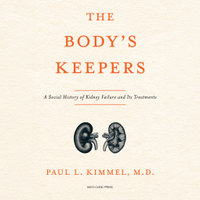
The Body’s Keepers (Audiobook) by Paul L. Kimmel, M.D., Lane Hakel (Narrator): The Social History I Didn’t Realize I Needed

The Body's KeepersThe Body’s Keepers:
A Social History of Kidney
Failure and Its Treatments

by Paul L. Kimmel, M.D., Lane Hakel (Narrator)

DETAILS:
Publisher: Dreamscape Media
Publication Date: March 12, 2024
Format: Unabridged Audiobook
Length: 17 hrs., 59 min. 
Read Date: Fevruary 27-March 5, 2024
Buy from Bookshop.org Support Indie Bookstores

What’s The Body’s Keepers About?

I feel underqualified to try to describe this book, and you’ll see why here in a sentence or two. So, I’m just going to paste what the Publisher’s Site says: (yes, I typically would cite the audiobook publisher here, but the print edition’s publisher gives more details)

A remarkable account of the kidney and the scientific, medical, and health evolution tied to our understanding of it.

The kidney is an extraordinary organ – in many ways the regulator, the metronome, the keeper of the human body’s delicate equilibrium. On a given day, minute by minute, it purifies the body of toxins it encounters from diet, climate, activity, and injury. It allows us to be and to move in the world. And yet most of us know so very little about these extraordinary vessels nestled in our bodies – and indeed millions of us only really learn about them when they stop working. Nearly a million Americans every year have end stage kidney disease, about 37 million have some form of chronic kidney disease. And it is an incredibly common universe of challenge and ailment that, until relatively recently, would simply kill those afflicted with it.

Renowned nephrologist Dr. Paul Kimmel takes us on an eye-opening journey through the history of kidney disease, dialysis, and transplantation. Drawing on both his extensive research and decades of experience in the field, he explains the development of treatments, technologies, and medical practices that have advanced the care of patients with kidney disease. Kimmel illuminates the impact of medical advances on the lives of those suffering from this debilitating disease and offers a clear understanding of the challenges that remain.

The Body’s Keepers also reveals the inequities and injustices at the heart of America’s healthcare system. Filled with case studies, personal histories, and first-hand accounts, the book reveals the shocking truth about the exploitation of vulnerable populations in the pursuit of profit. Kimmel examines how disparities in access to care have led to life-threatening consequences for many Americans. He also looks at the ways in which the medical industry has profited from the suffering of others, and how the path to health equity is still far from being realized. With unflinching honesty and a passionate commitment to social justice, his book is an essential read for anyone looking to understand the complexities of modern healthcare.

What Did I Think About the Narration?

With all due respect to Dr. Kimmel, this could very easily have been a dry-as-dust book. Yes, there’s occasionally some wit and some passion in the text–Kimmel’s personality does come through. Lane Hakel makes sure that shines through. He maintains the appropriate tone and seriousness to the subject, but with simple and subtle changes in inflection and so on to help maintain the listener’s engagement.

If nothing else, Hakel helped me pronounce a few terms and medication names that I’ve always stumbled on (or heard multiple ways).

I’m not saying that Hakel made this a joy to listen to, or that it was entertaining in the same way that, say, Luke Daniels makes a book–nor should it have been. But he keeps the listening experience accessible and interesting–even when the text seems just to be a list of names and acronyms. (which doesn’t happen often, but, occasionally it seems like it).

My Interest in the Book

So, I saw this on Netgalley the day after my son’s first dialysis treatment. And I clicked the request button as quickly as I could. I’ve talked in this space a little about his kidney transplant a few years ago. But what I know about kidney disease and the treatment of it doesn’t amount to much–and it’s very focused. So the opportunity to learn more–particularly in a history, was more than appealing.

Sure, I was discouraged a bit right off when one of the first things that Kimmel says is that he won’t be discussing the kidney disease my son had. But, he spent a lot of time talking about End Stage Renal Disease and transplants. So that more than made up for the skipped subject. And even the topics that didn’t directly have anything to do with my son were interesting to listen to. Because really, at the end of the day, the more medicine learns about various treatments for one area of kidney disease/treatment, the better off all patients are.

So, what did I think about The Body’s Keepers?

Can a non-medical professional read/listen to this and profit from this book? Absolutely. Are we the target audience? I don’t think so–well, those interested in the overlap of politics/economics/prejudices and medical treatments are definitely part of the target audience. So it’s not just the kind of book for M.D. after their name. But it’s not written for the person browsing a bookstore/library shelf for their weekend read, either.

This is an 18-hour listen, and it’s not the easiest listen, either–both because of the subject matter and the thoroughness with which Kimmel discusses things. Folks who are just idly curious are probably not going to make it through this book. But those who have a connection to the topic–because of their profession or professional interests, because (like me) they are or know someone going through these things, or because they’re invested in the social aspects and things like equitable access to care, or some other connection–will make it through this book and be glad for it.

For those who are interested in this subject, this is a fascinating book and a good audiobook experience. I do think I may end up getting the print edition just to make looking up a point or two easier. But for non-reference use? The audiobook is a good way to go.

I learned a lot, I have to say. The historical development of nephrology is fascinating. For such a young science the advances made are truly astounding (for example, when you hear how they made the first “artificial kidney”–the precursor to a dialysis machine, your mind will be boggled). The origins of the treatment of kidney diseases and injuries really start because of the World Wars and now kidney transplants happen all the time (not often enough for those on a transplant list for years), dialysis is routine, and the medical research is very promising to improve and innovate both.

Yes, the impacts of race, sex, income, and so on when it comes to access to and varieties of treatment are dismaying and befuddling (and on those providing the treatment). But the book suggests there’s every reason to be hopeful for the future, and that progress has been made. Easy for this white guy to say, but that was my takeaway from Kimmel. And, as in this post, I’m talking about this as a listening experience rather than commenting on the society that is depicted–the shortcomings of the system (especially in the U.S.) contrasted to the successes make for a more engaging narrative.

I should add that in the early chapters while doctors and researchers were still figuring out how to treat various kidney ailments, the symptoms and treatments (and failure rates), were strong reminders of how correct I was in choosing academic and career paths that took me far away from medicine. Some of that was rough for me (and no, I will not watch any documentary Dr. Kimmel decides to make in the future). People of stronger constitutions will not be bothered.

I’m really glad I listened to this, and encourage those interested to give it a try. It’s not a book for everyone, but for the right people will appreciate this.

Disclaimer: I received a copy of this book from North Star Editions via NetGalley–thanks to both for this.


4 Stars

This post contains an affiliate link. If you purchase from it, I will get a small commission at no additional cost to you. As always, the opinions expressed are my own.

Irresponsible Reader Pilcrow Icon

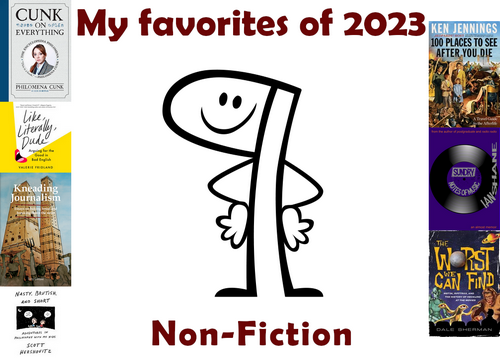
My Favorite Non-Fiction Books of 2023

Favorite Non-Fiction 2022
My 2023 Wrap up continues and now we’re on to the Non-Fiction list. While I liked a number of works that didn’t make this list, I felt strange calling them a “favorite.” So, we have 7 instead of the nigh-obligatory 10. These are the ones that stuck with me through the year; the ones I cited in conversation; that I thought about when reading something else or watching something on TV. Yeah, there’s some overlap between this list and the audiobook list from yesterday—lately, most Non-Fiction books I work through are in audiobook format. So it makes sense, even if it makes this post seem like an echo.

As always, I only put books that I’ve read for the first time on this list. I don’t typically return to NF books (outside of looking up things for one or three points), but occasionally I do—for example, The Pleasures of Reading in an Age of Distraction by Alan Jacobs would get a permanent spot on this list, were it not for this rule.

(in alphabetical order by author)

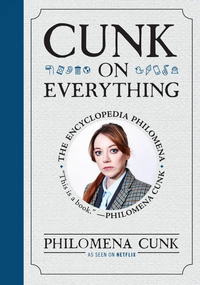
Cunk on EverythingCunk on Everything: The Encyclopedia Philomena

by Philomena Cunk

My original post
If you’ve ever watched a video clip or a full episode of Philomna Cunk’s various shows/specials, you know just what you’re going to get in this Encyclopedia. If you don’t, finish reading this post and then go find some. Probably pound-for-pound the funniest thing I read this year. Utterly useless outside of that—in case that wasn’t clear. Whether you go from cover to cover, or dip into it here and there (probably for longer than you intend to)—these brief entries are almost certainly going to be a burst of entertainment for you. Not all of them are going to work for every reader—but never fear, just turn the page and you’re probably going to come across one that will.

4 Stars

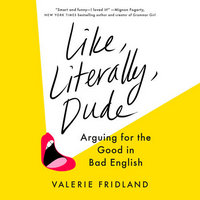
Like, Literally, DudeLike, Literally, Dude: Arguing for the Good in Bad English

by Valerie Fridland, Narrated by Valerie Fridland, Joniece Abbott-Pratt, Keylor Leigh, Andrew Eiden, Christopher Ryan Grant, Ellen Archer, Eileen Stevens and Nicky Endres

I’m a sucker for entertaining books about language, grammar, etc. Fridland’s apologetic for “Bad” English drives my inner prescriptivist, up the wall—but she joins the growing number of writers who are sealing up that prescriptivit’s coffin. How good is this book? Her chapter (or maybe it was a section of a chapter) on “Um” and “Uh” was fascinating. If she can pull that rabbit out of a hat, imagine how good she can be when she talks about the use/overuse of “like,” the history of “Dude,” or the figurative use of “literally”—and so much more. I spent most of the time listening to this book just geeking out in a way that made me regret not becoming a sociolinguist myself.

4 Stars

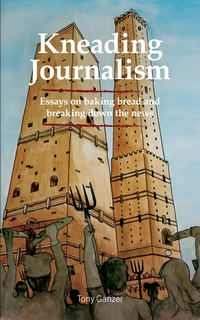
Kneading JournalismKneading Journalism: Essays on baking bread and breaking down the news

by Tony Ganzer

My original post
There’s just so much to commend about this book that this little paragraph isn’t going to come close to hitting it all. Partial memoir, small bread-recipe book, and some great insights into the state of journalism and what it means for our society. This is a great read—challenging, but in a friendly, welcoming way. Thoughtful and thought-provoking without being combative or overly critical. Ganzer has a point of view—and makes no claim about lack of bias here—but isn’t pushing a partisan outlook, just a pro-responsible press outlook. Brief, but not insubstantial.

4 Stars

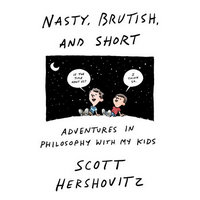
Nasty, Brutish, and ShortNasty, Brutish, and Short: Adventures in Philosophy with My Kids

by Scott Hershovitz

My original post
This was a great listen—Hershovitz is the kind of lecturer you want to pay attention to (or so imagine based on this). This book succeeded on multiple fronts: it was frequently amusing, if not downright funny; it was educational; it was insightful (even when I disagreed with what he did with the insights); it was thoughtful; it offered (largely by example, not being didactic) good parental advice; and kept this particular listener fully engaged throughout. Just what you want from an audiobook.

3.5 Stars

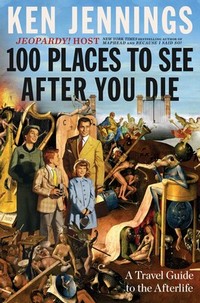
100 Places to See After You Die100 Places to See After You Die: A Travel Guide to the Afterlife

by Ken Jennings

My original post
A fun and informative traveler’s guide through afterlives depicted in Mythology, Religion, Books, Movies, Music and Theater, and from a few other sources. Jennings brushes against irreverancy, but (I think, I’m open to correction) stays on the respectful side. I absolutely had a blast with this—and learned quite a bit, too. It’s one that I’ll return to primarily as a reference, but I will appreciate the perspective and humor as I check my facts. The only problem I have with it is the lack of footnotes/endnotes—I want some source material!

4 1/2 Stars

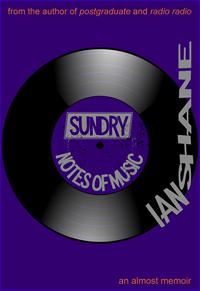
Sundry Notes of MusicSundry Notes of Music: an Almost Memoir

by Ian Shane

My original post
Given how much I like Shane’s novels, it’s probably to be expected that I enjoyed getting some insight into the novelist. And as most of his novels are centered around music/people obsessed with music, it’s fitting that this memoir focuses on songs. There are parts of this book that are very funny—some bittersweet, some tragic, some simply thoughtful. Multiple essays will hit all of those points and more. They’re all engaging in various ways. Not one track on this playlist is going to leave you looking for the skip button.

4 Stars

The Worst We Can FindThe Worst We Can Find: MST3K, RiffTrax, and the History of Heckling at the Movies

by Dale Sherman

My original post
Sherman is a man who knows about riffing on movies and helps the readers get a better knowledge of it, too. Yes, the focus is on Mystery Science Theater 3000‘s original run (runs?), but he talks about the show’s predecessors and the various projects that have sprung from it, too. Even if you know a lot about the show, its performers, etc., you’re probably going to learn something. And if you don’t? You’re going to enjoy the dashes of perspective that Sherman gives about movies in general and MST3K specifically. Everyone who did what they could to keep circulating the tapes in the 90s is going to eat this book up. Fans of more recent vintage likely will, too.

4 Stars

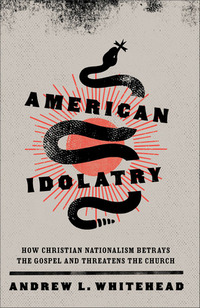
American Idolatry: How Christian Nationalism Betrays the Gospel and Threatens the Church by Andrew Whitehead

American IdolatryAmerican Idolatry:
How Christian Nationalism Betrays
the Gospel and Threatens the Church

by Andrew Whitehead

DETAILS:
Publisher: Brazos Press
Publication Date: August 15, 2023
Format: Hardcover
Length: 192 pgs.
Read Date: August 27-September3, 2023
Buy from Bookshop.org Support Indie Bookstores

Both parts of my identity* have led me to the same conclusion: Christian nationalism betrays the gospel and is a threat to the Christian church in the United States. It is from this perspective that I write this book. I want to make clear to my fellow white American Christians how much Christian nationalism threatens our faith—not only our individual expressions of it but also our organizations and institutions. It threatens our capacity to love our brothers and sisters in Christ who are minorities. It threatens our capacity to love and serve our brothers and sisters in Christ from countries around the world. It threatens our capacity to love and serve fellow bearers of God’s image at home and abroad who don’t share our faith at all. And it threatens how our organizations function, causing them to reproduce inequality and further harm the marginalized.

I am convinced that Christian nationalism makes us bad Christians.

* Those parts are a follower of Christ and a social scientist.

What’s American Idolatry About?

Essentially, this is an attempt to demonstrate the subtitle: “How Christian Nationalism Betrays the Gospel and Threatens the Church” (the above quotation does show he’s not talking about a threat to the throughout the world—or the future—but the contemporary church in the U.S., an important distinction).

It’s also a follow-up to the work he co-authored with Samuel Perry, Taking America Back for God: Christian Nationalism in the United States—this is a less-technical book (from what I can tell), to appeal to people who don’t enjoy digging through social science analysis and graphs. It also seems to be a “so what now?” response to that book—the earlier volume presented the data, and this is Whitehead’s suggested reaction to that data. I haven’t actually read the previous book, but from what Whitehead says in these pages and what I’ve read about the previous book, that’s my impression.

This doesn’t mean that Whitehead assumes a thorough knowledge of or familiarity with Christian Nationalism (he frequently appends “white” to that term for reasons he makes clear) going into this book, he spends two chapters outlining the basics of Christian Nationalism and how that impacts the Church. The next three chapters focus on what he calls “the three most powerful” idols of Christian Nationalism—power, fear, and violence—followed by three chapters describing alternatives to these idols, ways that are more faithful to the calling to which you have been called.*

* These are not exhaustive chapters, for more along these lines—see What Are Christians For? Life Together at the End of the World by Jake Meador. Some of the ideas in these books will align, but they will diverge, too. Yet, I would predict neither author would object to being read together.

A Disclaimer of Sorts

We have to look straight into the mirror and not try to hide or diminish the imperfections we see. Only then can we begin to imagine something new. Part of this work is recognizing that the God we worship has no particular interest in the greatness of the United States. The survival of any one nation over another is not paramount. The kingdom of God needs no global superpower in order to flourish….recognizing that human flourishing in the kingdom of God and in the United States (or any other nation) are not synonymous does not mean that Christians should not invest in the flourishing of a nation and its people. We can work toward peace, justice, and care for all who live and work within the boundaries of our home country. We can collaborate with God and those around us to create a more loving and liberating country for all our neighbors.

Whitehead returns to the idea frequently, but stresses it in the first two chapters—he is not calling for Christians to be anti-American, or even apathetic about our country. He’s not calling for them to remove themselves from the political process. His concern is how we see the country, how we view and treat our fellow citizens, and how we’re involved in the political process.

The choice is not Christian Nationalism or godless anarchy, or Communism, or Sharia law—and so on. His vision is for Christians to work alongside those of other faiths (or absence thereof) for the civil betterment of us all. While I think Whitehead’s politics tend toward the Left, he’s not calling for all Christians to embrace that—conservative and Republican Christians can agree with his arguments on the issues this book centers on.

The Idols of Christian Nationalism

There are many “idols” of CN, claims Whitehead, but the three he focuses on are the biggest problems in his view are power, fear, and violence. The heart of the book is devoted to this section (it’s not the longest, but it’s the most important), here he demonstrates how the devotion to and use of these characterize the movement and put it at odds with Christianity.

In these chapters, Whitehead begins by defining what he sees as the CN’s use of/dependence on the various idols. Then he’ll show how throughout our history—but particularly in recent decades/years how both political figures and religious leaders have tapped into and exploited these ideas for their own benefit and the detriment of other groups in the U.S. He’ll then look at Christ’s and/or early-Christian teachings on the same ideas, contrasting them with CN’s use (this is particularly effective on the ideas of power and violence).

The shortcomings (to put it mildly) of CN are on full display here. Frankly, I think the definition work done in chapter 2 is enough to turn someone off of this ideology, but chapters 3-6 really put the nail in the coffin.

So, what did I think about American Idolatry?

Over years of academic study and personal faith journey, I have become convinced that white Christian nationalism in the United States is fundamentally opposed to the ethics and teachings of Jesus. Through idolizing power, fear, and violence, white Christian nationalism betrays the gospel, in which Jesus’s sacrifice liberates us from our enslavement to sin as well as the destruction it causes through systems of oppression It betrays the gospel that realigned the power structures of society.

As a whole, I don’t see people who aren’t at least suspicious of CN responding well to this book—I think most of those who are suspicious will become more so after this—and those who are already pretty against it will have new reasons and will be strengthened in it. I’m not sure that those who have leanings or sympathies toward it are going to respond well. I could be wrong, and hope I am. That I don’t think it would reach the CN-leaning is the biggest flaw with the book (but if I’m wrong about the effectiveness, that flaw wouldn’t be that big).

Based on what little he indicated about his own theological positions, I don’t think Whitehead and I would agree on much. I think we’d probably agree on less when it comes to politics. But when it comes to the impact that CN is having on churches, our gospel witness, and the public perception of the Christian Church in the US? Well, we’re pretty much on the same page—which I think fits some of Whitehead’s points. He’s not really that concerned with the areas where he and I would disagree, in fact, he’d probably defend that ability. Where he is focused is the negatives that CN brings to political discourse and the work of the church.

On those points, I think he scored big in American Idolatry—showing the flaws, errant presuppositions, and wrong emphasis—and non-Christian attitudes of CN. I’m less sure that he was convincing in the last three chapters about healthy alternatives, but I do think what he offers there is better than CN, and he’s convincing to that point. Maybe not as far as he wants to be, however.

Crisp and clear writing, the text moves with the assurance of someone well-versed in the subject and clear-eyed about what they want to say about it. I recommend the book and thinking about the issues it raises.


3.5 Stars

This post contains an affiliate link. If you purchase from it, I will get a small commission at no additional cost to you. As always, the opinions expressed are my own.
Irresponsible Reader Pilcrow Icon

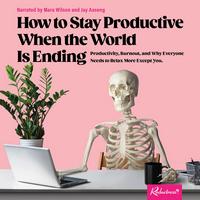
How to Stay Productive When the World Is Ending (Audiobook) by Reductress: Mara Wilson & Jay Aaseng: The “This is Fine” Meme, Expanded

How to Stay Productive When the World Is EndingHow to Stay Productive When the World Is Ending:
Productivity, Burnout, and Why Everyone Needs to Relax More Except You

by Reductress; Mara Wilson & Jay Aaseng (Narrators)

DETAILS:
Publisher: Andrews McMeel Publishing
Publication Date: June 20, 2023
Format: Unabridged Audiobook
Length: 4 hrs., 49 min.
Read Date: September 20-21, 2023
Buy from Bookshop.org Support Indie Bookstores

What’s How to Stay Productive When the World Is Ending About?

People being compelled to choose between having money to buy food/shelter/necessities and health (all while maintaining a social media presence) in the midst of worrying about the immanent death of the earth from climate change and various and sundry pandemics—this is the book for you.

a collection of essays, how-tos, and “inspirational” phrases to help you laugh when staying both sane and productive in a commodified world feels impossible. From “‘Doing What You Love’ and Why That’s Bad,” to “Why I’m Prioritizing My Career Over Finding a Better Career,” this collection perfectly skewers the indignities, big and small, of living through late-stage capitalism.

The Narrators

Mara Wilson and Jay Aaseng did a great job—a very dry delivery (unless something else was called for) and earnestness really sold the satire. I can’t help but imagine that they had to do many takes of parts of this because it was difficult to get through with a straight face. Even for professionals like they are.

I think Aeseng got to show a little more range in his performance, but that’s just because some of the things he was asked to do demanded it—when Wilson got to do more than the straight, dry reading, she stepped up as well. Maybe if I wasn’t multitasking, I could’ve taken more notes and kept better track, and I’d see that the ratio was different.

Essentially, they did a great job—I’d listen to more audiobooks by them—and they thoroughly entertained me.

So, what did I think about How to Stay Productive When the World Is Ending?

The website for Reductress states that it’s

The first and only satirical women’s magazine, Reductress was founded in 2013 by Beth Newell and Sarah Pappalardo. The mission of Reductress is to take on the outdated perspectives and condescending tone of popular women’s media.

and that tone and direction are clear throughout this book. Thankfully, even when it’s not targeted toward me, I can still (frequently) enjoy humor and satire done well. And this book, reader, is done well.

Very little of the satire and humor was mean-spirited toward an individual, political persuasion, or most lifestyles (I honestly can’t think of an example at the moment that was, but I’m going to say this to be safe). It does skewer the lifestyles/thinking of those who promote/require people to have to hold down a side-hustle or three to make ends meet, for example. But even then, not in a mean way.

I don’t think people should grab this audiobook, however. (no offense to the narrators, see above) Or if you do, don’t listen from beginning to end in a sitting or two. Listen for 15± minutes at a time and then switch to a podcast or other audiobook. It’s just too much at once, and all the jokes blur together. Also, I’ve looked at some of the samples of the book online—between the graphics and layout, and the ease of picking it up, reading a bit and then putting it down; print is the way to go with this book.

That said—I thought it was frequently hilarious, funny at almost every point—each piece had something that made me grin or chuckle. Most had several lines that did that—and a good portion made me laugh out loud. I even played a couple of pieces to my wife and daughter (my chronically ill daughter really enjoyed the piece, “How to #Grind when your #SideHustle is #ChronicIllness”). It feels like cheating to mention this one in particular, but I have lived (and know others who have, too) “Why I’m Prioritizing My Career Over Finding a Better Career.” Reader, I laughed so hard. And cringed.

That’s pretty much my reaction to the book as a whole.

I would absolutely recommend this to anyone with the above caveat about format.


3 Stars

This post contains an affiliate link. If you purchase from it, I will get a small commission at no additional cost to you. As always, the opinions expressed are my own.
Irresponsible Reader Pilcrow Icon

Page 1 of 5

Powered by WordPress & Theme by Anders Norén