Category: YA/MG/Children’s Books Page 26 of 42

My Favorite 2018 (Fictional) Dogs

In one of the lightest moments of Robert B. Parker’s Valediction (just before one of the darker), Spenser describes his reservation about the first two Star Wars movies: “No horses . . . I don’t like a movie without horses.” After watching Return of the Jedi, he comments that it was a silly movie, but “Horses would have saved it.” Which makes me wonder what he’d have thought about The Last Jedi. Horses aren’t my thing, it’s dogs. I’m not quite as bad as Spenser is about them — I like books without dogs. But occasionally a good dog would save a book for me — or make a good book even better. I got to thinking about this a few weeks back when I realized just how many books I’d read last year that featured great dogs — and then I counted those books and couldn’t believe it. I tried to stick to 10 (because that’s de rigueur), but I failed. I also tried to leave it with books that I read for the first time in 2018 — but I couldn’t cut two of my re-reads.

So, here are my favorite dogs from 2018 — they added something to their novels that made me like them more, usually they played big roles in the books (but not always).

(in alphabetical order by author)

  • Edgar from The Puppet Show by M. W. Craven (my post about the book) — Edgar has a pretty small role in the book, really. But there’s something about him that made me like Washington Poe a little more — and he made Tilly Bradshaw pretty happy, and that makes Edgar a winner in my book.
  • Kenji from Smoke Eaters by Sean Grigsby (my post about the book) — The moment that Grigsby introduced Kenji to the novel, it locked in my appreciation for it. I’m not sure I can explain it, but the added detail of robot dogs — at once a trivial notion, and yet it says so much about the culture Cole Brannigan lives in. Also, he was a pretty fun dog.
  • Rutherford from The TV Detective by Simon Hall (my post about the book) — Dan Groves’ German Shepherd is a great character. He provides Dan with companionship, a sounding board, a reason to leave the house — a way to bond with the ladies. Dan just felt more like a real person with Rutherford in his life. Yeah, he’s never integral to the plot (at least in the first two books of the series), but the books wouldn’t work quite as well without him.
  • Oberon from Scourged by Kevin Hearne (my post about the book) — Everyone’s favorite Irish Wolfhound doesn’t get to do much in this book, because Atticus is so focused on keeping him safe (as he should be). But when he’s “on screen,” he makes it count. He brings almost all of the laughs and has one of the best ideas in the novel.
  • Mouse from Brief Cases by Jim Butcher (my post about the book) — From the moment we read, “My name is Mouse and I am a Good Dog. Everyone says so,” a good novella becomes a great one. As the series has progressed, Mouse consistently (and increasingly) steals scenes from his friend, Harry Dresden, and anyone else who might be around. But here where we get a story (in part) from his perspective, Mouse takes the scene stealing to a whole new level. He’s brave, he’s wise, he’s scary, he’s loyal — he’s a very good dog.
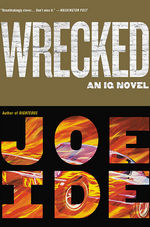
  • Ruffin from Wrecked by Joe Ide (my post about the book) — Without Isaiah Quintabe’s dog opening up conversation between IQ and Grace, most of this book wouldn’t have happened — so it’s good for Grace’s sake that Ruffin was around. And that case is made even more from the way that Ruffin is a support for Grace. He also is a fantastic guard dog and saves lives. His presence is a great addition to this book.
  • Dog from An Obvious Fact by Craig Johnson (my post about the book) — I might have been able to talk myself into ignoring re-reads if I hadn’t listened to this audiobook (or any of the series, come to think of it) last year — or if Dog had been around in last year’s novel. Dog’s a looming presence, sometimes comic relief (or at least a mood-lightener), sometimes a force of nature. Dog probably gets to do more for Walt in this book — he helps Walt capture some, he attacks others, just being around acts as a deterrent for many who’d want to make things rough on Walt. Walt couldn’t ask for a better partner.
  • Trogdor from The Frame-Up by Meghan Scott Molin (my post about the book) — Honestly, Trogdor probably has the least impact on the book than any of the dogs on this list. But, come on, a Corgi names Trodgor? The idea is cute enough to justify inclusion here. He’s a good pet, a fitting companion for MG — not unlike Dan’s Rutherford. He just adds a little something to the mix that helps ground and flesh-out his human companion.
  • Mingus from The Drifter by Nicholas Petrie (my post about the book) — Like Trogdor, a great name. Like Mouse and Dog, a great weapon. He’s really a combination of the two of them (just lacking Mouse’s magical nature). He’s vital in many different ways to the plot and the safety of those we readers care about. Petrie made a good move when he added this beast of a dog to the novel.
  • Chet from Dog On It by Spencer Quinn (my posts about Chet) — If I couldn’t cut Dog, I couldn’t cut Chet. Listening to this audiobook (my 4th or 5th time through the novel, I believe) reminded me how much I love and miss Chet — and how eager I am for his return this year. This Police Academy reject is almost as good a detective as his partner, Bernie, is. Chet will make you laugh, he’ll warm your heart, he’ll make you want a dog of your own (actually, all of these dogs will)
  • Zoey from Deck the Hounds by David Rosenfelt (my post about the book) — how do I not invoke Tara when discussing an Andy Carpenter book? Good question. It’s Zoey that brings Andy into the story, it’s Zoey that helps Don to cope with his own issues, it’s Zoey that defends Don and saves him (in many ways). Sure, Tara’s the best dog in New Jersey, but Zoey comes close to challenging her status in this book.
  • Lopside from Voyage of the Dogs by Greg van Eekhout (my post about the book) — It almost feels like cheating to bring in a dog from a novel about dogs — conversely, it’s hard to limit it to just one dog from this book. But Lopside the Barkonaut would demand a place here if he was the only dog among a bunch of humans — or if he was surrounded by more dogs. He’s brave, he’s self-sacrificing, he’s a hero. He’ll charm you and get you to rooting for these abandoned canines in record time.

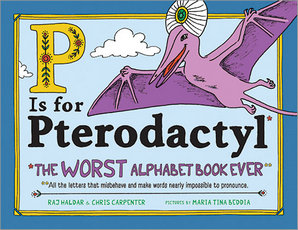
P Is for Pterodactyl: The Worst Alphabet Book Ever by Raj Haldar, Chris Carpenter, Maria Beddia: Twisted, Fun and even Educational

P Is for PterodactylP Is for Pterodactyl: The Worst Alphabet Book Ever

by Raj Haldar, Chris Carpenter, Maria Beddia (Illustrator)


Hardcover, 40 pg.
Sourcebooks Jabberwocky, 2018
Read: December 20, 2018

One of the first books printed in the American colonies was The New England Primer, filled with catchy lines like “In Adam’s Fall / We Sinned All.”

Since that time, many alphabet-type books have been published in the same — or similar — vein. One of the latest is P Is for Pterodactyl, which carries the subtitle, The Worst Alphabet Book Ever which doesn’t seem that complimentary, but when it includes lines like:

“J is for Jai Alai.

or

“E is for Ewe.”

or even

“U is not for You.”

and maybe you start to think there’s a little truth in advertising.

It’s actually an amusing book with some examples of the oddities and vagaries of English spelling/pronunciation that will stick with you. I’m not crazy about some of the selections (V’s a good example), but by and large, I really liked each “for” that the authors selected.

The artwork is great — it compliments the text well and will help keep shorter attention spans focused.

For everyone who enjoyed BNL’s “Crazy ABC’s”, this Picture Book entertains as well as educates. I’m not sure how well it’d work for the 7-and-under crowd, but for older elementary kids — and adults who just want a chuckle, this book will be just the ticket. I had a fun time reading it — as did my whole family. Unlike most of the picture books I post about here, you’ll note that this one doesn’t carry any kind of disclaimer — I bought this one after seeing a couple of pieces about it online, and am glad I did. I imagine you will be, too.

—–

4 Stars

Kitties Are Not Good To Eat by Cassandra Gelvin: and other useful and cute advice on feline care for the younger set.

Kitties Are Not Good To EatKitties Are Not Good To Eat

by Cassandra Gelvin
Kindle Edition, 14 pg.
2018
Read: November 17, 2018

This is just adorable. That’s really all I have to say.

This is a board book — I’d honestly forgotten those existed — so dial those expectation in to the correct channel. This is a collection of cute cat pictures (you know, the things the Internet was full of before we entered the era of heightened political discourse we’re now in) that are sure to delight little kids. Accompanying these pictures are handy rhyming tips like, “Kitties were not made to fly / And they do not want to try.”

Maybe not advice you need, but for a 2 year-old this could be life changing stuff — life extending, even.

The photos are fun, the text is, too. I can’t imagine that the target audience of a board book (or their electronic equivalent) wouldn’t love to hear this read to them a few times a day. Potentially more importantly, this won’t become really annoying to the reader all that quickly (it will eventually, but what doesn’t?)

A cute book that will entertain and/or not annoy — that’s pretty much all you can hope for with a board book. Give this a shot.

Disclaimer: I received a copy of this book from the author in exchange for my honest take.

—–

3 Stars

Be Brave, Little Puffy by Arline Cooper: A Cute Fish Tale

Be Brave, Little PuffyBe Brave, Little Puffy: Promoting Positive Body-Image and Self-Esteem

by Arline Cooper

Kindle Edition, 28 pg.
Ofek, 2018
Read: November 8, 2018

Puffy is a puffer fish with a little problem — he’s not terribly fond of his spines, if for no other reason than he’s frequently poking his friends with them. He leaves his fellow puffer fish to go on a journey to find other friends — maybe fish he won’t bother as much. Puffy encounters many other fish of various species in his effort to find a new group of friends he can live with. Eventually, naturally, he finds a way to win back his friends, and learn to accept his spines.

Each encounter is captured in a colorful drawing depicting the new species — attractive, fairly accurate and eye-catching.

It was a little wordier than most books for 4-8 year olds tend to be. Which isn’t a bad thing — just something I noticed. The thing that bothered me the most about this book was the pictures. I want to stress that this might just be a Kindle Version thing, and that other formats may not have the issue. But the pictures about each episode follow the encounter with the fish — so the visual aid comes too late. So you have to flip to the next screen before starting to read so you can see or show the fish in question, and then flip back to pick up the narration. Is this a problem? No, but it’s a pain — especially if your child/audience is impatient.

The pictures are also a little on the small side (yes, I know that can be changed for each picture as you go along, But it’d be nice if you didn’t have to do anything) — and they deserve a closer look than is easily possible.

Arline Cooper has the goods — story and pictures bother — to produce quality picture books, hopefully we see more. Quibbles aside, this is a fun book, a book I can see parents reading frequently — and kids demanding frequently. Nicely told, attractively illustrated, with a positive message — that’s a good combination.

Disclaimer: I received a copy of this book from the author in exchange for my honest opinion, as seen above.

—–

3 Stars

Voyage of the Dogs by Greg van Eekhout: An All-Ages SF that is a sure-fire crowd-pleaser

Voyage of the DogsVoyage of the Dogs

by Greg van Eekhout

Hardcover, 208 pg.
HarperCollins, 2018
Read: October 1, 2018

           Of course, the humans couldn’t go alone. There had to be dogs. Because wherever humans went dogs came along. Like rats, only more helpful. Dogs would herd livestock. Dogs would keep watch against the unknown. And, more importantly, dogs would keep the human crew company during the long spaceflight, and on their new home, far away from Earth.

But first they had to get there.

I guess this is technically a “Middle Grade” book — but forget about that. Call it All-Ages instead — that way, adults and YA readers and . . . everyone can enjoy this SF guilt-free. I should also include this line from The Big Idea post Van Eekhout wrote on Scalzi’s blog: “Spoiler: I don’t kill off any of the dogs in this book. Why not? Because I’m not a monster, that’s why not.” It’s important to get that out of the way.

Let’s start with this: the rationale to bring dogs along on a spaceship. It’s brilliant. It also points to one of the biggest problems with Starfleet, the Colonial Battle Fleet, the Serenity, etc. A lack of animals. Sure, NCC 1701-D had pets (not that we saw them often), but they were sealed up in cabins. And Firefly‘s episode “Safe” had cattle, but that was an oddity. The animals aboard Laika are there for purposes — like the main character, Lopside. He’s there to hunt rats — where there are humans and cargo, there are rats. Something small and fast — and with a good nose — is needed to hunt rats down.

The book will do a better job explaining the roles of the other three dogs and what advances in breeding have led to dogs being capable of being more than the dogs we have today — while still remaining dogs — to become Barkonauts.

These poor, brave dogs go into the hibernation state just before the humans do to complete the voyage to a nearby star system as part of human exploration and colonization, the first mission like this humanity has tried. But when the dogs wake up, they notice something’s wrong — part of the ship is missing, as is the crew.

They’re too far into the mission to turn around, too far away for a rescue mission to reach them. At this point, Lopside and the others have to try to salvage what they can and limp along to their final destination.

Lopside is a terrier mix, he’s brave, he has (understandably) abandonment issues — which are not helped at all by the absence of the humans. He’s a little scatter-brained (like a good terrier) and he’s incredibly loyal and has a great heart. The other barkonauts are as well-drawn and lovable.

Van Eekhout is clearly a dog-lover and it comes out in his characters. He’s also a pretty good story-teller, because even with that spoiler, I was invested in the outcome and really wasn’t sure how he was going to pull things off in a way that was satisfying and that wouldn’t reduce semi-sensitive 5th-graders across the globe to quivering balls of tears (a lesson Wilson Rawls could’ve used, I have to say — no, I’m not still torn up about Old Dan and Little Ann, why do you ask?). He does succeed in that — although some might get a bit misty at a point or two. It’s a fun and creative story, and takes some oft-repeated SF tropes and deals with them in a refreshing way.

Ignore the stars — I can’t bring myself to give it more, I don’t know why. Pay attention to what I have said above and this: read the book. It’ll warm your heart, it’ll make you make you a little sad, it’ll give you something to grin about — and it tells a good story, too. What more do you want?

—–

3.5 Stars

2018 Library Love Challenge

Trouble Never Sleeps by Stephanie Tromly: Tromly (and Digby & Zoe) saved the best for last.

Trouble Never SleepsTrouble Never Sleeps

by Stephanie Tromly
Series: Trouble, #3

Hardcover, 299 pg.
Kathy Dawson Books, 2018
Read: September 17, 2018

This picks up right on the heels of Trouble Makes a Comeback leaving Zoe and Digby (and their friends) to deal with the social fallout of the events of that party. Then and only then can they start to decide how they’re going to deal with the deal Digby was offered: steal some top-secret research data in exchange for information on his sister’s whereabouts. Sure, it’s technically treason and will likely end up destroying Digby’s life as well as the lives of Felix’s family.

Meanwhile, there’s a complication to the caper in the last book — Zoe left something tied to her in the evidence collected by the police. The repercussions of that caper are also in danger of hurting some of the students they set out to save.

Both stories are good uses of the characters, and were strong stories on their own. While I have enjoyed Digby’s schemes and how they work out (or how they almost do), but I had a hard time swallowing his plan (or how it was carried out) for the non-high school caper. By the way, it took several tries to stay away from spoilers in that sentence. However, once I decided to not care about how outlandish it all was, I enjoyed reading it.

The key to this book — series, really — are in the characters and their interactions. Not just Zoe and Digby (but nothing’s more important, or better, than that), but Zoe and her mom, Zoe and her friends/frenemies/enemies at school, and Digby’s strange interactions with everybody. I don’t know if Tromly hit that better this time, or just as well has she had before — either way, the dialogue sings and you believe it. These relationships are complicated and real and they make the books come alive.

I should probably add that the reason I didn’t listen to the audiobook (unlike the last two) is because my library didn’t have a copy, unlike the last two. It’s not a reflection on Kathleen McInerney’s work — it was good for me to see that it was Tromly’s words and not just McInerney’s great narration that hooked me, though.

It’s hard to talk about this book in any kind of depth without spoiling book 2 and ruining things here. So I’ll stop now. It’s a fun adventure, with laughs, tension, and all the warm fuzzies you could ask for.

The trilogy started off strong, stumbled a bit and then more than recovered with this one. It’s the strongest of the series easily — and sticks the landing (which I worried about, not because I didn’t think Tromly could do it, it’s just easy to miss). I’m going to miss Zoe and Digby. I’m so glad that I found this series this year — it’s been a blast to listen to and read. Great characters, strong character arcs over the trilogy, a good overall story, with some great smaller stories in the individual books. This series is going down as one of my favorite YA series ever.

—–

4 1/2 Stars2018 Library Love Challenge

Bearded by Jeremy Billups: A Charming Picture Book about a Bearded Bear

Bearded

by Jeremy Billups
Hardcover, 34 pg.
Billups Creative, LLC, 2015
Read: September 5, 2018
Picture books about bears are everywhere — I have a hard time believing many kids get out of the picture book stage without exposure to at least 4 of them (and that’s before they’re at the Pooh or Paddington stage). But how many of those bears have been bearded?

Enter Jeremy Billups and his little book.

This is the story of a little red-haired girl (no, not that one) traveling the world with her bearded bear, having all sorts of adventures and meeting a bunch of different animals. There really isn’t a lesson, moral or much of a plot — just a bunch of quick looks at the pair. A few quick lines and a picture on each pair of pages.

The art is simple and arresting. They just pop off the page — this is one of those times I wish I had the necessary vocabulary to describe why I like the drawings, but I don’t. I bought a print of what turns out to be page 16 before I even picked up the book to flip through. I’ve bought a handful of prints this year, and it’s my absolute favorite — I like it even more now that I’ve read the book. Also, if you ever see a better picture of someone making buffalo wings, I’ll eat my hat.

Oh, and the endorsements on the back cover are a lot of fun. If that doesn’t convince you to try it out, I can’t imagine what will.

Great art, cute story, fun rhymes — everything you want in a picture book. Even better — animals with beards are the best animals that aren’t dogs. This is a charming little book that’s sure to please.

—–

4 Stars

The Day That A Ran Away by B.C.R. Fegan, Lenny Wen: The Best Reasons (Excuses?) Schoolwork wasn’t Done that I’ve Ever Read

The Day That A Ran AwayThe Day That A Ran Away

by B.C.R. Fegan, Lenny Wen (Illustrator)

Kindle Edition, 32 pg.
TaleBlade Press, 2018
Read: July 9, 2018

Things are going bad for poor Jet — his teacher has noticed that he hasn’t finished his assignment of writing out the Alphabet. So he explains to Mrs. May that he did, in fact, do it, but . . . well, did you read the title? A ran away.

From there, Jet goes on to explain why each letter isn’t on his paper. D was scared, I just didn’t want to, something nefarious might have gone on with L, and so on. Each letter gets its own page with a fantastic picture personification and a line or two describing (in rhyme) why that letter didn’t make it onto the work.

Wen’s art is never not delightful, but I really enjoyed this one and have flipped through it a couple of times just to look at the drawings — I love the T and O characters in particular. I’m not sure I can describe it, it might take away from the value if I could — but T’s teeth are about the best bit of art I’ve seen this month. The details he fills the pages with are wonderful, eye-catching and will entertain adults as much as kids.

I’m a little surprised that I’ve become, at this stage in my life (my kids are teenagers or older) to become a fan of picture book creators — but these two have turned me into one. This book demonstrates why. Typical of Fegan and Wen, The Day A Ran Away this is imaginative, fun, and well-written. I cannot imagine a child of picture book age (and maybe a little older) not being entranced by the art, there’s plenty going on for parents/others to point out, and a story that’s fun enough to read that someone wouldn’t mind repeating a few dozen times — which is more important than non-parents can realize.

Disclaimer: I received a copy of this book from the publisher in exchange for my honest opinions about this book.

—–

4 Stars

BOOK BLITZ: Shadow Games by Jim Lester

 photo Shadow Games_zpsutlxortm.jpg

Coming of Age
Date Published: June 2018
 photo add-to-goodreads-button_zpsc7b3c634.png
Danny McCall loves basketball more than anything in the world. So why would he risk his basketball scholarship, the love of his life and his entire future to fix the point spread in a series of college basketball games?
Set in the early 1990s, Shadow Games is an exciting page-turner, filled with fast-paced hoops action. A topical novel for readers of all ages, the book is a powerful portrayal of the loss of youthful innocence.


About the Author

 photo Shadow Games Author Jim Lester_zps3ykf5nop.jpeg

Jim Lester is the author of three successful young adult novels: Fallout, The Great Pretender and Till the Rivers All Run Dry. He has a Ph.d in history and is the author of a non-fiction book entitled Hoop Crazy: College Basketball in the 1950s.
Contact Links
Purchase Link


RABT Book Tours & PR

Picket Town by Chris von Halle: An Age-Appropriately Creepy SF for the MG reader in your life

Picket TownPicket Town

by Chris von Halle

PDF, 178 pg.
Clean Reads, 2018
Read: July 31, 2018

Amanda is bored. Every day is the same — her life isn’t bad, she actually likes it. But she wants more. She’s not sure exactly what it is that she wants — but it’ll be found outside the city limits of New Pines (she calls it Picket Town). She and her friend Sam spend their days after school playing a computer RPG, eating with their families, playing the game some more and repeating the whole thing the next day.

Then something starts happening — some of the kids in town come down with some sort of bacterial infection that requires them to be hospitalized while a cure is worked on. Amanda starts to wonder if everyone is going to be okay — no matter how often she’s assured that the grown-ups have everything under control. She wants to strike out, she wants to learn something — and on the way home from school, they pass the same sign forbidding them to enter the forest that they walk by every day. But this day, this particular day she decides she’s had enough — and then she convinces Sam to come with her. They climb over the fence and explore the forest. This is the most thrilling thing they’ve ever done. Right up until the point that they find a what appears to be a flying saucer (well, a saucer that’s landed). Pretty much everything they’ve ever known ends right there. What follows is exciting, dramatic, and unexpected (well, at least for the target audience — Middle Grade — adult readers will have a pretty good chance of seeing what’s around the corner, most of the time).

I wasn’t so sure that I was going to enjoy this at the beginning, I’m not sure why, it just didn’t seem like it clicked. But it honestly didn’t take long before it reminded me of the better SF I read in grade school, and I was in it for the long haul. Although, honestly, I’m not sure any of the books I read when I was that age would’ve gone where von Halle took this. That’s a compliment, by the way, it may not look like one.

I’m not crazy about the conclusion, I have to say, as much as I liked almost everything that came before. There’s a good twist to it — and I really liked it. But the ending itself? I don’t know — it relied too much on a big info-dump, and then the reveal for Amanda and Sam could’ve been executed a little better. But I think those are quibbles, and I really don’t imagine that there’s a Fourth Grader out there that’ll say the same thing.

This isn’t a MG novel that transcends the label and that’ll appeal to adults — in other words, not everyone is J.K. Rowling. I’ll give you a moment to digest that revelation. This is a MG novel that knows its audience and that will deliver what it wants. Were I in that audience, I’d be re-reading this a few times. I’m not, so I’ll tell people to give it to someone who’ll appreciate it more.

Disclaimer: I received a copy of this book from the author in exchange for my honest opinion, given above.

—–

3 Stars

✔ Read a book with a child narrator.

Page 26 of 42

Powered by WordPress & Theme by Anders Norén