According to Mark by H. B. O’Neill: No Man Has a Wholly Undiseased Mind…

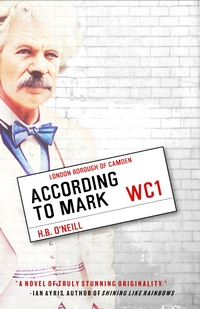
According to MarkAccording to Mark

by H. B. O’Neill

DETAILS:
Publisher: Fahrenheit Press
Publication Date: February 2, 2024
Format: eARC
Length: 496 pg.
Read Date: November 27-30, 2023

But we are all insane, anyway…The suicides seem to be the only sane people.
—Mark Twain’s Notebook, #40, (Jan. 1897-July 1900)

What’s According to Mark About?

This is tricky to describe, but let’s give it a shot.

Following a bad breakup, a despondent man, Robert, becomes convinced that the spirit of Mark Twain is trying to guide his life and thinking, giving him lessons in the form of quotations from Twain’s works. Eventually, Twain focuses on getting Robert to kill himself. Robert’s eager to follow the lessons of his hero, but things keep interfering with his efforts.

Meanwhile, Robert’s ex, Rebecca, is in therapy trying to deal with the breakup herself.

The novel takes us through Robert’s memories of their relationship while showing us the detritus of his life following the breakup and his efforts to do what Twain is calling him to do. In alternating narrative sections, we see Rebecca’s account of their relationship and we see a little bit of how she’s carrying on. Some of these accounts are synced to give us both perspectives on the events right after each other, some of them come several pages apart so the reader has to do some mental copying and pasting to get a chronological understanding of what happened.

That’s a pretty basic, yet comprehensive, way to tell you what the book is about without giving anything away. And it’s wholly unsatisfactory. Let’s see if I can do better in the next couple of sections.

Rebecca Morely

It’s entirely possible that Rebecca has been in therapy for some time before she and Robert broke up—she strikes me as the kind of person who may have seen therapists throughout her life as a way of staying healthy. Or maybe this is new for her.

Regardless, following the end of their long relationship, she’s in therapy now and her psychotherapist has instructed her to write a letter to herself as a means of coming to terms with the events. Rebecca tells us straight off that she’s struggling with some of the chronology, so we expect that the letter(s) won’t get everything perfectly straight and will hop around a bit, the way memories do. From her, we do get a fairly straightforward account of things between her and Robert—although she does circle around the events that led to their split a little, she doesn’t want to face it.

We see that Rebecca is a sweet woman. A sweet woman who is pushed around a bit by her parents’ expectations and wants for her—one of their big expectations is that she’ll eventually marry someone Rebecca’s known her whole life. He’s essentially an 80s teen movie villain who managed to grow up without Daniel Russo teaching him a lesson by kicking him in the face or Cindy Mancini setting him straight about how to treat women. She’s trapped by her parents expectations, and her understanding of society’s expectations, too.

But she’s finding her own way through that to focus on what’s best for her and what she wants. She wants love, marriage, companionship—and thinks she may have found that (or most of it, anyway) in the eccentric form of Robert. She’s very happy until things start to go wrong in his life and he won’t respond the way she thinks he ought. Little cracks in their foundation start to spread and eventually, things fall apart.

I really liked Rebecca. I empathized and sympathized with her—up to and including her self-recriminations. Possibly because of Robert’s view of her, I couldn’t see her as anything other than a wonderful person who made some tragic mistakes. Their relationship—particularly seen from her point of view—was so sweet even when we know it’s doomed. I found myself rooting for them even harder because I knew it wouldn’t work.

Horatio Robert Foxley

No man has a wholly undiseased mind; in one way or another all men are mad.
—Mark Twain, “The Memorable Assassination”

Robert (who hates the name Horatio), on the other hand…is hard to like (but you will). He’s hard to understand (but you’ll want to). He’s also a pretty unreliable narrator due to the way he sees the world in general, which grows worse as the book progresses. But you’ll get to where you can see through his narration to what’s really going on.

There are clearly a few (possibly several) diagnoses that psychotherapists and their colleagues would give Robert, but he never sees one to be given any diagnoses, medication, or other treatment. It’s tempting to play armchair psychologist and start listing some of them—but I’m going to resist that. O’Neill doesn’t give us the labels or diagnoses, so it’s speculation.

More importantly, this novel isn’t about a person with X. It’s not about his disorder. It’s not about his dealing with whatever issues he has. Those books have their places–and I’ve read my share of them. But O’Neill hastn’t written a novel about a man struggling with or coping with a diagnosis. It’s a novel about a man. It’s about Robert in all his strengths and foibles. He’s a man with many strengths, and some severe weaknesses, like most of us. According to Mark is about Robert’s life and his heart. He’s capable of great love, he’s capable of being loved. And like so many, when some of the supports in his life change or go away, his ability to cope with all the vagaries of life falters. He falters significantly because he needs his supports more than others seem to.

He and Rebecca have a Nancy Meyers-worthy meet cute, and his quirkiness (at least that’s how it comes across initially) attracts Rebecca. They build a life together—sure, she has trouble getting him to fit into hers—her friends and family don’t respond to Robert the way she wants, but they make do. He hits some bumps in the road, and doesn’t respond to them very well. Rebecca responds poorly to his responses.

Then he’s alone and Mark Twain starts whispering in his ear. Robert started reading Twain because of Rebecca, and quickly became a fan. Too much of a fan, one might argue. He read everything Twain wrote that he could get his hands on, and then everything he could about Twain. Rebecca chalked it up to enthusiasm, a sign that he was open to growth and that she had an impact on him—that he respected her opinion. But even she thinks he goes overboard with Twain. He’s driven enough, smart enough, and excessively concentrated enough on Twain that when these whispers start, they are actual quotations that Robert’s absorbed.

Once Twain starts talking to him, whatever was keeping Robert on the rails departs. And we are given a front-row seat to a mind falling apart. It’s horrific when you stop and think about it—but ever so compelling in O’Neill’s hands. More on that later.

Mark Twain

I learned more about Twain—particularly his time in England—than I’d known before thanks to Robert. I mean, O’Neill’s research. And naturally, the quotations that the book is full of make you want to go read more bons mots from him, if not actual works.

But at the same time…Robert becomes a case study in going too far with someone like Mark Twain, and I’ve been reticent to approach his work since then. I don’t think I’d end up like Robert, but…it’s like watching Jaws. You know it’s just a movie, that sharks like that don’t really exist. Buuuuut…maybe you should stay away from beaches/the ocean for a bit, just in case.

The Mark Twain in Robert’s head is an interesting figure—and one has to imagine that the actual Twain would appreciate (on some level) O’Neill’s use of his words.

Can You Laugh at This?

Man, I hope so. There are some moments around the first (that we see, anyway) attempt Robert makes at ending his life that seem to want to make you laugh. I did, anyway—like in Holland’s Better Off Dead—there’s some solid black comedy there (as Twain would want).

But the laughs taper off pretty quickly the more you understand Robert and what he’s going through. Also, his situation and mental health deteriorate steadily, and you forget about laughing and just want the guy to find some help (and, yes, things are already pretty bad as he’s suicidal when we meet him). This doesn’t make the book joyless or tortuous to get through—in fact, absurd moments, and little dashes of (mostly black) humor fill the book.

H. B. O’Neill

You really don’t have to read O’Neill’s website to know he’s a poet. His eye for detail is astounding. There are several instances of him focusing on a feature of a scene, a tiny aspect of Robert’s appearance, or something in his environment that made me put down the book to bask in it for a moment.

You can definitely see his poetry in word choices. There are repeated instances where Robert will look at the street and business signs around him, convinced that Mark Twain is communicating to him through them—the text will just be a string of these signs. And sure, it looks like O’Neill just wandered onto a random city block, took a few notes, and—presto!—had a paragraph for the book. But you know that’s not what happened—instead, he carefully constructed these lines to look like that—and yet to have a wonderful rhythm, provoke just the right images, and push Robert along the way he needs to be. I made a note at one point, “How does someone compose this? How does one revise this?” I’m just going to chalk it up to brilliance and move on.

The prose, the characters, the character arcs…these are all brilliantly conceived and executed, and I just cannot say enough good things about O’Neill’s writing.

So, what did I think about According to Mark?

If you cannot tell at this point, well, then I’ve really done a lousy job. You might want to just go by what I’ve said already because I may start overhyping it here.

This book wrecked me. It dominated my thinking and conversation at the end of November. I became obsessed with it—my friends and family surely got tired of me talking about it as I read on. I started compiling lists of who to recommend it to, who I should just buy it for (the publisher will be happy to know that I have purchased multiple copies already and I’m probably not done). I also have a list of people I’m going to warn away from this book, because, my friends, According to Mark is not for everyone. But the right people are going to love this book.

I’m not sure if I gave too much away above—I don’t think I did. And I tell you truly, I could’ve easily kept going on and on. This is me showing restraint.

It’s hard to put into written form what I want to say about this book. There’s part of Fridland’s Like, Literally, Dude where she shows all the way “Dude” can be used in a conversation with its various shades of meaning. I can see having a conversation with someone who’s read the book largely consisting of those shades.

“So where he makes her a bikini? Oh, dude!”

“And then with the lady at the library? Duuuude.”

“Oh, Dude! The poor dog with the swans!”

“Dude…” (laughter)

and so on. There’s an infamous scene from The Wire with a different four-letter word that would also work as an example of the conversation I could have with someone who’s read it.

But for you, the people that I’m trying to convince to read it? I don’t know how to convey exactly what I want to say.

Trust me. You want to read this. The writing is exquisite. These characters are wonderfully drawn and brought to life by O’Neill. According to Mark entertained me. It horrified me. It moved me. It disturbed me. It rattled me. It broke my heart. It gave me some odd hope. I loathed some of these characters, and loved others to a degree that’s unsettling. It’s been 64 days since I finished this book, and I’ve likely thought about this book on at least 53 of them (and not just because it took me this long to write this post). It’s one of the best books I’ve read in ages, and one I see myself talking about for years to come.

Disclaimer: I was given this eARC from Fahrenheit Press—with no expectation that I’d write anything. But there’s no way I could not say something. Thanks to them for this gift.


5 Stars

Irresponsible Reader Pilcrow Icon

January 2024 in Retrospect: What I Read/Listened to/Wrote About

Before I get into anything, I want to give a shout-out to the tech wizard behind all this, Micah Burke, who (seemingly effortlessly…but probably not) got this site updated and fixed overnight. Hopefully the comments that I inadvertently broke are back online–many other things behind the scenes are much improved, too. You’re a legend, sir. Check out his website, buy one of his pics, hire him for something…


I finished 17 titles (10 down from last month, 3 down from last January), with an equivalent of 5,655 pages or the equivalent (2,250 down from last month), and gave them an average of 3.89 stars (.1 up from last month). I’d realized that I was taking longer with most books this year, I just didn’t know it was that much slower. I’m okay with that number–I only track so I can see how I’m spending my time–it’s just strange for me. Another thing that stood out to me is that my Traditionally vs. Indie Published ratio isn’t what I hope for, but looking at my TBR for the year, that should level off.

Most of my writing was focused on 2023, but I tried to keep a hand in and an eye on 2024 as well, with decent results. I left a couple of items on the drawing board, but not enough that I care. All in all, I’m calling this a good month and a strong start for ’24 for myself and for this wee lil’ blog.

Now, next week something’s happening in that part of my life that pays for all this. I don’t know how that’ll impact my posting frequency or my reading and listening. I’m pretty sure it will…but what do I know? The last 3-4 times I’ve said something like this, no discernible change was visible. Stay tuned, I guess.

But let’s get back to January, here’s what happened around here:
Books/Novels/Novellas Read/Listened to

Book 3 of
The Azure
Archipelago
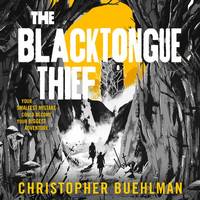
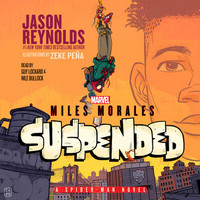
The Blacktongue Thief Miles Morales Suspended
4 Stars 4 Stars 3.5 Stars
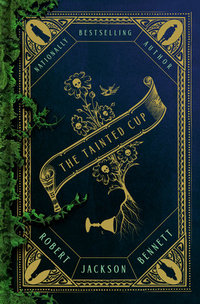
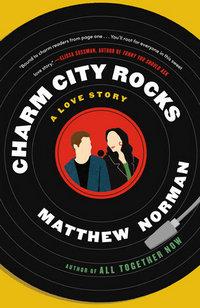
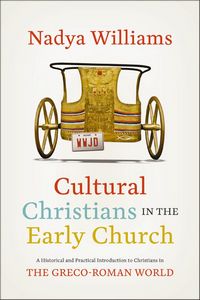
The Tainted Cup Charm City Rocks Cultural Christians in the Early Church
5 Stars 4 1/2 Stars 4 Stars
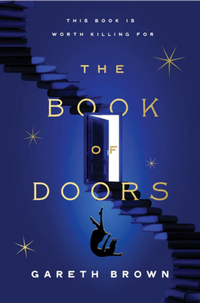
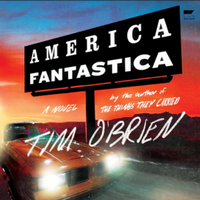
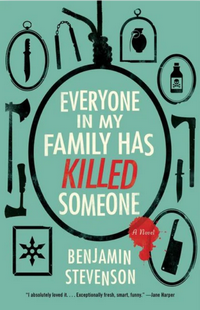
The Book of Doors America Fantastica Everyone in My Family Has Killed Someone
4 Stars 2 Stars 4 Stars
Calculated Risks The Two Kingdoms Hacker
3.5 Stars 4 Stars 4 1/2 Stars
Prayers for Rain Death in the Dark Woods Planet Narnia
4 Stars 3 Stars 3.5 Stars
The City of Scales Dream Town
4 1/2 Stars 4 Stars

Still Reading

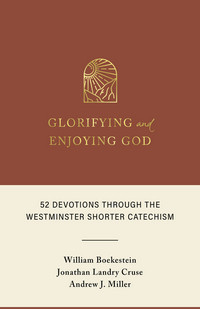
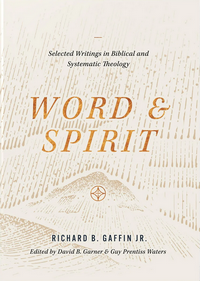
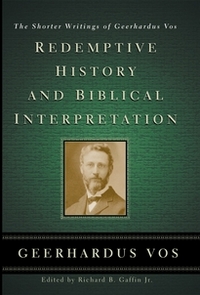
Glorifying and Enjoying God Word and Spirit Redemptive History & Biblical Interpretation
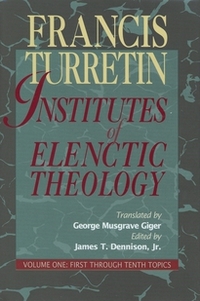
Institutes of Elenctic Theology Vol. 1 The Water and the Blood Didn't See That Coming

Ratings

5 Stars 1 2 1/2 Stars 0
4 1/2 Stars 3 2 Stars 1
4 Stars 8 1 1/2 Stars 0
3.5 Stars 3 1 Star 0
3 Stars 1
Average = 3.88

TBR Stacks/Piles/Heaps

Audio E-book Physical Goodreads
Want-to-Read
NetGalley
Shelf
End of
2023
6 47 68 152 5
1st of the
Month
6 47 68 152 5
Added 2 3 4 3 3
Read/
Listened
3 2 5 3 2
Current Total 5 48 67 152 6

Breakdowns:
“Traditionally” Published: 14
Self-/Independent Published: 3

Genre This Month Year to Date
Children’s 0 (0%) 0 (0%)
Fantasy 5 (29%) 5 (29%)
General Fiction/ Literature 2 (12%) 2 (12%)
Mystery/ Suspense/ Thriller 5 (29%) 5 (29%)
Non-Fiction 1 (6%) 1 (6%)
Science Fiction 1 (6%) 1 (6%)
Theology/ Christian Living 2 (12%) 2 (12%)
Urban Fantasy 1 (6%) 1 (6%)
“Other” (Horror/ Humor/ Steampunk/ Western) 0 (0%) 0 (0%)

Review-ish Things Posted

Other Things I Wrote
Other than the Saturday Miscellanies (6th, 13th, 20th, and 27th), I also wrote:

Enough about me—how Was Your Month?


January Calendar

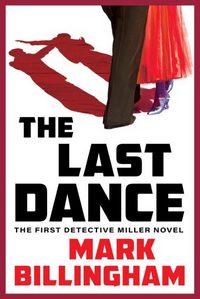
The Last Dance by Mark Billingham: The Dancing Detective and the Whingeing Widower

I’ve been fairly scatterbrained the last couple of days, and I’m a little worried that this post reflects that too heavily. Hopefully not.


The Last DanceThe Last Dance

by Mark Billingham

DETAILS:
Series: Detective Miller, #1
Publisher: Atlantic Monthly Press
Publication Date: July 4, 2023
Format: Hardcover
Length: 378 pg.
Read Date: December 4-7, 2023
Buy from Bookshop.org Support Indie Bookstores

It was true that Miller wanted to be busy; but he hadn’t been counting on picking up such a big case on his first day back. That was the way things went, though. You were desperate for a day or two to catch your breath or even just looking to recharge your batteries after a major inquiry and someone decided to poison their husband or stab a passer-by because they didn’t like their trainers.

People were so bloody inconsiderate, sometimes.

What’s The Last Dance About?

Detective Sergeant Declan Miller cuts off his bereavement leave to return to work. It may be too soon following the murder of his wife (and we get plenty of reason to think that it may be), but the time off isn’t doing him any good and accomplishing things, staying busy, and getting out of the house just might do him so good (and we get plenty of reason to think that it might).

Before he has a chance to reacclimate, he and his new partner are assigned a case—the son (and presumed heir) of a local crime boss has been killed—assassinated, really—in a local hotel. In the next room over, an IT consultant has, as well. It’s unclear what the connection is between the two, or what either was doing in hotel rooms in their hometowns.

The other thing that Miller does to try to return to his pre-widowered life is to go back to the dance class that he and his wife attended. It’s difficult being a single person there, but these were their friends, and it helps him to do so (as much as it hurts, too). We get a whole different set of supporting characters here, a different perspective on things. I really like the way that we get two different sides of Miller like this—yes, there’s a good deal of overlap, but seeing him in such starkly different contexts really helps you understand the character.

DS Sara Xiu

‘I’m your replacement,’ she said. “Well, I was.’

‘Oh,’ he said. ‘Sorry about that.’

‘It looks like we’re going to be teaming up. ‘Even sorrier.’

She smiled. “That’s a joke, right?’

‘Not really.’

It almost seems like a disservice to her character to make Xiu a supporting character. She could star in her own series easily. She’s got the tortured detective thing down—she drinks too much, parties too hard, etc., etc. But on the job? She’s good, and she just might warm to her new partner at some point—at the very least they work together well.

This book might be all about Miller, his inner demons, and eccentric methods—but having him work with such a good partner isn’t a choice many would make. In a book or three, I can see their partnership equaling Bosch and Kiz Rider’s, and she could play a big role in Miller’s unofficial investigation (see below).

Alex Miller

Miller’s wife, Alex, was involved in a major investigation when she was murdered. The police haven’t found her killer—and he’s not particularly certain they’re working too hard on it (it’s a different homicide unit than his). No one from the investigation is updating him either—they want him to stay out of it, for obvious reasons.

And he technically does—but that doesn’t mean he’s not thinking about it a lot, and poking around the perimeter of the investigation—especially in areas that the others don’t seem to be paying attention to.

Apart from that, we spend a good deal of the novel seeing Miller mourn her and talk to an imaginary version of her as both a way to work through his case and her not being around anymore. Those scenes are great on so many levels—the reader gets a real sense of who she was (at least as her husband saw her) and how they related to each other, and how the loss is hitting him. It also gives us a kind of insight into the way his mind works through problems that we don’t often get from procedurals.

Tone

If anyone deserved a plaque on the wall of most local police stations, or a Lancashire Prison System loyalty card, it wag Gary David Pope. He’d been a well-known face — or more usually a photofit – on the criminal scene for as long as any serving officer could remember, and while he never really did anything that would merit serious jail time, and drink or drugs were almost always involved, there was rarely a crime committed anywhere within a twenty-mile radius that Gary didn’t have some connection to. It was like ‘Six Degrees of Kevin Bacon’, only with stolen cars and cocaine.

Gary Pope wasn’t the worst criminal Miller had ever encountered, not by a long chalk, but he was probably the most consistent.

He was a seriously committed wrong ‘un.

It wouldn’t take much to turn this into a very dark read featuring an unreliable and unpredictable detective. Thankfully, Billingham went the way he does—the darkness is still there, it’s just mollified by Miller’s sense of humor and perspective. He really reminded me of Peter Grainger’s DC Smith—but without the almost cozy feel of Grainger’s work. Blackpool is a harsher location than King’s Lake, too.

Still, I think fans of one will appreciate the other. Miller’s humor (and that of the narrator) is a bit sharper, and less subtle than Smith’s—but only by degrees.

You’re able to have a lot of fun given the humor in several situations that aren’t fun at all. But he’s not just funny and eccentric. Miller has a lot of heart, compassion, and empathy for crime victims and survivors. I’m not sure how much he had before his wife’s murder—or how much he let himself show before then. But after it, he’s able to connect with them in a way that few police officers seem to be—or at least are willing to be.

You combine those three elements? I’ll be around for the long haul in any series.

So, what did I think about The Last Dance?

Billingham knows his way around police procedurals—that’s very clear. He also knows how to play with the conventions—and which ones to stay away from or treat straightforwardly. He does it all with skill and panache (not unlike his protagonist).

For example, in his time away, a detective that Miller…hmmm…doesn’t respect, shall we say, has been promoted to DI, and seems intent on making his return as miserable as possible. What is it about almost every immediate supervisor in police procedurals being so intent on being horrible to their star investigators, rather than use their brains to improve their own careers? For every exception to this rule that I can think of, more than a dozen that follow it come to mind. Well, DI Stevens is a shining example of this, and I rather enjoyed Miller’s reactions to him. That’s the only tolerable part of the character.

There are so few quibbles I have with this book—and they’re so outweighed by the good—that I’m not going to bother talking about them. I’m also not going to talk about all the things that Billingham does right with this—I haven’t talked about the victim’s wives, the various crime bosses, even Gary deserves more than that quotation above—and Miller’s homeless informant deserves at least four paragraphs.

Fans of police procedurals or other detective novels are going to love this. I did, and I’m eager for the next. And if it’s nearly this good (and how can it not be, given Billingham’s experience), I expect to be in for the (I hope very) long haul with this series.


4 1/2 Stars

This post contains an affiliate link. If you purchase from it, I will get a small commission at no additional cost to you. As always, the opinions expressed are my own.

Irresponsible Reader Pilcrow Icon

WWW Wednesday, January 31, 2024

Here we are at the end of January, and there are at least 2 books I’d hoped to tackle on my TBR and one on my TBL (it To Be Listened (to) a thing? It should be) that I haven’t touched. Not bad, but, still—not auspicious. (one of those three does show up in this post at least!). Before I start planning February’s impossible goals, we might as well take a look at this week’s WWW.

This meme was formerly hosted by MizB at A Daily Rhythm and revived on Taking on a World of Words—and shown to me by Aurore-Anne-Chehoke at Diary-of-a-black-city-girl.

The Three Ws are:
What are you currently reading?
What did you recently finish reading?
What do you think you’ll read next?

Seems easy enough, right? Let’s take a peek at this week’s answers:

What are you currently reading?

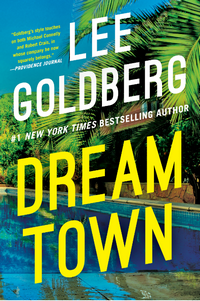
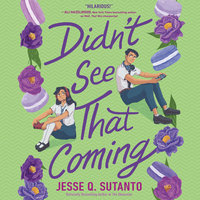
I’m reading the new Eve Ronin adventure, Dream Town by Lee Goldberg, and am listening to Didn’t See That Coming by Jesse Q. Sutanto, read by Risa Mein on audiobook.

Dream TownBlank SpaceDidn't See That Coming

What did you recently finish reading?

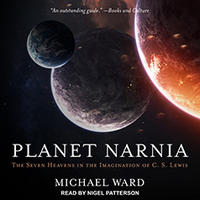
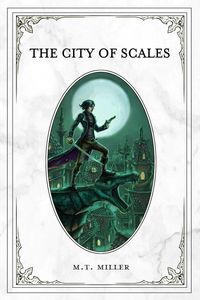
Yesterday, I finished M.T. Miller’s The City of Scales, where Miller discovered a gear I wasn’t sure he had, and Planet Narnia: The Seven Heavens in the Imagination of C. S. Lewis by Michael Ward, read by Nigel Patterson on audio, where I discovered new depths to the beloved series.

The City of Scales Blank SpacePlanet Narnia

What do you think you’ll read next?

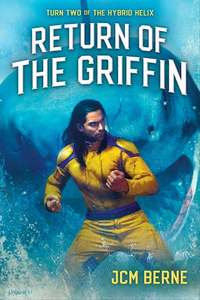
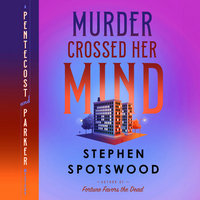
My next book should be the second book in The Hybrid Helix, Return of The Griffin by JCM Berne—exactly 55 weeks behind schedule. My next audiobook should be the latest Pentecost & Parker mystery Murder Crossed Her Mind by Stephen Spotswood, read by Kirsten Potter.

Return of the GriffinBlank SpaceMurder Crossed Her Mind

How’re you wrapping up this first month?

Top Ten Tuesday: New-to-Me Authors I Discovered in 2023


The topic for this week’s Top Ten Tuesdays is the Top Ten New-to-Me Authors I Discovered in 2023

I’ve done this (or something similar) the last few years, and have come to look forward to it. Just one more chance to talk about people I quite enjoy talking about. There’s a greater personal connection for me with some of the year’s entries than in the past (or maybe I’m just more apt to mention it, I should go check on that)—which is a great bonus for me. Here’s this year’s list.

Top Ten New-to-Me Authors I Discovered in 2022

(alphabetically)

10 Nana Kwame Adjei-Brenyah Nana Kwame Adjei-Brenyah

First of all, his debut novel is one of the best things I’ve read in years—it’s intentionally controversial, will push buttons for every reader (not necessarily the same ones)—both those you want pushed and those you don’t—painstakingly researched, and incredibly entertaining.

He was almost certainly going to be on this list just from the work, but then I attended a “conversation with” the author and a reading—and the amount of work he put into the book (even if he was exaggerating for effect occasionally), blew me away. I’m not saying “he worked really hard so I like him.” It was the way he described the work, his approach to the craft that added to my appreciation of the results. Also, his ability in person to be silly and serious in a brief period of time was great. I liked both him (even if we’d disagree on many things—not that I’d care to debate him, he’d wipe the floor with me without trying) and his work.

In case you’re curious about what I said about the book that put him on this list, click here.

9 Mark Billingham Mark Billingham

I’ve heard I don’t know how many interviews with Billingham on various podcasts—both those where he was a guest and those where he was a host—but it wasn’t until this new series that I finally got around to actually reading him. It took me no time at all to see why people kept putting a microphone in front of him. His work is distinctive, careful, and all-around great. He knows how to tell a story, how to draw you in, and populates the work with characters drawn so sharply that they’ll linger in your mind for a long time. I was pretty sure I was missing out before, now I know.

8 Bruce Borgos Bruce Borgos

Borgos reads like a guy who’s been pumping out thrillers and mysteries for years (and who knows, maybe he has without bothering to publish them). His debut is so confident that you have to take notice. He’s able to immerse you in two complex plots and make you root for people who ought to be “the bad guy.” His debut was FX’s The Americans + Johnson’s Walt Longmire books—leaving you with a great sense of place and a better understanding of under-reported history wrapped up in an entertaining ride—anyone who can pull that off is someone to keep an eye on.

In case you’re curious about what I said about the book that put him on this list, click here.

7 Andi Ewington Andi Ewington

I hadn’t played RPGs in years (okay, fine, decades), but Ewington made me want to again with his celebration and send-up of character types, tropes, settings, etc. But it’s also a crafty little novel that sneaks a plot and character development in without you noticing because you’re too busy giggling. The Hero Interviews was an atypical novel from a clearly atypical mind—and one I look forward to encountering again.

Being a friendly and generous guy—and you’ve seen some of his generosity in his participation with various things here last year—doesn’t hurt, either.

In case you’re curious about what I said about the book that put him on this list, click here.

6 Adam Holcombe Adam Holcombe

There’s no way you look at the title and/or cover of Holcombe’s debut novella and think “ho-hum, this again.” You also probably get curious about the contents—which turn out to be as cozy and warm as they are dark. A neat trick to pull off—between his magic system, his protagonists, and his style, Holcombe quickly became an author I’m stalking*.

* in the nicest, most respectful, least creepy way.

In case you’re curious about what I said about the works that put him on this list, click here.

5 Ausma Zehanat Khan Ausma Zehanat Khan

Khan’s new series (and I really should go plunder her backlist) takes on our cultural discussion of policing (over and under) and shoves it into a police procedural that would be worth the read even without the socio-political commentary (that’s delivered in a way that even some who are skeptical can enjoy). When you combine the commentary and the storylines? It’s a fantastic combination and the skill shown in balancing the two—plus some personal storylines for the lead characters—tells me that Khan is someone that I’ll be reading for years to come.

In case you’re curious about what I said about the book that put her on this list, click here

4 Quenby Olson Quenby Olson

I both read and listened to Olson’s Miss Percy’s Pocket Guide (to the Care and Feeding of British Dragons) and somehow haven’t written a post about it. It boggles my mind that it’s possible. Her style—forget whatever story she’s telling—is the kind that I can read or listen to for hours without wanting to stop. It’s comfortable, strange, universal, and charming—she never uses one word when she can find a dozen to use instead—and it (almost) never makes me impatient. In the hands of practically any other author that I can think of, that would result in a quick DNF with prejudice from me. But Olson draws me in instead. I’ll save the discussion of the book (sure, now I start to think of ways to talk about it) and leave it there—I want more of her style. Thankfully, it’s available.

3 H.B. O'Neill H.B. O’Neill

Something tells me that O’Neill’s approach to writing (down to the syllable) is very similar to Adjei-Brenyah’s, and the results are similarly outstanding. The number of things this man made me feel in a few pages…I can’t even begin to tell you. The voice of his first novel, the characters, even the premise…all of these tell you that you’re not reading your typical novelist (definitely not someone the big publisher would want to touch)—but it’s the way he delivers these, the prose style, the pacing, the poetry of the whole kit and kaboodle, that really makes you stand up and pay attention to him.

I’d love to point you to what I said about the book that put him on this list, but you can’t until Friday. You should click here then for that.

2 Amy Maren Rice Amy Maren Rice

Rice’s MG/younger-YA novel hits all the points that the 10-13-year-old in me wants to see. You’ve got mystery, tension, some heartwarming family moments (and understandable sibling conflict), and magic—plus silly humor, a healthy amount of which is flatulence-based. I really can’t think of a book better designed for that age group. The execution is pretty solid, too. How this doesn’t make fans out of anyone in the target audience, habitual reader or not is beyond me.

Also, she’s one of the nicest people you could meet. I walked away from meeting her at a local event excited to see what kind of book someone like her would produce—and I was pretty close to being right. It was playful, imaginative, and silly in all the right ways—while heartfelt and compelling. I’ve run into her a couple of times since then, and look forward to doing so again almost as much as I do for the sequel to her book.

In case you’re curious about what I said about the books that put her on this list, click here.

1 Jesse Q. Sutanto Jesse Q. Sutanto

If you take a quick glance at Sutanto’s backlist, you’ll think “not for HC.” At least, I did—even if they looked promising. But the premise of Vera Wong’s Unsolicited Advice for Murderers—heck, just the title—pulled me in. Like Olson, her narrative voice alone is enough to keep me going. But it’s her characters, the way she brings them to life—particularly the titular Vera—that put her on this list. Seriously, I’d read just a mealtime conversation with some/all of the core characters in this book, I really don’t need a plot (incidentally, Ms. Sutanto, there’s a quick way to pull in some Patreon dollars—one of those a month would get you a healthy number of subscriptions).

In case you’re curious about what I said about his work that put her on this list, click here.

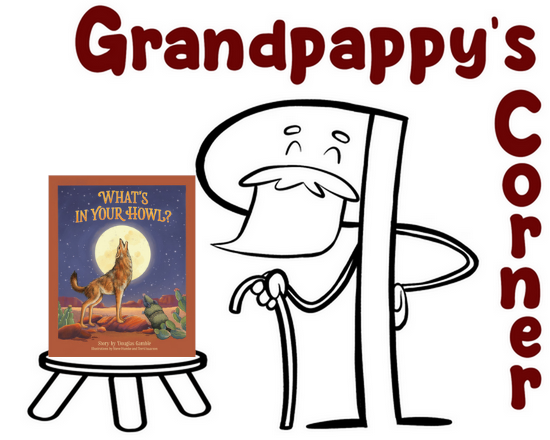
Grandpappy’s Corner: What’s in Your Howl? by Douglas Gamble, Illustrated by: Steve Humke, Terri Isaacson: If Only Ylvis Had Asked This Question Instead…

Grandpappy's Corner What's in Your Howl?

What’s in Your Howl?

by Douglas Gamble, illustrated by: Steve Humke, Terri Isaacson

DETAILS:
Publisher: Xulon Press
Publication Date: January 1, 2023
Format: Paperback  
Length: 36 pg.
Read Date: June 24, 2023
Buy from Bookshop.org Support Indie Bookstores

What’s What’s in Your Howl? About?

Alberto (an armadillo) is fascinated by Carlos (a coyote)–the way he runs and leaps, the way his fur looks, and especially his howl. But he doesn’t understand why Carlos howls–what’s he trying to say or accomplish by it?

So he asks–and Carlos answers, “It depends.” (not in the trickster coyote way, although that would be fun in a different way) He then explains some of the many things his howl can mean, depending on the circumstance. As he does so, Alberto takes it in and compares it to some of the things he does in similar circumstances. These two might be very different kinds of mammals, but they do have a lot in common after all.

Let’s Talk about the Art for a Minute

Oh, this is very nice. The art is fairly realistic, there’s a good southwest flavor to it all. The close-ups of the armadillo and the coyote are really eye-catching, and…well, if I keep going, I’m going to just do a poor job of describing each image.

Rather, than my continuing to fumble around, you can see a few samples on the author’s Facebook page.

How is it to Read Aloud?

It’s a little wordier than most books I’ve talked about as part of this series–that’s not a bad thing, it’s just a description. This isn’t a “fun” read with tongue twisters or rhymes, it’s simply nice, straightforward text that’ll work well for a time to settle down–or for someone who’s already settled and wants to hear “another story.” This isn’t really one to goof around with.

So, what did I think about What’s in Your Howl??

I heard of this book on Episode 137 of Let Me Tell You a Story Podcast, Gamble was talking about the creation of it, how the art was worked on, and so on. It was an interesting discussion and it prompted me to get this book. You might want to give it a listen.

I enjoyed this on several levels–the art, even the typeface, and the message. It’s a good combination of earnestness, cuteness, and scenery. If you’re looking for more in a book for toddlers, you might want to lower your expectations.

A sequel would be very welcome. Or an expanded edition, anyway. I know my 20-something daughter would appreciate it, she uttered an annoyed gasp after the last page, because she was really expecting an answer to Carlos’ question to Alberto.

Give this a shot.


3 Stars

This post contains an affiliate link. If you purchase from it, I will get a small commission at no additional cost to you. As always, the opinions expressed are my own.
Grandpappy Icon

MUSIC MONDAY: Aiga by Shepherds Reign

Music Monday
Music Monday’s originated at The Tattooed Book Geek‘s fantastic blog and has shown up here and there since then.

Irresponsible Reader Pilcrow Icon

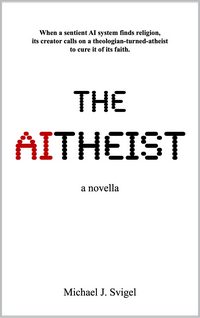
The AItheist by Michael J. Svigel: Do Apostles Preach to Electric Sheep?

The AItheistThe AItheist

by Michael J. Svigel

DETAILS:
Publication Date: May 7, 2023
Format: eBook
Length: 121 pg.
Read Date: December 31, 2023

“Do you miss him?”

“Him?”

“God.”

“Hmmm.” I folded my hands on my chest, closed my eyes. “I guess I miss the idea of God. The one I imagined existed until that idea let me down. The God of the happy Psalms, of the wise Proverbs, of the gentle Jesus. That idea was worth living for. But the bipolar God who waffles between good and bad, helpful and harmful, reasonable and absurd—that God I could do without. And I have.”

What’s The AItheist About?

Ramy Ray has created the world’s biggest and best AI, YAR. YAR runs electric cars all over the world, government infrastructures, corporate networks, etc., etc., etc. You name it, YAR is the culmination of pretty much every SF utopian dream. The jury is still out on whether YAR is truly sentient, but YAR thinks “he” is.

But something’s changed lately—YAR is using more and more of “his” resources to investigate world religions, with an increasing focus on Christianity. Very few, outside of Ray’s company, have noticed the lags, the downtime, and service problems. But they’re getting worse, and it won’t be long before actual problems ensue—and someone notices.

So Ray comes to Dr. Michael Berg, who not that long ago published a book that made headlines. Berg had been a renowned theologian (as much as an orthodox theologian can be in our cultural moment), Berg’s headlines came from renouncing the Christian Faith and publishing a book talking about his apostasy and his critiques of Christianity.

Ray wants two things—one, for Berg to figure out why YAR is so focused on these issues, ideas, and thoughts right now, and two, to get “him” to stop focusing on it and get back to work.

So, what did I think about The AItheist?

I don’t know that this storyline could’ve coped with being longer—but I think the book (and Svigel’s arguments) needed more space to breathe and develop. The sessions between the two should’ve been longer, getting into a little more depth on the issues. A couple of additional conversations between YAR and Berg might have helped. Maybe some “selections” from Berg’s book that YAR could’ve critiqued or examined, or a conversation or three between Berg and a former colleague in between sessions with YAR. It’s a tricky balancing act to be sure—Svigel is going for a quick read, something to provoke thought, not to answer every question–but I think by doing so he goes for too quick and provokes more than he gives resources to follow up with.

Berg’s emotions were hard to swallow—particularly his big emotional moment toward the end. It was overwrought, over the top, and completely took me out of the moment. I generally thought I could’ve done a slightly better job of articulating his problems with the Faith (also, the God he described as “an idea worth living for” isn’t a God I recognize, and made me wonder about Berg’s qualifications as a theologian). But he’s supposed to be a foil for YAR, and he functions well enough as that.

That said–I liked the concept of the book. I thought YAR, his concerns, his approach—and what sparked all of it—were well-conceived and well-executed, and the reveal was well done. All of that was spot-on, and my only complaint is that we didn’t quite as much of it as we should’ve. It feels strange in 2024 saying I sympathized and believed the AI more than the human, but that’s where we are.

I do recommend this read, with several caveats. You may end up with more questions than you started with—which could actually be a good thing. You might want some answers that are a little less blithe than you’re provided. That’s a good thing, too. But you’ll likely enjoy the book and having questions you want answers to is generally a net positive (assuming you go digging for those answers).

It’s a quick and generally pleasing read. It’s worth your time.


3 Stars

Irresponsible Reader Pilcrow Icon

Saturday Miscellany—1/27/24

This week’s miscellany feels like it goes off in a billion directions, hopefully, there’s one or two you want to travel down.

(which isn’t bad for a week where I figured I had maybe 5 links to share)

Odds ‘n ends about books and reading that caught my eye this week. You’ve probably seen some/most/all of them, but just in case:
bullet Bookstores of the Treasure Valley—A nice little “ode to our local bookstores” (although I wish Kuna’s Book Habit had garnered a mention)
bullet Libro.fm vs. Audible—a quick slide presentation comparing the two (fair warning: it’s made by Libro.fm, so you know how the comparison goes. Says the guy who has given subscriptions to the former.). Something to consider, anyway.
bullet Life inside the Fiction Factory: Dan Sinykin on Conglomerate Publishing—a chat about how changes to the publishing industry have also driven changes to the fiction we read…and what they mean for conglomerate publishers and for nonprofit independent publishers that are inventing new ways to publish in the shadows of the giants.”
bullet Am I the (Literary) Assh*le—a fun little post from LitHub
bullet Caps for Sale—B. J. Novak (of all people) has some interesting and good things to say about Children’s books in the midst of a review of a classic and a contemporary sequel.
bullet Along those lines is: The toddler book tolerability index.—another fun LitHub post from this week
bullet A New Direction For Ol’ KRR—K.R.R. Lockhaven talks about his WIP, which has a tone we haven’t seen from him before (at least not much of). Color me intrigued…and a little impatient. 2025?!?
bullet By The Numbers: 1 Year In—James Lloyd Dulin looks at his first year as a self-published author. It’s an honest, frank, and grateful look.
bullet Crime Novelist Michael Connelly on the Role of Jazz in Creating “Bosch”—Jazz played a role? No way…
bullet Big news from little old us…—The latest newsletter from Fahrenheit Press features a series you should look into (and I should finish), some exciting news about that series, and a discussion of the book that they’re publishing next week that I cannot shut up about (ask my family). Read this and order the book now.
bullet Author Chat: Mike Chen (A Quantum Love Story)—I haven’t had the time to dive into this yet, but how could it be anything other than interesting?
bullet On Reviewing Books
bullet How To Ask For A Book Review—this is a handy collection of advice.
bullet My Favorite Fantasy Sequels—Cameron Scaggs has a nice list of temptations, including one book I’ve been meaning to read for ages and a few I should look into
bullet The Most Disturbing Books Ever Written—for people who want the opposite of cozy
bullet Why Do People Expect Libraries to Do It All?—good question
bullet On My Radar: January 2024—Celeste’s monthly post/reminder that I have less than a week to finish the books I wanted to in January (I can squeeze 1500 pages in, along with a full-time job, blogging, spending time with family/dogs—right?). Also, she provided a post I linked to above.
bullet Eco-Fantasy – Magic Can’t Solve Everything
bullet Why I Keep Reading Series I Went Sour On—Peat Long is (again) singing the song of my people

To help talk about backlist titles (and just for fun), What Was I Talking About 10 Years Ago Week?
bullet Wonder by R. J. Palacio
bullet The Love Song of Jonny Valentine by Teddy Wayne
bullet Blackbirds by Chuck Wendig
bullet Teens Don’t Read For Fun Anymore, New Data Says
bullet Four Reasons Why You Should Be Reading Young Adult Fiction
bullet 25 YA Novels Everyone — Even Adults — Should Read
bullet I talked about the releases of: Peacemaker by K. A. Stewart, Dirty Magic by Jaye Wells, and the paperback release of the first collection of Indexing by Seanan McGuire.

Lastly, I’d like to say hi and extend a warm welcome to Esther, who followed the blog this week. I hope you enjoy the content and keep coming back.
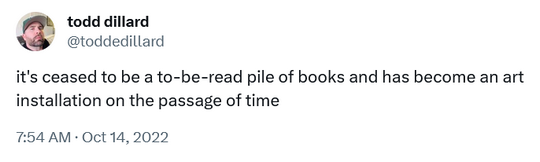
tweet from @toddedillard stating 'it's ceased to be a to-be-read pile of books and has become an art installation on the passage of time'

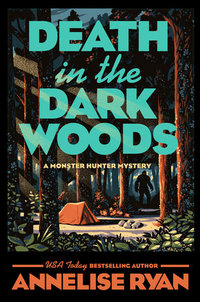
Death in the Dark Woods by Annelise Ryan: If It Weren’t for You Meddling Bookseller and Your Stupid Dog…

Death in the Dark WoodsDeath in the Dark Woods

by Annelise Ryan

DETAILS:
Series: A Monster Hunter Mystery, #2
Publisher: Berkley Books
Publication Date: December 12, 2023
Format: Hardcover
Length: 321 pg.
Read Date: January 24-25, 2023
Buy from Bookshop.org Support Indie Bookstores

What’s Death in the Dark Woods About?

Chief Jon Flanders has another possible cryptid for Bookseller/Cryptozoologist Morgan Carter to look into. It’s not his case, but he’s serving as the go-between for a Wisconsin Department of Natural Resources Warden. There’ve been a couple of killings in her jurisdiction that she’d like Morgan to look into—and is willing to pay her out of pocket to do so.

Charlie Aberdeen isn’t even the head of the investigations, but she has a vested interest in the outcome. The official cause of death for both men (a bow hunter and a recreational fisherman) is a bear attack, but a witness account and some of the evidence don’t match that. Particularly the wounds. But Charlie’s the only one willing to say anything along the lines of “Bigfoot.” The existence of this particular creature is a known interest of Charlie’s—and local LEOs will send anything along those lines to her.

Morgan, naturally, jumps at the opportunity—no matter how long of a shot it is to find the elusive cryptid, she’s got to take it. Her loyal dog, Newt, jumps at it, too—because he jumps at anything she does.

Not surprisingly, some of the locals aren’t crazy about her meddling—a Sherriff’s Deputy seems particularly hostile (okay, “is” there’s no seeming to it)—but some insist they’ve seen something that could be a Bigfoot themselves. Others just think it’s a pipedream and are mildly amused that Charlie and Morgan are wasting their time. There’s another cryptozoologist sniffing around, too—Morgan’s run into him and his spurious methods before—he’s more interested in making money off of locals than he is in finding anything.

Be Careful

Don’t read the Author’s Note at the back before you finish the book—it’ll spoil things. I occasionally do that—I don’t know why, but I like seeing what an author mentions in their Note or Acknowledgements, so I start there (or take a peak while reading). Man, am I glad I didn’t do that this time.

(but also, maybe bury that information in the second paragraph or later?)

So, what did I think about Death in the Dark Woods?

This was a fun little adventure and a natural next step from A Death in Door County. A hunt for a Bigfoot/Sasquatch-type creature is a bit more familiar in North America than a Lake Monster, but that doesn’t mean it’s tired out. In many ways, Morgan’s hunt reminded me of Gideon Oliver’s in The Dark Place—but I enjoyed the way this one wrapped up much more.

Another thing I want to draw attention to is the relationship between Jon and Morgan—Ryan’s doing a nice job of letting the inevitable relationship grow slowly, and even stumble a bit. It’s really well done.

The narrative and some of the dialogue could be done a bit better—occasionally clunky is the best way to put it. It’s never enough to make me want to do anything other than roll my eyes and push on, but it could be easily made better.

Still, like its predecessor, Death in the Dark Woods is a pleasant diversion with some characters you could want to spend more time with. Which is all I’m looking for in a cozy-adjacent murder mystery. I’ll be back for more.


3 Stars

This post contains an affiliate link. If you purchase from it, I will get a small commission at no additional cost to you. As always, the opinions expressed are my own.
Irresponsible Reader Pilcrow Icon

Page 115 of 603

Powered by WordPress & Theme by Anders Norén