Pub Day Repost: The Finders by Jeffrey B. Burton: A Serial Killer Hunt Goes to the Dogs

The Finders

The Finders

by Jeffrey B. Burton
Series: Mace Reid K-9 Mystery Volume 1

eARC, 288 pg.
St. Martin’s Press, 2020

Read: June 12-15, 220
Grab a copy from your local indie bookstore!


One of the worst things about the way this Spring got away from me is that I’ve been unable to get to this book until now—from the synopsis, this was so far up my alley that it might as well have been titled The Finders: Meet HC’s New Favorite Series. But the important this is that I got to it now, and that subtitle would’ve been pretty much correct. I can’t imagine there’ll be a new series this year that’ll top this for me.

I’ve kind of tipped my hand there, haven’t I? It’s a good thing I don’t pretend to write suspense, eh? Still, having established what I think about it—what about you—is this something you should read? Probably, yeah.

It’s called the “Mace Reid K-9 Investigations” series, and the novel pretty much starts with the K-9 part, so I will, too. We meet a golden retriever puppy on one of the worst days imaginable for a young dog (or person). She’s soon adopted by Mason Reid (call him Mace) a dog trainer who has a few Human Remains Detection dogs, in need of one more. This pup takes to HRD in a way that surprises Mace, she’s more than a natural. I absolutely adore this dog. Mace does, too. He’s in a pretty bad place when he meets this girl, and she’s just what he needs to get out of it.

The other members of this pack would probably be as endearing if we’d got enough time with them—I’m going to leave their names out because Mace’s names are so fun that you’d best read them (and the reasoning behind them) for yourself, I don’t want to take that from you. There’s a German Shepherd (Mace’s descriptions of him are wonderful) and two trouble-making Collies.

There is a section where Mace describes the process that the dog goes through when scenting—probably not as technically correct as what Cat Warren gave in her book (adult or young reader’s version*)—but as gripping (if not more so) and entertaining—and it really gives you an idea what’s going on (as best as we can understand) during that process. Burton could’ve given us two or three more passages along those lines in this book and I wouldn’t have complained at all.

* Either or both of which I recommend to anyone interested in this novel.

So, yeah, Mace is our narrator, he’s got a great voice. You pretty much feel like he’s a close friend telling you a story right away, and sitting around watching his dogs play while drinking cheap beer and eating pizza (preferably non-Hawaiian) sounds like a great way to spend an evening. He’s funny, self-deprecating, smart, and driven (especially when the health and well-being of one of his “kids” is on the line). If I wasn’t talking about an eARC waiting final revisions, this post would be littered with quotations–he is oh so quotable. His affection for his dogs and dogs in general, is right up there with Bernie Little, Andy Carpenter and anyone gutsy enough to try to feed and care for Clifford the Big Red Dog. Even if the plot was blah and the writing uninteresting, I’d have enjoyed meeting Mace (thankfully, that’s not the case)

There are four cops in this book that Mace interacts heavily with—an unusual number, to be sure. Two are uniformed officers and two are detectives. Mace’s relationship with each varies a little bit, but they’re the kind of cops you want to believe fill our police forces. I don’t know if all four of them will return in future volumes—but I’d be happy to see any or all of them again. I’ll hold off on further discussion of them for the future when we get to know them a little bit more (assuming that’s the case)

After Mace and his retriever find the remains of a serial killer’s latest victim, something goes very wrong. This compels him to take a more active role in the hunt for the killer. Between his dogs, desperation, and a healthy portion of beginner’s luck, he has remarkable success at that. Which ends up putting a target on his back—creating a need for more luck, his dogs, some more desperation, and the help of his police acquaintances/friends.

The plot moves pretty quickly—there’s a time or two that your credulity might get stretched a bit further than you’d like. But if you roll with it, Burton’ll reward you. The book moves quickly—even more than I realized a few times. Which isn’t to say that anything feels rushed, it doesn’t, you’re on a roller coaster that starts quickly and doesn’t let up. There were a couple of reveals that I didn’t see coming, some plot twists I wouldn’t have expected—in retrospect, I felt I probably should have seen it all, if I wanted to do something silly like stop reading the book to analyze and predict what’s coming rather than just buckle in and read it.

So here’s the thing about serial killers in fiction—I’m pretty much over them. I think I’ve been over-exposed to them, and by and large, I don’t react positively to them. That’s not to say I can’t enjoy a Serial Killer novel if the plot is well done, the other characters are well executed, and so on—but I’m almost always apathetic about the killer himself/herself anymore. But this one? Initially, it seemed like this was going to be one of those books that I liked despite the killer. However, by a little after the mid-way point, the killer had won me over and had got me interested. I can’t explain why without ruining the whole thing for you, so I won’t. But color this jaded reader interested.

It’s possible that I’m rating this a little higher than it deserves. If I was being entirely objective, I’d probably take off a half or maybe a full star from my rating. But this isn’t an objective piece, or an objective rating—this is about how much I enjoyed this, how it appealed to me, entertained me and made me want to read on. For that, it scored really high for me.

A strong and fun central character, a collection of interesting police officers, a compelling serial killer, a well-paced plot, and four wonderful dogs. I can’t think of anything else this book could deliver for me. I when I wasn’t on the edge of my seat, flipping the pages as quickly as I could, I was reading as slowly as possible so I could relish the scenes with Mace and his dogs doing their thing. Now that Burton has established Mace’s world and characters, I can’t wait to see him explore it some and build on this really strong foundation.

Highly recommended. I won’t pretend to assure you that you’ll enjoy it as much as me, but I can’t imagine anyone not liking this book.

Disclaimer: I received this eARC from St. Martin’s Press via NetGalley in exchange for this post—thanks to both for this. As always, my opinions remain my own.


4 1/2 Stars

20 Books of Summer

This post contains an affiliate link. If you purchase from it, I will get a small commission at no additional cost to you.

I Dare You! Book Tag

I Dare You! Book Tag
I’ve seen this on various blogs, but can’t seem to find the creator, so I can’t credit them. I’d like to, if anyone knows who did it.

Rules:

  • Be Honest! (ummm, really? Why bother lying here?)
  • Answer all the questions (what’s the point otherwise?)
  • Tag at least 4 people (so I’ve failed, I’m going to break this rule)

1. What book has been on your shelf the longest?

That’s a very good question, I’m not 100% sure, but I think it’s an a copy of

title

The Godfather by Mario Puzo

I think I got it at a neighbor’s garage sale just before I entered 7th grade, and while my mother was hesitant to let me read such salacious material (and she should have been), she allowed it. Not only did it blow my mind, but I distinctly remember some high schoolers seeing me reading it on the school bus and being impressed. It probably saved me from some hazing.


2. What is your current read, your last read and the book you’ll read next?

Last read: Looking for Rachel Wallace by Robert P. Parker
Current read: Of Mutts and Men by Spencer Quinn
Next read: The Curator by M. W. Craven

Looking for Rachel WallaceBlank SpaceOf Mutts and MenBlank SpaceThe Curator


3. What book did everyone like, but you hated?

Behind Her Eyes

Behind Her Eyes by Sarah Pinborough

As I said when I read it. I really, really liked it until the end. And then…nope. Just nope.


4. What book do you keep telling yourself you’ll read… but you probably won’t?

Maybe The Wheel of Time series, but I think I got honest about that a long time ago. Early Delillo? Oh, oh, Dennis Lehane’s Live by Night. I bought the hardcover the week it was released eight years ago, and I just don’t see it happening.


5. What book are you saving for your retirement?

The Wheel of Time series? I don’t know, I have a hard enough time planning the rest of this summer, I’ve got 20+ years until retirement, there’s no way I can think that far ahead.


6. Last page: Read it first or save it to the end?

Do I look like Harry Burns to you? The last page should be read last. That’s why it’s called that.


7. Acknowledgement: waste of paper and ink, or interesting aside?

I find them frequently interesting, if at a glance, they’re more than just a list of names, I’ll give them a read.


8. Which book character would you switch places with?

If the switch involved gaining his intelligence, then the choice is easy.

Nero Wolfe

Nero Wolfe created by Rex Stout

He spends most of his days reading, drinking beer and eating gourmet food. What’s not to like?


9. Do you have a book that reminds you of something specific in your life (place, time, person)?

Pretty much every book on my shelves does.


10. Name a book that you acquired in an interesting way?

Er…I really can’t think of anything that fits. Like most people, I’ve had the suprise find at a Library Sale, or Used Book store, but there’s really nothing terribly interesting there. The closest I came was when I was checking out a new indie store last year, and I tried to special order a paperback of Tom Jones, but one of the clerks insisted they had a copy. Their inventory didn’t show one, but he went off and looked through books that hadn’t been entered yet and came back with this spiffy hardcover in a slipcase. No online store is going to do that.


11. Have you ever given a book away for a special reason to a special person?

One of my own books? Um…no. I’ve “given” a few away via loaning them and not getting them back, but that’s not what the question was going for.


12. Which book has been with you most places?

It’d be a tie between: God Save the Child, Mortal Stakes , Promised Land, The Judas Goat,Looking for Rachel Wallace, Early Autumn, A Savage Place, Ceremony, The Widening Gyre , Valediction, A Catskill Eagle, Taming a Sea-Horse, and Pale Kings and Princes by Robert. B. Paker (13 of the first 14 Spenser novels. The first (as I mentioned) didn’t make the move with my family in 1988. But those have been everywhere I’ve lived since, including the various dorm rooms in college (most other novels stayed at my parents).


13. Any “required reading” that you hated in high school that wasn’t so bad two years later?

I can’t remember hating anything that I didn’t keep on hating (e.g., Heart of Darkness, A Portrait of the Artist as a Young Man, The Grapes of Wrath). I think I apprecaited The Great Gatsby and A Farewell to Arms more when I read them a couple of years later, but that’s as close as I get.


14. Used or brand new?

Either, but I skew new.


15. Have you ever read a Dan Brown book?

I read one of them twice–sure, it had different titles (Angels & Demons and The Da Vinci Code) and covers both times. More than enough for a lifetime.


16. Have you ever seen a movie you liked more than the book?

Sure, Matthew Vaughn’s Stardust is better than Gaiman’s (but if I read the latter a couple of more times, I may be swayed). I really dug Crighton’s Jurassic Park, but I might have enjoyed the movie a bit more. But the ultimate example of this is Let the Right One In (either version, though the Swedish is probably superior)–couldn’t finish the book (and I got pretty far, I think).

Let the Right One In


17. Have you ever made a book that made you hungry, cookbooks included?

A lot of what Elvis Cole and Spenser eat and/or cook does. I’d love to eat Nero Wolfe’s scrambled eggs (from The Mother Hunt. Faith Hunter’s Nell Ingram gives me cravings for stuff I shouldn’t eat as she discovers what food is like outside the cult she was raised in. Almost every cookbook I’ve eaten has made me want to eat. No fantasy novel has ever got me hungry (I like stew as much as the next guy, but not that much)–especially Martin’s “six page descriptions of every last meal”. But the best book along those lines is:

Sourdough

Sourdough by Robin Sloan

Even thinking about this book years later makes me hanker for the spicy soup and spicy sandwich. Still, that’s not what the prompt was about, technically, but as I noted when I wrote about it, I had to fight to not interrupt my reading and demand that my son bring some sourdough home from the bakery he worked at.


18. Who is the person who’s book advice you’ll always take?

Most people I know IRL are intimidated by giving me book advice (which is odd, I’m always open to suggestion) Still, Micah’s got a pretty good track record, Paul’s pretty spot on.


19. Is there a book outside of your comfort zone that you ended up loving?

Probably, but once I ended up loving (or at least enjoying it), I’d stop considering it outside of my comfort zone. The only thing that I can think of at the moment is the Romance Novel:

Finding Felix

Finding Felix by Jo Platt

Which was a heckuva fun read (and only outside of my comfort zone as it’s marketed as Romance). If a thing tells a story, it’s my comfort zone–or close enough, anyway.


As usual, I’m not tagging anyone in this—but I’d like to see what you all have to come up with.

How the Wired Weep by Ian Patrick: Patrick’s Latest Crime Thriller Does Not Disappoint

That’s a lame headline, but I couldn’t come up with anything short of 40 words that I was satisfied with. Also, I really should’ve devoted a couple of sentences to that cover, one of my favorites of the year.


How the Wired Weep

How the Wired Weep

by Ian Patrick

Kindle Edition, 293 pg.
2020

Read: June 22-25, 2020

In my world you’re always looking over your shoulder. Evade and escape is the game. To remain still makes you a target. A sitting or standing one doesn’t matter. Always be on the move until you’re sure it’s safe to stop. The training I’ve had was for a reason: survival.

London is a war zone. My battleground is the street. My unit is on a hearts and minds campaign to keep control and maintain law and order through gathering intelligence.

There are two point-of-view protagonists in this book, the first is DS Ed Hunter. He recruits and handles informants—excuse me, Covert Human Intelligence Sources. He’s been at it quite some time now—it’s in his blood, he’d have a hard time leaving for another assignment at this point. He has a number of sources, but we only see and track his involvement with one in this novel. Ed’s a solid detective, dedicated (would be the polite way to say it, Mrs. Hunter might have other words), but isn’t opposed to coloring just a bit outside the lines.

I started dealin’ young. I was nine years old when I got into this game. I’d move anythin’ they asked me. They knew that because of my age I wouldn’t get charged. Apparently at nine you don’t know nothin’ so can’t know what you’re doin’ is against the law. Screw that! I knew everythin’ I was doin’ were wrong. That’s why I did it!

The source the book focuses on is the other POV protagonist, Ben. Ben’s recently out of a short stint in prison and is looking to get back to the things that landed him in prison in the first place. Primarily robbery and miscellaneous tasks for a local gang leader, Troy*.

* As far as notorious, or would-be notorious, criminals go, Troy seems like an unlikely name. It really doesn’t command respect or fear. It’s mundane enough that it comes across as verisimilitude

With Ben freshly out of prison and re-establishing his criminal contacts and career, this is the prime time for Ed to use him. So he leans hard on Ben, looking for intelligence that he can use immediately as well as information on larger, future activities. Troy has a special combination of ambition and ruthlessness that makes this an advantageous time for both Ed and Ben.

These two men are really two sides of the same coin. Ed works Ben and the system to his benefit (and occasionally Ben’s), Ben works Ed, Troy, Ghost, and others for his benefit (and occasionally Ed’s). Both Ed and Ben seem trapped by circumstances, trapped by their association, but only one of them really has a shot at getting out, if he wanted it.

Theirs is not a partnership, a friendship, or anything really. Ed is using Ben to satisfy his superiors, to get some information that can lead to bigger arrests, or to prevent something major from happening (a large concern as London prepares for the Olympics). He may show flashes of concern for Ben or his soon-to-be-born child. But those flashes are quickly gone. Ben isn’t in this out of some ethical consideration, either. He’s not trying to go straight—he’s using Ed to get a little extra money, to take out a rival, and to keep at least some of the police off his back.

The cycle of Ed pressuring Ben for some intelligence, Ben giving him something largely true, the police using that information, Ben having to scramble to prove he didn’t inform and to take advantage of whatever the police have done for his own benefit. Ben knows (and is angered by) Ed using him like this. Ed knows he’s not getting the whole truth (but isn’t sure how much he is getting), and is angered when he can prove the lie, and is aware Ben’s at least trying to use him, too. This is the core of the book, and probably the majority of what does on in the book—and I could easily have easily read at least another 50-70 pages of this without growing impatient.

We get a little time with Ed’s superior and some detectives in other offices, using and supplementing what he’s gathered, and we get a little insight into Ed’s home life and wife. But largely, it’s his partner, DC Sienna Myles (“Smiles”) that we see Ed interacting with. She’s not as invested in Ben, Ed’s problems, or Troy as Ed is. She might actually care more for Ben’s welfare, but she’s also clear about Ben’s place in the world, and his priorities. Of all the secondary characters, she’s the one I wanted more of—I think she could carry a novel by herself (and would like to see something like this with her and her new source)

On the flip side, we see a few other people in Troy’s circle of influence, but we primarily see Ben interacting with Troy or his friend, Ghost. Ghost is the only person in the world that Ben truly trusts (and even then, that falters), they’re friends that go way back. I’m honestly not sure how to describe Troy—because Ben keeps vacillating in his estimation of him. He’s either an up-and-coming criminal near-genius, or he’s just some guy with enough lucky breaks and inherent meanness to take advantage of those breaks. It is clear that the streets and many, many lives would benefit from his being ousted from power and put somewhere he can’t inflict his poison or presence on more of the public more than he has.

One more similarity between the two that I want to focus on—impending fatherhood. One of the first things that Ben learns upon his release is that he’s going to be a father, he’d impregnated someone just before going away. Meanwhile, Ed and his wife can’t conceive—they’ve gone through fertility treatments but they don’t seem to be doing anything. Ed bewails the injustice in how easily someone who doesn’t want to be a father can become, while he and his wife want it so much. Both men’s reactions to future fatherhood, as well as the way they think of their own fathers (or lack thereof), says a lot about the two characters—and the office of Father in general.

Ed’s an interesting character, and I definitely felt invested in his story. But outside of a job that you don’t often see in Crime Fiction, I’m not sure there was much to make him stand out. Ben, on the other hand? I’ve seen similar characters before and were either annoyed or indifferent to them. But Patrick shaped him and used him in such a way that not only did I want to see him succeed (if he went straight or otherwise), but I cared about what happened to him. He reminded me of Dewey Crowe from Justified (or Leonard’s Raylan or any number of similar characters penned by Leonard), not that bright, overly impressed with their own criminal aptitudes, but you can’t help pity, like and wish the best for him (although Dewey was generally comic relief, and Ben’s not at all). He got under my skin, and will likely stay there for a while.

Most of this book isn’t that fast-paced—it’s well-paced, but there’s a lot of time spent establishing the characters and setting up the endgame. But there’s an energy to the narration—particularly Ben’s chapters—that makes you feel like you’re reading something at a breakneck pace. Ben’s character shines through so much, I could practically hear him as I read (in my mind he sounds suspiciously like a Kobna Holdbrook-Smith character). I should probably add that once, the plot starts moving—it matches the feel that you’d gotten from earlier when less was happening.

That ending? Perfection. That’s all I can safely say.

The difference in characters, voice, and the way the story plays out demonstrates Patrick’s skill and underlines the fact that he’s not a one-trick pony (not that many should’ve suspected that). It’d be easy for him to coast on the Sam Batford train for a while, but Patrick doesn’t do that, instead, he gives us this fascinating glimpse into another area of policing.

I’m tempted to keep going, but I’ve probably said too much. This is different, more intimate, more powerful, than Patrick’s DS Sam Batford books. If you’ve read those, you should enjoy seeing this other side of the author. If you haven’t, you should go grab them after this one. Patrick captured something special here in How the Wired Weep and I strongly encourage you to go grab it.


4 1/2 Stars

Programming Note: Update on the Host Transfer

A brief note here…I seem to have completed the transfer mostly intact. Most of the comments, followers, and so on survived. The categories took some major damage, and therefore my menus are only partially functional (I don’t know how many people use them). But I’m chipping away at that, and they’ll be good to go soon. New comments are pretty wonky, though. With the help of some users, I’ve worked through some issues–and created more.

If you see something weird or note a problem with the comments, feel free to pop me a note, or tweet at me, and I’ll continue to work on the problems.

I want to thank Micah Burke for doing a lot of (read: most of) the heavy lifting on this when the “easy” process proved not to be at all. If you’re into pretty photographs, neat calendars or the game Terraforming Mars–check out his stuff at his website or his etsy shop and maybe buy something,

Classic Spenser: The Judas Goat by Robert B. Parker

Classic Spenser

The Judas Goat

The Judas Goat

by Robert B. Parker
Series: Spenser, #5

Paperback, 203 pg.
Dell, 1978

Read: May 29, 2020
Grab a copy from your local indie bookstore!

…I looked at my situation. If they were going to shoot me, there was little to prevent them. Maybe they weren’t going to shoot me, but I couldn’t plan much on that.

“You can’t plan on the enemy’s intentions,” I said. “You have to plan on what he can do, not what he might.”

A boy cleaning the tables looked at me oddly. “Beg pardon, sir?”

“Just remarking on military strategy. Ever do that? Sit around and talk to yourself about military strategy?”

“No, sir.”

“You’re probably wise not to.”

We start with Spenser calling on Hugh Dixon. The word “rich” seems inadequate to express the wealth that Dixon seems to possess. Nowadays, he could probably hire a private security firm to do what he needs—maybe he could’ve in 1978, too. But he’s done his research and has decided to hire Spenser instead because he knows Spenser’s integrity and priorities are what’s kept him “in the minor league.”

We’re given a great description of Dixon:

Full front, his face was accurate enough. It looked the way of face should, but it was like a skillful and uninspired sculpture. There was no motion in the face. No sense that blood flowed beneath it and thoughts evolved behind it. It was all surface, exact, detailed and dead.

Except the eyes. The eyes snarled with life and purpose, or something like that. I didn’t know exactly what then. Now I do.

The eyes snarled with a need for revenge. That’s pretty much all that’s keeping Dixon going. A year before, he, his wife and daughters were in a London restaurant that was bombed. Dixon lived, although he almost died and lost the use of his legs. The rest of his family did not. He wants Spenser to do what the London police have failed to do—find the terrorists responsible and bringing them to justice—either by apprehending them for the police or killing them. Dixon remained conscious during the attack and has detailed descriptions of the personnel involved. Spenser agrees, after insisting that he doesn’t do assassinations—unless forced out of self-defense, he won’t be killing anyone. It’s all okay with Dixon, but you get the clear impression that he’d prefer they died.

Spenser makes travel arrangements (including learning how to bring his gun into London), says goodbye to Susan, and leaves that night. Dixon’s London-based lawyer introduces him to a Scotland Yard inspector who worked the case. There’s a group called Liberty who claimed responsibility for the bombing. They’re small-time, right-wing, and draw their membership from around Europe—they’re likely based in Amsterdam, but that’s conjecture. Which really doesn’t give Spenser much to work on.

So he tries a little something to draw them out. It results in two of them dying and Spenser being shot in the, ahem, “upper thigh.” It also gives Spenser a lead to some others. While he calls Susan to tell her what happened, he also asks her to do him a favor—get word to Hawk that he could use some help (this both relieves and worries Susan, she wants him to have backup, but hates that he needs it).

From here, Spenser and Hawk follow leads for Liberty to Copenhagen and Amsterdam. They even have a brief confrontation with the leader of Liberty, a man named Paul. Paul’s not one of the men directly involved in the death of the Dixons, however. Spenser and Hawk determine that Liberty has something planned for the 1976 Olympics in Montreal, and decide that even though the job is done, they need to stop Paul.

On the one hand, it’s hard to believe that security at the Olympics is as lax as it appears, then again 1976 was a different time. Through a combination of luck and good guessing, there’s a final confrontation with Paul and one of his top associates that ends in a nine-page fistfight between Spenser, Hawk, and a giant of a man named Zachary. This fight blew my preteen/early teen-aged mind when I first read it, and became the standard by which I judged all similar scenes in fiction (there’s one in Lee Child’s Persuader that reminded me of this one—although, Reacher didn’t have anyone fighting on his side).

While there is some deduction at work, this is largely Spenser as vigilante, not as a private investigator. On the one hand, I prefer the P.I. On the other hand, it’s a good story and it demonstrates another side of Spenser that we don’t get to see much of early on. And like the rest of these first twelve, it’s hard for me to engage my critical faculties.

In addition to the globe-trotting and the intense action scenes, we get Spenser’s typical narration when it comes to describing places (one of my favorite elements of each book) and people. Spenser’s wit and compassion both get to shine. It’s just a fun read. The scene that results in his upper thigh wound is one of my favorites in the series—combining humor, tension, and action.

But the thing that struck me the most this time through is that what seems to really interest Parker—more than Spenser, more than this revenge story, or anything else—is Hawk. We met him in the last book, but we didn’t get that much time with him, just a handful of scenes. But he’s all over this novel.

Spenser calling Hawk to come help represents a turning point in the series. It’s not an automatic thing yet, but from here on out, it’s more common for Spenser to call up on Hawk for help than not. The self-sufficient, independent operator develops a real dependence. It’s a real boon for the reader, for as fun as Spenser’s interior monologues are, having him banter with Hawk becomes a reliable highlight. There might be other, earlier, writers who’ve had a relationship like this, but I’m not aware of them (and would like to be). In Spenser and Hawk, we get the template that Elvis Cole and Joe Pike follow, or Patrick Kenzie/Angie Gennaro and Bubba Rugowski, or Walt Longmire and Henry Standing Bear, or Joe Pickett and Nate Romanowski, among others. The outsider, the friend/ally that the mostly lawful protagonist can rely on when there’s a need for something outside the law.

From Promised Land, we know that Hawk and Spenser fought on the same card in their youth; we know he’s stylish (I guess); that he’s respectful of Susan; he’s an enforcer, a leg-breaker, for whoever is paying for him at the moment; and he has some sort of code that reminds Spenser of his (with significant differences in Spenser’s mind, but not so much in Hawk’s).

Here we learn a bit more, he can disappear into a crowd, despite his flashy clothes and is almost infallible when tailing someone. Shortly after arriving in London, the two have some drinks while Spenser catches Hawk up on what’s going on and notes:

He showed no sign that he drunk anything. In fact in the time I’d known Hawk I’d never seen him show a sign of anything. He laughed easily and he was never off balance. But whatever went on inside stayed inside. Or maybe nothing went on inside. Hawk was as impassive and hard as an obsidian carving. Maybe that was what went on inside.

Later, when Spenser is in Boston to update Dixon, he leaves one member of Liberty with Hawk, as they use her as a source of information on the rest of the group. When Susan asks if that’s safe to do, Spenser replies:

“Hawk has no feelings,” I said. “But he has rules. If she fits one of his rules, he’ll treat her very well. If she doesn’t, he’ll treat her any way the mood strikes him.”

“Do you really think he has no feelings?”

“I have never seen any. He’s as good as anyone 1 ever saw at what he does. But he never seems happy or sad or frightened or elated. He never, in the twenty-some years I’ve known him, here and there, has shown any sign of love or compassion. He’s never been nervous. He’s never been mad.”

“Is he as good as you?” Susan was resting her chin on her folded hands and looking at me.

“He might be,” I said. “He might be better.”

“He didn’t kill you last year on Cape Cod when he was supposed to. He must have felt something then.”

“I think he likes me, the way he likes wine, the way he doesn’t like gin. He preferred me to the guy he was working for. He sees me as a version of himself. And, somewhere in there, killing me on the say-so of a guy like Powers was in violation of one of the rules. I don’t know. I wouldn’t have killed him either.”

“Are you a version of him?”

“I got feelings,” I said. “I love.”

“Yes, you do,” Susan said.

Part of this conversation will repeat throughout the series—is Hawk better than Spenser? Are the two versions of each other (this was touched upon already in Promised Land)? Does Hawk feel?

Hawk will contend that the two of them are more similar than Spenser will admit, but in The Judas Goat and in countless other books, he will note that Spenser’s abundance of rules helps him to deny that similarity, over-complicates Spenser’s life, and one day will get him killed. There are times when Spenser agrees to all of that (even the last), but those are the only terms upon which he can live his life, so that’s how it’s going to have to be.

Exciting, amusing, tense, and we get to delve for the first time into the character that’s arguably Parker’s greatest creation. The Judas Goat really has it all. If only so I had an excuse to read this one again, I’m so glad I started this little project this year. It will serve as a decent jumping-on point, for those who want one, and it’s a great spot to return to for long-term fans.


This post contains an affiliate link. If you purchase from it, I will get a small commission at no additional cost to you. As always, opinions are my own.


Why Would Anyone Go to Church? by Kevin Makins: A Book that Doesn’t Deliver on What it Promises, but is Still Rewarding

Why Would Anyone Go to Church?

Why Would Anyone Go to Church? A Young Community’s Quest to Reclaim Church for Good

by Kevin Makins

eARC, 192 pg.
Baker Books, 220

Read: June 21, 2020
Grab a copy from your local indie bookstore!


I’m sort of torn about this one. So bear with me. Let’s start with the book blurb:

A young community discovers why, despite everything, church still matters

There are plenty of reasons to criticize, judge, and even walk away from the church. When Kevin was twenty-three and didn’t know any better, he started a congregation with some friends who were on the edge of faith. Together they hoped to discover whether the church was worth fighting for. In this brutally honest account, he shares their story of becoming a community of misfits, outcasts, and oddballs who would learn that, even with all its faults, the church is worth being a part of . . . and must be reclaimed for good.

If you’ve been burned or burned out by the church, if you’ve been silenced or misunderstood, if you’ve left or never even joined in the first place, this candid, hopeful book is your invitation to consider what you miss out on when you give up on church—and what the church misses out on when it gives up on you.

That last paragraph is the dicey one for me—it fits the title, Why Would Anyone Go to Church?. But I don’t think the book delivers that, at all. That’s what I read the book for, that’s what I wanted to get (don’t get me wrong, I have answers already, I just wanted to see what this “Young Community” had to offer along those lines), but on those counts, I came away empty-handed.

So what did Makins fill these 192 pages with? Well, something along the lines of the subtitle, A Young Community’s Quest to Reclaim Church for Good.* The church that Makins pastors, Eucharist Church in Hamilton, ON, began meeting in 2010 in an impovrished—and largely churchless—part of the city. They struggled with focus, with identity, with location. But what they had—a sense of community and purpose—carried them through. The book outlines their struggles, triumphs, failings, and perseverance.

* I do think it’s unnecessarily combative—also unproven—to say that the Church is in need of any such reclamation. But that’s for another day.

That’s all I found in these pages, and that’s more than enough. It’s an inspiring story. I’m not sure I’d have picked the book up if that’s what was advertised, but I might have. It would’ve been my loss if I hadn’t.

Are there some lessons that new—or established churches—can take from their story? Yes, there are several that can be extrapolated. But as Makins makes a point of—often—this is a congregation that takes its shape and identity from its community. So much of what he recounts isn’t something that can be duplicated, nor should anyone try (I don’t think Makins suggests that, either).

I’ve repeatedly resolved to read outside my tradition, and repeatedly failed—I do it occasionally, but not as often as I could. I’m pretty sure Makins is about as far outside as I can go and still remain in the bounds of orthodoxy. While I have some problems with the book, it was an encouraging read, reminding me of the truth that, “the purest churches under heaven are subject both to mixture and error” and that part of that mix is a faith that can inspire. Just be sure you know what you’re getting into with this book.

If you come into it with the proper expectations, you should come out of it with a valuable experience. If you come for what the blurb and title suggests? You’ll be disappointed.

Disclaimer: I received this eARC from Baker Books via NetGalley in exchange for this post—thanks to both for this.


3 Stars

This post contains an affiliate link. If you purchase from it, I will get a small commission at no additional cost to you. As always, opinions are my own.

Saturday Miscellany—6/27/20

How is it the end of June already? Seriously…something’s just not right about that. Not much to blather about this week, so let’s just cut to the links!

Odds n ends about books and reading that caught my eye this week. You’ve probably seen some/most/all of them, but just in case:
bullet I’ve been seeing a lot about some Goodreads alternatives lately, The Story Graph—”A site for readers to track their reading and find books that perfectly suit their mood.” It’s in beta now, I’ve seen screenshots of some of their graphs, and it looks appealing. Giving it a shot. Any of you try it?
bullet The other I’ve seen noise for is BookSloth—”Our mission is to help readers discover their perfect book with our personalized recommendations app.” I’m not so hot on the app part, as you all know, I tend to go on a bit when I talk about a book, and the two just don’t mix. Still, giving it a whirl.
bullet 12 SF must reads for grimdark fans—This is a pretty cool list, I’m not sure The Diamond Age is all that grimdark-ish, but it’s something that more people need to read.
bullet “I decided just to write stories”: Rex Stout on his Mystery Fiction—this is a very nice post about Stout moving from “literary fiction” to Mystery–where he found success. (I’ve tried his pre-mystery stuff, and wow did he make the right move). There’s a nice thread about the continued snobbery he encountered throughout his career and how he responded to it. Even for non-Stout readers, this is a good read for people fed up with
bullet Are We Only Capable of Writing Liars?: An author reflects on an attempt to write a truthful narrator.
bullet The Evolution—and the Future—of the Private Eye: Cheryl A. Head on the authors and books ushering PI fiction into the 21st century.—I’m a sucker for a good P.I. novel, and I could live off of this list for a month or two (and am tempted to)
bullet The Great Fantasy Debate: Which Game of Thrones House Would You Marry Into? with authors Jim Butcher and Tochi Onyebuchi
bullet When your job is book blogging but your community wants you to take on every single thing not book blogging—Bookish Enby takes a bold stance (largely one I share, but don’t feel the same impetus to advertise)
bullet How to write a book review in 30 minutes—if only it were that easy. I’m actually envious.
bullet If I Was…—Bookaholic Bex answers several creative “What If” questions
bullet Recommending Books Based on Spam Comments—great concept
bullet Why I read—This is a good post. I think I would share a lot of these reasons, if I examined the idea. Maybe I should (although it’s also tantamount to asking “why I breathe”)


Lastly I’d like to say hi and extend a warm welcome toCathy746books, Kiara McCabe, educater34 MSc, NickMay and NewDogNewTricks for following the blog this week. Don’t be a stranger, and use that comment box, would you?

The History of Tom Jones, a Foundling by Henry Fielding: BOOK VIII., v.-x.

Fridays with the Foundling

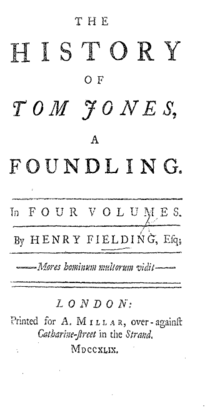
Tom Jones Original CoverSo our friendly and fairly educated barber, Benjamin, comes back to chat with Tom—he’s heard some gossip about him and would like to confirm it. Tom tells his side of the events, and sure, he reflexively tells the story in a way to make him look better—as people do—but isn’t really dishonest about any of it (although he instinctively withholds Sophia’s name for a bit). The two get a little more chummy, ad Benjamin offers to loan Tom some books during his convalescence (proving that he’s a gentleman of great value, even of the discussion of books goes nowhere).

Tom calls him back the next day, because he needs a little blood-letting, after the firing of the surgeon. While he comes back, Benjamin reveals to Tom that he’s the man who was suspected to be his father. He swears he wasn’t, but as followed the news about Tom and is quite impressed with him. Tom wants to make things up to him for all the trouble his hack of parentage has caused Benjamin. The barber says that’s not necessary, he’d just like to be a traveling companion for Tom and his adventures.

We’re told by the narrator, that Benjamin has an ulterior motive—he wants to patch things up between Tom and Allworthy, and to do so in a way that Allworthy is so overcome with gratitude that he reintroduces him to society.

The two begin their travels and eventually come across the home of someone they learn is called The Man of the Hill, one night while in need of a warm place to say. Tom saves him from a mugging and the two are given some shelter for the night.

This section is filled with interesting characters, odd conversations, and Tom getting the wool pulled over his eyes (even if it’s sort of for his benefit). It’s not the best this book has given, but it’s an interesting read, so I’m not going to complain. We seem to have more of the same in the wings, so that should be good reading for the foreseeable future.

The Friday 56 for 6/26/20

The Friday 56This is a weekly bloghop hosted by Freda’s Voice

RULES:
The Friday 56 Grab a book, any book.
The Friday 56 Turn to Page 56 or 56% on your ereader. If you have to improvise, that is okay.
The Friday 56 Find a snippet, short and sweet.
The Friday 56 Post it

from Page 56% of:
Nothing Is Wrong and Here Is Why

Nothing Is Wrong and Here Is Why by Alexandra Petri

N.B. I hesitated to use this book, since I posted about it earlier, but I used my current read last week, and I didn’t want to double-dip. And then my next read is an ARC that, and I try not to quote from them since I don’t know if it’ll make the final cut. So…

His head ached all the time. Once he used his excess mental energy to tip over a glass with his mind, but nobody gave him any credit for it. Just for kicks, he raised and lowered the flag on the Interior Department so that it appeared Ryan Zinke was there when in fact he was NOT, but that was not as much fun as anticipated. Everything began to wear on him. He could not sit through international summits. Everyone spoke too slowly.

Gradually he tried to move things that were bigger and bigger. By the end of the first week he was able to knock rockets out of the sky. He sent a tweet about it, but nobody understood that this was what he was trying to say. All the TV ever seemed to show was people closely misreading his tweets. It was miserable. It was a nightmare.

Nothing Is Wrong and Here Is Why by Alexandra Petri: Laughing So You Don’t Cry at the State of Our Country

Nothing Is Wrong and Here Is Why

Nothing Is Wrong and Here Is Why

by Alexandra Petri

Hardcover, 214 pg.
W. W. Norton & Company, 2020

Read: June 15-22, 2020
Grab a copy from your local indie bookstore!


Like I do so often, when it comes to non-fiction, I’m going to cheat on the summar part and quote from the official blurb:

These impossibly cheerful essays on the routine horrors of the present era explain everything from the resurgence of measles to the fiasco of the presidency.

In Nothing Is Wrong and Here Is Why, acclaimed Washington Post satirist Alexandra Petri offers perfectly logical, reassuring reasons for everything that has happened in recent American politics that will in no way unsettle your worldview.

In essays both new and adapted from her viral Washington Post columns, Petri reports that the Trump administration is as competent as it is uncorrupted, white supremacy has never been less rampant, and men have been silenced for too long. The “woman card” is a powerful card to play! Q-Anon makes perfect sense! This Panglossian venture into our swampy present offers a virtuosic first draft of history—a parody as surreal and deranged as the Trump administration itself.

I’d say that this is some of the most vicious political satire I’ve read, but then I remember all the P. J. O’Rourke that I’ve read. Not to mention Christopher Buckley. Or Jonathan Swift. Or William Langland…. Okay, so maybe I should abandon that idea… I am safe in saying that it’s satire from America’s political Left that could give ORourke a run for his money (although her pieces are shorter than I remember him able to do, therefore punchier).

I am not a Liberal*, and have problems with a lot of the politics underlying these essays. However, most of these essays don’t have particular positions or policy’s in their sights. They’re primarily focused on personality, corruption, competency and the culture the current administration fosters. So while I’d differ from her on vital points, I was able to find more to agree with in these pages than not.

* Not that there’s anything wrong with that.

There were a couple of pieces I was personally offended by, but largely I could write up differences in belief, conviction or understanding to a difference of opinion that are worth discussing—and even when I couldn’t I can admit that most of her points would be largely valid from Petri’s worldview. But none of that rendered any of these essays unreadable (there were two that came close for me, probably not for many others). In fact, I think there was only one of the 50+ essays that I didn’t find a point or two that made me smile or chuckle.

Some pieces work wherever you end up on the political spectrum—like, “You May Already Be Running” (how an elected official finds themselves running for President without deciding to), “Raising Baby Hitler” (rather than using a Time Machine to kill baby Hitler, going back in time to raise him differently). The piece about what she’d call a moderate Republican (I’d consider an actual conservative, not a Trump Republican) looking for someone else to stand up to the President was wonderful and haunting.

I don’t recommend reading more than 3-4 a day, I think they’d lose their impact if you went much further (I knocked off six on one day without meaning to, and I regretted it).

This is a refreshing read, it makes you think as well as grin. If you happen to agree with Petri on most of the issues, you’ll enjoy it more than others will. But frankly, a funny piece is a funny piece, even if I disagree with some/all of it. And that kept me turning pages. I enjoyed this, I recommend it, it’ll unsettle you, it’ll make you think, and it might provide a little relief just seeing someone eruditely make the same points you wish you could.


3 Stars

20 Books of Summer2020 Library Love Challenge

This post contains an affiliate link. If you purchase from it, I will get a small commission at no additional cost to you. As always, opinions are my own.

Page 345 of 625

Powered by WordPress & Theme by Anders Norén