Poison Fruit by Jacqueline Carey

Poison Fruit (Agent of Hel, #3)Poison Fruit

by Jacqueline Carey
Hardcover, 437 pg.
Roc, 2014
Read: October 7 – 10, 2014This one just made me mad.

Yes, there was some very good character development. Some of the backup stories that we’ve been waiting 3 books to get resolved, gets resolved. There’s even a great, epic climactic battle. Daisy gets to be kick-ass on more than one occasion.

But…but…but. It started with her being terrible, careless and incompetent.

And even then, I’m getting ahead of myself. Things start off with Daisy and her closeted werewolf partner, Cody, investigating what seems like a pretty run of the mill case (from the point of view of the reader, not the people being terrorized by the supernatural person). While they’re moving on that, there’s some follow-up on the events of the last book — namely a class action lawsuit against the local governments due to the pain and suffering that the bystanders and spectators weren’t protected from.

Now basically, due to miscellaneous shenanigans, if the settlement reached is too large, the city of Pemkowet will have to sell off a bunch of land — Hel’s demesne. And things will get bad from there. So, basically, it’s all about stopping the trial — or winning it. Which will be difficult as the opposing lawyer can bend the wills of whomever he wants.

So, what do Daisy and the rest do? Highlight to see the spoilers if you want: They cook up one harebrained scheme that may work, and then they wait months for the trial to start. That’s it. And sure, the scheme works — for a day or two, until the opposing lawyer proves he’s not an idiot, figures out what they’re doing and stops it.

Could they have come up with other things to try? A back-up plan, maybe? Could they have investigated just a smidgen to figure out who was behind these antics and maybe find a way to stop things before it got to trial? Nope.

So because they don’t do enough, a big battle between Daisy and the eldritch community and the people that Daisy couldn’t bother herself with investigating, and it is an awesome battle featuring nifty and tragic things — like any good climactic battle would. And trust me, I’d like to spend time talking about and thinking about how great a lot of what happened at that battle was, but I can’t. Because the only way we got there was through Daisy neglecting her duties as Hel’s liaison. It’s not apathy, and I give her too much credit for being distracted by her love life (and how distracting can it be, really, with one date a week?).

You know what Ivy Tamwood, Rachel Morgan, Toby Daye, Kitty Norville, Harper Blaine, Kara Gillian, or Anna Strong (to name a few of UF’s better female characters) would’ve done in this situation? Something. They wouldn’t have waited to see if Plan A would work, they’d have done what they could to prevent Plan A from being necessary.

Oh yeah, and the love story ends up concluding the way we all thought it would — with a little Deus ex machina thrown in to get it there. At that point, I didn’t care, really.

I was initially disappointed to find out that this would be the end of this series, but now I’m absolutely okay with that.

—–

2 Stars

Saturday Miscellany — 11/8/14

Odds ‘n ends over the week about books and reading that caught my eye. You’ve probably seen some/most/all of them, but just in case:

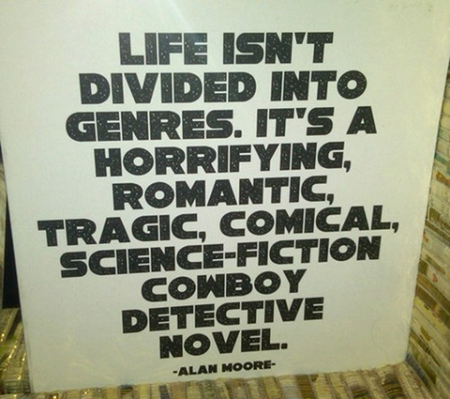
  • A Better Way to Think About the Genre Debate — despite the not-so-humble title, Joshua Rothman has some interesting things to say about genre.
  • Patrick Rothfuss Responds to Academic Snobbery — Rothfuss has a more colorful and succinct take on the genre debate as we see here, in his video response to a University professor not accepting his work as befitting a paper in their class.
  • Speaking of Rothfuss, in For Love and Sass — one blogger responds to many one-star reviews of Rothfuss’ new book. It’s pretty funny even if you’ve never read Rothfuss.
  • Dear Grimdark… — Sam Sykes writes a letter to Grimdark fantasy.

The Infinite Sea by Rick Yancey

The Infinite Sea (The 5th Wave, #2)The Infinite Sea

by Rick Yancey
Series: The 5th Wave, #2

Hardcover, 300 pg.
Putnam Juvenile, 2014
Read: October 4 – 5, 2014
Man, talk about trepidation. Did I want to pick up this book? Was there any chance it could live up to The 5th Wave? Slim to none. But man, I wanted to find out what happens to the Earth. I wanted to know if we ever figure out what the aliens want with the Earth, why they’re eliminating humanity in the way they are. So, prepared to be disappointed, I cracked the cover.

And Yancey doesn’t try to match — or even try to top — The 5th Wave. He writes a very different book. Not one that grabbed me as thoroughly, but one that works in its own way. Where The 5th Wave was a bullet train that you just tried to hang on to — The Infinite Sea was roller coaster you’re riding while blindfolded — the ride lopping, diving, screaming around a corner with no warning, leaving your stomach behind you.

Yancey can’t even give us a Prologue to reorient ourselves to this world, to get our feet under us so we can say, “Oh yeah, this is what’s going on…” before resuming the action. Sure, it starts to seem like that, but nope. He’s right there to pull the rug out from under us at the first possible moment, in a way that catches the reader just as off-guard as the bits of remaining humanity will be.

I read some criticism lately about The 5th Wave that complained about the lack of motivation given for the aliens to do what they’re doing — it makes no sense, and therefore the reviewer couldn’t buy into the book with a motive-less enemy. But to me, that’s why the book worked. Humanity doesn’t understand what’s going on, so there’s no reason we human readers should either. Try as they might, there’s just no figuring out what’s going on other then their great need to survive.

On the whole, we spend time with the characters we met in the first book, those that survived — and, in flashbacks, some that didn’t, Cassie, Sam, Ben/Zombie, and a few others I won’t name because I can’t be sure I won’t spoil something by doing so. We say good-by to some of them, too. We meet a few other characters, too. Some of which we’ll see again. It’s that kind of series. But we get to know almost all of them better, the last book was all about getting to know a couple of these characters really well. This time, we get backstories on everyone, even if it’s pages/paragraphs before they die. This is important, I feel more grounded in this world the more I get to know characters who aren’t Cassie, Evan or Ringer.

And we get some more mature, experienced — and in some cases, informed — hints at what’s really been going on. Still, not enough to placate that other reviewer, I bet — or, really anyone. At one point, Cassie’s complaining about her interactions since Day 1 with Evan.

Every time I edge too close to something, he deflected by telling me how much he loved me or how I saved him or some other swoony, pseudo-profound observation about the nature of my magnificence.

I chuckled as I read it, because this is pretty much Yancey’s modus operandi — just when you get close to learning something, being told something, a character figuring something out, etc. — something explodes or someone starts shooting. Or both. Not a way to tell a narrative that satisfies everyone or to show off brilliant world-building. But a it’s great way to keep pages turning.

I found this to be a very satisfying read. As I said, I didn’t expect to be as taken with this book as I was its predecessor, and I wasn’t — but in a way, I’m sucked into this series more than before. I really don’t know the last time I said “son of a — “* out loud at a book as much as I did with this one. It’s probably not since Butcher’s Changes that I’ve called a writer so many names as I’ve read. Yancey just keeps throwing me for loops. Not the best book I’ve ever read, not high literature, but edge-of-your-seat thrills, convincing characters, and honestly come by surprises. Really entertaining stuff. That’s all I ask for.

—–

* I seriously don’t finish the sentence, because I’m too busy shaking off whatever trauma is thrown my way and getting back into things to bother.

—–

4 1/2 Stars

The Blood of Olympus by Rick Riordan

The Blood of Olympus (The Heroes of Olympus, #5)The Blood of Olympus

by Rick Riordan

Hardcover, 516 pg.
Disney-Hyperion, 2014
Read: October 25 – 28, 2014
Well, after ten novels, it’s time to say good-bye to Percy, Annabeth, Grover, and the other residents of Camp Half-Blood — not to mention their new-found allies and friends (when they’re not trying to wipe them out) from Camp Jupiter. But first they have to stop Gaea and her army of giants from wiping out the gods, humanity, and all life as we know it.

Just another day for these demi-gods, really.

As is the norm for Riordan’s books, our heroes are faced with a series of tasks which build up to a major confrontation — this time, a couple of them. It’s amusing as usual to see these kids outwit various minor gods, titans, etc. Good teacher that he is, Riordan gives his readers plenty of education about the Greek and Roman pantheons under the thin disguise of plot development.

The big epic battles that he’s been building for since the beginning of this series — well, they were epic. They were tension filled. And still managed to be funny. And will likely be read with breaths caught, and lumps in throats. Possibly the funniest visual in Riordan’s works appears in the midst of one of these battles, and for a second I was torn between enjoying it and turning the page to find out what happened next.

My one quibble was that the resolution to the Gaea story was a little too easy, a little too quick after all this build up. Still, the way he wrapped up the other story lines and conflicts was sufficient, so I was able to move past it easily. Riordan continues dabbling in themes I’d prefer not to see in MG books, but I know I’m in the minority on that.

At the end of the day, especially at this point in these series, it’s the characters that readers care about. I read this ahead of my son (who started these back when there were only three in the original series, and is now a good deal older than the target audience) and made a joke about something bad happening to Grover — and the glare he gave me probably took a year off my life. It’d that kind of dedication that Riordan instills in his fans. As such, there’s plenty of development and resolution given to these characters — Riordan doesn’t spell out their futures the way that Rowling did at the end of her series, but he gives us enough to be able to say good-bye.

Riordan does right by his characters — Reyna, Jason, and Frank particularly. Annabeth and Piper shine like neither has before. And Leo Valdez is even more of a star than he was before (if I’m going to talk about my son’s soft spot for Grover, I’d better be honest about my Leo-centric focus). I’m not saying they all survive, or are otherwise unscathed, but Riordan treats his characters with respect and keeps his readers turning the pages.

It’ll be odd not getting a new adventure with these characters next year, but I’m looking forward to seeing what Riordan does with the Norse pantheon (and learning about them, too).

—–

4 Stars

Sleepy Hollow: Children of the Revolution by Keith R.A. DeCandido

Sleepy Hollow: Children of the RevolutionSleepy Hollow: Children of the Revolution

by Keith R.A. DeCandido

Paperback, 304 pg.
Broadway Books, 2014
Read: October 24, 2014DeCandido has given us the best possible first tie-in for Sleepy Hollow — it’s a good follow-up to the second episode, “Blood Moon,” (which I didn’t even realize needed a sequel until I read this); it captures the essence of the show; and tells a good story to boot.

This takes place about four months after “Blood Moon” — 8 half-moons, to be exact. We’re told it’s January 2014, but I’m not exactly sure where that locates things in the first season. Somewhere between episodes 10 and 11, by my reckoning. A coven is trying one more time to resurrect Serilda, using a collection of medals commissioned by General Washington for a group of heroes of the Revolution — including Ichabod, of course.

DeCandido touches base with the characters and most of the events that stand out in the first season, all the touchstones are there. Macey Irving, Sheriff Corbin, Andy Brooks (I’m pretty sure his name is dropped), Henry Parrish, the Golem . . .

The book is filled with random historical musings from Ichabod — though the part where he criticizes (to put it very mildly) the recreation of Ft. Ticonderoga was a bit too much like his dressing down of the docent about Paul Revere. But you know what? It was just as amusing — and what else are you going to to with our favorite time-displaced Witness?

Really, the key to this book (like the show) is getting the two central characters right. Let’s look at two brief snippets:

Abbie spent most of the drive up Interstate 87 to Ticonderoga being simultaneously charmed by Crane and seriously wanting to strangle him.
Thinking about it, that defined a lot of her relationship with him.

Captures Abbie’s attitude, her swagger, and her humor.
and then:

. . . he pulled out the device that was referred to as a “cell phone.” He assumed the modifier “cell” was a joke referring to how much modern humanity was imprisoned by such devices, as it seemed that the citizens of the twenty-first century relied on them to an appalling degree.

Even though that’s in the Third Person, if you don’t hear Tom Mison’s voice in your head there? Something’s wrong with you.

He captured the friendship, the feel of the characters and their voices — both in narration and in dialogue. Couldn’t ask for more.

This tie-in captured the show’s tone, its feel, its characters and its world while telling a compelling story. Great stuff.

Note:I received this book for free from Blogging for Books for this review. Which was generous and cool of them, but didn’t impact what I said about the book. It was strong enough to gain my respect on its own.

—–

4 Stars

Saturday Miscellany — 11/1/14

Odds ‘n ends over the week about books and reading that caught my eye. You’ve probably seen some/most/all of them, but just in case:

    This Week’s New Releases I’m Excited About and/or You’ll Probably See Here Soon:

  • The Peripheral by William Gibson — if you need more than the author’s name to get you interested in this one, here’s Cory Doctorow’s review
  • The Slow Regard of Silent Things by Patrick Rothfuss was a little slice of wonderful. Review forthcoming, but in short: beautiful, strange, strangely beautiful.
  • Drawn Blades by Kelly McCullough — the only reason I’m not more excited about the latest in the Fallen Blade series is because it reminds me that I didn’t read the previous one yet. Gah!

Opening Lines – Pickles and Ponies: A Fairy-Tale

We all know we’re not supposed to judge a book by its cover (yet, publishing companies spend big bucks on cover design/art). But, the opening sentence(s)/paragraph(s) are fair game. So, when I stumble on a good opening (or remember one and pull it off the shelves), I’ll throw it up here. Dare you not to read the rest of the book.

Yeah, yeah, I know…another modern fairy-tale intro. What can I say, I’m a sucker for ’em?

Once upon a time, in a land far away, a prince was in rather a pickle. Not a literal pickle, of course— prince-sized pickles are rather hard to come by. No, the type of pickle this prince was in was a thoroughly metaphorical one. To be honest, he might have preferred the vegetable.

from Pickles and Ponies: A Fairy-Tale by Laura May

The Deaths of Tao by Wesley Chu

The Deaths of Tao (Tao, #2)The Deaths of Tao

by Wesley Chu
Series: Tao Trilogy, #2


Mass Market Paperback, 462 pg.
Angry Robot Books, 2013
Read: October 17 – 24, 2014
It’s been a few years since the events of The Lives of Tao, and things have not gone well for Roen Tam, either personally or in the war. He’s basically dropped out of everything, going rogue, running covert ops for Tao while ignoring Prophus’ command structure. Tao’s sure he understands what’s going on in the world better than anyone else, and so he pushes Roen to leave everything behind and find evidence for Tao’s theory.

Meanwhile, Jill — and Raji — have wormed their way into the corridors of power in the Capitol, moving and shaking on behalf of Prophus while also keeping her cover as a Senatorial aide intact. This is where Prophus seems to be holding its own – but barely.

We bounce around between Roen, Jill, and a new Gengix host, Enzo, who is trying to find a level of dominance very quickly for himself in the Gengix hierarchy. He’s rash, impetuous, and egotistical — not the signs of a great leader. But the Gengix he’s hosting is wise, methodical, honorable and tries to impress these characteristics on this host.

But like I said, things aren’t going well for the Prophus — they’re on the verge of losing this war once and for all, clinging to power and influence some areas, absolutely losing it in others. They’re so close to the brink that they eventually are driven to one final act of desperation that will change everything forever.

As the title suggests, The Deaths of Tao is darker (like any good 2nd volume of a trilogy), not as fun (understandable given the darkness, but would’ve been helpful), and slower paced than The Lives of Tao. But, still, I was enjoying it enough to keep going — and I wanted to see what happened to Roen and the rest. Hopefully get to see my favorite Prophus host whip that Gengix Enzo around a bit. But Chapter 29? Made everything up to that point worth it. And excitement, the pace, and the stakes picked up after that (not the stakes for the whole armies, obviously, but for Roen and Jill)

Still, it took until Chapter 29 for this really to come together for me — and that’s far too long. Which is strange, because up until that point, I’d say this was better structured than its predecessor. It built better in plot development, character and tension. But Chapter 29 made me rethink that, it’s just too much of a jump in development and voice.

I find it hard to understand — except for strength in numbers — just how the Gengix are winning this thing. The Prophus seem to come out on top — if not even with — the Gengix almost every time we see them. It’s difficult to extrapolate from this to them almost losing this war. Yet that’s exactly the situation they’re in, and you believe it, up until you think about it a day or two later.

Giving it three stars — as good as the last 150 pages or so were, as huge as the ending was — it was a slog up until that point. I just couldn’t connect with Roen or Tao (or anyone else). But believe you me, I’m anticipating The Rebirths of Tao and expect it to blow me away. Just wish this had done that.

—–

3 Stars

A Less Happy Anniversary – Rex Stout (December 1, 1886 – October 27, 1975)

Don’t worry, this is not going to become the Rex Stout/Nero Wolfe Almanac. But the Rex Stout Facebook page just posted something about this being the 39th anniversary of Rex Stout’s death at the age of 88. I was barely reading at the time — certainly not murder mysteries — so the event meant practically nothing to me. I certainly couldn’t have known then that he’d make a bigger impact on me than just about any other writer.

He’d have led a fascinating life if he’d never started writing novels. What he was able to do because he started writing — particularly writing the Nero Wolfe/Archie Goodwin series — is beyond the hopes of most people. Yeah, a lot of what he labored for politically would be the sort of thing that I’d be opposed to (but not all of it). Nevertheless, he showed the kind of civic activity that’s admirable.

As I write this, John McAleer’s 600+ page Rex Stout: A Biography, is literally an arm’s reach from me. I’m going to resist the urge to pull it off the shelf and start relating some of my favorite bits. Instead, I’ll just point you to this pdf version of the obituary The New York Times ran on the front page the day after he died.

Saturday Miscellany — 10/25/14

Odds ‘n ends over the week about books and reading that caught my eye. You’ve probably seen some/most/all of them, but just in case:

Page 568 of 627

Powered by WordPress & Theme by Anders Norén