Tag: 20 Books of Summer Page 2 of 5

20 Books of Summer 2025: Can I Make it Five in a Row?

20 Books of Summer 2025g
After Cathy of 746 Books retired from hosting this challenge after an impressive 10 years, I figured this was going away. But Emma of Words and Peace and Annabel from AnnaBookBel stepped up to carry the torch. You can read their kick-off post here. So, I’m back for my fifth year of participation in this challenge–and hopefully completing it. “But HC,” some of you might be saying, “a lot of these books look suspiciously like books from other challenges you mentioned.” Yes, yes they are. I’ve not done a great job at some of my challenges this year (okay, most of them0. So, why not multitask? I’ll force myself to read some anticipated new releases (another thing I’ve failed at this year), read every book I’ve borrowed from a friend, and chip away at two other challenges (possibly more). That’s a win-win-win in my book.

Still, I’m worried about completing it. Feel free to harass me about this from time to time.

I’ve frequently used the unofficial US Dates for Summer—Memorial Day to Labor Day, but Memorial Day has already passed. So, I’ll go along with the June 1-August 31 (actually, none of these books are what I’d read on a Lord’s Day, so June 2-August 30). And It’s going to be Friday at the earliest before I can start one from this list. So…sure, I’m stacking the deck against me (although a couple of years ago, I didn’t read any in June and finished okay).

There’s still time to join in the fun—if you’re into this kind of thing. (there are 10 and 15 book versions, too)

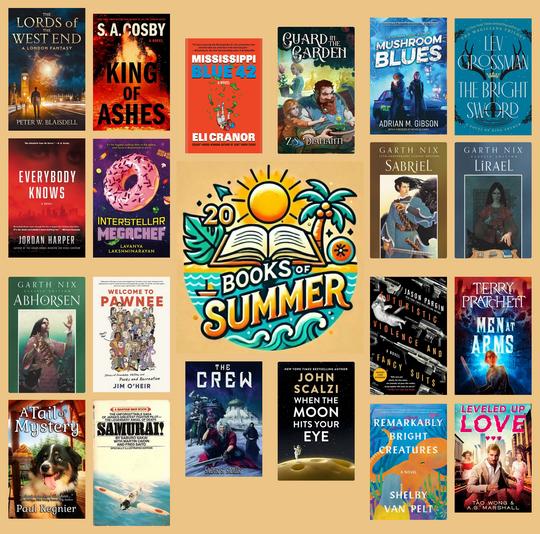
This summer, my 20 are going to be:

1. The Lords of the West End by Peter Blaisdell
2. King of Ashes by S. A. Cosby
3. Mississippi Blue 42 by Eli Cranor
4. Guard in the Garden by Z. S. Diamanti
5. Mushroom Blues by Adrian M. Gibson
6. The Bright Sword by Lev Grossman
7. Everybody Knows by Jordan Harper
8. Interstellar MegaChef by Lavanya Lakshminarayan
9. Sabriel by Garth Nix
10. Lirael by Garth Nix
11. Abhorsen by Garth Nix
12. Welcome to Pawnee: Stories of Friendship, Waffles, and Parks and Recreation by Jim O’Heir
13. Futuristic Violence and Fancy Suits by Jason Pargin
14. Men at Arms by Terry Pratchett
15. A Tail of Mystery by Paul Regnier
16. Samurai! by Saburo Sakai with Martin Caiden and Fred Saito
17. The Crew by Sadir S. Samir
18. When the Moon Hits Your Eye by John Scalzi
19. Remarkably Bright Creatures: Shelby Van Pelt
20. Leveled Up Love by Tao Wong & A. G. Marshall

(subject to change, as is allowed, but I’m going to resist the impulse to tweak as much as I can).

What do you think of this list? Any warnings—or anything you think I should be really excited about?

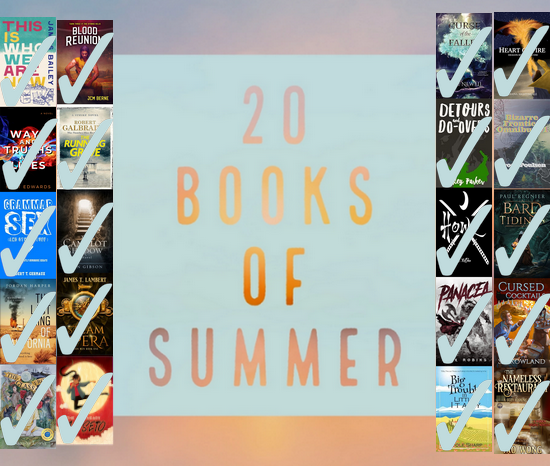
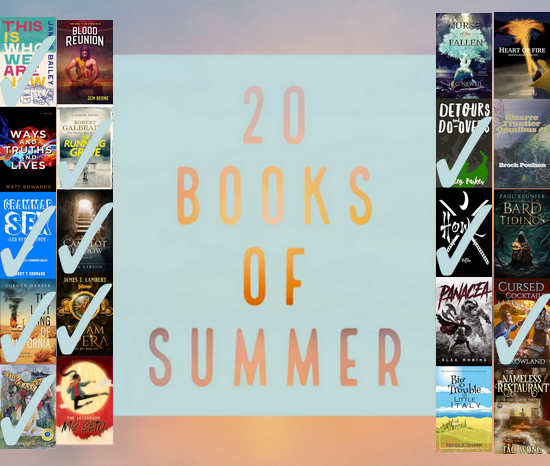
20 Books of Summer '25 Chart

This Is Who We Are Now by James Bailey: One Corvette Short of a Textbook Mid-Life Crisis

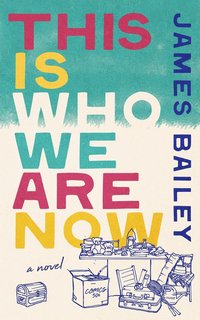
Cover of This Is Who We Are Now by James BaileyThis Is Who We Are Now

by James Bailey

DETAILS:
Publication Date: October 23, 2023
Format: eBook
Length: 240 pg.
Read Date: July 23-24, 2024

“Sorry.”

“For what?” Her honey brown eyes are equal parts amused and curious when she looks up into mine.

I don’t have an answer. Sorry is just a word you say when you have nothing substantive to offer. I’m sorry you missed your bus. I’m sorry your boss was in such a foul mood. I’m sorry everyone is such assholes these days. I didn’t cause any of these problems, and I can’t make any of them better, but I can offer you some useless empathy. I’m sorry your life didn’t turn out to be more fulfilling. Rest assured, however, in a parallel universe in which we didn’t break up, you’re happier. Maybe. And I’m sorry if you’re not. Or at least the parallel me is. He’s the one that let you down there.

What’s This Is Who We Are Now About?

Henry drags his wife and sons to his parents’ house for a few days. One son doesn’t want to leave his girlfriend behind, his wife is trying to finish organizing a charity activity that takes place while they’re away, and Henry really doesn’t want to be there because his family will be celebrating Henry’s 50th birthday.

When they arrive, his parents are having a yard sale, selling a lot of memorabilia from Henry’s childhood and he’s upset by that. A rivalry with his brother reheats, and he keeps running into his incredibly serious high school/college girlfriend.

Things go bad with his wife, his brother, his parents, and his kids. Henry repeatedly tries—and sometimes succeeds—to keep their connection alive. But the challenges (many self-created) continue. Can Henry make it through the visit with his family intact? Is it too late to come-of-age when you’ve hit 50?

So, what did I think about This Is Who We Are Now?

I can defend everything I’ve done since we arrived. Even the worst of Denise’s complaints, in isolation, would be waved away by most objective observers. Collectively, however, maybe it’s not a body of work to stake a flag in. Maybe the picture when all the dots are connected isn’t a flattering one.

I have struggled with this post—especially because I’ve had to write it in bits and pieces over a couple of weeks, which I do often enough that’s not the issue. But I keep changing my mind about the book every time I write—which leads to a lot of editing, re-editing, re-re-editing, and I just give up and walk away.

Even when Henry was making it really easy not to like him (which was often), there’s something very charming, very effortless, and pretty entertaining about this book. His moments with his sons would largely make you wonder why his family is in such a precarious state—then you remember he doesn’t have/make/take the time when they’re at home to be this kind of dad. Then there’s everything he says to, reacts to, or treats Denise…it’s just painful.

I thoroughly enjoyed everything about Henry’s sister, Margo, on the other hand. Her strengths, her bad decisions, and how she reacts to them are easily the saving grace of the novel.

I enjoyed this novel while reading it. But I haven’t been able to decide what I think about almost any part of it that doesn’t involve Margo or Henry’s kids. I think that says something about how realistic Henry, Denise, and their problems and family are. But I don’t know how real I want a book like this to be.

I like Bailey’s writing, I think he’s amusing enough when he wants to be, he gets you invested in his characters, and I wanted to like this a lot. But at the end of this day, I like it just enough to recommend it (most days, other days I could like it a lot more or a lot less).


3 Stars

20 Books of Summer

Big Trouble in Little Italy by Nicole Sharp: Filled with Great Food, a Lot of Laughs, and Love

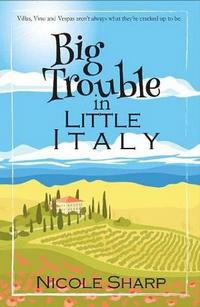
Cover of Big Trouble in Little Italy by Nicole SharpBig Trouble in Little Italy

by Nicole Sharp

DETAILS:
Series: Simply Trouble Series, #1
Publisher: Writing Moose
Publication Date: October 3, 2023
Format: Paperback
Length: 343 pg.
Read Date: August 27-28, 2024
Buy from Bookshop.org Support Indie Bookstores

The Back of the Book

There’s no way I could put all this as concisely as (I’m guessing) Sharp did for the back of the book. Also, I think I’d trip over myself not saying some of this, but I clearly think some things are more spoiler-ish than others do. So I’m just going to steal this:

Life is looking pretty good for thirty-two-year-old Jessica Dodd. She just bought her wedding dress and closed on a house with her trial lawyer fiancé, Thomas. But first, she needs to take care of one tiny issue: her husband – a youthful indiscretion from a drunken weekend in Vegas years ago. She never saw the guy again, so it didn’t really count. Still, she needs to get divorced.

CIA agent Parker Salvatore has thought of his “Vegas wife” over the years, though it was never time to start dating her. However, when he returns from a two-year assignment to find that she is literally in bed with the enemy, he realizes it’s time to make his move. First, he needs to catch the bad guy, then he can woo the girl.

Things begin to unravel when Jessica finds out Thomas has been lying to her. Determined to confront him she follows him to Italy. Fueled by a surplus of caffeine and a colossal lack of sleep her plan becomes a hell of a lot more complicated when she walks straight into the middle of the CIA’s criminal investigation of her fiancé.

Set against the backdrop of the Tuscan countryside, Parker and Jessica find themselves treading the perilous waters of infiltrating a well-known crime family, filing for divorce and attempting to keep their rekindled attraction at bay.

Slightly Ajar Door Romance

I’m not an expert on this kind of thing, but I can read definitions online, so I feel safe saying that this isn’t a closed-door romance. But it’s really not that far off–I’ve read books (Romance and otherwise) that put more on the page. Sharp does fade to black pretty quickly, thankfully*, but she could fade a bit quicker–and take a little more time before fading back into light.

* That’s a reflection of my prudish-inclinations.

I just figure that I should mention it since I’ve talked about things like this in the past–and I know some of my readers care. Basically, I’ve learned from the Sunshine Vicram books–these are not ones I will give my mother. Although I have to say, I kind of think I’d be more comfortable knowing that my mother read this over Sunshine (and much more comfortable with my mother knowing I read these, too). That might be a silly basis for rating, but that’s where I am.

So, what did I think about Big Trouble in Little Italy?

I only took one note while reading this book–after the first chapter, I wrote simply “Zany.” And I really never came up with anything to say beyond that. There is a lot more to the book than that–but that word is pretty much always applicable.

Sharp’s voice is infectious–I thoroughly enjoyed the writing here, more than the rest of it (which is saying something). The characters lept off the page and right into your heart (except for the small handful you just wanted to spit out as quickly as possible, and then spit on). There’s an Italian agent working with Parker who is one of those characters that comes close to stealing the show–I’d love to read more about him. That’s true for most of the more significant supporting characters, too. Yes, the focus of the book is (rightly) on Jessica, Parker, and Thomas–but Sharp has this book bursting with characters you want more of.

This is very much a Romance novel–yes, a Romantic Comedy, yes, a Romantic Comedy with a Thriller flavor. But the key word there is Romance/Romantic. As such, I’m not really the intended audience for this, but after talking with Sharp at an event this Spring, I really wanted to read something she wrote–and thankfully, the Comedy and Thriller parts of the book were strong enough that I could handle the Romance.

I’m not sure what people who read more Romance fiction than I do would think of this. I think die-hard Thriller readers would think it stretches things a bit (but not as much as a couple of Lee Child books have, for just one example). The Comedy never misses, though. Not once.

I can see myself coming back for more in this series, actually. I can also see me dropping it pretty quickly if the laughs die down. I say that without rancor–but because I recognize that I’m just dabbling in this world.

I’d definitely like to hear what people better versed in Romantic fiction have to say about Sharp’s work. But for my money, this is worth your time and money. The plot zips along well, the CIA-Crime story zigs and zags the way it should, and the comedy is pretty consistently goofy and yet heartfelt–actually, all of it is heartfelt. Zany and Heartfelt. A heckuva combination.

Oh, be sure to have your local Italian restaurant’s online delivery menu pulled up, you’re going to want to use it. Or have it, and your payment methods, locked away if you don’t need to treat yourself in that way.


4 Stars

This post contains an affiliate link. If you purchase from it, I will get a small commission at no additional cost to you. As always, the opinions expressed are my own.

20 Books of Summer

Bizarre Frontier Omnibus #1 by Brock Poulsen: Death Doesn’t Stop this Marshall

Cover of Bizarre Frontier Omnibus #1 by Brock PoulsenBizarre Frontier Omnibus #1

by Brock Poulsen

DETAILS:
Series: Bizarre Frontier, Omnibus #1
Publication Date: October 20, 2021
Format: Paperback
Length: 349 pg.
Read Date: August 5-6, 2024

I hate dying. It usually hurts something awful and ruins my whole day. I avoid it whenever possible.

What’s Bizarre Frontier About?

This is a collection of the first three novellas in Poulsen’s Bizarre Frontier series. This series focuses on the adventures of the former Deputy Marshall, Willard Beckett. He didn’t always wear a “white hat,” back in his black hat days, he was cursed by a dying Romani woman. He can’t stay dead. He can die, he can go through all the pain and suffering before death—but he shakes it off after a little while.

As curses go, it’s not the worst, actually.

On Moths

In the first novella, we meet Beckett and learn about his, um, condition.

As any “retired” protagonist in a Western starts, Beckett is living alone, away from everyone else, self-medicating and merely existing. His wife divorced him, he lost the taste for the work (or so I assume, I don’t remember it being spelled out), and really doesn’t have much purpose in life. Until, of course, his old boss comes for help. It seems some brothers that he ran with are causing problems in a local mining town and they can’t be stopped.

The funny thing about that situation, those brothers were killed by the aforementioned Romani woman.

Hanged Man’s Boots

After finding out how those brothers got in the position where they could terrorize the town, Beckett and his ex-wife, Sue, learn that the man behind it all is cutting a swath of destruction behind him as he tries to escape justice. Can the pair stop him?

Husk

The big hook to this one comes from Willard not doing something I’d assumed he took care of in between novellas. And the fact that he didn’t made me roll my eyes pretty hard. Yes, he justified his lack of action to someone later in the novella—and it’s plausible, but I still don’t buy it. Still, without his being careless, we wouldn’t have gotten this story.

It begins with Willard going off to take care of the repercussions of his carelessness and Sue having to go rescue some of her sister’s sheep following a storm and her brother-in-law coming into close contact with a monster (or so he claims and not enough people believe).

Craziness and action ensue. And while the last novella brought the pair into contact with evil made stronger by the supernatural, this one brings them into some supernatural mayhem. It’s hard to argue which is worse

The Strangest Bit

For me, the thing that was stranger than Willard’s curse—or anything else he ran into—was the way he (and everyone else) called the woman who cursed him (and her family) Romani instead of that term that I grew up hearing. I’m not complaining about it—if I’m buying a Deputy Marshall who can’t stay dead for long, I can buy a degree of cultural sensitivity that is just as out of place.

It just took me a second to accept it. But honestly, I like the fact Poulsen made that choice, he didn’t need to.

So, what did I think about Bizarre Frontier?

These stories are light on the Western and heavier on the Urban Fantasy—which is fine with me, if you forgive the anachronistic nature of that. They’re Western enough to qualify, but by a hair—they remind me of the Bodacious Creed Zombie-Steampunk-Westerns in this way. (and actually fans of one of these series, should check the other out)

I wouldn’t mind a little more depth to each of these, but I don’t think they need much more. They work really well for what they are—quick, episodic, adventures with just enough of a tie between them to keep readers coming back (if you get them individually) or to carry you through the omnibus (if you go that way).

There’s a lightness to the prose that keeps it engaging and fun even in the midst of monsters, death, and mayhem. The action is smooth, the recurring characters are fun and I can see hanging out with Willard and Sue for quite a while to come. I’d like to see them deal with something that has no contact with anything they’ve encoutered yet—but if Poulsen keeps going down this path, I’m not going to complain.

I will be back for more as soon as I get a chance. It’d be nice if there was a second omnibus (I mention in case Poulsen reads this), but it looks like I’ll be picking up the novellas at my earliest convenience. I’d recommend you trying these yourself.


3 Stars

20 Books of SummerLiterary Locals logo

20 Books of Summer 2024: Wrap Up and Other Summer Reading

20 Books of Summer
It’s time to wrap up this challenge run by Cathy at 746 Books.

Last week, I honestly thought I’d be posting “well, I got 18.5 out of 20 this year.” Maybe a full 19. I guess I wasn’t too optimistic in July, either. But as of yesterday, I finished all 20 of this year’s selections. That’s the earliest I’ve completed this challenge in the four years I’ve done it.

Most of these were as good, if not better, I expected. A couple were just good enough, but I’m still glad that I read them. There was one that I DNF’d, and I do regret that–thankfully, I had a blast with the substitute. I only read 6 of my Top Ten Tuesday: Books on My Summer 2024 to-Read List (That Aren’t on My 20 Books Challenge), although, to be fair–one of them only came out Tuesday, so I haven’t had much of a chance to get it. Sure, 5 of those 6 were for a tour or an ARC that I wanted to post about by publication. The four that have no deadline attached will hopefully be tackled next month. Hopefully.

Speaking of writing about…I’ve only written about 7 of these (3 posts should’ve been posted this week, but I couldn’t quite finish them before sleep overtook me). That’s my other September goal.

Anyway, it’s done, I had fun–I read things I’ve been meaning to get to for months (if not years). Color me satisfied.

✔ 1. This is Who We Are Now by James Bailey
✔ 2. Blood Reunion by JCM Berne
✔ 3. Ways And Truths And Lives by Matt Edwards
✔ 4. The Running Grave by Robert Galbraith
✔ 5. Grammar Sex and Other Stuff: A Collection of (mostly humorous) Essays by Robert Germaux (my post about it)
✔ 6. The Camelot Shadow by Sean Gibson
✔ 7. Last King of California by Jordan Harper
✔ 8. Steam Opera by James T. Lambert (my post about it)
✔ 9. The Glass Frog by J. Brandon Lowry (my post about it)
✔ 10. The Legendary Mo Seto by A. Y. Chan (substitution) (my post about it)
✔ 11. Curse of the Fallen by H.C. Newell
✔ 12. Heart of Fire by Raina Nightengale
✔ 13. Detours and Do-overs by Wesley Parker (my post about it)
✔ 14. Bizarre Frontier Omnibus #1 by Brock Poulson
✔ 15. Howl by e rathke (my post about it)
✔ 16. Bard Tidings by Paul J. Regnier
✔ 17. Panacea by Alex Robins
✔ 18. Cursed Cocktails by S.L. Rowland (my post about it)
✔ 19. Big Trouble in Little Italy by Nicole Sharp
✔ 20. The Nameless Restaurant by Tao Wong (my post about it)

20 Books of Summer '24 August Check In Chart

Cursed Cocktails by S.L. Rowland: Mixing Drinks and Starting Over

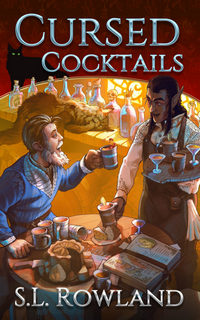
Cover of Cursed Cocktails by S.L. RowlandCursed Cocktails

by S.L. Rowland

DETAILS:
Series: Tales of Aedrea, #1
Publisher: Aethervale Publishing
Publication Date: February 18, 2023
Format: Paperback
Length: 265 pg.
Read Date: July 22, 2024

Buy from Bookshop.org Support Indie Bookstores

What’s Cursed Cocktails About?

The cynical side of me wants to summarize this as a gender-flipped Legends & Lattes with a couple of twists. But as apt as that is, it feels petty and dismissive.

Rhoren is a retired blood mage. I won’t get into what a blood mage is, but it’s about as pretty as the name would lead you to believe. The fact that his nickname “Bloodbane” (a nickname known throughout the nine kingdoms, I should add), is another clue. The “retired” part of Rhoren’s description is a rarity, not many blood mages survive long enough to retire. Those who do, like Rhoren, aren’t in the best of health. Rohren’s given some advice about relocating to the coast (and away from the cold) for his health. Needing a change of pace and scenery, that’s just what he does.

And it’s just the right call for him.

Being in the military (and a fairly active part of it), he didn’t have a lot of chances—or reasons—to spend his earnings, so he has a pretty nice nest egg in addition to his pension. A new place to live and a good amount of funding—just what you need to start the second part of your life.

One of the first things he does when he moves to his new city is befriend a bartender, Kallum. Kallum loves his job, but dreams of being able to be more creative with a menu and creating new cocktails.

Rhoren needs a new purpose in his life and finds an open storefront building with an apartment above it. Sure, it’s open because it seems to be haunted, but what’s a rogue spirit (if the place is actually haunted) for a guy like Rhoren? So he buys the place, moves in, and suggests a partnership with Kallum.

It’s not smooth sailing by any means from this point forward, but chasing dreams (old or new) is worth a few risks, right?

Bloodbane

Rohren doesn’t like to think about his days of service—and likes to talk about it even less. He doesn’t want anyone to know he was a blood mage—especially not Bloodbane. He’s ready to shed that name, that vocation, and the reputation that follows both.

Also, using that kind of power the way he has for decades is the biggest thing impacting his health—the very reason he had to move.

But even the best-kept secrets have a tendency to come to light—especially when events outside of Rohren’s control might call upon him to unleash his abilities.

While I really have no complaints about anything in this book, I thought this was its strongest point. Rowland depicted Rohren’s desire to get away from his past, dealing with his health (both how he’s still limited, and how he’s improving with the weather), and having to step up and tell people about his past, with sensitivity and precision. That was really well done.

The Cozy-ness

After a little peak at the hardships of those who serve and protect in the north and the hazards they face, we shift into the cozy atmosphere we’re promised in this book. And aside from a scene or two (which don’t detract that much), that atmosphere pervades the rest of the book.

There’s some light humor (including some fantastic liquor names—and a cameo from a distinctive bottle design)—there’s a warmth between the characters, a largely supportive populace in the city, and the setting is ripe for stories.

You just can’t help but feel comfortable while reading this. You really might as well be kicking back in your favorite cocktail bar while reading this (and, I should add, you really should have something to drink—not necessarily alcoholic—nearby), you just feel content and warm.

So, what did I think about Cursed Cocktails?

There’s just enough conflict and danger to keep this from being the coziest fantasy that I’ve ever read—but it’s close. In fact, one source of potential conflict never produced any (which was a relief, but also a mild irritation), making the whole thing cozier.

That doesn’t mean the book is dull—far from it. It’s just that you turn the pages for another reason—instead of being on the edge of your seat to see what happens next. You keep going to keep the warm and fuzzy feelings going. It’s here that my mostly joking comparison to Baldree’s book really comes into play, if you got into one, you’ll get into the other.

And that’s a feeling that I don’t mind in the slightest. If you need a break from mayhem and suspense in your reading—or an escape from the world at large—Cursed Cocktails will give you the oasis you need. With at least two more books in this series that promise the same kind of thing, you’d best be hopping on board—you’ll be glad that you did.


3 Stars

This post contains an affiliate link. If you purchase from it, I will get a small commission at no additional cost to you. As always, the opinions expressed are my own.

Irresponsible Reader Pilcrow Icon

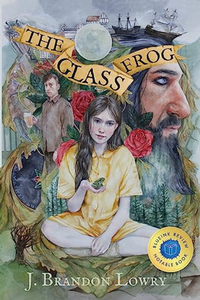
The Glass Frog by J. Brandon Lowry: A Fairy-Tale-esque Fantasy for All Ages

Cover for The Glass Frog by J Brandon LowryThe Glass Frog

by J. Brandon Lowry

DETAILS:
Publisher: Trailerback Books
Publication Date: June 20, 2023
Format: Paperback
Length: 376 pg.
Read Date: July 27-30, 2024
Buy from Bookshop.org Support Indie Bookstores

Every Who is shaped by a Where.

In this case, the Where is a tiny coastal village named Seaside. from the beach there is a constant, breathy shhh-ahhh sound as the waves flow first in, then out, each exhalation coating the simple, whitewashed buildings with a fine, salty mist. Through the village center runs the Queen’s Road, a winding ribbon that traces the curving shoreline of the island nation to which Seaside belongs. Grassy, rolling hills surround the village to the north, so that when viewed from above, it appears as a single pearl on a string nestled on a bed of seagrass.

Seaside was given its unimaginative name by its unimaginative people. In fact, hostility toward creativity and change is a central feature of the Seasider mentality, a proud tradition handed down from generation to generation. They value simplicity, practicality, and—above all—uniformity. For this reason, it has been decreed that every building in the village must adhere to the same basic plan: squarish shape, white walls, dark roof. This arrangement makes it obvious which villagers are lax in their home maintenance, and are therefore not to be trusted. The same principle applies to matters of appearance, behavior, and topics of conversation. Unsurprisingly, the most popular topic of conversation is the failure of others to conform….

With the matter of Where set aside, it is time to meet our Who—Sophie Farrier, a kind-hearted and imaginative young girl who fits into Seaside about as well as a whale fits into a rowboat, and has been just as uncomfortably shaped.

What’s The Glass Frog About?

Thankfully for her, Sophie will not spend the entire novel in Seaside. But she has indeed been shaped by that village, and try as she might, she will act in the way she was shaped (both in ways she recognizes and ways she doesn’t). She’s also been shaped by books she’s read—a scandalous notion to many people in Seaside—and a devoted older brother, Damon, who has stepped up in so many ways that her deceased parents cannot and that her guardian aunt will not. Without her books and her brother, Seaside would’ve turned Sophie into a successfully conformed young woman.

Things change in Seaside one day when some kelp harvesters find an unconscious stranger who had the absolute temerity to wash up on shore. It’s rude, unheard of, and not at all fitting with the unimaginative ethos they prefer. There’s some debate amongst the villagers—with a majority wanting to send this stranger back to the sea he came from—but a couple of stalwarts (including Damon) refuse and arrange for him to be cared for by the local doctor. Sophie helps the doctor in her own way—and the doctor beings to think she might have a future in medicine.

When the stranger finally awakes, he wastes little time before he sets out to leave Seaside and resume his interrupted quest. Something about him, about what he says to her—and some drama at home—drives Sophie to follow him. Or try to, anyway. He has a pretty solid headstart and can move much more quickly than she can. Also…Sophie’s never left Seaside, so she really doesn’t know what to expect or how to interact with people who aren’t from there.

Meanwhile, a powerful group arrives at Seaside, demanding that the stranger be returned to them or the city will be destroyed. Everyone in the Village who was ready to throw him back into the sea are more than ready to give him up. If they only knew where he was.

So, what did I think about The Glass Frog?

I’m not certain who Lowry’s audience is, like the BlueInk Review cited on the back cover says, it can work for “discerning reader[s], from middle grade to adult.” I can think of readers I know/have known up and down that range who would appreciate the book, and I can’t think of any reasons to try to wave off a middle grader (which is refreshing).

It’s hard not to like Sophie—and I don’t understand why anyone would resist it—her brother is a little tougher to like, but that’s not necessarily his fault. Most people that she encounters after she leaves Seaside are pretty likable, too (with some notable, and easy-to-identify exceptions). The people of Seaside are an interesting mix—most (maybe all of them, I didn’t take a census) are good fictional characters and the reader will appreciate them as such. As people? Eh, it’s a mixed bag. But it’s a more complicated question than you’d expect from the early descriptions of the village.

I don’t believe Lowry’s prose was particularly purple at the beginning of the book, but it was headed to that end of the visible light spectrum. My notes said something like, “you’d better not use every adjective in your account too early or you won’t have any leftover for the last chapters.” I do think he got it under control pretty quickly—or I became inured to it, I’d believe either, but I think it’s the former.

There was some pretty solid comedy in this book (particularly involving the citizenry of Seaside), but it’s not a humorous fantasy in the mode of Terry Pratchett or Sean Gibson. I’d categorize it as a light, whimsical fantasy with some really funny moments. But there are some serious moments, too. A lot of heartbreak and loneliness—some self-destructive behaviors on display, too. Maybe a dash or two of romance. Plus some villainy, cowardice, avarice, xenophobia, and manipulation to balance out the acts of heroism (intentional or inadvertent). A little bit of everything, really.

I don’t know that I want a sequel to this—but I would like other books set in this work (with Sophie and those close to her showing up in the background). There’s just so much to explore, and Lowry has created a bunch of fun places and ideas to play with. Some of the minor characters from this book would be great to see again as protagonists—or at least, playing a larger role than they got to here.

But most of all, I’m curious about what the next novel (in this world or another) from Lowry will look like, I bet it’ll be worth the time—just like The Glass Frog was. You should check it out.


3.5 Stars

This post contains an affiliate link. If you purchase from it, I will get a small commission at no additional cost to you. As always, the opinions expressed are my own.


20 Books of SummerLiterary Locals logo

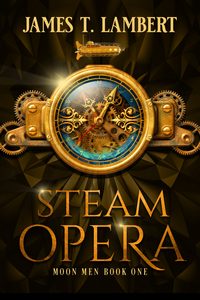
Steam Opera by James T. Lambert: Choosing It Not Because It Was Easy…

Cover to Steam Opera by James T LambertSteam Opera

by James T. Lambert

DETAILS:
Series: Moon Men, Book One
Publisher: Bert Books
Publication Date: November 18, 2022
Format: Paperback
Length: 416 pg.
Read Date: July 8-12, 2024

What’s Steam Opera About?

I’m both tired and apt to meander too much when trying to answer this question, so I’m just going to lift the answer from Lambert’s website:

London, England, 1894

Patrick Smythe lives a comfortable life in London coming up with new inventions. His close friend Thomas Melton finances many of these ventures and together they advance technology. Geoffrey Trenton takes the occasional investigative work after retiring from Scotland Yard.

Airships fill the sky

The world is on the move with dirigibles and Zeppelins hauling freight and passengers. On land and sea people travel at will in an era of plenty.

Unbridled invention fills the laboratories

New discoveries fill the news as scientists probe past the boundaries of human knowledge. Every field advances as knowledge of the natural world drives new innovation.

Telescopes scan the heavens

The Royal Observatory at Greenwich has a new telescope and the astronomers are using it to view the universe. Even when they’ve been told to take the night off. A strange discovery and a brutal murder draws Trenton out of retirement to investigate.

And we want to go to the moon!

Patrick develops his most ambitious project: a trip to the moon and back! With Thomas’s help securing financing and Trenton running security, what could possibly go wrong? But a mysterious organization wants to prevent this and will go to any length to stop them!

My Big Complaint

The next section will touch on a maybe larger concern. Or maybe it’s a quirk. I’m not sure. But I had an easier time getting over it than this part. There’s a quick arc that introduces us to the future security chief for this endeavor—it starts out pretty interesting, maybe more interesting than the “go to the moon” story at that point. And just as that story gets your hooks into you…it’s dropped. I do think that I can see where and how Lambert is going to pick it up again in the future. But the way he abandoned the story in this novel was abrupt and off-putting.

Lambert is capable of better.

Um…Where’s all the Steam?

You call something Steam Opera, you set it in the latter 1800s in London, you make it about inventors and engineers (among others), you give it that color scheme and cover design—you sorta indicate to your reader that this is going to be a Steampunk novel.

But we really don’t get one—we get a lot of Zepplins and dirigibles, science that’s more advanced than it should be, and the rest of it is pretty era-appropriate. No gadgets, no science that’s hard to pull off on this side of the Industrial or Digital Revolutions. Sure, there are plenty of people wearing goggles—but that’s about it. This is the least Steam-punky Steampunk I think I’ve read.

And I know Lambert can pull off Steampunk gadgets—Aether Powered demonstrated that clearly. So why not here?

Really, why not?

So, what did I think about Steam Opera?

Okay—all I’ve really said after the description sounds negative, and I don’t want to sound that way. Because once you get past the above quibbles (which is really pretty easy), this is a perfectly entertaining read.

This is easily the most ambitious of Lambert’s first three novels, and his writing has improved over what his first books delivered (and I liked those I want to stress). His characters, prose, eye for detail, and imagination are better represented here (as is a capability to carry a story for another 100 pages or so than he has in the past). If he keeps improving like this, he should get the fanbase he deserves.

Lambert does a good job with the pacing—sometimes it seems he speeds up more than is advisable, and occasionally he swings the other way—but overall, he keeps things moving well enough to keep you engaged while dipping into some pretty technical areas (even if the technology is made up). It’d have been very easy for him to get so into the technical descriptions that he’d kill any momentum and turn this thing into a slog. All things considered, he made the right choices on that front.

And the technical bits themselves? I think Lambert really succeded there—both the way he adapted Zepplin-esque technology to mimic the work that the Atlas and other rockets did in our timeline and in the way he described their flight while still in Earth’s atmosphere—I bought it all. It seemed plausible enough for this world (moreso than, say, the music devices that The Ministry of Peculiar Occurrences enjoyed, for example)—particularly the in-flight moments.

I wouldn’t have minded some more named characters—and some female characters would’ve been good to see*. This is very much a book about Moon Men. However, the characters we did get were engaging and interesting (even the antagonists). The more time we spent with all of them, the more I wanted to spend time with them—which is always a good sign.

* The lack of female characters probably deserves its own section, I now realize—but what more is there to say? Yes, the Victorian-era was dominated by men in engineering and business, so it helps things ocme across as more realistic to not have women around. But if we’re going for that level of realism…maybe keep everyone on Earth?

What we learn in the closing pages and what leads up to them is came out of nowhere—or so it seems, but really didn’t. What’s better is it sets up the next book and satisfies your curiosity about “Why is this a Book One?” Sure, it creates a whole bunch of new curiosity about Book Two (and maybe beyond, I’m not sure how long Lambert is thinking), but that’s the point. As long as you give me some answers, you can add all the questions you want.

In short, I had plenty of fun with this book and this world, and am eager to return to it. As good as Lambert’s next release, Relics of War, looks—I can’t help but be irked that it’s not Moon Men Book Two. I really want to know where he’s going with this. But that’s a problem for future-H.C. Present-H.C. is happy to recommend this to you and strongly suggests you become familiar with the very pleasant experience that is reading a James T. Lambert novel.


3 Stars

20 Books of SummerLiterary Locals logo

20 Books of Summer 2024: July Check-In

20 Books of Summer
Here’s a quick check-in for this challenge run by Cathy at 746 Books.

I am making a substitution, I had to DNF one of the books. With prejudice. That’s really all I want to say about it. (but that’s why one books is out of order on the graphic and list below).

Math is not my friend right now…I’m 50% done with the reading for this challenge with 33% of the time left. And I’ve written about 15% of the books.The book I’m substituting is one I need to be posting about on August 15, so that will help the latter stat at least.

Things aren’t looking good at this point. But I’m going to go down swinging (or reading…probably reading)

Let’s take a quick look at my progress in June:

✔ 1. This is Who We Are Now by James Bailey
2. Blood Reunion by JCM Berne
3. Ways And Truths And Lives by Matt Edwards
✔ 4. The Running Grave by Robert Galbraith
✔ 5. Grammar Sex and Other Stuff: A Collection of (mostly humorous) Essays by Robert Germaux (my post about it)
✔ 6. The Camelot Shadow by Sean Gibson
✔ 7. Last King of California by Jordan Harper
✔ 8. Steam Opera by James T. Lambert
✔ 9. The Glass Frog by J. Brandon Lowry
10. The Legendary Mo Seto by A. Y. Chan
11. Curse of the Fallen by H.C. Newell
12. Heart of Fire by Raina Nightengale
✔ 13. Detours and Do-overs by Wesley Parker (my post about it)
14. Bizarre Frontier Omnibus #1 by Brock Poulson
✔ 15. Howl by e rathke (my post about it)
16. Bard Tidings by Paul J. Regnier
17. Panacea by Alex Robins
✔ 18. Cursed Cocktails by S.L. Rowland
19. Big Trouble in Little Italy by Nicole Sharp
20. The Nameless Restaurant by Tao Wong

(subject to change, as is allowed, but I’m going to resist the impulse to tweak as much as I can).

20 Books of Summer '24 July Check In Chart

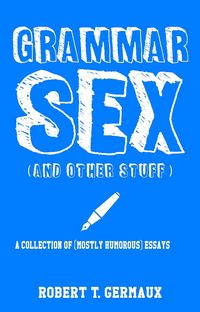
Grammar Sex and Other Stuff: A Collection of (mostly humorous) Essays by Robert Germaux: A Collection That (mostly) Amused Me

Cover of Grammar Sex and Other Stuff by Robert GermauxGrammar Sex and Other Stuff:
A Collection of (mostly humorous) Essays

by Robert Germaux

DETAILS:
Series: Grammar Sex Collection, #1
Publication Date: February 19, 2017
Format: eBook
Length: 82 pg.
Read Date: June 22-25, 2024

Research shows, and here I’m talking my made- up research, but I’m sure actual research would back me up on this . . . anyway, research, real or otherwise, indicates that once you’ve grabbed your readers’ attention (by, for example, throwing the word sex into your title), the best way to keep them turning those pages is to present them with prose so superbly written, so free of errors in spelling and punctuation and syntax, that they simply lose themselves in your wonderful narrative.

What’s Grammar Sex and Other Stuff About?

Well, that’s in the subtitle—it’s A Collection of (mostly humorous) Essays. The word “brief” is the only thing missing from the title—there are 32 of them and the book is 82 pages long, so none of them are all that long.

The title itself comes from the sixth essay, “Grammar Sex (How Dangling Your Participle Can Hurt Your Book Sales),” a fun list of tips for authors—aspiring or otherwise—when it comes to learning how to use language. That’s not all he has to say about grammar, either, a little later we’re treated to a series called “The Grammar Snobs Trilogy”—a combination of useful tips and some silliness (neither of which interfere with the other).

We also get essays about the brief experience he and his wife had as being an Arbitron family, Jury Duty, baseball (and the money behind it), a dog he bought in college, some semi-random observations, and more.

If You’d Like a Sample

Germaux has provided a few guest posts here over the years, in case you’d like to take a quick look at his work. One of those happens to be an essay from this book, so you can get an actual sample of this book—”Literally? Really?” popped up on this site back in 2016(!). It’s a good way to catch a little flavor of this collection—and just a decent read in general. You might as well read the others, while you’re at it (if you haven’t already—and/or could use a refresher)

So, what did I think about Grammar Sex and Other Stuff?

The non-humorous essays weren’t my favorite—they were a little too generic, a little too…something. They were heartfelt for sure, and I don’t want to take away from that. But they didn’t do much for me, it seemed like Germaux was restraining himself in one way or another so he could make a point, and I don’t think the price was worth the result.

The rest were well worth the (short) time it took to read—and probably worth more than the time. I’m not going to promise you that you’re going to laugh out loud on every page—or even in every humorous essay. But you’ll find enough amusing to keep going.

A couple of months ago, I described the humor of a Patrick McManus book as “gentle.” That’s a good word to describe this humor, too. However, there’s a little oomph to Germaux’s humor that McManus doesn’t really have—I attribute that to the clear influence of Dave Barry on Germaux. He doesn’t rip off Barry’s style or anything (and I should know, I used to do that a lot), but even beyond mentioning Barry a time or three, you can tell that Germaux has read his share of the Floridian humorist.

I had a good time with this collection, and am more than ready to try the next in the series (and not just because I accidentally purchased it when I tried to get this one). I do recommend this for some pleasant and mostly humorous reading time.


3 Stars

Self-Published Authors Appreciation Week Footer

The 2024 Self-Published Authors Appreciation Week Logo was made by Witty and Sarcastic Book Club

Page 2 of 5

Powered by WordPress & Theme by Anders Norén