Tag: 4 Stars Page 23 of 88

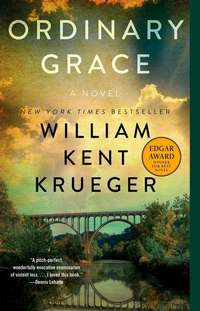
Ordinary Grace by William Kent Krueger: A Summer In the Valley of the Shadow of Death

Ordinary GraceOrdinary Grace

by William Kent Krueger

DETAILS:
Publisher: Atria Books
Publication Date: March 26, 2013
Format: Hardcover
Length: 307 pg.
Read Date: April 19-20, 2022
Support Independent Bookstores - Visit IndieBound.org

All the dying that summer began with the death of a child, a boy with golden hair and thick glasses, killed on the railroad tracks outside New Bremen, Minnesota, sliced into pieces by a thousand tons of steel speeding across the prairie toward South Dakota. His name was Bobby Cole. He was a sweet-looking kid and by that I mean he had eyes that seemed full of dreaming and he wore a half smile as if he was just about to understand something you’d spent an hour trying to explain. I should have known him better, been a better friend. He lived not far from my house and we were the same age. But he was two years behind me in school and might have been held back even more except for the kindness of certain teachers. He was a small kid, a simple child, no match at all for the diesel-fed drive of a Union Pacific locomotive.

What’s Ordinary Grace About?

It’s the summer of 1961, and thirteen-year-old Frank and his younger brother, Jake, are going to be irrevocably changed over the next few months. Their small Minnesotan town of New Bremen, will be rocked by five deaths and some near-deaths, as well.

Frank and James live there with their older sister, Ariel—eighteen and about to leave their parents’ home. Nathan and Ruth married before Nathan went to serve in WWII—when he came home, he became a Methodist minister instead of the lawyer he’d planned on being before the war changed him. Ruth hasn’t entirely forgiven him for that but does her best to take part in congregational life, and to make do with his small salary.

Ariel is their golden child, Julliard-bound. Jake stutters, and is clearly fearful of almost everything—and everyone—around him, drawing what little confidence he has from his proximity to Frank. Frank is the family rebel—by most standards, he’s only slightly mischievous, but compared to the rest of the Drum family, he’s the equivalent of Bart Simpson.

The first death (see the quotation of the novel’s first paragraph, above) is that of someone that Frank and Jake knew–even played with. The boys discover the second body, a stranger to them. Those two are enough to alter the course of their development to a degree—but the next three (and the accompanying events) are what will leave an indelible mark on the entire family.

God’s Awful Grace

Krueger likes to use the phrase “the awful grace of God,” and makes other references to it, he wants that idea in your head as you read about the horrible things and deaths the reader and the characters encounter. You’re supposed to think about the (apparent) contrast between “awful” and “grace”, as well as catch the references to Aeschylus and Robert F. Kennedy (and, by extension, Martin Luther King’s death).

As far as the Aeschylus/RFK allusions go—yes, think about those. I think there’s a lot to chew on there. Sure Kennedy has yet to cite that poem, but the narrator has heard it–he’s writing from the perspective of four decades later.

But the former suggestion? I’m sure that Krueger, and many/most of his readers, know the phrase isn’t to evoke something extremely bad or shocking/saddening, but the archaic definition of awe-inspiring or enormous. But the reflex for contemporary readers isn’t to go with the lesser-known/used understanding but to think of the surface and the tension between the ideas, and it bothers me that we’re supposed to spend time on that understanding, even if it’s only a little bit. I’m not sure why it does, but it does.

But while I’m here on the subject of God’s grace, can I just say that the one sermon that we get all of from Nathan Drum, during the darkest part of this book, is one of the best I’ve read in a long time. Drum doesn’t understand grace the same way that RFK or Aeschylus does—grace to him is the unmerited sort, the kind that will come to someone in loss, in misery, in despair, and will cause them to believe, hope, and love. The book was worth the effort for this sermon alone, the rest is just gravy.

Krueger’s Prose

On the one hand, the prose is gorgeous—Krueger’s one of those authors that feels like he’s writing, perpetrating hooptedoodle. He breaks most of Leonard’s rules for writing all over the place, notably, “If it sounds like writing, I rewrite it.” But, as Leonard notes himself, there are authors who can skip them–Krueger’s one of those authors.

Still, there are a couple of things that got under my skin and would frequently take me out of the moment. For one, Krueger is sparing in his use of commas—a couple of times, I’d read a sentence out loud the way it’s in the book, and then with the missing commas; and I think I could get close to understanding why he made the choice. I didn’t agree, but I could maybe see what he’s going for.

But the thing that really bothered me was the dialogue. It really reads like someone wrote it, everyone (or almost everyone) is almost constantly sounding like they’re making a profound point about whatever. Particularly when it comes to Frank and his brother—I don’t need prepubescent boys uttering sentences with layers of meaning and dripping with wisdom nearly every time they say something.

That doesn’t mean that some of those sentences aren’t great and readable and even quotable. It just means it bothered me.

So, what did I think about Ordinary Grace?

“… He’s a vet. Korea. Had a tough time over there. It’s eating at him, I believe. He drinks. He’s hard on his family…”

“Sometimes, Nathan, I think it wasn’t as what we took into the war. Whatever cracks were already there the war forced apart, and what we might otherwise have kept inside came spilling out.”

Once I’d gotten on board with the hooptedoodle, I was able to appreciate what Krueger was about. This really brought Tiffany McDaniel’s The Summer That Melted Everything to mind (and Betty to a lesser extent). I also was reminded of Songs In Ordinary Time by Mary McGarry Morris, A Prayer for Owen Meany by John Irving, and early Richard Russo, as I read this. None of which would ever be considered for the Edgar, Anthony, Macavity, or Barry Awards like Ordinary Grace won. I know those awards mean I should think of this as a Mystery or Crime novel, but I just don’t. It fits with the others better, I think (but I do see why it won those).

It’s a book that will get its hooks into you, if you let it, just not the way that most Mystery novels do. It will make you think, it will make you feel, and it may cause you to think deeper (or more shallow, I suppose) thoughts about God and His grace. But mostly, it’ll make you think about humanity and many of the ways we can harm each other, intentionally or not.

I won’t say that I enjoyed 98% of this book—but the entire time I spent reading it I was fully aware that I was reading something of quality–something that deserved my attention, and I was glad to give it. I also had no trouble seeing why my friend recommended it to me–and I owe her a solid recommendation in return.


4 Stars

This post contains an affiliate link. If you purchase from it, I will get a small commission at no additional cost to you. As always, opinions are my own.

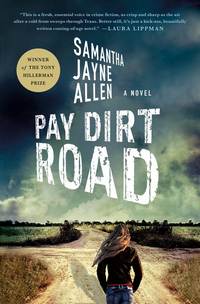
PUB DAY REPOST: Pay Dirt Road by Samantha Jayne Allen: A Tale of Oil, Murder, and Land

Pay Dirt RoadPay Dirt Road

by Samantha Jayne Allen

DETAILS:
Series: Annie McIntyre Mysteries, Volume 1
Publisher: Minotaur Books
Publication Date: April 19, 2022
Format: eARC
Length: 304 pg.
Read Date: March 21, 2022
Support Independent Bookstores - Visit IndieBound.org

What’s Pay Dirt Road About?

Annie just graduated from college and moves back to her hometown to decide her next move. That’s the generous way to look at it, anyway, we’ll get back to that in a bit. She’s waiting tables at a local diner—well, the local diner in Garnett, TX. It’s hard to say exactly how large Garnett is, but it’s not big. But given the nearby oil fields, there’s a lot of money as well as a lot of poverty in this smaller town.

Annie and her roommate/cousin spend a lot of their evenings drinking, frequently with others they graduated from high school with. One night they go to a bonfire at the home of one of Annie’s former classmates and unexpectedly run into a co-worker, Victoria. Victoria has overserved herself at this point and doesn’t show signs of slowing down. When Annie decides to leave, she tries to find Victoria but is told that she’s gone off with someone.

That’s the last anyone sees Victoria—the last anyone will admit to, anyway. Her body is found a few days later. Driven by guilt for abandoning her, Annie takes advantage of an offer from her grandfather—former sheriff, now a PI—to work for him and look into the case.

Annie

Annie is what many would call a deeply flawed character, but others would just say human. She’s trapped by her own insecurities as well as ego. She knows she could likely do well in law school—but it would be hard and risky. She could probably talk herself into the challenge, but failing means losing hope she could get away from Garnett, and I don’t think she’s willing to do that.

Like so many people in similar circumstances, not knowing what to do, she drinks, so she doesn’t have to think about it for a while. And drinks a lot. This wouldn’t be a big deal for me as a reader, but Annie spends a lot of time judging her grandfather for his drinking—especially when they’re supposed to be working. She doesn’t say anything to him, she just keeps it inside and lets herself indulge. It’s things like this that make her a wonderful, complex character.

The Sense of Place

I’m vague on a lot about the town of Garnett (size, demographics, etc.), but I also have some concrete visions of certain parts of it. It reminds me a lot of the TV version of Dillon, Texas—which seemed to change size, economic status, and makeup from week to week, depending on what the story called for.

As I type that, I realize that my ideas about Garnett are basically half-Samantha Jayne Allen/half-Friday Night Lights. Annie would basically fit in with the Tyra Colletes and Tim Riggins of the world, not the Jason Streets and Lyla Garritys (although we get glimpses of that part of Garnett, too). I just thought of three paragraphs I could do paralleling the worlds of these two fictional towns, so I’d better move on before this becomes a very different kind of post.

What I kept getting was a feel for the town more than anything—it’s the kind of place where the best and brightest leave after high school, and the big question is: will they come back? You get the impression that if they do, it’s not because they chose to—they either have no choice, or it’s just as a way station–like Annie intends. Some of those in the latter category end up sticking around, usually not by choice. This bleakness covers the whole of the novel—in the successes as well as the failures (and the in-between moments).

At the same time, it seems that few of these people are there by choice. It is their home. Up until two weeks before her death, Victoria had been tied to Garnett, but she had plans. Annie intends on leaving. But when it comes to the land of Garnett? Their families’ acres? There’s a reflexive, instinctive, and deep sense of possession and binding. Everyone knows that Annie’s going to leave town at some point—but when there’s a suggestion that someone is going to buy the land she’s set to eventually inherit? That sets an emotional fire in her that I think surprised even her. You see something similar with Victoria, too. People like them may not like Garnett, may not want to live there but it’s home. It’s their home, and will be.

So, what did I think about Pay Dirt Road?

I don’t know that I can say that I particularly enjoyed this book—by design, it’s not a good time. But it’s a great experience. Allen’s sense of character and sense of place ensures that the reader feels what’s going on. Particularly, but not limited to, Annie’s experiences.

Like with any good mystery—and look at character—Pay Dirt Road is as much about the investigation as it is the history of the characters—for Annie, this goes back to High School, for her family, the history we see goes back far before that. The past illumines the present, and helps the reader—and eventually, Annie and others—to see what’s going on in the present.

Last year, I finally got around to reading The Far Empty by J. Todd Scott. Garnett doesn’t have the same kind of corruption (at least that we see) going on, but it has the sense of setting, of bleakness, and dedication to place/city/home. Between these two books—not to mention Locke’s Bluebird, Bluebird and Kent’s The Dime—I’m starting to think I should focus more of my Crime reading on the Lone Star State.

This could be the beginning of a series—and if it is, I’ll be at the front of the line for the sequel. This could be a stand-alone, and if so, it leaves the characters in a good place—both in terms of closure and promise for the future. Either way, this is a book that’s going to linger in the back of my mind for a while, and I think that’ll be true for others.

Disclaimer: I received this eARC from St. Martin’s Press via NetGalley in exchange for this post—thanks to both for this.


4 Stars

This post contains an affiliate link. If you purchase from it, I will get a small commission at no additional cost to you. As always, opinions are my own.

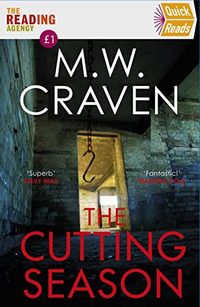
The Cutting Season by M. W. Craven: A Fast, Satisfying Read in this Dynamite Series

The Cutting SeasonThe Cutting Season

by M.W. Craven

DETAILS:
Series: Washington Poe, #3.5
Publisher: Constable
Publication Date: April 14, 2022
Format: Kindle Edition
Length: 105 pages
Read Date: April 15-16, 2022

What’s The Cutting Season About?

In lieu of writing a synopsis, how about the first four paragraphs?

It started with an old lady.

An old lady who had stepped in front of a train.

There were gangsters and bent cops and a contract killer called the Pale Man, but they were not as important as the old lady. And neither was the dead good man who turned out to be a dead bad man.

In the years that followed, some people would forget about the old lady. They would forget that, if it was not for her, none of this would have happened. Nobody would have been murdered. Nobody would have dangled from a meat hook in a cold warehouse. Nobody would have called in the Pale Man.

There you go—there’s murder, there’s drama in a warehouse, there’s a man known by a title, and a dead woman. There’s your hook. Add in a detective from the National Crime agency—Washington Poe, who’s called in to help with the murder investigation (although he usually investigates serial killers)—and his friend/colleague who is a wizard with tech—Tilly Bradshaw—and you’ve got yourself the makings of a great thriller.

Quick Reads

The Cutting Season was one of eight novellas published this year as part of The Reading Agency’s Quick Reads program.

Quick Reads provide a route into reading that prioritises great story telling and adult-focused content while ensuring the books are written in an accessible and easy to read style. The books are written by some of the most popular authors in the UK – including Andy McNab, Jojo Moyes, Anne Cleeves, Ian Rankin and Benjamin Zephaniah – so they can be a brilliant entry point to new genres, authors as well as the spark to reignite or build up the joy of reading.

The Quick Reads programme has collaborated with over 30 publishers to produce a total of 135 titles since 2006 (many still available to borrow from your public library or buy from The Reading Agency’s bookshop) with over 5 million copies distributed and over 6 million library loans.

That just sounds fantastic, doesn’t it?

So, what did I think about The Cutting Season?

This is a novella—short, sweet, to the point. Well, not that sweet—there’s a lot of dead people and threats to health and well-being. So it’s short and to the point. Think of it as a Washington Poe/Tilly Bradshaw novel in espresso form.

It’s got everything you want—a disturbing killing, Poe’s antics, Tilly saving the day—and as a nice bonus, there’s a chapter at the beginning where Poe is enjoying himself at the office with co-workers, so we get to see there’s more to him than just the single-visioned man we see when he’s on the case (a great way to introduce Poe and Tilly to new readers).

Given the streamlined way this story had to be told to fit, there weren’t any twists or nuance—for a 105-page novella, I’m fine with that. I think this’d work well to introduce Poe and Tilly to a reader who hasn’t done much in the genre before—and I could definitely see this convincing someone who really doesn’t read novels to give one in the series a shot.

As is to be expected from a M.W. Craven work, I strongly recommend this. I had a blast reading it, you will, too.


4 Stars

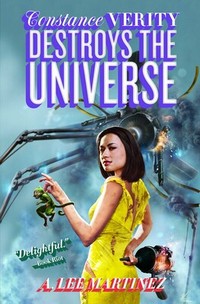
Constance Verity Destroys the Universe by A. Lee Martinez: Saying Good-Bye to this Hero

Constance Verity Destroys the UniverseConstance Verity Destroys the Universe

by A. Lee Martinez

DETAILS:
Series: Constance Verity, #3
Publisher: Gallery / Saga Press
Publication Date: March 7, 2022
Format: Hardcover
Length: 290 pg    
Read Date: April 6-8, 2022
Support Independent Bookstores - Visit IndieBound.org

She pushed a chair into a corner of the room not visible from the street and sat. There was a feel to her life. Danger didn’t usually feel this dangerous. Danger was just background noise. But this was a lot of people trying to kill her. More than normal.

What’s Constance Verity Destroys the Universe About?

This book starts off with Constance Verity doing something almost unbelievable for her—normal things. She attends a dinner party to celebrate her best friend’s/sidekick’s upcoming wedding, she spends a day hanging out with her fiancé at a park and museum—sure, there’s a duel with an alien in there, as well as dealing with an international crisis, etc. But for Connie, that’s pretty sedate.

Then things stop happening—no death rays, mad scientists, pan-dimensional threats—not even a kitten stuck in a tree. It’s unnerving to all who know her well. On the plus side, Tia and Hiro’s wedding should go off without an interruption, right? And it does—the reception, however…

When things start happening again, there’s a distressing trend—people from all over the universe and time show up because they’ve been told that Constance Verity is going to destroy the universe, and they’re going to stop her. The assassins are plentiful enough that Connie’s getting nervous—so she does what she can to keep her loved ones safe and then sets out to see why people are saying she’s going to destroy the universe. All she’s ever done is save it, why would she change?

A Plethora of Ideas

Connie had a problem with Nebraska. And that problem was that it was too close to Kansas.

Kansas, where dark gods waited to rise from their forgotten tombs and bring about the extinction of mankind.

Kansas, where all time travel led to a black void where a pale, wizened figure would greet you, playing a banjo and singing endless choruses of “Achy Breaky Heart.”

Kansas, where Connie had come the closest to death on more than one occasion.

Kansas, her kryptonite.

In a sentence or two—or five brief paragraphs in the above quotation—Martinez is able to tell a whole story—or at least hint at one. Most of these little stories could be fodder for a novella or a novel, but in this trilogy, they’re given anywhere from a sentence fragment to a page. And then he moves on to something else so the plot can be advanced.

Every A. Lee Martinez novel has a surfeit of ideas that come flying at you, that’s nothing new. But I think in these Constance Verity novels that he’s outdone himself. Martinez treats these all as throw-away remarks, with no real investment of time on the reader’s part. But it has to be the kind of thing that would drive your average novelist to exhaustion just trying to come up with them all.

You get just a taste of a fantastic adventure or death-defying feat that Connie’s pulled off (frequently with Tia at her side) in these. You add enough of these together and you really start to see all the things that Constance has done and you understand how much is riding on her successes and how she’s become a legendary figure throughout the universe.

Sorry, Desiderius Erasmus Roterodamus*

It probably says something about the way my brain works that my favorite writing on Free Will vs. Determinism comes from Science Fiction—particularly those prone to a comedic tone. Okay, it says a lot about me, but that’s for another time.

Constance Verity Destroys the Universe plays with those ideas a lot—even knowing (after being told repeatedly from reliable sources) that she’s going to destroy the Universe, Connie refuses to believe it and flat out says she won’t. This idea is treated with derision by some (rightly) and supported and echoed by others (also, rightly). The mostly retired demigoddess of destiny that has moved into Connie’s apartment building cannot muster up the desire to weigh in on this, and of anyone, you’d think she’d have a lot to say about it.

I’m not saying that I think Martinez has penned a well-developed treatise on the idea in the middle of this SF/Fantasy Action novel—I’m just saying he has a lot of fun playing with the idea and that anyone who enjoys that sort of thing will find the Free Will vs. Determinism discussion a tasty side dish to accompany the SF/Fantasy entree.

* Okay, not really sorry.

So, what did I think about Constance Verity Destroys the Universe?

“I don’t have a lot of other leads, and if there’s one thing I know, it’s that when in doubt, point myself toward the nearest adventure and let it work itself out.”

I hate that this volume is the end of the road for this trilogy—but I’m not sure what else he could accomplish in this world. When the series started, Connie was an adventurer/savior-of-the-universe wanting a normal life and being unable to; and we wrap up things up with her finding her own brand of normal, which she’ll be able to enjoy if she survives the assassination attempts and doesn’t destroy the universe. That’s a pretty decent arc.

I think I like the arc that her side-kick/best friend Tia goes on a smidge better, but that might be because Tia’s a bit more relatable to those of us not burdened with cosmic destiny. Either way, it’s a good run.

The ending of this is perfect on several levels—exactly how a novel (or a series) like this should end.

Could you read this apart from the other two novels? Yeah, I suppose. But I don’t think it’d be a great stand-alone, but you could get away with it. Why you’d want to, I don’t know—the first two books in the series are a blast.

On Twitter and his blog, Martinez will insist that he doesn’t write humor or comedy, that he’s not that satirical. I’m not so sure, but let’s take him at his word. His SF/Fantasy adventures (this one and all his others) are so funny that you can see why people would make that mistake. But when you ignore the humor, you get a very satisfying SF/Fantasy story that takes tropes and themes you’re very familiar with and presents them to you in a way that makes you see them with fresh eyes and frequently makes you re-evaluate the trope/theme to come at it with a new appreciation. If you happen to chuckle along the way, consider that a bonus.

Obviously, I recommend Constance Verity Destroys the Universe to you—and everything else Martinez has penned. Thank me later (if you remember to).


4 Stars

This post contains an affiliate link. If you purchase from it, I will get a small commission at no additional cost to you. As always, opinions are my own.

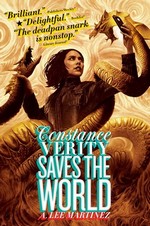
REPOSTING JUST ‘CUZ: Constance Verity Saves the World by A. Lee Martinez: Connie Verity is trying to have it all — a personal life while saving the world on a regular basis

Like I said earlier, I’m not having any success with my post about the third book in this series. So I’m reposting what I said about the previous two books to 1: To Have something to post today, and B. To hopefully use this as a way to get my brain in gear.

Constance Verity Saves the WorldConstance Verity Saves the World

by A. Lee Martinez
Series: Constance Verity, #2

Trade Paperback, 385 pg.
Saga Press , 2018<br/
Read: August 18 – 20, 2018

“It’s a problem I have. When you’re ten years old and dangling from a cliff while rabid hyenas circle below, you learn to be stubborn. You can’t quit, because quitting isn’t an option. You dig your fingernails and pray that root doesn’t come loose. And if it does, you plan how best to fend off hyenas when all you have is a Pez dispenser and a priceless diamond in your pocket. I fight. It’s what I do. It’s how I survive. When people turn and run, I go forward. It’s kept me alive so far, but it’s skewed how I look at things.

“Somebody tells me I can’t do something, I want to do it more. Want isn’t a strong enough word. I need to do it. Give me that big red button labeled DO NOT PUSH in bright neon letters, and I’ll push it every time.”

Having fought for the ability to have a normal life in The Last Adventure of Constance Verity Connie’s out to try to have one. Which is harder than saving the world a few times a week. She’s still saving the world regularly, as well as having all sorts of adventures. She’s trying to settle down with her boyfriend Byron the accountant, while relying on her best friend/sidekick Tia some more (all the while, Tia is trying to strengthen her relationship with her ninja-thief boyfriend, Hiro). There are evil geniuses, aliens, robots, and vampires living in her condo — all of them behaving themselves, thank you very much.

One of the activities that takes most of Connie’s time right now is trying to help out an old friend cleanup the supercriminal organization that he’s in charge of now that his mother has apparently died. There’s a lot of rogue agents, assassins and experiments that need cleaning up if the organization is going to be come a legitimate force for good — or at least not a force for evil and chaos in the world. Connie’s tempted to spend more time doing that than she should, to the detriment of her relationship with Byron. Thankfully, Tia’s there to help keep her priorities in order. Hopefully, that’ll be enough.

You ever find yourself eating something — say, some cake — and you’re not sure if it’s too rich, if the frosting is too sweet? And then you realize how stupid you sound? Wondering if the cake is too good? Well, that’s the experience I had with this (and, I’m pretty sure with the previous Constance Verity book) — where there too many quips? Too many (seemingly) random ideas, aliens, evil masterminds, robots, henchmen of a variety of stripes, strange occurrences? What a stupid thing to ask. Yeah, there’s a lot going on, but it actually doesn’t get to the overload status. It may come close, but it stays on the right side. It’s like asking if there are too many animated personages in Who Framed Roger Rabbit?, if there are too many Easter Eggs in whatever your Super-Hero movie of choice is. No, there’s not — there’s a lot of good things that are fun. Shut up and enjoy.

Really, that’s the worst thing I can say about the book — occasionally, there are too many fun things happening. The pacing is great, the characters are rich, lively, and well-developed (including many of those only around for a page or so), you’ll laugh, you’ll be moved, you might even have a thought provoked. It’s just a charming book set in a delightful world.

Do not make the mistake of thinking this is a romp, just a free-wheeling ball of fun, snark and self-referential humor. It’s an A. Lee Martinez book, so yeah, there’s a lot of that — but laying underneath that is a good story, some interesting ideas about relationships, about trust, about fate. A whole lot of other things, too, I’m sure, but let’s stick with those. Too many people will read this, focus on the “fun” stuff and will miss the very thoughtful portions — it’s Martinez’ strength and weakness that it’s so easy to do with his works. There’s nothing wrong with a silly adventure story, and there’s nothing wrong with a book that’s about something. But when you have a novel that’s both — you should pay attention to both.

I knew Martinez could write a series if he wanted to — I had no idea what it was going to look like when he did. I’m glad I got the chance to find out. Constance Verity Saves the World is equal to its predecessor in every way that it doesn’t outdo The Last Adventure of Constance Verity — which is no mean feat. It’s fun, the characters are better defined and have grown some, and there’s never a dull moment. Constance Verity, the caretaker of the universe, the Legendary Snurkab, possibly the only woman with more titles than Daenerys Targaryen, is a character you need to get to know. Her sidekick Tia is, too. I cannot wait to see what the two of them do next.

—–

4 Stars

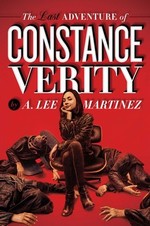
REPOSTING JUST ‘CUZ: The Last Adventure of Constance Verity by A. Lee Martinez

I’ve spent a couple of hours trying to say something about the third book in this trilogy, but haven’t come up with more than “this is good.” So I’m going to repost this (and then what I said about Book 2 later on) while I go back to the drawing board.

The Last Adventure of Constance VerityThe Last Adventure of Constance Verity

by A. Lee Martinez
Series: Constance Verity, #1

Hardcover, 384 pg.
Saga Press, 2016

Read: September 8 -12, 2016

“I didn’t think you believed in jinxes,” said Tia.

Connie didn’t.

But she wasn’t so sure that jinxes didn’t believe in her, and they’d had a long, long time to build a grudge.

I go in to a Martinez book assuming I’ll like it, this one took less time than usual for me to know I liked it. Lines like that are just part of why.

Thanks to a gift from a fairy godmother, since she was 7, Constance Verity has been saving the world as she goes on unbelievable adventure after unbelievable adventure — she travels the galaxy, time, alternate realities and all over (and under) the Earth. She’s run into demons, aliens, wizards, killer robots, mad scientists and many more threats — and overcome them all. A couple of decades later, she’s starting to think that she’s missing out on something despite all the excitement. She’s missing out on being ordinary.

Haven’t you saved the world on multiple occasions?”

“That’s what people tell me, but I’m beginning to think that the world isn’t as fragile as all that. The universe got along just fine for billions of years without me. I don’t think it needs me to save it. I think it all works out about the same in the end. Sometimes, I like to think of myself with a dead-end job that I dislike, a husband who is letting himself go, and some ungrateful kids I take to soccer practice. It sounds dreary, but at least it would be my life.”

Connie doesn’t stop to consider if she’s really cut out for ordinary, but if anyone can rise to the challenge of normality, it’s Constance Verity.

So she and her sidekick best-friend, Tia, head out to get that normal life for her. Step 1: Kill her fairly godmother.

I really don’t know what to say about the book beyond this without getting into more details than I ought. I guess I could say a few things about character. Connie is a great character, for someone who’s lived a superhuman life, she’s really human. Tia is incredible — wise, funny, caring, a real good friend. The relationship between the two is almost perfect.

This is a typical Martinez — a strange combination of loony and thoughtful. You can laugh and then be struck by a profound thought within a couple of pages. This is a fun adventure (a handful, really), and a bit of a commentary on heroes, villains, tropes and themes in SF stories (particularly the pulp-ier variety).

This is the first installment in a series — which is something Martinez hasn’t done before — I have no clue how he’ll pull this off, the book ends like I’d expect a Martinez stand-alone to end, so I have no idea how he’s going to follow this up. But I cannot wait to see.

—–

4 Stars

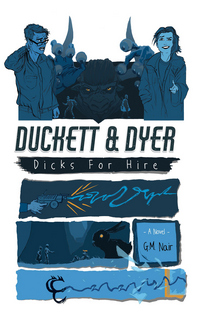
Duckett & Dyer: Dicks For Hire by G.M. Nair: No case too tough. No case too crazy.

After you finish this, take a minute to go register for the Giveaway!

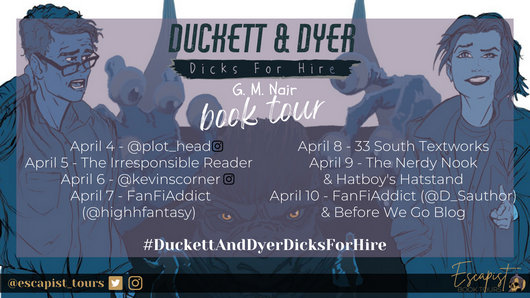
Duckett & Dyer: Dicks For Hire Tour Banner

Duckett & Dyer: Dicks For HireDuckett & Dyer: Dicks For Hire

by G.M. Nair

DETAILS:
Series: Duckett & Dyer: Dicks For Hire, #1
Publisher: dS-dF
Publication Date: June 30, 2019
Format: Kindle Edition
Length: 302 pg.
Read Date: March 30-April 1, 2022
Support Independent Bookstores - Visit IndieBound.org

What’s Duckett & Dyer: Dicks For Hire About?

I have been dreading this day for a little bit now, because I have to answer this question, and I’m not sure I can. At one point, Stephanie Dyer describes their
experiences as:

It’s like Quantum Leap, but if Scott Bakula had a concussion.

I’m tempted to leave it there and move on, but you’re going to want a little more than that.

So, Michael Duckett shares an apartment with his best friend since childhood, Stephanie Dyer. Shares is being generous—he pays the rent, utilities, and food bills. Stephanie tries not to cause trouble for him. Sometimes.

Michael hates his/their apartment, his job, and his life in general. What he doesn’t hate is flirting with a particular woman at the laundromat. There’s really not much more to say about his life—until a woman accosts him on the way home from the laundromat, demanding that he takes her case. He’s confused, and she presents an advertisement for his detective agency.

He has no idea what she’s talking about or where the advertisement came from. Stephanie doesn’t, either. Soon they’re hired to look into a woman’s disappearance by that woman. Somehow, she knew she was about to disappear and wants them to find out what’s about to happen to her/has happened to her by the time they get on the case.

Clear as mud? Yeah, I know.

Meanwhile, a grizzled detective is trying to take down a drug dealer—until he disappears in a way he can’t explain. It’s not long before he crosses paths with Duckett and Dyer and things get stranger for him (by this time, they’re already pretty strange for the detectives, but it gets worse for them, too).

The Multiverse of Madness

(with apologies to a certain franchise)

“That’s it?” Michael scowled. “It looks like you took a stopwatch and glued some extra stuff on it.”

Matteo slammed the box closed and yanked it away. “You make your own dimension hopping device on a grad school budget and see how it looks.”

Without giving too much away, the duo finds themselves bouncing from parallel universe to parallel universe—some have a slightly asynchronous timeline, others have bigger differences—some have differences that are so small, like people’s hair color.

The explanation for both their travel and the research that led to it being possible (and how they’ll stop, I should add) is slightly more coherent than a certain someone’s “wibbly-wobbly timey-wimey” speech. Coherent, but goofy and entertainingly explained. The jumping from universe to universe is a great joke delivery mechanism, Nair was able to let his imagination run wild here—and it was worth it.

The Humor

“You’re kidding me. You’re traveling across dimensions using black holes?”

“Yeah. Plus I made the whole thing light up blue. Took me a whole weekend to figure out how to do that. I think it looks cool,” Matteo was quite pleased with himself.

Speaking of joke delivery mechanisms—Nair has quite a few of them at work here. Some of the humor is quiet and observational, some is the classic situational kind of thing that comes from the Odd Couple-esque pairing of Michael and Stephanie, and then there’s the ridiculous SF/Multiverse stuff—I don’t even know how to describe that.

This story felt like the love child of Dirk Gentley’s Holistic Detective Agency and Comedy Central’s Corporate, but sweeter. The humor is sophisticated and juvenile, subtle and broad, cynical and sentimental. Not only was the story unpredictable, but so was the humor—Nair almost never went where you thought he would go with the jokes.

So, what did I think about Duckett & Dyer: Dicks For Hire?

“I can’t believe there are people who actually want to hire a couple of detectives with no experience.”

“Don’t doubt the power of internet marketing,” Stephanie said.

“Also, the ad said we’ve been in business since 1989.”

“We were born in 1989.”

She shrugged, “So, technically, I guess. It’s true.”

This was just absurd (in the best way). It’s not novel to combine any of the genres involved in the novel, but the way Nair does it makes it feel fresh and original—why didn’t anyone think of this before?

Both Stephanie and Michael are hard to like sometimes—okay, Michael is difficult to like as a person more than sometimes—mostly you take him because Stephanie likes him. Actually, just about every character is realistically human and flawed—very flawed. That’s not something you often get in such a comic novel, it’s nice when you do.

Duckett & Dyer: Dicks For Hire is a great start to this trilogy—it’s an SF romp with just a touch of Detective Fiction. Once things get moving, it’s one of the faster-paced books I’ve read this year, and the jokes keep the story moving well. You’re not going to find a lot of books like this one—you’d better pounce on it (and the sequel) when you can.


4 Stars

This post contains an affiliate link. If you purchase from it, I will get a small commission at no additional cost to you. As always, the opinions expressed are my own.


My thanks to Escapist Book Tours for the invitation to participate in this tour and the materials (including the novel) they provided. The opinions expressed by me are honest and my own.

Escapist Book Tours

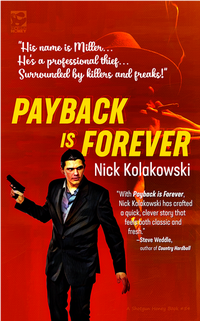
Payback Is Forever by Nick Kolakowski: There’s a lot of opportunity in doom.

Payback Is ForeverPayback Is Forever

by Nick Kolakowski

DETAILS:
Publisher: Shotgun Honey Books
Publication Date: March 24, 2022
Format: Kindle Edition
Length: 170 pg.
Read Date: March 29-30, 2022

What’s Payback Is Forever About?

Miller’s a thief, a fairly successful one. This comes in handy because he’s not as successful when it comes to gambling. He needs to pay a debt, so he takes a job with a couple of strangers. They betray him, the job goes wrong, and Miller (and the cash) escape without his partners. They don’t know his name or home base, so he figures he’s safe for a little bit.

He’s soon contacted by a figure from his past, Rick Redfield:

“I’ve entered into an arrangement with some… men of violence, shall we say. Which means I need the services of the most violent man I know. Which is you.”

“I’m no bodyguard.”

“No. You’re capable of terrible acts, and that’s the necessary thing here. Besides, bodyguards ask too many questions.”

With the promise of a large payday on the horizon, Miller’s in—and soon finds himself involved with some Nazis who escaped from Germany in the waning days of the war, Nazi hunters, and a few more dead bodies than Miller was prepared to deal with.

Supporting Cast

Miller and most of the characters that he deals with are of a fairly typical sort—you’ll recognize the types easily. They’re interestingly-drawn and well-used, but they’re types.

Then there’s Jill Reilly—she’s Miller’s love interest and is a secretary in the Medical Examiner’s office. Given the proper circumstances, she’d probably make a pretty good Examiner herself—but between the education, she’d need, and the rampant chauvinism in the office, that’s probably not going to happen. Reilly feels like she’s got one foot in the Girl Friday type, but with a rebellious streak that keeps the other foot out of the type.

The other character that stands out as not fitting into a typical mold is Scott, Redfield’s friend who acts as a liaison to the outside world when Redfield needs to stay out of the light. He’s a timid, uncertain man—who needs to use a ventriloquist’s dummy, Colonel Longshanks, to communicate those things that are too much for Scott to handle. Miller has no patience for either of them—but can force himself to work with Scott. The Colonel on the other hand…

There was a moment where I wondered if Scott/Colonel Longshanks would over-take Monkey Man as my favorite strange Kolakowski character. He didn’t, but that he was in the running says something about the character development in this short novel.

The Hidden Agenda

If what I’ve described seems pretty straight-forward, it is. If anyone’s read Kolakowski before, that’s not how he rolls. Right?

There is something else afoot here. I don’t know that it added much (if anything), but it didn’t hurt anything either. Maybe if I was in a different mood when I read this I’d have a more positive take on the “something else,” but right now, I can take it or leave it.

The material with Miller, the Nazis, Nazi Hunters is enough to focus on and keep you entertained. If you happen to get the rest of it, that’s gravy.

So, what did I think about Payback Is Forever?

This feels like the kind of pulpy thrillers from the 1960s and 70s I’ve read—just in a post-WWII setting with a dash of Nathanael West thrown in. It’s a surprisingly effective combination, and I’d have read another 200 pages of it without blinking. Although I do think this lean, mean, streamlined approach is far more effective.

Miller’s absolutely the kind of character you want in this setting—his morality is stuck in the gray—it’s a pretty dark gray, but he’s not a full-on villain. And he’s thinking about reforming, at least a little.

There were two scenes—or parts of scenes—that make this more than a quick, fun read. There’s a visual in the last big gunfight that’s so ridiculous, so comical, in the middle of a big action scene that makes you want a film version immediately (but it may be better in your imagination).

Before that there’s another scene that I can’t describe—you start it assuming X might happen, and yet when X does happen you still sit up and pay attention because you can’t believe that Kolakowski actually did that. And then over the next 3 or 4 paragraphs, the shocking scene becomes something so unexpected that you have to read it a couple of times to make sure you read it right. Cackling while you read it every time makes the comprehension a little difficult.

A solid, stylish thriller with Kolakowski’s style and sense of character is exactly what I needed to read last week, and Payback is Forever delivered. Do yourself a favor and pick it up.


4 Stars

Recovering Our Sanity: How the Fear of God Conquers the Fears that Divide Us by Michael Horton

Recovering Our SanityRecovering Our Sanity:
How the Fear of God Conquers
the Fears that Divide Us

by Michael Horton

DETAILS:
Publisher: Zondervan
Publication Date:  February 14, 2022 
Format: Kindle Edition
Length: 320 pg.
Read Date: February 27-March 13, 2022
Support Independent Bookstores - Visit IndieBound.org

Even in more conservative contexts today, the reading of a “fear of God” passage is often quickly followed up with an explanation, dying the death of a thousand qualifications. The upshot is that fear doesn’t really mean “fear.” In such widespread dismissals we are not only failing to give God his due but are depriving ourselves and each other of the only antidote to the crippling fears that haunt us.

…The fear of God leads to trust, and trust bears the fruit of the Spirit, producing a harvest of blessings for ourselves and for others. Fear really is worship— we fear what we believe is ultimate, what we think has the last word over our lives.

What’s Recovering Our Sanity About?

In Part 1, “The Fear to End All Fears,” the goal is to remind readers about the Biblical virtue of the Fear of God—what it means, how it contrasts to other fears, and how when our focus is on the Fear of God, other fears lose significance and power.

In Part 2, “Facing Our Fears with Eyes Raised to God,” Horton puts shoe leather to this understanding of Fear of God vs. other fears. He looks at our fears of death, suffering, disease, the future—and, perhaps most importantly, other human beings.

Confronting Our Fear of Each Other

Once we regain the fear of God— indeed, of Christ as well (he’s not just the friend of sinners but the judge of all)—and face up to who we are before him, coming with empty hands to receive his Son, we’ll begin to lose this fear of the world. We will not be embarrassed when the unkempt widow sings off-key with the gusto of heartfelt conviction or when the building is drab or if we have never had a brush with greatness and our pastor has never been photographed with anybody in the news. The faithful preaching of the Word, baptism, and the Lord’s Supper; the gracious care, encouragement, and warnings of elders and the wider body; the extension of Christ’s love for temporal needs through the deacons; common prayers, singing, confession of our faith and of our sins, Christ’s declaration of forgiveness, and even God’s greeting at the beginning and his benediction at the end— all these will seem so marvelously familiar and new to us at the same time. And then we will begin to not need the world’s affection any longer.

Roughly the last third of the book is taken up by the third part of Part 2, “Confronts Our Fear of Each Other.” In this Horton talks about the fear we have of other Christians and other people outside the Church—there’s a focus on social and political issues and how American Christians ought to react to them instead of how we tend to. Horton avoids a “Left Wing” or “Republican” response—finding positive things on both sides of an issue (many of which shouldn’t find binary responses, but it seems impossible for Americans to do anything else), as well as things to critique on both sides.

Horton goes out of his way not to demonize those who disagree, but reminds his readers that there are those on each side who are fellow image-bearers, and all need Christ more than they need to be corrected or encouraged about their stances on any issue. The Church’s calling is to set aside the focus on the temporal and point others to the eternal and the world to come, while showing our gratitude for Christ’s work by serving those around us.

This sub-section is worth the price of the book (not that the rest was a waste).

So, what did I think about Recovering Our Sanity?

My goal in this book is not to take sides in cultural and political debates. Instead, it is to raise our eyes to heaven so that our sanity can be restored, as Nebuchadnezzar experienced in Daniel 4.

There were more than a few times where I wondered if Horton had lost track of the thesis of the book—I found each chapter, each topic that he covered very valuable and was impressed by the wisdom that Horton offered.

But I was wrong about that—and by the end, it was easier to see where he was going all along. Horton’s been one of those writers that have been helpful to me for a couple of decades now and it’s good to see that hasn’t changed.

There’s a lot to chew on here, and as I said, a lot of wisdom to be gleaned. I can’t imagine every reader is going to agree with everything he has to say (and I can’t believe that Horton expects that, either)—but his major points are sound, Biblical, and needed by the American Church so that we remember what our priorities are supposed to be.


4 Stars

This post contains an affiliate link. If you purchase from it, I will get a small commission at no additional cost to you. As always, opinions are my own.

Pay Dirt Road by Samantha Jayne Allen: A Tale of Oil, Murder, and Land

Pay Dirt RoadPay Dirt Road

by Samantha Jayne Allen

DETAILS:
Series: Annie McIntyre Mysteries, Volume 1
Publisher: Minotaur Books
Publication Date: April 19, 2022
Format: eARC
Length: 304 pg.
Read Date: March 21, 2022
Support Independent Bookstores - Visit IndieBound.org

What’s Pay Dirt Road About?

Annie just graduated from college and moves back to her hometown to decide her next move. That’s the generous way to look at it, anyway, we’ll get back to that in a bit. She’s waiting tables at a local diner—well, the local diner in Garnett, TX. It’s hard to say exactly how large Garnett is, but it’s not big. But given the nearby oil fields, there’s a lot of money as well as a lot of poverty in this smaller town.

Annie and her roommate/cousin spend a lot of their evenings drinking, frequently with others they graduated from high school with. One night they go to a bonfire at the home of one of Annie’s former classmates and unexpectedly run into a co-worker, Victoria. Victoria has overserved herself at this point and doesn’t show signs of slowing down. When Annie decides to leave, she tries to find Victoria but is told that she’s gone off with someone.

That’s the last anyone sees Victoria—the last anyone will admit to, anyway. Her body is found a few days later. Driven by guilt for abandoning her, Annie takes advantage of an offer from her grandfather—former sheriff, now a PI—to work for him and look into the case.

Annie

Annie is what many would call a deeply flawed character, but others would just say human. She’s trapped by her own insecurities as well as ego. She knows she could likely do well in law school—but it would be hard and risky. She could probably talk herself into the challenge, but failing means losing hope she could get away from Garnett, and I don’t think she’s willing to do that.

Like so many people in similar circumstances, not knowing what to do, she drinks, so she doesn’t have to think about it for a while. And drinks a lot. This wouldn’t be a big deal for me as a reader, but Annie spends a lot of time judging her grandfather for his drinking—especially when they’re supposed to be working. She doesn’t say anything to him, she just keeps it inside and lets herself indulge. It’s things like this that make her a wonderful, complex character.

The Sense of Place

I’m vague on a lot about the town of Garnett (size, demographics, etc.), but I also have some concrete visions of certain parts of it. It reminds me a lot of the TV version of Dillon, Texas—which seemed to change size, economic status, and makeup from week to week, depending on what the story called for.

As I type that, I realize that my ideas about Garnett are basically half-Samantha Jayne Allen/half-Friday Night Lights. Annie would basically fit in with the Tyra Colletes and Tim Riggins of the world, not the Jason Streets and Lyla Garritys (although we get glimpses of that part of Garnett, too). I just thought of three paragraphs I could do paralleling the worlds of these two fictional towns, so I’d better move on before this becomes a very different kind of post.

What I kept getting was a feel for the town more than anything—it’s the kind of place where the best and brightest leave after high school, and the big question is: will they come back? You get the impression that if they do, it’s not because they chose to—they either have no choice, or it’s just as a way station–like Annie intends. Some of those in the latter category end up sticking around, usually not by choice. This bleakness covers the whole of the novel—in the successes as well as the failures (and the in-between moments).

At the same time, it seems that few of these people are there by choice. It is their home. Up until two weeks before her death, Victoria had been tied to Garnett, but she had plans. Annie intends on leaving. But when it comes to the land of Garnett? Their families’ acres? There’s a reflexive, instinctive, and deep sense of possession and binding. Everyone knows that Annie’s going to leave town at some point—but when there’s a suggestion that someone is going to buy the land she’s set to eventually inherit? That sets an emotional fire in her that I think surprised even her. You see something similar with Victoria, too. People like them may not like Garnett, may not want to live there but it’s home. It’s their home, and will be.

So, what did I think about Pay Dirt Road?

I don’t know that I can say that I particularly enjoyed this book—by design, it’s not a good time. But it’s a great experience. Allen’s sense of character and sense of place ensures that the reader feels what’s going on. Particularly, but not limited to, Annie’s experiences.

Like with any good mystery—and look at character—Pay Dirt Road is as much about the investigation as it is the history of the characters—for Annie, this goes back to High School, for her family, the history we see goes back far before that. The past illumines the present, and helps the reader—and eventually, Annie and others—to see what’s going on in the present.

Last year, I finally got around to reading The Far Empty by J. Todd Scott. Garnett doesn’t have the same kind of corruption (at least that we see) going on, but it has the sense of setting, of bleakness, and dedication to place/city/home. Between these two books—not to mention Locke’s Bluebird, Bluebird and Kent’s The Dime—I’m starting to think I should focus more of my Crime reading on the Lone Star State.

This could be the beginning of a series—and if it is, I’ll be at the front of the line for the sequel. This could be a stand-alone, and if so, it leaves the characters in a good place—both in terms of closure and promise for the future. Either way, this is a book that’s going to linger in the back of my mind for a while, and I think that’ll be true for others.

Disclaimer: I received this eARC from St. Martin’s Press via NetGalley in exchange for this post—thanks to both for this.


4 Stars

This post contains an affiliate link. If you purchase from it, I will get a small commission at no additional cost to you. As always, opinions are my own.

Page 23 of 88

Powered by WordPress & Theme by Anders Norén