
Tag: 4 Stars Page 28 of 88

Dead Mercy by Noelle Holten: An Apt Title for A Grim Thriller

Dead Mercy

Dead Mercy

by Noelle Holten
Series: DC Maggie Jamieson, #5

eARC, 416 pg.
One More Chapter, 2021

Read: October 4-5, 2021

What’s Dead Mercy About?

The closing chapter of Dead Secret set this up (as Holten is so good about doing): a business has gone up in fire and a body has been found inside—possibly the body of someone Maggie’s worked with in Probation. From the start, this case has its hooks in Maggie.

It’s soon decided that the body was the source of the fire—and before the victim had been set ablaze, he’d been restrained and had teeth pulled. The killer had wanted to punish him, not just kill him.

Soon another victim is discovered—and the team has to race to find a connection so they can prevent anyone else from suffering this fate.

When the link is finally discovered, it suggests potential new victims as well as several suspects. It also shines a bright light on a striking failure of the criminal justice system.

Bethany and Kat

Back when I talked about Book 3, Dead Perfect, I wrote that they were overworking PC Bethany Lambert, “Miscellaneous errands, thankless tasks, things requiring technological expertise, and more fall to her. I lost track of how many things Maggie threw her way to do—on top of her own assignments. I have multiple notes about how they’re working this woman to death.” They’ve yet to let up on her—however, it’s talked about both as the way she likes to work and as something other people are concerned about. This is efficiently done—the characters around her get to be observant and sympathetic, and they can continue to throw too much work at her so Holten doesn’t have to create 2-3 more characters to keep the stories moving at that pace.

Dead Perfect was also where DC Kat Everett was added to the team—she’s better integrated into the action over the last couple of books now and I really enjoy her. I’m ready to read a spin-off series focusing on her now, either in her same assignment or transferred somewhere. Her brashness would make for a fun protagonist (not that Maggie isn’t brash, but hers is a side-effect of her impetuousness).

A Refreshing Approach

With most police procedurals you get the maverick, lone-wolf detective—maybe with a couple of people they trust. Or (particularly with UK-based procedurals), you get a focus on a detective squad. With the Maggie Jamieson books, we get a good look at her squad, probation services, and other social services.

Not just as a drop-in for a convenient bit of information, either. But characters that matter, there’s interconnectedness between the groups and it’s good to see the flow of information (formally, informally, unauthorized) informing the investigations. I like seeing that approach, and I like to think it reflects reality far more than any lone-wolf thumbing their nose at regulations.

Although, the pathologist still seeming to hold a grudge over one of her staff being (justifiably) questioned a while back seems to be petty. Which, so it’s not all super-professional and mutually helpful.

Let’s Hope This Is Fiction

Not every author spends too much time on the motivation behind the killings, but an author that gives a believable motivation separates their work from the pack. This is another of those areas that Holten excels in.

Yes, this is a work of fiction. Yes, things are heightened. But when you read this, there’s going to be a voice in the back of your head saying, “I could see that happening.”

Not only that, there’s a pretty good chance that you’re going to be a little conflicted about the crimes. Odds are, you’re not going to be hoping that Maggie and her team fail, or that the killer (killers?) gets away with it. Buuuut…once you understand the motive pushing the killer(s), you may not feel that bad about what happens to the victims.

So, what did I think about Dead Mercy?

Holten’s got this down now—the characters and world are well established, as are the relationships in them. Despite the relatively brief chronology between books 1-5, there’s been some decent character growth on several points, too. So a new Maggie Jamieson thriller is a chance to spend some time catching up with new acquaintances while getting to go for a pretty intense ride as those acquaintances try to stop a brutal killer.

Okay, maybe that’s not the ideal way to catch up and check in on anyone, but it’s a pretty exciting read.

Crime Reads had that piece a couple of weeks ago discussing “all crime is cyber crime,” which was ringing in my ears as I read this. This very visceral series of murders is evidence to support that thesis—cyber-policing wasn’t enough to stop the series, either, but it played its part. Holten’s always been good at balancing the computer-work and the boots-on-the-ground policing but might have outdone herself here.

The accent does fall on the physical world, of course, given the nature of the crimes. If your stomach doesn’t church a little at the description of the murders (likely both as they’re happening and as the pathologist breaks them down), you’re made of pretty stern stuff. Thankfully, Holten’s narration doesn’t ever seem to relish in the disturbing details as too many do.

Basically, this is a top-notch thriller with a lot for the reader to chew on as they’re burning through the pages.

It does appear that this is going to be the last Maggie Jamieson book–at least for a while. I’m hoping it’s just a break, and we get back to Maggie and the rest of the Major and Organised Crime Department soon. If not? These five books are a great set and I (again) strongly recommend them to you.

Disclaimer: I received this eARC from HarperCollins UK via NetGalley in exchange for this post — thanks to both for this.


4 Stars

What God Has to Say about Our Bodies by Sam Allberry: The Body and the Christian

It is frequently difficult to remember that this is a book blog and not a theology blog and I’m frequently tempted to engage with the teaching presented in a book, rather than talking about a book as a book. This is one of those times…I ended up deleting about 5 paragraphs from this (and was gearing up to write more when I remembered what I was supposed to be writing).


What God Has to Say about Our Bodies

What God Has to
Say about Our Bodies:
How the Gospel Is Good News
for Our Physical Selves

by Sam Allberry

Paperback, 185 pg.
Crossway, 2021

Read: October 3, 2021
Grab a copy from your local indie bookstore!

What’s What God Has to Say about Our Bodies About?

At the center of the Christian faith is the belief that by coming to earth as one of us, Christ could die for our sins, rise to new life, bring us into fellowship with God, and begin the process of putting right all that’s gone wrong. But at the center of that claim, tucked away where we don’t always see it, is the notion that to become one of us, Jesus had to become flesh. To become a human person, he needed to become a human body.

Become a body, not simply don one for a few years…

Bodies matter. Jesus couldn’t become a real human person without one. And we can’t hope to enjoy authentic life without one either. That his body matters is proof that mine and yours do too. He became what he valued enough to redeem. He couldn’t come for people without coming for their flesh and without coming as flesh.

From the foundation that bodies matter, that humans aren’t just souls trapped in bodies, but are bodies with souls, Allberry sketches out a theology of the body. Something that the Western Church just hasn’t thought a lot about recently.

He discusses things like: identiry, sex, gender, disease, death, the body and discipleship, resurrection. There isn’t a lot of Law in these pages (though it’s not antinomian), as the subtitle says, it’s about the Gospel and what it means for our bodies (both in weakness and in promised renewal).

High Points

Hardwired into most of us is some sense that we all get what we deserve. So it is easy to apply that mindset to sickness and infirmity and wonder if the suffering isn’t some sort of payback for sins. But Jesus is unequivocal in his response: “It was not that this man sinned, or his parents” (John 9:3). We’re not to extrapolate from someone’s suffering what they might have done to deserve it. It doesn’t work like that. The main connection between suffering and sin is at a general, humanity-wide level rather than at an individual level. It is not that one person’s suffering is a sign of his or her sin, but that anyone’s suffering is a sign of everyone’s sin.

While reading the book and when I sat down to write this, I had in mind two specific chapters to mention, but flipping through it, I almost doubled the list (and there was a danger I’d have gone further). Basically, I’m saying there’s a lot to like here.

But let’s get back to the highpoints of the book—I’m going to stick with my original plan and mention chapters 1 and 5.

Chapter 1, “Fearfully and Wonderfully Made: The Body and its Creator,” is one of those things that I wish everyone would read. It’s foundational for this book, and a vital reminder that our bodies are made and made for a purpose.

“Subjected to Futility: The Body, Affliction, and Shame,” Chapter 5, is similarly foundational—in a fallen world, each of us is confronted daily by the weakness of the body—affliction, sickness, and even shame. Some of the problems discussed in this book aren’t things that we all struggle with—and even with the certainty of death for all of us, it’s clear that in the West we’re pretty good at denying that. But weakness? Sickness? Infirmity? We’ve all dealt with that—deal with it all the time, and seeing that in Scriptural light, in terms of the Gospel, is just so helpful.

So, what did I think about What God Has to Say about Our Bodies?

We need to know this. In too many areas of our discipleship we have separated our Christianity from our bodies. There are areas of our physical life that we think are irrelevant to our faith, and there are parts of our Christian life that we think have nothing to do with our bodies.

The truth is that the New Testament often speaks of discipleship in bodily terms, and in ways that tend to surprise us…These things are not trivial or spiritually irrelevant. The problem many of us have is that we are oblivious to their spiritual significance; we don’t see them as part of our discipleship and service to God.

I’ve read a few books by Allberry (and my wife owns a couple I haven’t gotten to yet), and this is noticeably longer and goes a bit deeper than he normally writes, but still, it’s an introductory volume. So I’m left wanting a little more.

That said, it’s an introductory discussion The Church (and others) need. The contemporary Church’s teaching on the body, on physical-ness is so narrow, so negative*, so deficient that it’s pointless. This is a good corrective. It’s only a first step, but we need to start somewhere. Regardless, Allberry’s writing is crisp, clear, engaging–the prose flows smoothly and the ideas are clear.

* Basically “taste not, touch not” kind of things.

I do wonder if Allberry had gone a little deeper if I’d quibble more or even downright disagree with him on some things, but here? I just spent time appreciating that he was addressing topics and ideas that I haven’t really seen done before. I do strongly recommend this—not as a final word, but as the beginning of a course of study (now I just have to figure out where to go from here).

Introductory and basic or not—I really commend this to your attention.


4 Stars

This post contains an affiliate link. If you purchase from it, I will get a small commission at no additional cost to you. As always, opinions are my own.

It’s a Wonderful Woof by Spencer Quinn: Chet’s on the Search for a Missing PI

It's a Wonderful Woof

It’s a Wonderful Woof

by Spencer Quinn
Series: Chet and Bernie, #12

eARC, 272 pg.
Forge Books, 2021

Read: September 13-14, 2021
Grab a copy from your local indie bookstore!

What’s It’s a Wonderful Woof About?

Someone comes to the Little Detective Agency to hire them, but it’s just not the kind of case that calls for Bernie’s strengths, but he knows just the right guy for the job, Victor Klovsky. The two had recently run into each other on different cases, and Bernie’s been reminded that Victor isn’t cut out for the more, shall we say, physically demanding cases—but he’s great at the stuff you can do behind a desk, which is what this case calls for.

Also, I think Bernie feels sorry for the guy and thinks he can do him a favor by sending work his way to make up for the way things went during that recent encounter.

You know what they say about roads and best intentions, though. It’s not long before Victor has gone missing—a very concerned mother (who has less confidence in his abilities than Bernie does) hires Chet and Bernie to find him. It turns out that not only Victor is missing, but his client is, too.

There’s nothing about this case that suggests a cushy desk job anymore—a strong sense of violence surrounds the disappearances—and other elements of the case as it develops. Can Chet and Bernie sniff out what happened to them, and what the relationship is between these disappearances, Mary and Joseph fleeing to Egypt, Caravaggio, and an old Spanish mission?

Relationship Issues

This is news to no one that has read one book in this series, but Bernie’s not good at relationships. Expressing himself to a woman he cares about is not a skill he possesses (I’m sure Chet would differ with me here, but I stand by it).

His current relationship is still pretty new—and seems to be going pretty well. But that’s all stuff that happened since Tender is the Bite. It doesn’t take him too long to mess things up with Weatherly. Both his reaction to this throughout the novel and the way it started felt different than the way he’d put his foot into it with Suzi (but not completely). The relationships between Bernie and the two women are notably different—which is a relief, too often in situations like this it feels like a duplicate of a previous romance.

A Very Bernie Christmas?

It would be very easy to forget that this is a Christmas/Holiday Themed novel—I did more than once, and I was expressly looking to see how Quinn dealt with it.

However, when the holidays do come up? It’s great. There’s a Hannukah scene that I just loved, and…well there are a couple of great other scenes about the holidays, but my no-spoiler policy stops me from getting into those.

Language Choice

This isn’t a big deal—I don’t want to make a proverbial mountain out of anything. But it struck me that Bernie’s language is a bit stronger than usual. I don’t want to take the time and do word counts or anything—I’m lazy and I’m not going to buy e-copies just to document this point. This book is still PG-13, but it jumped out at me and struck me as different—and I’m curious about it.

So, what did I think about It’s a Wonderful Woof?

I had a blast with this—there was a time 5 or 6 books ago, that my interest in the series waned a bit—I still enjoyed the books, but they didn’t grab me the way the initial novels did. That’s gone, and I have to wonder what was wrong with me—Quinn and Chet are as fresh and entertaining now as they were in Dog Gone It.

There’s heart, there’s excitement, there’s humor, there’s the devotion that only a dog can have for their human, and you even can even learn a little bit about art history. Throw in a little holiday magic and you’ve got yourself another winner in this series.

Go read this—which readers of this series probably don’t need me to say. But if you haven’t read any before, this functions well enough as a jumping-on point, just be prepared to make some time for the previous 11 novels. You’re going to want to read them all.

Disclaimer: I received this eARC from Macmillan-Tor/Forge via NetGalley in exchange for this post—thanks to both for this.


4 Stars

This post contains an affiliate link. If you purchase from it, I will get a small commission at no additional cost to you. As always, opinions are my own.

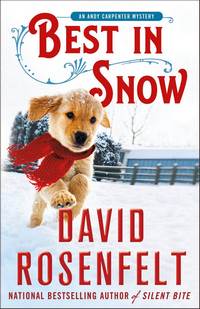
Best in Snow by David Rosenfelt: Tara Digs Up Trouble for Andy

Best in Snow

Best in Snow

by David Rosenfelt
Series: Andy Carpenter, #24

eARC, 320 pg.
Minotaur Books, 2021

Read: September 10, 2021
Grab a copy from your local indie bookstore!

What’s Best in Snow About?

After a snowstorm dumps a healthy amount of snow on the ground, Andy takes his dogs for a walk. Tara, his beloved golden retriever goes digging in that snow and uncovers a body. Not just any body, it turns out, but the mayor.

The evidence points to a reporter that used to work for Andy’s friend, Vince, at his paper. Despite this scandal that he kicked off last year centering on the mayor, Vince believes him and supports him the best he can. One way Vince supports the reporter is that he gets Andy to defend him.

Also, instead of Andy taking in the suspect’s dog for the duration of the trial, Vince does it this time. Vince is not a dog person—he’s not much of a people person, either, so readers can imagine how his housing the dog will go.

Comfort Food

I’m pretty sure I’ve said this (or something like it) before—it’s hard to track in a 24 book series just what I’ve said. But these Andy Carpenter books literary comfort food. You know what you’re going to get, you know you like it, and it just makes you feel good.

For example, you know when it gets to the part about jury deliberation, Andy’s going to say and do a few things. And it’s just as enjoyable to see him say that in this book as it was 20+ books ago.

That said? Rosenfelt managed to surprise me a couple of times and did some stuff in the courtroom that I haven’t seen from him before.

Holiday Content

In the last few years that Rosenfelt has been doing these Christmas-y themed books, I’ve always been mildly surprised at how low little “Holiday Content” there is in the book. This one seemed to be the lightest on Christmas/New Year’s material.

Yeah, the weather and dates help ground the action and show how fast things are moving in terms of the trial. But there’s not much more to it than that. Basically, this is just an excuse to get another Andy Carpenter book this year. And I’m fine with that.

So, what did I think about Best in Snow?

I really enjoyed this—the case was a good puzzle. The courtroom antics and strategies were up to Rosenfelt’s usual standards (maybe a little better than some). The little bit of action that crept in (mostly involving Marcus) was great, too.

The members of Andy’s team were as entertaining as usual and, of course, so were the dogs (including Vince’s new charge).

If you’re a long-time reader of the series, you know what you’re going to get here—with a couple of surprises. If you haven’t tried this series yet, you really should—this is as good a place as any. But once you start, you’ll have a hard time stopping. That’s not a warning, that’s an assurance.

Disclaimer: I received this eARC from St. Martin’s Press via NetGalley in exchange for this post—thanks to both for this.


4 Stars

This post contains an affiliate link. If you purchase from it, I will get a small commission at no additional cost to you. As always, opinions are my own.
The Case of the Missing Firefly by Chris McDonald: A Locked-Island Mystery

The Case of the Missing Firefly

The Case of the Missing Firefly

by Chris McDonald
Series: The Stonebridge Mysteries, #4

Kindle Edition, 96 pg.
Red Dog Press, 2021

Read: September 24, 2021

What’s The Case of the Missing Firefly About?

What better place than Northern Ireland’s “most haunted” island for a corporate Halloween party? This particular company is a local radio station—their on-air talent is known for heavy drinking, and being on an island (nearly) by themselves should provide a nice, safe environment for the heaviest of drinkers to indulge.

And they’re going to need to drink because they’re all going to get some bad news—and thanks to a bad storm, no one is leaving (or coming to) the island for a day or so.

Stranded with them are our intrepid Sherlock-inspired duo of Adam and Colin. Colin’s mother was the party planner and her tech guy wasn’t available, so these two get a nice payday for a quick job. While these two have matured a bit lately, easy money to mostly hang out in a hotel room where they can watch TV and play video games is worth having to endure a boat ride on choppy waters.

Naturally, because why would I be talking about this otherwise, in the midst of all the drinking and after the bad news—there’s a murder. And a robbery. With all the suspects trapped with them and almost no contact with the outside world, it’s time for Adam and Colin to dust off their Holmes and Watson act.

The Most Satisfying Paragraph of 2021?

People who read a lot—in any genre—are very likely going to see themselves in an observation the narration makes when Adam finds himself in a very tense situation. It was a great little moment, and a nice bonus to read.

It’s a small thing, but it brought a smile to my face. Each of the handful of times I’ve read it.

So, what did I think about The Case of the Missing Firefly?

There was a very somber tone to the first chapter that felt out of character for the series—but I was relieved to see it shift seamlessly into the typical Stonebridge tone in the next chapter as we get into Adam and Colin’s back and forth.

It’s good to see a little bit of the police’s attitude toward our pair—and theirs toward the police. Adam and Colin have a little notoriety—enough that the radio personalities know who they are, so the police certainly do. And, not at all shockingly, they’re not fond of a couple of amateurs making them look bad. Giving the duo a day on their own trapped on an island with the suspects to get a head start on things isn’t going to do much for long-term relations.

It’s hard to say something new about a series as consistent as this—especially with four installments in less than a year. I’m in great danger of repeating myself. So let me keep this short: The Case of the Missing Firefly* is yet another refreshing, fast-paced, and clever dose of cozy crime fiction (even for those who wouldn’t consider themselves cozy readers).

* Which, alas, is not a reference to the SF series—Adam and Colin save their fandom for Cumberbatch/Freeman and sports video games.

Go get your hands on this—and if you haven’t read the rest of the series, you should probably do that, too.


4 Stars

The Path of Faith by Brandon D. Crowe: Covenant and Law for Believers from Genesis to Revelation

The Path of Faith

The Path of Faith:
A Biblical Theology of
Covenant and Law

by Brandon D. Crowe
Series: Essential Studies in Biblical Theology

Paperback, 169 pg.
IVP Academic, 2021

Read: September 12-19, 2021
Grab a copy from your local indie bookstore!

What’s The Path of Faith About?

In his Introduction Crowe previews the book as a whole:

The topics of covenant and law are complex and have often been debated, but I’m not interested in getting bogged down in technical debates. Instead, in this book I make four key points.

  1. All people are obligated to obey their Creator.
  2. Though he did not have to, from the beginning God freely entered into a covenant with humanity to offer a reward upon the condition of perfect obedience.
  3. Only Jesus perfectly obeys God’s law, which is necessary for eternal life. Eternal life is granted by grace through faith on the basis of Christ’s work.
  4. Even though we can’t perfectly obey God’s law, the law continues to guide us in how we should live. Obedience to God’s law is still required. And yet obedience is not a burden but the path of blessing.

These are four landmarks to maintain your bearings in the discussion that follows, and they also serve as a handy summary of the book.

From there, the book traces the development of those concepts from Genesis to Revelation and at all points in between—as every book in this series has done/likely will do.

Relation between Old and New Covenant

Obviously, as he’s working through Redemptive History as it progresses, he begins with the Old Covenant—but always keeps the New Covenant in view, as the goal of the Old. I was particularly struck by the way he did this in Chapter 5, “The Prophets: Remind, Reprove, Renew.” I noted a few times how helpful the discussion there was at pointing at the differences between the two covenants, while stressing the continuity of the two.

I didn’t realize (but admittedly should have assumed) that that chapter was merely the foundation for a lot of the chapters to follow—particularly in Chapter 9, “The New Covenant in Practice: Hebrews Through Jude.” Which was just dynamite, and was probably my favorite chapter in the book. It wasn’t necessarily “more practical” than the rest of the book—but its focus on what what The Path of Faith looks like for believers in a post-apostolic age makes it more obviously applicable to contemporary believers.

I should add that a lot of the material in that chapter came from/was similar to Crowe’s The Message of the General Epistles in the History of Redemption: Wisdom from James, Peter, John, and Jude—and I feel compelled to recommend that book at this time (I didn’t do a post on it when I read it back in 2015, or I’d point you to that).

Revelation

Revelation fittingly concludes the biblical canon by echoing earlier Scripture, highlighting the completed work of Christ and sketching a vision for the future. Revelation wrestles with the ambiguities and difficulties of this age but doesn’t leave the plot dangling. Revelation proclaims that Christ rules, and his people will be vindicated. Revelation is an immensely practical book that provides guidance for living today.

That last sentence is going to strike more than a few readers as odd—but it shouldn’t. While the previous chapter was my favorite, this one took a lot more thought and reflection—and was more striking for me. Believers in the twentieth and twenty-first centuries are not used to reading Revelation for reasons other than “cracking the code” and figuring out the eschatological message of the book. Which isn’t to say that’s not important—but as Crowe argues, the book is more practical than that.

It’s crucial that we recognize and heed Revelation’s calls to faithfulness in life. We go astray if we think of Revelation as a fatalistic book of predictions. Revelation does not teach us to shut our eyes and sing, Que Será, Será (“whatever will be, will be”). Instead, Revelation provides motivation for faithful covenant living in the present, in light of God’s promises about the future.

This means Revelation is not only about the future; it’s about the entire age of the church, from the first coming of Christ to his second coming. It doesn’t focus only on the last few years of world history; it’s about every era of the church’s history. It’s about things that are persistently true. As one helpful book on Revelation puts the matter, “[Revelation] is a book for every age. It is always up to date.”

Given that reminder about the purpose of Revelation, Crowe’s able to point to the call for faithfulness, the motivations to perverse and the promise of the consummation of the covenants at the end.

So, what did I think about The Path of Faith?

It has been a while since I’ve read a book in this series—primarily because the outline was getting a bit repetitive, and it was causing me to glaze over a bit. It’s been long enough and (based solely on recollection without looking at a prior volume to compare) I think Crowe approaches it with a just-noticeable tweak to the standard outline that I was able to appreciate what he was saying without struggling to differentiate this work from the others.

Even without that gap for myself, I found this to be one of the (if not the) strongest volumes in the series—Crowe is able to deliver on explaining his summary from the introduction, explaining and expanding on them in each era of Redemptive History so that those of us living in the New Covenant age can profit from what was written for our benefit in the Old and seeing what our Covenant Head accomplished for us and for our salvation.

This is a great work on the ideas of Covenant and Law and I strongly encourage you to give it a read.


4 Stars

This post contains an affiliate link. If you purchase from it, I will get a small commission at no additional cost to you. As always, opinions are my own.
PUB DAY REPOST: Stalker Stalked by Lee Matthew Goldberg: Who Watches the Watchers? Who Stalks the Stalkers?

Stalker Stalked

Stalker Stalked

by Lee Matthew Goldberg

eARC, 245 pg.
All Due Respect, 2021

Read: September 7, 2021

What’s Stalker Stalked About?

Lexi Mazur is a pharmaceutical sales rep who has a habit of sampling her products in addition to drinking pretty heavily. When her boyfriend of about a year breaks up with her, things get worse. Her pill uptake and drinking increase, and she escapes into Reality Shows like The Real Housewives of ______, and her new obsession (literally), Socialites. She’d been heavily invested in those shows before—it was a bone of contention with her ex—but she sunk to pathological levels after the break-up.

Soon, Lexi begins showing up at locations that she knows one or more of the stars of Socialites will be, trying to put herself in a situation where their paths will cross, in the belief that it’s all it will take for them to befriend her. Once they’re friends, her life will improve and she’ll get a bit of the glamorous life they have—maybe even a role in the show.

She has some reason to think that this behavior will work—it has been the foundation (and eventual doom) of her romantic relationships.

Yeah, Lexi is a stalker—she just has a new outlet for these impulses. Her behavior and substance abuse spiral to new depths. We get some details about her prior issues and behaviors, but the novel primarily documents her descent to rock bottom.

That would be enough for most authors, but here’s where Goldberg throws in the plotline that makes Stalker Stalked stand out. In the midst of all the above, Lexi starts to sense that someone is watching her. Stalking her. Is it one of her exes? Is it someone from Socialites? Is it just her imagination, maybe a side-effect of some of the medication she’s abusing?

And then the threats begin…

Low-Hanging Fruit?

Lexi’s story aside (as much as you can do that kind of thing in this book), this book is a sharp satire and critique of TV Reality Shows.

As I read it, I wondered occasionally about Goldberg picking a target that’s too easy. Where’s the challenge in taking shots at Reality Shows?

As easy a target they might be, it’s a target that seems to demand this kind of attention and examination. The cultural impact of this kind of shows—and the social media influencer accounts (and wanna-be social media accounts) that tell the same kind of fictions—is large enough, disturbing enough, that we need as many artists in as many possible media to put them under the microscope.

Looking at this phenomenon through Goldberg’s lens something jumps out at me (and I realize that I’m probably fifteen years behind other people on this insight), this kind of reality shows provide a socially acceptable form of stalking for the masses. How many people think they’re getting a special kind of insight into the lives of these stars? A special, private, view of their day-to-day life? How many unbalanced viewers like Lexi are out there learning that this is an appropriate way to live and take the license to do the same but for people who aren’t on TV?

So, what did I think about Stalker Stalked?

I didn’t like Lexi—at all—for the majority of the novel. I wouldn’t have described myself as terribly invested in what was going on with her or in her well-being. She’s just unsympathetic, unpleasant—the kind of character that most novels would have cast as the villain (one you may ultimately find sympathy for).

As much as I wasn’t able to get invested in her as a character, I couldn’t stop reading. Something about the novel—and I really should be able to put my finger on what it was, but I can’t—gripped me like a Lee Child or Nick Petrie thriller. Compelling doesn’t quite express it—I had to know what was coming next. Lexi was like the proverbial car wreck that you can’t take your eyes off of. Also, I was pretty curious about some of the people around Lexi, how were they going to fare in the face of her problems.

Eventually, however, I started pitying Lexi. I started understanding how she got where she is and how she was tumbling toward rock bottom.

Stalker Stalked is a gripping read, a tragedy that you can’t look away from—that you can’t get enough of. It’s disturbing and thought-provoking. You’re going to want to get your hands on it.


4 Stars

Disclaimer: I received this eARC from Down & Out Press via NetGalley and Lori Hettler of The Next Best Book Club in exchange for this post—thanks to all of them for this.

Stalker Stalked by Lee Matthew Goldberg: Who Watches the Watchers? Who Stalks the Stalkers?

Stalker Stalked

Stalker Stalked

by Lee Matthew Goldberg

eARC, 245 pg.
All Due Respect, 2021

Read: September 7, 2021

What’s Stalker Stalked About?

Lexi Mazur is a pharmaceutical sales rep who has a habit of sampling her products in addition to drinking pretty heavily. When her boyfriend of about a year breaks up with her, things get worse. Her pill uptake and drinking increase, and she escapes into Reality Shows like The Real Housewives of ______, and her new obsession (literally), Socialites. She’d been heavily invested in those shows before—it was a bone of contention with her ex—but she sunk to pathological levels after the break-up.

Soon, Lexi begins showing up at locations that she knows one or more of the stars of Socialites will be, trying to put herself in a situation where their paths will cross, in the belief that it’s all it will take for them to befriend her. Once they’re friends, her life will improve and she’ll get a bit of the glamorous life they have—maybe even a role in the show.

She has some reason to think that this behavior will work—it has been the foundation (and eventual doom) of her romantic relationships.

Yeah, Lexi is a stalker—she just has a new outlet for these impulses. Her behavior and substance abuse spiral to new depths. We get some details about her prior issues and behaviors, but the novel primarily documents her descent to rock bottom.

That would be enough for most authors, but here’s where Goldberg throws in the plotline that makes Stalker Stalked stand out. In the midst of all the above, Lexi starts to sense that someone is watching her. Stalking her. Is it one of her exes? Is it someone from Socialites? Is it just her imagination, maybe a side-effect of some of the medication she’s abusing?

And then the threats begin…

Low-Hanging Fruit?

Lexi’s story aside (as much as you can do that kind of thing in this book), this book is a sharp satire and critique of TV Reality Shows.

As I read it, I wondered occasionally about Goldberg picking a target that’s too easy. Where’s the challenge in taking shots at Reality Shows?

As easy a target they might be, it’s a target that seems to demand this kind of attention and examination. The cultural impact of this kind of shows—and the social media influencer accounts (and wanna-be social media accounts) that tell the same kind of fictions—is large enough, disturbing enough, that we need as many artists in as many possible media to put them under the microscope.

Looking at this phenomenon through Goldberg’s lens something jumps out at me (and I realize that I’m probably fifteen years behind other people on this insight), this kind of reality shows provide a socially acceptable form of stalking for the masses. How many people think they’re getting a special kind of insight into the lives of these stars? A special, private, view of their day-to-day life? How many unbalanced viewers like Lexi are out there learning that this is an appropriate way to live and take the license to do the same but for people who aren’t on TV?

So, what did I think about Stalker Stalked?

I didn’t like Lexi—at all—for the majority of the novel. I wouldn’t have described myself as terribly invested in what was going on with her or in her well-being. She’s just unsympathetic, unpleasant—the kind of character that most novels would have cast as the villain (one you may ultimately find sympathy for).

As much as I wasn’t able to get invested in her as a character, I couldn’t stop reading. Something about the novel—and I really should be able to put my finger on what it was, but I can’t—gripped me like a Lee Child or Nick Petrie thriller. Compelling doesn’t quite express it—I had to know what was coming next. Lexi was like the proverbial car wreck that you can’t take your eyes off of. Also, I was pretty curious about some of the people around Lexi, how were they going to fare in the face of her problems.

Eventually, however, I started pitying Lexi. I started understanding how she got where she is and how she was tumbling toward rock bottom.

Stalker Stalked is a gripping read, a tragedy that you can’t look away from—that you can’t get enough of. It’s disturbing and thought-provoking. You’re going to want to get your hands on it.


4 Stars

Disclaimer: I received this eARC from Down & Out Press via NetGalley and Lori Hettler of The Next Best Book Club in exchange for this post—thanks to all of them for this.

PUB DAY REPOST: Robert B. Parker’s Stone Throw by Mike Lupica: The Twentieth Jesse Stone Novel Shows this Series Still has Plenty of Life in It

Stone's Throw

Robert B. Parker’s Stone’s Throw

by Mike Lupica
Series: Jesse Stone, #20

eARC, 336 pg.
G.P. Putnam’s Sons, 2021

Read: August 17-18, 2021
Grab a copy from your local indie bookstore!

What’s Stone’s Throw About?

The mayor of Paradise is found dead at the site of a contentious land deal—it’s one of the most sought-after properties in Paradise, and the City is preparing to weigh in and deciding which of two buyers get to put a casino on it—while several citizens are trying to block the sale at all. The mayor is clearly sympathetic to the anti-sale voices, but it doesn’t look like he’s going to be able to do anything to stop it going forward.

And then he apparently commits suicide on that piece of real estate. Jesse’s not so sure about the suicide part, however, it doesn’t make sense to him for several reasons—his friendship with the mayor is just one of them (the fact that the left-handed man seemingly used his right hand to shoot himself would be another).

Jesse just has to decide who has the most motive to kill him—one of the buyers? The seller? The anti-sale group?

Then the leader of the conservation movement goes missing, and his girlfriend is worried. Then it turns out that Wilson Cromartie—Crow—is working for one of the casino builders. He and the Paradise Police Department have a very shaky history—his criminal past (all beyond the statute of limitations) makes Jesse dis-inclined to trust him, no matter how much assistance he rendered in finding a missing girl later. Is Crow on the side of angels this time, or could he be behind the mayor’s death?

In a case that clearly calls for someone to “follow the money” there’s so much of it flying around that it’d be easy to get lost trying that, there are no easy answers for Jesse and the rest of the PPD.

Molly

From the beginning of the series, Molly Crane has been one of the highlights of the books and of the Paradise Police Department. She’s loyal, competent, and has a big heart. She’s stood by Jesse when things were at their worst for him—covering for him as much as she could. She’s almost too perfect—except for the one time she slept with Crow. That’s pretty much the only time she’s done something wrong.

And since then—at least once per book*—Jesse has brought that transgression up. Every author—Parker, Brandman**, Coleman, and now Lupica—has had Jesse throw this in her face regularly. It’s always bothered me that it’s so constant, so frequent—the woman beats herself up for it, she’s been so good to Jesse, and this is how he treats her?

* As far as I remember, I could be wrong about that, I doubt there’s been more than 2 books without it.

** I honestly remember so little about the Brandman novels, I only assume he followed suit.

And now, Crow is back—and he and Molly interact a bit, both with others around and one-on-one. Without getting into anything, I hope that this allows Molly to get past this act of infidelity—and that Jesse stops bringing it up. Really, there’s an opportunity for closure here, and I hope Lupica takes it.

Talkin’ Baseball

I always liked that Parker wrote Jesse as someone who became a cop not because he had the drive to see justice done, to serve and protect, etc.—but because he had to re-evaluate his life after his baseball career-ending injury and then came to the career in law enforcement.

Parker treated this well, in a “road not taken” kind of way. Coleman did a good job with it—although Blind Spot was more about being part of a team, more than the sport. But Lupica? Lupica really knows how to write about this part of Jesse’s life. He has Jesse think about this a lot in the first chapter and I put in my notes, “this is the best passage in Lupica’s Parker books.” And then it comes up later in the book, too. I don’t know if it’s all the sports books in Lupica’s past, just a better insight into the mindset of the baseball player, or what—but this book has the best usage of Jesse’s former career that this twenty-book series has had.

So, what did I think about Stone’s Throw?

I wasn’t crazy about this at the beginning—it was always good, but I didn’t get sucked in right away. I also wasn’t crazy about the way that Crow was being used—it reminded me of the way that Parker took some of the danger away from Vinnie Morris, Bobby Horse, and Chollo after their initial appearances. But it started to grow on me the further I got into it—and by the last half, I was invested as I could’ve hoped to be.

And even if I wasn’t—just being back in Paradise with Jesse, Suit, and Molly is good enough.

Lupica’s got the voices down, he understands Paradise, he gets the cast of characters right and this book feels like he’s been writing Stone novels for more years than he has—I had to remind myself that this is only his second time with this series. I’d have easily believed this is the fifth.

Whether you’re new to Jesse Stone, or you’ve been reading them since the beginning, this is a novel that will entertain you and leave you looking forward to the next one.

Disclaimer: I received this eARC from PENGUIN GROUP Putnam via NetGalley in exchange for this post—thanks to both for this.


4 Stars

This post contains an affiliate link. If you purchase from it, I will get a small commission at no additional cost to you. As always, opinions are my own.
The Person of Christ: An Introduction by Stephen Wellum: Scriptural and Historical Perspectives on Christ

The Person of Christ:
An Introduction

The Person of Christ: An Introduction

by Stephen Wellum
Series: Short Studies in Systematic Theology

Paperwork, 180 pg.
Crossway, 2021

Read: August 29, 2021
Grab a copy from your local indie bookstore!

Thinking through all chat Scripture says about Jesus and wrestling with the church as she has sought to faithfully confess Christ is not an easy task, but it’s absolutely necessary, especially if we are going to think rightly about God, the gospel, and the entire Christian faith, The study of Christology is not reserved for academic theologians; it’s the privilege, responsibility, and the glory of every Christian.

What’s The Person of Christ: An Introduction About?

In this installment of Short Studies in Systematic Theology, Wellum examines the doctrine of the Incarnation, the Second Person of the Trinity, and the Divinity of Jesus.

He spends four chapters opening the Scriptural testimony concerning Christ and the Incarnation. Then he looks at the development of the Church’s teaching and doctrinal formulation from an historical perspective—pre-Chalcedon, post-Chalcedon, and then contemporary issues. Finally, he gives a couple of chapters of theological reflection and summary.

The Strengths of the Book

I really appreciated most of the book, but two chapters, in particular, stood out to me—Chapter 2, “The Identity of Christ from the Bible’s Storyline” and Chapter 8, “Jesus as God the Son Incarnate.”

Chapter 2 lies the foundation for the next two chapters of the consideration of Christ as presented in the New Testament by examining the storyline of the Old Testament starting with Creation, the Fall, and then seeing how the Law and Prophets point to the coming Messiah.

Chapter 8 draws the testimony of Scripture and the formulations of the creeds, confessions, and theology of The Church throughout history into ten doctrinal statements explaining the essential elements of Jesus’ identity and the doctrine of the Incarnation.

The call to action in the last chapter, “Recovering the Centrality of Christ.” is a great conclusion—something that not every entry in the series has had, but is a welcome presence, and does a good job of wrapping up the book, summing up the high points and pointing the reader to application.

As One of the Short Studies in Systematic Theology

Of the four entries in this series that I’ve read this is the least accessible overall—most of the book is just fine on that front. A large part of that less-than-accessibleness comes from the fact that this appears to be a shorter version of Wellum’s 2016 book, God the Son Incarnate: The Doctrine of Christ. Assuming I’m right about that, he should’ve edited a bit more for this. Part of the first chapter (“Approaching Scripture on Its Own Terms to Identify Christ”) and most, if not all, of the seventh (” Current Challenges to Christological Orthodoxy”) seem unnecessarily technical, and possibly beyond the Introductory nature of this series.

I’m not saying they’re completely inaccessible to laity, but they felt out of place for both the series and the rest of the book. Maybe it was just my mood or attention span as I read it, but those parts of the book in particular, bugged me.

So, what did I think about The Person of Christ: An Introduction?

Overall, I liked it—I do think it would’ve been stronger without the chapters I mentioned in the previous section (or just with them reworked). But pushing that aside—this is an important entry in the series and focuses on things that too often get ignored.

I appreciated this entry in the series, but do hope the next entry I read is a little more in line with the others. Still, get your hands on this—what it does right is very good, and the rest isn’t bad, either.


4 Stars

This post contains an affiliate link. If you purchase from it, I will get a small commission at no additional cost to you. As always, opinions are my own.

Page 28 of 88

Powered by WordPress & Theme by Anders Norén