Tag: 4 Stars Page 29 of 88

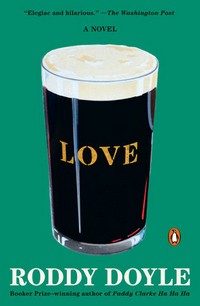
Love by Roddy Doyle: Pull Up a Stool, Order a Pint, Listen In on This Conversation

Love

Love

by Roddy Doyle

Hardcover, 327 pg.
Viking, 2020

Read: August 19-20, 2021
Grab a copy from your local indie bookstore!

—Well, that was how it felt, he said. —Like we’d never been apart.

—But—.

—I know, he said. —I know. We’d never been much together. But I’m talking about feelings here, not facts. Feelings. The feel of the thing.

It sounded like something he’d said before. More than once.

What’s Love About?

Joe and Davy are men in their 50s—in their 20s, they were drinking buddies, spending every weekend together at as many Dublin pubs as they possibly could. Eventually, they grew out of it. Davy moved to England with his wife. Joe settled down, too.

Now they see each other once or twice a year when Davy comes over to visit his father. It’s really the only time Davy drinks anymore. And, boy howdy, do they drink a lot.

This novel takes place over the course of one night/early morning, starting after dinner when they have a couple of drinks. Joe has a story he wants to tell Davy, he needs to unburden himself. Davy has something he needs to talk about, too, but he won’t let himself.

And that’s the novel—the two going from pub to pub, having a couple of drinks, and moving on. Sometimes out of choice, sometimes because they got a little too loud and are asked to leave. They walk a bit, sober up a touch (while continuing their conversation), and find a new pub to have a pint or two in before being asked to leave.

And if that doesn’t sound that interesting to you, have you ever listened to a couple of Irish people telling stories?

The Title

In the cleverly titled book, The Four Loves, C. S. Lewis posits that there are four different types of love and spends some time describing each.* Others have come up with different numbers, different categories. Which is just to say that the concept of “love” is a tricky one to nail down. To borrow Justice Stewart’s phrase, most of us know it when we see it, and most of us settle for that.

* It’s beside the point, but I feel compelled to list them: Affection (storge), Friendship (philia), Romantic (eros), Charity (agape).

All this is to say, it’s really impossible to know precisely what the title refers to—there are several types of love displayed in this book, and I can see some people trying to argue for which one is most fitting.

After a little thought, I’ve decided that Doyle is referring to them all (and I don’t think that’s a cop-out). It’s about two men struggling—and aided by several of the pints in the cover image—to find ways to talk about love.

Feelings

There is a reason why men don’t talk about their feelings. It’s not just that it’s difficult, or embarrassing. It’s almost impossible. The words aren’t really there

That’s from the beginning of the book, Davy’s narration noting the difficulty that Joe’s having getting his story started. It’s seen a few times after that (I should point out that at least Joe is trying, Davy’s avoiding it entirely).

Which is where beer comes in, I guess. Joe never quite expresses himself the way he wants—Davy doesn’t help that much, really—but he gets asymptotically close. The number of pints they consume to get him to the point where he gets close is enough to make my liver sick. Part of the enjoyment of this novel is watching these two try to get the words right.

—The drink is funny, though, isn’t it? You see things clearly but then you can’t get at the words to express them properly.

—Or somethin’.

—Or somethin’, yeah.

Conventional wisdom suggests that two women wouldn’t need that much alcohol—or any, really—to achieve the same ends, if not do a better job of expressing and understanding the emotions being discussed. I expect that wisdom is right (but wouldn’t die on that hill)—and the ensuing novel might be less entertaining. Still, I’d like to see someone give it a shot.

So, what did I think about Love?

—It’s a thing abou’ gettin’ older, he said. —At least, I suppose it is. So many memories, you know. It become, harder to separate wha’ happened from wha’ might’ye happened an’ wha’ didn’t happen but kind o’ seemed to.

He was looking at me.

—Is it? he asked.

—Is memory reliable? I said. —Is that wha’ you mean?

—I think so, yeah. yeah.

This is a novel about love—obviously—and old friends, memory, nostalgia, the power of reminiscing, aging, dealing with the past (whether it happened or not), family, forgiveness, trust…and a few more things, too. All discussed in the story that Joe’s telling and the stories that Davy isn’t telling.

When I read this in a couple of years, it wouldn’t surprise me if I come up with a different list of subjects.

But in a sense, it really doesn’t matter what you think the novel is about—it can be enjoyed and chewed on just with the surface. A couple of old friends talking.

Doyle’s dialogue is as strong as it ever was. The dialect makes it jump off the page, you don’t so much read this book as hear it with your eyes.* It is funny, it is tragic, it’s heartbreaking, it’s wistful, and occasionally silly. It runs the gamut—both for the characters and the reader.

* Yeah, I know, I know. Roll with it, will you?

If you haven’t read Doyle before—this is a pretty good ice-breaker. If you know his work, this is exactly what you expect (a little closer to the feel of The Barrytown Trilogy than A Star Called Henry or Paddy Clarke Ha Ha Ha). His idiosyncratic punctuation and approach to dialogue tags and paragraphs might cause you to stumble at first—but once you catch on, you won’t even notice it.

It’s like you’re sitting there on a night on the town with these two, just catching up with old friends and enjoying the conversation with them (even if you’re not holding up your end). And who doesn’t think that sounds like a fun time?


4 Stars

20 Books of Summer '21

This post contains an affiliate link. If you purchase from it, I will get a small commission at no additional cost to you. As always, opinions are my own.

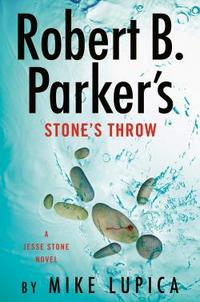
Robert B. Parker’s Stone Throw by Mike Lupica: The Twentieth Jesse Stone Novel Shows this Series Still has Plenty of Life in It

Stone's Throw

Robert B. Parker’s Stone’s Throw

by Mike Lupica
Series: Jesse Stone, #20

eARC, 336 pg.
G.P. Putnam’s Sons, 2021

Read: August 17-18, 2021
Grab a copy from your local indie bookstore!

What’s Stone’s Throw About?

The mayor of Paradise is found dead at the site of a contentious land deal—it’s one of the most sought-after properties in Paradise, and the City is preparing to weigh in and deciding which of two buyers get to put a casino on it—while several citizens are trying to block the sale at all. The mayor is clearly sympathetic to the anti-sale voices, but it doesn’t look like he’s going to be able to do anything to stop it going forward.

And then he apparently commits suicide on that piece of real estate. Jesse’s not so sure about the suicide part, however, it doesn’t make sense to him for several reasons—his friendship with the mayor is just one of them (the fact that the left-handed man seemingly used his right hand to shoot himself would be another).

Jesse just has to decide who has the most motive to kill him—one of the buyers? The seller? The anti-sale group?

Then the leader of the conservation movement goes missing, and his girlfriend is worried. Then it turns out that Wilson Cromartie—Crow—is working for one of the casino builders. He and the Paradise Police Department have a very shaky history—his criminal past (all beyond the statute of limitations) makes Jesse dis-inclined to trust him, no matter how much assistance he rendered in finding a missing girl later. Is Crow on the side of angels this time, or could he be behind the mayor’s death?

In a case that clearly calls for someone to “follow the money” there’s so much of it flying around that it’d be easy to get lost trying that, there are no easy answers for Jesse and the rest of the PPD.

Molly

From the beginning of the series, Molly Crane has been one of the highlights of the books and of the Paradise Police Department. She’s loyal, competent, and has a big heart. She’s stood by Jesse when things were at their worst for him—covering for him as much as she could. She’s almost too perfect—except for the one time she slept with Crow. That’s pretty much the only time she’s done something wrong.

And since then—at least once per book*—Jesse has brought that transgression up. Every author—Parker, Brandman**, Coleman, and now Lupica—has had Jesse throw this in her face regularly. It’s always bothered me that it’s so constant, so frequent—the woman beats herself up for it, she’s been so good to Jesse, and this is how he treats her?

* As far as I remember, I could be wrong about that, I doubt there’s been more than 2 books without it.

** I honestly remember so little about the Brandman novels, I only assume he followed suit.

And now, Crow is back—and he and Molly interact a bit, both with others around and one-on-one. Without getting into anything, I hope that this allows Molly to get past this act of infidelity—and that Jesse stops bringing it up. Really, there’s an opportunity for closure here, and I hope Lupica takes it.

Talkin’ Baseball

I always liked that Parker wrote Jesse as someone who became a cop not because he had the drive to see justice done, to serve and protect, etc.—but because he had to re-evaluate his life after his baseball career-ending injury and then came to the career in law enforcement.

Parker treated this well, in a “road not taken” kind of way. Coleman did a good job with it—although Blind Spot was more about being part of a team, more than the sport. But Lupica? Lupica really knows how to write about this part of Jesse’s life. He has Jesse think about this a lot in the first chapter and I put in my notes, “this is the best passage in Lupica’s Parker books.” And then it comes up later in the book, too. I don’t know if it’s all the sports books in Lupica’s past, just a better insight into the mindset of the baseball player, or what—but this book has the best usage of Jesse’s former career that this twenty-book series has had.

So, what did I think about Stone’s Throw?

I wasn’t crazy about this at the beginning—it was always good, but I didn’t get sucked in right away. I also wasn’t crazy about the way that Crow was being used—it reminded me of the way that Parker took some of the danger away from Vinnie Morris, Bobby Horse, and Chollo after their initial appearances. But it started to grow on me the further I got into it—and by the last half, I was invested as I could’ve hoped to be.

And even if I wasn’t—just being back in Paradise with Jesse, Suit, and Molly is good enough.

Lupica’s got the voices down, he understands Paradise, he gets the cast of characters right and this book feels like he’s been writing Stone novels for more years than he has—I had to remind myself that this is only his second time with this series. I’d have easily believed this is the fifth.

Whether you’re new to Jesse Stone, or you’ve been reading them since the beginning, this is a novel that will entertain you and leave you looking forward to the next one.

Disclaimer: I received this eARC from PENGUIN GROUP Putnam via NetGalley in exchange for this post—thanks to both for this.


4 Stars

This post contains an affiliate link. If you purchase from it, I will get a small commission at no additional cost to you. As always, opinions are my own.

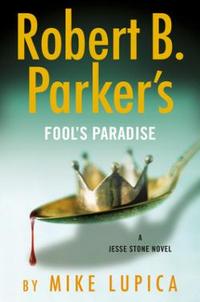
Reposting Just Cuz: Robert B. Parker’s Fool’s Paradise by Mike Lupica: Jesse Stone takes a Murder Case Personally

Fool's Paradise

Robert B. Parker’s Fool’s Paradise

by Mike Lupica
Series: Jesse Stone, #19

eARC, 352 pg.
G.P. Putnam’s Sons, 2020

Read: September 2-3, 2020
Grab a copy from your local indie bookstore!

What’s Fool’s Paradise About?

Suitcase Simpson calls Jesse to the scene of a murder, an unidentified man has been found shot at the lakeshore. Jesse recognizes the man—they’d been at the same AA meeting the previous night. It’s not Jesse’s regular meeting, and he didn’t think this man was a regular, either. But at least they had a first name to go off of.

Suit is able to find out at least a little about what the man did after the meeting. He’d taken a taxi from the neighboring town into Paradise. He even had an address—the mansion of a rich and influential family who’d been in Paradise for ages. They’re quick to claim they didn’t know the man, or that he’d been at the house in the hours before he was shot. No member of PPD believes this, but there’s little they can do until they learn a bit more about the victim.

Jesse admits this isn’t entirely rational—but doesn’t back off from it—the fact that he and the victim came to the same meeting, both needing the help that can be found there, created a link for between the two of them. Jesse felt like he owed this man justice more than he would another victim (not that Jesse’s ever been known to not try to find justice for anyone, it’s just personal this time). I loved this little touch—it felt very true to the character and his circumstances, but something that a lot of authors wouldn’t do.

Not long after this, someone takes a shot at Jesse while he’s in his home. Soon, other members of the PPD are attacked off-duty. As always, Jesse, Molly, and Suit acknowledge that coincidences exist, but they have a hard time believing in them. So while they try to identify the murder victim and figure out what he’s going in Paradise (and that part of Paradise in particular), they also need to figure out why someone would be attacking the PPD. And are the two cases related?

A Nice Little Bonus

There’s a lot of Molly in this book. She gets whole chapters without Jesse in them, and a lot of space on her own in chapters with him. We get a little bit of an off-the-job look at Molly, as well as seeing her work part of the investigation. Yes, Jesse’s the central character and should be the focus—but any time that Lupica (or whoever) can flesh out Molly, Suitcase, or any of the others is time well spent (I like the new deputy, too—he was a nice touch). But Molly’s been a favorite since Night Passage introduced this world, and she’s rarely been used as well as the character should’ve been. It’s so nice to see that.

Lupica’s Take on Jesse Stone

I was worried about Lupica being given the reins of this series. I was such a fan of what Colman had done, saving the series from the Michael Brandman debacle—and even from some of the uneven quality that Parker had given toward the end.

But Lupica did exactly what he needed to do—and exactly what I’d hoped (and didn’t expect). He embraced the developments that Coleman introduced and built on them. He could’ve ignored them, or written around them, but he kept Jesse going to AA, he worked on the new relationship with Cole, and Paradise and the Paradise Police Department the same way Coleman had, treating that bit of the series with as much respect and influence as the first nine novels.

Stylistically, Lupica’s closer to Parker than Coleman—which makes sense, it’s the more natural way for him to write (and will likely win back some of Coleman’s detractors). It works for the series, it works for the author—all in all, it’s a good move.

I freely admit that I was skeptical and pessimistic about anyone but Coleman at the post-Parker helm of Jesse Stone and am glad to be proven wrong.

Something I was Pleasantly Surprised By

While I have thought in the past that the best use of Sunny Randall was when Parker used her in the Jesse Stone novels, I wasn’t thrilled to see her in these pages—I thought that Stone, at least, had grown past this relationship. It’s not what it was back in the 3-4 books that Parker wrote with them as a couple, but reflects where they both are now.

I’ve got to say, I liked her here. I liked her in Paradise more than I liked her in the two books that Lupica has written about Sunny. If he keeps this up, I won’t complain.

Lupica’s War on my Sanity

Sure, that’s hyperbolic. But it felt like he was doing this to just bug me.

The mansion that the taxi pulled up to that fateful night is owned by the Cain family, Whit and Lilly Cain. Whit suffered a stroke a few months back, so his wife, Lilly, is who Jesse primarily interacts with. She’s brash, confident, loud, and flirtatious.

Now, I’ve watched the Veronica Mars series more times than I should have. Season One more than the rest. Every time I read “Lilly Cain,” I couldn’t think about anything other than “Lily Kane,” Veronica’s brash, confident, loud, and flirtatious friend.

I know it’s a coincidence, that neither name is all that rare. But it didn’t feel that way.

So, what did I think about Fool’s Paradise?

I liked this so much more than I expected to. I went into this hoping I wouldn’t hate it, and it didn’t take long at all for me to realize I was enjoying it. The prose crackled and moved quickly. There was enough of Jesse’s quiet humor to keep me grinning. The relationships and banter between the characters was spot on. The cases were compelling, interestingly framed, and well-executed. Lupica tied his novel into the overall history of the series well (referencing over half of the books, I think) and established that he’s the right man for the job. I strongly recommend this—either for new readers or established fans. Robert B. Parker’s Fool’s Paradise is a satisfying read that’ll get you eager to see what comes next.

Disclaimer: I received this eARC from PENGUIN GROUP Putnam via NetGalley in exchange for this post—thanks to both for this.


4 Stars

This post contains an affiliate link. If you purchase from it, I will get a small commission at no additional cost to you. As always, opinions are my own.
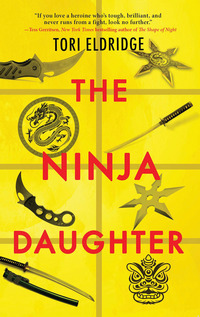
REPOSTING JUST CUZ: The Ninja Daughter by Tori Eldridge: The Norwegian-Chinese Ninja Hero You Never Realized You Needed in Your Life

I’m stumbling over myself trying to write my post about the sequel, The Ninja’s Blade–seriously, I’ve tossed out the first paragraph 5 times so far. So, as has been my habit of late, I’m reposting what I said about the previous book in its stead. If you haven’t looked into this yet, maybe this’ll prompt you to do that (while I hope it prompts me to finish the post on the sequel)


The Ninja Daughter

The Ninja Daughter

by Tori Eldridge
Series: Lily Wong, #1

Paperback, 300 pg.
Agora Books, 2019

Read: August 21-22, 2020
Grab a copy from your local indie bookstore!

What’s The Ninja Daughter About?

Lily Wong’s nickname is Dumpling, and like that food, there’s a lot hidden underneath the surface.

For starters, there’s the fact that she trained extensively in martial arts—more than her parents realized—growing up. Then there’s the fact that she (in her mind, at least) let her sister down the night that her sister was sexually assaulted and murdered. Which fuels the last hidden part of her life—she uses her guilt and need for vengeance to fuel her utilization of those martial arts skills to be a kunoichi—a female ninja—to help women and children who are the victims of abuse while she hunts for her sister’s killer. Her parents only know she does IT work from home.

When the book opens she’s trying to help a Ukrainian immigrant woman and her son get away from her abusive husband (who brags about his criminal connections), but that’s not going too well. To distract her self from the lack of success there, she takes up the cause of a waitress who’d been attacked in her home by a customer. The judge tossed the case based on insufficient evidence following weeks of the waitress being victim shamed through the media (traditional and social).

Lily decides that this waitress needs a big sister to look out for her and appoints herself to fill that role. She does this by doing what she can to keep Mia safe and then to investigate the guy she pressed charges against. This leads her into a murky world of government contracts, real estate, organized crime, and murder.

You Know Who Lily Reminds Me Of?

Part of it’s the city of L.A., part of it’s the female action-hero vibe, the one woman against the world kind of thing. Part of it is ineffable. But I couldn’t help but think of Cas Russell (of Zero Sum Game and Null Set) and Teagan Frost (of The Girl Who Could Move Sh*t with Her Mind) as I read this book.

Sure, Lily’s more grounded than either of them, she has no real powers other than those that are the result of years of training and practice. Theoretically, everything that Lily does in this book Tori Eldridge is (or at least was at one point) capable of doing herself—and a lot of what Cas and Teagan do are purely the stuff of fiction. Still, I’m probably going to lump the three of them together in my mind for some time to come.

The biggest difference between them is that Lily knows just who she is and where she comes from—her family is strong, affectionate (in their way), and supportive. She may have friends to augment that core support, but they’re not everything she has. This makes her a bit more stable and capable of dealing with challenges that come than the others.

(and, yeah, I thought of Lydia Chin and her mother every time Lily and her Ma interacted, but that’s a whole other can of worms).

The Food

There’s food all over this book. Lily’s father owns and runs a Chinese restaurant in Chinatown. The woman that runs the shelter she works with cooks amazing sounding soul food. The meals she eats with her family and on her own sound amazing. Spenser and Elvis Cole may know their way around a kitchen, but Lily Wong knows her way around some fantastic restaurants in L.A. She’s so far ahead of the game than Kinsey Milhone’s lousy sandwiches and Hungarian food that it’s hard to believe they’re in the same genre.

Do not read this book if you’re peckish. Keep yourself fed well, or you’re going to be snacking far too much.

Lily’s Heritage

It’s that family makes Lily who she is. In these three hundred pages, we hear more about Lily’s grandparents and parents than I’m used to hearing about a protagonist’s family over several books. Particularly when we’re talking about an action hero.

Eldridge has given Lily the same heritage that she has—a Norwegian father from North Dakota and a Chinese mother. So Eldridge knows the special kind of alchemy that the mixture of the two cultures produces.

The Important Word in the Title

Obviously, it’s Ninja that draws your attention and is the memorable takeaway, but as you can tell, it’s Daughter that colors the whole book. It’s Lily’s interactions with her parents, her application of the way they raised her and still care for her, the way she draws on what they teach and tell her that defines her and proves to be the key to figuring out what’s going on in the book.

So, what did I think about The Ninja Daughter?

If you want to ignore the deeper stuff and enjoy a book about a determined young woman out for vengeance (presumptive and by proxy, as it often is) on the streets of Los Angeles, this book will do the trick.

If you want a rounded, complex, female character trying to figure out how to deal with personal guilt, and trauma while helping out women and children by any means necessary, this book will do the trick, too. The idea that she may be starting to figure out a way past the guilt and move into healing and happiness* makes that all the better.

* Sure, I realize that within the first fifty pages of the sequel, all that can go away. The important thing is that it was there

You could make the case that Philip Marlowe was Chandler’s attempt at telling the story of a knight errant in early-twentieth-century L.A. Lily’s in the same vein—just a little more modern (and, ironically enough, using an older kind of warrior). Eldridge’s L.A. has slightly nicer mean streets, but they’re just as deadly and are in just as much need for a hero. I hope we get to see her at work for quite some time.


4 Stars

20 Books of Summer

This post contains an affiliate link. If you purchase from it, I will get a small commission at no additional cost to you. As always, opinions are my own.

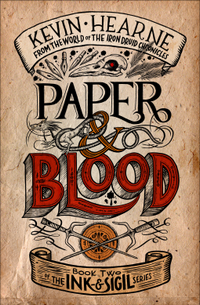
PUB DAY REPOST: Paper & Blood by Kevin Hearne: Like the Spanish Inquisition, Nobody Expects a Turtle Dragon Spider.

Paper & Blood

Paper & Blood

by Kevin Hearne
Series: Ink & Sigil, #2

eARC, 304 pg.
Del Rey Books, 2021

Read: July 31-August 3, 2021
Grab a copy from your local indie bookstore!

What’s Paper & Blood About?

Al MacBharrais gets a message from an apprentice Sigil Agent—her teacher went to investigate an oddity in Australia and didn’t return—a nearby Agent went looking for her and hasn’t returned either. She’s (rightly) worried and needs help. She’s close to taking her exams, but she’s not at the point she’d need to be to take on whatever it was that seems to have captured—or killed—two veteran Agents.

Al and the hobgoblin in his service, Buck Foi, hitch a ride with a Fae to deliver them to Melbourne. Al also asks if a message can be delivered to the Iron Druid, Atticus O’Sullivan (now going by the alias Connor Molloy). If whatever this is has proved too much for two Sigil Agents, he knows that he and the apprentice are going to need all the help they can get.

Connor and his two dogs—Oberon (it’s been too long since I got to spend time with him, even if we only get a little bit of his speech) and Starbuck—join Al, Buck, and Ya-ping (Shu-hua’s apprentice) and they head to a hiking trail that was the last known location to find hikers screaming and fleeing from some sort of monster. There are injuries and casualties—and a monster unlike anything they’ve seen and/or read about. It’s not long before they decide that this monster is likely just the first thing they’ll have to deal with to find the Agents—and it’s probably going to get much more dangerous. Eventually, Nadia—the manager of Al’s print shop and battle seer—joins in the search when she starts getting visions of the danger they’re headed toward.

The Iron Druid Chronicles Postscript

This series is a spin-off of the Iron Druid Chronicles and functions very well in that way. But it frequently felt like Connor/Atticus was about to take over the focus of this book—just with Al’s narration rather than Connor’s first-person. That never happened, I just wondered a few times if it would.

At the same time, Paper & Blood served as a sequel to Scourged, or maybe it’d be more accurate to say that it was a belated epilogue to it. The more time that goes by the less satisfied I’ve become with the conclusion of Scourged and where it left Atticus and Oberon. This is the ending they needed, and even if I didn’t think Al, Buck, etc. were fully entertaining on their own, I’d be glad I read this for the Connor material.

I do hope that he can drop into this series from time to time, still—I’m not ready to say goodbye forever. But if I have to, this is the note I want to go out with.

Secondary Characters

In addition to those I mentioned above, there’s a local police officer, a couple of familiar faces from the Iron Druid Chronicles, and the return of someone from Ink & Sigil—it’s tough to describe without ruining the effect Hearne’s going for. But let me just say that something that I thought was a throwaway line in that book comes back and means so, so much more than I could’ve guessed (am pretty sure Al would say the same). Hearne is able to take these characters—new and established—and make you care about what they’re facing in no time flat. I’ve always been impressed in his skill in that and, if anything, he’s getting better at it than he was when Hounded first came out.

And, the monsters, too. I guess I should talk about them—Hearne let his very fertile imagination go crazy with these strange hybrid creatures (like the Turtle Dragon Spider that I mention in the headline)—it was great to see in action, and horrible to imagine.

Paper and Ink

Along the way, Al gives lessons about/tributes to the making and uses of both paper and ink in his narration. These little vignettes are just golden. They cement Al’s calling as a Sigil Agent—one who deals in ink and paper as their stock in magical trade—and capture the romance of these things that readers depend on just as much as the Agents do. Even in our world, these things are used to make magic and I appreciate Hearne reminding us of that.

So, what did I think about Paper & Blood?

There’s just so much to like about this book that it’s hard to know where to start. There’s the Glaswegian dialect that, like Ink & Sigil, the narration is written in (or at least a flavor of it)—Hearne gives us a nice Author’s Note describing it, too.

Next, I’d talk about the perspective that an elderly protagonist is able to approach things in—he has wisdom and experience that your typical UF narrator doesn’t. Something in the way that MacBharrais and the rest are able to use to defeat the final monster that gives him an idea about how to combat his curse—I’m assuming we’ll get to see it in action soon (I’m not sure how long Hearne plans this series, but I’m pretty sure it’s about over as soon as Al takes care of the curse). I don’t know if it’ll work or not, but I like that Hearne seems to be finding a way to resolve things that doesn’t fit the typical UF mold. Just the fact that Al is able to start making this plan says a lot about him. I should really spend a couple of paragraphs talking about what makes Al unique, but I don’t have the time.

There’s also all the fun of the supporting characters and what they bring to the story—again, something I should spend more time on, but I’d end up spoiling something—but while there’s nothing wrong with the main plot (killing monsters and trying to find the Agents), it’s these secondary characters and plots that make this so much fun.

There’s really just so much to commend about this book that I can’t list it, so I’ll just say that this is a must-read for anyone who enjoyed Ink & Sigil to any degree—this shows what Hearne can do in this world now that it’s established—and/or IDC. I don’t know that this is the best jumping on point—but if you do, you’re not going to regret it (your life would just be easier if you read the first book before this, though).

Hearne’s one of the best around, and this just cements this—go pick up Paper & Blood now.


4 Stars

Disclaimer: I received this eARC from Random House Publishing Group – Ballantine via NetGalley in exchange for this post—thanks to both for this.

This post contains an affiliate link. If you purchase from it, I will get a small commission at no additional cost to you. As always, opinions are my own.
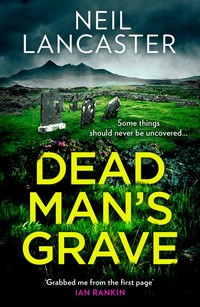
Dead Man’s Grave by Neil Lancaster: The Debut of Your New Favorite Police Procedural Series

Dead Man’s Grave

Dead Man’s Grave

by Neil Lancaster
Series: DS Max Craigie Scottish Crime Thrillers, #1

Kindle Edition, 400 pg.
HQ Digital, 2021

Read: July 17-19, 2021

What’s Dead Man’s Grave About?

Tam “Peeler” Hardie has been the head of one of Scotland’s most powerful, most violent (you don’t want to know how he got that nickname*), crime families for decades. He’s looking at the end of his life and has an overwhelming desire to look into his family’s roots. This quest takes Hardie to an old, small graveyard near a small Scottish town. Thanks to a feud that goes back generations, he won’t leave that graveyard alive.

* Okay, you probably do in some twisted way—but I’m not going to go into it. Go buy the book.

It doesn’t take long before Hardie’s sons suspect something’s wrong—at the very least their father is missing (maybe kidnapped?). Now, if you’re the Scottish Police, the last thing you want is the Hardies to take it upon themselves to go looking for their father—they’re much more likely to start a war with some other criminal organizations than they are to find him. So DS Max Craigie and DC Janie Calder are assigned to the search, which will hopefully placate the sons for a little while.

Some good detecting by Craigie—and some better instincts—lead to the discovery of Hardie’s body—and some good fortune leads to a quick arrest. It’s soon after that when Craigie starts to notice something’s amiss with the investigation—it’s clear that the Hardies know more than they should, investigative lines are shut down by superiors, and Craigie’s aid is taken as interference, In fact, he’s put on leave when he won’t stop.

There’s something rotten afoot, and now the question is: can Craigie (with or without the aid of Calder, a new detective that he barely knows) find out what kind of corruption is meddling with this investigation and put a stop to it without risking their careers or lives?

DS Max Craigie and DC Janie Calder

In a very real sense, we’ve seen both of these characters before. He’s the cynical experienced detective who still has a sense of right and wrong; he’s not afraid to defy orders and go his own way to make sure the right people are arrested; his career has taken a toll on his health and family, but he’s driven by a sense of mission that he can’t shake. She’s a little odd and not that popular with the rest of the detectives—but she’s smart, she’s eager, she’s tech-savvy—and you don’t want to face off against her in a physical confrontation. But somehow Lancaster takes these very familiar types and makes them feel fresh—like he’s one of the first to try this combination of partners with these characteristics. Don’t ask me how he did that, but he did.

Even if it didn’t feel fresh—there’s a reason we’ve seen these characters paired in this way before: it works really well. Storytellers gravitate to them, readers respond well to them. Lancaster is a great example of someone who takes these characters and uses them right.

I really liked these characters, and can’t wait to see how Lancaster develops them. I predict it won’t be long before most readers of the series think of Calder as their favorite character. (and very likely has started already)

So, what did I think about Dead Man’s Grave?

It took me no time at all to be hooked by this novel–it starts off strong and improves from there. It was tense, well-plotted, and (mostly) well-paced. Add in Max and Janie and Dead Man’s Grave becomes a real winner—one of the better Crime Novels I’ve read this year.

One little complaint—the book wraps up too quickly, it was just a bit too difficult to believe that they met their objectives that speedily. But, by that time, you’re so into the story and characters that you’re willing to go with Lancaster. And the conclusion was so satisfying that the only reason I remember this gripe is that I wrote it down.

I strongly recommend this one to you—it’s the kind of book that makes me want to go and lower the stars on Lancaster’s earlier books because this is so much better than what he’d done before—there’s a depth, complexity, and richness to plot, character, and style that wasn’t there in the Tom Novak books (don’t get me wrong—I enjoyed each of them). If he’s stepped up his game this much in so short a time, Lancaster’s going to have a long and very satisfying career.


4 Stars

20 Books of Summer '21

Paper & Blood by Kevin Hearne: Like the Spanish Inquisition, Nobody Expects a Turtle Dragon Spider.

Paper & Blood

Paper & Blood

by Kevin Hearne
Series: Ink & Sigil, #2

eARC, 304 pg.
Del Rey Books, 2021

Read: July 31-August 3, 2021
Grab a copy from your local indie bookstore!

What’s Paper & Blood About?

Al MacBharrais gets a message from an apprentice Sigil Agent—her teacher went to investigate an oddity in Australia and didn’t return—a nearby Agent went looking for her and hasn’t returned either. She’s (rightly) worried and needs help. She’s close to taking her exams, but she’s not at the point she’d need to be to take on whatever it was that seems to have captured—or killed—two veteran Agents.

Al and the hobgoblin in his service, Buck Foi, hitch a ride with a Fae to deliver them to Melbourne. Al also asks if a message can be delivered to the Iron Druid, Atticus O’Sullivan (now going by the alias Connor Molloy). If whatever this is has proved too much for two Sigil Agents, he knows that he and the apprentice are going to need all the help they can get.

Connor and his two dogs—Oberon (it’s been too long since I got to spend time with him, even if we only get a little bit of his speech) and Starbuck—join Al, Buck, and Ya-ping (Shu-hua’s apprentice) and they head to a hiking trail that was the last known location to find hikers screaming and fleeing from some sort of monster. There are injuries and casualties—and a monster unlike anything they’ve seen and/or read about. It’s not long before they decide that this monster is likely just the first thing they’ll have to deal with to find the Agents—and it’s probably going to get much more dangerous. Eventually, Nadia—the manager of Al’s print shop and battle seer—joins in the search when she starts getting visions of the danger they’re headed toward.

The Iron Druid Chronicles Postscript

This series is a spin-off of the Iron Druid Chronicles and functions very well in that way. But it frequently felt like Connor/Atticus was about to take over the focus of this book—just with Al’s narration rather than Connor’s first-person. That never happened, I just wondered a few times if it would.

At the same time, Paper & Blood served as a sequel to Scourged, or maybe it’d be more accurate to say that it was a belated epilogue to it. The more time that goes by the less satisfied I’ve become with the conclusion of Scourged and where it left Atticus and Oberon. This is the ending they needed, and even if I didn’t think Al, Buck, etc. were fully entertaining on their own, I’d be glad I read this for the Connor material.

I do hope that he can drop into this series from time to time, still—I’m not ready to say goodbye forever. But if I have to, this is the note I want to go out with.

Secondary Characters

In addition to those I mentioned above, there’s a local police officer, a couple of familiar faces from the Iron Druid Chronicles, and the return of someone from Ink & Sigil—it’s tough to describe without ruining the effect Hearne’s going for. But let me just say that something that I thought was a throwaway line in that book comes back and means so, so much more than I could’ve guessed (am pretty sure Al would say the same). Hearne is able to take these characters—new and established—and make you care about what they’re facing in no time flat. I’ve always been impressed in his skill in that and, if anything, he’s getting better at it than he was when Hounded first came out.

And, the monsters, too. I guess I should talk about them—Hearne let his very fertile imagination go crazy with these strange hybrid creatures (like the Turtle Dragon Spider that I mention in the headline)—it was great to see in action, and horrible to imagine.

Paper and Ink

Along the way, Al gives lessons about/tributes to the making and uses of both paper and ink in his narration. These little vignettes are just golden. They cement Al’s calling as a Sigil Agent—one who deals in ink and paper as their stock in magical trade—and capture the romance of these things that readers depend on just as much as the Agents do. Even in our world, these things are used to make magic and I appreciate Hearne reminding us of that.

So, what did I think about Paper & Blood?

There’s just so much to like about this book that it’s hard to know where to start. There’s the Glaswegian dialect that, like Ink & Sigil, the narration is written in (or at least a flavor of it)—Hearne gives us a nice Author’s Note describing it, too.

Next, I’d talk about the perspective that an elderly protagonist is able to approach things in—he has wisdom and experience that your typical UF narrator doesn’t. Something in the way that MacBharrais and the rest are able to use to defeat the final monster that gives him an idea about how to combat his curse—I’m assuming we’ll get to see it in action soon (I’m not sure how long Hearne plans this series, but I’m pretty sure it’s about over as soon as Al takes care of the curse). I don’t know if it’ll work or not, but I like that Hearne seems to be finding a way to resolve things that doesn’t fit the typical UF mold. Just the fact that Al is able to start making this plan says a lot about him. I should really spend a couple of paragraphs talking about what makes Al unique, but I don’t have the time.

There’s also all the fun of the supporting characters and what they bring to the story—again, something I should spend more time on, but I’d end up spoiling something—but while there’s nothing wrong with the main plot (killing monsters and trying to find the Agents), it’s these secondary characters and plots that make this so much fun.

There’s really just so much to commend about this book that I can’t list it, so I’ll just say that this is a must-read for anyone who enjoyed Ink & Sigil to any degree—this shows what Hearne can do in this world now that it’s established—and/or IDC. I don’t know that this is the best jumping on point—but if you do, you’re not going to regret it (your life would just be easier if you read the first book before this, though).

Hearne’s one of the best around, and this just cements this—go pick up Paper & Blood now.


4 Stars

Disclaimer: I received this eARC from Random House Publishing Group – Ballantine via NetGalley in exchange for this post—thanks to both for this.

This post contains an affiliate link. If you purchase from it, I will get a small commission at no additional cost to you. As always, opinions are my own.
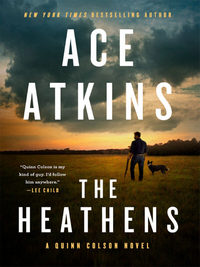
The Heathens by Ace Atkins: Colson and Virgil Try to Stop a Modern Bonnie and Clyde

The Heathens

The Heathens

by Ace Atkins
Series: Quinn Colson, #11

Hardcover, 400 pg.
G.P. Putnam’s Sons, 2021

Read: July 20-23, 2021
Grab a copy from your local indie bookstore!

Tanya Jane Byrd, known to her friends as TJ, never gave a damn about being famous. But here she was, four days on the run from Tibbehah County, Mississippi, with that girl Chastity passing along the burner phone to show they now had more than a hundred thousand followers on Instagram. They only had six posts, the newest one from just two hours ago after TJ cut her hair boy short, dyed it black as a raven’s wing, and made her ultimatum to that cowardly son of 2 bitch Chester Pratt. She called him out for not only her mother’s murder but the money she and her little brother John Wesley were owed.

On the forty-five-second clip shot outside the Tri-State Motel in Texarkana, she held up her fist on the diving board to an empty pool and said, “Fair is fair,” remembering the line from one of her mothers old VHS tapes in the trailer.

“What do you think?” Chastity asked.

“I think I better drop that phone into the nearest creek.”

What’s The Heathens About?

Seventeen-year-old TJ Byrd has spent her life convinced that her father was killed by Tibbehah County’s Sherriff, the uncle of the current Sherriff. This has left her with a pretty jaded view of law enforcement. So when she’s suspected in the disappearance—and then the murder of her mother, it’s understandable that she doesn’t assume she’s going to get a fair shake from those that suspect her. So, she grabs her little brother and with her best friend and her boyfriend, they hit the road and run. They’re not sure where they’re driving to, but it’s far away from Tibbehah.

That’s maybe not the brightest move, but she’s desperate.

Former Deputy/now US Marshall, Lilly Virgil assumes that TJ killed her mother. Lilly has seen what happens when the two of them fight and assumes that TJ has gone one step too far. Lilly pulls some strings and gets herself assigned to the fugitive hunt for TJ and the rest.

Sheriff Quinn Colson isn’t that convinced of TJ’s guilt but would like to talk to her about what happened. With her on the run, he does some legwork on the case on his own—looking into her mother’s boyfriend, finances, and history. The more he finds, the less he’s convinced that TJ had anything to do with her death, he just needs to find enough evidence to convince Lilly.

Meanwhile, Johnny Stagg is at work greasing palms and making plans for the future—and what he has in mind will look entirely different than anything we’ve already seen from him. He’s also trying to get a father and son to join his team—they have a penchant for violence, and Stagg is pretty sure he’ll have some work for them.

TJ Byrd

…I’m real sorry, TJ. You’re too young to got through a mess like this.”

“My life’s been a mess since I was born,” TJ said. “Don’t shed a tear for me, Sheriff.”

TJ Byrd is one of those characters that you can sense that an author really enjoys writing, and it carries over to the reader—she’s just a blast to read about. I felt like I got a better sense of her than I have a couple of protagonists this year. I want to write a lot about her, but I won’t because I just don’t want to take away the joy of discovery from a reader. So let me just say that if you can see the joy in reading about a rebellious, stubborn, delinquent teenager on the run from the law because she’s suspected of the gruesome murder of her mother, you’re really going to have fun with her. If that kind of character doesn’t really seem like something you’d enjoy—give Atkins a chance to prove you wrong.

The only thing I do feel safe in saying is that Atkins made a great Spotify playlist based on the character, and it tells you a lot about her (and makes pretty good reading/writing music if you’re dragging a bit).

A New Side of Colson?

The little girl wide awake now, as Maggie wiped her face with a napkin and handed her over to Quinn. He held his daughter tight, the child’s eyes wide and unfocused. Halley so small, light in his lap, while she checked out all the smells and sounds of the Fillin’ Station diner.

“She sure is curious,” Maggie said.

“Skeptical,” Quinn said.

“I guess she comes by it naturally.”

Quinn’s been a great step-dad to Brandon—and was a good uncle to Jason. But it feels different now with Halley in the picture. It seems like Quinn’s going to be a good, involved dad (as much as his job allows). I got a real Joe Pickett-vibe off of a couple of passages with Quinn at home in this one. Which is good—Joe at home is the most appealing part of the character, so seeing Quinn in this light makes me look forward to seeing how he develops along these lines.

Mythology vs. “Monster of the Week”

It’s a little off-genre here, but when I was thinking about this novel and its relation to the rest of the series, I thought about The X-Files and Fringe. There were essentially two types of episodes for those series—”Mythology” episodes that advanced or at least explored the overarching story about the series, and “monster of the week” episodes that were pretty much about some freakish thing that was taken care of within one episode—and while nods might have been made towards the mythology, overall it was independent of that story.

The Heathens follows a major mythology novel, The Revelators that tied up storylines that went back to the beginning as well as some new ones. The Heathens takes a break from it, telling a largely stand-alone story. This is good, it gives readers a chance to catch their breath, it gives Atkins a chance to tell a different kind of story while beginning to set the stage for the next big mythology chapter.

That said, it’s not “mythology”-free. The “new, improved” Johnny Stagg (who will remind you a lot of the “old, corrupt” Johnny Stagg) starts making plans, giving readers a hint about the kind of misery that’s heading to Tibbehah County and Quinn’s life. And there are references to and advances on some of the ongoing subplots, but they’re not the focus of the novel.

Edging Toward a Spoiler In This Paragraph

I don’t like to think this—even about fictional characters—but there’s a character death that brought me just so much pleasure. I’m not going to ruin it, as much as I want to. Murdered Character is someone I find nothing redeemable about—Stagg, at least, is entertaining to read about/detest. But this one? Didn’t enjoy reading about them, was hoping never to see them again—but if Atkins is going to bring them back just so he can kill them off? That’s more than okay by me.

So, what did I think about The Heathens?

This is a great way to start phase 2 of the Quinn Colson series, taking a little breather from major arcs to focus on this story—one that Quinn and Lilly really play supporting roles in—is a nice break from the intensity of the last couple of novels.

It’s also a great place to come on board the series if you haven’t read any of it before.

Lilly and Quinn being on opposite sides of the case—not really working against each other but sure not helping each other too obviously—is another nice touch. There’s an honest difference of opinion, and on the whole, they treat each other like adults set out to get to the bottom of something, no matter their divergent positions when it comes to how to deal with TJ.

Especially in the Quinn Colson series, Atkins has a history of giving us solid plots, great characters, and something extra. That’s the same here, but it feels a little fresher, a little rejuvenated after The Heathens. Choosing to focus on a few kids from Tibbehah County, while Lilly and Quinn are closing in on the truth (and the teens) is a nice change of pace, too.

As much as I enjoy his Spenser novels, it’s these Quinn Colson books where Atkins can show the world what he’s capable of. This is no exception to the rule—do yourself a favor and pick this up.


4 Stars

2021 Library Love Challenge

This post contains an affiliate link. If you purchase from it, I will get a small commission at no additional cost to you. As always, opinions are my own.
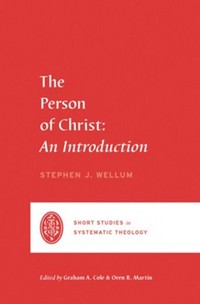
The Attributes of God: An Introduction by Gerald Bray: Sketching out The Essence of God and How He Relates to Us

The Attributes of God

The Attributes of God: An Introduction

by Gerald Bray
Series: Short Studies in Systematic Theology

Paperback, 109 pg.
Crossway, 2021

Read: July 11, 2021
Grab a copy from your local indie bookstore!

What’s The Attributes of God About?

While there are technically four chapters in this book, it’s really two–the first chapter introduces the concept of God’s attributes, where we got the idea, and so on. The last chapter endeavors to sketch out how these attributes are relevant to believers, why we should study and care about them.

The bulk of the book resides in the other two chapters–one what Bray calls God’s Essential Attributes, the second on what he calls His Relational Attributes. Typically, these are referred to as his incommunicable (omnipresence, omnipotence, omniscience) and communicable attributes (holiness, righteousness, goodness), respectively, but Bray has his reasons for changing the names and explains it (I’m not saying I’m dropping the usual labels myself, but I can appreciate his thinking).

Bray describes each attribute, what the Biblical justification is for ascribing it to God and relates it to the others. He even touches (it’s only an introduction, so he doesn’t get too far) on some of the historic discussions about the attribute.

So, what did I think about The Attributes of God?

There was a voice in the back of my head early on wondering if we needed this volume. Recent years have given us Mark Jone’s God Is…, Matthew Barret’s None Greater and Terry Johnson’s The Identity and Attributes of God, and a few others. Is there a place for Bray’s slim volume?

Of course—1. this series needs to address the topic and 2. contemporary Evangelicals have really dropped the ball on reflecting and applying that reflection on their theology and lives. We need more writing and thinking on these things which ought to characterize our thoughts not less.

Bray does a good job in introducing the notion here. Of the three I’ve read in this series, it’s the least accessible. But I’d argue that it’s still on the level with the others, you just might have to take your time with the occasional passage. These are deep waters that Bray is introducing the reader to, things that the Church has spent centuries establishing, and we need to at least see the immensity of the topic before we can say we are starting to understand it. It’s a short book and he has a lot to cover, so every word counts.

Another solid entry in this series. I’m appreciating the varied approaches and styles that the authors address their topics, while sharing similar concerns for theological method. I’m really glad that Crossway gave the green light to the Short Studies in Systematic Theology and hope it’s discovered by many. The Attributes of God: An Introduction is as good a place as any to dive in and see what it’s about.


4 Stars

This post contains an affiliate link. If you purchase from it, I will get a small commission at no additional cost to you. As always, opinions are my own.
Reposting Just ‘Cuz: Breaking the Lore by Andy Redsmith: A Funny, Fresh Take on a Police-filled Portal Fantasy

I’d planned on reposting this today to go along with my post about the sequel, Know Your Rites—it’s been so long since I posted this, I wanted to put it back out there. But now, I’m going to just repost this today and try to find the energy to follow up tomorrow. These are good books, you should check them out.


Breaking the LoreBreaking the Lore

by Andy Redsmith
Series: Inspector Paris Mystery, #1

eARC, 321 pg.
Canelo, 2019

Read: April 3 – 5, 2019

Inspector Nick Paris is your all too typical cynical, bitter, hard-drinking, chain-smoking police detective, and his world is being rocked. The latest corpse he’s been brought out to see and investigate the circumstances around the death is that of a fairy. The tiny, impossibly good looking, humanoid with wings kind of fairy. While still trying to wrap his mind around how that was possible, a crow (named Malbus) flies into his house demanding, demanding a smoke and talking to him about the murdered fairy. Not long after this, he’s visited by an elf and a rock troll (Tergil and Rocky).

And that’s just Day One of his new reality.

Essentially, there’s a connection between our world and the world of all these magical beings—a portal of sorts that those who desire to can travel between the two (or people and animals can stumble through unintentionally). For all sorts of great reasons, the magical creatures/folk kept their existence from humanity—and let what humans know fade into myth and legend. But something’s happened in their world, and those who are over here have to come seeking help (in terms of political asylum) and possibly even letting humanity in on what’s going on around them.

This is a little beyond Paris’ typical caseload, but he and his Superintendent, a no-nonsense woman named Thorpe, respond very well to these new challenges—dragging other officers and even the army along with them. They are obviously relying on the advice and guidance of the magical creatures—Tergil in particular (although Malbus makes sure his input is heard, too). They also recruit a local supernatural expert—Cassandra, a self-styled witch that no one in the police would’ve given any credence to if not for this new reality.

As fun as Paris, Tergil and Malbus are, Cassandra is a delight. She’s wise, insightful, and has a fantastic sense of humor—she might be harder for Paris to cope with than fairies, dwarves, and trolls. I shouldn’t forget Paris’ Sergeant Bonetti—he’s loyal, strong, brave, and probably not as mentally quick as he should be. He’s also the target of near-constant mockery from his superior. I’m not sure why he puts up with the abuse, but I found myself laughing at it. When the fate of multiple worlds is on the line, it’s these few who will stand strong in Manchester, England to keep everyone safe.

I can think of as many reasons that this is a lousy comparison to make as I can to make it—but throughout Breaking the Lore I kept thinking about Chrys Cymri’s Penny White books. There’ll be a big overlap in the Venn diagram of Fans of Penny White and Fans of Inspector Paris. I’m sure there are other comparisons that are as apt, or more so—but this is the one that I kept coming back to for some reason.

I had so much fun reading this book, Redsmith has a way with words that makes me think it really doesn’t matter what story he decided to tell—I’d want to read it. He was able to express the seriousness of the situation, while never stopping (either narratively or through the characters) the quips, jokes, and sense of fun. There’s an infectious charm to the prose and characters that easily overcomes whatever drawbacks the novel has. I’m not saying this is a novel filled with problems, it’s just that I wouldn’t care about most of them thanks to the voice.

Now, Redsmith’s wit does have an Achilles’ heel—puns. Redsmith is an inveterate punster, and will hit you with them when you least expect it. Now me? I love a good pun—and I hate them at the same time. Maybe you know what I mean. I cackled at pretty much all of them (frequently audibly), but I hated both myself and Redsmith for it. You know those Pearls Before Swine strips where Rat beats up Stephan Pastis because of the very carefully constructed pun? Yeah, this book is a series of those moments (but he rarely gives the setup Pastis does, usually it’s a quick sucker punch).

There are many other points I’d intended to make, but I think I’ve gone on long enough. This novel is silly, goofy, intelligent, charming—with a fresh take on a great idea. You’ll find yourself enjoying Paris, Cassandra, Malbus, Tergil, and the rest. I can see a few different ways that Redsmith takes Book Two, and I’m looking forward to seeing which one he picks (probably none of my ideas). But before that happens, I’m just going to relish the fun that Breaking the Lore was and encourage you all to go buy and read it for yourself.

Disclaimer: I received this eARC from Canelo via NetGalley in exchange for this post — thanks to both for this.

—–

4 Stars

Page 29 of 88

Powered by WordPress & Theme by Anders Norén