Tag: 4 Stars Page 30 of 88

Foundations of Covenant Theology by Lane G. Tipton: A Fascinating Approach to Genesis 1-3

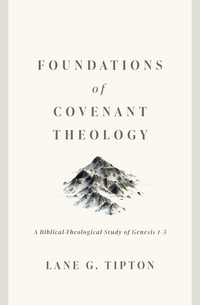
Foundations of Covenant Theology

Foundations of Covenant Theology:
A Biblical-Theological Study
of Genesis 1–3

by Lane G. Tipton

Paperback, 131 pg.
Reformed Forum, 2021

Read: July 4, 2021

What’s Foundations of Covenant Theology About?

In 2019, Lane Tipton gave a series of lectures for a Reformed Forum seminar on covenant theology. Tipton’s now turned these lectures into “a brief and non-technical” book, suitable for private use or as a supplement to a Sunday School class, building on the work of Geerhardus Vos and Meredith G. Kline.

I really don’t like it when I don’t provide my own summary/synopsis, but after a few attempts, I’m bailing. Primarily because my attempts ended up 2-3 times long as what’s on the back of the book/Reformed Forum’s website. So…why bother reinventing the wheel, if I’m just going to make it bloated and cumbersome?

Drawing from Genesis 1:1 and subsequent biblical revelation, Lane Tipton argues that before creating the visible world, the immutable triune God created a heavenly temple dwelling, filled that heavenly dwelling with the unchanging glory of his Spirit, and sanctified that heavenly dwelling as the realm of everlasting Sabbath rest.
Adam, as the created image of God and federal head of his posterity, could have advanced through perfect covenantal obedience beyond probation on the mountain of God in earthly Eden into the heavenly dwelling of God in Sabbath rest. This God-centered and heaven-focused theological backdrop enriches our understanding of the person and work of Jesus Christ, as the second and last Adam in the covenant of grace, who in his humiliation and exaltation has opened the gates of heavenly paradise for his church.

Vocabulary and a Glossary

This is a non-technical book as Tipton says in the preface. But at a glance, you’d be tempted to think otherwise. Tipton has a very precise and erudite vocabulary, and it’s in full view here. Where some writers will (unintentionally) obfuscate with their language, Tipton’s doesn’t do that at all. I find his style and word choice to helpful—once you get used to it (and it doesn’t take long), you don’t even notice that it’s not your run-of-the-mill non-technical language.

There are concepts and phrases he uses throughout that he wants to highlight, and they’re included in a Glossary at the end of the book. There were a few he used in the text that I’d have liked a bit more detail on, but it’s clear that he uses the Glossary to focus on the vital concepts to his argument. I wish more people would do things like that.

So, what did I think about Foundations of Covenant Theology?

I’ve lost track of the books/chapters I’ve read that serve as an introduction to Covenant Theology in the last couple of decades. Yet I keep reading them (and, largely, enjoy and profit from them). This is a different way of covering these concepts and it’s a very effective one.

It’s also a different way of looking at Genesis 1-3. Almost every time I’ve seen these chapters explained and exegeted, it had to do with the doctrine of Creation, the Fall and the Promise of the Seed in Genesis 3, and so on. But Tipton’s approach—while addressing all that—focuses on the Big Picture, looking at the purposes behind Creation, the protoevangelium, the Covenants of Work and Grace, and how those are worked out in history (particularly in the last two chapters about Christ as the Promised Seed and the Second Adam).

Would I have liked this book to be longer and these brief chapters to be expanded—making this still non-technical, just not brief. If this had taken me a few hours to read rather than just an afternoon, I’d have been happier. But…this was a fascinating book, a helpful read, and I know I’ll profit from meditating on and returning to these concepts. You really should try this one yourself, you’ll be rewarded for it.


4 Stars

PUB DAY REPOST: Dog Eat Dog by David Rosenfelt: Man Defends Dog, Andy Carpenter Defends Man

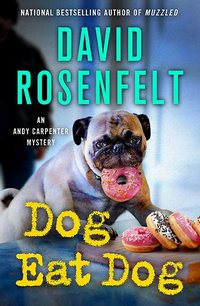
Dog Eat Dog

Dog Eat Dog

by David Rosenfelt
Series: Andy Carpenter, #23

eARC, 304 pg.
Minotaur Books, 2021

Read: June 24, 2021
Grab a copy from your local indie bookstore!

What’s Dog Eat Dog About?

Coming home from a walk, Andy and Laurie see a man abusing his dog across the street. Before they can intervene someone else jumps in to defend the dog (and it’s probably good for the abuser that it happens before Laurie can get her hands on him). Both the man who protected the dog and the man who attacked it are arrested—but the way the defender reacts, Andy’s sure it’s about more than just the assault.

It turns out that this man, Matthew Jantzen, had used one of those online genetic tracing sites to try to find out if his father had left other kids when he died (Jantzen is pretty sure he did). This allows him to track down a half-sister and to put his DNA in a place where law enforcement can see it and compare that DNA to what was found at the scene of a murder. Jantzen knew it was coming (the police had visited his sister about the time of the murder a few years ago), but had hoped to avoid having to deal with it.

Andy just can’t figure out why someone who was wanted by the police would expose himself the way Jantzen did when he protected the pug. So he has to learn more about Jantzen. Then he finds himself going to the town in Maine where the killing took place to help secure legal counsel on Jantzen’s behalf. One thing leads to another, and Andy ends up in court defending Jantzen.

Little by little, Andy’s team comes to join him in Maine, investigating the things the police were supposed to take care of. They find themselves looking into a mess of drugs, racist militias, and hard-to-explain DNA evidence.

How Did Rosenfelt Make It This Long?

Given the number of Dog-themed and Dog-Pun-Filled titles in this series, how has he not used Dog Eat Dog until book 23? Even if you subtract the holiday-themed titles, it’s still nineteen novels without using it. You have to admire the restraint he’s shown up to now.

Stranger in a Strange Land

Unless I’m forgetting something, this is the second time that Andy’s taken on an out-of-state client (the last time was in 2007’s Dead Center, the fifth book in the series). When he arrives in Maine he learns three things quickly: the people are friends and welcoming, the lobster rolls in Maine are a wonderful thing; just about everyone is convinced Jantzen did it, no matter what the big-shot New York lawyer says (he seems incapable of convincing anyone he’s from New Jersey).

Andy has to employ a local lawyer for the purposes of the trial and hires a criminal defense attorney Charlie Tilton. Tilton has no desire whatsoever to take on Jantzen’s case himself—but is perfectly content to take Andy’s money to help out. He ends up taking on the role of Eddie Dowd, Kevin Randall, or Hike Lynch—he does the paperwork, legal research, and so on while Andy investigates, annoys the judge, and needles the prosecution. Charlie’s pretty normal compared to the rest, maybe a little more mercenary than the others, but that’s about it. It was a refreshing change (but I’m ready to see Eddie Dowd again).

It’s nice seeing Andy in a new setting, unable to rely on his media and police contacts, etc.

So, what did I think about Dog Eat Dog?

This is the second David Rosenfelt book I’ve read in 2021—there’s one more to go (The holiday-themed novel). How he’s able to write three solidly entertaining, frequently humourous, complex mystery novels in a year is mind-boggling. Once again, I thought I knew where Rosenfelt was going with the case and was ready for it—and then Rosenfelt pulled a rabbit out of his hat and I was caught unprepared a couple of times to see where he went.

I loved some of the recurring jokes in this-both those exclusive to this novel and some that are ongoing over the years.

There are series out there that ebb and flow in terms of quality—I don’t think these books have done that—truly impressive at the 23rd book. You know what you’re going to get when you crack open a David Rosenfelt book—and I’m so glad he continues to deliver.

Solid courtroom action, some good out-of-court detection, plenty of fun with characters old and new—particularly with Andy’s narration. These can be read as stand-alones or as part of a series. Either way you go—you’ll be happy you tried this.

Disclaimer: I received this eARC from St. Martin’s Press via NetGalley in exchange for this post—thanks to both for this.


4 Stars

This post contains an affiliate link. If you purchase from it, I will get a small commission at no additional cost to you. As always, opinions are my own.

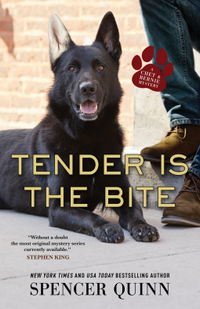
Tender is the Bite by Spencer Quinn: Will Chet Share Bernie with a Ferret?

Tender is the Bite

Tender is the Bite

by Spencer Quinn
Series: Chet and Bernie, #11

eARC, 272 pg.
Forge Books, 2021

Read: June 25-28, 2021
Grab a copy from your local indie bookstore!

What’s Tender is the Bite About?

A young woman—a frightened young woman—approaches Bernie, she needs help. But before she explains herself, something spooks her and she leaves.

Curious, Bernie starts looking for her—and stumbles into the middle of a situation involving stalking, murder, dog-napping, and all sorts of other things. There’s an international aspect of this—but it’s a very local story. There’s a lot to chew on, a lot to talk about—but all of it is in spoiler territory, so I’m going to leave it at that.

Approaching the Political

This is the second time in a week that I’ve said something along those lines, and it’s a bit strange. Chet and Bernie keep finding themselves in the neighborhood of a senate election. The case brings the two of them across the path of both candidates (one of them repeatedly). But it’s closer to home than that—Bernie’s neighbors on either side are very invested in this campaign and their enthusiasm spills over onto the a-political P. I. (or so he tries to be)—at least at one point, one neighbor’s has a considerable blow-back on Bernie’s investigation. This is a new thing for Quinn to dabble in and he does it well.

If you don’t catch the parallel between this campaign and the way people are behaving during it and…well, all of American politics right now. Quinn gives us some pretty good commentary to chew on.

Non-Chet Animal Characters

Sure, we’ve got Chet’s friend, Iggy doing his thing. But we have more animal guest stars. There’s a dog—who could be Chet’s sister (or niece), and I really hope we get to see more of her.

But the big guest star is a ferret. A ferret named Griffie—without Griffie it’s hard to say if Bernie’d been able to very far with things. Chet can’t stand ferrets, or so he repeatedly says…I’m not sure about Griffie, though.

Chet talking about adults, criminals or otherwise, is a lot of fun. Chet talking about kids is simply fantastic. But Chet talking about other animals is a different kind of fun.

A Little Light Gets Shed on Certain Events

For ages now—possibly since the first book, definitely since the second or third—Chet’s been alluding to a case that didn’t end well. He’s given us a little more information here and there about it, but never much. That ends now. Chet tells us some about it. Bernie tells someone else about it. We even get some hints from other characters about it.

I don’t know why Quinn’s decided now is the time to start clueing us in, but I’m so glad he did. We didn’t get the whole story—I don’t know if we will (and I’m not sure I care)—but we got a lot of it, and that’s enough for now.

The Trick to These Books

This is tied to the above point. The trickiest part about reading Chet as a narrator is that he doesn’t understand what he’s telling you, and because of that he leaves a lot out. He’s the best kind of unreliable narrator—he’s well-intentioned and honest, he believes what he’s telling us and he thinks he’s giving us all the information.

What that means for the reader is that we have to think a little more about what he’s saying, we have to do almost as much detective work as Bernie to understand what’s really going on. Which is just so much fun, really. Sure, you might spend a couple of chapters with the wrong idea, but Quinn doesn’t let you keep the wrong idea for long.

I need to spend time writing about this every time I talk about a Chet and Bernie book—I need to do better at this, but it’s hard. If I could describe it better, I’d probably get paid to do this stuff.

So, what did I think about Tender is the Bite?

Yes, Quinn gave us a great pair of characters that we love in Chet and Bernie. He gives us a good story. He plays with the unreliable narrator to reveal what he really wants to say. Put it all together and he gives us another great read in one of the most reliably satisfying series in print.

Read this one. If this is your first time with Chet and Bernie, go back and read the rest after it. You’ll be glad you did.

Disclaimer: I received this eARC from Macmillan-Tor/Forge via NetGalley in exchange for this post—thanks to both for this.


4 Stars

This post contains an affiliate link. If you purchase from it, I will get a small commission at no additional cost to you. As always, opinions are my own.

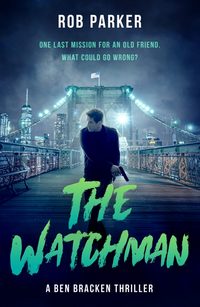
The Watchman by Rob Parker: Ben in the U.S.A.

I had a little trouble finishing this on time, and hope it’s mostly coherent and typo-free. Just to be on the safe side, let me give you a quick synopsis of what follows: The Watchman is great stuff. You should go buy it now. Then come back and read what I have to say.
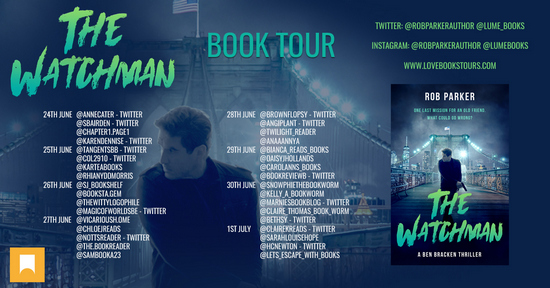
The Watchman Tour Poster

The Watchman

The Watchman

by Rob Parker
Series: Ben Braken, #5

Kindle Edition, 259pg.
Lume Books, 2021

Read: June 29-30, 2021
Grab a copy from your local indie bookstore!

At some point, later, I’ll have to have a word with myself about how it got to this, but sometimes your hand is forced. There’re goodies, baddies, your side, their side. Winners get to go home, losers get dead.

And I’ve got a family I need to get back to.

What’s The Watchman About?

Ben’s benefactor, protector, ally, and almost-father-figure, William Grosvenor comes to him for a favor: go to New York and get an envelope for me. Ben can’t know what’s in the envelope, he just needs to bring it back. Grosvenor throws in an obscene payday to sweeten the deal.

Ben really doesn’t want to do this—he wants to stay at home with Carolyn and the kids. But it’s not the kind of money you can walk away from—especially with three kids to provide for—and that’s assuming Ben’s sense of duty wouldn’t oblige him to answer Grosvenor’s request.

Almost everything you can think of going wrong once he had the envelope goes wrong. Ben and his American contact find themselves on the run, they’re just not sure who from, they only know they have guns and aren’t afraid to use them. But soon, Ben’s able to summarize things like this:

This is turning into something preposterously big. The FBI, the CIA, the Secret Service, maybe Russia and perhaps my own countrymen back home – all wanting the contents of one little envelope.

Ben neglected to mention a New York Crime Family in his list, which is odd, as he says this to their head (but maybe he assumes she’s aware that she’s one of those making the situation preposterously big).

Ben and the American stay one step ahead of all these groups (by the skin of their teeth) all over an envelope they don’t understand the significance of. They move from NYC quickly to another state, and then another…and well, you get the idea. The chase is lethal, demanding, and quite likely full of treachery.

Something New in Parker’s Arsenal

In last year’s Far from the Tree, Parker used multiple perspectives quite effectively. But in the Ben Bracken series, it’s all been Ben’s first-person point of view up until this point. In The Watchman, he sprinkles in some chapters in the third-person. These chapters follow a figure called Sinclair, and it’s a long time before we have any idea about the connection between the envelope and Sinclair. But you know that he’s important right away.

It’s always risky (I think) when an author starts putting third-person chapters in a first-person narrator’s book. Parker’s use is effective, you want to know more about Sinclair—you want to understand what he’s up to and to learn more about him in general, with the curiosity about how he ties into the envelope coming in third place to the others. All three items are covered in these pages, thankfully, leaving no lingering questions.

Ben in the U.S.A.

My smile broadens irrepressibly. There’s something about this country that, while I can’t quite put my finger on it, I really enjoy. The expanse maybe. The freedom of choice. The sensation that you can have it all. No wonder immigrants have flocked to it in their droves, drunk on the idea of streets paved with gold.

Equally entertaining—and far less stressful than the rest of the book—is watching Ben’s reactions to America. He has great comments about NYC, our roads, cars, food, politics, and so on.

Ben’s been around a bit, he’s seen things, and can come across as fairly jaded sometimes. It takes a lot to impress him. Until he enters the U.S. for the first time, and then almost all of that is stripped away.

One of my favorite examples is his reaction to the idea of fried gator on a menu—both before and after ordering it—it’s just great. I wish we could read more of Ben reacting to American restaurant fare.

Actually, that’s a great idea for a short story—Ben uses some of the money he makes in this novel to bring Carolyn and the kids on an American vacation. There’s no death, no fights, no danger—just them touring a few states and eating strange things.

The Thing I Cannot Talk About

For a while, you start to wonder if the envelope is the equivalent of Marsellus Wallace’s briefcase—inside it is something that everyone wants, but no one will tell you what it is. Thankfully, that ends at some point and we get to look into it.

The contents of the envelope—and here’s where I have to be careful what I say—indicate something that’s a frequent idea in Fiction—Fiction of various genres, not just Crime Fiction. I hate it. Really. It’s over-used. Usually not used well and/or interestingly. I also usually find it fairly distasteful, yet dull. I’ve complained about it elsewhere on this blog in less-spoilery circumstances. I can count on the fingers of one hand the number of times I’ve seen it used well or interestingly—and would still have a few phalanges to spare.

That said? In The Watchman, Rob Parker pulls it off. I bought it. I was curious. I got over my initial groan once and enjoyed it. I wish I could say more, but I really can’t. So let me just say that for me, Rob Parker pulled off a feat here that few have, and should be applauded for it.

So, what did I think about The Watchman?

I started this week talking about how much of an improvement the fourth book in this series was over the others. This book is similarly an improvement over the fourth. It was just great.

For those who might care, this novel features two of the most disgusting deaths I can think of. I don’t mean to put anyone off from reading this—just know that there are two or three paragraphs you may want to skim and not think too hard about. Thomas Harris and M. W. Craven need to work a little harder to assert their dominance in the area.

There’s a reveal towards the end, that I sincerely hope wasn’t supposed to be shocking, because I think Parker pretty well telegraphed it from the opening chapters of the book. It makes sense that it shakes the characters in the novel, but no one who reads the book should be surprised (although I’m glad Parker revealed this later in the book, rather than spelling it out in a descriptive passage toward the top of the book.

Do you need to have read the previous four novels to appreciate this one? Nope. It can be read as a stand-alone, but it helps if you have read them so you understand what drives Ben—what keeps him moving forward and helps him get through the discouraging, political, or dangerous parts of his job. All that will come through if this is your first exposure to Ben, but not quite as clearly.

Parker’s outdone himself here—it’s tense, twisty, and compelling. Even when dealing with things that frequently make it hard for me to finish a book, Parker’s writing and pacing kept me turning the pages. In the end, The Watchman is going down as one of my favorite thrillers of 2021. Do yourselves a favor and pick it up.


4 Stars

This post contains an affiliate link. If you purchase from it, I will get a small commission at no additional cost to you. As always, opinions are my own.

My thanks to Love Books Group for the invitation to participate in this Tour and the materials they provided.


Love Books Group

Dog Eat Dog by David Rosenfelt: Man Defends Dog, Andy Carpenter Defends Man

Dog Eat Dog

Dog Eat Dog

by David Rosenfelt
Series: Andy Carpenter, #23

eARC, 304 pg.
Minotaur Books, 2021

Read: June 24, 2021
Grab a copy from your local indie bookstore!

What’s Dog Eat Dog About?

Coming home from a walk, Andy and Laurie see a man abusing his dog across the street. Before they can intervene someone else jumps in to defend the dog (and it’s probably good for the abuser that it happens before Laurie can get her hands on him). Both the man who protected the dog and the man who attacked it are arrested—but the way the defender reacts, Andy’s sure it’s about more than just the assault.

It turns out that this man, Matthew Jantzen, had used one of those online genetic tracing sites to try to find out if his father had left other kids when he died (Jantzen is pretty sure he did). This allows him to track down a half-sister and to put his DNA in a place where law enforcement can see it and compare that DNA to what was found at the scene of a murder. Jantzen knew it was coming (the police had visited his sister about the time of the murder a few years ago), but had hoped to avoid having to deal with it.

Andy just can’t figure out why someone who was wanted by the police would expose himself the way Jantzen did when he protected the pug. So he has to learn more about Jantzen. Then he finds himself going to the town in Maine where the killing took place to help secure legal counsel on Jantzen’s behalf. One thing leads to another, and Andy ends up in court defending Jantzen.

Little by little, Andy’s team comes to join him in Maine, investigating the things the police were supposed to take care of. They find themselves looking into a mess of drugs, racist militias, and hard-to-explain DNA evidence.

How Did Rosenfelt Make It This Long?

Given the number of Dog-themed and Dog-Pun-Filled titles in this series, how has he not used Dog Eat Dog until book 23? Even if you subtract the holiday-themed titles, it’s still nineteen novels without using it. You have to admire the restraint he’s shown up to now.

Stranger in a Strange Land

Unless I’m forgetting something, this is the second time that Andy’s taken on an out-of-state client (the last time was in 2007’s Dead Center, the fifth book in the series). When he arrives in Maine he learns three things quickly: the people are friends and welcoming, the lobster rolls in Maine are a wonderful thing; just about everyone is convinced Jantzen did it, no matter what the big-shot New York lawyer says (he seems incapable of convincing anyone he’s from New Jersey).

Andy has to employ a local lawyer for the purposes of the trial and hires a criminal defense attorney Charlie Tilton. Tilton has no desire whatsoever to take on Jantzen’s case himself—but is perfectly content to take Andy’s money to help out. He ends up taking on the role of Eddie Dowd, Kevin Randall, or Hike Lynch—he does the paperwork, legal research, and so on while Andy investigates, annoys the judge, and needles the prosecution. Charlie’s pretty normal compared to the rest, maybe a little more mercenary than the others, but that’s about it. It was a refreshing change (but I’m ready to see Eddie Dowd again).

It’s nice seeing Andy in a new setting, unable to rely on his media and police contacts, etc.

So, what did I think about Dog Eat Dog?

This is the second David Rosenfelt book I’ve read in 2021—there’s one more to go (The holiday-themed novel). How he’s able to write three solidly entertaining, frequently humourous, complex mystery novels in a year is mind-boggling. Once again, I thought I knew where Rosenfelt was going with the case and was ready for it—and then Rosenfelt pulled a rabbit out of his hat and I was caught unprepared a couple of times to see where he went.

I loved some of the recurring jokes in this-both those exclusive to this novel and some that are ongoing over the years.

There are series out there that ebb and flow in terms of quality—I don’t think these books have done that—truly impressive at the 23rd book. You know what you’re going to get when you crack open a David Rosenfelt book—and I’m so glad he continues to deliver.

Solid courtroom action, some good out-of-court detection, plenty of fun with characters old and new—particularly with Andy’s narration. These can be read as stand-alones or as part of a series. Either way you go—you’ll be happy you tried this.

Disclaimer: I received this eARC from St. Martin’s Press via NetGalley in exchange for this post—thanks to both for this.


4 Stars

This post contains an affiliate link. If you purchase from it, I will get a small commission at no additional cost to you. As always, opinions are my own.

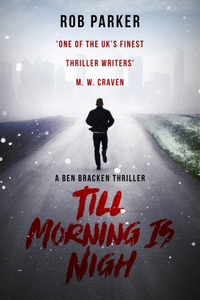
Till Morning is Nigh by Rob Parker: It’s Not Quite the Employee Party in Nakatomi Plaza, But It’s Close

Till Morning is Nigh

Till Morning is Nigh

by Rob Parker
Series: Ben Braken, #4

Kindle Edition, 267 pg.
Lume Books, 2019

Read: June 21, 2021
Grab a copy from your local indie bookstore!

I’ve never been at a large crime scene before, moreover I’ve usually been part of their creation and have high- tailed it before the flashing lights showed up. Consequently, this is interesting. It’s a hub of activity, of urgency, of constant footsteps and the cold crackle of static.

I take a moment, and feel it.

What’s Till Morning is Nigh About?

So Ben’s got a day job (under an assumed name) working with the National Crime Agency. He’s doing some data entry work, some number crunching—and theoretically, he’s around to impart some of his special knowledge when needed.

The NCA is focused on a sudden upsurge in the drug trade in Manchester (which had experienced a good drop in criminal activity after the last time Ben was in town). So they’ve sent in an Undercover Officer. When we start this novel, that officer is dead—in a particularly vicious killing, almost performative. Ben accompanies some of his colleagues to the Crime Scene (his first out-of-the-office work), which leads to some more time out of the office—and eventually, fieldwork.

If you’ve read any of the Ben Bracken works, you have a pretty good idea what follows his being given a Field Work assignment. If you haven’t read any of these—let’s just say there are many bullets, probably some explosions, some hand-to-hand combat, and a decent number of people who end up bloody and beaten (very possibly Ben).

DCI Okpara, Maasai Warrior

There are a lot of new characters introduced in this book—and I”m not just talking suspects/targets for Ben, but allies, colleagues, etc. But DCI Okpara stands out—I’m not going to describe him much, because that’s the kind of thing that ruins the effect of meeting him in the novel. And really, who needs more than “DCI” and “Maasai Warrior” referring to the same character to not want to know more?

There’s just something special about this guy—he’s the second character this year that I’d love to see as the subject of a spin-off series. I know I’d buy at least the first three installments.

Back to His Roots

Circumstances have brought Ben back to Manchester where we first met him. I’m a little troubled about some of the details on that front, I realize as I write this, but that’s neither here nor there.

He’s back because he recognizes one of the main suspects for the killing–someone he met in A Wanted Man, other experiences he had in that novel pave the way for him to be a very effective presence for the NCA for the case. Bringing him back to the beginning at this point works well, both in terms of story and character.

I Didn’t See That Coming

Jack Reacher, Zeb Carter, Orphan X, Peter Ash–and all the other lone gunman/vigilante/hero types you can think of along these lines—have a few things in common beyond their uncanny fighting abilities and high body counts. One of those is lack of a day job—but Ben breaks the mold a little here. As I said, he has a job as a consultant for the National Crime Agency. No running around three steps ahead of the law for Ben, he is the law. Or at least consults for it.

The other relates to thing these characters have in common relates to a personal life—and wow, you’re not going to believe what’s going on for Ben there.

Approaching the Political

Ben gets a little political in response to some of what he’s forced to listen to over the course of this novel, but not much—and it’s not that preachy. But Ben does end up spending time around a group dedicated to getting Britain “back” to a purer state (read: white), which was a little hard to read*. It frequently reminded me of a UK version of Ace Atkins’ Tibbehah County.

* Just to be clear, it’s ard to read because Parker does a good job portraying that kind of bigot, not that he or Ben are bigots.

Of course, this group had a plan to take over the UK government as a means to get that pure UK. Over the last 2 years, I’ve read more books where a militant and powerful group wants to take over the British government and clean up society. This is the first one that seemed plausible—the one that might actually work in the real world. And that’s terrifying.

So, what did I think about Till Morning is Nigh?

There is indeed more than a few things that are extremely horrible about the way that the man has been quite clearly executed, but too many times I have witnessed human life reduced to nothing but tissue and pulp, the romance of the miracle of life lain exposed for what it really is. Each time I have seen someone split asunder, their contents revealed, what comes out of the person is always the same as the last. Blood and organs arranged artfully on bone. No myth, no mysticism. We are made of soft material that splits and spills, nothing more.

This. This novel right here is the payoff to the potential I saw in Ben Bracken back in A Wanted Man—I liked it, and the novels that followed, but I didn’t think they were everything the character could be. This is exactly the kind of thing I thought Ben could be, and probably a little more. Sure, Parker’s more than capable of writing a better thriller, and there’s room for Ben to grown and/or develop—I’m not saying this is the definitive Rob Parker/Ben Bracken. I’m just saying that this surpasses everything that’s come before.

I’m curious about what happens to those behind the death of the UC officer in general—but don’t foresee Parker spending time on that in the future. I’m very curious about the fallout from this on Manchester and the NCA team Ben’s associated with—assuming Parker decides to let us see that. But mostly, I can’t wait to see what comes next for Ben, in terms of story and quality. Thankfully, the next book of the series is out and I can jump into that in a day or so.*

* Also, I have to—I have a Book Tour spot for the next book on July 1. But I probably would’ve jumped in this week anyway.

Can you jump on at this point? Yeah, you could. I do think it’s worth it to get a running start with the earlier books in the series, but it’s not a deal-breaker either way. The main takeaway from this post should be that if you want to see a Thriller writer doing just about everything right and seeming to have a lot of fun with it while he’s at it—grab Till Morning is Nigh.


4 Stars

This post contains an affiliate link. If you purchase from it, I will get a small commission at no additional cost to you. As always, opinions are my own.

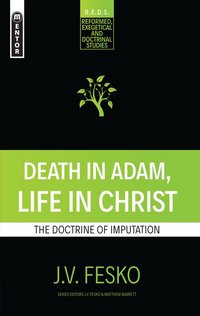
Death in Adam, Life in Christ: The Doctrine of Imputation by J. V. Fesko: Careful Words on an Important Topic

Death in Adam, Life in Christ

Death in Adam, Life in Christ:
The Doctrine of Imputation

by J. V. Fesko
Series: Reformed Exegetical and Doctrinal Studies

Paperback, 280 pg.
Mentor, 2016

Read: May 23-June 21, 2021

What’s Death in Adam, Life in Christ About?

The Back of the Book:

The doctrine of imputation is the ground in which salvation is rooted. It centers around the three great ‘assignments’ of the Bible:

  • Adam’s original sin assigned to mankind
  • The sins of God’s people assigned to Chrsit
  • And Christ’s righteousness assigned to all of His people.
    This doctrine is often seen as superfluous or splitting hairs, and yet, without it, redemption automatically becomes reliant on our own works and assurance of salvation is suddenly not so sure.J. V. Fesko eloquently and systematically works through this doctrine, looking at its long history in the church, its exegetical foundation, and its dogmatic formulation. In exploring imputed guilt from the First Adam alongside the imputed righteousness from the Second, this volume offers a helpfully well-rounded explanation of the doctrine.

Fesko starts out by sketching the doctrine and how he’s going to approach the argument. He then discusses the history of the doctrine, how the Church has discussed this from the Early Church through to the present—this takes about half the book. Then we get two carefully structured chapters looking at Imputation in the Old and New Testaments. He wraps things up with a long chapter that brings all the data together to lay out a doctrine of Imputation that reflects the exegesis and honors the best of the history.

So, what did I think about Death in Adam, Life in Christ?

I’d been wanting to try the R.E.D.S. series for a while, but hadn’t taken the leap. When Jonathan Landry Cruse cited this in The Christian’s True Identity, I figured this was the way in. This volume speaks well for the series.

If J. V. Fesko convinces you to embrace his position on something it won’t be through soaring rhetoric, emotional ploys, or charm and wit—it’ll be because he’s right. I’m not saying that Fesko drains all the life and verve out of important and interesting topics; but if you said it, I wouldn’t argue. It’s dry, it’s careful, it’s painstaking. It’s also very good.

These are important ideas, difficult topics, and they should be talked about as if they are. This is what Fesko does.

The historical overview was helpful and informative. The exegetical chapters were great. The doctrinal chapter and conclusion? Gold. It’ll take work and perseverance, but if you want to understand this vital doctrine, I can’t think of a better way.


4 Stars

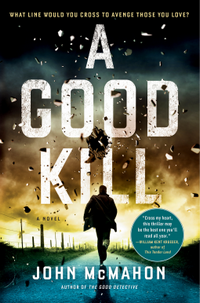
A Good Kill by John McMahon: Crimes New and Old Rock a Small City

A Good Kill

A Good Kill

by John McMahon
Series: Detective P.T. Marsh, #3

eARC, 384 pg.
G.P. Putnam’s Sons, 2021

Read: June 11-14, 2021
Grab a copy from your local indie bookstore!

What’s A Good Kill About?

We open P.T. Marsh and his partner, Remy, on the grounds of a high school where an active shooter has taken some hostages. The two of them are able to bring things to a swift resolution, gaining them praise as heroes. The question stops being “who could do this” and changes into a “why did someone do this.”

Due to the staff size for this small city and that there are other crimes that need investigating, P.T. and Remy have to look into a double homicide while the other partners continue to follow up on the shooter. It’s this crime that provides most of what P.T. and Renee to go down a rabbit hole of corruption—one that might tie into the killing of his wife and son a few years back. Even if it doesn’t—it certainly ties into several deaths, drug use/sales, and other crimes.

A Word About the School Shooting

As we talked about in the Q&A yesterday, mass shootings in general—but specifically school shootings—are about as controversial as anything in American culture today. As they should be, I think I can say without getting into it. And some readers might be put off of the book because of that, this would be a mistake. First, because as McMahon said, “the subject is not entered into divisively or politically.”

Secondly, while the book starts with the school shooting—it’s not what the book is about. It’s the instigating event. It casts a shadow over everything that happens in the days following it for P.T. and the rest of Mason Falls. You can’t get away from it for long (but there are a few pages every now and then that might draw your attention away from it).

It reminded me of the Ian Rankin novel A Question of Blood, where Rebus is called to come help a friend look into a school shooting, and it turns out to be about a lot more than that. The two books approach the subject differently and go in different directions with it. But that doesn’t stop the reader from thinking about them at the same time.

Wait—You Can Do This In a Procedural?

P.T. and his partner Remy get along—they spend time with each other outside of work. Yes, they disagree on some things, but there’s a mutual affection and respect. In fact, that carries through the department—detectives and uniformed officers, every detective, even the Chief and everyone else—they look out for each other, support and help each other.* There’s no petty jealousies coloring things, no rivalry, no behind-the-scenes machinations. I cannot think of another police procedural like that, what a refreshing change.

* Okay, the Force Investigation Unit detective has something against P.T.

Now, there are politicians at various levels and federal agents from a couple of agencies—so I’m not suggesting it’s all rainbows and unicorns. In fact, things get pretty nasty on these other points. So it’s not like P.T. has nothing to worry about or put up with.

Jumping On At This Point

This is a tricky one to jump into the series with—McMahon says that he treated the three books as a series, and so jumping on with the third book brings some challenges. And no matter how well he blends in the details about what happened in the first two books, readers like me are going to miss something. But McMahon does a great job in giving you enough information from the first two books that you can jump in and get almost all the weight of the first two books on P.T. and the rest. I knew I missed out on some of the nuances, but I had no problem following things or caring about the way he wraps up this trilogy within a series.

I’m not convinced I could go back and read the first two at this point, I should add. But you never know…

Purvis!

Purvis is an eight-year-old bulldog, who had been P.T.’s son’s pet but is now P.T.’s. Not only is he good for comic relief. P.T. bounces a lot of ideas off of Purvis, who is just the listener P.T. needs. It was a really good depiction of a man and his pet, and you all know I’m a sucker for that kind of thing, and Purvis is off to a commanding lead in my “Favorite Pets of 2021” race.

There’s another dog, who seems like an adorable handful, in this book, and in P.T.’s life now. He seems like he could be a fun cast member—but the star of the K-9 action is Purvis. Still, I hope I get to see both of them again soon.

So, what did I think about A Good Kill?

There’s very little about this book that didn’t work for me—great characters; solid, twisty story; some strong action scenes; and believable criminals around at every stage. There’s more than your daily minimum requirement of fictional emotions—P.T. and Remy are put through the wringer, and you feel it at every step of the way. Which just makes the ending of the book so much more meaningful, even to people who hadn’t read the two previous books. You name it, McMahon provides it in one way or another.

All of this just makes this Crime Fiction reader all sorts of happy.

Grab this one, or the first in the trilogy, The Good Detective. You won’t regret it.

Disclaimer: I received this eARC from PENGUIN GROUP Putnam via NetGalley in exchange for this post—thanks to both for this, and to Wiley Saichek and Saichek Publicity for bringing it to my attention.


4 Stars

This post contains an affiliate link. If you purchase from it, I will get a small commission at no additional cost to you. As always, opinions are my own.

Meat is Murder by Chris McDonald: Adam and Colin Look into an Activist’s Death

Meat is Murder Tour Banner

Meat is Murder

Meat is Murder

by Chris McDonald
Series: The Stonebridge Mysteries, #3

eBook, 142 pg.
Red Dog Press, 2021

Read: June 10, 2021
Grab a copy from your local indie bookstore!

What’s Meat is Murder About?

Really, as with most of the investigation, he didn’t know what he was doing here. He was hoping that something would appear at his feet, or become luminous like in a video game, but he knew that wasn’t going to happen, so he got busy.

The amateurest of amateur detectives are back for another investigation. This time, it appears that a man died in setting fire to an abattoir in an act of protest. Hours earlier, he’d been part of a group that had chained itself to the front gates, interfering with a tour that a prospective buyer had intended to make. After that had been broken up by the police, the story goes, Tyler Love had come back to make a bigger and hotter statement and things had gotten away from him.

The police are done with the matter and have moved on. Tyler’s mom, on the other hand, wants some reassurance. So she convinces Adam to look into his death for her.

Speaking Ill…

‘Like I say, I don’t want to speak ill of the dead. All I’ll say is that he wasn’t well liked.’

‘By who?’

‘By most of the group…’

Tyler was not a good guy. In fact, outside of his mother, it’s difficult to find anyone who has a good thing to say about him. I’m enjoying the way that McDonald finds victims that the reader can have almost no sympathy for. None of these are hardened criminals, they aren’t the dregs of society, but they’re just…jerks. People that no reader is going to want to spend time with, generally fresh off of doing something no reader wants to associate themselves with.

So why do we care who killed them? Why do we care why they died? Because of these two yutzes who until recently were only good for playing FIFA and binging Netflix. They’re who make this series work, who make these stories interesting—the stories are good enough, but it’s McDonald’s work with these characters that brings readers back.

Incremental Growth

The feeling of pride he’d had at solving those cases had spurred him on to do something with his life. That something had turned out to be a garden maintenance business. It had started small; just him, his car, a lawnmower and a rickety trailer he’d managed to salvage from the dump.

Now, here he was, unloading tools from a van with his name and company logo on the side.

That point about “until recently” is the key—yeah, they still binge Sherlock, etc. They probably spend too much time playing FIFA even in this novella. But they’re stumbling into maturity.

Adam’s business is growing, and his relationship with his mother is much better than it was in the first novella. Colin’s still doing well at his job—and is even able to use his position to their advantage in this investigation—he’s again the one putting his health and well-being on the line while Adam’s off trying to learn something through questioning.

So, what did I think about Meat is Murder?

‘I don’t think I could handle any more excitement,’ Adam said.

‘I don’t think Stonebridge has any more to throw at us.’

‘You say that, but…

I continue to really enjoy this series—it’s a highlight of 2021 for me. And Meat is Murder is a great example of it.

Despite what Colin predicts—Stonebridge has more to throw at them. This is the most dangerous case these two have yet taken on, but that doesn’t stop it from being a little silly, a little fun, and very enjoyable.

It’s a quick, clever, and fun read that’ll keep you turning pages and make you regret that it’s over quite so soon. You should grab this one—and the other two if you haven’t yet—and join me in eagerly awaiting the next.


4 Stars

This post contains an affiliate link. If you purchase from it, I will get a small commission at no additional cost to you. As always, opinions are my own.

Red Dog Press
My thanks to Red Dog Press for the invitation to participate in this tour and the materials (including a copy of the novella) provided.

Million Dollar Demon by Kim Harrison: Cincy’s New Boss Vampire has Rachel on the Ropes

Million Dollar Demon

Million Dollar Demon

by Kim Harrison
Series: The Hollows, #15

eARC, 464 pg.
Ace, 2021

Read: June 3-7, 2021
Grab a copy from your local indie bookstore!

What’s Million Dollar Demon About?

It hasn’t been all that long for Rachel Morgan, but for her readers, it’s been ten books (and 14 years) since Cincinnati’s Master Vampire was killed. When this book opens, Constance, the new Master Vampire is days away from arriving to take over.

But she’s already exerting her influence to make things difficult for non-Vampire Interlanders in the city. From bogus evictions, trumped-up charges, intimidation, and just about everything else you can think of. There’s a certain common denominator among many of these targets—they’re tied in some way to Rachel. In more than a few cases, Rachel herself is clearly the target.

The message delivered is very clear—it’s time for Rachel to get out of town. Otherwise, Constance is going to make Rachel’s life miserable—and she’ll also target Rachel’s friends and families, their friends and families, and anyone that looks like might be sympathetic.

One of Rachel’s demon friends mentions an idea—it hasn’t been used recently but there is an old demon office called the subrosa—essentially the demon equivalent of the Master Vampire (there are nuances that I need to let you read for yourselves). Rachel initially blows off the suggestion to take up that mantle and from that position she can take on Constance, save some innocents and perhaps the city. But she keeps circling back to that idea, and her allies keep trying to talk her into it.

As a quick aside—Jane Yellowrock has a tendency to do things like this, too (I just finished revisiting Raven Cursed and the two reminded me of each other). It might not be a bad idea when someone mentions you taking up a title/position that you’ve never heard of to ask a few questions before you think about assuming the title.

Add in the ongoing drama with Trent and the Elves, the Elves fluctuating power structure, the changing relations between Elves and Demons, the Demons internal problems, Rachel’s problems with the Demons (and Al in particular), and…well, all the stuff that we all thought were pretty well settled until last year’s American Demon showed us we were wrong. Basically, there’s a lot going on.

Constance

The idea that the ruling Vampires named Constance as the City’s Master is pretty troubling. She is, to put it simply, bat guano crazy. I don’t remember a lot about her predecessor, Piscary, but I remember he was nasty and cruel. But Constance is a monster. She’s the kind of character that UF heroes are supposed to be focused on taking down, I wish Rachel had been quicker to step up (although I do understand her reasoning). I’ve been reading Urban Fantasy for about sixteen years, and I’ve seen a lot of nasty vampires (and other creatures), and Constance has got to be in the running for the worst.

But I’ve got to tell you, by the end of this book, I was convinced that her #2, Pike, is likely the vampire that’s the real threat. I’m wondering what you think.

So, what did I think about Million Dollar Demon?

I liked it. I had a lot of fun in these pages. And for a series as long-in-the-tooth as this one is, that’s saying something.

I didn’t get as thorough in this post as usually do and/or intended to. I had a few more notes that I wanted to cover, and I actually deleted 5 paragraphs from this because it just ended up being too vague to be of use—or all that interesting. Almost everything that I really wanted to chew on falls under what I’d call a spoiler.

Because there is a lot going on here—after shaking up the status quo in American Demon Harrison establishes—or at least starts to—a new status quo. She’s ignored Vampires for quite a while, and that’s over (and we shouldn’t expect that werewolves won’t stay out of the spotlight, either). I’m not convinced she’s pushing Elves or Demons to the back burner any time soon, but they’re going to have company on the front. How she’s going to keep all these balls in the air at the same time? I have no idea, but it’s going to be fun to watch.

Million Dollar Demon was exciting, there was plenty of drama, a lot of good action, and some important character growth—and as I said, it was fun. At the end of the day, that’s all I ask for.

Disclaimer: I received this eARC from Berkley Publishing Group via NetGalley in exchange for this post—thanks to both for this.


4 Stars

This post contains an affiliate link. If you purchase from it, I will get a small commission at no additional cost to you. As always, opinions are my own.

Page 30 of 88

Powered by WordPress & Theme by Anders Norén