Tag: 4 Stars Page 32 of 88

He Drank, and Saw the Spider (Audiobook) by Alex Bledsoe, Stefan Rudnicki: LaCrosse’s Break from His Vacation Changes History

Like with the previous Eddie LaCrosse audiobook, The Wake of the Bloody Angel, I can’t think of much more to say than I did in 2014 when I read the book. But, this is the last one in the series, and I can’t just let this pass unremarked. So I shuffled it a bit, cleaned a couple of things up, and added bit here and there. That’s not cheating too much, is it?


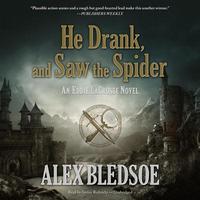
He Drank, and Saw the Spider

He Drank, and Saw the Spider

by Alex Bledsoe, Stefan Rudnicki (Narrator)
Series: Eddie LaCrosse, #5

Unabridged Audiobook, 9 hrs., 6 min.
Blackstone Audio, 2014

Read: February 16-19, 2021

Grab a copy from your local indie bookstore!

I felt that little knot in my belly that meant a mystery was taking its irrevocable hold. Usually this was a good thing, because usually I got paid for it. But here and now I was on vacation, and the last thing I wanted to do was spend it unraveling the truth of the strange prince, his rotund protector, and the girl I’d once saved from a bear. But damn it, I knew that’s exactly what I was going to do.

What’s He Drank, and Saw the Spider About?

After a couple of adventures that aren’t quite typical in their nature, Eddie La Crosse gets back to basics with a fairly straightforward case. Well, that’s not exactly true—it’s just that the last was more grand-adventure-y, less LaCrosse-as-sword-jokey, and the one before that took on this epic nature by the end. This is Eddie doing what he does best. But still, there’s magic and monsters, and all the other trappings that keep this from being something that Sue Grafton or Dennis Lehane would’ve written.

Sixteen years ago, Eddie promised a dying man on the run that he’d take care of the baby that the other man was running to protect. He found a seemingly-trustworthy family willing to take the infant in, and went on his merry way, and actually forgot all about the incidents surrounding that. Years later, Eddie and his girlfriend, Liz, are on vacation in that area and suddenly it all comes back to him and he decides to try and track down the (now) young woman and see how she’s doing.

Naturally, things start to go poorly about there. He does find her—pretty easily, too—it is a small community, with an economy largely-based on sheep-herding and farming, so it’s not really a bustling metropolis where no one knows anyone else. But there’s a whole lot of interesting things happening around the young woman—royalty in disguise, a meddling sorceress, an untrustworthy mercenary-type, an over-protective mother, a dose of sibling rivalry, and some sort of articulate and super-strong inhuman creature with a healthy interest in the girl.

Even though he was just supposed to check on her and not interfere with her life—he had no intention of even introducing himself to her. Eddie can’t help himself, and before you know it, he’s neck-deep in intrigue and danger.

Biggest Magic Yet

When you think about Fantasy novels (or maybe I should just say “I”, who knows what you think) you think about magic all over the place. But if it’s really that ubiquitous, that takes away some of the special-ness of magic. In LaCrosse’s world, almost no one believes in magic. Eddie sure wouldn’t if magic, deities, and supernatural creatures hadn’t rubbed their existence in his face on repeated occasions.

That’s certainly the case here—most of the people that Eddie is around in this novel (and by most, I mean an overwhelming majority) refuse to admit that what they are seeing—some of them on multiple occasions—has anything to do with magic. I think this is a great choice—it’s another hurdle for Eddie and Liz to get over, it adds some real tension when you’d be tempted to think we’re done with tension, and it keeps the magic mysterious.

Rudnicki’s Narration

I think this is probably Rudnicki’s best work in the series. he nails every character—particularly the character of Billy Cudgel (the aforementioned untrustworthy mercenary-type). He captures the humor, the drunkenness, the misery, the madness, and everything else. I thought the choices he makes in the narration (he and/or the director) and tone were spot-on. He’s definitely a narrator I’m going to seek out in the future.

So, what did I think about He Drank, and Saw the Spider?

On the whole, this is a fun, brisk novel—a lot of humor, some good action, nice banter, and interaction between the characters (especially Eddie and Liz). Yet, even as the answers to the questions surrounding the girl’s mysterious origins become obvious, and some of the characters get to the point where they seemed irredeemable, Bledsoe (as he can every so well) keeps you completely drawn in and even tugs the heartstrings a bit as the truth is revealed to the characters. Just really, really well done.

There’s a lot of nice little touches along the way. For example, towards the end of the book, Eddie and those he’s traveling with encounter a preteen who joins their little band for a while. She’s pretty new to swearing and tries to get in as much practice as she can while with them. At first, I thought she was an odd (but entertaining) and pointless distraction. It didn’t take too long to see she was a perfect tension-breaker, just what that part of the novel needed to keep from being too tense and so much more serious than what had come before.

Eddie’s narration has never been better—humor-tinged and hard-boiled, a medieval Philip Marlowe or Elvis Cole. I liked all of these characters, and really wanted to spend more time with each of them—I don’t know how Bledsoe could’ve pulled that off without getting the whole thing too slow and ponderous (which would’ve sucked the fun out of 60-70% of these characters). This is really such a well-done and fully realized series.

Either Bledsoe or his publishers decided that was enough, and it doesn’t look like we’re going to get any more adventures from our favorite sword-jockey, but man, I’m glad we got what we did.


4 Stars

2021 Audiobook Challenge

This post contains an affiliate link. If you purchase from it, I will get a small commission at no additional cost to you. As always, opinions are my own.

A Two-Fer: Twenty Palaces and Child of Fire (Audiobooks) by Harry Connolly and Daniel Thomas May

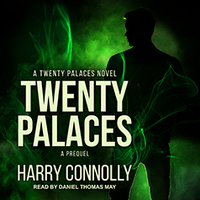
Twenty Palaces

Twenty Palaces

by Harry Connolly, Daniel Thomas May (Narrator)
Series: Twenty Palaces, #0
Unabridged Audiobook, 8 hrs., 14 min.
Tantor Audio, 2020
Read: July 29-30, 2020
4 Stars

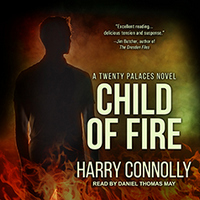
Child of Fire

Child of Fire

by Harry Connolly, Daniel Thomas May (Narrator)
Series: Twenty Palaces, #1
Unabridged Audiobook, 10 hrs., and 9 min.
Tantor Audio, 2020
Read: September 8-10, 2020
4 Stars

What is The Twenty Palaces Series?

The Twenty Palace Society is a secretive and ancient group that has devoted itself to the regulation of magic in this world for the benefit of humanity. Those who use magic outside of the Palaces control have a tendency to unleash disaster—and by disaster, I mean things with the potential to destroy the world—and the Society stops them with extreme prejudice (and if collateral damage happens, so be it—we’re talking about the survival of the human race here).

Most of these threats come by way of unleashing Predators—beings from the “Empty Places” between dimensions. Their main drive seems to be coming into this (or any) reality and snacking on whatever life forms they can find. They typically begin by seeming to obey and/or help the humans who summoned them. But eventually, they turn on their summoners and exact a horrible price.

The Society’s methods, structure, and personnel largely lie in darkness, but we know a little bit—there are peers (magic users of impressive strength, but not as strong as others in the Society), investigators (whose purpose is to look for magical/Predatory activity), and wooden men. Wooden Men are cannon fodder. They’re the designated redshirts whose purpose is to draw the attention of the humans or Predators the Society is attacking so their peer can come in and eliminate the threat while they’re focused on the Wooden Man. It’s obviously not a place to be if you’re all that concerned with living a long and quiet life.

Our protagonist, Ray Lilly, is a Wooden Man (or becomes one in TP). In that book, he stumbles upon some unauthorized magic use, casts one spell himself (which would be enough to kill him over, but he proves useful to Annalise so she delays that), and then stumbles upon a group of predators and helps Annalise stop them from turning Seattle into a home base to bring in others of their kind and then to destroy humanity.

In Child of Fire, the two find themselves in a small town, where a man/company (it’s hard to tell at first) seemingly has made a deal with a Predator for some benefit to the town, but at the cost of the children of the town—and it happens in such a way that the memories of parents are affected enough that they don’t remember their children ever existed.

Publication/Listening Order

While I do think a good prequel can be fun, by nature they are wholly unnecessary. If you don’t have everything you need in the books/movies/whatever as they were published, the author/creators failed. Also, you probably don’t get something successful enough to generate a prequel.

Again, they’re fun. It can be entertaining to get an explanation for something in the original work (“Oh, so that’s why there’s a lampstand in the middle of the wood”), occasionally it gives you a new perspective on the series, that kind of thing. I was more than happy to read Twenty Palaces when the series had been mothballed, but I wasn’t clamoring for it.

But last year, when Tantor started putting out the whole series in audiobook form (the first book had been already, but the rest hadn’t been), I went with the order that Tantor published—Twenty Palaces first and then moving on to the rest.

I was surprised at how well it flowed. There’s very little time between Twenty Palaces and Child of Fire and it really felt like CoF was a sequel. There were just so many throwaway details in CoF that were there to make it seem like Ray had a past (not that we learned much about it), that there was a little bit of history with Ray and Annalise (but not much of one). As you read it (assuming you read in publication order), there’s a mysterious, violent past—one that it’s good to know Ray has, but we don’t need to know it.

Connolly did a great job of taking those details and building events in Twenty Palaces around them. I’m not saying this is the best way to listen to the books—but it makes them a lot more approachable. I can see why Tantor went the way they did.

Ray Lily

Yes, Ray Lilly is an ex-con with a violent streak. But he sincerely wants to live a straight life—while he admits to himself that he enjoys the rush of violence. He also likes the fact that his work for the Society matters. He tries to be a good, law-abiding citizen as much as possible. He works hard to prevent injury to those who have nothing to do with the Predators.

He’s incredibly loyal to Annalise—which is not a little twisted because Annalise has told him repeatedly that she will kill him.

He’s essentially what you expect in a male UF protagonist—but he’s as close to powerless as you can be in this world and yet survive. Which definitely marks him out as different. He also has a real talent for getting people (many people, anyway) to trust him and is better at inspiring bystanders to action than most UF protagonists (although most of them don’t need to recruit help, and Ray does). There’s a very human quality to Ray that makes you like him.

Annalise Powliss

Annalise is old (well over one hundred years old), but looks younger than Ray. She has a high voice and looks like she hasn’t had a decent meal in ages. But that’s deceptive—she’s supernaturally strong and magically powerful. While she doesn’t relish the prospect of collateral damage/fatalities—she’s familiar enough with the treat posed by Predators that she’s more than willing to let a town’s worth of citizens die to prevent all of humanity from being consumed. Still, she’s largely willing to indulge Ray’s compassion—up to a point.

Annalise has all the powers of your typical UF protagonist—maybe even more. But none of the wit, sarcasm, or optimism. For her, this is a duty, not one she particularly enjoys, but it’s something that has to be done.

Daniel Thomas May

I admit that I was worried about Daniel Thomas May as the narrator for these audiobooks. All I know him from is the Venators series, and this is about as far from a YA Portal Fantasy as you can get. But my worries proved groundless and he does a bang-up job portraying Ray Lilly and the horrors that this world holds.

More than that, I’m glad I listened to these if only for Annalise’s voice. It’s both exactly what Connolly says it sounds like—and is about 3.4 million miles away from what I’d imagined.

So, What Did I Think about these Audiobooks?

They’re just great—I thoroughly enjoyed being back in this world and I still don’t understand why the books weren’t bigger sellers. I hope they find a new audience in audiobook. I don’t know if I’ve ever talked about the series on this blog without using the phrase “criminally underselling,” (or words to that effect). It comes to mind once again, I just don’t get why readers didn’t get behind this.

They’re dark, they’re grim, they’re on the violent end of the UF spectrum (but I can easily find darker, grimmer, and more violent series)—but there’s a glimmer of hope throughout them all. Not just from Ray’s undaunted trust in humanity, but that’s where most of it comes from. Even with all the death and destruction, they’re entertaining reads and you get immersed enough in the world that you don’t want to come out of it.

You really should get these in your earbuds or in front of your eyes.

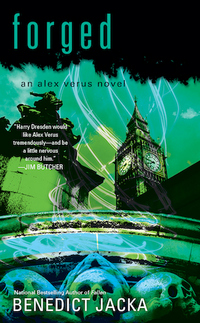
A Few Thoughts about Forged by Benedict Jacka

Forged

Forged

by Benedict Jacka
Series: Alex Verus, #11

Mass Market Paperback, 294 pg.
Ace Books, 2020

Read: December 17-22, 2020
Grab a copy from your local indie bookstore!


The whole time I read this, I kept thinking, “How do I write something about this?” More than a month and a half later, I’m still not sure.

Book Blurb

I’m so unsure what to say, that I’m not even going to attempt to summarize the setup. I’ll just steal the back of the book:

To protect his friends, Mage Alex Verus has had to change–and embrace his dark side. But the life mage Anne has changed too, and made a bond with a dangerous power. She’s going after everyone she’s got a grudge against–and it’s a long list.
In the meantime, Alex has to deal with his arch-enemy, Levistus. The Council’s death squads are hunting Alex as well as Anne, and the only way for Alex to stop them is to end his long war with Levistus and the Council, by whatever means necessary. It will take everything Alex has to stay a step ahead of the Council and stop Anne from letting the world burn.

Not Quite Fully-Formed Thoughts

I was blown away by the first novel in this series, Fated back in ’12. The cover caught my eye, the pull-quote from Jim Butcher on the front put it in my checkout stack at the Library. I was impressed enough that I bought the paperback almost immediately. And the series has been an auto-buy for me since. Here we are at the penultimate novel and so much of my loss for words is attributable to not knowing what he’s going to do with the events of this book.

Yes, it’s a complete story—we even get introduced to a new character. But I’m not sure what any of the events will actually mean for Alex/the series, so my judgment feels like it’s in limbo. If he does X, Y, or Z in Risen, well, sure it’ll be worth it. But if he goes in another direction…I just don’t know.

I’ve read four Urban Fantasy series from start to conclusion. Anna Strong, The Hollows,* Kitty Norville, and The Iron Druid Chronicles. If you stand back and take in the series as a whole, the first three had a very similar arc, and the IDC had a different one. It sure seems like Jacka’s taking a more IDC approach. If I’m right, that puts things in the last couple of books in a certain kind of light, and I can evaluate them on that basis. If I’m wrong (to some extent) it puts those things in a different light, and I’ll think about them differently. At the moment the book is in a pretty “is the dress white and gold or black and blue” kind of place for me. I don’t usually say that kind of thing about a book, I normally know what I think about a book without wondering too much about the future of the sequel/series. But I can’t help it this time, even if it feels like a cop-out.

Which is not to say that I think there’s a superior way for Jacka to land this plane—I’m confident he’s going to nail the landing regardless.

* Yeah, sure, that was temporarily concluded, but let’s pretend that Harrison didn’t come back for the sake of this paragraph

So, can I say anything? Yeah. This was the most violent of any of the books, Alex knows full well that this is the endgame for something, and has nothing holding him back. I’m sure that in many ways the Alex Verus of the early series wouldn’t do what he’s doing now, and wouldn’t want to. But things have changed him, and he doesn’t have time to waste pulling his punches.

Alex is running out of choices—an odd thing for a diviner. He’s burnt a lot of bridges lately—many of which I held out hope that he could repair. Instead, he burnt them to the ground, gathered the ashes, stomped on them, and then scattered them to the four winds. I’m not sure that he has a whole lot of moves left—if Alex is the King on a chessboard, it truly seems he’ll be checkmated in just a couple of moves.

I enjoyed this book, I don’t particularly like the choices that Alex is making—but I get why he’s making them. I don’t particularly like the choices Jacka’s making, either—but I think he’s probably doing the right thing for the series.

I’m not sure what else to say, really. Come back this fall after Risen and I’ll probably be a bit more definitive.

There was another realisation too, something that was harder to explain. I had the feeling that Morden was going to survive all this. He wasn’t aiming to settle grudges and wasn’t seeking the crown, and because of that everyone else would always have someone they wanted dead more badly than him. When this was over he was going to be walking away, back to the forests and streams of his shadow realm and to his new group of disciples. The same wasn’t likely to be true for me.


4 Stars

This post contains an affiliate link. If you purchase from it, I will get a small commission at no additional cost to you. As always, opinions are my own.

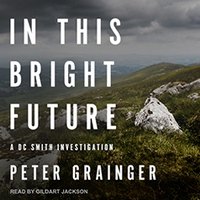
In This Bright Future (Audiobook) by Peter Grainger, Gildart Jackson: A Stranger in a Strange Land

This Bright Future

In This Bright Future

by Peter Grainger, Gildart Jackson (Narrator)
Series: A DC Smith Investigation, #5

Unabridged Audiobook, 9 hrs., 18 min.
Tantor Audio, 2017

Read: January 7-8, 2021
Grab a copy from your local indie bookstore!

It’s Time to Wrap up Some Things

We’ve known for some time, that someone connected to DC Smith’s time in Belfast has been trying to get in touch with him. We know almost nothing about what he did, and he’s in no rush to think about it as whoever makes these attempts. But that’s done with now.

While recuperating from knee surgery, Smith finally confronts/is confronted by (you could make the case either way) with that person and ends up using his convalescence time going to Belfast to look into something that happened (probably) the day after he left.

Smith is brought face-to-face with friends and adversaries for the first time in decades. He has to come to terms with many consequences of his actions. And he looks into a killing from that time that he didn’t even know had happened until he made the trip.

So we learn who has been looking into him/trying to communicate with him. We learn a lot about his backstory that we’d only got glimpses of shadows of before. For fans who want to know more about DC Smith, here’s the place.

There’s another plotline that gets some resolution, too—in a very pleasant way. But I’m not going to get into it.

Never Fear, There are Still Some Storylines Alive

We don’t have any resolution when it comes to this author friend and her book (and digging up all sorts of horrible memories with it). And there’s a new one introduced in the closing moments, one that will probably shake up a lot of Kings Lake…

Jackson Nails It Again

Gildart Jackson makes sure that you get what DC is feeling, how the past is coming back to haunt him while confronting him with his failures, his missed opportunities, the what could have been. This is a lonely book for Smith, and Jackson ensures the listener experiences it.

So, what did I think about In This Bright Future?

Overall, this was strange. Still good, but strange. As much as we all pick up these books for DC, it’s DC in relation to his fellow officers. Here, he’s fairly isolated—he has his ghosts, his memories, and people he hasn’t seen for decades (some he’s tried not to think about since)—but he doesn’t have his team. The fact he can’t give any tutorials, he doesn’t have anyone around to amuse with his commentary, the fact that he’s constantly on his guard, all combine to heighten the emotional impact of this one.

But man, I want to get back to King’s Lake.

This was as good as the previous entries—probably better in some ways—but in a different way. I’m all for that, let’s keep this series from getting stale. You can read/listen to this without the rest, and enjoy it. But it’s a lousy way to sample the series. If you want to know what this winning series is like, grab book 1 or 2. But if you grab this? You’re in for a very pleasant experience.


4 Stars

2021 Audiobook Challenge

This post contains an affiliate link. If you purchase from it, I will get a small commission at no additional cost to you. As always, opinions are my own.

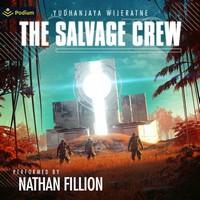
The Salvage Crew (Audiobook) by Yudhanjaya Wijeratne, Nathan Fillion: A Unusual Tale of Artificial Intelligence, Cascading Failure, and Poetry

The Salvage Crew

The Salvage Crew

by Yudhanjaya Wijeratne, Nathan Fillion (Narrator)

Unabridged Audiobook, 8 hrs., 21 min.
Podium Audio, 2020

Read: January 20-22, 2020

Red Dwarf Remix?

I’m not suggesting for a second that Wijeratne’s mind worked this way (at least I don’t mean to), but this is the impression I got as this started.

The Red Dwarf TV Show/Novels had a couple of great ideas at the beginning—an AI that ran the ship, that had a strange personality, an odd sense of humor, and wasn’t entirely reliable. The second was that the ship generated a holographic officer based on the memories and personality of one of a dead member of the crew (whoever was highest ranking/most needed among the dead). A long time ago, it had been determined that AI with memories and real emotions actually perform better than those not based on actual humans.

Our main protagonist and narrator in this novel is an AI, made from the memories and personality of an engineer who served his whole professional life in space (after leaving his family’s farm). He’s now in charge of a small salvage crew for the company Planetary Crusade Service, sent to a tiny planet Urmahon Beta to recover as much as they can from an old colony ship that presumably crashed there.

His role is Overseer, and his crew nicknames him OC. This is OC’s first command, if it goes well—and a few others—he can move up to a larger, better body/command. In a few decades or so, he could work is his up to a large ship, overseeing a major operation. Again, that’s if everything goes well.

Everything Doesn’t Go Well

OC is promised an “A-Team” of a crew for his first command. He doesn’t get one. They’re not a B-Team either. There are not enough letters to describe how far this trio is from an A-Team. For that matter, I’m not sure OC is A-Team material either—they land far off-course (turbulence during descent, we’re told).

Almost instantly, the crew starts falling apart, ignoring orders and protocol. They begin to build a base to work from, but get distracted by things like indigenous flora and fauna, personality conflicts, and evidence that suggests they may not be the only salvage crew on the planet (there’s a rival company with bionic operators with aggressive tendencies).

From a rough start, it gets worse, and the next few weeks are a spiral of cascading failure, disease, injuries, strife, crop failure, questionable vodka distillation, bargain-basement tech, and…well, I can’t keep going. It gets messy, and what starts off as a quirky, comedic version of The Martian with a side of Red Dwarf turns into something tense, taut, dark, and suspense-filled. It doesn’t stay that way, depending on how you want to count things, ends up taking one or two other overall flavors, while never completing shedding the offbeat humor that characterized the book since the opening paragraph.

Poetry and Other Quirks

I’m going to focus on OC, rather than the rest of the crew (and they are all worth writing about) to keep this short (and because you really need to get into spoilers to do a proper job of talking about the humans). He is funny. There’s a snarky, offbeat humor to his narration and dialogue throughout.

He’s also a poet. I’m not saying he’s a good one, but he is one. Frequently in Fantasy novels (particularly older ones that wear their Tolkien-influence on their sleeves), you get a lot of poetry/songs/etc., but that’s rarely a feature of Science Fiction novels. The Salvage Crew is the exception to this rule. OC writes it, recites it to his crew to encourage them, he quotes and ruminates on other’s poetry…he’s the most poetic AI I think I’ve ever encountered in a novel. He’s also a Buddhist, and will often apply that to his situation.

He also has the best curses. He’s frequently letting off steam by cursing his crew, PCS executives, or local fauna to a horrible future reincarnation. I could have listened to some of those for a solid hour.

Fillion’s Narration

It’s tough to say for certain, but I think that Fillion raised this about a star in my book (maybe just a half). It’s his voice, his charm that hooks you in and gets you to like, believe in and root for OC. That said, at some point, I stopped thinking of this as Fillion, and just let OC tell me a good story.

It’s not the best narration I’ve ever heard, but it’s really good and it made me hope that Fillion does more audiobooks.

Co-written by AI?

So, there was apparently actual AI software involved in the writing of this. I learned about this when I started writing this post, and I’m not sure I understood everything I skimmed (I didn’t want to take the time to read carefully instead of just posting this). I’m intrigued by this notion, but am relieved to see that the software only “helped” with portions of the book and that Wijeratne was the final word.

So, what did I think about The Salvage Crew?

Roughly the first half of the book* is about what I expected—an amusing SF adventure—and was a lot of fun to listen to. The rest of the book isn’t what I expected from the premise in terms of story or tone. And I was riveted. There are portions of the book that get into more philosophical territories, and while I wasn’t as interested in them as I think the novel wanted me to be, they were really well constructed and told.

* This is an estimate, I didn’t jot down notes about when the tenor of the plot/novel changes)

I’m really glad I took a chance on this book, I’ll definitely listen to future audiobooks by Fillion (assuming any are produced) and am probably going to be trying some of Wijeratne’s other novels. I heartily recommend it to SF readers/listeners.

Disclaimer: I received this eARC from Podium Audio via NetGalley in exchange for this post—thanks to both for this.


4 Stars

2021 Audiobook Challenge

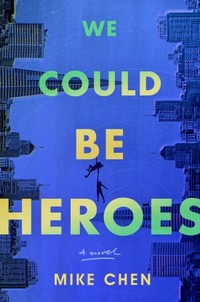
Pub Day Repost: We Could Be Heroes by Mike Chen: A Super-Powered Thief and Vigilante Together Could Be Extraordinary

We Could Be Heroes

We Could Be Heroes

by Mike Chen

eARC, 336 pg.
Mira Books, 2021

Read: January 11-14, 2021
Grab a copy from your local indie bookstore!


At this point with Mike Chen, I don’t bother looking at the book blurb, I just read what he publishes. But so I could decide how much to say in this post, I had to go look at the blurb. Just between you and me, I think I wouldn’t have given as much away as it did, but now I feel a little freer about what to say.

Jamie Sorenson/The Mind Robber

Two years ago, Jamie Sorenson woke up in an apartment with no memory of who he was or how he got there (the name is something he picked). He’s a coffee snob, has taken in a stray cat that he’s named, “Normal.” He reads a lot of autobiographies and memoirs from the library, because he likes hearing life stories since he doesn’t have one.

Oh, and he has super-powers. He can read people’s memories, and erase a little bit of them. He uses these abilities to rob banks as “The Mind Robber.” He’s not living an extravagant lifestyle with these funds, in fact, he lives fairly frugally. His goal is to save up enough to finance his retirement on a tropical beach—just him, Normal, coffee, and books. If he can just pull off one or two more without getting caught, he should be able to do just that.

He was almost caught once, and he’s pretty sure he won’t be able to evade capture too easily next time. He was almost caught by:

Zoe Wong/The Throwing Star

She, too, woke up without memories in an apartment two years ago. She had a name tag, so at least she didn’t have to come up with a name. She spends her time watching horror movies on an app on her phone and drinking so much I think I might have liver damage from reading about it. She makes ends meet by working for a food delivery service.

She doesn’t drive for one, though, she has super-powers, too. Including speed—not Flash or Quicksilver fast, but she’s fast. So fast that she can deliver food fast enough to maintain a 5-Star rating, even though she’ll take quick detours to beat up criminals. She’s also super-strong (not quite Superman-level, but more than Captain America) and has a couple of other tricks up her sleeve.

She’s assembled enough of a uniform to stand up to the punishment her speed puts on normal clothing and to protect her identity, and was dubbed “The Throwing Star” by the press. Although, she’d prefer Shuriken, not that anyone asked. Besides, she’s pretty sure she’s of Chinese descent, not Japanese, so both names are problematic.

The Team Up

Jamie regularly attends a support group for people with Dementia or other memory problems. No one’s treating them there, it’s just a place for emotional support. One day, not long after he’s almost captured by The Throwing Star, Zoe walks in. Afterward, the two have a quick conversation by the coffee pot and (thanks to their abilities) recognize each other. For the sake of the group, they don’t start battling each other, instead, they talk.

A few things happen, and then Zoe decides to ask Jamie to help her with her memory—surely, he can use his powers for something other than crime, right? They strike a little quid pro quo deal and get to work.

From this point, two things happen, one harder to believe than the other. First, they start to uncover things about Zoe’s past (and Jamie’s, although he’s really not that interested at first) that lead them to a therapeutic organization that seems to have something else going on. And, the two begin to become friends.

It’s that “something else,” naturally, that gets their attention. It’s not long before they discover that not only does this organization (or maybe just what it’s a front for) hold the key to their pasts but has a secret plan to change to the world as we know it. To combat it, this thief and this vigilante might have to be something more, they might have to be heroes.

The Mad Scientist

A mad scientist at work is a mainstay of Super-Hero Fiction and Chen delivers that well. Not just a mad scientist, but one who doesn’t see herself in that way. Indeed, she’s going to save humanity from itself and the world from humanity while she’s at it. And sure, she’s doing this on her own, without consulting the countless lives that she’s going to radically alter, because when you’re a super-genius with a messianic-complex (among other psychiatric problems) playing with unimaginable technology, who cares what anyone else might think?

That sounds almost dismissive, and I don’t mean it to be. She’s a well-drawn character, absolutely convinced she’s doing the right thing, and is pretty convincing about it. Don’t get me wrong, I love a super-villain who’s just out to watch the world burn, or driven by pure avarice. I was raised on that stuff. But a super-villain convinced they’re the city’s/nation’s/world’s savior? There’s something more compelling about them, and that’s what we have here.

Extraordinaries

One challenge that non-Marvel/DC Super-Hero Fiction has it coming up with what they’re going to call their costumed, super-powered crime-fighters. Most of the time, I note the term and move on, while it’s usually a serviceable term, it’s a challenge to come up with something that really clicks on this front.

Chen’s world uses the term, “Extraordinaries.” That’s catchy, a little quirky, and it sticks with you. Sure, this is a minor point, but you add up enough of these minor points, and you elevate a good book into something more.

The Mike Chen Factor

The something more…does this have it? Readers of this blog know that I’m always game for a Super-Hero novel, and from early on, it was clear that this was a good one. And that’d be enough for me to recommend it, maybe even highly recommend it. But Here and Now and Then and A Beginning At The End have taught me that I should expect something more than just a good Time Travel/Dystopian/Super-Hero novel from him. The Mike Chen Factor.

And while I didn’t go looking for it—that would distract me from this entertaining story—I did keep wondering when it’d crop up (and if I’d recognize it right away). I think it popped up in a couple of different places and while I espied one instantly (or pretty quickly) the other slipped by me until it was in full bloom—making it my favorite.

The first thing that makes this more than a good Super-Hero novel is that it’s about the role our memories play in who we are—our identity, our personality, how we act. Two characters whose tabulas are about as rasa as you can get make excellent candidates to explore this. In the end, one character’s deliberate choices in spite of natural inclinations and what we learn about their past becomes something they didn’t expect. While the other character is driven by their past (especially the parts they can’t remember but shaped who they are) and ends up being a better (more complete) version of what they were all along.

So, you know, if you were looking for Chen to settle a debate, I think you can skip that.

The other expression of the Mike Chen Factor was the friendship that develops between Jamie and Zoe. This was something special. Too, too, too often when we look at relationships in fiction (in whatever medium) we focus on romantic relationships, familial bonds, or even that between enemies. We don’t see enough explorations of friendship. I wish we had more of them—Rick and Louis aren’t the only one’s with a beautiful friendship, a well-written one is a great thing.

And Jamie and Zoe’s friendship promises to be a beautiful friendship, it’s off to a great start, anyway. I think the reader sees it before either of them do, which is an added layer of fun. But before they realize it their mutual aid pact starts to carry shades of something else. They banter, they tease each other (including in that almost-cruel way that only good friends can), they look out for each other beyond what’s needed for their project and care about each other. Eventually, they’re inspiring each other to be more than they think they are.

So, what did I think about We Could Be Heroes?

This was great. It was a good Super-Hero Story that had a lot of other things going on. Like Chen’s other work, it could probably spawn a sequel or two—but probably won’t.

Can you enjoy this without spending time thinking about what he’s exploring in terms of identity, memory, and friendship? Sure—I don’t know why you’d want to, but if you’re just looking for a compelling story featuring people in outlandish dress flexing super-abilities, this would absolutely fill that need. On the flip side, if you prefer to focus on the other material? This would work, but you’d have to put up with the Super-Hero stuff, and that might be harder for you. If you’re a Greedy Gus like me and want it all? You’re definitely in for a treat.

There’s a little something for everyone here, get to it.

Disclaimer: I received this eARC from Harlequin Trade Publishing via NetGalley in exchange for this post—thanks to both for this.


4 Stars

This post contains an affiliate link. If you purchase from it, I will get a small commission at no additional cost to you. As always, opinions are my own.


We Could Be Heroes by Mike Chen: A Super-Powered Thief and Vigilante Together Could Be Extraordinary

We Could Be Heroes

We Could Be Heroes

by Mike Chen

eARC, 336 pg.
Mira Books, 2021

Read: January 11-14, 2021
Grab a copy from your local indie bookstore!


At this point with Mike Chen, I don’t bother looking at the book blurb, I just read what he publishes. But so I could decide how much to say in this post, I had to go look at the blurb. Just between you and me, I think I wouldn’t have given as much away as it did, but now I feel a little freer about what to say.

Jamie Sorenson/The Mind Robber

Two years ago, Jamie Sorenson woke up in an apartment with no memory of who he was or how he got there (the name is something he picked). He’s a coffee snob, has taken in a stray cat that he’s named, “Normal.” He reads a lot of autobiographies and memoirs from the library, because he likes hearing life stories since he doesn’t have one.

Oh, and he has super-powers. He can read people’s memories, and erase a little bit of them. He uses these abilities to rob banks as “The Mind Robber.” He’s not living an extravagant lifestyle with these funds, in fact, he lives fairly frugally. His goal is to save up enough to finance his retirement on a tropical beach—just him, Normal, coffee, and books. If he can just pull off one or two more without getting caught, he should be able to do just that.

He was almost caught once, and he’s pretty sure he won’t be able to evade capture too easily next time. He was almost caught by:

Zoe Wong/The Throwing Star

She, too, woke up without memories in an apartment two years ago. She had a name tag, so at least she didn’t have to come up with a name. She spends her time watching horror movies on an app on her phone and drinking so much I think I might have liver damage from reading about it. She makes ends meet by working for a food delivery service.

She doesn’t drive for one, though, she has super-powers, too. Including speed—not Flash or Quicksilver fast, but she’s fast. So fast that she can deliver food fast enough to maintain a 5-Star rating, even though she’ll take quick detours to beat up criminals. She’s also super-strong (not quite Superman-level, but more than Captain America) and has a couple of other tricks up her sleeve.

She’s assembled enough of a uniform to stand up to the punishment her speed puts on normal clothing and to protect her identity, and was dubbed “The Throwing Star” by the press. Although, she’d prefer Shuriken, not that anyone asked. Besides, she’s pretty sure she’s of Chinese descent, not Japanese, so both names are problematic.

The Team Up

Jamie regularly attends a support group for people with Dementia or other memory problems. No one’s treating them there, it’s just a place for emotional support. One day, not long after he’s almost captured by The Throwing Star, Zoe walks in. Afterward, the two have a quick conversation by the coffee pot and (thanks to their abilities) recognize each other. For the sake of the group, they don’t start battling each other, instead, they talk.

A few things happen, and then Zoe decides to ask Jamie to help her with her memory—surely, he can use his powers for something other than crime, right? They strike a little quid pro quo deal and get to work.

From this point, two things happen, one harder to believe than the other. First, they start to uncover things about Zoe’s past (and Jamie’s, although he’s really not that interested at first) that lead them to a therapeutic organization that seems to have something else going on. And, the two begin to become friends.

It’s that “something else,” naturally, that gets their attention. It’s not long before they discover that not only does this organization (or maybe just what it’s a front for) hold the key to their pasts but has a secret plan to change to the world as we know it. To combat it, this thief and this vigilante might have to be something more, they might have to be heroes.

The Mad Scientist

A mad scientist at work is a mainstay of Super-Hero Fiction and Chen delivers that well. Not just a mad scientist, but one who doesn’t see herself in that way. Indeed, she’s going to save humanity from itself and the world from humanity while she’s at it. And sure, she’s doing this on her own, without consulting the countless lives that she’s going to radically alter, because when you’re a super-genius with a messianic-complex (among other psychiatric problems) playing with unimaginable technology, who cares what anyone else might think?

That sounds almost dismissive, and I don’t mean it to be. She’s a well-drawn character, absolutely convinced she’s doing the right thing, and is pretty convincing about it. Don’t get me wrong, I love a super-villain who’s just out to watch the world burn, or driven by pure avarice. I was raised on that stuff. But a super-villain convinced they’re the city’s/nation’s/world’s savior? There’s something more compelling about them, and that’s what we have here.

Extraordinaries

One challenge that non-Marvel/DC Super-Hero Fiction has it coming up with what they’re going to call their costumed, super-powered crime-fighters. Most of the time, I note the term and move on, while it’s usually a serviceable term, it’s a challenge to come up with something that really clicks on this front.

Chen’s world uses the term, “Extraordinaries.” That’s catchy, a little quirky, and it sticks with you. Sure, this is a minor point, but you add up enough of these minor points, and you elevate a good book into something more.

The Mike Chen Factor

The something more…does this have it? Readers of this blog know that I’m always game for a Super-Hero novel, and from early on, it was clear that this was a good one. And that’d be enough for me to recommend it, maybe even highly recommend it. But Here and Now and Then and A Beginning At The End have taught me that I should expect something more than just a good Time Travel/Dystopian/Super-Hero novel from him. The Mike Chen Factor.

And while I didn’t go looking for it—that would distract me from this entertaining story—I did keep wondering when it’d crop up (and if I’d recognize it right away). I think it popped up in a couple of different places and while I espied one instantly (or pretty quickly) the other slipped by me until it was in full bloom—making it my favorite.

The first thing that makes this more than a good Super-Hero novel is that it’s about the role our memories play in who we are—our identity, our personality, how we act. Two characters whose tabulas are about as rasa as you can get make excellent candidates to explore this. In the end, one character’s deliberate choices in spite of natural inclinations and what we learn about their past becomes something they didn’t expect. While the other character is driven by their past (especially the parts they can’t remember but shaped who they are) and ends up being a better (more complete) version of what they were all along.

So, you know, if you were looking for Chen to settle a debate, I think you can skip that.

The other expression of the Mike Chen Factor was the friendship that develops between Jamie and Zoe. This was something special. Too, too, too often when we look at relationships in fiction (in whatever medium) we focus on romantic relationships, familial bonds, or even that between enemies. We don’t see enough explorations of friendship. I wish we had more of them—Rick and Louis aren’t the only one’s with a beautiful friendship, a well-written one is a great thing.

And Jamie and Zoe’s friendship promises to be a beautiful friendship, it’s off to a great start, anyway. I think the reader sees it before either of them do, which is an added layer of fun. But before they realize it their mutual aid pact starts to carry shades of something else. They banter, they tease each other (including in that almost-cruel way that only good friends can), they look out for each other beyond what’s needed for their project and care about each other. Eventually, they’re inspiring each other to be more than they think they are.

So, what did I think about We Could Be Heroes?

This was great. It was a good Super-Hero Story that had a lot of other things going on. Like Chen’s other work, it could probably spawn a sequel or two—but probably won’t.

Can you enjoy this without spending time thinking about what he’s exploring in terms of identity, memory, and friendship? Sure—I don’t know why you’d want to, but if you’re just looking for a compelling story featuring people in outlandish dress flexing super-abilities, this would absolutely fill that need. On the flip side, if you prefer to focus on the other material? This would work, but you’d have to put up with the Super-Hero stuff, and that might be harder for you. If you’re a Greedy Gus like me and want it all? You’re definitely in for a treat.

There’s a little something for everyone here, get to it.

Disclaimer: I received this eARC from Harlequin Trade Publishing via NetGalley in exchange for this post—thanks to both for this.


4 Stars

This post contains an affiliate link. If you purchase from it, I will get a small commission at no additional cost to you. As always, opinions are my own.

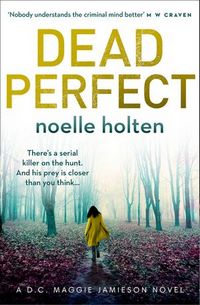
Dead Perfect by Noelle Holten: A Desperate DC Races to Save Her Friend’s Life

This is one of those that I struggled for over a week to finish. I can only hope it’s coherent. The short version: Get this book. Read this book.

Dead Perfect

Dead Perfect

by Noelle Holten
Series: DC Maggie Jamieson, #3

Kindle Edition, 449 pg.
One More Chapter, 2020

Read: December 30, 2020-January 2, 2021

What’s Dead Perfect About?

So, Dead Wrong left us with:

‘Just had a call come in. Police are on the scene. Body of a female has been found. Initial description sounds just like your friend Dr Moloney. I’m so sorry, Maggie …’

Obviously the important thing there is “sounds just like,” because it isn’t Moloney* but the body looks so much like her, that no one can be blamed for assuming it was Moloney. It’s quickly determined that it’s not her, but Maggie and Kate Moloney’s colleagues are having difficulty finding her. Making sure that the tension is as high as it can get in a first chapter.

* That’s not a spoiler, it’s in the blurb, which I should’ve read before diving in.

But even before we get to that, there’s the Prologue. It seemed ominous but fairly typical. Then I looked up one word that I didn’t know, orbitoclast, “A surgical instrument for performing transorbital lobotomies, resembling an icepick.” Then I reread the Prologue and got seriously creeped out.

Kate’s located (and given a talking-to about keeping her phone with her), the body is identified, but that just clarifies the issues at the heart of the investigation. We knew Kate had a stalker, and it seemed like the stalker was getting more intense, more threatening. There’s almost certainly a connection between the murdered woman, the stalker, and Kate. But Maggie has to prove that before they can act on it.

So Maggie and her team dive into the murder investigation, but Maggie’s attention is divided between finding out what happened to this woman and preventing the same thing from happening to Kate. This is probably not the best way to tackle the problems, but it’s not like Maggie is going to let either objective out of her hands.

And then another body is found.

Maggie’s State of Mind

It’s been a while since things were stable for our series protagonist, she’s been caroming off emotionally and mentally challenging cases for so long that she’s got to be close to unraveling. She’s barely had her chance to catch her breath from the events of Dead Wrong before she’s plunged into this race to save her friend’s life.

Add in the pressure of the press, getting used to the shift in the dynamic between her and friend/new boss, and her personal life—she’s not in the best headspace for this (or any) investigation. I think it’s starting to show, she makes some errors in judgment, she’s not dealing well with people, and unless this series is about the downfall of DC Maggie Jamieson, something’s going to have to change.

Although I can totally see Holten pulling off Maggie hitting rock bottom and trying to recover from that, come to think of it. So maybe that’s what we’re starting to see.

Supporting characters

I’ll touch on this more later, but one of the best things about the series is this great world that Holten’s creating. And it’s filled with some great characters, I have a few thoughts about some of the more prominent from this book.

We’ll start with DS Nathan Wright, he’s trying to acclimate to his new position and the way that changes the way he relates to and interacts with his team and friends—and seems to be doing it as well as you can hope. But he’s not perfect, and the transition isn’t smooth. It’s a minor thing, and I don’t imagine many authors would spend the time to do it, but I think it says a lot about the world that Holten’s creating that we see this.

That said, his team needs some more blood. and there’s a newly minted DC he’s got his eye on to help. Everyone’s very excited when Kat Everett is seconded to the investigation, and then she largely disappears. She’s eager, she’s bright, and then it’s like she doesn’t exist until the end when she plays a decent-sized role. It felt a little strange, is all I’m saying. Also, I’m not sure anyone needs a series where a “Kat” and a “Kate” play a major role, I’m just thinking someone needs a new nickname.

A reporter that made few friends, and probably a couple of enemies in Dead Wrong resurfaces. Julie Noble is well on her way to being a regular feature of this series, but for the moment, I don’t know what to think of her. I expect books four and five will solidify my impressions. She promises to be interesting—but I’m not sure in what way yet.

Lastly, there’s poor PC Bethany Lambert. She’s the unit’s go-to worker. Miscellaneous errands, thankless tasks, things requiring technological expertise, and more fall to her. I lost track of how many things Maggie threw her way to do—on top of her own assignments. I have multiple notes about how they’re working this woman to death, and even tweeted Holten about it. I’ve been assured that Bethany likes to be overworked, and that it’ll be addressed soon. But I’m telling you now if she snaps and takes out a lot of pent-up aggression on Maggie, I’ll be cheering her on.

The Killer

I’ve spent more than a week trying to write this post and failing because of this section right here. I still don’t know how I’m going to write something that I like and that doesn’t give anything away.

Sure, I could not talk about The Living Doll Killer, but Holten does something here that I feel compelled to write about. So I’m stuck. You’ll have to read the book to get the unsettling reason for the name, but that won’t keep me from using it.

We get a lot of information at some point in the novel from LDK’s own mouth. Now, I’m not sure the reader or police are supposed to believe everything told to them by LDK, but for the moment, I’m going to pretend I do.

Holten comes as close as possible to giving us a serial killer that the reader can empathize with. Sure, that’s not that close at all, but that doesn’t disprove my point.

I can say that I picked out the LDK straight off, but that’s all I got right. The “how” of the killings is bad, the “what” (abducting and killing) is disturbing, but the “why” will cast everything in a different light and somehow make it all worse (and, at the same time, almost understandable).

I can’t think of a serial killer with this kind of backstory and motivation. And for a fictional serial killer, there’s a strong “Yeah, I can imagine reading about this in the paper” kind of vibe. When I talked about her debut, I said that “Holten writes humans, not caricatures or types.” That applies to LDK, too.

The World Around Maggie Jamieson

This is the Maggie Jamieson series, and she is the core of it. But Holten has put her in the middle of a complex world. We touch base in this book with characters from the first two books—particularly from the first book, and we see a lot of growth and development. These people have put in the time and effort to change their lives and move on from the nightmares we met them in.

The way Holten has set up the series guarantees it won’t just be DC Jamieson and her boss (and the rest of her team) bouncing from investigation to investigation, they’ll brush up against these people, focusing on them for significant periods.

I really appreciate this design and am eager to see how it’s developed.

So, what did I think about Dead Perfect?

I got sucked into this story fast, and if anything above sounds critical, it’s only because I’ve spent a lot of time thinking about them (and talking about three or four niggling points out of one hundred is more interesting to write about than fanboying over the other 96 or 97). I was quickly invested in what was going on—and was soon thankful that it wasn’t Kate’s body in the opening chapter.

And yes, I was convinced that Holten had killed her off at the end of Dead Wrong.

I had many, many opinions about how Maggie and Kate were behaving over the course of this investigation (positive and negative), and sincerely wished that DS Wright would have sat them down in his office and talked some sense into both of them. I’m not sure that I usually spend quite as much time talking back to books about what protagonists are doing/thinking as I did in these pages.

And then the reveals about LDK? Didn’t see any of them coming (other than the one I mentioned). I love it when an author does that.

And then, just like she did last time, Holten doesn’t let you fully absorb and reflect on the conclusion of the novel without hitting you with an image that makes you want the next book now, not in a few months.

So what did I think about it? It was great. I need Book Four next week, and probably Five a couple of weeks after that.


4 Stars

The Curious Dispatch of Daniel Costello by Chris McDonald: A Cozy Mystery for People who Don’t Read Cozies

The Curious Dispatch of Daniel Costello

The Curious Dispatch of Daniel Costello

by Chris McDonald
Series: The Stonebridge Mysteries, #1

Kindle Edition, 94 pg.
Red Dog Press, 2021

Read: January 9, 2021
Grab a copy from your local indie bookstore!

The Would-Be Sherlock

Adam Whyte is a late bloomer, or at least he expects to be.

He remembered reading that Susan Boyle had been 47 when she auditioned on whatever talent show she’d gone on, and the guy who founded McDonald’s didn’t do it until he was 59. Some people simply came into their own a little later in life – like a fine wine.

He’s still a couple of decades away from those ages, and if he can’t apply himself a bit better, he’s going to be living with his mother until then. Just like he has since he dropped out of college and began holding a series of dead-end jobs.

From a young age, he loved playing detective and even started university to study Psychology with an eye to joining the police. Now, he binges the Mark Gatiss/Steven Moffat Sherlock. When he discovers a dead body at the hotel he’s staying at for a wedding, he decides to take it upon himself to solve the crime he’s convinced was committed (even if no one else thinks there’d been any crime), dragging his friend Colin along.

His Watson

His friend Colin, on the other hand, has his life together. He works at an assisted care facility and likes it. He has an easier time talking to people—and getting them to talk to him.

Early on, Colin realizes that Adam’s cast him as a Watson-figure and wonders why he was the sidekick (he could handle the sight of blood, for starters, unlike his friend), but it takes almost no time for him to realize why he is. I appreciated both his ambition and quick understanding about his own nature.

Interestingly, for a Watson, Colin’s not the narrator, nor the exclusive point-of-view character. I’m sure I’ve seen this before, but since reading this book, I haven’t been able to think of another example.*

* Reader, you’re invited to make me feel foolish by listing a few examples in the comments.

Their First Case

After a night of heavy, heavy drinking, most of the wedding gifts are stumbling around and trying to recover. But the best man doesn’t make an appearance, and Adam is sent to get him. Sadly, Adam discovers his body and notifies the police. Once they arrive, Adam is dismayed at the small number who show up and even more dismayed at the cursory look they give the victim and his room. It’s a busy weekend, so it will be some time before paramedics are able to come and get the body.

Adam and Colin don’t believe the police’s conclusion—Danny had too much to drink and choked on his own vomit. They instinctively know that Danny didn’t die from overindulging—he’d drank them under the table without trying too often to believe that. With nothing else to do for the rest of the day, they decide to look into things themselves.

It ends up being good that the body hasn’t been removed yet, they’re able to sneak back into the room, and Colin’s able to give their friend’s body a closer look. Then they start asking a few of the guests and the groom some questions. People indulge them and answer—mostly for their own amusement it seems. The pair start to uncover some actual evidence, which leads them to more and quickly, a theory emerges for Adam.

Then he just has to come up with a way to prove his theory—hopefully in a way worthy of Cumberbatch.

So, what did I think about The Curious Dispatch of Daniel Costello?

This is a quick and enjoyable read. It’s a clever little mystery—most (maybe all) of the clues are there for the reader to pick up and put together with (or before) Adam. For me, at least, this is what I want in this kind of story—a little bit of fair play so that I can match wits with the sleuth (amateur or not).

The language is a little rougher than I’m used to seeing in this kind of story, and the protagonists aren’t the norm either. Honestly, they’d both be a better fit for a harder-boiled, more noir-ish fare. I’m not criticizing this, I’m trying to describe it.

Nor am I complaining—McDonald makes this work. Maybe it’s the contrast between what I’m used to seeing in “cozy” mystery and what he gives, maybe it’s just the strange charm that the boorish Adam displays that does it. I’m not sure I can describe why it works, I’m just enjoying the fact that it does. Also, the language and protagonists are what make this novella/series what I suggest in the headline—something for people who aren’t drawn to the aesthetic of a cozy, but like the way they work.

The one thing that I’d be tempted to grumble about is the length of the novella and the resulting lack of depth to the story. But both of those are by design, so I’ll hold my tongue. And really, if my gripe is that I didn’t get enough of something that I liked, it really just says that I’m a glutton.

I don’t know when the second Stonebridge Mystery will be available, but I’ll be waiting for it when it is. Spend a few minutes with this unlikely crime-fighting duo and you’ll likely be waiting with me.


4 Stars

This post contains an affiliate link. If you purchase from it, I will get a small commission at no additional cost to you. As always, opinions are my own.
Red Dog Press
My thanks to Red Dog Press for the invitation to participate in this tour and the materials (including a copy of the novella) provided.

Twisted Twenty-Six by Janet Evanovich: Stephanie’s Discontented but Provides Readers with the Best Book in Years

Twisted Twenty-Six

Twisted Twenty-Six

by Janet Evanovich
Series: Stephanie Plum, #26

Paperback, 305 pg.
G.P. Putnam’s Sons, 2019

Read: December 25, 2020
Grab a copy from your local indie bookstore!

“You still want to chase after this guy?”

“You bet your ass. Just because he made fools out of us three times, don’t mean one of these times we won’t luck out. Notice he called us losers and not quitters. That’s on account of we never quit. In my mind, that’s the difference between being a loser-and a winner. A winner is willing to look like a idiot for as long as it takes to get the job done. I figure you stick with i it long enough ~ and you win. Unless you die or come down with some disease like shingles or cancer of the rectum. If I ever got cancer of the rectum, I’d go to the best rectumologist out there. Like I’d get a celebrity rectumologist. I wouldn’t mess around with some local yokel.”

“All good to know,” I said.

I don’t even need to provide dialogue tags to that, do I? If you’ve read a single Stephanie Plum novel, you know who’s saying what there.

What’s Twisted Twenty-Six About?

When we last left Stephanie*, her Grandma Mazur had left for a getaway with her new love, who just happens to be a semi-retired mobster. We pick up a week or so later, Grandma Mazur and Jimmy Rosolli had been married, and then forty-five minutes later, Rosolli died (of natural causes, I feel compelled to add). Still, even a 45-minute marriage makes Grandma a widow, but more importantly, a widow of some status in the neighborhood.

* Yeah, I know, right? I’ll talk about that in a minute.

We don’t know a lot about Jimmy’s criminal life, but among his group, he had a particular importance. He was “Keeper of the Keys.” Now, no one—not Grandma, not the cops, not almost anyone that Stephanie can talk to about Jimmy knows what that means. The few that do know, aren’t talking to anyone about them (also, they don’t believe Stephanie or Grandma when they say they don’t know where the keys are).

So Jimmy’s partners are looking for the keys, their rivals are looking for the keys. And everyone thinks Grandma Mazur either has them or can get them (she is the beneficiary of his will, after all). And none of these men are willing to take any means necessary to get her to talk. Stephanie, Ranger and Morelli team up to keep Grandma Mazur and the Plums safe.

All the while, Stephanie and Lulu are on the hunt for people who missed their court dates for the Bail Service, Stephanie is dealing with a destroyed car, Stephanie is fending off advances from Ranger—and not doing fending off much from Morelli, you know, typical stuff.

A moment of chronological accuracy

At one point, Stephanie is lamenting to Lulu about how her life isn’t working out the way she wants and states her age—a larger number than Lulu is ready for (okay, I wasn’t ready for that amount of candor, either—but the math works), and a sign that maybe Evanovich is going to start aging her in real time. It’s not long before Stephanie blows off that moment of honesty as a joke and we’re elft wit an indeterminate age again.

Still, for a couple of poages, it looked liek Evanovich might have been making a big step.

Old Dog, New Trick?

From the start of this series, there’s been a little carry-over from one book to the next—Stephanie’s sister’s marriage and kids, glacially slow advancement of her relationships with Ranger and Morelli, and so on. But largely, these are stand-alone books and can be read in any order.

Until now (obviously).

The end of Look Alive Twenty-Five leads into this book. The ending of this book propels the reader into Fortune and Glory (aka Tantalizing Twenty-Seven). This is new. This is a positive movement, there’s something to sink our teeth into. Not much, maybe, but it’s something.

I’m not sure why Evanovich has changed her approach. I’m not sure I care, either. I’m just happy to see that it has happened, and wonder where she’s going with all of this.

So, what did I think about Twisted Twenty-Six?

“I don’t want to do this job anymore. I’m not good at it. I don’t like it. I don’t like being in the bad neighborhoods looking for the bad people.”

“What would you rather do?”

“I don’t know,” I said.

“Do you have a direction?”

“No.”

“Babe.”

“Yeah, I’m a mess.”

“You aren’t a mess,” he said. “You’re just a little burned out.”

“It’s more than that. I’m stagnant. There’s no growth in my life.”

“That’s okay as long as you like what you’re doing. Not everyone needs to keep moving up the ladder.”

I have to read a State of the Series in these words (see also: the quotation at the top). I doubt that Evanovich set out to do that, but “mess,” “stagnant,” and directionless are words I’d use to describe this series lately. But like Stephanie’s (no doubt) futile efforts at self-improvement, over the last couple of books I’m seeing signs that Evanovich might be trying to add some direction and clarity to the series

I do not think it’ll ever reach the comedic heights it once hit. Nor do I think that Evanovich is going to suddenly become the new Grafton (not that I’d complain), but it seems like she’s taking the storytelling component of this seriously again. I could be 2-3 books away from again wondering why I’m sticking with these series. But until I get to that point, I’m going to enjoy the ride.

As for this book? It was fun—I admit to laughing out loud on a few occasions. I liked the story (I’m not convinced the bad guy was set-up correctly before the reveal, but…I’m not going to argue about it). The action was decent. I didn’t roll my eyes at the destruction of the car, and best yet, I think this is one of the best uses of Stephanie’s parents in ages (if not ever).

This might actually be a decent jumping-on point (Look Alive Twenty-Five would be marginally better) for this long-running series. This is definitely one to use to come back to the series after a time away. Or if you’re just plugging away with a new annual entry, you’ll be satisfied. Give this series a shot, it’ll be worth it.


4 Stars

This post contains an affiliate link. If you purchase from it, I will get a small commission at no additional cost to you. As always, opinions are my own.
Page 32 of 88

Powered by WordPress & Theme by Anders Norén