Tag: 4 Stars Page 57 of 88

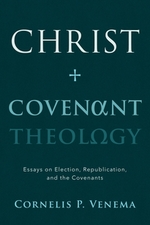
Christ and Covenant Theology by Cornelis P. Venema

Christ and Covenant TheologyChrist and Covenant Theology: Essays on Election, Republication, and the Covenants

by Cornelis P. Venema

eARC, 504 pg.
P&R Publishing, 2017
Read: July 23 – August 20, 2017


The doctrine of covenants is in many ways the heart of Reformed Theology, defining Reformed Christianity and marking the dividing line between it other forms of Protestantism. Which is not to say that after 400 years and change that we’ve managed to work out all the details. Even now controversies (of varying degrees of heat) over aspects of Covenant Theology keep blogs, twitter and theologians busy. This particular tome is a collection of essays by noted theologian and author, Cornelis P. Venema, on some of these issues. They’re all slightly re-worked articles originally published in various journals, books, etc. but in one handy collection for those who haven’t tracked them all down before.

Broken into three sections, the book covers the relationship between the Covenant of Works and the Covenant of Grace; the relation between Covenant and Election (particularly as applied to children of believers); and then “Covenant Theology in Recent Discussion,” which focuses on the Federal Vision and N. T. Wright’s view of justification.

In a nutshell — I found Part 1 to be the most intriguing, Part 2 to be the most helpful, and Part 3 didn’t do much at all for me. But that’s me, and I can’t imagine that my experience will be replicated. I’m not going to spend a lot of time summarizing his arguments — I couldn’t do a good job of that; it’s beyond the scope of this blog; and it’d take far too much time to read — he does a better job of it anyway (or just read Ferguson’s foreward, which gives an excellent overview).

Part 1, “The Covenant of Works and The Covenant of Grace” focuses on the a couple of problems surrounding the concept of the “Covenant of Works” — in chapter 1, he explores some criticisms of the concept, the history of its development and then defends it (at least in is Westminster Confessional form). Venema then moves on to look at the ways in which some contemporary Reformed theologians are seeing to find a “republication” of the Covenant of Works in the Mosaic covenant. He begins with building the case for Republication, drawn from some of the primary sources, and then critiques it. I won’t say I’ve read everything on this topic in print, but I’ve read enough to get the issues, and this is probably the fairest job I’ve seen describing the position. It’s also a pretty good critique, showing many of the problems inherent to it. This was very helpful to me, and I expect, for many.

Part 2 is wider in focus — he devotes two chapters to looking at Herman Bavinck’s understanding of Covenant, Election and the relationship between the two. Bavinck is becoming one of my favorite theologians and this study, pulling from many of his works, was useful focusing on these themes. Venema then spends two chapters on the teaching of the Canons of Dort about children of believers who die in infancy — there’s an overall pastoral tone to these chapters (and the Canons), with some good historical overviews of what lead to it and how the Canons have been used since their writing while dealing with grieving parents and others. These two chapters probably helped me more than any others in this book. Finally, leading from both of those, Venema applies the doctrine of the Covenant to the baptism of children. I read this in the original book it was published in, and it was one of the better chapters in that book — it’s still good now.

The third part dragged for me, I’ll admit. Venema does his characteristic thorough job laying out the issues with both the so-called “Federal Vision” and N. T. Wright’s ideas about justification as seen in his interpretation of Romans 5. I know better than to think that the issues surrounding the FV or NPP are dead, and I know that the issues are important enough that we need to keep exploring and expounding on them — but man, I devoted so much time and energy in the early 2000s to the FV in particular that unless he had something new to say, I just wasn’t going to get anything out of it. These chapters were a good overview and analysis, with some very good elements of critique. I do think that those who are newer to the topics, or haven’t spent a lot of time on them will profit from Venema’s work here.

What can I say about the writing? Venema’s very dry, very careful. When it comes to some of these topics, passions can flare, rhetoric can overtake even the more sanctified writers, getting them to say things more casually than they ought, even recklessly. Veneama avoid that, going out of his way to attempt to be fair to his opponents, while making it clear where he stands. This can be annoying if you’re looking for a quick answer to a controversy, but a great boon if you’re trying to understand it. It’s that care, that patience, that fairness that makes his critiques as effective. You don’t get the impression that he’s creating strawmen, or presenting the worst of his opponents, so the problems he points to are significant and deserving of your attention.

I know this book will not appeal to many — if the subtitle “Essays on Election, Republication, and the Covenants” doesn’t catch your interest, this book isn’t likely to do much for you. But if your ears perk up to just one of those areas, this is a very helpful book, a sure guide through some of the hotspots of the contemporary Reformed Church.

Disclaimer: I received this eARC from P&R Publishing via NetGalley in exchange for this post — thanks to both for this.

—–

4 Stars

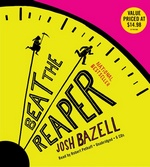
Beat the Reaper (Audiobook) by Josh Bazell, Robert Petkoff

Beat the ReaperBeat the Reaper

by Josh Bazell, Robert Petkoff (Narrator)
Series: Dr. Peter Brown, #1

Unabridged Audiobook, 6 hrs and 48 mins
Hachette Audio, 2009

Read: April 19 – 21, 2017


Dr. Peter Brown is having a rough day — he’s fighting to keep a patient alive long enough for someone competent to diagnose him properly — he’s also fighting to get someone to diagnose him properly. And he’s a got a new patient that recognizes him from his past life, who makes a threat — keep him alive, or someone will divulge that Brown’s got a new name and can be found at this hospital.

Peter Brown is the new name for someone in the Witness Protection Program — he was a contract killer who flipped on his employers and got sent to medical school. He’d been doing a pretty good job of moving on, but . . .

The novel tells Brown’s story in flashbacks through his childhood, becoming a criminal and what forced the break from that, um, atypical career path. Then we get to see him scrambling to stay alive in the present, and maybe keep some of his patients in the same state.

A first-person narrator describing how he’s killing someone with medical precision, and a touch of humor is just so much fun. This is a very visceral book — whether describing what a patient is suffering, what Peter is inflicting on someone, what someone’s inflicting on Peter, or even the drugs he takes to maintain alertness — he describes in the kind of detail you just don’t see anywhere else. You can feel it.

Peter’s got a great sense of humor — dark, sure, but what else can he have in is position? But if you don’t find yourself at least grinning a a few times, there’s something wrong with you.

Robert Petkoff narrates this in a hyper-masculine tone of voice, which fits perfectly. He embodies Peter in a way that you hope an audiobook narrator can. I liked the audiobook by him I heard last year, but this one seems like he got into the story more, like he was having fun (of course, this is a much more “fun” book than Before the Fall wants to be). Basically, he does a great job.

Part of me wants to go into more detail — but I find myself being restrained. Beat the Reaper is visceral, witty, intelligent and violent — this has all the elements of a thriller that’ll appeal to me. The plot and characters are pretty decent, too — that’s more than you can ask, really.

—–

4 Stars

The Driver (Audiobook) by Hart Hanson, Ari Fliakos

The DriverThe Driver

by Hart Hanson, Ari Fliakos (Narrator)

Unabridged Audiobook, 9 hrs and 11 mins .
Penguin Audio, 2017

Read: August 10 – 14, 2017


Michael Skellig was a Special Forces Sergeant in the Army, who came out of the War on Terror with more than just scars and stories. He also came back with a burden to help Vets. So far, he’s gathered a small group of them around him in his limo company. It’s more than just a company, it’s a family — a place for them all to heal. These are the strangest, most tragic, yet funniest group of characters you’re likely to meet this year. You’ll be glad that Hanson introduced you to them as well as being a little angry that he does what he does to them.

Skellig is driving for a skating mogul/rap musician/all around lifestyle entrepreneur, Bismarck Avila, and he stumbles upon an attempt on Avila’s life and thwarts it — with no help at all from Avila’s bodyguards. Avila blackmails Skellig into driving for him regularly (no, really) which gets Skellig involved in Avila’s less-than-legal activities. All Skellig is trying to do is keep Avila alive — and maybe find out why people are trying to kill him.

But Avila’s criminal associates and rivals don’t understand that, they think Skellig is an accomplice, assistant, or just generally in cahoots with Avila. So they come looking for a pound of flesh from Skellig and his little found family, hoping that’ll result in them getting what Avila owes them. All it does is provoke Skellig.

Skellig isn’t your typical thriller figure — he’s got a couple of PhD’s — one in mathematics, a sense of duty and loyalty, a knack for categorizing people using Hippocrates’ four humors (hey, it beats Myers–Briggs Types — at least for entertainment value), and an odd sense of humor. I don’t know that Hanson’s setting this up as a series, but if he is, Skellig is going to be one of my favorite series’ leads soon.

Avila . . . I just don’t know what to say about him. He’s an interesting weasel of a character. There are times when you’d like Skellig to just walk away and let the police or some criminal or another take him out. Other times you feel sorry for the kid and hope someone protects him from himself and his dumb choices.

The plot moves quickly — not so much that you don’t get invested in characters, their hopes, dreams, phobias — and steadily. There’s a wit to the writing, as well as to the dialogue. Skellig’s right-hand-man is his former interpreter, an Afghan man, is wise, funny and wily — he’s also Skellig’s conscience pretty often. The two of them going back and forth is one of the highlights of the month for me. The writing is crisp, descriptive (sometimes you might feel overly so, as you read descriptions about the kinds of trauma visited upon bodies/body parts), and engaging. Really, for a debut, this is some outstanding work.

Ari Fliakos does a fantastic job — accents, voices, emotions, humor — he nails them all. Last year, I listened to his narration of Mr. Penumbra’s 24-Hour Bookstore, which was easily as good as this. But I didn’t recognize his voice — the only reason I know both books had the same reader is that’s what the Internet tells me — the performance he gives is so good. I’ve got to make a point of listening to more things with his name on them.

The Driver is perfect for fans of Shane Kuhn’s John Lago books (The Intern’s Handbook, Hostile Takeover) or Josh Bazell’s Peter Brown (Beat the Reaper) books — but a little less violent. Just as smart, just as witty, just as . . . not your typical thriller. This is probably the best thing that Hanson’s ever brought into the world, I hope this is the first in a long line of novels from him.

—–

4 Stars

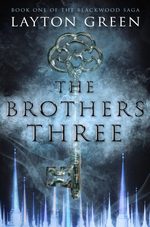
The Brothers Three by Layton Green

The Brothers ThreeThe Brothers Three

by Layton Green
Series: The Blackwood Saga, #1

Kindle Edition, 332 pg.
Cloaked Traveler Press, 2017

Read: August 4 – 8, 2017


Ever since Edmund, Lucy and Eustace got sucked into that tacky painting and into the sea in Narnia, I’ve been a sucker for a good portal fantasy*. Which is exactly what Layton Green has given us here.

Will Blackwood works for a general contractor, with the occasional shift at a medieval-themed family restaurant where he will engage in stage fighting, and spends a lot of time reading fantasy novels. He’s suffered from panic attacks since childhood and that’s kept him from much more. His buddy, Lance, a New Orleans police officer will occasionally take him on ride-alongs, but he’s just not up for much more excitement. His older brother Caleb, is a bartender and perpetual adolescent (given time and opportunity, I’d have liked to see that explored more, because I suspect there’s more to it than meets the eye). The oldest, Val, is a corporate lawyer in New York who has served as self-appointed guardian to his brothers since their father’s death while they were children.

Until one day, things get a little strange: Will and Lance run into a zombie Rottweiler and the weird guy who controls it. Lance explains it away, but Will can’t. He knows what he saw, and apparently has a willingness to be flexible with his presuppositions about what may be real. Not long after this, the Blackwood’s godfather shows up, tells them that their father was a wizard, gives them some magical weapons and then gets kidnapped by the guy who had the Rottweiler (it was a pretty eventful conversation). Before they can wrap their minds around this, a stranger claiming to be a wizard shows up and talks to Will, telling him that Zedock is the name of the man who kidnapped Charlie — he’s a necromancer from a parallel universe where magic rules, not science.

Not only that, he’s arranged for the brothers to go to that parallel universe to learn a little about magic, their weapons and maybe find a way to defeat Zedock. Will is game, but he knows that he’s not going to be able to convince his brothers that this is a possibility. They’ve managed to convince themselves that they didn’t see anything magical and that there’s a reasonable explanation for everything going on (except Charlie’s statements) — they’re not quite at the level of the explanations that Tommy Lee Jones uses in Men in Black, but they’re close. So Will tricks them into triggering the portal to the other world with him (and Lance gets sucked through it, too).

Even in a world clearly not our reality — with swords, magical creatures, and different looking streets in New Orleans — it takes time for those who aren’t Will to accept what’s going on. But they eventually do, and hire some locals to help them get to a fortress where they should be able to find something they can use to challenge Zedock. I seem to be talking about the willingness of Val, Caleb and Lance to accept what they’ve seen and experience — but that’s a pretty big plot point. I like the way they struggle with this, unlike what goes on with kids in portal fantasies who seem to swallow the whole concept in seconds

The travel isn’t easy — it’s not long before all of them get to learn how to fight with pre-modern weapons. Val shows some signs of magical ability and begins training in its use, while Will learns how to use a sword in a fight that doesn’t happen on a stage, and Caleb picks up a trick or two from a thief. They don’t just train and travel — they see and fight creatures straight out of a D & D manual. A lot more happens, of course, but I don’t want to give it all away — so I’ll just sum up by talking about how the adventurers they travel with are a great collection of characters, pretty compelling, and just what’s needed to keep the story move forward and acclimate the dimension-jumpers to this world.

There is real peril — as demonstrated by enough deaths to satisfy the grimdark fans while not really being a grimdark world. Sure, there were a couple of Red Shirt deaths (Red Tunic deaths?), but characters you assume are safe turn out not to be after all. I read one paragraph a few times just to convince myself that I read about the gruesome death of a major character actually happened. Even without that, the way this story is told isn’t what you expect — there are secrets, ulterior motives, and barrels of denial everywhere. It’s very compellingly and interestingly put together.

The Brothers Three is well-written, skillfully structured, and well-paced — there are some nice turns of phrase throughout the novel, too. Green is the real thing, giving the readers a good story, great characters, an interesting world (or pair of them), in a well-written package. Book 2 comes out next month and it’s on my TBR. I’m resisting the impulse to move it higher, but it’s not easy.


* Yeah, I read The Voyage of the Dawn Treader first — I read series out of order in my childhood. As a kid, I was practically feral, it seems.

Disclaimer: I was provided with this copy for an honest review by the author.

—–

4 Stars

Pub Day Repost: Fox Hunter by Zoë Sharp

Fox HunterFox Hunter

by Zoë Sharp
Series: Charlie Fox, #11
eARC, 400 pg.
Pegasus Books, 2017
Read: May 22 -24, 2017

I honestly had given up on seeing another Charlie Fox novel — which was a cryin’ shame, but I get that authors have to move on sometimes. But then a couple of weeks ago, when I logged onto NetGalley to take care of something, there it was on the front page — and I jumped to request it (despite promising myself I was taking a NetGalley break to catch up on other things).

“You were a soldier, Miss Fox , and you are now a bodyguard. There is an old saying that is true in both cases : To survive—to protect a life— you have to be lucky every day. But your enemies, they have to be lucky only once.”

Following his near-miraculous recovery from the injuries no one expected him to survive, Charlie Fox’s love/boss, Sean, hasn’t been the same. Now, it looks like he’s settling old debts — not necessarily his own. The fact that he’s doing that is bad enough — it’s not quite de rigueur for someone in his position to go around exacting vengeance. But the way these debts are being settled (if that’s what’s happening) speaks to someone not in full control. Charlie fights for the opportunity to do the boots-on-the-ground investigation to prove that it’s not Sean’s handiwork.

This ground is Kuwait and Iraq, and before she knows it, Charlie is dealing with soldiers/mercs that she’s annoyed in the past, Russians with a grudge, Iraqis trying to defend cultural artifacts and certain three-letter agencies mucking around in it all — and every sign is that Sean’s up to exactly what Charlie is convinced he’s not doing. Before the book ends, she’ll come face to face with multiple faces from her past (none of which she ever wanted to encounter again) and will be forced to reassess some of the most formative events of her past and career.

For those new to Charlie Fox — this would make a pretty good entry point, by the way — she’s former British Army, who received some special forces training, before her career was derailed. Since then she’s done plenty of work as a bodyguard and worked other types of security. She’s stubborn, loyal, inventive and tenacious. And deadly — it eats away at her, but when push comes to shove, Charlie’s as lethal as you can find.

Killing because your life—or that of another—is in immediate danger is one thing. I’d been trained to accept that possibility right from the start of my army career. But appointing yourself judge, jury, and executioner is quite another. As is doing it anyway, only to discover that it doesn’t trouble your conscience nearly as much as it should.

Sharp has given Charlie a strong voice — one you can believe can accomplish all she needs to, yet one that’s entirely human.

The new characters are well developed — and we see plenty of old faces, too. One unexpected antagonist is almost too evil to be believable (but, sadly, I imagine that plenty of Armed Forces have people just like him). There’s one death that was a real gut-punch for the reader (or at least this one) — that’s a testimony to Sharp’s skill that she can create someone like that in a brief period.

I don’t remember any of the previous novels being all that tied to current events, but Fox Hunter clearly took place post-Brexit and during the Trump administration. I’m not saying that’s bad, but oddly specific — and changes when the rest of the books happened as well, because this didn’t take place long after Die Easy despite the 5 years between the novels — I’d have had an easier time swallowing the book without that specificity, but not much — I note it because I found it strange.

That aside, this is exactly what Charlie Fox readers have come to expect from her — she takes the proverbial licking and keeps on ticking, and kicking, swinging and everything else. Best of all, she thinks — she plots, she improvises, she keeps on trying. Not to sound cliché, but this damsel finds herself in plenty of distress — and gets herself out of it (occasionally with help — but not in a Nell Fenwick sort of way; more like Lt. Templeton Peck way). Plenty of action, plenty of violence, plenty of suspense — all with some character development, moving ongoing story arcs forward (while re-evaluating everything before).

Not much else to ask for — except another volume soon.

Disclaimer: I received this eARC from W. W. Norton & Company via NetGalley in exchange for this post — thanks to both for this.
N.B.: As this was an ARC, any quotations above may be changed in the published work — I will endeavor to verify them as soon as possible.

—–

4 Stars

Dead is Good by Jo Perry

Dead is GoodDead is Good

by Jo Perry
Series: Charlie & Rose Investigate, #3

Kindle Edition, 282 pg.
Fahrenheit Press, 2017

Read: August 3, 2017

Oh, and after all this time I learned something else about being dead.

Death is failure.

Death is loss.

Everything—who you are, what you know—goes.

Whoever you thought you were, you weren’t and you’re not.

When he was alive, Charlie Stone was married multiple times to pretty horrible women (if we’re to believe him — and we might as well, he seems pretty upfront and honest about this kind of thing), not that he was any catch, either. But he really only loved one person, Grace Morgan. Grace broke things off with Charlie and moved on with her life, but apparently after hearing about his murder, she was moved to change her approach to art — deciding to challenge the audience, forcing them to realize how close to death they are.

Yeah, it sounds pretty silly and pretentious to me, but hey…that’s not the important part of the story. Maybe if we got more examples of her art, I’d care more and maybe even understand. What is important about Grace, for our purposes, is that her life is in danger, it’s because of this danger that Charlie and Rose have been brought from their afterlife-limbo back to Earth.

The book opens with one of the more blatant suicide-by-cop scenes you’ve ever read, which is intended to serve as protection for Grace. It doesn’t work out, or the book would be really short. Powerless to do anything but watch and hope things turn out okay, Charlie and Rose travel around L.A. discovering for themselves what it was that endangered Grace in the first place — which brings them into a world of drugs, sweatshop workers, deceptive piñatas, and smuggled birds.

This is a very tangled story, it takes Charlie quite a while to put the pieces together — Rose has her own priorities in this mess and spends some time away from Charlie, unwilling to turn her focus on his behalf. The way that this criminal enterprise is eventually revealed to work not only seems like something that really exists, but is revealed in a way that is narratively satisfying.

Charlie will tell his readers over and over that there’s no character growth in death — that’s nonsense. Post-mortem Charlie is a much more emotionally mature and self-sacrificing kind of guy than pre-mortem Charlie was. In this book we see him come to — or at least acknowledge — a greater and deeper understanding of what love is, and what he allowed his previous relationship to become. It may not do him any good in the afterlife, but Charlie is better for it, and in someway we can hope that Grace is better off having gone through all this, so that whatever life has in store for her can be tackled face-on.

I love these characters — even while we readers don’t fully understand their circumstances, how they know where to go, what brings them to this world at certain times. Even while they don’t have much better of an idea than we do (at least Charlie doesn’t). I love how while they can’t interact with their environment, the people they see and events they watch unfold, they are driven to find answers, driven to care about what’s happening. There’s something about that compulsion — and success they have in figuring things out — that matters more than when Bosch or Spenser or Chin and Smith put all the pieces together to thwart someone.

This wasn’t as amusing as previous installments, but it was just as satisfying — maybe more so. For a good mystery with oddly compelling characters, once again, look no further than Jo Perry.

The L.A. County Department of Medical Examiner-Coroner has a gift shop?? Why isn’t anyone investigating this? It may be real, it may be popular and legal. But surely that’s a crime against tact, right?

—–

4 Stars

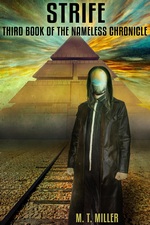
Strife by M. T. Miller

StrifeStrife

by M. T. Miller
Series: The Nameless Chronicle, #3

Kindle Edition, 336 pg.
2017

Read: July 28 – 31, 2017


The first two books of this series feature Nameless just struggling to survive, while along the way stumbling into adventure, some wealth and other kinds of success. He really never seemed to have much of a plan, but things worked out in his favor (eventually, and at great cost). But after the great success — if it is that — after Ascent, Nameless isn’t worried about survival, about doing more than subsisting this time. He’s got time for plans — not just plans for himself, but for the citizenry of the Pyramid.

Whoops. Maybe he should go back to just eking out a living.

Things don’t go so hot for him this way — but man, what character growth. Really, there are depths to Nameless that may not surprise readers, it makes sense that they exist, but we’ve never had the opportunity to see it before.

There are two other cities on the post-apocalyptic landscape, New Orleans and the White City. New Orleans is full of the New Voodoo Movement, and the White City is the home base of the One True Church of America — religious movements that Nameless doesn’t have a good track record with, and has done a lot to try to get rid of. Now both of these cities have plans for Babylon and Nameless — but it’s clear that pretty much all the White City wants out of them is abject surrender and assimilation. That’s just not going to sit well with Nameless.

Now Nameless has to look at the world that he’s helped to create, but he has a chance to reshape it, and save the city he’s adopted.

There’s some soul-searching here, there’s a lot of exploration into what makes Nameless tick and his origins. But the focus is on what he’s going to do next and why. This is only the third book in the series, so you really can’t say what a “typical” Nameless book would be — but whatever that would be, this isn’t it. I don’t know how to really talk about it without divulging all the nuts and bolts of the plot, sadly. There are old friends and new, old threats and new (and some old friends are new threats and vice versa). Which is not to say that the core of Nameless — a ruthless, skillful killer of all in his way — isn’t there, he is and he does. But there’s a little more to him than just that.

I’ve enjoyed Miller’s writing in the past, but this is at a whole new level for him. There’s a complexity to his writing, a subtlety that hasn’t been there before. There’s a good balance of lightness and darkness in the story, the writing itself. He’s clearly maturing as a writer, hopefully people give him a shot to impress them, he will.

This isn’t the place to jump on for new readers — the first two books are cheap and pretty entertaining, too, grab them first. I don’t know if Miller’s going to be able to keep this series going, if so, I can’t wait to see where he goes from here. But if not, I’m more than satisfied with where things are left. A very satisfying ending after a good mix of thrills, fighting and character growth.

Disclaimer: I was provided a copy of this book by the author in exchange for this post and my honest opinion. Thanks, Mr. Miller! This didn’t impact my opinion of the book in any discernible way.

—–

4 Stars

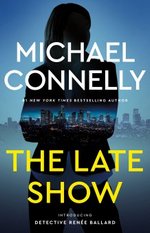
The Late Show by Michael Connelly

The Late ShowThe Late Show

by Michael Connelly
Series: Renée Ballard, #1

Hardcover, 405 pg.
Little, Brown and Company, 2017

Read: July 17 – 22, 2017


Det. Renée Ballard works the graveyard shift out of the Hollywood Station, nicknamed the Late Show. She and her partner, the veteran detective John Jenkins, are basically place-holders — they handle the initial investigation of a crime (or sign off on a suicide) and then hand off their notes to one of the other detective squads that work days. It’s not demanding work — Jenkins likes it because there’s almost no overtime, and he can go home and be with his sick wife during the day. Ballard is stuck on the Late Show because she made some political waves a couple of years back, she couldn’t be fired over it, they could just make sure she found the prospect of another line of work appealing.

We meet Ballard on a pretty eventful night, she and Jenkins look into an elderly woman’s report of her purse being stolen and people using her credit cards; the vicious assault of a transvestite prostitute; and are involved in a minor role following a night club shooting. She and her partner are supposed to be turning over their involvement in these cases to someone else, but Ballard just can’t let go. She works the murder under the radar (as much as she can), gets permission to keep at the assault (which should not be construed as her investigating it according to Hoyle), and is brought back into the robbery organically — I stress this because it’s not all about Ballard skirting regulations, she works within (or near) the system.

Connelly constructs this like a pro — weaving the storylines into a good, cohesive whole. Each story feels like it gets enough time to be adequately told (without the same amount of space being devoted to each), there’s no grand way to connect them all into one, larger crime (which I almost always enjoy, but this is a bit more realistic), while something she learns on one case can be applied to another.

There’s one point where I thought that a plot development meant “oh, now we’re going to wrap things up now — cool.” Which I never would have thought if I bothered to pay attention to which page I was on, but it still seemed like the point that most writers would wrap it up. Instead, Connelly plays things out the way you expect, and then uses that to turn the novel in a different direction.

The book is full of nice little touches like that — Connelly’s been around enough that he knows all the tricks, knows all the plays — he can give you exactly what you think he will and then have the result come up and Connelly’s you.

In the future, I’d like to see a little more about Jenkins — but then again, how much did Connelly really develop Jerry Edgar or Kiz? Still, this is a new series, so he can develop things a bit more — I don’t think there’s a lot that can be done with Jenkins, but he can be more than just the guy who splits paper work with her. I hope that [name withheld] doesn’t become Ballard’s Irving, but I can think of worse things that might happen, so I won’t complain. I also hoped I’d get out of this with only 1 bit of comparison to the Bosch books. Oops.

The best thing — the most important thing — to say here is that Renée Ballard is not a female Harry Bosch; all too often, an established crime writer will end up creating a gender-flipped version of their primary character — basically giving us “X in a skirt” (yeah, I’m looking at you, Sunny Randall). This isn’t the case here. There’s a different emotional depth to Ballard, different lifestyles, different aspirations. Sure, she’s driven, stubborn, and obstinate, just like Harry — but name one fictional detective that isn’t driven, stubborn and obstinate. Readers don't show up in droves for slackers. Is there plenty of room for development and growth for Ballard in the future? Oh yeah. She's not perfect by any means (as a fictional character or as a person). But what a great start.

Same can be said for the series, not just the character — this book does a great job of capturing L.A. (an aspect of it at least), has a great plot, with enough turns to keep the reader satisfied, and a final reveal that's truly satisfying. The last thing that Connelly really needed was to start something new — but I'm glad he decided to.

—–

4 Stars

Henry and the Hidden Treasure by B.C.R. Fegan, Lenny Wen

Henry and the Hidden TreasureHenry and the Hidden Treasure

by B.C.R. Fegan, Lenny Wen (Illustrator)

eARC, 32 pg.
TaleBlade, 2017

Read: July 14, 2017


It’d be easy for this to contain more words than the actual book — so I’ll try to keep it short. Henry’s got a little bit of money, and doesn’t want his little sister to get it. So he sets up a series of elaborate traps and challenges (think Raiders of the Lost Ark meets Home Alone) to keep her from it.

Along the way, his imagination his on full display and he eventually learns something. There’s a very sweet ending that will hopefully teach by example.

I cannot say enough good things about Wen’s artwork. It’s adorable. It’s dynamic. It’s simple, but eye-catching. It doesn’t detract from the story, but shapes and propels it. There’s not a lot of detail, but what’s there is important.

For the younger set, I can’t imagine how this won’t become a favorite. Thankfully, it should be pretty easy for parents to re-read. Amusing story with great art. That’s pretty much what you’re looking for in this kind of book, right? Available in hard copy and e-book, it’s a great buy.

Disclaimer: This book was provided to me by the publisher in exchange for my honest opinion.

—–

4 Stars

Besieged by Kevin Hearne

BesiegedBesieged

by Kevin Hearne
Series: The Iron Druid Chronicles, #4.1, 4.2, 4.6, 4.7, 8.1, 8.6

Hardcover, 235 pg.
Del Rey Books, 2017

Read: July 25 – 27, 2017

“Tell me about the old days, Atticus, when you were wee and had to walk both ways uphill in feces because no one had toilets.”

Granuaile’s request for a story around the campfire during her training sets the stage for this collection of stories from The Iron Druid Chronicles, primarily about events that took place prior to the first time we meet Atticus. Thankfully, we don’t get as much fecal matter as she suggests (although, it is there).

We see Atticus in San Francisco during the Gold Rush; in Egypt, annoying that pantheon (and setting the stage for complications in a previously published short story); in London, meeting and influencing a certain Bard of Avon; we also get a bit of post-Tricked action and learn why Atticus doesn’t spend much time in Nebraska. I enjoyed all of these — I don’t know that I got amazing new insights in to any of the characters, it was just nice to see them in low-risk adventures. Time with Atticus and Oberon (and the rest) is almost always time well spent.

Not all of the stories were from Atticus’ perspective. These weren’t as appealing to me, but I did enjoy them. I wasn’t crazy about the story featuring Flidias and Perun — the setting was pretty off-putting for me. Although I did enjoy Perun’s narration and in the end the story won me over. There’s a story from Granuaile’s perspective about enforcing the agreement to rid Poland of vampires. This was the most I’ve liked her since Trapped, which was quite a relief. Of the two stories told from Owen’s perspective, the one set post-Staked worked better for me than the one about his life before he became anyone’s archdruid. I really like watching Owen try to train this group of children while attempting to keep from recreating the mistakes of the past.

I can’t say much about the last story, because it takes place immediately before the series finale, due next year. It whet my appetite for the last book, for sure (not that I needed it) — and reminded me that I might need to keep a supply of Kleenex handy.

Not as good as a novel, but a satisfying collection of tales in this world. A must for fans — casual or die-hard.

—–

4 Stars

Page 57 of 88

Powered by WordPress & Theme by Anders Norén